Insurance Lead Database Reactivation Guide 2026
Your CRM has leads you already paid for and never worked. Here's how to legally reactivate an insurance lead database in 2026, and what it's actually worth.

Insurance lead database reactivation is the practice of re-contacting leads that already exist in your CRM, leads you paid for once, called a time or two, and never converted, using a fresh sequence of calls, texts, and emails instead of buying a new list. If you’ve got a few thousand contacts sitting in a pipeline stage nobody’s touched since last spring, this is the answer to what to do with them: work the list you already own before you spend another dollar acquiring a new one.
Every agency has this list. It’s the ACA leads from open enrollment that didn’t answer the third call. It’s the Medicare leads from a campaign that wrapped in October. It’s the life and final expense inquiries a producer meant to get back to and didn’t. None of those contacts are gone. They’re sitting in a CRM stage labeled “no answer” or “not interested” or nothing at all, and most agencies never go back.
The short version
- Reactivation means re-working leads you already own, not buying a new list. The acquisition cost is already sunk; the only new spend is the outreach itself.
- Age alone doesn't make a lead illegal to call again, but a reassigned phone number does. The FCC built the Reassigned Numbers Database because millions of numbers change hands every year, per its December 2018 order.
- A comparable aged lead bought fresh from a broker runs roughly $0.15 to $5.00 depending on age tier, per Aged Lead Store's published 2026 pricing, and a second vendor, The Leads Warehouse, prices the oldest tier at "pennies" to $0.50. Your own database already cost you more than that once.
- Using an AI caller for reactivation doesn't change the compliance math. The FCC's February 2024 ruling (FCC 24-17) holds AI-generated voices to the same TCPA consent and disclosure rules as a human caller.
- Medicare-touching contacts in your database carry a separate rule: calls have to be recorded in full and retained at least six years, the first three in audio, under 42 CFR 422.2274(g).
What database reactivation actually is, and what it isn’t
A database reactivation campaign is a defined outreach sequence, usually built once and run repeatedly, that targets contacts filtered by how long it’s been since you last touched them. HighLevel’s own support documentation describes the mechanic plainly: filter contacts by a date field like last-appointment or last-contact, tier them into windows (their example uses 30 to 60 days and 90-plus days), and trigger an email or SMS sequence for each tier, with conditional logic that escalates or alerts a human when someone replies. That’s the entire mechanism. It’s not complicated, and it’s not new; what’s changed is how cheap it’s gotten to run at volume once you’ve got a workflow tool and, if you want the phone channel included, a caller that can work the list without eating a producer’s whole afternoon.
It isn’t the same thing as buying an aged lead list. An aged list from a broker is someone else’s leads, someone else’s original consent capture, and someone else’s asking price, typically anywhere from about $0.15 to $5.00 per lead depending on how old the tier is, according to Aged Lead Store’s published 2026 pricing guide. Your own database is different: you already paid full price once, whether that was in the $8 to $50 range typical of a fresh ACA or Medicare lead depending on exclusivity, and every one of those contacts represents money already spent that either converts or doesn’t. Reactivation is the difference between writing that spend off and trying to collect on it.
A few terms this article uses
Disposition is the outcome tag attached to a lead after a contact attempt: no answer, not interested, callback requested, and so on. Lead age is time since the lead was created or last contacted, not time since it was originally sourced. A reactivation sequence is the specific set of messages and calls sent to a segment, distinct from your normal new-lead follow-up cadence.
Why the database goes cold in the first place
Nobody sets out to let four thousand leads sit untouched. It happens because the standard follow-up cadence most agencies run is built for speed on day one and runs out of steps by day five. A new lead gets a call within minutes, a text if the call doesn’t connect, another call the next day, maybe one more after that, and then the automation, or the producer’s own patience, stops. The lead moves to a pipeline stage that functions as a parking lot, and nothing brings it back out unless someone manually decides to.
That’s a capacity problem more than a strategy problem. A producer working a full pipeline of fresh leads has a limited number of hours in a day, and re-dialing month-old contacts competes directly with calling today’s leads, a fight today’s leads almost always win because they’re more likely to answer and more likely to still be shopping. The result is a queue that only grows: every week adds new “no answer” and “not now” contacts to the pile, and nothing structural ever subtracts from it. We’ve covered the staffing side of this constraint in detail elsewhere, including why agencies can’t just hire their way out of the follow-up gap; the database problem is the accumulated residue of that same capacity shortage, sitting in your CRM instead of on a dial sheet.
| Lead type | Cost the first time (fresh purchase) | Cost of a comparable lead, bought aged, from a broker |
|---|---|---|
| Shared ACA lead | $7–$18 (industry lead-vendor listings) | $0.50–$3.00, aged tier |
| Exclusive ACA lead | $22–$48 (industry lead-vendor listings) | $0.50–$3.00, aged tier |
| Shared Medicare lead | $12–$32 (industry lead-vendor listings) | $0.50–$5.00, aged tier |
| Exclusive Medicare lead | $35–$95 depending on season (industry lead-vendor listings) | $0.50–$5.00, aged tier |
| Any aged lead, 180+ days | Already sunk if it's your own database | $0.15–$0.50, lowest tier |
Fresh-purchase ranges reflect current listed pricing on industry insurance-lead marketplace sites as of August 2026; treat them as directional market ranges, not a single vendor's guaranteed price. Aged-tier ranges: Aged Lead Store, Health Insurance Leads Cost 2026, and The Leads Warehouse, How Much Do Medicare and ACA Leads Cost in 2026, both fetched August 2026.
Read that table the way an agency owner should: whatever you paid the first time for a lead sitting in your database right now, a comparable lead bought aged from a broker today would cost a fraction of that, usually under a dollar once it’s more than six months old. Your list is worth at least that much and almost certainly more, because you have the original conversation history, the disposition notes, and, for many contacts, a specific reason they inquired in the first place. You’re not starting from zero the way a broker’s aged list does.
Is it actually legal to call these leads again?
This is the question that stops most agencies before they start, and it deserves a straight answer: age by itself doesn’t make a lead illegal to call again. What can make it a problem is a phone number that’s changed hands since you captured consent, and that happens more often than most agencies assume. The FCC built the Reassigned Numbers Database specifically because, as the Commission put it in the order establishing it, “millions of phone numbers are reassigned each year,” and a caller working an old list has no way to know that without checking. When a number that used to belong to your lead gets reassigned, a new person answers, and continuing to call them as if they’re still your original prospect creates the exact TCPA exposure the reassigned-numbers rule was written to prevent.
The fix is procedural, not a reason to abandon reactivation entirely: run the numbers you’re about to dial against a reassignment check, whether that’s the FCC’s database directly or a dialing platform that queries it for you, before the campaign goes out, not after a complaint comes in. Pair that with a look at what the original consent actually said. If a lead gave prior express written consent for a marketing call or text at the time they inquired, and that consent wasn’t scoped to a specific time window, the number being six months or a year old doesn’t erase it on its own. What erases it is the number no longer being theirs, or the consent language never having covered the kind of contact you’re about to make.
Check reassignment before you dial, not after
A number that's been reassigned since your lead gave consent no longer belongs to that lead. Calling it as though it still does isn't a database problem, it's a fresh, unconsented call to a stranger. Screen the list against a reassignment check before the campaign launches.
Medicare adds a layer specific to that product line. Under 42 CFR 422.2274(g), marketing and sales calls touching Medicare Advantage or Part D have to be recorded in their entirety and retained for a minimum of six years, with the first three years specifically in audio format. If your database includes Medicare-touching contacts from a prior open enrollment period, confirm whatever platform runs the reactivation calls is actually configured to retain recordings that long in the right format before the first call goes out. We go deeper on the current Medicare marketing rule changes in our piece on the 2027 CMS updates if that’s the segment you’re reactivating.
And if the list in question is a purchased, resold list rather than your own house database, the calculus shifts again. A lead resold through multiple buyers can carry consent language that’s vague about who’s actually authorized to call, or that was captured through a lead source that’s since shut down. On a list like that, route unclear contacts to a live, manually dialed call rather than an automated or artificial-voice one; a manual call to a lead with ambiguous written consent sits under a different, generally lower, regulatory bar than an automated or AI-voice call does. Our earlier piece on what’s actually legal to call in an aged lead database covers the consent-verification process in more detail than fits here.
Age doesn't void consent. A reassigned number does. Check the number, not the calendar.
— The rule this whole section boils down toHow to run a reactivation campaign yourself, start to finish
Here’s the method in full, no part of it held back. You can build this with a spreadsheet and a phone, or with a CRM’s workflow tools; the steps are the same either way.
1. Pull and segment the list. Export every contact that hasn’t converted and hasn’t been touched in your chosen window, commonly 30, 90, and 180-plus days. Segment by disposition as well as age: a contact who never picked up is a different case than one who had a full conversation and asked to be called back later.
2. Screen for reassignment and stale consent. Before anything goes out, run the segment against a phone reassignment check and pull the original consent record for a sample. Anything unclear routes to manual outreach instead of automated dialing, or gets dropped from the list entirely.
3. Build tiered messaging, not one blanket blast. A lead that’s 30 days cold needs a different message than one that’s 10 months cold. HighLevel’s own reactivation documentation frames this as separate sequences by time window, each with its own offer or reason to re-engage, rather than one generic “checking in” message sent to everyone at once.
4. Sequence the channels. A text lands faster and gets read even when a call goes unanswered; an email carries more detail; a call is where an actual conversation, and a booked appointment, happens. Most working sequences use all three, spaced a few days apart, rather than leaning on one channel alone.
5. Wire an alert for the moment someone responds. This is the step agencies skip and pay for later. The same notification gap that strands a booked appointment from a fresh lead strands a reactivated one too: if a reply doesn’t trigger an alert to a specific person, the reactivation converts a cold lead into a warm one and then lets it go cold again, for the second time, unnoticed.
6. Run it as a standing sequence, not a one-time push. A single reactivation blast recovers whatever responds immediately and then the rest of the list goes quiet again. Running the segmentation and sequence as an ongoing workflow, so leads that age past 30 days automatically enter the next tier, keeps the list working instead of requiring someone to remember to relaunch it every quarter.
What most CRMs actually have
- Thousands of contacts in a "no answer" or "not now" stage
- No filter separating a 30-day-old lead from a 2-year-old one
- One generic message sent occasionally, if at all
- No alert when someone finally responds
IdleMoney already spent, sitting with no plan to collect on it
What a reactivation sequence does instead
- Segmented by age and disposition into tiers
- Screened for reassigned numbers and stale consent first
- A tiered, multi-channel sequence tailored to each window
- A notification fires to a specific person the moment someone replies
WorkingThe same list, actually generating conversations again
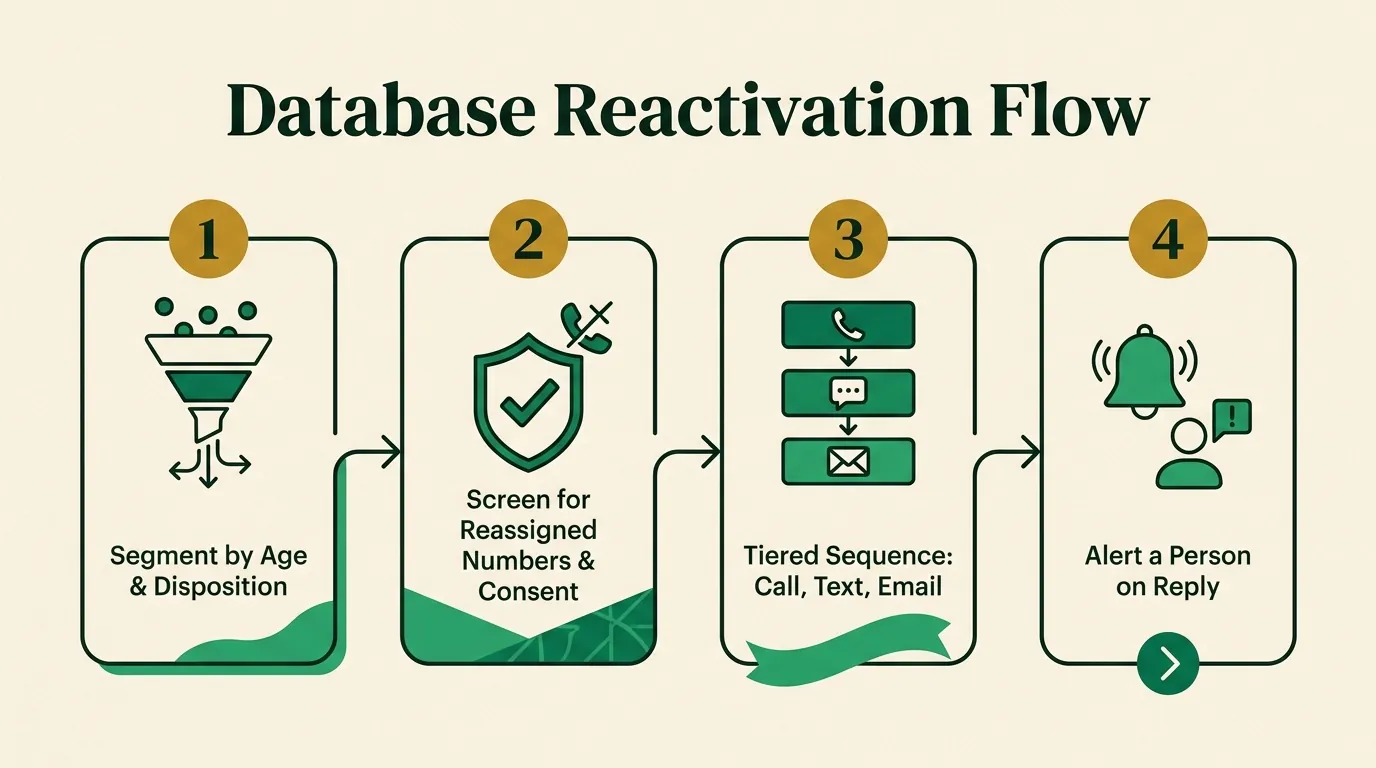
You can build all six steps by hand, and plenty of agencies do, with a shared spreadsheet, a personal cell phone, and a producer who blocks off Friday afternoons for it. That works at a few hundred contacts. It gets genuinely hard to sustain past a few thousand, because the screening and sequencing steps take real hours every time the list refreshes, and those are hours that come directly out of time spent on today’s fresh leads.
What we do for the phone-call piece of this
TheAffordableAI is a managed AI caller built for exactly the volume problem described above: it can work through a segmented reactivation list on the phone without pulling a producer off today’s leads to do it. Calls run at $0.20 per minute on a Single Account or $0.18 per minute on Agency, both with bulk rates available, so the per-call cost of dialing a database you already own stays low relative to what any of those leads cost you the first time. Every call syncs to HighLevel automatically, warm transfers check real-time availability before handing a responsive lead to a person, and number warmup and spam defense run as a standing part of the service so the number doing the reactivation dialing doesn’t pick up a flag halfway through the campaign.
None of that replaces steps one and two above. Segmenting the list and screening it for reassigned numbers and stale consent are still the agency’s job, and no platform, ours included, does that verification for you. What the managed caller changes is step four and five: it can work the call channel of a tiered, multi-touch sequence at volume, and its native CRM sync means a reply routes to a person automatically instead of depending on someone checking a spreadsheet.
Dials your existing database, not just new leads
The same managed caller that handles fresh inbound and outbound volume can run a segmented reactivation list on its own schedule.
Warm transfers check availability first
A reactivated lead who's ready to talk gets handed to a person who's actually free, not routed into an empty queue.
Native HighLevel sync
Every call, transcript, and disposition lands in the CRM automatically, so a reactivated lead doesn't go cold a second time from a missed notification.
Number warmup and spam defense, ongoing
A reactivation campaign means calling a lot of numbers again; the caller ID running those calls stays protected the whole time.
If you want to hear what a call like this actually sounds like before deciding anything, there’s a demo call on the homepage. https://theaffordableai.com/ And if you’re already on HighLevel, the sync piece is usually the first thing people ask about, so it’s worth reading how the trigger-to-warm-transfer workflow is actually built before you commit to anything. Full detail on what’s included on every plan is on the features page, and the pricing page has the current per-minute rates if you want to run the math against your own database size.
What it costs to leave the list alone
The clearest way to see the cost of an idle database is to compare it against buying new volume to replace what it represents. A shared ACA lead runs $7 to $18 and an exclusive one $22 to $48 based on current industry lead-marketplace listings; a shared Medicare lead runs $12 to $32 and an exclusive one $35 to $95 depending on season. Every one of those figures describes what it costs to generate a new lead from scratch. A database sitting untouched is a pile of leads you already paid those prices for once, generating a return of exactly zero on that spend for as long as it sits there.
What a fresh lead costs to acquire vs. what an aged lead costs to buy already-old
Low end of the published 2026 range for each category. Your own database already cost the "fresh" figure once; reactivating it costs roughly what the outreach itself takes, not a new acquisition price.
Sources: fresh-lead low-end figures from current industry insurance-lead marketplace listings, August 2026; aged-lead figures from Aged Lead Store, Health Insurance Leads Cost 2026, and cross-checked against The Leads Warehouse, How Much Do Medicare and ACA Leads Cost in 2026 (both fetched August 2026, latter reports the oldest tier at "pennies" to $0.50). Bars scaled relative to the highest figure shown ($35).
There’s a real cost on the compliance side too, and it’s worth naming plainly rather than glossing over. A TCPA violation, for example dialing a reassigned number without valid consent, carries $500 to $1,500 of statutory exposure per call under 47 U.S.C. § 227(b)(3), and that number doesn’t care whether the call was part of a reactivation campaign or a first-touch one. Running reactivation without the screening step isn’t a shortcut, it’s a way to multiply that exposure across an old list instead of a new one.
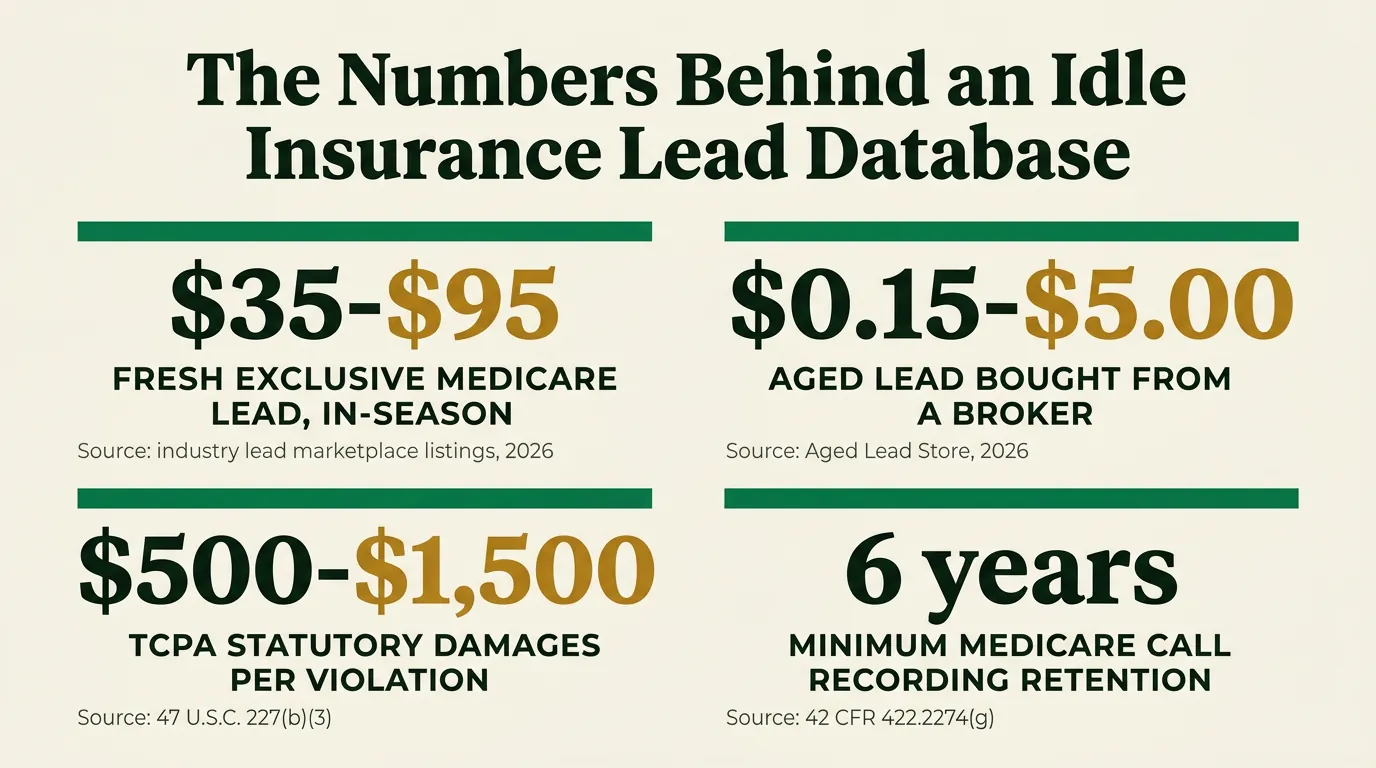
$95
High end of a fresh exclusive Medicare lead, in-season
Source: industry lead-marketplace listings, Aug 2026
$0.15
Low end of a 180-day-plus aged lead bought from a broker
Source: Aged Lead Store, 2026 pricing
$1,500
Maximum per-violation TCPA damages for a willful or knowing violation
Source: 47 U.S.C. § 227(b)(3)
6 yrs
Minimum retention for a recorded Medicare marketing call
Source: 42 CFR 422.2274(g)
What actually happens when the database gets worked
The realistic outcome of a reactivation campaign isn’t every dormant lead turning into a policy; it’s a segment of contacts who were genuinely still interested and simply never got a second real attempt, now getting one. Some will have already bought coverage elsewhere and tell you so, which is useful information on its own, since it lets you clean the record and stop wasting future attempts on them. Some won’t respond at all, which is also useful, since a documented, unresponsive second or third attempt is exactly the kind of record that supports moving a contact to a genuinely dormant list rather than an indefinitely “maybe” one. And some will pick up the phone or reply to a text because the timing finally lined up, a renewal is coming due, a life event changed their situation, or they simply never got a real second call the first time around.
What you get from doing this correctly is a smaller, cleaner, more honest database: contacts who are actually still live get worked and, where they convert, generate revenue against spend you already made months ago. Contacts who are genuinely done get flagged and stop absorbing outreach hours. And the whole exercise runs as a repeatable sequence instead of a one-off project someone has to remember to redo.
Segment triage: what to do with each age tier
| Tier | Typical age | Recommended action |
|---|---|---|
| Warm | 0–30 days, one or two attempts made | Standard follow-up cadence, no special sequence needed yet |
| Cool | 31–90 days, gone quiet after normal cadence ended | First reactivation tier: multi-channel sequence with a specific reason to re-engage |
| Cold | 91–180 days | Screen for reassignment first, then a second, differently-worded sequence |
| Aged | 180+ days | Mandatory reassignment and consent screen before any contact; light-touch sequence only |
| Purge | Confirmed opted out, confirmed reassigned, or confirmed already covered elsewhere | Remove from all future campaigns and document why |
The point of a tier system like this isn’t precision for its own sake. It’s that a single blanket “reactivation blast” treats a lead who went quiet three weeks ago the same as one who’s been sitting for two years, and those are different problems requiring different messages and, in the aged tier’s case, a mandatory screening step the newer tiers don’t strictly need.
The purge tier matters as much as the outreach tiers
A database that only ever adds contacts to reactivation sequences and never removes any grows into an unmanageable pile again within a year. Documenting who gets removed, and why, is what keeps the list workable long-term instead of becoming next year's version of the same problem.
Where reactivation isn’t worth doing
It’s worth saying plainly where this doesn’t pay off, because it doesn’t always. A very small book, a few dozen contacts rather than a few thousand, usually isn’t worth building a formal sequence for; a producer can just work that list by hand in an afternoon, and the overhead of segmenting and screening a tiny list costs more than it returns. A database built almost entirely on a single lead source that’s since shut down, or on consent language that was already thin at the point of sale, may not be worth reactivating at all if a proper screen finds most of it can’t be safely contacted; in that case the honest move is to write it off rather than spend outreach hours chasing a list that was never solid.
And if the underlying issue is lead quality rather than an idle database, reactivation doesn’t fix that either. A faster, better-organized way to re-contact a list of people who were never a good fit for what you sell just gets you to “no” more efficiently. Diagnose which problem you actually have; a genuinely dormant list of once-qualified leads is worth working, a list of poor-fit leads generally isn’t, no matter how well you sequence the outreach.
The audit to run before you launch a reactivation campaign
Before pulling a list and building a sequence, walk through this in order: how old is the database and does it need tiering by age and disposition, has a sample been checked for reassigned numbers, does the original consent language actually cover the channel you’re about to use, is there a plan for who gets notified the moment someone replies, and does the list include Medicare-touching contacts that need the six-year recording retention configured before the first call. Most agencies that run through this list find they already have a workable segment sitting in their CRM right now, along with a smaller number of contacts that genuinely need to be screened out or manually verified before anything goes out to them. That’s a far more useful place to start than a general sense that the old leads are “probably worth calling again.”
Pull your own stale-lead report this week
Filter your CRM for contacts with no activity in 90-plus days and see how large the list actually is. If you want to see how the call channel of a reactivation sequence works in a live demo before deciding anything, there's one on the homepage.
Frequently asked
What is insurance lead database reactivation?
It's a structured campaign that re-contacts leads already sitting in your CRM, purchased or generated leads that were called once or twice, never wrote a policy, and then sat untouched, sometimes for months or years. Instead of buying a new list, you work the one you already paid for, using a fresh sequence of calls, texts, and emails built around the fact that the lead's original reason for inquiring may still apply. It is not the same as buying an aged lead list from a broker; the leads are already yours, so the only cost is the outreach itself.
Is it legal to call insurance leads that are months or years old?
It depends on what the original consent covered and whether the number is still assigned to the same person, not on how old the lead is by itself. If the lead gave prior express written consent for a call or text at the time they inquired, and nothing in that consent was time-limited, the age of the lead alone doesn't void it under the TCPA. What can void it is the number changing hands: the FCC's Reassigned Numbers Database exists precisely because millions of numbers are reassigned to new subscribers every year, and dialing a reassigned number as if it still belongs to your original lead creates real exposure. Check the number against the database or your dialing platform's reassignment check before a reactivation campaign goes out, not after.
How old is too old for a lead to still be worth reactivating?
There's no fixed cutoff in any regulation. The practical limit is whichever comes first: the number gets flagged as reassigned, the original consent language doesn't cover the channel you want to use, or the underlying product need has clearly expired, for example a life event quote for a policy the person has since bought elsewhere. Most agencies triage on disposition and age together rather than age alone: a lead that went cold after one unanswered call six months ago is a very different prospect than one who had a real conversation and asked to be called back in the spring.
Do I need special software to run a database reactivation campaign, or can I do it manually?
You can do it manually with a spreadsheet, a phone, and a lot of hours. Most agencies use their CRM's workflow or automation tools instead, because the mechanics, filtering by last-contact date, sending a sequence of texts and emails, flagging replies for a human, are the same regardless of list size, and doing it by hand doesn't scale past a few dozen contacts before something gets missed. HighLevel's own reactivation workflow documentation describes exactly this pattern: filter contacts by a date field, trigger a message sequence, and alert a person the moment someone replies.
What's a realistic response rate for a reactivation campaign?
We're not going to hand you a percentage here, because the honest answer is that it depends heavily on how the original leads were sourced, how old they are, how many channels you use, and how well the outreach message is written, and no independently verified, methodologically public figure exists that would apply evenly across those variables. Treat any conversion percentage you see in a vendor's marketing copy with skepticism unless it names its own source and sample. What's verifiable is the cost side of the math: the leads are already paid for, so the only new spend is the outreach itself, which for phone-based reactivation runs at whatever your per-minute calling cost is.
Does using an AI caller for reactivation calls change the compliance rules?
No. The FCC's February 2024 declaratory ruling, FCC 24-17, confirmed that AI-generated voices are "artificial voice" under the TCPA, which means the same prior-consent, disclosure, and opt-out requirements apply whether the caller reactivating your old leads is a person or a machine. If the leads touch Medicare Advantage or Part D, the calls also have to be recorded in full and retained for a minimum of six years under 42 CFR 422.2274(g), with the first three years in audio format specifically. None of that changes because the list is old rather than new, and none of it transfers away from the licensed agent because software placed the call.
Should I reactivate a purchased lead list from a broker I no longer work with?
Check the original consent language before you do. Purchased leads that were sold to multiple buyers can carry consent language that's vague about who's actually authorized to call, and if the broker relationship ended, you may not have a clean record of what the lead was told at the point of sale. This is a different risk profile than reactivating your own house database, where you generated or directly purchased the lead and have your own consent record. When in doubt on a resold list, route it to manual, live calling rather than automated dialing, since manual calls to a lead with ambiguous written consent carry a different, generally lower, regulatory bar than an automated or artificial-voice call.
What's the difference between reactivating my database and just buying a fresh aged-lead list?
An aged list you buy from a broker is still someone else's list, priced anywhere from about $0.15 to $5.00 per lead depending on age tier, according to Aged Lead Store's published pricing. Your own database is leads you already paid full price for the first time, whether that was $8 to $50 for a fresh ACA or Medicare lead depending on exclusivity, so reactivating it isn't a new purchase, it's collecting on money you already spent. The two aren't mutually exclusive: an agency can buy a fresh aged list to supplement volume while also running a reactivation sequence against its own house database, but they're different line items with very different economics.
Sources
- Federal Communications Commission — Press Release, FCC Establishes Reassigned Phone Numbers Database (December 12, 2018), Second Report and Order FCC 18-177, CG Docket No. 17-59
- Federal Communications Commission — Declaratory Ruling FCC 24-17, CG Docket No. 23-362, AI-Generated Voices and the TCPA (adopted February 2, 2024, released February 8, 2024)
- Cornell Law School Legal Information Institute — 47 U.S.C. § 227, Telephone Consumer Protection Act, statutory damages
- Cornell Law School Legal Information Institute — 42 CFR § 422.2274(g), call recording and retention for Medicare Advantage and Part D marketing
- Aged Lead Store — Health Insurance Leads Cost: 2026 Pricing Guide (aged-lead price tiers by age, fetched August 2026)
- The Leads Warehouse — How Much Do Medicare and ACA Leads Cost in 2026? (aged-lead pricing, fetched August 2026)
- HighLevel Support Portal — Build a 5-Star Reputation and Bring Back Lapsed Patients Without Manual Follow-Up (reactivation workflow mechanics)
- TheAffordableAI — Pricing (fetched August 2026)
Put this on your own phone line
See the AI dial, qualify, and warm-transfer a live call in under a minute. No contract, no dev work.
Keep reading

Aged Insurance Leads in 2026: What's Legal to Call
The FCC's one-to-one consent rule for insurance leads is dead. Here's what changed, what still applies, and how to reactivate an aged database correctly.

GoHighLevel Insurance Workflows: Trigger to Warm Transfer
Most GoHighLevel insurance workflows stop at 'assign the lead.' Here's the trigger-to-warm-transfer build, GHL's own docs, and where TCPA rules bite.

The True Cost of a Missed Insurance Lead in 2026
A missed insurance lead is not a mystery cost. It is a paid-for lead, a forgone commission CMS puts a real number on, and a seat nobody was watching.