2027 Medicare Advantage Star Ratings: What Agents Do Now
CMS's 2027 Medicare Advantage star ratings dropped again. What changed, what it means for your book, and how to reach switchers before December 7.

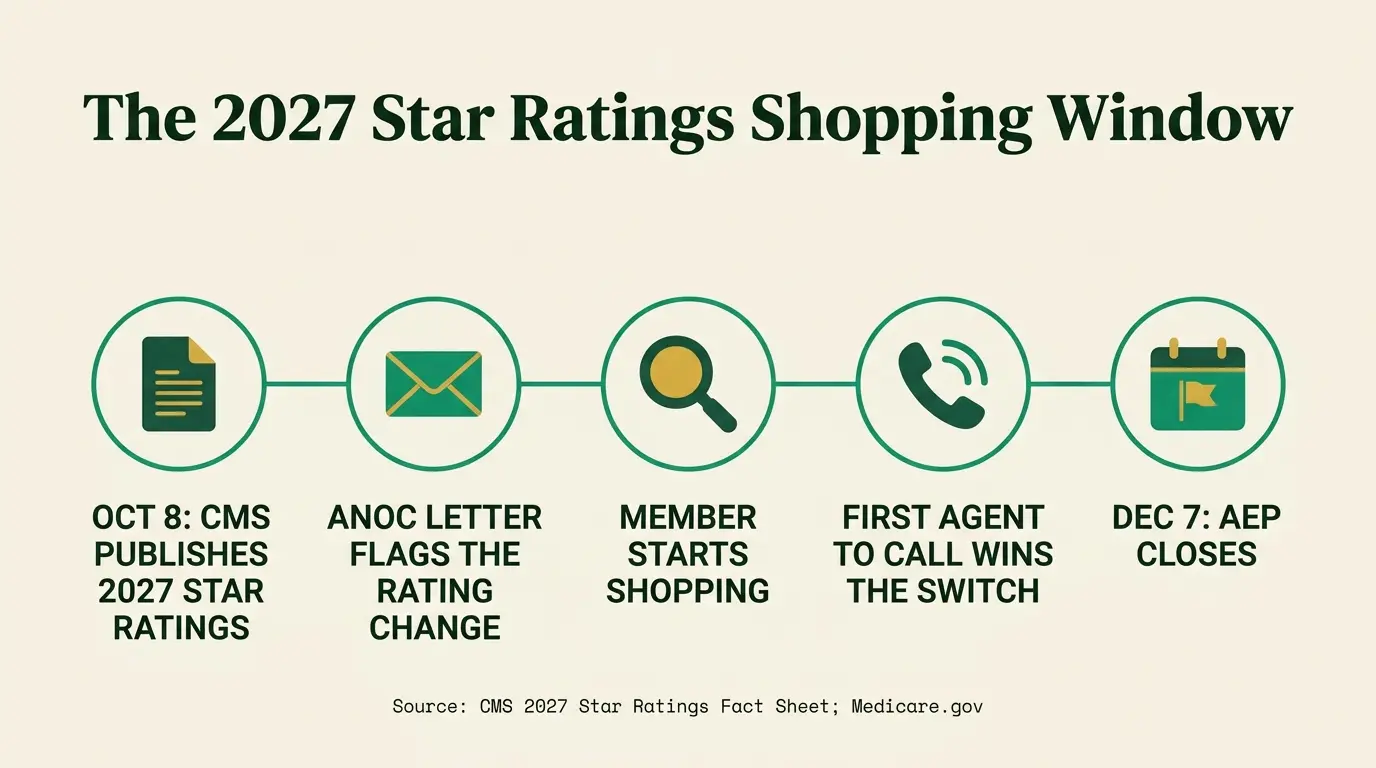
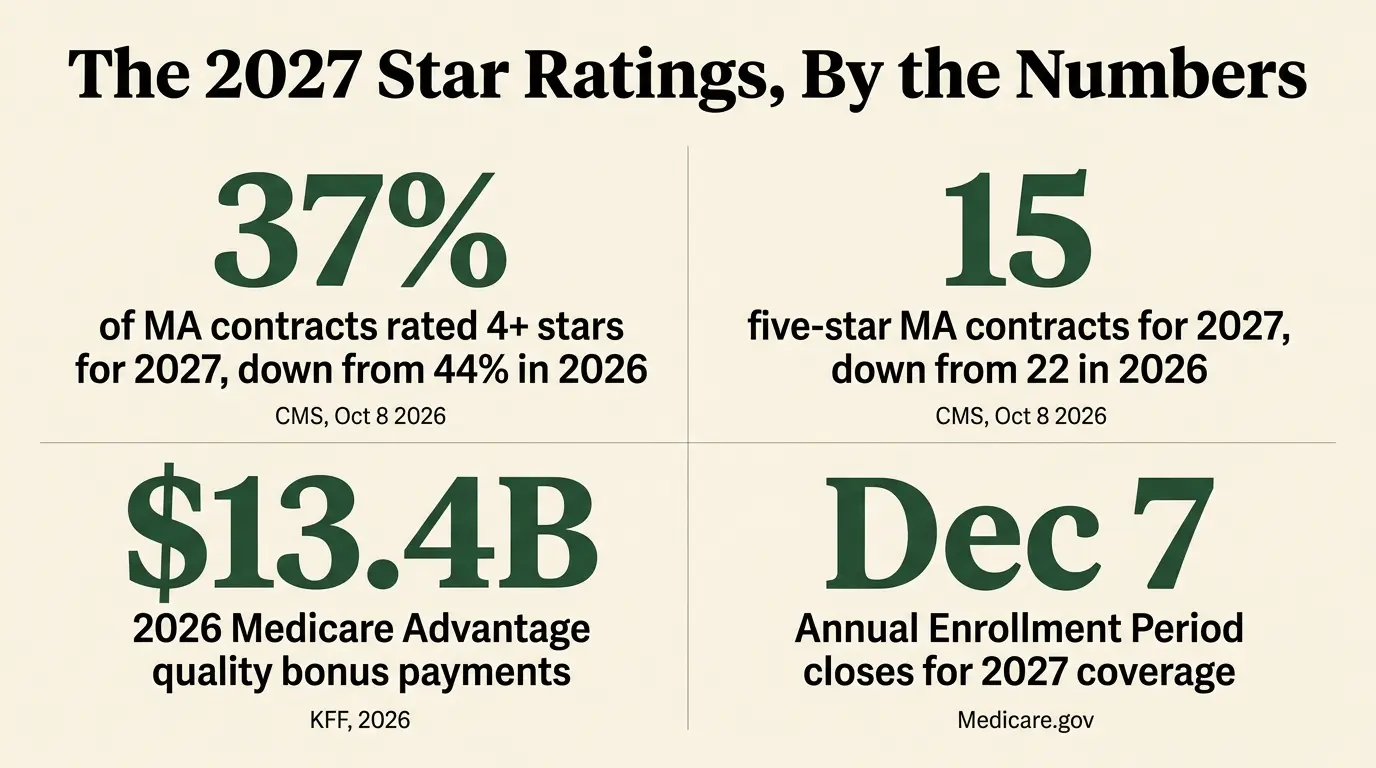
On October 8, 2026, CMS published the 2027 Medicare Advantage and Part D Star Ratings, and the national picture got worse for the second year running: the enrollment-weighted average rating fell to 3.99 stars from 4.01, and the number of 5-star contracts dropped to 15 from 22, per CMS’s own fact sheet. That matters to an insurance agent for a specific, practical reason that has nothing to do with the rating itself: a plan that loses stars usually loses rebate dollars, and rebate dollars are what funds the dental allowance, the OTC card, or the reduced drug copay a member notices the moment their Annual Notice of Change letter shows up in September. A quiet rating change becomes a very loud reason to shop, and it lands squarely inside the Annual Enrollment Period that’s already running, October 15 through December 7, 2026, per Medicare.gov. Today is October 26. There are 42 days left in that window.
This article covers what actually changed in the 2027 ratings, why CMS’s own methodology shift pushed more plans below the 4-star bonus threshold, what a rating drop costs a plan (and by extension, what it signals to a member), how to find out which of your own clients are affected without buying a list, and the compliance rules that apply to calling them, whether a human or an AI places the call.
The short version
- CMS's 2027 Star Ratings, published October 8, 2026, show the enrollment-weighted average MA-PD rating falling to 3.99 from 4.01 in 2026, and 5-star contracts dropping to 15 from 22. Only 188 of 508 rated MA-PD contracts (37%) reached 4 stars or higher, with about 71% of enrollees in a 4-plus-star contract.
- CMS tripled the weight of the Improving/Maintaining Physical Health and Mental Health measures for 2027, from a weight of 1 to a weight of 3, and added two new Part D measures on opioid/benzodiazepine use and anticholinergic medications, changes that pulled more scores down than up, per CMS's fact sheet.
- Federal Medicare Advantage quality bonus spending reached at least $13.4 billion in 2026, but the share of enrollees in a bonus-eligible (4-plus-star) plan fell to 68% from 75% a year earlier, the lowest since 2018, per KFF's analysis updated August 12, 2026.
- A star rating drop alone does not create a new Special Enrollment Period. It sits inside the AEP window already open through December 7, 2026, per Medicare.gov, the same window every other Medicare Advantage lead this fall is working inside.
- Every marketing and sales call on Medicare Advantage or Part D, human or AI, must be recorded and retained for 6 years under 42 CFR § 422.2274(g)(2)(ii), and using AI to place the call doesn't move TCPA consent or CMS compliance obligations off the licensed agent.
What the 2027 Star Ratings Actually Showed
CMS rates every Medicare Advantage and Part D contract on a 1-to-5 star scale, built from dozens of individual measures covering clinical outcomes, how members rate their own care experience, and process measures like screening rates, weighted and rolled up into one overall score per contract. The ratings publish every October on Medicare Plan Finder for the plan year that starts the following January, so the 2027 ratings released October 8, 2026 describe coverage members will be shopping for between now and December 7.
The headline number is the enrollment-weighted average: 3.99 stars for 2027, down from 4.01 in 2026, per CMS’s fact sheet. That’s a small move in the average, but averages hide the distribution. Of the 508 MA-PD contracts CMS rated for 2027, only 188, about 37%, reached 4 stars or higher: 108 at exactly 4 stars, 65 at 4.5, and 15 at the full 5 stars. About 71% of MA-PD enrollees are in a contract rated 4-plus stars, which is a different, enrollee-weighted number from the 37% contract-level figure, because larger plans skew toward the higher ratings. Both numbers matter for different reasons: the contract count tells you how widespread the drop is across the market, and the enrollee share tells you how many actual members are sitting in a plan that still cleared the bonus bar.
| Metric | 2026 | 2027 |
|---|---|---|
| Enrollment-weighted avg. MA-PD rating | 4.01 | 3.99 |
| 5-star MA-PD contracts | 22 | 15 |
| Contracts rated 4+ stars | ~44% of contracts | 37% (188 of 508) |
| Enrollees in a 4+ star contract | — | ~71% |
Source: CMS, "2027 Medicare Advantage and Part D Star Ratings" fact sheet, published October 8, 2026. The 2026 enrollee-share figure is not broken out in the same fact sheet, so it's left blank rather than estimated.
Terms worth defining before you read further
Quality bonus payment (QBP): an extra 5% added to a plan's county benchmark payment from CMS, available only to contracts rated 4 stars or higher. Rebate dollars: a share of the gap between a plan's bid and its CMS benchmark, returned to the plan and required to fund extra benefits, drug cost reductions, or lower premiums; the rebate share a plan keeps is tied to its star rating. ANOC (Annual Notice of Change): the letter every MA and Part D plan must send members each September disclosing what's changing for the coming plan year, including benefit and cost changes. Low-performing icon: a CMS flag on a contract rated below 3 stars for 3 consecutive years, which is also the one scenario that opens a star-specific Special Enrollment Period.
Why the Ratings Fell This Year
A rating drop this broad doesn’t happen because every plan’s clinical quality got worse overnight. It happens, in large part, because CMS changed how it measures quality, and 2027 carried more change than most years. Per the fact sheet, CMS added two new Part D process measures for 2027: Concurrent Use of Opioids and Benzodiazepines, and Polypharmacy: Use of Multiple Anticholinergic Medications in Older Adults, each weighted at 1. It brought back a respecified Colorectal Cancer Screening measure and a reworked Care for Older Adults Functional Status Assessment measure after earlier specification changes. And it retired two older measures, Care for Older Adults Pain Assessment and Medication Reconciliation Post-Discharge.
The change that moved the most plans, though, was a weighting shift on two measures that were already in the formula: Improving or Maintaining Physical Health and Improving or Maintaining Mental Health. Both went from a weight of 1 in the 2026 ratings to a weight of 3 for 2027, tripling their influence on a contract’s overall score. Those two measures track how members report their own health status changing year over year, a self-reported outcome measure that a plan can influence through care management but can’t fully control the way it controls, say, whether a screening got scheduled. Tripling the weight on two measures with that much member-level variance, across hundreds of contracts, is a mechanical reason scores moved down more than up this cycle, independent of whether care quality actually changed.
There’s also a wrinkle worth knowing about even though it mostly affects the prior cycle: a court decision in favor of Clover Health earlier in 2026 forced CMS to recalculate some 2026 star ratings, and CMS has appealed that ruling. KFF’s analysis notes the recalculation is expected to raise 2027 quality bonus payments by roughly $600 million compared with no recalculation at all, separate from the methodology changes baked into the 2027 ratings themselves. The litigation doesn’t change what the 2027 ratings say today, but it’s a reminder that even “final” star ratings have had a volatile few years, and a plan’s rating this October isn’t guaranteed to be the last word if litigation reaches it too.
Why a Rating Drop Turns Into a Phone Call
Most Medicare beneficiaries don’t shop around during Open Enrollment, and it’s worth being honest about that baseline before arguing this is a huge opportunity. Per KFF’s analysis of open enrollment behavior, published November 1, 2022, only about 29% of beneficiaries compared their current plan against other options during a recent Open Enrollment Period, and only about 1 in 10 Medicare Advantage enrollees with drug coverage voluntarily switched plans. Among Medicare Advantage enrollees specifically, though, 54% said they reviewed their current plan for changes in premiums or other costs, a meaningfully higher share than the “compared to competitors” number, which tells you something useful: MA members are more likely to check whether their own plan changed than to go shop a whole new market from scratch.
That’s exactly the behavior a star rating drop triggers. The ANOC letter a member receives every September is required to disclose material changes to their plan for the coming year, and when a plan’s rating and rebate dollars drop, the ANOC often reflects a smaller or restructured benefit package: a lower OTC allowance, a changed dental limit, a drug tier that moved. A member who’d otherwise auto-renew without a second look has, in that letter, a concrete, dated reason to ask “does this still work for me,” which is the review behavior KFF measured at 54% among MA enrollees, not the lower “shopped a new plan from scratch” behavior. Your existing clients in a downgraded contract are disproportionately represented in that reviewing group, because they have the clearest, most personal version of the reason to look again.
The group this actually points you toward
This isn't an argument for cold-calling a purchased list of strangers whose plan rating changed. It's an argument for working your own existing book first: the clients you already have a documented relationship and consent basis with, whose contract just lost stars, and who are statistically more likely than average to be rereading their renewal paperwork right now.
What a Member Actually Sees When Their Plan Loses Stars
Walk through what actually lands in a mailbox, because the abstraction of “star rating fell from 4.5 to 3.5” isn’t what prompts a phone call; the ANOC is. Every Medicare Advantage and Part D plan is required to send enrolled members an Annual Notice of Change each September, laying out what’s different about their coverage for the coming plan year: premium, deductible, copays and coinsurance by service, the drug formulary and its tiers, and the supplemental benefits, dental, vision, hearing, OTC allowance, fitness memberships, that rebate dollars fund. When a contract’s rating falls and its rebate share shrinks with it, the ANOC is where that shows up as a specific, dollar-denominated change: a $75 quarterly OTC card that becomes $50, a dental allowance that drops a tier, a drug that moves from a $10 copay to a higher one.
None of that says “star rating” anywhere on the page. A member reading their ANOC sees a worse deal, not a methodology change, and the instinct that follows is the ordinary consumer instinct: check whether something else is better before the window closes. That’s the behavioral link between a CMS data release on October 8 and a phone ringing in late October, through a document the member already has in hand, not through anything an agent has to introduce. Your advantage, as the agent, is being the first call they get about it rather than the fifth, and being able to explain in one sentence why the benefit changed, because you already know the mechanism this article just covered.
This Isn’t the Same Thing as a Forced Plan Exit
It’s worth being precise about what this article covers versus a related but different AEP pattern: a plan non-renewing its CMS contract or exiting a county entirely, which pushes members out whether they want to leave or not and can open a separate Special Enrollment Period under 42 CFR § 422.506. A star rating drop is not that. The contract is still there, the member is still enrolled unless they actively choose to leave, and nothing about a lower rating forces anyone off their plan. The only rating-specific SEP CMS offers is for a contract rated below 3 stars for three consecutive years, letting an affected member switch to a 3-star-or-better plan at any time, a narrow, specific trigger that most of this year’s rating drops don’t meet.
What connects the two situations is simpler than the mechanics: both put a documented, legitimate reason to reach out into an agent’s hands during a window that’s already open, and both reward whoever calls first. If part of your book is dealing with an actual non-renewal this year, that’s a different list with a different legal trigger, worth working separately rather than folding into a general rating-drop campaign.
What a Rating Drop Costs the Plan, and Why That Signals to You
Follow the money on the plan side, because it explains why a rating drop isn’t cosmetic. Per KFF’s analysis of the MA Quality Bonus Program, updated August 12, 2026, federal spending on quality bonus payments reached at least $13.4 billion in 2026, up from $12.7 billion in 2025. But the share of MA enrollees in a bonus-eligible plan, one rated 4 stars or higher, fell to 68% in 2026 from 75% in 2025, the lowest share since 2018, as the number of 4-plus-star contracts fell to 209 from 261. Those are the 2026 payment-cycle numbers, calculated from the star ratings CMS published back in October 2025; the 2027 ratings this article covers, released October 2026, determine the next round, feeding into 2028 quality bonus payments, per CMS’s own fact sheet. Two consecutive cycles now show the same direction: a shrinking share of contracts and enrollees clearing the 4-star bonus bar.
A contract that drops below 4 stars loses its 5% quality bonus on the county benchmark CMS pays it against, and typically loses rebate dollars that fund supplemental benefits. That’s the mechanism behind the ANOC letter getting worse. It’s also, separately, a reason some lower-rated contracts shrink their footprint or exit counties entirely in the following plan year, the forced-disenrollment pattern this site has covered elsewhere. For the purposes of this article, the relevant version of that cost isn’t the plan’s bottom line; it’s that a rating drop is a documented, dated, legitimate reason for an agent to reach out to an existing client about a real change in their coverage, not a manufactured excuse to call.
The bonus-eligible share of MA enrollment keeps shrinking
Share of Medicare Advantage enrollees in a 4-plus-star, bonus-eligible plan
Source: KFF, "Medicare Will Spend More Than $13 Billion on the Medicare Advantage Quality Bonus Program in 2026," updated August 12, 2026. Figures reflect the 2025 and 2026 bonus payment cycles, calculated from star ratings published the prior October; KFF has not yet published the equivalent 2027/2028-cycle figure using the ratings covered in this article.
| Metric | 2025 | 2026 |
|---|---|---|
| Federal QBP spending | $12.7B | $13.4B+ |
| Contracts rated 4+ stars | 261 | 209 |
| Enrollees in a bonus-eligible plan | 75% (~26M) | 68% (~24M) |
Source: KFF, "Medicare Will Spend More Than $13 Billion on the Medicare Advantage Quality Bonus Program in 2026," updated August 12, 2026.
How to Work This Without Buying a Single Lead
None of what follows requires a purchased list. It requires a spreadsheet and a few hours before the next AEP wave of calls.
- Pull your book’s contract and plan IDs. Every client’s MA enrollment ties to a specific contract (H-number) and plan ID, both on their ID card and in your CRM if it’s populated correctly.
- Cross-reference against the published 2027 ratings. CMS’s Star Ratings data is public on Medicare Plan Finder and summarized by contract in the fact sheet. Flag anyone whose contract dropped below 4 stars, or whose rating fell even if it’s still above 4, since a drop from 4.5 to 4 can still mean fewer rebate dollars.
- Confirm what the ANOC actually told them. Where you can, check the specific benefit changes in that client’s September ANOC rather than assuming the rating drop and the benefit change are identical; sometimes they move together, sometimes a plan absorbs the hit elsewhere.
- Prioritize by December 7, not by alphabetical order. A client flagged in late October has more runway than one you get to in the first week of December. Work the list in order of how much time is left, and how material the benefit change actually is.
- Call first, document the consent basis you’re relying on, and keep it to your own book. This is existing-client outreach about a documented plan change, not a cold list. Confirm your consent record actually supports the call before you make it.
- Log the Scope of Appointment and the disposition on every call, same as any other Medicare marketing conversation, and route anyone genuinely confused or upset about new benefit limits to a human conversation immediately, AI-assisted or not.
- Treat December 7 as a hard stop on your calendar. A flagged client who doesn’t hear from you by then has, by default, kept the lower-rated plan for another year.
An agency that reads that list and thinks “we can build this spreadsheet ourselves” is right. It’s a few hours of cross-referencing public CMS data against a CRM export, no vendor required. The part that doesn’t scale with a spreadsheet is making the actual calls, at volume, inside a window that’s also carrying every other piece of AEP call volume your agency already has.
Licensed staff build the list and dial it between everything else
- Cross-referencing contract IDs against CMS ratings competes with daily AEP call volume for staff time
- Flagged clients get called in whatever order staff get to them, not by urgency
- Calls that reach voicemail or don't connect rarely get a documented second attempt
- December 7 arrives with part of the flagged list still uncalled
The flagged list gets worked at volume while staff handle live conversations
- Outbound calling works the flagged list in the background while staff handle inbound and live transfers
- Every call is recorded and routed into the 6-year retention requirement automatically
- A member who wants to talk gets warm-transferred to a licensed agent on the spot
- The list gets a documented attempt before December 7, not just the top of it
A worked example. Say 150 of your Medicare Advantage clients sit in a contract that dropped below 4 stars for 2027. Called by hand at roughly 8 minutes per call including notes and disposition logging, that’s 20 hours of a licensed producer’s dial time, on top of whatever else is already on the AEP calendar. At TheAffordableAI’s published Single Account rate of $0.20 a minute, fetched from the pricing page for this article, an AI caller working the same 150-name list at an average 4-minute qualifying call costs roughly $120 to reach the whole list and warm-transfer anyone who wants to talk. That’s not 20 hours of selling conversation replaced; selling a Medicare Advantage plan change stays a licensed, human conversation start to finish. It’s 20 hours of dialing to find out who wants that conversation, replaced with a process that runs in the background while your staff actually have it.
The Compliance Rules That Don’t Change Because the Trigger Is a Rating
A star rating drop is a legitimate, documented reason to reach out. It doesn’t change a single Medicare marketing or TCPA requirement.
TCPA consent. An automated or AI-voice call to a cell phone still requires the called party’s prior express consent under 47 U.S.C. § 227(b)(1)(A)(iii). An existing client relationship can support that consent depending on how and when it was documented, but confirm your own records actually cover this kind of outreach before you rely on them.
Recorded calls, retained for 6 years. Under 42 CFR § 422.2274(g)(2)(ii), “all marketing and sales calls, including the audio portion of calls conducted via web-based technology, must be recorded” and “retained in their entirety for a minimum period of 6 years,” with the first 3 years specifically in audio format. A rating-drop outreach call is a marketing and sales call like any other for this purpose.
Agent testing. Under § 422.2274(b)(2), the agent or broker handling the actual conversation about plan changes must have scored 85% or higher on the carrier testing required to market and sell that contract.
TPMO disclosures, if a third party is involved. If any part of this outreach runs through a third-party marketing organization rather than directly through the carrier-appointed agent, the TPMO disclosure and transfer-disclosure requirements at § 422.2274(g)(3) still apply.
Scope of Appointment. Per § 422.2274(b)(3) and (c)(9)(ii), a personal marketing appointment to discuss specific plan options still needs a documented Scope of Appointment, obtained before the appointment, not after.
AI does not transfer liability. Using an AI voice agent to place the call doesn’t move responsibility for consent, disclosure, recording retention, or Scope of Appointment away from the licensed producer whose name ends up on the sale. The call’s trigger being a public CMS data point doesn’t change that chain of responsibility either.
Not legal advice
CMS marketing rules, TCPA requirements, and the specific consent basis you can rely on depend on your state, your carrier contracts, and how your existing consent was documented. Confirm current requirements with your compliance department, carrier partners, or counsel before building outreach around anything in this article.
Hear how the follow-up actually sounds
There's a live demo call on the homepage if you want to hear an AI caller qualify an inquiry and hand off a warm transfer before you decide anything.
Where We Fit, and Where We Don’t
TheAffordableAI is a managed AI caller, not a Medicare marketing organization, and it doesn’t build or sell rating-drop lists. What it does, per TheAffordableAI’s own service offering: dial outbound within seconds of a flagged client being added to a call queue, answer every inbound call around the clock when a worried client calls back on their own schedule, and warm-transfer anyone who wants to talk to a licensed agent, ringing 20-plus agents at once on the Agency plan so the first one available takes the call live. It syncs two-way with HighLevel, writing the call recording, transcript, and disposition back into the CRM record that’s also your documentation for the 6-year retention requirement. Multi-calendar intent routing keeps a Medicare Advantage conversation separate from an ACA or dental booking landing in the same inbox during AEP.
Works the flagged list in the background
Outbound calling reaches your rating-drop list without pulling a licensed agent off live AEP calls.
Warm transfer to a licensed human
A client who wants to talk about the change reaches a licensed agent live, while the window is still open.
Recording built for the retention rule
Every call records and syncs to HighLevel automatically, feeding the 6-year documentation CMS requires.
A rating drop and a verified live transfer have the same deadline. Only one of them usually gets a phone call.
Pricing, restated since the math above depends on it: Single Account runs $200 a month plus a $500 one-time setup fee, at $0.20 a minute, down toward $0.15 at bulk volume. Agency runs $500 a month plus a $1,000 one-time setup fee, at $0.18 a minute, down toward $0.16 at bulk volume, and adds routing to 20-plus agents, round-robin across numbers, and team availability toggles, useful when AEP call volume from several licensed producers lands at once. Both plans are month to month with no long-term contract, per TheAffordableAI’s pricing page fetched for this article. You can build the ratings cross-reference and the dialing discipline yourself with a spreadsheet, a dialer, and staff willing to work it between live calls; plenty of agencies do exactly that. It’s worth pricing both approaches before December 7 makes the decision for you.
Where This Isn’t the Right Tool
Say this plainly: if a client wants to understand what a rating drop actually changed about their specific benefits, their network, or their drug coverage, that conversation belongs to a licensed agent from the first sentence, not an AI call. A voice AI confirming interest and routing to a calendar is not a substitute for a licensed producer walking someone through what their new rebate dollars do or don’t cover. And if your book is small enough that a disciplined manual cross-reference and call list already gets everyone a documented, timely call inside the window, the economics in this article may not move the needle enough to justify a new line item. Run your own numbers before deciding either way; a 40-client book and a 4,000-client book are not the same decision.
What You Get When You Move on This Before December 7
A star rating drop is one of the few AEP signals that’s entirely public, dated, and legitimate to act on with your own existing book, no purchased list required. Knowing the 2027 ratings fell nationally is only useful if you turn it into a specific list of your own clients whose contract lost stars, and that list is only useful if it actually gets called, recorded, and documented before December 7, not half-worked between everything else AEP already has your staff doing. The data came out October 8. The window closes December 7. What happens in the 42 days in between is the only part of this that’s still up to you.
Frequently asked
What are Medicare Advantage Star Ratings, and why do they matter to an agent?
CMS scores every Medicare Advantage and Part D contract from 1 to 5 stars each year on a mix of clinical outcomes, member experience, and process measures, then publishes the result on Medicare Plan Finder every October for the following plan year. The rating does two things that touch an agent directly: it's visible to the beneficiary shopping on Medicare.gov, and it sets the plan's quality bonus payment and rebate dollars, which fund the extra benefits (dental, vision, reduced drug costs) that make one plan more attractive than another. A plan that loses stars often loses some of those extras the following year, which is exactly the kind of change that makes an otherwise-passive member start comparing options.
Why did the 2027 Medicare Advantage star ratings fall compared to 2026?
Per CMS's 2027 Medicare Advantage and Part D Star Ratings Fact Sheet, published October 8, 2026, the enrollment-weighted average MA-PD star rating fell to 3.99 from 4.01 in 2026, and the number of 5-star contracts dropped to 15 from 22. CMS made several methodology changes for 2027: it added two new measures (Concurrent Use of Opioids and Benzodiazepines, and Polypharmacy: Use of Multiple Anticholinergic Medications in Older Adults), brought back a respecified Colorectal Cancer Screening measure and a reworked Functional Status Assessment measure, and tripled the weight of the Improving or Maintaining Physical Health and Improving or Maintaining Mental Health measures, from a weight of 1 in 2026 to a weight of 3 in 2027. Tripling the weight on two outcome measures that plans don't fully control, how members report their own health changing year over year, pulled more scores down than up.
Does a plan's star rating dropping give a member a new Special Enrollment Period?
No, and this is worth being precise about. A star rating change by itself does not create a Special Enrollment Period. The only star-related SEP is the one CMS offers once a year to beneficiaries in a plan rated below 3 stars for three consecutive years, letting them switch to a plan rated 3 stars or higher at any time outside AEP. A plan that simply dropped from, say, 4.5 to 3.5 stars for one year doesn't trigger that SEP. What it does is sit inside the AEP window that's already open, October 15 through December 7, 2026, per Medicare.gov, during which any member can switch for any reason. The urgency here isn't a new legal window; it's that a rating drop is a documented reason a member who'd otherwise auto-renew might start paying attention before this existing window closes.
How can an agent find out which of their clients' plans lost stars for 2027?
Two places, both public. CMS's 2027 Star Ratings data, published October 8, 2026 on Medicare Plan Finder, lists every contract's rating and is also summarized in CMS's own fact sheet with the prior year's rating alongside it. Medicare Plan Finder at Medicare.gov lets you look up a specific contract and plan ID and see the current rating directly. Members themselves also received an Annual Notice of Change (ANOC) from their plan in September, which is required to disclose material changes for the coming year, including, in practice, a materially different benefit package when a plan's rebate dollars shift with its rating. Cross-referencing your book's contract and plan IDs against the published 2027 ratings is a spreadsheet exercise, not a data purchase.
Can an agent call an existing client about their plan's rating change, or does that need new consent?
The consent analysis doesn't change because the subject of the call is a star rating instead of a renewal reminder. An automated or AI-placed call to a wireless number still needs the called party's prior express consent under 47 U.S.C. § 227(b)(1)(A)(iii), the TCPA's cell phone provision. A documented existing-client relationship can support consent depending on how and when it was obtained and whether it covers this kind of outreach, but "they're my client" alone isn't a blanket exemption. Confirm what your own consent records actually cover before dialing, the same as any other outbound campaign.
What does a star rating drop cost the plan, and why does that matter to the agent?
Per KFF's analysis of the Medicare Advantage Quality Bonus Program, updated August 12, 2026, federal spending on MA quality bonus payments reached at least $13.4 billion in 2026, versus $12.7 billion in 2025, but the share of MA enrollees in a bonus-eligible plan (4 stars or higher) fell to 68% in 2026 from 75% in 2025, the lowest share since 2018, as the number of 4-plus-star contracts fell to 209 from 261. A plan that drops below 4 stars loses its 5% quality bonus on top of its county benchmark and typically loses rebate dollars it would have had to spend on supplemental benefits. That's not abstract to the agent: it's the dental allowance, the OTC card, or the reduced drug copay that may shrink or disappear from the member's renewal packet, which is the detail that gets a phone picked up.
When does the window to act on the 2027 Star Ratings actually close?
December 7, 2026. Medicare.gov states Open Enrollment "happens from October 15 – December 7," and any plan change made in that window takes effect January 1, 2027, with the request needing to reach the plan by the close date. There's no extension built into the calendar for a rating-driven conversation any more than for any other AEP lead; a member whose plan dropped stars and who doesn't hear from their agent, or anyone else, by December 7 defaults into whatever they're already enrolled in.
Does using an AI caller change any of the Medicare marketing compliance rules here?
No. Every marketing and sales call touching Medicare Advantage or Part D, placed by a human or an AI voice agent, must be recorded in its entirety and retained for a minimum of 6 years, the first 3 in audio format, under 42 CFR § 422.2274(g)(2)(ii), and the agent or broker handling the actual sale must score 85% or higher on carrier testing under § 422.2274(b)(2). Using AI to dial or answer the call doesn't transfer TCPA consent obligations, CMS marketing rules, or Scope of Appointment requirements away from the licensed producer whose name ends up on the enrollment. The technology changes who dials; it doesn't change who's responsible.
Sources
- CMS — 2027 Medicare Advantage and Part D Star Ratings Fact Sheet (published October 8, 2026)
- KFF — Medicare Will Spend More Than $13 Billion on the Medicare Advantage Quality Bonus Program in 2026 (published July 1, 2026, updated August 12, 2026)
- Medicare.gov — Open Enrollment (dates and what you can change)
- KFF — Medicare Advantage in 2026: Enrollment Update and Key Trends (published June 5, 2026, updated July 1, 2026)
- KFF — Two New KFF Analyses Show a Relatively Small Share of Medicare Beneficiaries Compared Plan Options or Switched Plans During a Recent Open Enrollment Period (published November 1, 2022)
- Cornell Law School Legal Information Institute — 42 CFR § 422.2274, Medicare Advantage marketing, call recording, and agent/broker training and testing
- Cornell Law School Legal Information Institute — 47 U.S. Code § 227, Telephone Consumer Protection Act
- TheAffordableAI — Pricing (fetched October 26, 2026)
Put this on your own phone line
See the AI dial, qualify, and warm-transfer a live call in under a minute. No contract, no dev work.
Keep reading
Medicare Advantage Leads in 2026: What They Cost
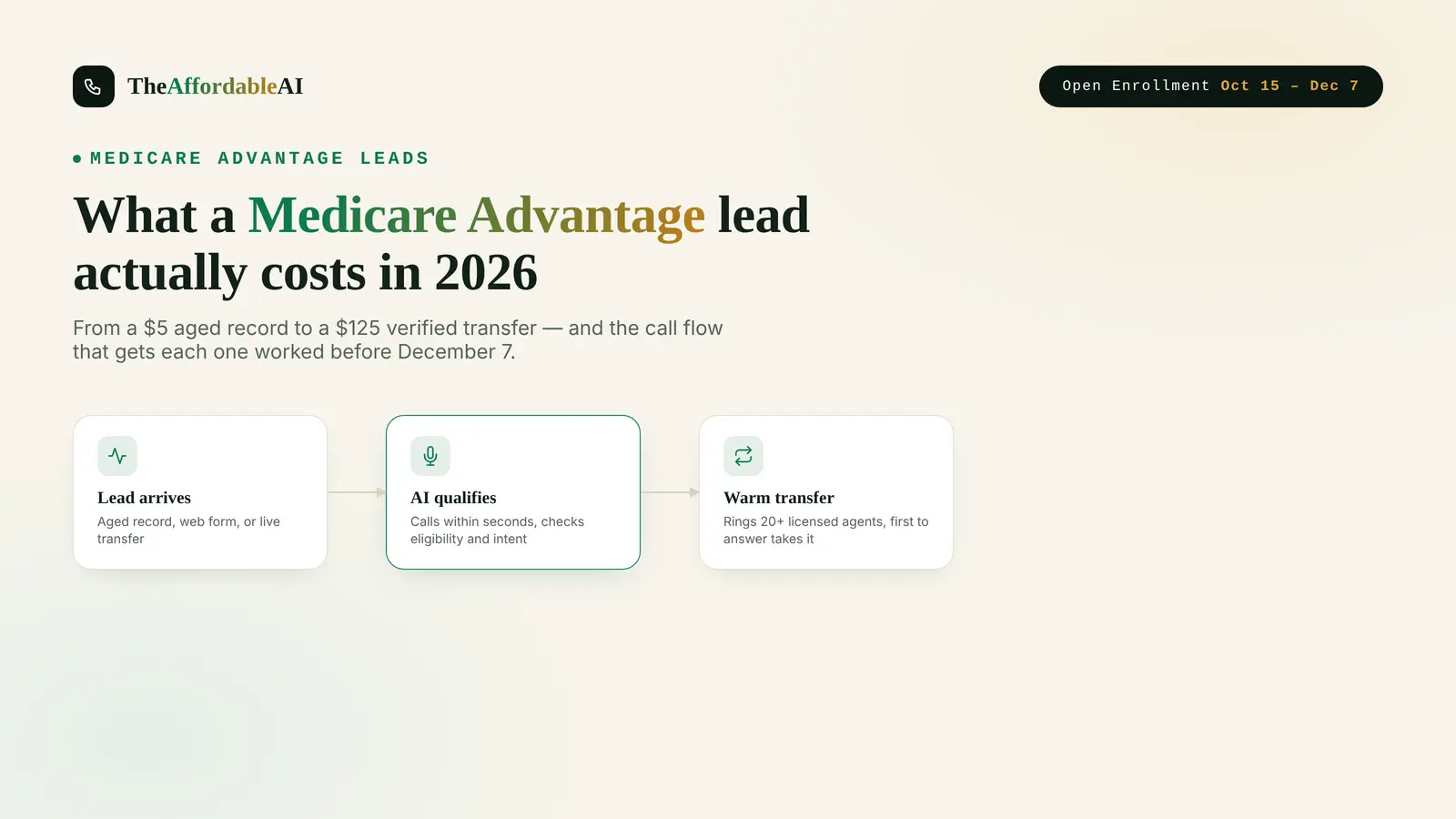
Medicare Advantage leads run $5 to $125 each, and Congress is scrutinizing how lead generators sell senior data. What they cost and how to follow up fast.

Surviving Medicare AEP 2026 Without a Seasonal Hire
Medicare AEP runs October 15 to December 7. Real math on staffing that window without hiring and licensing seasonal reps you don't have time for.

Medicare Advantage Forced Disenrollment: 2027 Agent Guide
1 in 10 Medicare Advantage members lost their plan in 2026, per a JAMA study. Here's what the 2027 exits mean and how to work the list fast.