Medicare OEP 2027: What Agents Can (and Can't) Do
Medicare's Open Enrollment Period runs January 1 to March 31 and bans unsolicited marketing. Here's what agents can legally do, and why every call matters.
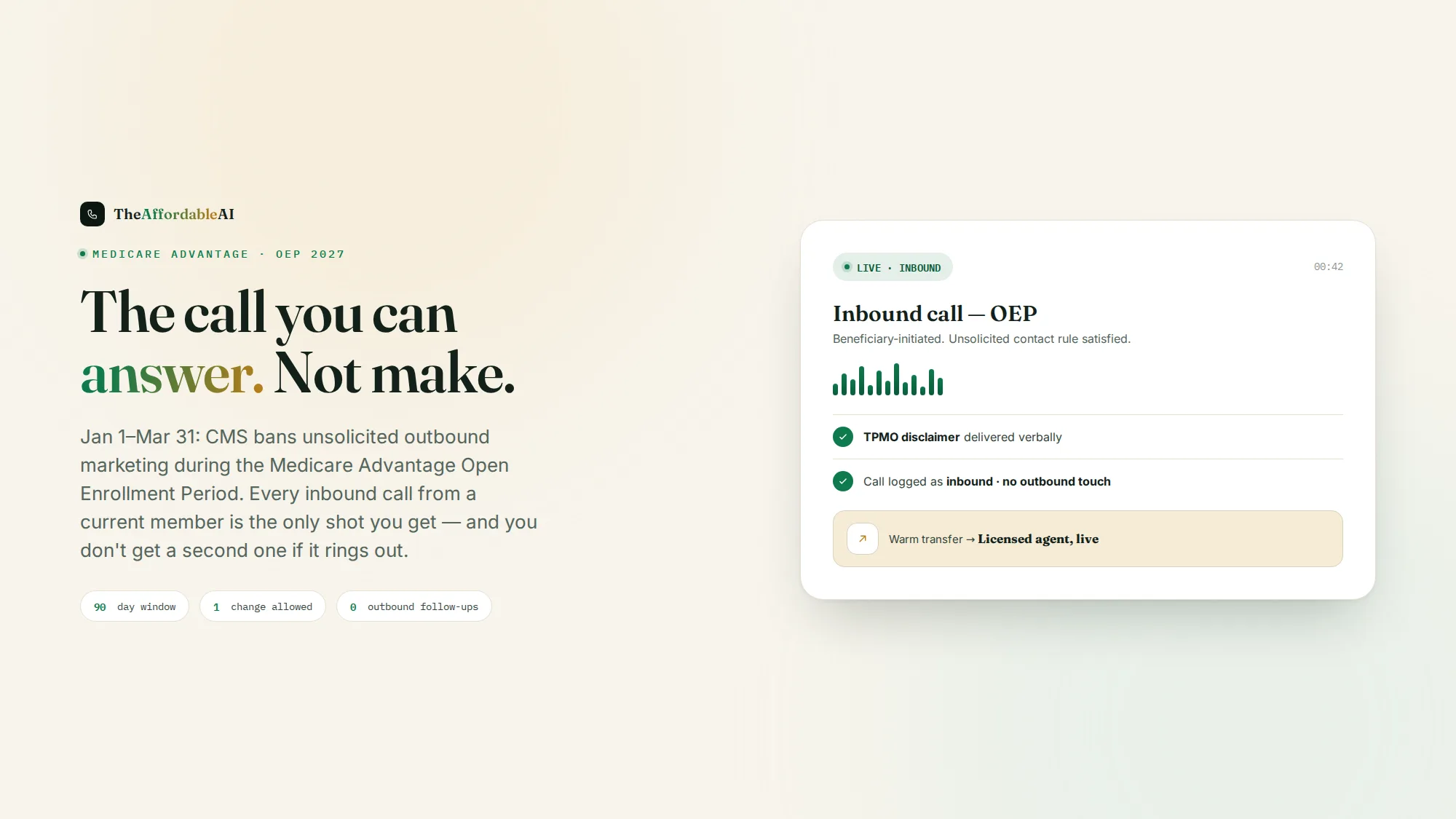
Medicare’s Open Enrollment Period runs January 1 through March 31, and during it, CMS bans agents from doing the one thing agents normally do to win business: reach out. 42 CFR 422.2263(b)(7) prohibits knowingly targeting or sending unsolicited marketing to a Medicare Advantage enrollee during OEP. You can’t call them. You can’t mail them anything that mentions the OEP. You can’t buy a list of people who just picked a plan during AEP and try to win them back. The only door that’s open is the one the beneficiary opens themselves, by calling you, walking into your office, or asking for information directly. Everything in this piece is about what happens on the other side of that door, and what it costs an agency that isn’t standing there when it opens.
This is the compliance skeleton, the plain-English version of what’s allowed and what isn’t, the arithmetic on what an unanswered OEP call actually costs, a full method for building compliant coverage yourself, and where a system built to answer every call live changes the outcome instead of just the paperwork.
The short version
- OEP runs January 1 to March 31 under 42 CFR 422.62(a)(3), and it lets a current Medicare Advantage enrollee make one change: switch MA plans, or drop MA and return to Original Medicare.
- 42 CFR 422.2263(b)(7) bans unsolicited marketing to MA enrollees during OEP. Agents can respond to a beneficiary who calls in; agents can't call out.
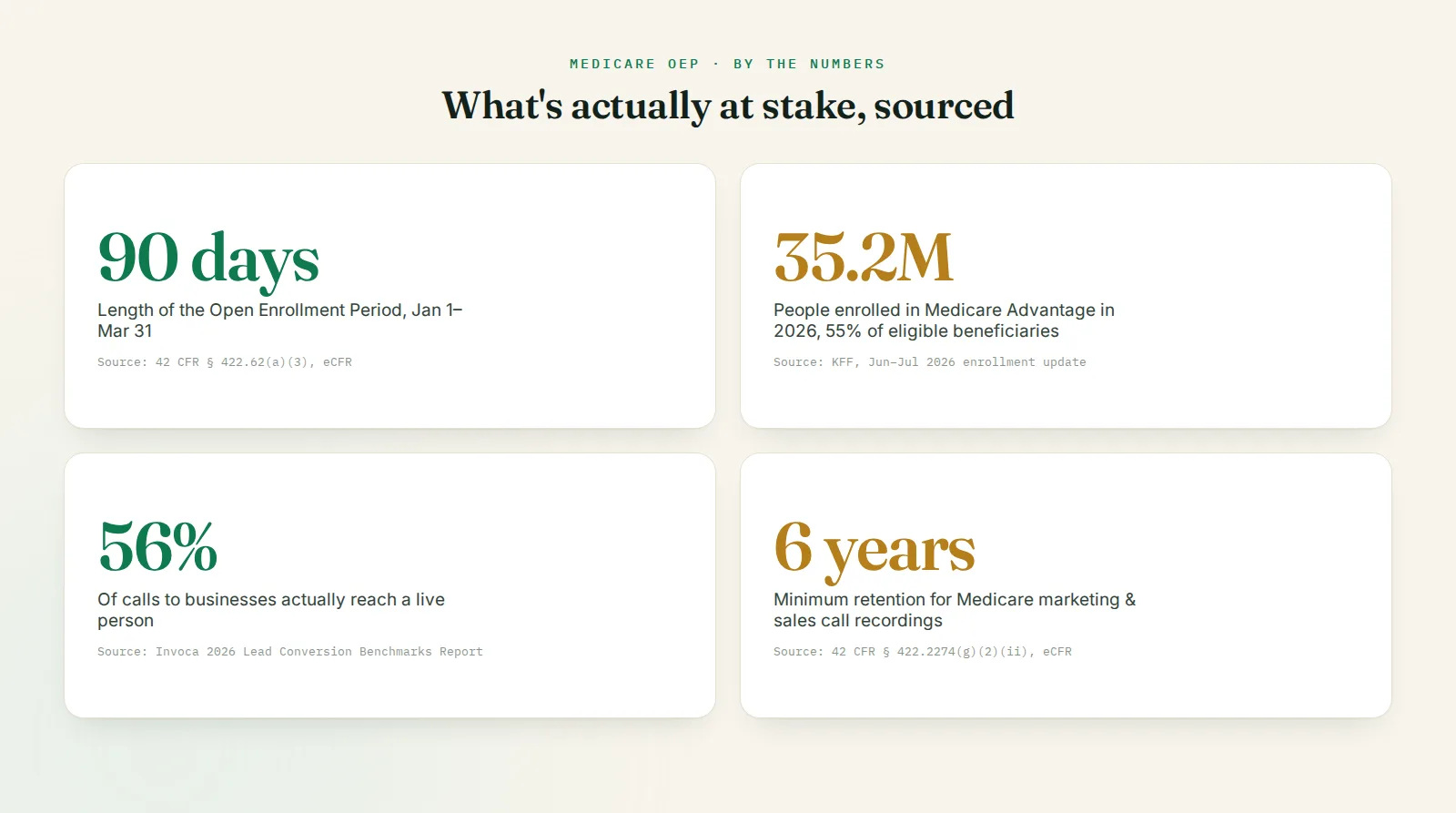
- KFF puts 2026 Medicare Advantage enrollment at 35.2 million people, 55% of the 64.2 million beneficiaries with both Part A and Part B, so the population who can act during OEP is large and growing, just slower than it used to.
- Invoca's 2026 benchmarks report, built from more than 70 million calls, found 56% of callers to businesses actually reach a person. During OEP, since you can't call the other 44% back to try again, a missed inbound call isn't a delay. It's the whole opportunity, gone.
- Whoever answers the phone, live or AI, the TPMO disclaimer, 6-year call recording retention, and the licensed agent's compliance responsibility all still apply on exactly the same terms as any other time of year.
What Medicare’s Open Enrollment Period Actually Is
The Medicare Advantage Open Enrollment Period is a narrow, one-time window, January 1 through March 31, that lets someone already enrolled in an MA plan make a single change for the year. Per 42 CFR 422.62(a)(3), an individual enrolled in an MA plan may make one election during the first three months of the calendar year to enroll in a different MA plan, or to disenroll and return to Original Medicare. If they drop MA to go back to Original Medicare during OEP, they can also add a standalone Part D prescription drug plan at the same time, since dropping MA coverage would otherwise leave a gap. The regulation is explicit that this is a once-per-window election: use it, and that’s your one shot for the year, outside of a handful of exceptions like a Special Enrollment Period triggered by moving or losing other coverage.
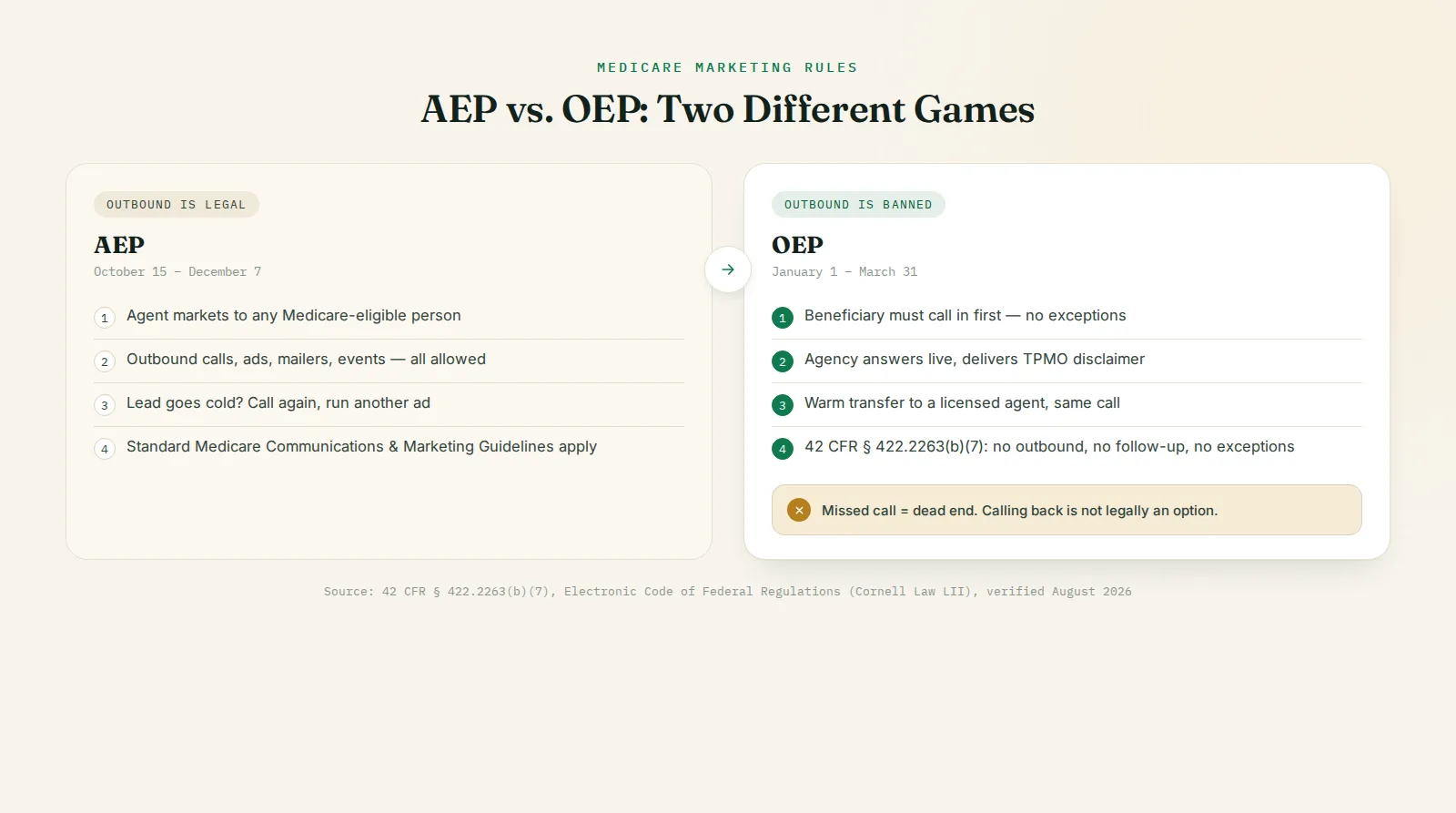
That’s a fundamentally different animal from the Annual Enrollment Period, October 15 through December 7, which is fixed by the neighboring paragraph of the same regulation and is when nearly all Medicare Advantage plan shopping and switching actually happens. AEP is open season: any Medicare-eligible person can join, drop, or switch a plan, and agents can market to the entire eligible population the normal way, ads, calls, mailers, events, all of it governed by the standard Medicare Communications and Marketing Guidelines. OEP only opens for people who are already in an MA plan and want to undo or adjust that choice, and CMS built the marketing rules around it specifically so it can’t be worked like a second AEP.
Define the terms before anything else
OEP (Open Enrollment Period): the January 1–March 31 window where a current MA enrollee can make one plan change. AEP (Annual Enrollment Period): the October 15–December 7 window where any eligible person can join, drop, or switch. Unsolicited contact: outreach the beneficiary didn't initiate or ask for, the category CMS prohibits during OEP under 42 CFR 422.2263(b)(7). TPMO (Third-Party Marketing Organization): any entity, including an agent or agency, that markets or sells Medicare products on behalf of a plan, subject to the disclaimer requirement under 42 CFR 422.2267(e)(41). Warm transfer: connecting a live caller directly to an available licensed agent while they're still on the line, instead of taking a message.
Scale matters here, because OEP isn’t a niche event. KFF’s June 2026 enrollment brief, updated July 1, 2026 with March 2026 data, puts total Medicare Advantage enrollment at 35.2 million people, 55% of the 64.2 million Medicare beneficiaries who have both Part A and Part B. That’s a lot of current MA enrollees who are, by definition, eligible to use their one OEP change if something about their plan bothers them enough in January, February, or March, a premium increase they notice on the first bill of the year, a doctor who dropped out of network, a formulary change that hit a prescription. KFF also notes enrollment growth slowed to 3% between 2025 and 2026, down from 4% the year before, which matters for a different reason: a maturing market means more of your book is renewal business you already have, and OEP is disproportionately about keeping or losing people you already won, not net-new acquisition.
What CMS Actually Prohibits, and What’s Still Allowed
The rule that governs everything in this piece is 42 CFR 422.2263(b)(7): plans, and agents acting on their behalf, may not knowingly target or send unsolicited marketing materials to any MA enrollee during OEP. The regulation gets specific about what that means in practice, and it’s worth reading the actual list rather than the summary, because the boundary lines matter.
What CMS prohibits
- Sending unsolicited materials that advertise the ability to make an additional enrollment change, or that reference the OEP by name
- Buying or building mailing lists based on who made a choice during the prior AEP, to specifically target them for OEP outreach
- Running or promoting agent or broker activity aimed at treating OEP as a fresh sales opportunity
- Calling or otherwise contacting a former enrollee who already picked a new plan during AEP, to try to win them back or steer them elsewhere
What's still open
- Answering a call, email, or walk-in visit the beneficiary initiated themselves
- Holding a one-on-one meeting the beneficiary specifically requested
- Providing OEP information through a call center or office when someone asks for it directly
- General marketing about other, unrelated enrollment opportunities: age-ins turning 65, 5-star plan special enrollment periods, and similar events not tied to the OEP switch itself
Read plainly, the line CMS drew is initiation. Who started the conversation. A beneficiary who picks up the phone and calls your office in February because their new plan’s pharmacy network doesn’t include their regular drugstore is doing something the regulation fully permits you to respond to. An agent who pulls a list of everyone who just enrolled during AEP and starts dialing in January, hoping some of them are having second thoughts, is doing exactly what 42 CFR 422.2263(b)(7) exists to stop. The two calls can sound almost identical once they’re happening. The only thing that separates a compliant OEP conversation from a violation is who picked up the phone first, which means your entire OEP compliance posture rests on being able to prove, cleanly, that every call in your system this quarter was inbound and beneficiary-initiated.
That’s also why the TPMO disclaimer requirement doesn’t take a break during OEP. 42 CFR 422.2267(e)(41)(ii) requires the disclaimer be conveyed verbally on sales calls before any benefits get discussed, and that rule applies to a beneficiary-initiated OEP call exactly the way it applies to an AEP call you made yourself. The channel that starts the conversation changed; what has to happen once someone’s on the line didn’t.
Why a Missed Call in OEP Isn’t a Delay, It’s the Whole Thing
Outside of OEP, missing an inbound call is a problem you can usually work around. You call the person back an hour later, or the next morning, and you’ve lost some momentum but not the opportunity. During AEP, if a lead goes cold, you can generate another one, run another ad, buy another list, dial again. Speed matters, but the door stays open because outbound marketing is legal the whole time.
OEP removes that safety net entirely. Once a beneficiary hangs up after your line rang out unanswered, you cannot legally call them back to pick the conversation back up, not tomorrow, not next week, unless they call you again first. 42 CFR 422.2263(b)(7) doesn’t carve out an exception for “they called us first, so a follow-up call from us is fine.” The initiation has to be theirs, every time, for the whole 90-day window. A missed OEP call isn’t a delayed conversation. It’s a permanently closed one, at least through the channel that would have been easiest for both sides.
That reframes what an unanswered line actually means during these three months. Invoca’s 2026 Lead Conversion Benchmarks Report, built from an analysis of more than 70 million calls and 600 million minutes of conversation data across ten industries including insurance, found that 56% of callers to businesses actually reach a person, which read the other way means 44% of inbound calls don’t connect to anyone at all. Outside OEP, that 44% is a follow-up list. Inside OEP, unless the caller tries again on their own, it’s gone.
Test your own line before OEP starts
Call your agency's main number from a phone you don't normally use, on a Saturday afternoon and again after 6pm on a weeknight. Note whether it rings out, goes to a generic voicemail, or gets answered by someone who can actually talk about a plan change. Whatever you find is what an actual OEP-season member experiences the moment they decide to call.
What Missing That Call Actually Costs
Two separate costs stack up here: the cost of a call that never gets answered at all, and the cost of staffing a phone well enough that it usually does.
On the first, Invoca’s benchmark figure, 56% of business calls reaching a live person, isn’t insurance-specific in isolation, but it’s drawn from a dataset that explicitly includes insurance among its ten covered industries, and it’s the most current sourced figure available on general business call answer rates. We did not locate a second independently published dataset using a comparable methodology to corroborate that exact percentage, so treat it as a strong current benchmark rather than a universal constant, and check your own agency’s actual answer rate against your call tracking platform or CRM rather than assuming it matches.
On the second, staffing a phone with a person costs what a person costs, and that cost doesn’t shrink just because the busy season is three months instead of nine weeks. The Bureau of Labor Statistics’ Occupational Outlook Handbook puts the median annual wage for a receptionist at $37,230, or $17.90 an hour, as of its May 2024 data. That’s one person, covering standard business hours, for a full year. OEP calls don’t confine themselves to business hours any more than AEP calls do; a retiree with a Saturday morning free or a working adult calling about a parent’s coverage after dinner is a completely normal OEP caller, and a single receptionist working a 9-to-5 covers neither.
Run the two together and the shape of the problem gets clearer. A book of 35.2 million potential MA switchers nationally, per KFF, means your own book’s share of that population is going to generate some real number of OEP-season inbound calls if you carry any meaningful volume of Medicare Advantage clients, and each one of those calls is a beneficiary who, by definition, already has a plan and is deciding in real time whether to keep it, switch it, or leave you for someone else who answered. You can’t buy your way to a second chance at any of them once the call goes unanswered. The only lever left is answering the first time.
How to Build Compliant OEP Coverage Yourself
None of this requires buying anything. Here’s the actual method, the same one an agency with a spreadsheet, a shared inbox, and some discipline can run.
1. Route every OEP-season inbound call through one system you can audit. Whether that’s a single tracking number, a shared line, or your existing CRM’s call log, the point is that every call this quarter needs a timestamp and a record of who called in, so you can prove, if it ever comes up, that the contact was inbound and beneficiary-initiated, not something your team dialed out.
2. Cover the hours a retiree actually calls, not just your office hours. Look at when your OEP calls land, if you have historical data, or estimate conservatively: weekday evenings after 5pm, and weekend mornings, are realistic windows for a population that’s often retired or caring for someone who is. Staff those hours with a rotating on-call person, a live answering service, or forward the line to a cell phone that someone actually checks.
3. Script the disclaimer so nobody skips it under pressure. Write out the TPMO disclaimer verbatim per 42 CFR 422.2267(e)(41), post it somewhere every person answering the phone can see it mid-call, and make delivering it before any benefit discussion a non-negotiable first step in the call flow, not something that happens “usually.”
4. Build a hard stop against outbound follow-up on OEP contacts. This is the step agencies miss. A CRM workflow that automatically re-engages someone who called in but didn’t convert, “check back in a week,” a drip sequence, a reminder task to call them again, needs to be disabled or manually reviewed for every OEP-season contact specifically, because that kind of automated follow-up is exactly the unsolicited contact 42 CFR 422.2263(b)(7) prohibits, even when the CRM doesn’t know it’s breaking a rule.
5. Record and retain every call the same way you do the rest of the year. 42 CFR 422.2274(g)(2)(ii) requires 6 years of retention, audio for the first 3, regardless of season. Set it up once, in whatever recording tool you already use, and let it run.
6. Decide, in writing, what an answering person is allowed to say before an agent takes over. If you’re using a live answering service or a junior team member as the first point of contact, define exactly where their job ends, disclaimer delivery, basic identification, scheduling, and where a licensed agent has to take the call. Guessing on that boundary in the moment is how compliance gaps happen.
An agency that runs this by hand for a season, tracking calls in a spreadsheet, rotating who’s on call for evenings and weekends, checking the log weekly for anything that looks like it drifted into outbound territory, can do it. It’s real work for 90 days, and it competes with everything else an agency owner is already doing during a quarter that also includes tax season and, depending on the book, wrapping up whatever AEP left unfinished.
Where a Managed AI Answering System Changes the Math
This is the part TheAffordableAI actually does, described plainly and only in terms of what it does. It answers every inbound call, on the first ring, at any hour, so an OEP-season caller reaches a live conversation instead of a ring-out or a generic voicemail. It delivers the TPMO disclaimer verbally, before any benefit discussion, every single time, because the script doesn’t get tired or skip a step under call volume. It logs the call as what it is, inbound and beneficiary-initiated, with number warmup and spam defense running so your line doesn’t pick up a “Spam Likely” tag mid-season. And when the caller is ready, it does a warm transfer to a licensed agent, or books the appointment directly against real calendar availability through multi-calendar intent routing and HighLevel CRM sync, so the beneficiary lands with a human who can actually talk about their plan while they’re still on the line, not a callback promise for later.
That’s it. The licensed agent still handles the plan conversation, the recommendation, and the sale. The system doesn’t touch any of that, and using it doesn’t move compliance responsibility off the agent of record, the same as it wouldn’t if a human receptionist answered instead. Single Account runs $200 a month plus a $500 one-time setup, billed at $0.20 a minute down to $0.15 at bulk; Agency is $500 a month plus a $1,000 one-time setup, at $0.18 a minute down to $0.16 at bulk, and both come with no long-term contract, so trying it for one 90-day OEP season and stopping if it isn’t worth it is a real option, not a hypothetical one. Re-check current numbers on the pricing page before budgeting, since the live page is the source of truth. If you want to hear what an actual call sounds like before deciding anything, there’s a demo call on the homepage.
| Question | AEP (Oct 15–Dec 7) | OEP (Jan 1–Mar 31) |
|---|---|---|
| Who's eligible | Any Medicare-eligible person | Only current MA enrollees |
| Changes allowed | Join, drop, or switch, more than once if needed before Dec 7 | One change only, per 42 CFR 422.62(a)(3) |
| Can agents market or call out? | Yes, under standard MCMG rules | No, unsolicited contact is banned under 42 CFR 422.2263(b)(7) |
| How business comes in | Outbound + inbound | Inbound only, beneficiary-initiated |
| TPMO disclaimer required? | Yes, before benefits discussed | Yes, identical requirement |
| Call recording retention | 6 years, 3 in audio | 6 years, 3 in audio, no exception |
What You Get When Coverage Doesn’t Take a Season Off
An agency that answers every OEP call live gets a few concrete things. It stops losing the members it already won during a previous AEP to whichever competitor happened to answer when that member decided to look around. It stops the awkward, compliance-risky improvisation of a busy staffer trying to remember mid-call whether this particular follow-up is allowed or not. And it gets a clean, auditable record that every OEP-season contact was exactly what the regulation requires it to be: inbound, unsolicited by the agency, and properly disclosed. None of that guarantees a close, and nothing here should be read as a promise that it will; what it changes is whether the beneficiary who called gets a real conversation instead of a dial tone.
The math above uses TheAffordableAI’s own numbers because that’s the product we build, but you don’t have to take the framing on faith. You can build the same coverage yourself with a rotating on-call schedule and a live answering service, and plenty of smaller agencies do exactly that. It’s worth pricing both against your actual OEP call volume before deciding either way, and no contract on either path means the risk of trying one for a season is capped at that season.
FAQ
What is the Medicare Advantage Open Enrollment Period (OEP), and when does it run in 2027?
The Medicare Advantage Open Enrollment Period runs January 1 through March 31 every year, fixed by 42 CFR 422.62(a)(3). It lets someone already enrolled in a Medicare Advantage plan make one change during that window: switch to a different MA plan, or drop MA entirely and return to Original Medicare, adding a standalone Part D plan along with it if they do. It's a separate window from the Annual Enrollment Period, which runs October 15 through December 7 and is when most Medicare plan shopping actually happens.
Can an insurance agent call a Medicare Advantage member during OEP to try to get them to switch plans?
Not on the agent's own initiative. 42 CFR 422.2263(b)(7) prohibits a plan or an agent acting on its behalf from knowingly targeting or sending unsolicited marketing materials to an MA enrollee during OEP, and specifically bars advertising the ability to make an additional enrollment change or referencing the OEP unprompted, buying mailing lists built around AEP choices to identify who to target, or contacting someone who just picked a new plan during AEP to try to win them back. What's allowed is responding when the beneficiary reaches out first: a call they place to you, a one-on-one meeting they request, or educational information they come looking for.
What's the actual difference between OEP and AEP for an agent's day-to-day work?
AEP, October 15 to December 7, is when you can market, call, mail, and run ads to Medicare-eligible people under the normal Medicare Communications and Marketing Guidelines, and it's when the overwhelming majority of Medicare Advantage enrollment activity happens. OEP, January 1 to March 31, only opens for someone already in an MA plan who wants one more change, and CMS built it specifically so plans and agents can't treat it as a second AEP. You can't out-market your way to more OEP business. You can only be reachable when a beneficiary decides to call.
Do I still have to deliver the TPMO disclaimer on a call that happens during OEP?
Yes, on the same terms as any other sales call. 42 CFR 422.2267(e)(41)(ii) requires the Third-Party Marketing Organization disclaimer be conveyed verbally during sales calls prior to any discussion of benefits, regardless of what time of year the call happens. OEP doesn't create an exception; a beneficiary calling you in February to ask about switching plans still needs to hear the disclaimer before you talk about what any plan covers.
Can an AI voice system answer inbound OEP calls instead of a live licensed agent?
The mechanics can be built to handle the front of the call: answering on the first ring, verifying it's a genuine inbound, unsolicited contact from the beneficiary rather than something the agency initiated, delivering the TPMO disclaimer verbally before any benefit talk, and getting the caller either warm-transferred to a licensed agent or booked onto a licensed agent's calendar. What it can't do is replace the licensed agent for plan recommendations, application review, or the actual sale, and using AI for the mechanical front-end of the call does not transfer that responsibility away from the agent of record.
Does a call recording from OEP season need to be kept as long as an AEP recording?
Yes. 42 CFR 422.2274(g)(2)(ii) sets a flat minimum retention period of 6 years for marketing and sales call recordings, with the first 3 years required in audio format and years 4 through 6 allowed as audio or a complete, accurate transcript. That clock doesn't reset or shorten based on which enrollment period the call happened during.
What happens if my agency accidentally markets to someone during OEP?
That depends on what actually happened and who catches it, but the exposure is real: CMS treats unsolicited OEP marketing as a violation of the plan's own communications and marketing obligations under 42 CFR 422.2263, which carriers enforce down through their agent agreements, often with consequences up to termination of an agent's contract with that carrier. The safer posture is to build the restriction into your process rather than trusting everyone on the phones to remember a rule that only applies for 90 days a year: log every OEP-season call as inbound-only, and don't let a CRM workflow or a well-meaning follow-up sequence quietly turn a January call into an outbound touch.
Is it worth building dedicated inbound coverage for a 90-day period instead of just powering through?
It depends on how much inbound volume actually reaches you during OEP and what a missed call is worth if it converts. If your agency gets a handful of OEP-season calls, a person checking voicemail promptly probably covers it. The case for dedicated coverage gets stronger in direct proportion to your Medicare Advantage book size, since more current MA members means more of them calling in January, February, and March, on weekends and evenings a small office doesn't staff, and OEP is the one period all year where every one of those calls is the only shot you get at that member if you didn't win them during AEP.
Hear what an OEP call actually sounds like
There's a live demo call on the homepage, no pitch required to listen. If you'd rather run the numbers first, current pricing is one page away.
Sources
- Cornell Law School Legal Information Institute — 42 CFR 422.62, Election periods and effective dates for elections and changes in enrollment
- Cornell Law School Legal Information Institute — 42 CFR 422.2263, Marketing and communications requirements related to specific enrollment periods
- Cornell Law School Legal Information Institute — 42 CFR 422.2267, Required materials and content
- Cornell Law School Legal Information Institute — 42 CFR 422.2274, Agent, broker, and other third-party requirements
- KFF — Medicare Advantage in 2026: Enrollment Update and Key Trends
- Invoca — The Invoca Lead Conversion Benchmarks Report 2026
- U.S. Bureau of Labor Statistics — Occupational Outlook Handbook: Receptionists
- TheAffordableAI — Pricing
Frequently asked
What is the Medicare Advantage Open Enrollment Period (OEP), and when does it run in 2027?
The Medicare Advantage Open Enrollment Period runs January 1 through March 31 every year, fixed by 42 CFR 422.62(a)(3). It lets someone already enrolled in a Medicare Advantage plan make one change during that window: switch to a different MA plan, or drop MA entirely and return to Original Medicare (adding a standalone Part D plan along with it if they do). It is a separate window from the Annual Enrollment Period, which runs October 15 through December 7 and is when most Medicare plan shopping actually happens.
Can an insurance agent call a Medicare Advantage member during OEP to try to get them to switch plans?
Not on the agent's own initiative. 42 CFR 422.2263(b)(7) prohibits a plan or an agent acting on its behalf from knowingly targeting or sending unsolicited marketing materials to an MA enrollee during OEP, and specifically bars advertising the ability to make an additional enrollment change or referencing the OEP unprompted, buying mailing lists built around AEP choices to identify who to target, or contacting someone who just picked a new plan during AEP to try to win them back. What's allowed is responding when the beneficiary reaches out first: a call they place to you, a one-on-one meeting they request, or educational information they come looking for.
What's the actual difference between OEP and AEP for an agent's day-to-day work?
AEP, October 15 to December 7, is when you can market, call, mail, and run ads to Medicare-eligible people under the normal Medicare Communications and Marketing Guidelines, and it's when the overwhelming majority of Medicare Advantage enrollment activity happens. OEP, January 1 to March 31, only opens for someone already in an MA plan who wants one more change, and CMS built it specifically so plans and agents can't treat it as a second AEP. You can't out-market your way to more OEP business. You can only be reachable when a beneficiary decides to call.
Do I still have to deliver the TPMO disclaimer on a call that happens during OEP?
Yes, on the same terms as any other sales call. 42 CFR 422.2267(e)(41)(ii) requires the Third-Party Marketing Organization disclaimer be conveyed verbally during sales calls prior to any discussion of benefits, regardless of what time of year the call happens. OEP doesn't create an exception; a beneficiary calling you in February to ask about switching plans still needs to hear the disclaimer before you talk about what any plan covers.
Can an AI voice system answer inbound OEP calls instead of a live licensed agent?
The mechanics can be built to handle the front of the call: answering on the first ring, verifying it's a genuine inbound, unsolicited contact from the beneficiary rather than something the agency initiated, delivering the TPMO disclaimer verbally before any benefit talk, and getting the caller either warm-transferred to a licensed agent or booked onto a licensed agent's calendar. What it can't do is replace the licensed agent for plan recommendations, application review, or the actual sale, and using AI for the mechanical front-end of the call does not transfer that responsibility away from the agent of record.
Does a call recording from OEP season need to be kept as long as an AEP recording?
Yes. 42 CFR 422.2274(g)(2)(ii) sets a flat minimum retention period of 6 years for marketing and sales call recordings, with the first 3 years required in audio format and years 4 through 6 allowed as audio or a complete, accurate transcript. That clock doesn't reset or shorten based on which enrollment period the call happened during.
What happens if my agency accidentally markets to someone during OEP?
That depends on what actually happened and who catches it, but the exposure is real: CMS treats unsolicited OEP marketing as a violation of the plan's own communications and marketing obligations under 42 CFR 422.2263, which carriers enforce down through their agent agreements, often with consequences up to termination of an agent's contract with that carrier. The safer posture is to build the restriction into your process rather than trusting everyone on the phones to remember a rule that only applies for 90 days a year: log every OEP-season call as inbound-only, and don't let a CRM workflow or a well-meaning follow-up sequence quietly turn a January call into an outbound touch.
Is it worth building dedicated inbound coverage for a 90-day period instead of just powering through?
It depends on how much inbound volume actually reaches you during OEP and what a missed call is worth if it converts. If your agency gets a handful of OEP-season calls, a person checking voicemail promptly probably covers it. The case for dedicated coverage gets stronger in direct proportion to your Medicare Advantage book size, since more current MA members means more of them calling in January, February, and March, on weekends and evenings a small office doesn't staff, and OEP is the one period all year where every one of those calls is the only shot you get at that member if you didn't win them during AEP.
Sources
- Cornell Law School Legal Information Institute — 42 CFR 422.62, Election periods and effective dates for elections and changes in enrollment (current CFR text)
- Cornell Law School Legal Information Institute — 42 CFR 422.2263, Marketing and communications requirements related to specific enrollment periods (current CFR text)
- Cornell Law School Legal Information Institute — 42 CFR 422.2267, Required materials and content (current CFR text)
- Cornell Law School Legal Information Institute — 42 CFR 422.2274, Agent, broker, and other third-party requirements (current CFR text)
- KFF — Medicare Advantage in 2026: Enrollment Update and Key Trends (published June 5, 2026; updated July 1, 2026 with March 2026 data)
- Invoca — The Invoca Lead Conversion Benchmarks Report 2026 (published July 2026; 70+ million calls and 600 million minutes analyzed across 10 industries including insurance)
- U.S. Bureau of Labor Statistics — Occupational Outlook Handbook: Receptionists (data as of May 2024)
- TheAffordableAI — Pricing
Put this on your own phone line
See the AI dial, qualify, and warm-transfer a live call in under a minute. No contract, no dev work.
Keep reading

Surviving Medicare AEP 2026 Without a Seasonal Hire
Medicare AEP runs October 15 to December 7. Real math on staffing that window without hiring and licensing seasonal reps you don't have time for.

CMS 2027 Medicare Rules: The 48-Hour Wait Is Gone
CMS eliminated the 48-hour Scope of Appointment wait, changed the TPMO disclaimer timing, and cut call retention to 6 years ahead of AEP 2027.

Missed-Call Text-Back vs AI Answering for Insurance Agents
A missed insurance call doesn't need a text reply, it needs a live answer. Missed-call text-back vs AI phone answering, compared and sourced for 2026.