Medicare Part D Changes 2027: The Call Before December 7
CMS raised the 2027 Part D deductible to $700 and the cap to $2,400, then ended drug-plan subsidies. Here is what to do with your book before December 7.

The 2027 Medicare Part D out-of-pocket cap is $2,400, up from $2,100 in 2026, and the standard deductible is $700, up from $615, under CMS’s final CY 2027 Rate Announcement. CMS also ended a drug-plan subsidy program a year early, and the result is a premium landscape that moved by wildly different amounts depending on the plan and the state: some standalone drug plans got cheaper for 2027, others jumped $50 to $100 or more a year, and the number of plans on the market dropped. None of your current Part D or Medicare Advantage drug-plan clients are going to read the CMS Rate Announcement. Most of them are going to find out what changed when their premium debits for more in January, or not find out at all until a pharmacy counter tells them.
This piece covers exactly what changed for 2027, why the premium swings are so uneven, what it actually costs an agency to let a book of Part D clients auto-renew without a call, a method to prioritize and work that book before December 7 with no new software, and where a managed AI caller fits once the list is bigger than any one agent can dial alone.
The short version
- CMS's final CY 2027 Rate Announcement sets the Part D out-of-pocket cap at $2,400 (up from $2,100) and the standard deductible at $700 (up from $615).
- CMS ended the Part D Premium Stabilization Demonstration a year early. Without its $15 premium subsidy and $35 increase cap, premium moves for 2027 are uneven: some plans dropped, others rose $50 to $100-plus a year, per KFF's analysis of the resulting landscape.
- The number of standalone Part D plans on the market is falling from 360 to 316 nationally, and about 4 million non-subsidized enrollees who paid $0 a month in 2026 will not have a $0-premium option in 2027.
- The Annual Enrollment Period deadline did not move: October 15 through December 7, fixed since 2011 under 42 CFR 422.62(a)(2).
- The fix is a prioritized call list, not a mass mailing. Segment by dollar swing and plan status, call the biggest swings first, and document it the way CMS already requires.
The Pain: Your Book Is About to Auto-Renew Into the Wrong Plan
Here is what actually happens if nobody calls. A client who has been in the same standalone Part D plan for three years gets an Annual Notice of Change (ANOC) letter sometime in late September, reads the first page or skims none of it, and does nothing. On January 1, they are automatically re-enrolled in the same plan at its new 2027 premium. If that plan happened to be one of the ones KFF found jumping $50 to over $100 a year because the federal subsidy that had been propping up its price disappeared, the client finds out in February when the bank statement looks different, or in March at the pharmacy when a drug that used to cost $12 now costs $40 because the deductible is $85 higher.
They do not call you to ask why. Most of them call the number on the back of the card, or they call nobody at all and just pay it, annoyed, assuming this is just what Medicare costs now. A few of them call a competitor who happened to reach them first with a review offer. None of that is a hypothetical. It is what auto-renewal does every single year to the portion of a book nobody worked before December 7, and this year the portion of the book with a real reason to move is larger than usual, because the subsidy propping up a chunk of the market just went away.
The agent’s problem is not that this information is hard to find. It is public, it is in a 200-plus page CMS document most agents will never open, and even if they did, matching “the Rate Announcement changed the Part D deductible to $700” to “which 40 of my 300 clients does that actually affect enough to call” is not something a PDF tells you. That matching work, client by client, plan by plan, is the actual bottleneck, and it lands during the same five-week window agents are already drowning in new Medicare Advantage leads.
Why It Happens: Two Separate Changes Stacked on Top of Each Other
Two different things moved for 2027, and conflating them is where most of the confusion starts.
The first is the statutory redesign continuing on schedule. The Inflation Reduction Act rebuilt the Part D benefit starting in 2025, introducing a hard annual out-of-pocket cap for the first time: $2,000 in 2025. That cap is indexed to rise with Part D cost growth each year, which is why it moved to $2,100 for 2026 and now $2,400 for 2027, per CMS’s own Rate Announcement. The standard deductible moved the same way, from $615 in 2026 to $700 in 2027. This part was fully expected. Every agent who sold through 2025 and 2026 AEP has already seen a version of this conversation.
The second is a policy choice CMS made separately, and this is the part catching agents off guard. When the IRA redesign first took effect in 2025, insurers were new to pricing a benefit with a hard cap and worried about getting their bids wrong, so CMS launched the voluntary Part D Premium Stabilization Demonstration to smooth the transition. Per CMS’s July 28, 2026 fact sheet, the demonstration applied a $15 direct subsidy against each participating plan’s base premium calculation and capped any plan’s total year-over-year premium increase at $35, through the end of CY 2026. It was originally expected to run through 2027. CMS discontinued it a year early instead, stating plan sponsors now have enough pricing experience to bid without it.
Define the terms before the numbers mean anything
Standard benefit: the statutory baseline Part D design CMS resets every year; actual plans can be more generous but not less. Deductible: what the client pays before the plan starts sharing drug costs; $700 is the 2027 statutory maximum. Out-of-pocket threshold (the "cap"): the dollar amount a client pays in true out-of-pocket drug costs in a year before catastrophic coverage kicks in and they owe $0 more for covered drugs; $2,400 for 2027. Base beneficiary premium (BBP): a national figure CMS calculates each year from plan bids, used as the reference point for calculating each plan's actual premium and for income-related surcharges; $41.33 for 2027, up from $38.99, a 6% increase, which is the maximum single-year increase the IRA permits through 2029. National average monthly bid amount (NAMBA): the enrollment-weighted average of what plans bid CMS to provide the basic benefit; $296.05 for 2027. Premium Stabilization Demonstration: the now-ending program that had been subsidizing and capping standalone plan premium increases. PDP: a standalone Part D prescription drug plan, paired with Original Medicare. MA-PD: a Medicare Advantage plan with drug coverage bundled in. LIS: Medicare's Low-Income Subsidy ("Extra Help"), which shields eligible clients from most premium and cost-sharing increases. ANOC: the Annual Notice of Change letter a plan must send each client before AEP describing next year's costs and coverage.
Stack those two changes and the practical result is this: the deductible and cap moved by a predictable, published amount that applies to everyone equally. The premium moved by an unpredictable amount that depends entirely on which plan a client is in, because plans that leaned on the expiring subsidy to keep premiums flat for two years are the ones facing the sharpest correction now that it is gone.
What $700 and $2,400 Actually Mean in Drug Costs, Not Just Headlines
A deductible number and a cap number by themselves don’t tell a client anything about their own year, so here is the arithmetic, using the three-phase structure KFF’s issue brief on the redesign lays out: a deductible phase where the enrollee pays 100% up to the deductible, an initial coverage phase where the enrollee generally pays 25% coinsurance on covered drugs, and a catastrophic phase where the enrollee owes $0 more for the rest of the year once the annual cap is reached.
Take a client with $7,500 in total covered drug costs for 2027, spread across the year. They pay the first $700 in full during the deductible phase. In the initial coverage phase, they owe 25% coinsurance until their own out-of-pocket spending reaches the $2,400 cap, which takes $1,700 more in enrollee payments against $6,800 in drug costs at that 25% rate ($700 + $1,700 = $2,400 paid; $700 + $6,800 = $7,500 in total drug costs). Past that point, for the rest of the year, the client owes $0 more no matter how many refills they fill. That client’s entire year costs them $2,400 out of pocket, full stop, which is $300 more than the same client would have paid under the 2026 parameters ($2,100 cap) and a different number entirely from what they paid in 2025 under the original $2,000 cap.
A client with lower drug costs, say $1,500 for the year, never reaches the cap at all. They pay the $700 deductible, then 25% coinsurance on the remaining $800 in drug costs, for a total of $900 out of pocket, and the $2,400 cap and the Premium Stabilization Demonstration ending never touch them in any meaningful way beyond whatever their plan’s premium alone does. That split, high drug spend versus low drug spend, is the second axis worth sorting your book by, alongside the premium-swing tiers covered next, because a client hitting the cap cares about the cap number; a client who never gets near it mostly just cares about the premium.
What It Costs: The Swing Is Real and Wildly Uneven
This is not a uniform, modest increase story, and treating it like one is how agents end up calling the wrong clients first, or not calling anyone because the “average” sounds small.
KFF’s October 30, 2026 analysis projects the average standalone PDP premium at roughly $51 a month for 2027, based on current enrollment, against CMS’s own projected national average of $36; KFF notes the gap exists because the national average doesn’t account for how skewed actual enrollment is toward specific higher-cost plans, and the real 2027 average will likely come down some once clients switch plans during AEP. That is the headline number. The plan-by-plan reality, from KFF’s October 2, 2026 analysis of the post-subsidy landscape, is far more uneven:
| Plan | Direction and size of the 2027 change | Where |
|---|---|---|
| AARP Medicare Rx Preferred | Up $50 or more | Every state and DC; over $75 in 37 states, over $100 in 4 states |
| AARP Medicare Rx Saver | Up $50 or more | 33 states |
| Humana Basic Rx | Up $6.30 to $30.60 a month | 28 states |
| HealthSpring Assurance Rx | Up $9.30 to $14.70 a month | 11 states |
| Wellcare Value Script | Down, for non-LIS enrollees in 2026 who keep it: from under $1 to $17.50 lower in 29 states; up from under $1 to $5.30 in 22 states | Varies by state |
Source: KFF, "Many Medicare Part D Stand-Alone Drug Plan Enrollees Will See Modest Premium Increases for 2027, But Others Could Pay Much More If They Don't Switch Plans," October 2, 2026. Figures describe non-low-income-subsidy (non-LIS) enrollees only; LIS enrollees are shielded from most of this swing by the subsidy itself.
That table alone explains why “the average premium is only going up a little” is the wrong thing to tell a client whose specific plan happens to sit in the Humana or AARP rows. It also explains why some clients genuinely have nothing to worry about and calling them first wastes a dial that should have gone to someone facing a real increase.
The second real cost is shrinking shelf space. Per KFF’s October 2, 2026 analysis, the total number of standalone PDPs available nationally drops from 360 plans across 17 parent organizations in 2026 to 316 plans across 15 parent organizations in 2027, and the average number of PDPs available to a given beneficiary drops from 11 to 9. About 4 million non-LIS PDP enrollees paid $0 a month in 2026; none of those specific plans carry a $0 premium into 2027. An LIS client whose benchmark plan exited the market gets auto-reassigned by CMS to a different $0-premium plan if they don’t actively choose one, and a reassignment does not guarantee the same drugs, tiers, or pharmacy network.
Standalone Part D plan supply, 2026 vs. 2027
Fewer plans on the market, and fewer options per beneficiary
Source: KFF, "Many Medicare Part D Stand-Alone Drug Plan Enrollees Will See Modest Premium Increases for 2027..." October 2, 2026.
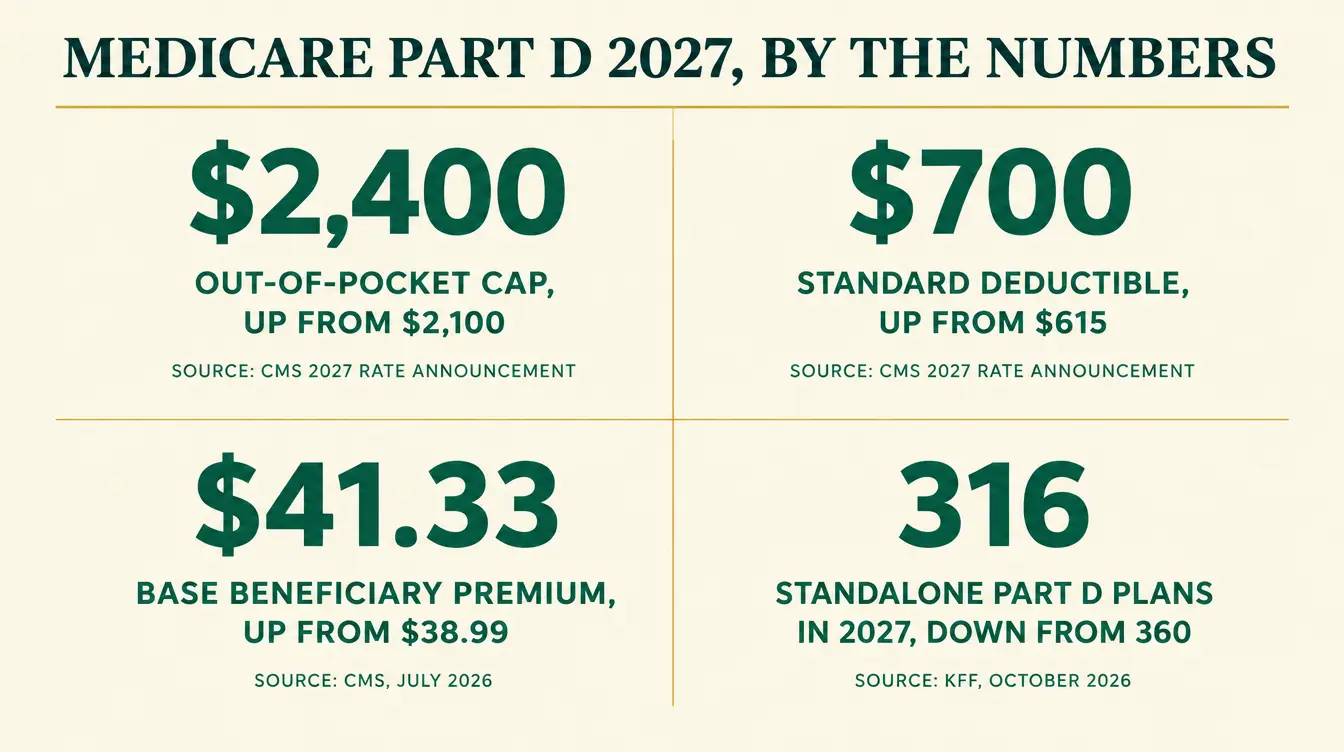
$2,400
2027 Part D out-of-pocket cap (CMS Rate Announcement)
$700
2027 standard deductible, up from $615
53d
From Oct 15 to the Dec 7 AEP deadline
4M
Non-LIS enrollees losing a $0-premium PDP for 2027 (KFF)
None of these figures tell you what any one of your actual clients owes. What they tell you is that the spread between “this client is fine” and “this client’s costs just jumped triple digits a year” is wide enough that guessing, or mailing everyone the same generic renewal reminder, misses both ends.
How to Fix It: Prioritize the Book, Then Call It, Before December 7
This is the part that does not require buying anything. It requires a spreadsheet, the ANOC data you likely already have access to through your agency management system or carrier portals, and enough calling hours to get through a sorted list before December 7.
Step 1: Pull every current Part D and MA-PD client into one list. Not just this year’s new enrollments, your whole active book. The clients most at risk of a bad outcome are the ones who have been in the same plan for multiple years and are the most likely to assume nothing changed.
Step 2: Tag each client by plan. You almost certainly already know which specific PDP or MA-PD plan each client holds. Cross-reference that plan against whatever carrier-level premium and formulary change notices you have received, or against the client’s own ANOC once it arrives.
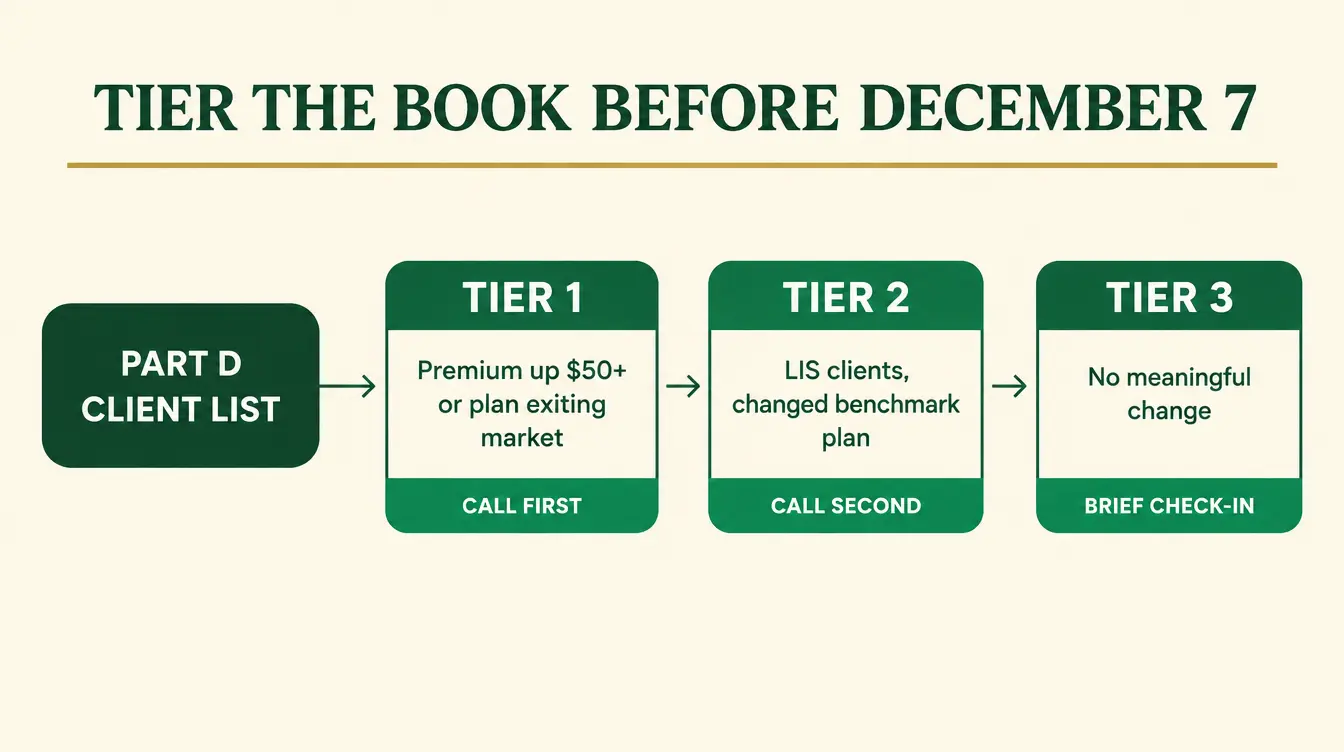
Step 3: Sort into three tiers, not a flat list. Tier one: clients in a plan facing a meaningful premium increase (use $50 a year or more as your working threshold, since that is roughly where KFF’s data shows real swings start) or whose plan is exiting the market. Tier two: LIS clients whose benchmark plan status changed, even if their premium itself is protected, because a bad auto-reassignment can still break their pharmacy network or drug tiers. Tier three: everyone else, who likely needs nothing more than a brief courtesy check-in.
Step 4: Call tier one first, every single one, before touching anything else. This is the list where a missed call has the highest chance of costing the client real money or costing you the relationship when they find out in February that nobody told them.
Step 5: Keep the call itself short and honest. Tell them what changed in their specific plan, not the industry in general. Ask if they want a quick review of whether it is still their best option, or whether their drug list or pharmacy changed enough to make a different plan worth a look. Do not promise a dollar savings figure before you have actually run their drugs through a comparison; that promise is the kind of claim that gets agents in trouble separately from anything in this piece.
Step 6: Document the call the way you already have to. A Scope of Appointment before any specific plan discussion, the verbal TPMO disclaimer before benefits come up, and a retained recording. CMS’s current rules on exactly how and when to deliver each of those are covered in full in the CMS 2027 marketing rules piece; nothing about the Part D parameter changes in this piece changes those separate requirements.
A Short, Honest Call Script
This is close to word for word what the call in step 5 should sound like once you have the client’s specific plan and dollar change in front of you. It is not a Scope of Appointment or a disclaimer script; it is the conversation after those pieces are in place.
“Hi, this is [agent name] with [agency]. I’m calling about your [plan name] drug plan, nothing’s wrong, I just want to flag something before your plan renews on January 1st. For 2027, your specific plan’s premium is changing by about [$X] a [month/year], and Medicare’s own out-of-pocket cap for everyone is moving to $2,400. I don’t know yet whether your plan is still your best option or not; I’d want to actually run your current drug list against it to say that honestly. Do you have about ten minutes in the next week or two for me to take a real look and tell you what I find, one way or the other?”
Notice what that script does not do. It does not promise a savings number before anyone has checked. It does not say “your plan got worse,” because for a meaningful share of clients it didn’t. It gives the client the one fact that matters to them, their own premium direction, and offers a specific, time-bound next step instead of a vague “call us if you have questions” that most people file away and never act on.
You can run this entire method with a spreadsheet and your own phone
Nothing in the six steps above requires new software or a vendor. An agency with a clean book export and a few calling hours a day between now and December 7 can tier and call its entire Part D and MA-PD book using exactly this method. The actual constraint most agencies hit is not the method. It is that a book of 400 or 1,000 clients, sorted into a real tier-one list, is more dials than one or two humans can finish before the deadline on top of everything else AEP already demands.
Where TheAffordableAI Fits, and Where It Doesn’t
Be precise about what changes here. The tiering and the honest, short call script above work with or without us, and plenty of smaller books should just run them directly. Where a managed AI caller changes the math is pure volume against a fixed deadline: tier one on a 600-client book might be 80 to 150 calls that all need to happen in the same three-week window, alongside new-lead follow-up that cannot wait either.
Outbound calling that can run your whole tier-one list
The AI caller dials the prioritized list you build in the method above, at volume, without taking a human off new-lead follow-up to do it.
Warm transfer when a client wants the review
A client who says yes to a plan review gets handed to a licensed agent on the same call, against real calendar availability, rather than a callback that competes with everything else in your queue.
SOA, disclosure, and recording captured on every call
The required Scope of Appointment, verbal TPMO disclaimer timing, and call retention are built into the call flow as required steps, not a dropdown a rushed agent can skip during a 150-call week.
Number warmup so a high-volume push doesn't get flagged
Calling a large tier-one list in a short window is exactly the dialing pattern that triggers spam labeling on an outbound number; warmup and spam defense run as a standing routine, not an afterthought.
No contract, cancel anytime
Single Account runs $200/mo plus a $500 one-time setup at $0.20/min; Agency runs $500/mo plus a $1,000 one-time setup at $0.18/min, dropping to $0.16 at bulk. Price a few weeks of tier-one calling against what a $50-to-$100 surprise, discovered in February, costs the relationship.
If you want to hear what an actual outbound call like this sounds like before deciding anything, there is a live demo on the homepage. https://theaffordableai.com/
What You Actually Get
A tier-one list that gets called before December 7 instead of discovered as a complaint in February. A client who hears about their own plan’s real change from you, in a two-minute call, instead of from a bank statement or a pharmacy counter. A documented record of the Scope of Appointment, disclosure, and the call itself, the same records CMS already expects you to keep, now actually complete across a list too large for one person to dial by hand. None of that guarantees a client switches plans, stays with you, or that any specific dollar amount gets saved; it guarantees the conversation happens instead of not happening.
Unworked Book vs. Tiered and Called
Auto-renewal decides for them
- Clients find out their premium changed from a bank statement, not from you
- A plan that exited the market gets replaced by a CMS reassignment nobody reviewed
- The clients facing the biggest swing and the ones facing none get the same generic reminder, or nothing
- Complaints and lost clients show up in February and March, after the window to fix anything has closed
Prioritized outreach before the deadline
- The clients facing a real swing or a market-exit plan get called first and specifically
- LIS clients with a changed benchmark status get a check before a bad auto-reassignment lands
- The call is short, honest, and documented the way CMS already requires
- Nothing promises a dollar outcome; the client gets the information and the offer of a review while there is still time to act on it
A Worked Example: 600 Clients, Three Weeks
Picture an agency with 600 active Part D and MA-PD clients heading into the second week of November. Sorting the book against known plan premium changes puts 95 clients in tier one, 140 in tier two, and the rest in tier three. One agent working alone, at a realistic 25 outbound dials a day between everything else AEP already demands, needs about four full days just to reach tier one once, with no room for the voicemails, callbacks, and no-answers that any real calling list produces. Tier two and tier three do not get touched at all before December 7 at that pace.
Running the same 95-client tier one through an AI caller at volume alongside the human team, with warm transfer booking the clients who say yes to a review, gets a first-touch attempt to all 95 inside the first week, with the humans freed up to take the warm transfers and handle the plan comparisons themselves. Tier two, the 140 LIS and benchmark-status clients, becomes reachable in the second week instead of never. The deadline does not move either way. What changes is how much of the actual book gets a real conversation before it does.
Where This Is the Wrong Tool
None of this fixes a book where the underlying problem is that nobody has accurate plan data for half the clients in it, or where the agency’s real gap is new-lead follow-up during AEP, which is a different and arguably bigger problem covered in the AEP call-surge piece. If your book is small enough that one agent can realistically call every tier-one client twice before December 7 without AI involved, do that; the per-minute cost of outbound calling on a 20-client tier-one list is not worth setting up a new tool for. And if your clients are overwhelmingly LIS with benchmark plans that did not change status for 2027, the premium story in this piece barely touches them, and the honest answer is that a courtesy postcard covers most of what they need.
A client does not find out their premium changed from the CMS Rate Announcement. They find out from a bank statement, unless you call first.
Mike MooreUsing AI does not transfer this responsibility away from you
Prior express written consent for automated or prerecorded calls and texts to a cell phone, clear disclosure, and immediate honoring of opt-outs remain the agent's obligation under the Telephone Consumer Protection Act, and that obligation does not transfer to a vendor or a piece of software. For Medicare Advantage and Part D outreach specifically, the Scope of Appointment, the verbal TPMO disclaimer, and the call-recording retention rules under 42 CFR 422.2267 and 422.2274 apply to this kind of plan-review call exactly as they apply to a new-lead sales call, detailed in the CMS 2027 marketing rules piece. TheAffordableAI is a private technology company, not an insurance agency, a carrier, or a government entity, and nothing here is insurance, tax, or legal advice. Confirm your own obligations with your compliance counsel before running a large-scale outreach push.
Get your tier-one list called before December 7
See what it costs to run your highest-swing Part D clients through a managed AI caller for the next few weeks, with warm transfer to a licensed agent the moment someone says yes to a review. No contract either way, so trying it is a few weeks of risk, not a season.
The CMS Rate Announcement already happened. The plan exits already happened. The only variable left before December 7 is whether your book hears about any of it from you, or finds out the hard way in February.
Frequently asked
What is the 2027 Medicare Part D out-of-pocket cap, and how much did it go up?
$2,400. CMS's final CY 2027 Medicare Advantage and Part D Rate Announcement, published April 6, 2026, sets the annual out-of-pocket threshold at $2,400 for 2027, up from $2,100 in 2026 (Table V-2 and Table V-6). That 2026 figure was itself up from the $2,000 cap that took effect in 2025, the first year of the Inflation Reduction Act's redesigned Part D benefit. The cap is indexed to Part D cost growth each year, not fixed, so it will keep moving.
What is the 2027 Part D deductible?
$700, up from $615 in 2026, per the same CMS Rate Announcement (Table V-2 and Table V-6). KFF's October 30, 2026 analysis of the 2027 landscape puts the weighted average deductible actually charged, after accounting for plans that set a lower deductible, at $643 for standalone prescription drug plan (PDP) enrollees and $489 for Medicare Advantage drug plan (MA-PD) enrollees. The $700 figure is the statutory maximum a plan can charge, not what every client pays.
Why are some clients' Part D premiums jumping so much more than others?
Because CMS ended the Part D Premium Stabilization Demonstration a year early. Per CMS's July 28, 2026 fact sheet, the demonstration applied a $15 direct subsidy to every participating plan's base premium calculation and capped any plan's year-over-year total premium increase at $35, through the end of CY 2026. CMS is discontinuing it after that, stating that plan sponsors now have sufficient experience pricing CY 2027 bids without it. KFF's October 2, 2026 analysis of the resulting 2027 landscape found swings by plan and state: AARP Medicare Rx Preferred rises $50 or more in every state and DC, over $75 in 37 states, and over $100 in 4 states, while Wellcare Value Script actually drops for non-subsidized enrollees in 29 states. There is no single number that applies to every client; it depends on which plan they are in and which state they live in.
Does this affect clients who get Medicare's Low-Income Subsidy (LIS)?
Differently, and mostly through plan availability rather than premium. LIS enrollees are shielded from most premium increases by the subsidy itself. What changes for them is which plans qualify as $0-premium 'benchmark' plans in their region for 2027, because KFF's October 2, 2026 analysis found the number of standalone PDPs nationally is dropping from 360 plans across 17 parent organizations in 2026 to 316 plans across 15 parent organizations in 2027. An LIS client whose current plan drops out of benchmark status, or exits the market entirely, gets reassigned by CMS to a different $0-premium plan if they do not pick one themselves, and a reassignment is not guaranteed to keep their current drugs on the same tier or their current pharmacy in network.
Does any of this apply to Medicare Advantage clients, not just standalone Part D plans?
Only through the drug coverage bundled into their plan, and the effect is smaller. KFF's October 2, 2026 analysis found 56% of all Part D enrollees were already in Medicare Advantage drug plans (MA-PD) in 2026, and that share is still growing for 2027. KFF's October 30, 2026 companion analysis projects the average premium for the drug portion of an MA-PD plan at roughly $9 a month in 2027, far below the standalone PDP average, because the plan's overall bid, not just the drug formula, sets the premium. The $700 deductible and $2,400 out-of-pocket cap are the same statutory numbers either way; what differs is how much of the premium swing from ending the stabilization demonstration actually reaches an MA-PD client, which is less than a PDP-only client in most cases.
What is the real deadline, and did it move for 2027?
No, it did not move. The Annual Enrollment Period (called the annual coordinated election period in the regulation) runs October 15 through December 7 every year under 42 CFR 422.62(a)(2), a date fixed since 2011, confirmed on Medicare.gov's own enrollment-period page. What changed is not the calendar. It is how many of your existing clients actually need a conversation before that date closes, because a premium increase of $50 to $100-plus a year, or a plan that quietly dropped out of the market, is not something most clients will notice or act on themselves before their current plan auto-renews on January 1.
Can an AI voice agent legally make these outreach calls to an existing book of Medicare clients?
The mechanics can be built to handle the call correctly, but the legal responsibility never moves. A call to an existing client about their current Part D or MA-PD plan still needs the Scope of Appointment, the verbal TPMO disclaimer before any benefit is discussed, and the retained recording that 42 CFR 422.2267 and 422.2274 require, details covered in full in the CMS 2027 marketing rules piece linked below. An AI caller can be configured to capture all of that consistently on every call, including the three-hundredth call of the week, which is exactly where a rushed human workflow tends to skip a step. None of that transfers the underlying compliance or advice obligation away from the licensed agent of record.
What should an agency actually do with this information before December 7?
Pull the book, sort it, and start dialing the highest-dollar-swing clients first. The full method, with no software required to start, is laid out step by step further down this piece: segment every current Part D and MA-PD client by premium change and plan status, prioritize anyone facing a swing of $50 or more or a plan that exited the market, and run a short, honest call that tells them what changed and offers a review, documented the way CMS already requires.
Sources
- CMS — Final CY 2027 Medicare Advantage and Part D Rate Announcement, April 6, 2026 (Table V-2 and Table V-6: Part D standard deductible $615 to $700, out-of-pocket threshold $2,100 to $2,400)
- CMS — Fact Sheet: Medicare Part D 2027 National Average Monthly Bid Amount Information, July 28, 2026 (NAMBA $296.05, base beneficiary premium $41.33, de minimis $2, Premium Stabilization Demonstration discontinued after CY 2026)
- KFF — Many Medicare Part D Stand-Alone Drug Plan Enrollees Will See Modest Premium Increases for 2027, But Others Could Pay Much More If They Don't Switch Plans, October 2, 2026
- KFF — Medicare Part D Premiums and Cost Sharing in 2027, October 30, 2026
- Medicare.gov — Joining a Health or Drug Plan (Annual Enrollment Period October 15 to December 7; Medicare Advantage Open Enrollment Period January 1 to March 31)
- KFF — Changes to Medicare Part D in 2024 and 2025 Under the Inflation Reduction Act and How Enrollees Will Benefit (deductible phase, 25% initial coverage coinsurance, and catastrophic phase structure)
- Cornell Law School Legal Information Institute — 42 CFR 422.62, Election periods (annual coordinated election period, subsection (a)(2))
- TheAffordableAI — Pricing (verified November 4, 2026)
- TheAffordableAI — Features
Put this on your own phone line
See the AI dial, qualify, and warm-transfer a live call in under a minute. No contract, no dev work.
Keep reading

CMS 2027 Medicare Rules: The 48-Hour Wait Is Gone
CMS eliminated the 48-hour Scope of Appointment wait, changed the TPMO disclaimer timing, and cut call retention to 6 years ahead of AEP 2027.

Surviving Medicare AEP 2026 Without a Seasonal Hire
Medicare AEP runs October 15 to December 7. Real math on staffing that window without hiring and licensing seasonal reps you don't have time for.

Medicare Advantage Forced Disenrollment: 2027 Agent Guide
1 in 10 Medicare Advantage members lost their plan in 2026, per a JAMA study. Here's what the 2027 exits mean and how to work the list fast.