TCPA Revoke-All Rule 2026: What the FCC Just Adopted
The FCC adopted a new TCPA revocation order on September 30, 2026, months ahead of the 2027 deadline. Here is what changed for insurance agents.

The rule everyone had been planning around for eighteen months is not the rule that shipped. On September 30, 2026, the FCC voted at its Open Meeting to adopt the Report and Order it had circulated on September 9, rewriting the TCPA’s “revoke-all” consent rule, the one insurance agencies were told to prepare for by January 31, 2027, and replacing it with something narrower, faster, and structured differently, according to Tech Times’ same-day report on the meeting and a client alert Mac Murray & Shuster LLP published the next morning.
This was not a delay. It is a different rule, with a different shape, arriving on a different schedule, and most of what agencies read about the “revoke-all” rule over the past year, including an earlier version of this article written before the vote, described a version of the rule the FCC has now moved away from. Here is what the adopted order actually does, what’s still settled law today while everyone waits on a Federal Register date, and what to do with both.
The short version
- On September 30, 2026, the FCC adopted the Report and Order and Further Notice of Proposed Rulemaking it had circulated on September 9 under CG Docket No. 02-278 (draft FCC-CIRC 2609-05), replacing the cross-topic "revoke-all" approach before it ever took effect.
- The order lets a business designate one exclusive opt-out method, something the current rule explicitly forbids, and narrows an informational-message opt-out to the specific category it responds to, while leaving marketing opt-outs broad.
- The new rule takes effect 30 days after Federal Register publication, which had not happened as of October 2, 2026, but will land well before the January 31, 2027 date attached to the old approach.
- None of this changes what's already required right now: any-reasonable-means revocation, a 10-business-day compliance window, and cross-channel honoring on the same subject matter have been in effect since April 11, 2025, and stay in effect until the new rule's Federal Register date arrives.
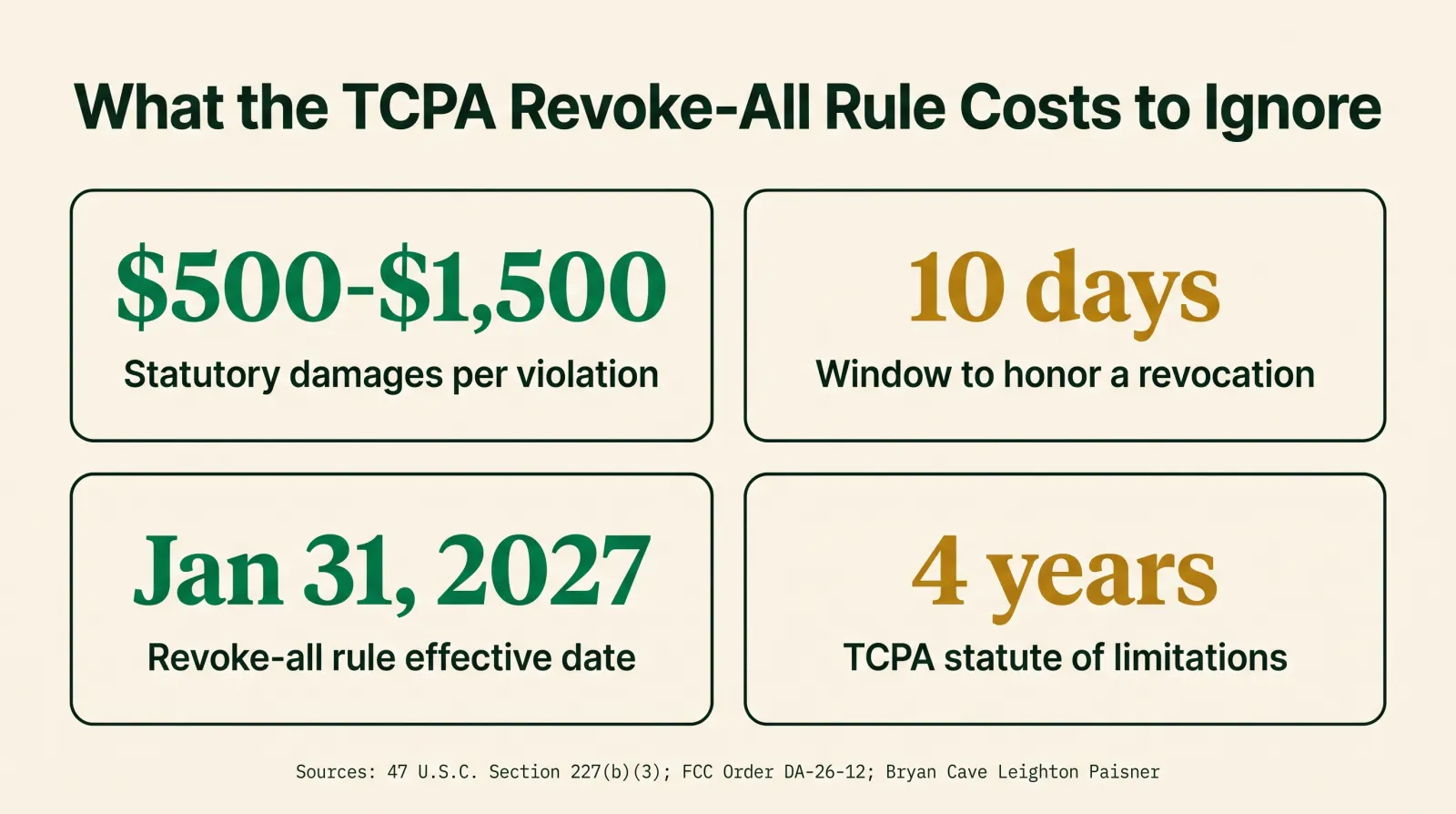
- A single non-compliant call or text still carries $500 to $1,500 in statutory damages under 47 U.S.C. Section 227(b)(3), whether the rule changes again or not.
What the FCC’s September 30 order actually does
The order the Commission adopted pairs a Report and Order with a Further Notice of Proposed Rulemaking, a combination the FCC uses when it wants to finalize part of a policy while asking for public comment on what else might need to change. Two things in it matter directly to how an insurance agency runs its follow-up calls and texts.
Informational opt-outs get narrower, not broader. Right now, the piece of the 2024 order already in effect links a revocation across channels on the same subject matter: a text opt-out and a call opt-out about the same product are already treated as one revocation. What was still coming, on the original 2027 timeline, was extending that link across every unrelated product and campaign. The adopted order takes informational, non-marketing messages, payment reminders, appointment confirmations, service alerts, in a different direction: a revocation now applies only to the specific category of informational message it responds to, not to every informational message a business sends, per Tech Times’ report on the adopted text. Marketing and telemarketing opt-outs are not changed by this piece; a single revocation there still cancels all future marketing contact from that caller.
Callers can finally pick one exclusive opt-out channel. This is the bigger operational change for anyone running automated dialing and texting. Since April 11, 2025, a business has not been allowed to tell a consumer there is only one valid way to opt out; any reasonable method counts, and the FCC put the burden on the business to show otherwise. The new order lets a caller designate a single exclusive method instead, an automated interactive voice or key-press option on calls, a defined set of text-reply keywords such as stop, quit, end, revoke, opt out, cancel, or unsubscribe, or a designated website or phone number, as long as it’s clearly and conspicuously disclosed. Once designated, the business will not have to process a revocation made through any other channel, once the order’s Federal Register effective date arrives, not before.
A financial-institution fraud-alert exemption got wider too. The adopted order also expands the existing TCPA exemption that lets financial institutions send fraud, identity-theft, and security-breach alerts without prior consent. That exemption used to cover only numbers a customer gave the institution directly. Under the new order it extends to numbers from what the order calls “reliable sources”: a number supplied by a spouse or other authorized family member on the account, a number captured from caller ID when the customer called in, or a number obtained from another financial institution’s records, per Tech Times’ reporting. This piece is not aimed at insurance agents, but it shows the Commission moved on more than the headline opt-out issue in the same order.
Terms worth knowing
Report and Order (R&O): the FCC document that adopts a final rule after a rulemaking process. Further Notice of Proposed Rulemaking (FNPRM): a companion document seeking public comment on additional changes the Commission is still considering, separate from what the R&O adopts. Cross-topic revocation: treating an opt-out from one subject matter as canceling consent for unrelated subjects from the same caller, the original "revoke-all" concept. CG Docket No. 02-278: the FCC's long-running docket for TCPA rulemaking, the same docket this and the underlying 2024 order both live in.
This is now the settled outcome, not a draft anyone can still comment their way out of. The FCC moved this timeline twice before adopting the new approach outright, and a vote at an Open Meeting is a real, binding Commission action, not a signal of intent. What’s still pending is the paperwork: the full adopted order text and a Federal Register publication date, both of which determine exactly when the new rule starts applying.
The rule everyone planned for was a single STOP silencing every campaign. The rule the FCC actually adopted does something closer to the opposite: it narrows the automatic linkage and lets businesses pick one clear channel instead.
Mike MooreThe FNPRM half: what’s still just a question
The order doesn’t only tighten things in the industry’s favor. The Further Notice half opened a new comment period on ideas that would go the other direction: shortening the current 10-business-day window a business has to honor a revocation, requiring businesses running one-way texting platforms to support two-way replies so a consumer’s STOP actually gets acknowledged, creating a mandatory universal “revoke everything at once” option regardless of what a business’s own designated channel is, and clarifying how a revocation should travel across affiliated businesses and brands operating under a shared parent. None of that is adopted yet, and an FNPRM can sit open for a long time before anything comes of it. It’s worth tracking anyway, because it shows the Commission isn’t done shaping this area even after finalizing the piece it just adopted.
The timeline, updated
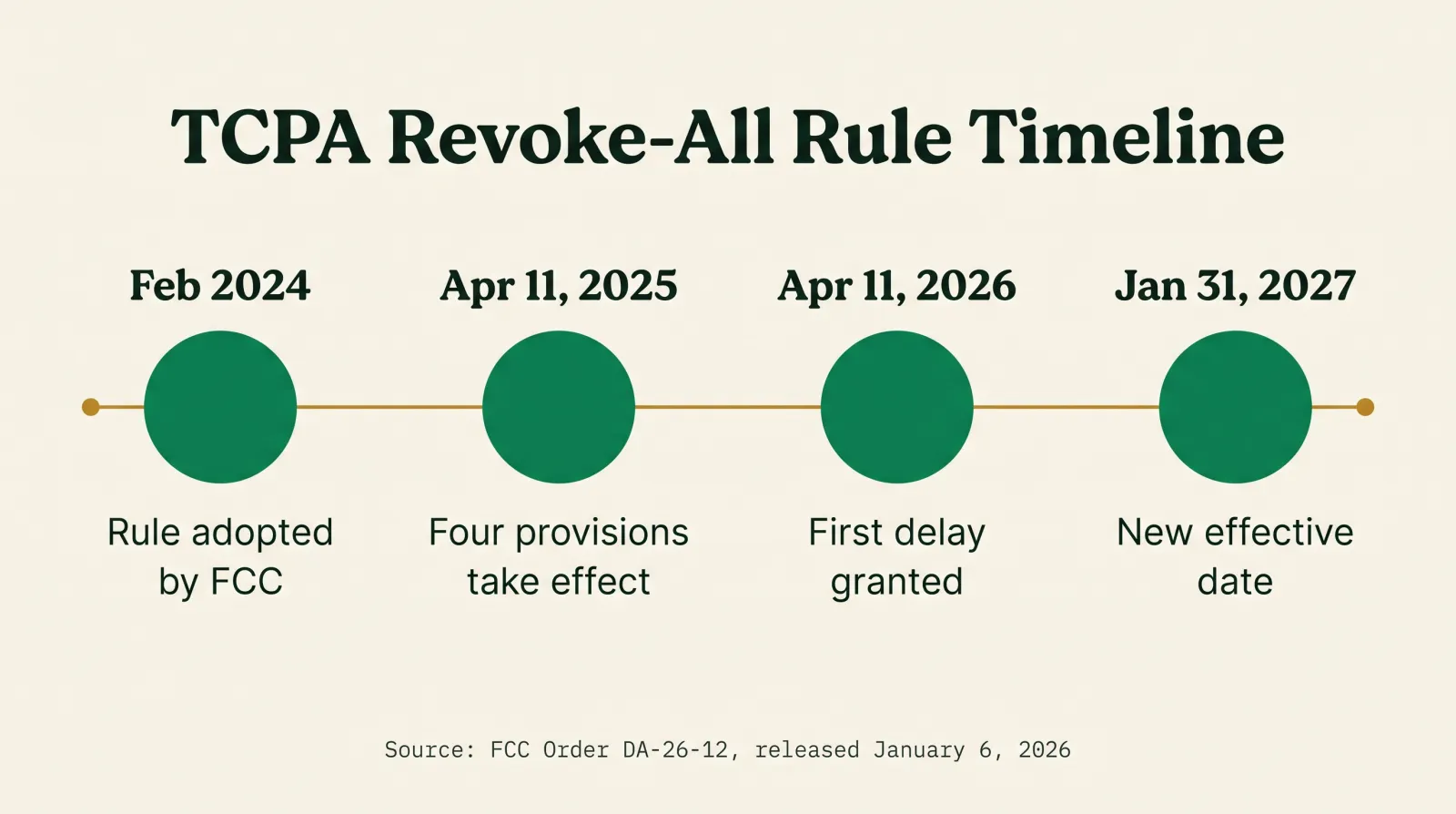
| Date | Event |
|---|---|
| February 2024 | FCC adopts the TCPA Consent Order, including any-reasonable-means revocation, the 10-business-day window, and the cross-topic "revoke-all" provision at 47 CFR Section 64.1200(a)(10) |
| April 11, 2025 | Any-reasonable-means revocation, the 10-business-day window, and cross-channel honoring on the same subject matter take effect; no exclusive opt-out method is allowed |
| First waiver | The FCC's Consumer and Governmental Affairs Bureau delays only the cross-topic revoke-all provision to April 11, 2026 |
| January 6, 2026 | FCC Order DA-26-12 grants a second waiver, moving the cross-topic provision's target date to January 31, 2027 |
| September 9, 2026 | FCC circulates draft FCC-CIRC 2609-05, a Report and Order and FNPRM narrowing informational-message opt-outs and permitting an exclusive opt-out channel, designed to supersede the 2027 approach |
| September 30, 2026 | FCC adopts the order at its Open Meeting, largely as circulated, per Tech Times and Mac Murray & Shuster LLP |
| October 2, 2026 (as of this writing) | Full adopted order text and Federal Register publication date not yet released; new rule takes effect 30 days after that publication |
Three shifts in under two years is worth reading plainly: the FCC kept deciding the original cross-topic “revoke-all” concept, in the form it was written, didn’t fit how businesses and platforms actually operate. Twice it bought time with a delay. The third time, it changed the substance instead and adopted the replacement.
What already applies today, while everyone waits on a Federal Register date
This is the part that gets lost every time there’s new FCC news, and it hasn’t changed through any of the drafts, delays, or the September 30 adoption. Four things have been the law since April 11, 2025, right now, and they stay the law until the new order’s Federal Register effective date actually arrives.
Any reasonable means, for now. A business cannot currently tell a consumer the only way to opt out is one specific channel. A consumer can revoke however they reasonably choose: replying STOP, QUIT, END, REVOKE, OPT-OUT, CANCEL, or UNSUBSCRIBE to a text; saying “stop calling me” on a call; leaving a voicemail; or emailing an address the business actually monitors, per Bryan Cave Leighton Paisner’s summary of the rule. The September 30 order changes this, but only once it’s published and its 30-day clock runs out; until then, an exclusive channel is not enforceable.
A 10-business-day window. Once a revocation request comes in, current law gives you no more than ten business days to stop. Treat that as the outer edge, not a target, especially with an FNPRM already asking whether that window should shrink further.
Cross-channel honoring, same subject matter. If a lead revokes consent for texts about a specific product, that revocation already has to be honored for calls about that same product too, and vice versa. What changes under the September 30 order is how far a revocation reaches beyond that one subject, not whether the same-subject, cross-channel piece applies; that part stays in force regardless.
No CRM feature does this for you automatically. HighLevel’s own support documentation describes its automatic opt-out messaging as a setting controlled per sub-account, per location, not something that propagates account-wide. That’s a useful disclosure tool. It is not the same thing as a revocation automatically reaching every campaign your agency runs, especially if Medicare, life, and P&C sit in separate sub-accounts.
| Question | In effect today | Under the adopted order, once effective |
|---|---|---|
| Can a business require one exclusive opt-out method? | No; any reasonable method is valid | Yes, one designated and clearly disclosed method |
| Scope of an informational-message opt-out | Same subject matter, cross-channel | Narrowed to the specific informational category |
| Scope of a marketing-message opt-out | Same subject matter, cross-channel | Unchanged; still cancels all future marketing from that caller |
| Cross-topic "revoke-all" across unrelated campaigns | Delayed, target date January 31, 2027 | That approach is superseded; it never takes effect as written |
| Rule status | Current law | Adopted September 30, 2026; awaiting Federal Register publication |
Timing matters for AEP
The order was adopted September 30, 2026. If it publishes in the Federal Register within the following few weeks, a 30-day effective-date clock could put the new opt-out framework in force right around or shortly after the start of Medicare's Annual Enrollment Period on October 15. The exact publication date was not available as of October 2, 2026; publication timing varies. It's a reason to know how your opt-out process actually works now rather than finding out mid-AEP.
What one mistake still costs, regardless of which rule applies
None of the drafting activity changes the penalty for getting an existing rule wrong. Under 47 U.S.C. Section 227(b)(3), a consumer who receives a call or text that violates the TCPA can sue for actual monetary loss or $500 in statutory damages, whichever is greater, and a court has discretion to raise that award to as much as three times that amount, up to $1,500, if it finds the violation was willful or knowing, per Cornell Law School’s Legal Information Institute. That’s per call or per text, not per campaign, and it has nothing to do with whether the contact led to a sale.
Continuing to contact someone after a documented revocation is one of the clearest fact patterns for a willful finding, because the business had actual notice and acted anyway. An agent who keeps a lead in an active dialer after a STOP, because a different campaign in a different sub-account never saw the opt-out, is not a hypothetical. It is the exact seam every version of this rule, adopted or proposed, is aimed at.
Cost of one call or text, done right versus done wrong
Illustrative, built from this article's sourced figures: TheAffordableAI's published Single Account per-minute rate against the federal statutory damages range for one non-compliant automated contact.
Per-minute rate from TheAffordableAI's published pricing, re-verified October 2, 2026. Statutory damages per 47 U.S.C. Section 227(b)(3). This is not legal advice and does not estimate your actual exposure, which depends on your own consent and revocation records.
$500
TCPA statutory damages floor per violation, up to $1,500 if willful
Source: 47 U.S.C. Section 227(b)(3)
Sep 30
2026: date the FCC adopted the new revocation rule at its Open Meeting
Source: Tech Times, Mac Murray & Shuster LLP
3
Exclusive opt-out methods a business may now designate: IVR/keypress, text keywords, or a designated site or number
Source: Tech Times report on the adopted order
10 days
Current maximum window to honor a revocation request, business days
Source: BCLP, effective April 11, 2025
Hear it call a lead
Put your own number in and the AI calls you in seconds, so you can hear what a compliant, disclosed follow-up call actually sounds like before you decide anything about your own setup.
How to get ready, step by step, without buying anything
None of this requires new software before you decide whether it’s worth it. Every step below runs on a CRM you already have and staff you already employ.
- Find out how your CRM actually scopes an opt-out today. Log into each sub-account, campaign, or number you use and manually test whether a STOP in one place is visible in the others. HighLevel’s own documentation confirms its automatic opt-out language is configured per sub-account, a strong hint that revocation tracking may be scoped the same way unless you’ve built a workaround.
- Separate your informational messages from your marketing messages, in your own records, not just in theory. The adopted order treats these two categories differently. If your CRM tags a payment reminder and a marketing drip the same way, you won’t be able to tell which scope applies to a given revocation once the new rule’s effective date arrives.
- Decide now whether you want to designate an exclusive opt-out channel, and don’t implement it yet. The order allows one, but it is not enforceable until its Federal Register effective date passes. Plan which channel you’d choose, most agencies will land on a text-reply keyword set, but wait for that date before telling leads it’s their only valid option.
- Keep your internal SLA well under 10 business days regardless of the Federal Register timeline. That’s the current federal maximum, and the open FNPRM raises the possibility it gets shorter, not longer.
- Log the revocation itself, not just its effect. Keep the date, the channel, the exact language, and which category, informational or marketing, it applied to. That distinction mattered less before September 30; it matters more now that the order is adopted.
- Watch for the Federal Register publication date. That date, not September 30 itself, is what starts the 30-day clock to the new rule’s actual effective date. Nothing in the order is enforceable against you, and nothing new is enforceable by you, until that clock runs out.
You can run all six steps yourself with a CRM export and a disciplined process, and plenty of agencies do exactly that rather than change vendors over it.
The CMS layer stacks on top, separately
If one of your parallel campaigns touches Medicare Advantage or Part D prospects, none of the above replaces CMS’s own marketing rules; it sits alongside them. CMS’s Medicare marketing framework carries its own recording-retention, disclosure, and unsolicited-contact restrictions, independent of the TCPA’s consent and revocation framework, and both apply at once to the same call. The CMS 2027 Medicare marketing rules guide on this site covers that layer in full, and the aged insurance leads guide covers how consent questions interact with an older, already-collected database specifically.
Where TheAffordableAI fits
Building a revocation record that correctly separates informational from marketing contact, by category, the distinction the FCC’s adopted order now turns on, is a CRM-configuration and process decision, and no vendor, including us, makes that decision for you. Where a managed AI caller helps is in what happens once that structure exists: every call TheAffordableAI places gets logged against the lead’s record automatically, including disposition and any opt-out language spoken on the call, and that log syncs natively with HighLevel rather than sitting in a system someone has to reconcile by hand later. That doesn’t remove your obligation to build the categorization correctly. It does mean the calling layer stops being the part most likely to drift out of sync with the rest of your compliance setup, whichever version of the rule ends up in force. The full list of what’s included on every plan is on the features page.
Native HighLevel CRM sync
Every call, disposition, and transcript lands in the CRM automatically, the documentation trail a revocation dispute would ask you to produce.
Multi-calendar intent routing
Route Medicare, life, and P&C conversations to the right calendar and the right licensed agent without merging them into one undifferentiated pipeline.
Warm transfers and auto-booking
A lead that clears your consent and revocation checks gets connected to a licensed agent live, or booked against real calendar availability, instead of parked in a queue.
Agency-plan routing across 20+ agents
For agencies running several lines of business, route calls to the right team without duplicating a compliance setup for every sub-account.
Price it against your own setup
A Single Account runs $200 a month plus a $500 one-time setup fee, at $0.20 a minute, down to $0.15 a minute at bulk volume. An Agency plan runs $500 a month plus a $1,000 one-time setup fee, at $0.18 a minute, down to $0.16 a minute at bulk. No long-term contract either way. See pricing.
If your workflows already live in HighLevel, the GoHighLevel workflow guide on this site walks through building a trigger-to-warm-transfer sync that logs opt-outs the same place everything else lands.
Where this isn’t the right tool, and where a rule change doesn’t help either
It would be dishonest to sell this as a technology fix, because it isn’t one. The hard part of the adopted rule is the decision layer: does your agency want to categorize informational versus marketing contact consistently across every campaign, and does it want to pick one exclusive opt-out channel once the Federal Register date makes that option enforceable. No AI caller, no CRM feature, and no vendor answers those questions for you. They’re compliance and operations decisions that belong to someone who understands your book of business, ideally with input from counsel who has looked at your specific multi-line structure, before any calling platform gets configured around them.
If your agency runs a single line of business through a single system already, you likely don’t need to change much beyond keeping your SLA under the 10-business-day window and watching for the Federal Register publication date. Spending money on new tooling to solve a problem you don’t actually have isn’t a good trade, and it’s worth ruling that out before assuming a bigger system is the answer.
Using AI does not transfer liability
A faster, better-documented way to honor a revocation is a real operational benefit. It is never a transfer of licensing liability. Prior express written consent, disclosure that a caller is an AI where required, Do Not Call compliance, and honoring revocation within the required window are still the responsibility of the licensed agent and agency, whether a human or an AI voice places the call. Medicare campaigns carry CMS's rules on top of all of it, including the TPMO disclaimer and call-recording requirements. An automated caller does not carry any of that responsibility away from you. This is general information, not legal advice; verify current requirements against the FCC's published rules and your own counsel before running a large outbound push.
The rule that would have forced one revocation to silence every unrelated campaign an agency runs was never allowed to take effect. On September 30, 2026, the FCC replaced that idea entirely with a narrower, category-specific framework. What’s enforceable right now, since April 11, 2025, still hasn’t moved and won’t until the new order’s Federal Register date arrives: any-reasonable-means revocation, a 10-business-day window, and cross-channel honoring on the same subject matter. The $500-to-$1,500 statutory exposure for getting any of that wrong applies the same way it always has. Check how your CRM actually scopes an opt-out this month, and start separating informational from marketing contact in your own records now. It’s a smaller project than it sounds like, and it’s the one piece of this story that doesn’t depend on when the Federal Register publishes.
Frequently asked
What is the TCPA revoke-all rule?
It started as a provision inside the FCC's 2024 TCPA Consent Order, at 47 CFR Section 64.1200(a)(10), that would have required a business to treat a consumer's revocation of consent for one type of robocall or robotext as canceling consent for every future robocall or robotext from that same caller, including unrelated products or campaigns. That cross-topic version never took effect. The FCC delayed it twice, most recently to January 31, 2027, then on September 30, 2026 voted to replace it with a narrower, category-specific framework instead of letting the original version take effect at all.
Did the FCC actually change the TCPA revoke-all rule?
Yes. At its September 30, 2026 Open Meeting, the FCC adopted the Report and Order it had circulated on September 9, 2026 (draft FCC-CIRC 2609-05, CG Docket No. 02-278), largely as written, according to Tech Times' same-day report on the meeting and Mac Murray & Shuster LLP's October 1, 2026 client alert. The new rule replaces the cross-topic 'revoke-all' approach that had been scheduled for January 31, 2027.
When does the new rule actually take effect?
Thirty days after it publishes in the Federal Register, per the FCC's own September 9 Fact Sheet and confirmed again in post-adoption reporting. As of this writing, October 2, 2026, the FCC had not yet published the full adopted order text or a Federal Register date, so the exact effective date is not yet set, though it will land well before the old January 31, 2027 deadline.
What's different between opting out of an informational text and a marketing text under the new rule?
Under the adopted rule, revoking consent for an informational message, a payment reminder or appointment alert that isn't advertising, applies only to that specific category of informational message, not to every informational message from that caller. Revoking consent for a marketing or telemarketing message stays broad: a single opt-out from marketing calls or texts still cancels all future marketing contact from that caller. That split is confirmed in Tech Times' report on the adopted order.
Can my agency require leads to opt out through one specific method, like a text reply?
Yes, once the new rule takes effect, but not before. The rule in effect right now, since April 11, 2025, lets a consumer revoke consent through any reasonable means, and a business cannot designate an exclusive channel. The FCC's September 30, 2026 order changes that going forward: a caller will be able to designate one exclusive opt-out method, an automated IVR or keypress option on calls, a specific set of text-reply keywords, or a designated website or phone number, and will not have to honor requests made a different way, as long as the method is clearly and conspicuously disclosed. Until the Federal Register effective date arrives, any-reasonable-means still governs.
What happened to the January 31, 2027 effective date for the revoke-all rule?
It's superseded. The FCC's September 30, 2026 order replaces the cross-topic 'revoke-all' approach that date was attached to before that version ever took effect. The new framework, narrower for informational messages and unchanged for marketing, now runs on its own faster timeline, 30 days after Federal Register publication, instead of the version originally set for January 2027.
What does a TCPA violation actually cost an insurance agency?
Under 47 U.S.C. Section 227(b)(3), per Cornell Law School's Legal Information Institute, a consumer can recover actual monetary loss or $500 in statutory damages per violation, whichever is greater, and a court can raise that to as much as three times that amount, up to $1,500, if it finds the violation was willful or knowing. That's per call or text, not per campaign, and it applies regardless of whether the contact ever led to a sale. The September 30 order doesn't change this exposure at all.
Does using an AI voice agent change any of this liability?
No. Consent, disclosure, honoring revocation, and Do Not Call compliance stay the responsibility of the licensed agent and agency, whether a human or an AI places the call. An AI caller does not carry that responsibility away from you. What a well-built AI calling setup can do is log every disposition, opt-out, and transcript against the CRM automatically, which is exactly the documentation a revocation dispute would ask you to produce.
Sources
- Tech Times — FCC Votes to Replace Blanket Robocall Opt-Out: One STOP Now Halts Only That Message Type (published September 30, 2026, reporting the Open Meeting vote)
- Mac Murray & Shuster LLP — FCC Finalizes New TCPA Revocation Rules (published October 1, 2026)
- Federal Communications Commission, Consumer and Governmental Affairs Bureau — Fact Sheet, draft Report and Order and Further Notice of Proposed Rulemaking on TCPA consent revocation (released September 9, 2026, CG Docket No. 02-278, draft FCC-CIRC 2609-05, adopted at the September 30, 2026 Open Meeting)
- Troutman Pepper Locke — FCC Revises TCPA Revocation of Consent Rules That Were Set to Go Into Effect in January (published September 17, 2026, pre-vote draft analysis)
- Federal Communications Commission, Consumer and Governmental Affairs Bureau — Order DA-26-12 (released January 6, 2026, extending the prior effective date of the cross-topic revocation provision to January 31, 2027)
- Bryan Cave Leighton Paisner (BCLP) — The TCPA's New Opt-Out Rules Take Effect on April 11, 2025
- Cornell Law School Legal Information Institute — 47 U.S.C. Section 227, Telephone Consumer Protection Act
- HighLevel Support — Set Up Automatic Opt-Out and Sender Info Updates in Messaging Compliance
- TheAffordableAI — Pricing (re-verified October 2, 2026)
Put this on your own phone line
See the AI dial, qualify, and warm-transfer a live call in under a minute. No contract, no dev work.
Keep reading

GoHighLevel Insurance Workflows: Trigger to Warm Transfer
Most GoHighLevel insurance workflows stop at 'assign the lead.' Here's the trigger-to-warm-transfer build, GHL's own docs, and where TCPA rules bite.

CMS 2027 Medicare Rules: The 48-Hour Wait Is Gone
CMS eliminated the 48-hour Scope of Appointment wait, changed the TPMO disclaimer timing, and cut call retention to 6 years ahead of AEP 2027.

Aged Insurance Leads in 2026: What's Legal to Call
The FCC's one-to-one consent rule for insurance leads is dead. Here's what changed, what still applies, and how to reactivate an aged database correctly.