A2P 10DLC for Insurance Agents: Why Texts Get Blocked
Unregistered business texts get blocked outright, not delayed. Here's what A2P 10DLC requires, what it costs, and how to register an agency in 2026.

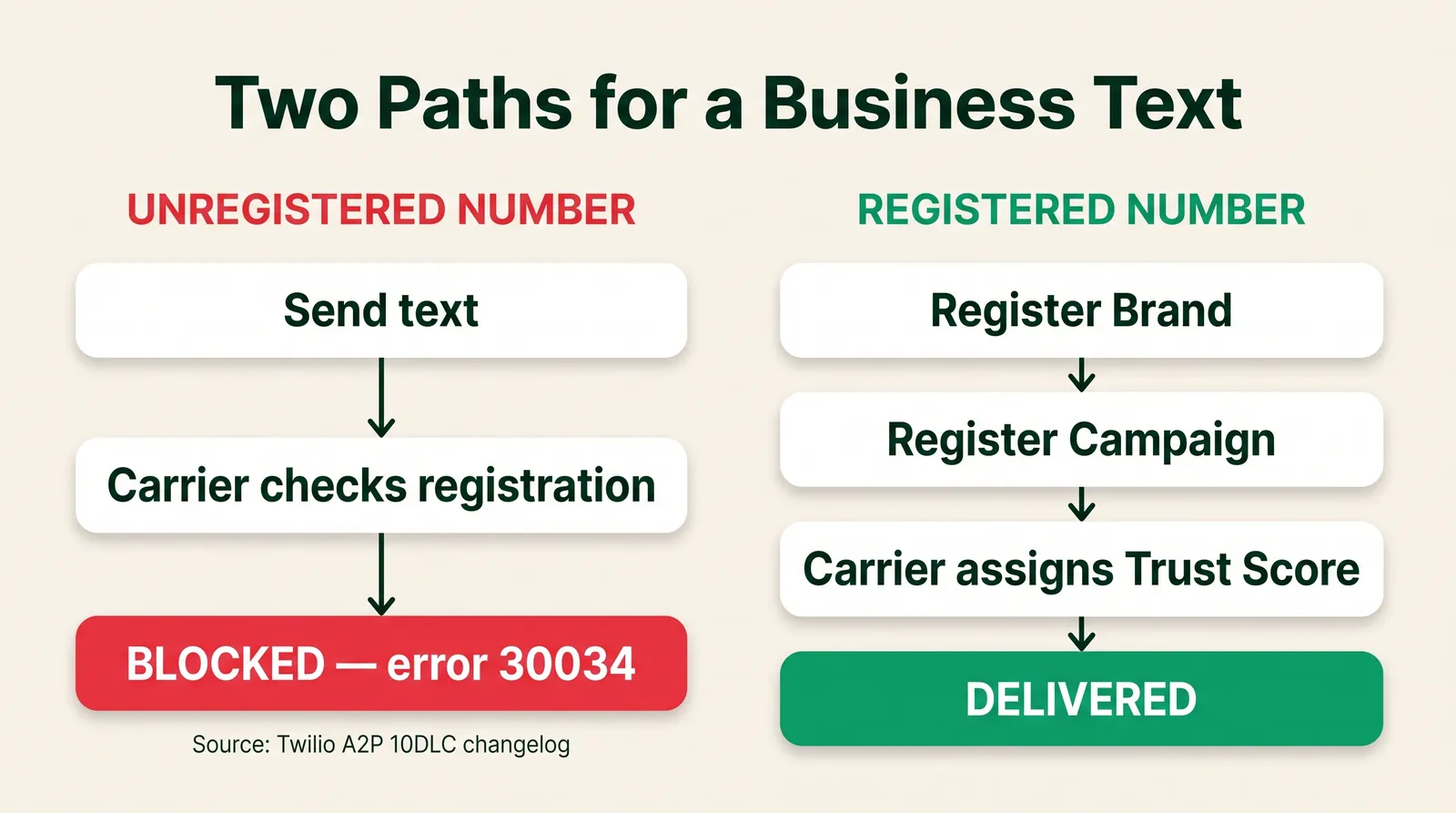
A lead fills out a form, your CRM fires off three follow-up texts over the next two days, and every one of them shows “Sent” in your dashboard. None of them ever reached a phone. That’s not a bad list. It’s very likely A2P 10DLC: the carrier system that decides whether a business text from a standard 10-digit number gets delivered at all, and per Twilio’s own changelog, an unregistered number’s texts to US phones haven’t been merely throttled since September 1, 2023, they’ve been fully blocked, returning error code 30034.
This article works through what A2P 10DLC actually is, why an insurance agency is more exposed to it than most small businesses realize, what it costs in real dollars to register correctly, the exact steps to do it, and where a text is the wrong channel entirely, texting compliance and calling compliance are not the same system, and conflating them is how agencies end up thinking they’ve fixed a problem they’ve only partly touched.
The short version
- Unregistered business texts to US numbers are blocked outright, not slowed down, per Twilio's changelog: full blocking took effect September 1, 2023, returning error code 30034.
- Most CRMs, HighLevel included, will still show a blocked text as "Sent," because the block happens at the carrier, not the platform, so agencies often don't know it's happening.
- Registering a Brand and Campaign runs roughly $24.50 to $71.91 one time plus $1.50 to $10 a month, per HighLevel's own published fee schedule, well under the cost of a single lost policy.
- There's no dedicated "Insurance" use case; a multi-producer agency's closest fit in Twilio's own use-case list is "Agents and Franchises," built for one brand with several agents needing individual numbers.
- A2P 10DLC governs texting only. A phone call, including an AI-placed one, runs through a separate system entirely, so a registered-texting problem and a "Spam Likely" calling problem require two different fixes.
What Is A2P 10DLC, and Why Does It Block Insurance Agents’ Texts?
A2P 10DLC stands for application-to-person messaging sent from a 10-digit long code, meaning an ordinary-looking 10-digit phone number rather than a short code or a toll-free number. Twilio’s own compliance documentation describes the system carriers built around it plainly: verify who is texting, tie the message content to a declared purpose, and use that information to decide how much volume to let through and how hard to filter it. Before this system existed, a 10-digit number could send bulk business texts with essentially no registration, which is exactly what spam operations exploited, and exactly why carriers locked it down.
Two pieces of vocabulary matter before anything else makes sense. A Brand is your business’s registered identity with The Campaign Registry, the third-party organization carriers use to administer this system; it’s built from your legal business information. A Campaign is a declared use case registered under that Brand, describing what kind of messages you send and how recipients agreed to get them, appointment reminders, customer care, marketing, and so on. You register a Brand once, then register one or more Campaigns under it depending on what you actually send.
The part that catches agencies off guard is what happens without either. Per Twilio’s own changelog, enforcement wasn’t a soft rollout: messages from unregistered US 10DLC numbers faced a graduated increase in blocking starting July 5, 2023, and reached full blocking of all unregistered US-bound traffic on September 1, 2023, returning error code 30034, “US A2P 10DLC - Message from an Unregistered Number.” That changelog also notes something worth sitting with: Twilio’s own messaging rates still apply to a blocked message. You can pay to send a text that a carrier throws away before it ever reaches a phone.
A2P 10DLC is not the same system as TCPA consent
Registration and consent solve two different problems, and fixing one does nothing for the other. A2P 10DLC is a carrier delivery requirement: it decides whether a message from your number gets through at all. The Telephone Consumer Protection Act, 47 U.S.C. Section 227, is a legal consent requirement: it decides whether you were allowed to text that specific person in the first place, and per the statute's own language, its prior-express-consent rule explicitly covers "text messaging service" alongside calls. A registered number with no real consent is still a TCPA problem. An agency with airtight consent records and an unregistered number still won't get the text delivered.
Why Insurance Agencies Get Blocked More Than They Realize
Here’s the mechanism that makes this specifically an insurance-agency problem, not just a generic small-business one: agencies text more like a call center than a solo shop, and they’re more likely to be structured in a way the standard registration flow doesn’t obviously match.
Start with volume and cadence. A follow-up sequence for a new lead commonly fires two or three texts inside the first 48 hours, plus renewal reminders, plus open-enrollment blasts on a seasonal cycle. That’s exactly the pattern carrier filtering is built to catch when it comes from an unregistered or poorly matched number, higher volume than a typical person-to-person conversation, sent from a number with no declared use case behind it.
Then there’s structure. Twilio’s own use-case list, pulled directly from its API documentation, has twenty declared categories: things like 2FA, Customer Care, Marketing, Mixed, and a category called Agents and Franchises, defined specifically as “for brands that have multiple agents, franchises or offices in the same brand vertical, but require individual localised numbers per agent/location/office.” Notice what’s missing: there is no dedicated “Insurance” category at all. An agency registering without knowing that list exists typically defaults to “Mixed” or guesses, and a mismatch between your declared use case and what you actually send, mixing appointment reminders with marketing content under a use case that only covers one, is itself a common reason a properly-registered campaign still gets filtered after approval.
There’s a seasonal wrinkle on top of the structural one. Medicare’s Annual Enrollment Period and ACA Open Enrollment both produce the same pattern: weeks of near-zero texting followed by a sudden spike as an agency blasts renewal reminders, plan-change notices, and appointment confirmations to a much larger list than it touches the rest of the year. Per Twilio’s own compliance documentation, throughput and filtering are tied to a Brand’s registered use case and Trust Score, not to a promise that volume will spike in October; a campaign registered under a low-volume category, or never registered at all, hits exactly the kind of sudden-volume pattern carrier filtering is designed to catch, at the worst possible moment for an agency that needs every renewal reminder to land.
The silent-failure part is what makes this worse than most compliance gaps. A blocked call, at least, sometimes shows up as a hangup or a “number not in service” message. A blocked text usually shows “Delivered” or “Sent” in whatever CRM sent it, because the platform’s job ends when it hands the message to the carrier; what the carrier does with it after that isn’t always reported back cleanly. An agency can run an entire follow-up sequence for months, watch cold response rates, and never connect it to registration, because nothing in the dashboard says “blocked.”
What it looks like from inside the CRM
- Every follow-up text shows "Sent" regardless of whether it landed
- No dedicated "Insurance" use case selected; a guess or default is in place
- Multiple producers texting from numbers under one brand, registered as a single generic campaign
- Consent checkbox language that doesn't match what the registered campaign describes
What Twilio's own documentation describes
- A registered Brand, verified against real business information
- A Campaign use case that actually matches what's sent, e.g. "Mixed" or "Agents and Franchises"
- Separate marketing and non-marketing opt-in checkboxes, per HighLevel's own approval guidance
- Carrier-assigned Trust Score determining real throughput instead of a flat, unregistered block
What It Costs to Get This Wrong, and to Get It Right
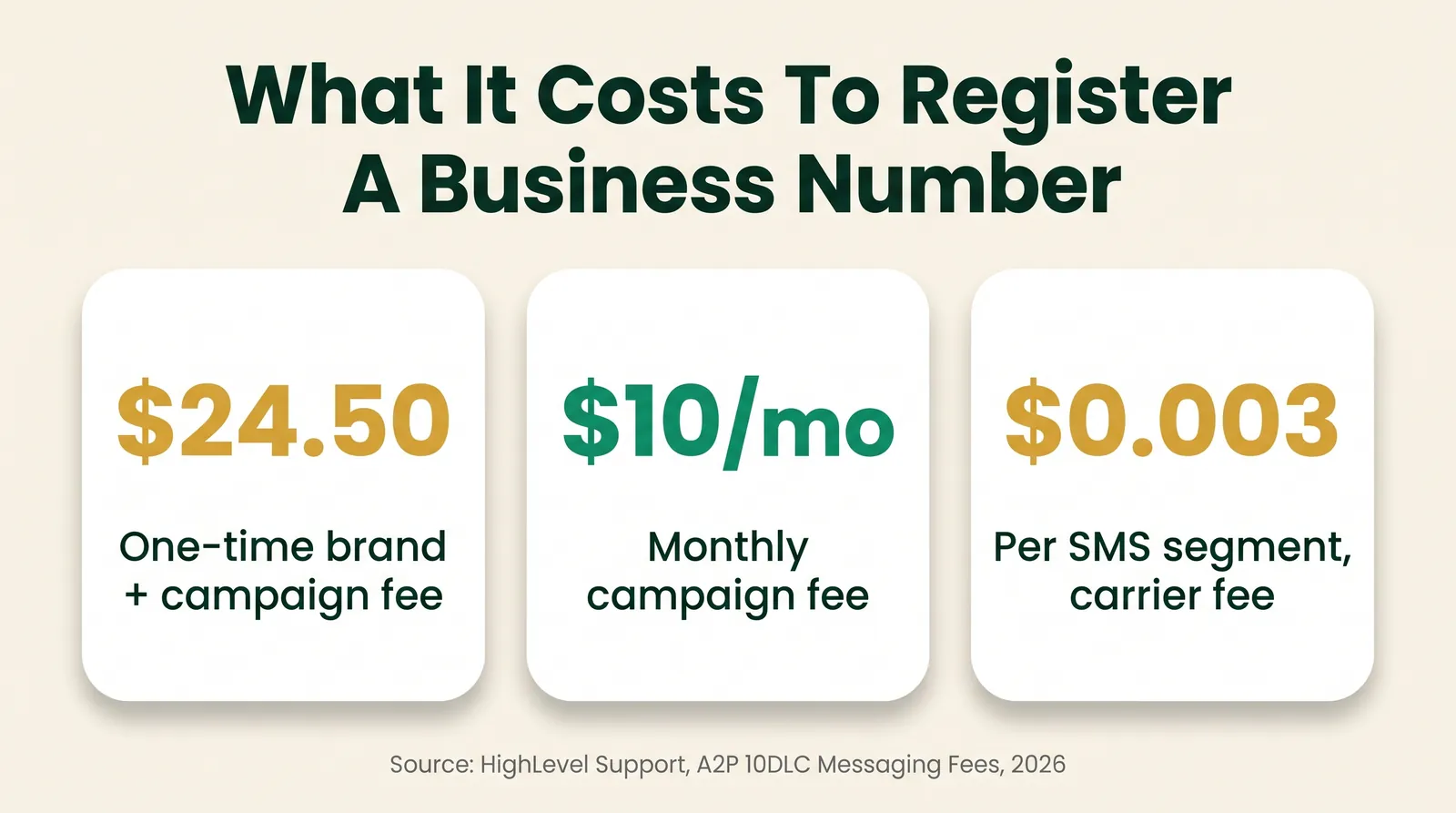
The registration cost itself is not the expensive part; it’s cheap enough that price shouldn’t be the reason an agency skips it. Per HighLevel’s own published fee schedule, which passes through The Campaign Registry’s, Twilio’s, and the carriers’ fees with no HighLevel markup, a Sole Proprietor or Low-Volume Standard brand runs about $24.50 one time, a High-Volume Standard brand runs about $71.91 one time, and each additional campaign registered under a brand costs $15. Monthly campaign fees range from $1.50 for Low Volume Mixed use cases up to $10 for Standard use cases, and carriers add a small per-message fee on top of that, around $0.003 per SMS segment across AT&T, T-Mobile, and Verizon, with MMS running higher and varying by carrier.
| Fee | Amount | When it's charged |
|---|---|---|
| Brand + campaign registration, Sole Proprietor / Low-Volume Standard | ≈ $24.50 | One time, at vetting |
| Brand + campaign registration, High-Volume Standard | ≈ $71.91 | One time, at vetting |
| Each additional campaign | $15.00 | One time per campaign |
| Monthly campaign fee (by use case) | $1.50–$10.00 | Recurring, while active |
| Carrier fee, outbound SMS (AT&T, T-Mobile, Verizon) | $0.003 / segment | Per message sent |
Source: HighLevel Support, "A2P 10DLC Messaging Fees: Registration, Monthly, and Carrier Costs," fetched August 2026. Figures are pass-through charges from The Campaign Registry, Twilio, and mobile carriers; HighLevel states it applies no markup.
What actually costs money is what happens on the other side of a block: nothing. A lead who never got the “here’s your quote comparison” text, the appointment-confirmation text, or the renewal-reminder text doesn’t call to complain that your texts stopped coming. They just don’t show up, and the agency has no direct signal that the reason is a $30-a-month registration gap rather than a bad list, bad timing, or bad offer. That ambiguity is the real cost: an agency can spend months tuning message copy to fix a delivery problem that copy can’t touch.
Registration also isn’t a one-time flat rate regardless of volume; throughput itself is tiered. Per Twilio’s own compliance documentation, a Sole Proprietor brand is capped around 3,000 combined SMS and MMS messages a day across carriers, a Low-Volume Standard brand around 6,000 daily segments, and a Standard brand anywhere from 2,000-plus up to unlimited daily volume depending on its carrier-assigned Trust Score. Separately, Twilio’s changelog on its March 18, 2026 MMS rate-limit update shows exactly how much that score matters: MMS throughput for a standard campaign scales from 5 messages per second per carrier at a Trust Score under 50, up to 20 MPS in the 50-to-74 range, up to 40 MPS at 75 or above, replacing a flat 1 MPS cap that applied to every registered number regardless of trust. Sole Proprietor brands get a fixed 0.5 MPS per number, independent of score.
MMS throughput scales with Trust Score, not with wanting more volume
Messages per second, per carrier, for a Standard-brand MMS campaign, effective March 18, 2026.
Source: Twilio changelog, "Increased MMS rate limits for A2P 10DLC phone numbers in the U.S.," effective March 18, 2026. Figures are for MMS on Standard-brand campaigns and replace a prior flat 1 MPS account-level cap; SMS throughput is governed by a related but separate schedule.
A low Trust Score isn’t a life sentence, and it isn’t assigned by guesswork on your end either; it comes from how completely and accurately your Brand’s business information matches public records when The Campaign Registry checks it, among other signals. An agency that registers with a real EIN, a matching business name and address, and a website that confirms what the brand claims to be tends to score better than one that registers with placeholder details to get it done quickly.
How to Register an Insurance Agency Correctly
Give this the full method, because none of it requires buying anything beyond the registration fees above:
- Register the Brand with real, complete business information. Legal business name, EIN, address, and website all need to match each other and match what’s publicly findable. Mismatches are the most common reason Trust Scores land low even for a legitimate business.
- Pick the Campaign use case that actually matches what you send, not the first option in the list. Per Twilio’s own use-case documentation, most single-location agencies fit “Mixed” for a combination of appointment and account messages, or a narrower category like “Customer Care” if that’s genuinely all you send. A multi-producer agency where each licensed agent texts from their own number under one shared brand should look specifically at “Agents and Franchises,” built for exactly that structure.
- Match your consent language to your campaign description, word for word in spirit. HighLevel’s own approval guidance is specific here: separate opt-in checkboxes for marketing versus non-marketing messages, and a campaign description that aligns with what the checkbox actually says. A campaign registered as “account notifications” that later sends marketing blasts is a mismatch carriers can and do catch after approval, not just at review.
- Put a Privacy Policy and Terms of Service link in your message footer or opt-in flow. This is a stated requirement in HighLevel’s own onboarding checklist for A2P approval, and it’s a five-minute fix if it’s currently missing.
- Register every producer’s number under the right campaign, not as an afterthought. If your agency adds numbers as agents get hired, add each one to the appropriate registered campaign at the same time, rather than letting a new hire’s number quietly run unregistered until someone notices reply rates look off.
- Check for the block, don’t assume the dashboard is telling you the truth. A “Sent” status in your CRM does not confirm carrier delivery. If you have any doubt about an existing setup, send a real test text from the number in question to a phone on each of the three major carriers and confirm it physically arrives, rather than trusting the sent log alone.
- Re-verify after any brand change. A new EIN, a legal name change, a new website domain, anything that touches what the Brand claims to be can affect the Trust Score tied to it. Treat registration as something to revisit, not a box checked once and forgotten.
You can do every one of these steps yourself through HighLevel’s Trust Center or directly through Twilio’s console if you’re not on HighLevel; none of it requires a vendor. It does require someone actually sitting down with the real business paperwork rather than clicking through with placeholder information to get to “approved” fastest.
Registration isn't consent, and consent isn't registration
Getting a Brand and Campaign approved proves to a carrier that your business is who it says it is. It says nothing about whether you had the legal right to text any specific person on your list. Under 47 U.S.C. Section 227, prior express consent is required before sending an automated or marketing text to a cell phone, the same statute that governs automated calls, and that consent obligation belongs to the licensed agent and agency, not to a platform or vendor. A well-registered number sending unconsented marketing texts is fully deliverable and fully illegal at the same time. For Medicare marketing specifically, CMS's separate rules, including the TPMO disclaimer and required disclosures, still apply on top of both of these.
If you want to hear how a compliant, human-sounding call actually goes before you touch any of this on the calling side, there’s a live demo on the homepage; putting your number in gets you one real call, no obligation attached.
A Worked Example: What 90 Days of Unregistered Texting Actually Costs
Run the numbers on a plausible middle-of-the-road agency, using only the fee figures cited above; the lead volume and cadence are illustrative assumptions for the arithmetic, not sourced statistics, so substitute your own before drawing a conclusion for your agency.
Say an agency brings in 25 new leads a week and sends each one a 3-text follow-up sequence over the first week: an instant acknowledgment, a day-two nudge, and a day-five check-in. That’s 75 texts a week, or roughly 975 texts across a 13-week quarter, sent from a number nobody ever registered because the CRM never complained.
The registered path costs, per the fee schedule above, about $24.50 one time for a Sole Proprietor or Low-Volume Standard brand and campaign, plus $1.50 to $10 a month depending on the use case selected, plus roughly $0.003 per SMS segment. At one segment per text, 975 texts costs about $2.93 in carrier fees for the quarter. Total cost for the quarter, registration included: under $60, most of it the one-time fee.
The unregistered path costs the same $0.003 per attempted segment, per Twilio’s own changelog, since messaging rates still apply even to a blocked message. So the agency pays roughly the same $2.93 in attempted-message fees, receives zero delivered follow-up texts, and has no line item anywhere that says “here is what that cost you,” because the cost isn’t a fee, it’s every lead in that quarter who never got a follow-up text they were supposed to receive.
| Path | Direct cost, one quarter | What actually happens |
|---|---|---|
| Registered Brand + Campaign | ≈ $58 (one-time + monthly + carrier fees) | 975 texts attempted; carrier-filtered delivery based on Trust Score, not blocked outright |
| Unregistered number | ≈ $3 (attempted-message carrier fees only) | 975 texts attempted; 0 delivered per Twilio's full-blocking policy, dashboard still shows "Sent" |
Sources: HighLevel Support, A2P 10DLC fee schedule; Twilio changelog, full blocking of unregistered traffic. The 25-leads-a-week volume and 3-text cadence are illustrative assumptions for this arithmetic, not sourced statistics.
The unregistered path looks cheaper on a fee statement and is dramatically more expensive in the only way that matters: every one of those 975 attempted texts did nothing. Registration isn’t a cost center competing with your marketing budget; at these volumes it’s closer to a rounding error next to the value of a single kept appointment.
Where a Managed AI Caller Fits, and Where It Doesn’t
Here’s the part worth being precise about: nothing above is something TheAffordableAI does for you, and it shouldn’t be. Brand and Campaign registration is a texting-specific carrier process; we’re a voice calling platform. What we can tell you, because it’s true of the underlying systems and not a claim about our product specifically, is that A2P 10DLC governs text messaging only. It has no authority over phone calls at all. A call placed to a lead, by a human or by a compliant AI voice agent, runs through an entirely separate set of carrier systems: STIR/SHAKEN for caller ID authentication, and carrier reputation scoring for the “Spam Likely” label, neither of which reads or cares about your texting Trust Score.
That separation matters practically. If your text follow-up sequence is stuck behind an unregistered number while you sort out Brand and Campaign approval, a call isn’t blocked by the same gate. TheAffordableAI’s outbound calling fires the moment a lead is created, and every plan includes number warmup and spam defense as a standing routine, the calling-side equivalent of what A2P registration does for texting; we’ve written separately about how a calling number gets flagged “Spam Likely” and what fixes it, since it’s a genuinely different mechanism from anything in this article.
If your agency is weighing text-based follow-up against getting a call answered live, the missed-call text-back comparison walks through when an automated text actually substitutes for a live answer and when it doesn’t. And the GoHighLevel workflow guide covers wiring a trigger through to a warm transfer for agencies building this on their own CRM.
Calling isn't gated by A2P 10DLC
Outbound and inbound calls run on STIR/SHAKEN and carrier voice-reputation systems, entirely separate from the texting Trust Score described above.
Number warmup and spam defense, built in
A standing routine on every plan, not a one-time setup step, aimed at keeping outbound caller ID from getting mislabeled.
Native HighLevel CRM sync
Call transcripts and dispositions land on the same contact record your texting compliance documentation already lives on.
No contracts either way
Single Account runs $200/mo plus a $500 one-time setup at $0.20/min, down to $0.15 at bulk. Agency runs $500/mo plus a $1,000 setup at $0.18/min, down to $0.16 at bulk. Cancel anytime.
The math above uses $0.20 a minute because that’s what a Single Account costs today; check the current numbers before you budget, since the live page is always the source of truth. And if you’re already running your follow-up through HighLevel, the CRM sync is usually the first thing agencies ask about, worth a look on the how-it-works page or the full feature list before deciding anything.
What You Actually Get
Concretely: text messages that reach a phone instead of disappearing into a carrier’s filter, documented through a real Brand and Campaign registration rather than a guess. A calling channel that keeps working even while a texting registration issue gets sorted out, because the two run on different infrastructure. A contact record, if you’re on HighLevel, where both the call transcripts and the text compliance setup live in one place instead of two systems that don’t talk to each other.
What you don’t get from any of this, registration, calling, or both: a promise that a registered, delivered text converts a lead, or that a warm-transferred call closes a policy. Delivery and consent are the floor, not the outcome. Using an AI voice agent to place a compliant call doesn’t change who’s responsible for the underlying consent either; the licensed agent and agency carry that obligation whether the caller is a person or a well-built AI system, the same way registering a Brand doesn’t create consent it didn’t already have.
A blocked text and a mislabeled call look identical from the outside: silence where a response should be. They are fixed by two completely different systems, and treating them as one problem is how agencies fix half of it and wonder why the numbers didn't move.
Mike MooreWhere This Doesn’t Apply
Be honest about the edges. If your agency already runs everything through a properly configured HighLevel Trust Center, with real business information behind the Brand and a Campaign that matches what you actually send, you don’t have this problem, and nothing here should send you re-registering numbers that are already working. Check the delivery, not the anxiety; a quick real-world test text to a few live phones settles it faster than reading another article about it.
And if your actual bottleneck is response rate, not delivery, meaning texts are landing but nobody’s replying, no amount of A2P registration touches that. That’s a message-content and offer problem, and it deserves its own diagnosis rather than being lumped in with a carrier-filtering issue. The two produce the same symptom, silence, from completely different causes, which is exactly why checking actual delivery before assuming either one is worth the ten minutes it takes.
Compliance disclaimer
Prior express consent is required under the TCPA, 47 U.S.C. Section 227, before sending automated or marketing text messages or placing automated or artificial-voice calls to a cell phone, and that obligation belongs to the licensed agent and agency, not to a platform, vendor, or carrier. A2P 10DLC registration is a separate carrier delivery requirement and does not substitute for consent. Medicare marketing carries CMS's additional rules, including the TPMO disclaimer and required disclosures. Using a registered texting platform or an AI calling system does not transfer compliance liability away from the licensed agent or agency. This article reflects a review of the cited platform documentation and government sources as of the date published and is general information, not legal advice for your specific setup.
Most agencies that hit this either find out the hard way, months of quiet non-delivery before someone finally sends a test text, or they register correctly on day one and never think about it again. The second path costs about the same as a couple of coffee runs and takes an afternoon with your actual business paperwork in front of you. The first path costs every lead who never got a text they were supposed to get.
Hear the calling side while you sort out registration
There's a live demo call on the homepage. Put your number in and hear how it answers, qualifies, and hands off, on a channel A2P 10DLC never touches.
Frequently asked
What is A2P 10DLC and why does it matter for insurance agents?
A2P 10DLC stands for application-to-person messaging over a 10-digit long code, the standard 10-digit phone number most agencies already text from. Twilio's own documentation describes it as the system US carriers built so they can verify who is sending business texts and apply the right spam filtering and throughput to that sender. For an insurance agency it matters because carriers do not throttle unregistered traffic gently; Twilio's changelog confirms unregistered messages to US numbers have been fully blocked, returning error code 30034, since September 1, 2023.
Why are my text messages to leads not going through?
The most common cause for a business texting from a standard 10-digit number is that the number, or the specific campaign it is texting under, was never registered as an A2P 10DLC Brand and Campaign. Per Twilio's own changelog, a message from an unregistered US 10DLC number does not get delayed, it gets blocked outright and returns error code 30034. Most platforms, including HighLevel, will show the message as sent in your dashboard because the platform is not always the party that catches the block; the carrier is.
How much does A2P 10DLC registration cost for an insurance agency on HighLevel?
Per HighLevel's own published fee schedule, a Sole Proprietor or Low-Volume Standard brand's one-time registration runs about $24.50, a High-Volume Standard brand runs about $71.91, and each additional campaign is $15. Monthly campaign fees run from $1.50 to $10 depending on the use case, and carriers charge a small per-message fee on top, around $0.003 per SMS segment across AT&T, T-Mobile, and Verizon. These are pass-through fees set by The Campaign Registry, Twilio, and the carriers, not a HighLevel markup.
What campaign use case should an insurance agency pick when registering?
There is no dedicated 'Insurance' category in Twilio's use case list. Most agencies fit under 'Mixed' or 'Low Volume Mixed' for general account and appointment messaging. If your agency runs multiple licensed producers who each need their own local number under one shared brand, Twilio's own use case list includes 'Agents and Franchises,' defined specifically for a brand with multiple agents, franchises, or offices in the same vertical that need individual localized numbers per agent or office, which maps closely to how a multi-producer agency is actually structured.
Does registering through HighLevel's Trust Center make my agency fully compliant?
It handles the carrier-registration half, not the consent half. HighLevel's own onboarding guidance for getting a number A2P-approved requires separate opt-in checkboxes for marketing versus non-marketing messages, wording in your campaign description that matches your actual consent language, and Privacy Policy and Terms of Service links in your message footer. Registration proves to a carrier that you are who you say you are and text what you said you would; it does not, by itself, create the underlying TCPA consent to text a specific person in the first place.
Does A2P 10DLC affect phone calls too, or only text messages?
A2P 10DLC is specific to application-to-person text messaging over standard 10-digit numbers; it is a carrier messaging-filtering system, separate from STIR/SHAKEN caller ID authentication and separate from the reputation scoring that gets a calling number labeled 'Spam Likely.' A number can be perfectly registered for texting and still get flagged for calling, or vice versa, because different systems govern each channel. That also means a compliant outbound or inbound AI voice call is not gated by a text messaging Trust Score at all.
Is it legal to text insurance leads without their consent?
No, and that has nothing to do with A2P 10DLC. Under 47 U.S.C. Section 227, the Telephone Consumer Protection Act's prior-express-consent requirement for automated calls explicitly extends to text messaging service, a scope Congress wrote into the statute directly. A2P 10DLC registration is a carrier delivery requirement that sits on top of that legal requirement; passing carrier registration does not create consent, and having consent does not exempt you from registering to actually deliver the text.
What happens to texts an agency already sent before registering?
If the number was unregistered, they were most likely blocked at the carrier level and never reached the recipient, not merely delayed and later delivered. Twilio's messaging rates still apply to attempted messages even when they are blocked, per its own changelog, so an unregistered agency can end up paying to send texts that never landed while a CRM dashboard shows them as sent. Registering does not retroactively deliver those messages; it only fixes delivery going forward.
Sources
- Twilio — Changelog: US A2P 10DLC, full blocking of traffic sent from unregistered numbers (effective September 1, 2023)
- Twilio — Programmable Messaging and A2P 10DLC (brand types and daily volume documentation)
- Twilio — Changelog: Increased MMS rate limits for A2P 10DLC phone numbers in the U.S., effective March 18, 2026
- Twilio — A2P 10DLC Use Cases API resource (full use-case list, including Agents and Franchises)
- HighLevel Support — A2P 10DLC Messaging Fees: Registration, Monthly, and Carrier Costs
- HighLevel Support — HighLevel A2P Opt-In Compliance (getting a number A2P-approved)
- Cornell Law School Legal Information Institute — 47 U.S.C. Section 227, Telephone Consumer Protection Act
- TheAffordableAI — Pricing
Put this on your own phone line
See the AI dial, qualify, and warm-transfer a live call in under a minute. No contract, no dev work.
Keep reading

GoHighLevel Insurance Workflows: Trigger to Warm Transfer
Most GoHighLevel insurance workflows stop at 'assign the lead.' Here's the trigger-to-warm-transfer build, GHL's own docs, and where TCPA rules bite.

Missed-Call Text-Back vs AI Answering for Insurance Agents
A missed insurance call doesn't need a text reply, it needs a live answer. Missed-call text-back vs AI phone answering, compared and sourced for 2026.
Why Your Outbound Number Says 'Spam Likely' — and How to Get It Clean Again
A flagged number quietly destroys a calling operation. Nobody tells you it happened; the pickups just stop. Here is what causes the label, how carriers decide, and the warmup routine that keeps a number healthy.