AI Receptionist for Insurance Agencies: The 2026 Cost Guide
An AI receptionist answers every insurance lead call, day and night. Real 2026 pricing against a live answering service and a receptionist's wage, sourced.
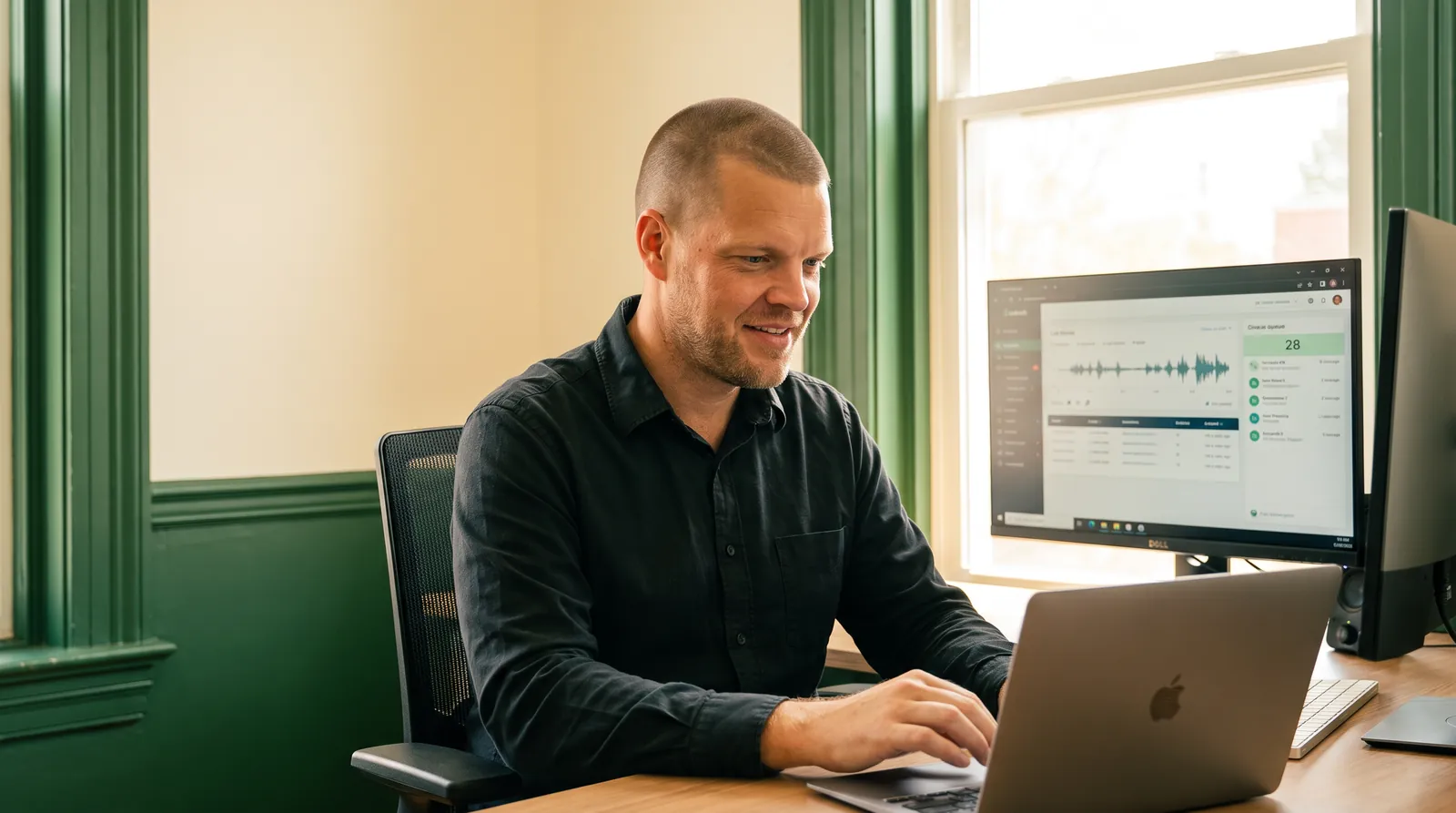
A prospect calls your office number at 11am on a Tuesday because they just got a rate increase notice and want a quote. Your CSR is on another line. It rings four times and drops to voicemail. Most callers in that position don’t leave a message; they hang up and call the next agency on their list. An AI receptionist is software that answers that call instead of voicemail, in a synthesized voice, asks a few qualifying questions, and either books the caller on a real calendar or hands them to a licensed person, and this guide breaks down what one actually costs against a human receptionist, a live answering service, and doing nothing, using pricing every vendor named here published this week.
This isn’t a pitch dressed up as an explainer. There are real situations where a live answering service or a human receptionist is the better call, and this piece says so plainly. What follows is the actual cost math, the compliance questions that come up the moment “AI” and “phone call” appear in the same sentence, and a straight comparison of what’s on the market right now.
The short version
- A median human receptionist costs $37,230 a year in salary alone, per the Bureau of Labor Statistics' 2024 data, before benefits, payroll tax, or the fact that one person can't work nights and weekends.
- Live-staffed answering services like Smith.ai ($300/mo for 30 calls) and Ruby ($250/mo for 50 minutes) price close to what the humans behind them cost, and both are metered by volume.
- Purpose-built AI receptionist tools price far lower per minute: Rosie runs $49 to $299 a month for 250 to 2,000 minutes of AI answering, per its own pricing page.
- TheAffordableAI's Single Account plan is $200/mo plus a one-time $500 setup fee at $0.20/min (down to $0.15 at bulk), built specifically to qualify insurance leads and warm-transfer them to a licensed producer, not just take a message.
- The FCC ruled in February 2024 that AI-generated voices count as "artificial voice" under the TCPA, which mainly governs outbound calling; a separate FCC proposal from August 2024 to require AI-call disclosure has not been finalized as of this writing.
What an AI receptionist actually is, and what it isn’t
An AI receptionist answers your phone the same way a human would, greets the caller, asks why they’re calling, and moves the call forward, except the voice on the other end is generated in real time by software, not spoken by a person sitting at a desk.
The pipeline behind that voice has three stages that are worth naming, because vendors use the terms loosely and it’s useful to know what you’re actually buying. Speech recognition turns the caller’s spoken words into text. A language model reads that text, decides what the caller needs, and drafts a response, whether that’s answering a question, asking a follow-up, or deciding to transfer the call. Speech synthesis turns that response back into audio, spoken in a voice the caller hears as roughly natural. Chained together, those three steps run in under a couple of seconds per exchange in a well-built system. If you want a deeper walkthrough of that pipeline and its actual per-minute compute cost, that’s covered in depth in our piece on how AI voice agents for insurance work; this article stays focused on the buying decision.
It’s worth being precise about three adjacent terms that get used almost interchangeably in marketing copy, because they describe genuinely different things:
Virtual receptionist / live answering service. A real person, usually employed by a staffing company like Smith.ai or Ruby, answers your calls off a script you provide, typically from a remote call center. They work scheduled hours. You’re billed close to what supports a human wage, either per call or per minute.
AI receptionist / AI answering service. Software, not a person, answers using the speech-to-text-to-LLM-to-speech pipeline described above. It runs continuously, doesn’t take breaks, and scales to simultaneous calls without adding headcount. Pricing is usually a flat monthly fee tied to included minutes, sometimes with per-minute overage.
IVR (interactive voice response). The older “press 1 for sales” phone tree. No language understanding, just a fixed decision tree of button presses. Most callers dislike it, and it can’t handle an open-ended question, which is most of what an inbound insurance call actually is.
The category this article is about, the AI receptionist, sits between a live answering service and a plain voicemail greeting: closer to a live service in what it can do, closer to voicemail in what it costs to run.
"AI receptionist" and "AI voice agent" describe the same underlying technology
The industry doesn't have settled terminology yet. "AI receptionist" usually emphasizes inbound answering; "AI voice agent" or "AI caller" usually emphasizes outbound dialing plus inbound. The better platforms, including the ones compared in this piece, do both from the same system, since a lead who called once and a lead who needs a follow-up call are often the same person on different days.
Why the phone doesn’t get answered in the first place
An insurance agency’s inbound call volume doesn’t arrive on a schedule that matches business hours. A rate-increase letter lands in someone’s mailbox on a Saturday and they call Monday morning while getting kids ready for school, or they call at 7pm after work, or they call during their lunch break at 12:15 while your CSR is also at lunch. None of that is a staffing failure. It’s a mismatch between when people decide to call and when a phone is staffed to answer.
A human receptionist is a full-time job with a full-time cost. The Bureau of Labor Statistics’ Occupational Outlook Handbook puts the 2024 median annual wage for receptionists at $37,230, or roughly $17.90 an hour, across 1,007,200 jobs nationally. That’s salary only, before payroll tax, benefits, a computer, a desk, and training time, and it buys coverage for however many hours that one person is scheduled to work, not 24 hours a day. BLS projects essentially flat growth for the occupation through 2034, 0 percent, meaning the labor pool for this specific role isn’t expanding, even though the position still generates roughly 128,500 openings a year, almost entirely from people leaving the role rather than new positions being created.
| Measure | Figure | Period |
|---|---|---|
| Median annual wage | $37,230 | 2024 |
| Median hourly wage | $17.90 | 2024 |
| National jobs in the occupation | 1,007,200 | 2024 |
| Projected employment growth | 0% | 2024-2034 |
| Projected annual openings | ~128,500 | 2024-2034 (mostly replacement) |
That single BLS wage figure is the clearest sourced anchor for “what a human costs to answer your phone,” and it’s worth being direct: it’s a single primary source. There isn’t an independent second dataset with its own methodology that measures the same thing, so treat it as the government’s own labor statistics program reporting on itself, which is about as authoritative as this kind of figure gets, but not corroborated by a second organization.
An agency that’s fully staffed 9 to 5 on weekdays, a fairly standard schedule, is unstaffed roughly 60 percent of the hours in a week just doing that arithmetic on a standard calendar. Add lunch breaks, sick days, and the seat being briefly empty between hires, covered in detail in our piece on the insurance agency staffing shortage, and the real coverage gap is bigger than the schedule on the wall suggests.
What it actually costs to cover the phone, by option
Four real options exist for answering an inbound call your agency doesn’t want to send to plain voicemail, and each has a real, currently published price. All four prices below were fetched directly from each vendor’s own pricing page this week.
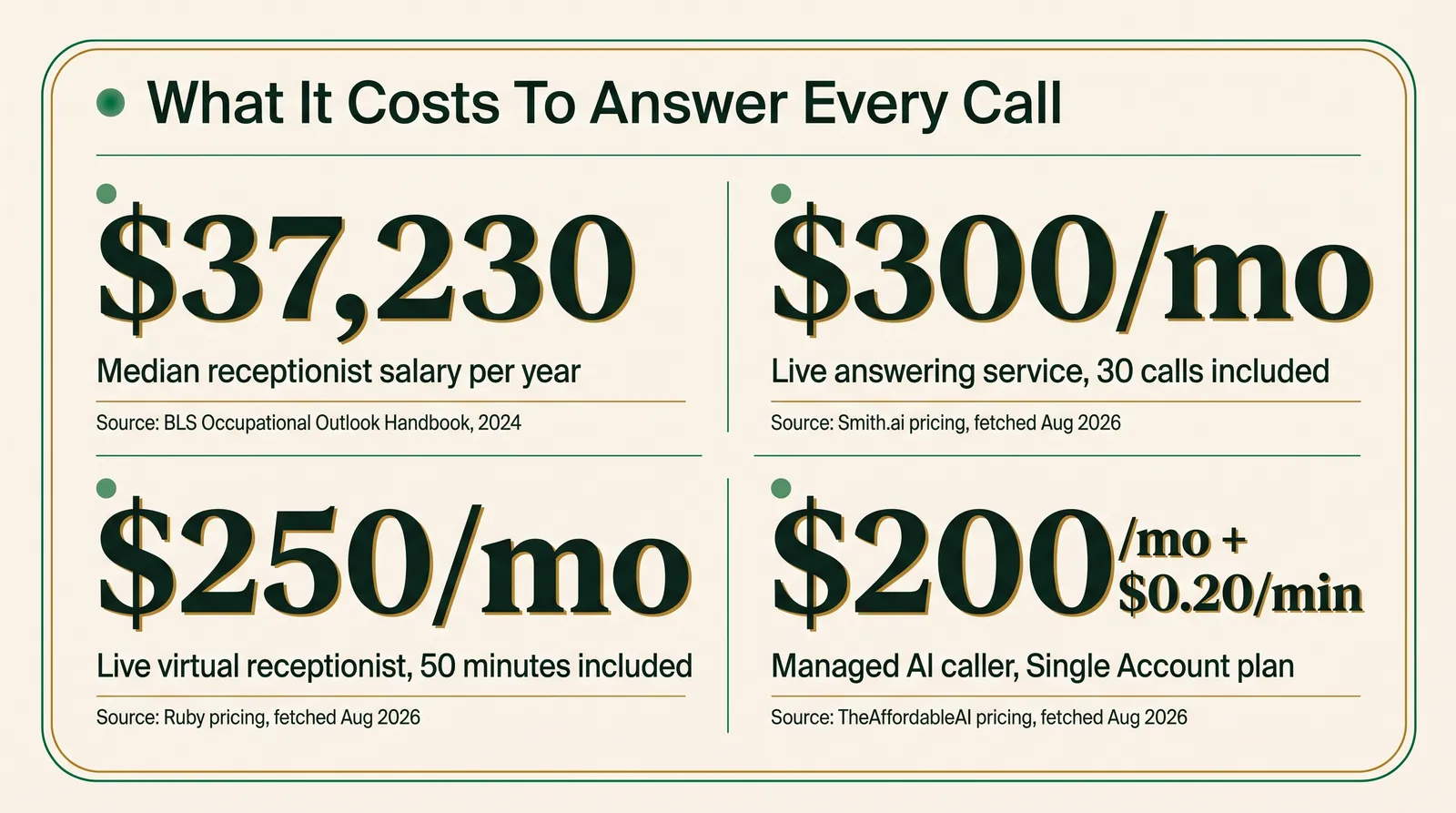
A human receptionist, hired directly. $37,230 a year in salary alone per the BLS median, plus payroll tax and benefits an employer typically layers on top, for coverage during whatever hours that person is scheduled and able to work.
A live-staffed answering service. Smith.ai’s Starter plan is $300 a month for 30 calls, with overage at $11.50 per call beyond that, live-staffed 24/7 according to its own pricing page. Ruby’s Starter virtual receptionist plan is $250 a month for 50 minutes, scaling to $1,725 a month for 500 minutes on its Growing Business tier. Both are real people, which is exactly why the price sits closer to a wage than a software subscription.
A minutes-based AI receptionist tool. Rosie prices at $49 a month for 250 minutes, $149 a month for 1,000 minutes, or $299 a month for 2,000 minutes, all-inclusive of 24/7 AI answering, per its own pricing page. That works out to roughly $0.15 to $0.20 a minute depending on the tier, a fraction of what a live-staffed option costs per minute of coverage.
A managed AI caller built for insurance lead flow. TheAffordableAI’s Single Account plan runs $200 a month plus a one-time $500 setup fee, billed at $0.20 a minute (down to $0.15 a minute at bulk volume), with no long-term contract. The Agency plan, built for routing calls across 20 or more producers with round-robin and availability toggles, runs $500 a month plus a one-time $1,000 setup fee, at $0.18 a minute down to $0.16 at bulk. The difference from a generic AI receptionist tool isn’t the underlying voice technology, it’s that the platform is purpose-built to qualify an insurance lead against your criteria and warm-transfer them to a licensed producer while they’re still on the phone, plus native HighLevel CRM sync, rather than just taking a message for someone to act on later.
Effective cost per minute of inbound coverage, by option
Calculated from each vendor's own published pricing at its lowest tier, fetched August 2026. TheAffordableAI figure uses the Single Account monthly fee spread across 60 minutes plus the per-minute rate, for comparability; actual usage will vary.
Sources: Rosie, Ruby, and Smith.ai pricing pages, all fetched August 2026. Smith.ai bills per call rather than per minute, so its figure isn't directly comparable to a per-minute rate; shown at 80% scale for legibility only. Bars scaled relative to the highest per-unit figure in this set.
The pattern across the vendors compared here is consistent: paying for a human’s time, whether that human works for you directly or for a staffing company like Ruby or Smith.ai, lands around $5 to $10 per minute or per call of actual coverage in this specific comparison, because you’re funding a wage. Paying for AI compute costs a fraction of that per minute, because the marginal cost of one more AI-handled minute is server time, not a person’s hour. That gap is the core economic argument for this category, and it’s also exactly why a caller who wants to talk to an actual human, not a machine, is a real cost this math doesn’t capture; more on that below.
| Provider | Type | Entry price | What's included |
|---|---|---|---|
| Ruby | Live, human-staffed | $250/mo | 50 minutes; up to $1,725/mo for 500 minutes |
| Smith.ai | Live, human-staffed | $300/mo | 30 calls; $11.50 per call beyond that |
| Rosie | AI, minutes-based | $49/mo | 250 minutes; up to $299/mo for 2,000 minutes |
| TheAffordableAI, Single Account | AI, insurance-specific | $200/mo + $500 setup | $0.20/min (from $0.15 at bulk); warm transfers, calendar booking, HighLevel sync |
| TheAffordableAI, Agency | AI, insurance-specific | $500/mo + $1,000 setup | $0.18/min (from $0.16 at bulk); routes to 20+ agents, round-robin |
$37K
Median annual receptionist salary, before benefits or payroll tax
Source: BLS OOH, 2024
0%
Projected U.S. receptionist job growth, 2024 to 2034
Source: BLS OOH, 2024-2034
$49
Cheapest monthly entry price among the AI options compared
Source: Rosie pricing, Aug 2026
$0.20
Per-minute rate, TheAffordableAI Single Account plan
Source: TheAffordableAI pricing, Aug 2026
How to build this yourself, honestly
None of what an AI receptionist does is impossible to approximate without buying one. If you want to try the free or cheap version first, here’s the real path, not a watered-down version designed to make the paid option look better by comparison.
- Turn on visual voicemail with transcription. Most modern business phone systems, including Google Voice and RingCentral, transcribe voicemails to text automatically. That alone cuts the delay between a missed call and someone reading what the caller wanted from hours to minutes, at no added cost if you already have the phone system.
- Set an auto-text-back on missed calls. Many VoIP providers and CRMs, HighLevel included, can fire an automatic text the moment a call goes unanswered: “Sorry we missed you, what can we help with?” This converts a dead-end voicemail into a live text thread a staffer can jump into within minutes, and it costs nothing beyond a workflow you build once.
- Route after-hours calls to a shared cell phone on a rotation. A cheap prepaid phone or a forwarded number, carried by whoever’s on call that week, at least gets a human on the line outside business hours without hiring anyone. It’s unglamorous and it works, at the cost of asking staff to be reachable on their own time.
- Hire a live answering service for the gaps you can’t cover. Smith.ai and Ruby both let you route only your unanswered or after-hours calls to them, rather than all calls, which keeps the bill closer to your actual coverage gap instead of your full call volume.
- Build a basic AI receptionist yourself on a no-code voice platform. Several platforms let you configure a script, connect a phone number, and go live without engineering help, for the minutes-based pricing shown above. It takes real setup time to get the qualifying questions and calendar connection right, and you’re on your own for troubleshooting when a call goes sideways.
Someone who reads that list and thinks “I can wire steps 1, 2, and 4 together myself this week” is right, and should. The honest tradeoff against a managed platform isn’t capability, it’s the setup and maintenance time, and whether that time is worth more to you than the monthly fee.
Price both approaches with your own call volume before deciding
Pull your last 90 days of inbound call logs and count how many calls went to voicemail versus were answered live. That single number, multiplied by your average premium and a conservative close rate you're comfortable defending, is the only version of this math that matters for your agency. We're not going to hand you an invented industry-wide conversion number to plug in instead.
The compliance questions, answered plainly
Two different legal questions get tangled together whenever “AI” and “phone” show up in the same sentence, and they have different answers.
Question one: is it legal for an AI voice to answer a call the caller placed to you? The Telephone Consumer Protection Act’s core consent requirement, codified at 47 U.S.C. § 227, governs calls a business initiates to a consumer, especially autodialed or artificial-voice calls to a wireless number. When a lead calls your published business number and an AI answers, the consumer initiated that contact. That’s a materially different scenario from the one TCPA’s prior-consent rule was built to police, which is unsolicited outbound calling.
Question two: is it legal for that same AI system to call leads back? Here the full TCPA machinery applies. The FCC ruled on February 8, 2024, in a declaratory ruling numbered FCC 24-17, that calls using AI-generated or cloned voices are “artificial or prerecorded voice” calls under the TCPA, meaning they require the same prior express consent, identification, and opt-out handling as any other automated call to a wireless number. If your AI receptionist also dials leads back, and most agencies using one do exactly that, the outbound side of that same system is fully governed by TCPA consent rules regardless of how the inbound side is treated.
Using AI does not transfer liability
Adding an AI receptionist, on the inbound or outbound side, is an operational decision, not a transfer of licensing or compliance responsibility. Consent for outbound calls, honest disclosure, a working opt-out, and CMS's Medicare marketing rules including the TPMO disclaimer where applicable remain the licensed agent's and agency's obligation. None of that moves to a software vendor because the vendor's tool made the calls or answered the phone.
There’s a third piece worth knowing about even though it isn’t settled law yet. On August 7, 2024, the FCC adopted a Notice of Proposed Rulemaking, FCC 24-84, that would require callers to disclose the use of an AI-generated voice, both at the point consent is captured and at the start of the call itself. As of this writing in August 2026, that rule has not been finalized. Nothing here should be read as “no disclosure is required,” since state laws and general consumer-protection principles can still apply, and disclosing plainly that a caller is speaking with an AI system remains the safer, more transparent practice regardless of what a not-yet-final federal rule eventually requires. If a violation does occur on the outbound side, the TCPA’s private right of action, per 47 U.S.C. § 227(b)(3), allows a consumer to recover $500 per violation or actual damages, whichever is greater, and a court can raise that to as much as $1,500 per violation if the violation was willful or knowing.
Where a managed AI receptionist fits, and where it doesn’t
If the free steps above cover your actual gap, that’s a completely reasonable place to stop; not every agency needs to buy anything here. If your call volume is high enough that voicemail-to-text and a shared after-hours phone still leave real leads uncontacted, that’s the point where a purpose-built platform starts to earn its monthly fee.
TheAffordableAI answers every inbound call around the clock, qualifies the caller against your criteria, checks real calendar availability, and warm-transfers anyone ready for a real conversation straight to a licensed agent while they’re still on the line, rather than just logging a message. The same system also handles outbound dialing the moment a new lead comes in, with number warmup and spam defense built in so the outbound side of the phone doesn’t get flagged, and native two-way sync with HighLevel so every call, disposition, and transcript lands in your CRM automatically. Full detail on what’s included is on the features page.
Answers, doesn't just record
A caller gets a live conversation and a booked slot on a real calendar, not a voicemail box waiting for a callback.
Warm transfers to whoever's licensed and available
A qualified caller reaches a real person while they're still engaged, instead of being parked in a callback queue.
One system for inbound and outbound
The same platform that answers the call also dials the lead back if they hang up before reaching anyone, with the same disposition history.
Native HighLevel CRM sync
Every call, transcript, and outcome lands in your CRM automatically, no manual logging after the fact.
Hear what it actually sounds like
There's a live demo call on the homepage if you want to hear the AI qualify a caller and route a transfer before deciding anything. No contract either way, so the cost of testing it is one month's subscription at most.
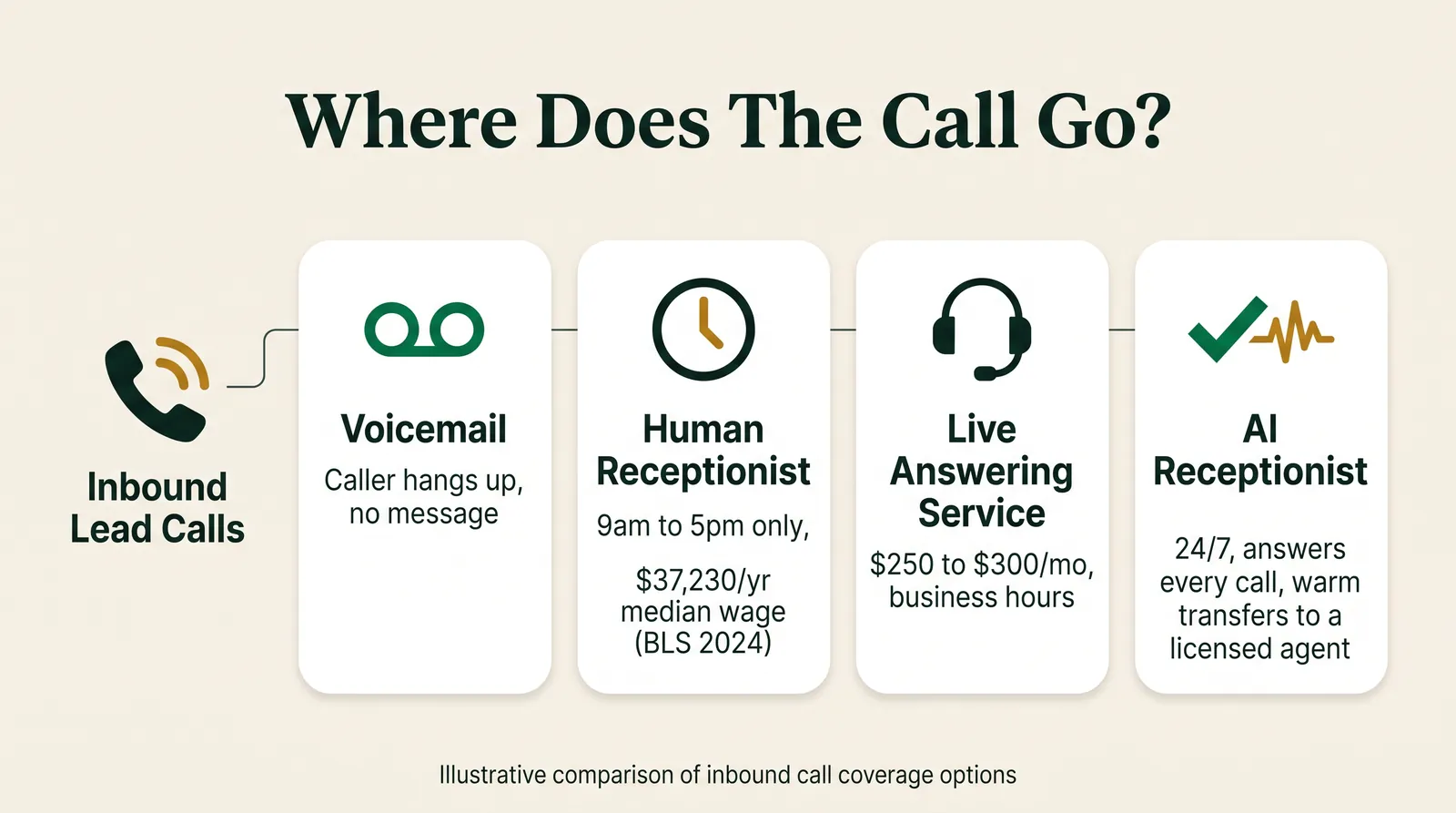
Before and after: the same missed call
The call that goes unanswered
- Rings four times during a busy stretch, drops to a generic voicemail greeting
- Caller doesn't leave a message and calls the next agency instead
- If they do leave a message, it sits until someone has a free moment to listen and call back
- No record of the call exists unless a staffer manually logs it
SilentThe call simply doesn't happen for your agency
The call that gets answered
- Answers within a second or two, any hour, any day
- Asks qualifying questions and checks real calendar availability
- Warm-transfers to a licensed agent if one's free, or books a callback slot if not
- Transcript, disposition, and outcome land in the CRM automatically
AnsweredThe call becomes a conversation, not a missed opportunity
The economics here aren't complicated: a human costs a wage whether they're on the phone or not, and an AI costs compute only while it's actually talking. The question worth answering honestly is whether your callers are the kind who mind the difference.
— The tradeoff this whole comparison comes down toWhen a human still wins
It would be dishonest to close this out pretending an AI receptionist is the right fit for every agency and every caller. A handful of situations genuinely call for a human, and they’re worth naming directly.
A caller in real distress, mid-claim, upset about a denial, dealing with a death in the family, needs a person who can hear tone and respond with actual judgment, not a system optimized for efficient qualification. Route that kind of call to a human as fast as possible, and design the AI’s handoff logic to recognize distress signals and escalate rather than push forward with a script.
A book of business built on long relationships, where clients expect to reach someone who remembers their renewal date and their kid’s name, loses something real if every first contact is automated, even briefly. If that’s the actual character of your agency, a live receptionist who knows your clients may be worth the wage premium over any automated option, AI or otherwise.
A caller base that skews toward people who actively dislike talking to a machine, which varies by demographic and by how the AI is introduced, is a real segment worth measuring rather than assuming away. If you try an AI receptionist and your close rate on AI-answered calls drops noticeably against a live-answered baseline, that’s a signal to listen to, not a result to explain away.
And if your actual call volume is low enough that a shared after-hours phone and a fast callback habit genuinely cover the gap, spending money on any of the paid options in this article solves a problem you don’t have yet. Measure your own missed-call volume before assuming you need any of this.
The honest test before you spend anything
Pull your call logs for the last full month. Count how many inbound calls went to voicemail rather than being answered live, and separately, how many of those callers left a message versus simply hung up. That single set of numbers, not an industry benchmark, not a vendor’s case study, is the only input that should drive this decision for your specific agency. If the number is small, the free steps earlier in this piece probably close the gap. If it’s large enough that you can see real revenue walking away every week, that’s the point to start pricing live-staffed and AI-receptionist options against each other with your own numbers, not anyone else’s.
Frequently asked
What exactly is an AI receptionist, and how is it different from a virtual receptionist or an answering service?
A virtual receptionist and an answering service are the same thing in different clothing: a live human, usually working for a staffing company like Smith.ai or Ruby, answers your calls off-site and follows a script you give them. An AI receptionist replaces that human with a voice pipeline: speech recognition converts the caller's words to text, a language model decides what to say and do, and a synthesized voice speaks the reply, all in under a second or two per turn. Both can greet a caller, take a message, and book an appointment. The practical difference is availability and price: a live service is staffed on a schedule and billed close to the human wage that supports it, while an AI receptionist runs continuously and is usually billed on a flat monthly fee, a per-minute rate, or both.
How much does an AI receptionist cost for an insurance agency in 2026?
It depends heavily on who's building and running it. Off-the-shelf AI answering tools like Rosie price by included minutes: $49 a month for 250 minutes, $149 for 1,000 minutes, or $299 for 2,000 minutes, per Rosie's own pricing page fetched in August 2026. A managed platform built specifically for insurance calling, like TheAffordableAI's Single Account plan, runs $200 a month plus a one-time $500 setup fee, billed at $0.20 a minute (down to $0.15 at bulk volume), with no long-term contract. The Agency plan, built for routing across 20 or more producers, is $500 a month plus a $1,000 one-time setup, at $0.18 a minute down to $0.16 at bulk. Run your own expected call volume against both pricing models before picking one; a generic minutes-based tool can be cheaper at low volume and more expensive than a managed platform once you're routing real lead flow to licensed producers.
Does an AI receptionist replace a licensed producer?
No. An AI receptionist, however it's built, isn't a licensed producer and can't quote, bind, or advise on coverage. What it does is answer the phone, ask qualifying questions, and either take a message or warm-transfer the caller to a person who is licensed. The licensing requirement doesn't move because a machine picked up first. If your current plan is to have the AI itself explain plan details or answer coverage questions, that's outside what any voice AI product, including this one, is built or licensed to do.
Is it legal for an AI voice to answer inbound insurance calls without a human?
Answering an inbound call the caller placed themselves is a different legal question than making an outbound call to them. The Telephone Consumer Protection Act's prior-consent requirement, enforced under 47 U.S.C. § 227, governs calls a business initiates to a consumer, particularly to a wireless number using an autodialer or an artificial or prerecorded voice. When a lead calls your published number and an AI answers, that's not the outbound scenario TCPA consent rules were written for. The FCC did rule on February 8, 2024 (FCC 24-17) that AI-generated voices count as "artificial voice" under the TCPA, which matters most for outbound dialing and for any recorded consent language you play back. If the same AI system is also placing outbound calls to leads, and most agencies that use one do, the full TCPA consent and disclosure rules apply to that outbound side regardless of what happens on inbound.
Do I have to tell callers they're talking to an AI?
There's no finalized federal rule mandating a specific disclosure script for inbound AI answering as of August 2026. The FCC proposed one in an August 2024 rulemaking (FCC 24-84) that would require callers to disclose AI-generated voice use, but as of this writing that rule hasn't been adopted. Regardless of what's legally mandated, honest disclosure is the safer and more brand-consistent choice: a caller who realizes mid-conversation that they're talking to a machine and weren't told is a worse experience than one who was told upfront and stayed on the line anyway. Plan for disclosure as a standing practice, not just a compliance minimum.
When does a live, human-staffed answering service still make more sense than an AI receptionist?
When the calls are genuinely complex, low-volume, or relationship-driven enough that a scripted or AI-guided conversation would frustrate the caller rather than help them. A boutique agency with 40 long-tenured client households and a handful of calls a day may get more value from a live receptionist who recognizes names and knows account history than from any automated system. Live services are also the safer choice when your callers skew toward people who actively dislike talking to a machine, which is a real segment of any customer base. The tradeoff is coverage and cost: live-staffed options like Smith.ai and Ruby are billed close to the cost of the humans behind them and are typically scheduled rather than truly 24/7.
Can an AI receptionist book appointments directly on a producer's calendar?
The better platforms in this category do, TheAffordableAI included, checking real-time calendar availability rather than just taking a message and hoping someone follows up. That's a meaningfully different outcome than a traditional answering service, which almost always just relays a message for a human to act on later. The gap between "someone will call you back" and "you're on the calendar for 2pm Thursday" is where a lot of the actual conversion difference lives, though we don't have a sourced number for how much that specific gap is worth and won't invent one.
What happens to a call the AI can't handle?
A well-built AI receptionist for insurance is designed to recognize the edge of its own competence and hand off rather than guess. That means recognizing an angry caller, a complex claims question, or anything touching actual coverage advice, and routing it to a live person, either a warm transfer if someone's available or a flagged callback if not. If a system you're evaluating can't describe what it does when it doesn't know the answer, that's worth asking about directly before you commit to it.
Sources
- U.S. Bureau of Labor Statistics — Occupational Outlook Handbook: Receptionists (2024 data, projections 2024-2034)
- Federal Communications Commission — Declaratory Ruling FCC 24-17, AI-Generated Voices and the TCPA (released February 8, 2024)
- Federal Communications Commission — Notice of Proposed Rulemaking FCC 24-84, AI-Generated Robocalls and Robotexts (adopted August 7, 2024)
- Cornell Law School Legal Information Institute — 47 U.S.C. § 227, Telephone Consumer Protection Act
- Smith.ai — Virtual Receptionist Pricing (fetched August 2026)
- Ruby — Virtual Receptionist Pricing (fetched August 2026)
- Rosie — AI Answering Service Pricing (fetched August 2026)
- TheAffordableAI — Pricing (fetched August 2026)
Put this on your own phone line
See the AI dial, qualify, and warm-transfer a live call in under a minute. No contract, no dev work.
Keep reading
After-Hours Insurance Leads: The 128-Hour Gap
An agency staffed 9 to 5 on weekdays is unstaffed 128 hours a week. Here is what that costs in after-hours insurance leads, and how to close the gap in 2026.

AI Voice Agents for Insurance: How They Actually Work
An AI voice agent for insurance chains speech recognition, an LLM, and a synthetic voice into one loop: the pipeline, the cost, and where a human is required.

Speed to Lead in 2026: Why the First 60 Seconds Decides Who Writes the Policy
The lead you paid for is not lost to a better agent. It is lost to a faster one. Here is what response time actually does to contact and conversion rates, and how to get to sixty seconds without hiring a dialer team.