Speed to Lead in 2026: Why the First 60 Seconds Decides Who Writes the Policy
The lead you paid for is not lost to a better agent. It is lost to a faster one. Here is what response time actually does to contact and conversion rates, and how to get to sixty seconds without hiring a dialer team.

I spent years as a personal producer building an ACA book past a million a year in production. The single most expensive lesson in that whole run had nothing to do with product knowledge, objection handling, or price. It was this: the lead I paid for was almost never lost to a better agent. It was lost to a faster one.
You have felt this. A lead comes in at 2:14 while you are on another call. You get to it at 2:51. It rings out. You try again the next morning. By then somebody else has already been on the phone with them for twenty minutes and the deal is over before you ever said hello.
This article is about closing that gap, what the response-time curve actually looks like, and how to get to a sixty-second first touch without hiring a dialer team.
The short version
- Response time compounds: it moves contact rate and conversion rate at the same time.
- Most agencies think they respond in minutes. Measured from form-submit to first ring, they respond in hours.
- Attempt count matters as much as speed. Two attempts is where most agents quit and most contacts have not happened yet.
- An AI caller fixes the mechanical part of this problem — always dialing, instantly, on every lead — and hands you a live human.
The curve nobody wants to look at
Ask an agency owner how fast they call a new lead and you will hear “right away” or “within five minutes.” Then instrument it. Measure from the timestamp on the form to the timestamp on the first outbound ring, across every lead, including nights and weekends. The real number is almost always measured in hours, and the median is dragged up by exactly the leads you would most want to catch: the ones that came in while everyone was busy, at lunch, or after five.
Here is the shape of what happens as that gap widens.
Relative contact rate by first-touch delay
Illustrative curve based on widely reported outbound response-time patterns — measure your own book before quoting numbers.
Directional only. The point is the shape of the curve, not the exact percentages — run the same report on your own CRM.
The important thing is not any single number. It is that the curve is steepest at the start. The difference between one minute and thirty minutes costs you more than the difference between one day and one week. Most agencies spend their energy on the flat part of the curve — the follow-up sequence on day four — and almost none on the cliff.
Measure it before you fix it
Pull two timestamps for every lead in the last ninety days: form submission and first outbound attempt. Chart the median and the 90th percentile, not the average — the average hides the nights and weekends where all the damage happens.
Speed alone is not the whole story
Speed gets you the first swing. Persistence gets you the contact. These are two different failures and most agencies have both.
The pattern I saw in my own book, and in every agency I have looked at since, is that attempts stop at two. Someone dials, it rings out, they dial again the next day, and then the lead quietly ages into the “old leads” bucket that nobody ever works. Meanwhile a meaningful share of connects happen on the third through eighth attempt, spread across different times of day.
| When | Channel | Purpose | Who does it |
|---|---|---|---|
| 0 to 60 seconds | Call | Reach them while they are still on the page | AI |
| 2 minutes (no answer) | Text | Name the reason for the call, invite a callback | AI |
| Same day, +3 hours | Call | Different time of day, different odds | AI |
| Day 2 | Call + email | Give a concrete next step and a booking link | AI |
| Days 4, 7, 10 | Call + text | Spaced attempts across morning, midday, evening | AI |
| On contact | Warm transfer | Advice, plan selection, enrollment | Licensed agent |
Notice what the licensed human is doing in that table: exactly one thing, the thing only they can legally and usefully do. Everything above it is mechanical.
What changes when the dialing is automatic
This is the part I care about, because it is the part I got wrong for years. I kept trying to solve a mechanical problem with discipline. Discipline does not scale past your own calendar.
Manual follow-up
- First touch depends on who is free
- Nights, weekends, and lunch go uncovered
- Attempts stop at two, then the lead ages out
- Notes live in someone's head, not the CRM
- Scaling means hiring another caller
HoursTypical real first-touch time
AI dials, agent closes
- Every lead is called the moment it posts
- 24/7 coverage including the after-hours leads
- Full cadence runs whether or not anyone remembers
- Transcript, tags, and notes sync to the CRM
- Scaling is a settings change, not a hire
Under 60sFirst-touch time, every lead
The agent’s day changes shape. Instead of forty dials to get four conversations, you get four conversations. The AI absorbs the dead air, the voicemails, the wrong numbers, and the “who is this?” — and hands you a person who has already said they want to talk about coverage.
60s
Target first-touch on every inbound lead
24/7
Coverage including nights and weekends
8+
Touches in the cadence before a lead is retired
20+
Agents ringable on a single warm transfer
Hear it call you
Put your own number in and the AI will call in seconds. It is the fastest way to understand what your leads would experience.
The compliance part, said plainly
Speed is not an excuse to skip the rules, and “the AI did it” is not a defense. A few things are non-negotiable.
Before you automate a single dial
- You need prior express consent for automated calls and texts, captured and stored with the lead record.
- Disclose what the call is and give a clear, working opt-out on every channel.
- For Medicare, follow current CMS marketing rules — including the TPMO disclaimer where required and call recording retention.
- The AI qualifies and schedules. A licensed agent gives advice and completes the sale.
- Honor federal and state calling-hour restrictions and the Do Not Call registry.
This is general information, not legal or compliance advice. Verify against current FCC and CMS guidance and your own carrier contracts.
What “good” looks like in practice
Instant trigger
The dial fires off the form post itself, not a batch job that runs every fifteen minutes.
Warm transfer
When the prospect is qualified and willing, the call rings your team live instead of dropping a task.
Real calendar awareness
If nobody is available, it books against actual availability rather than promising a callback.
Number warmup
New numbers get warmed and monitored so your calls do not land tagged as spam.
CRM sync
Transcript, disposition, and tags land on the contact record automatically.
Consent trail
Consent, disclosure, and opt-out are logged with the contact, not stored in someone's memory.
The lead was never lost to a better agent. It was lost to a faster one.
Mike MooreWhere to start this week
You do not need to rebuild your stack to move the needle. Do these three things in order.
- Measure the truth. Form-submit to first-ring, median and 90th percentile, last ninety days. Split it by hour of day. The after-hours column is your opportunity.
- Automate the first touch only. Leave your existing sequence alone. Put an instant call in front of it and compare contact rates for a month.
- Extend the cadence to eight touches. Once the first touch is automatic, the marginal cost of attempts three through eight is close to zero.
A fair test
Run it on one lead source at a time and hold everything else constant. If you change the source, the script, and the cadence at once, you will not know what worked — and you will not be able to defend the spend.
Open enrollment does not care how busy you were. The leads arrive in a wave, they arrive at all hours, and the ones you do not reach in the first minute are the ones a competitor reaches instead. Fix the mechanical part, and let the licensed human do the part that actually requires a licensed human.
Frequently asked
What is a good speed-to-lead time for insurance leads?
Under one minute. Contact rates fall off a cliff after the first five minutes and keep falling after that. If you cannot answer inside sixty seconds every time, an AI caller that dials the instant the form posts will outperform a human who dials when they get a chance.
Does calling faster actually increase conversion, or just contact rate?
Both, but they are different effects. Faster dialing raises the odds you reach a human at all, which is the contact rate. It also raises conversion, because you reach the prospect while they are still on the page thinking about coverage instead of three days later when they have already spoken to someone else.
How many times should I attempt a new insurance lead?
Most agents stop after two attempts. The data on outbound sales has been consistent for years that a large share of contacts happen on attempts three through eight. The practical answer is to build a cadence of six to eight touches across call, text, and email over the first ten days, and to automate it so it happens whether or not anyone remembers.
Is an AI caller compliant for insurance leads?
It depends on how it is used. You need prior express consent for automated calls, clear disclosure, an easy opt out, and for Medicare specifically you must follow current CMS marketing rules including the TPMO disclaimer and call recording retention. The AI can qualify and schedule; a licensed agent still has to give advice and complete the sale.
Sources
Put this on your own phone line
See the AI dial, qualify, and warm-transfer a live call in under a minute. No contract, no dev work.
Keep reading
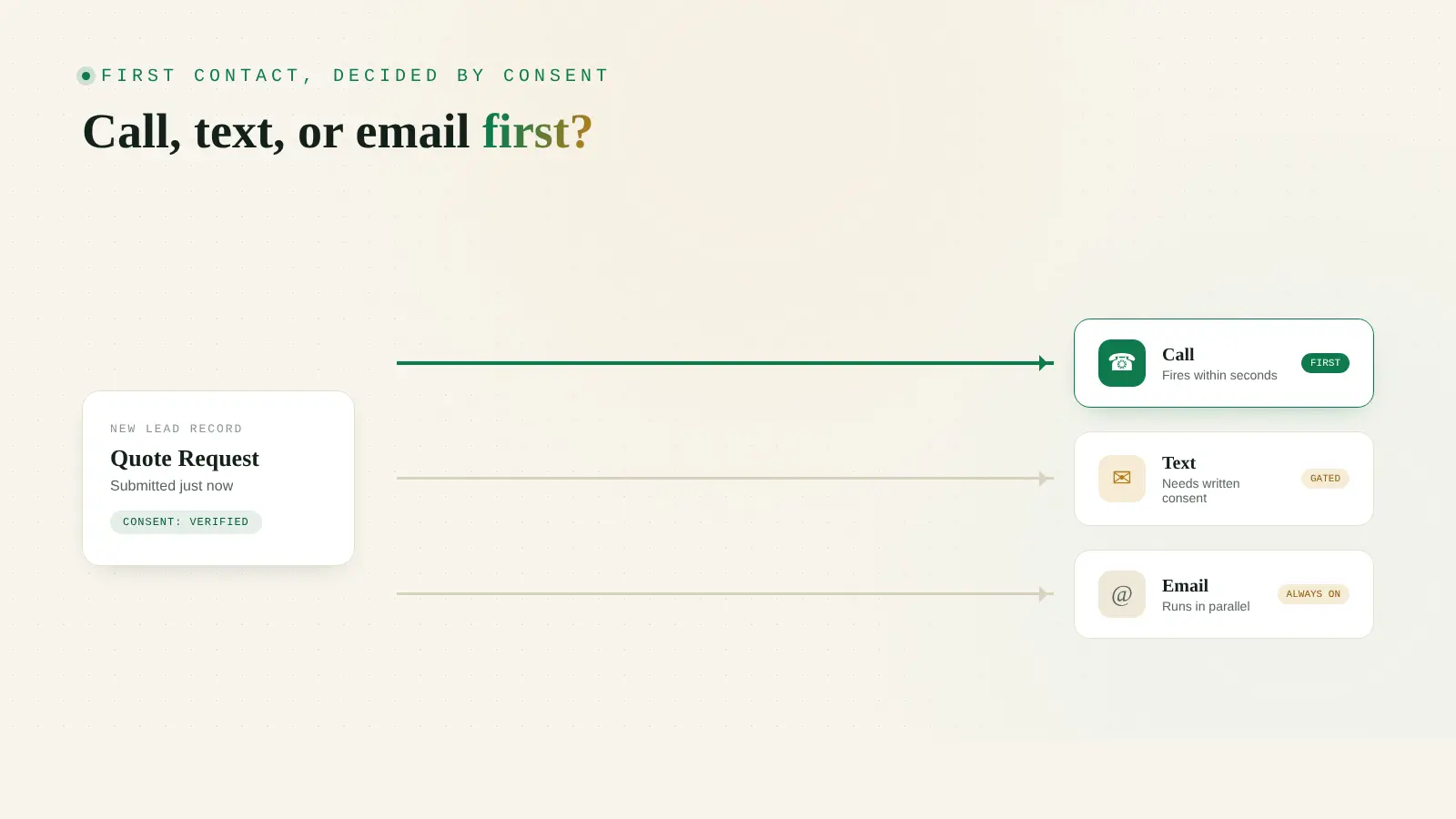
Should You Call, Text, or Email a New Insurance Lead First?
Calling and texting a new insurance lead trigger TCPA consent rules that email never does. Here's the legally compliant sequence that's also the fastest one.
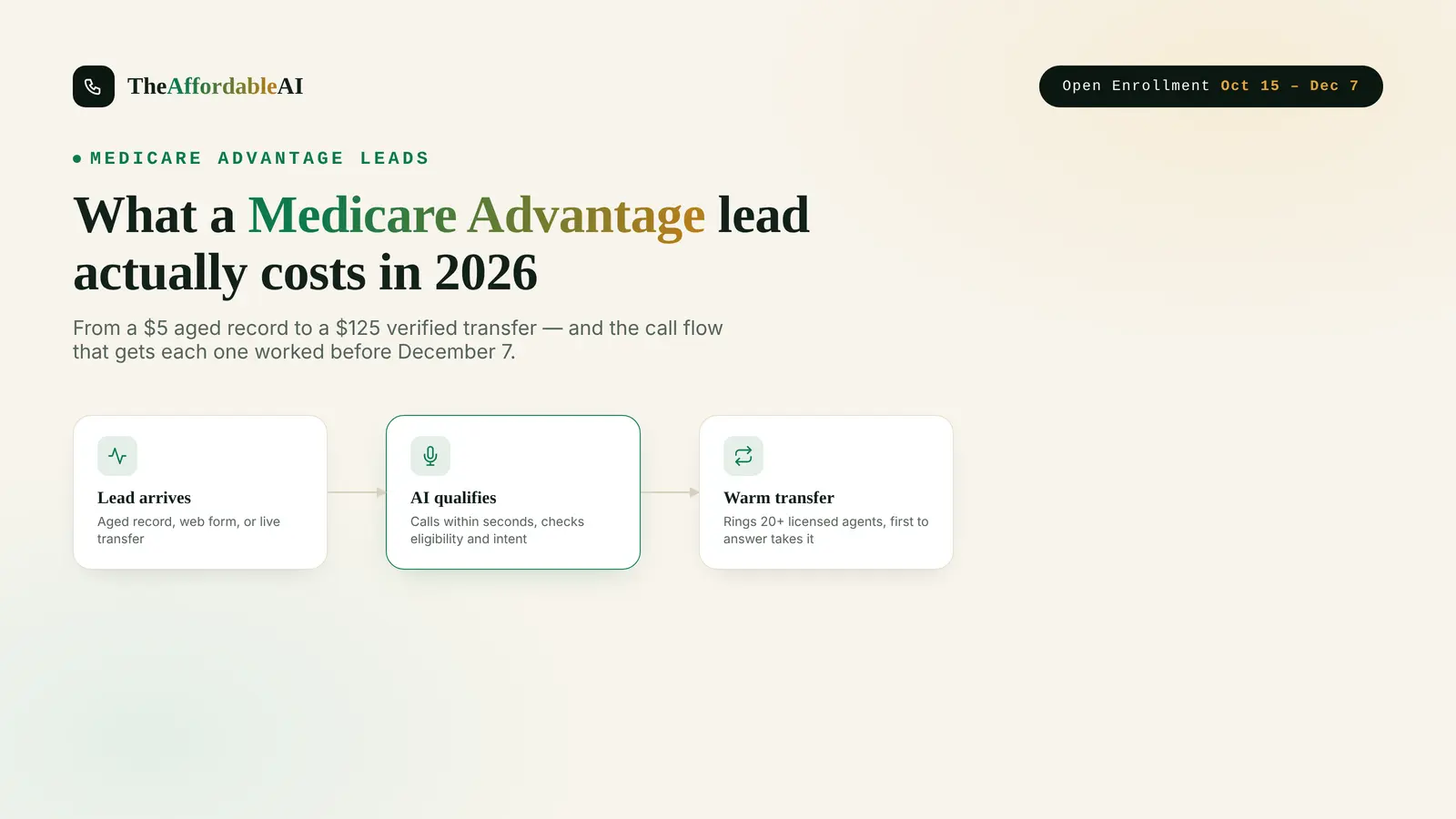
Medicare Advantage Leads in 2026: What They Cost
Medicare Advantage leads run $5 to $125 each, and Congress is scrutinizing how lead generators sell senior data. What they cost and how to follow up fast.

ACA Insurers Exit for 2027: What Agents Do Now
Nine insurers are leaving the ACA marketplace for 2027, and Cigna alone affects up to 369,000 members. Here is how agencies handle the call surge.