Call Abandonment Rate Rules for Insurance Agencies
The FTC and FCC cap abandoned calls at 3%: what counts as abandonment, what a violation costs, and how AI voice agents change the math for agencies.

If you have ever wondered why a predictive dialer sometimes connects you to dead air, or worse, hangs up on a lead before anyone gets on the line, the call abandonment rate rule is the reason that behavior is capped by federal law. Both the FTC’s Telemarketing Sales Rule and the FCC’s parallel TCPA rule say no more than 3% of the calls a real person answers can go unconnected to a live agent, or to a compliant recorded message, within two seconds. Go over that limit on a campaign, and every abandoned call past the threshold is a separate violation carrying $500 to $1,500 in statutory damages. Most insurance agencies running an outbound dialer at any real volume have never actually calculated their own abandonment rate, and the ones that use a predictive dialer during Medicare AEP or an ACA open enrollment surge are the ones most likely to be over the line without knowing it.
This is not a rule about who you are allowed to call, which is what most insurance calling compliance content covers. It is a rule about what your dialing technology is allowed to do to the people who do answer. That distinction matters because an agency can have flawless prior express written consent on every lead in its list and still be racking up abandoned-call violations because of how the dialer is paced, not because of who it is calling.
The short version
- Federal law caps call abandonment at 3% of all calls a live person answers, measured over a rolling 30-day window per calling campaign, under both 16 CFR 310.4(b)(4)(i) (FTC) and 47 CFR 64.1200(a)(7) (FCC).
- An "abandoned call" is a specific, defined event: a person answers, and no live sales rep, or compliant recorded message, connects within two seconds of their completed greeting.
- Each abandoned call over the cap is treated as a separate TCPA violation, carrying $500 to $1,500 in statutory damages under 47 U.S.C. § 227(b)(3), on top of possible FTC or state enforcement.
- The FTC has pursued abandoned-call cases directly: in 2007 it settled with telemarketer The Broadcast Team for a $1 million civil penalty after the company abandoned more than 64 million calls.
- Predictive dialers create abandonment risk by design, because they place more calls than confirmed available agents. An AI voice agent that answers one call at a time does not carry the same overdial mechanism, though it still has to meet the same connection-speed definition if it uses automated dialing.
What counts as an abandoned call, exactly
An abandoned call is not just any dropped or missed call. Under the FTC’s Telemarketing Sales Rule, “an outbound telephone call is ‘abandoned’ under this section if a person answers it and the telemarketer does not connect the call to a sales representative within two (2) seconds of the person’s completed greeting.” The FCC’s parallel rule under the TCPA uses almost identical language: “a call is ‘abandoned’ if it is not connected to a live sales representative within two (2) seconds of the called person’s completed greeting.”
Read that definition carefully, because two things about it surprise most agencies the first time they look it up. First, the clock does not start when the phone rings, and it does not start when the person picks up. It starts after they finish saying “hello,” or whatever their greeting is, because the rule is measuring how long a real human being is left waiting in silence after they have already spoken. Second, calls that are never answered at all, that go to voicemail or an answering machine, or that hit a disconnected or non-working number, do not count toward abandonment in either direction. The rule is only measuring what happens to the calls a live person actually picks up.
Prerecorded messages get the same two-second clock
If your outbound call delivers an artificial or prerecorded voice message rather than connecting to a live agent, it is not automatically exempt from being counted as abandoned. Under 16 CFR 310.4(b)(4)(iii) and the FCC's equivalent, the prerecorded message has to begin within that same two-second window and, when a live rep is not available, has to open with a required disclosure: the name of the business or individual on whose behalf the call was placed, a phone number the person can use to make a Do Not Call request, and an automated opt-out mechanism. Skipping that disclosure does not just risk an abandonment violation, it is a separate abusive-practice violation on its own under the same section.
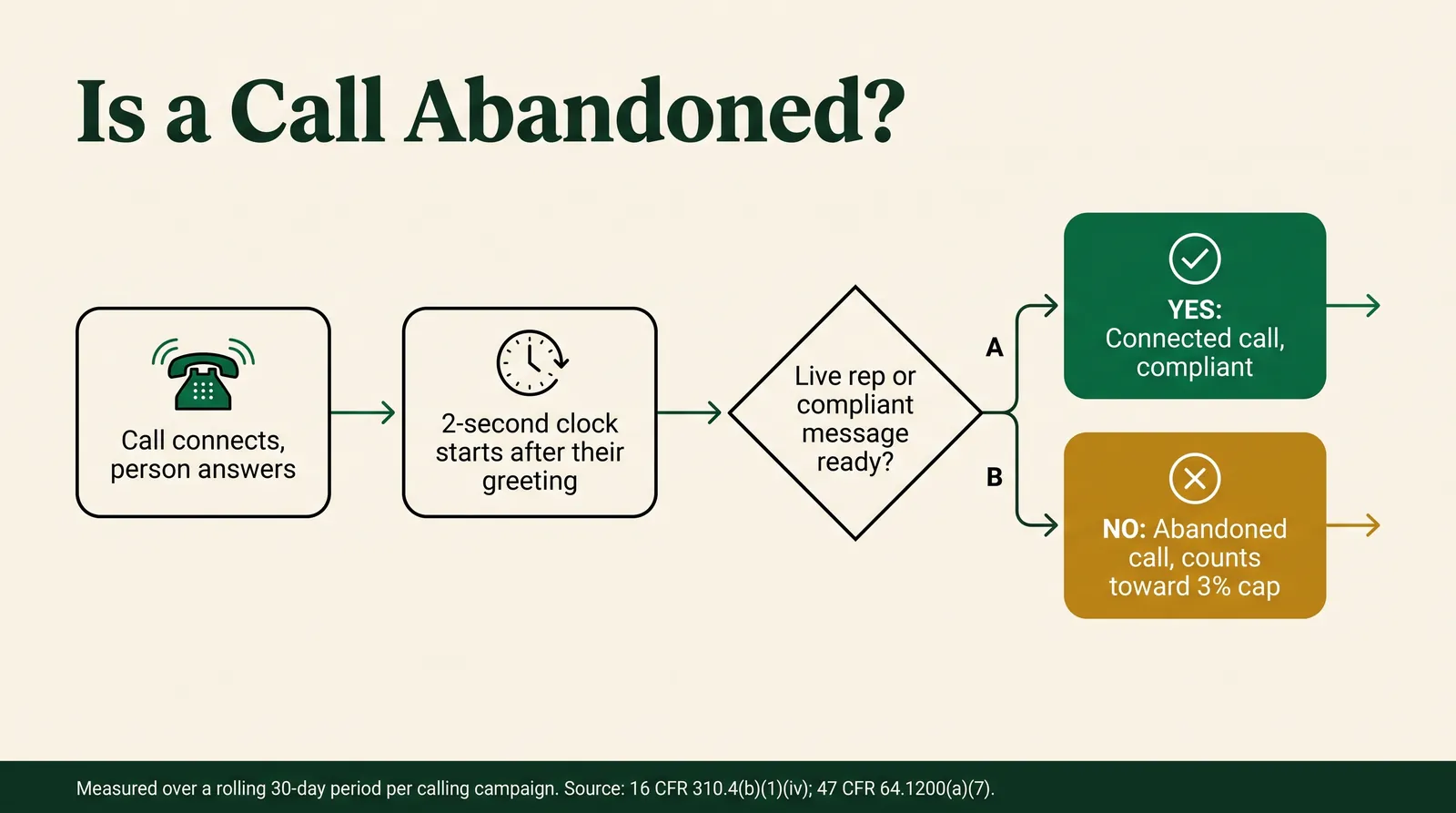
Two related rules set the boundaries around that two-second test. Both the FTC and FCC require you to let a call ring for at least 15 seconds or four rings before treating it as unanswered, so a dialer cannot juice its numbers by hanging up early on calls that were about to be answered. And both regulators cap the actual abandonment rate at 3% of all calls answered by a live person, measured separately for each successive 30-day period a single calling campaign runs. Stay under that 3% ceiling, meet the ring-time and disclosure requirements, and keep records proving it, and you are inside the safe harbor both rules provide. Go over it, and the safe harbor disappears.
The rule, side by side: FTC and FCC versions
Two federal agencies wrote near-identical abandonment rules because they regulate overlapping ground: the FTC’s Telemarketing Sales Rule covers telemarketing generally, and the FCC’s TCPA rule covers calls placed with an automatic telephone dialing system or an artificial or prerecorded voice. An insurance agency dialing leads with an autodialer or predictive dialer is very likely operating under both at once, which is why the two frameworks were harmonized to use the same numbers.
| Requirement | FTC Telemarketing Sales Rule | FCC TCPA rule |
|---|---|---|
| Citation | 16 CFR § 310.4(b)(1)(iv), (b)(4) | 47 CFR § 64.1200(a)(6), (a)(7) |
| Abandonment cap | No more than 3% of calls answered by a person | No more than 3% of telemarketing calls answered live by a person |
| Measurement window | Each successive 30-day period per single calling campaign | 30-day period per single calling campaign |
| Connection clock | Live rep or compliant message within 2 seconds of completed greeting | Live rep within 2 seconds of completed greeting |
| Minimum ring time | 15 seconds or 4 rings before disconnecting unanswered calls | 15 seconds or 4 rings before disconnecting unanswered calls |
| Recordkeeping | Must retain records establishing compliance with (b)(4)(i)-(iii) | Must maintain records establishing compliance with (a)(7) |
| Who enforces it | FTC, state attorneys general | FCC, and private right of action under 47 U.S.C. § 227(b)(3) |
The practical upshot: it does not matter which of the two rules technically applies to a given call, since an insurance agency running automated outbound calling is realistically subject to both, and both draw the line in the same place. There is no version of this where meeting the FTC’s 3% and missing the FCC’s, or the reverse, gets you out of trouble.
Why predictive dialers create abandoned calls by design
Nobody sets out to abandon calls. The reason it happens is baked into how a predictive dialer works. A manual dialer, or a simple auto-dialer that calls one number per available agent, cannot generate abandonment at scale, because it is never trying to guess ahead of agent availability. A predictive dialer does the opposite on purpose: it dials multiple numbers per agent simultaneously, using an algorithm that predicts, based on recent answer rates and average call-handling time, how many of those simultaneous dials will actually connect to a person. The whole point of the technology is to keep agents from sitting idle waiting for the next connection, which is a real and expensive problem for any high-volume outbound operation.
The math the dialer is running only has to be wrong in one direction to create abandonment. If the algorithm predicts that dialing five lines will produce two live answers, and it is right about the answer rate but every agent is still finishing a prior call when those two people pick up, both callers get either dead air, a hold message, or an abrupt disconnect. That is an abandoned call under the federal definition even though nobody at the agency intended it, and even though the dialer’s own reporting might not flag it clearly unless someone is watching for it.
The risk concentrates exactly when your call volume spikes
An abandonment rate that sits comfortably under 3% on a normal week can climb fast the moment you add call volume without adding staffed capacity, which is precisely the pattern of a Medicare AEP surge or an ACA open enrollment push. More simultaneous dials against the same agent headcount raises the odds that several lines connect to a live person in the same few seconds, and the 30-day measurement window means a bad week can pull your whole campaign's average over the line even if the rest of the month was clean.
What it actually costs when abandonment goes wrong
The dollar exposure here is not hypothetical, and it is not small relative to what a single call is worth. Under the TCPA’s private right of action at 47 U.S.C. § 227(b)(3), a consumer can recover $500 in statutory damages for each violation, or the court can raise that to as much as three times that amount, up to $1,500, if it finds the violation was willful or knowing. Every abandoned call past the 3% threshold is its own violation, not a single violation per campaign, which is what turns a bad dialer configuration into a large number very quickly.
What one abandoned call over the cap can cost, against what a call costs to place
Illustrative, built from this article's sourced figures: TheAffordableAI's published Single Account per-minute rate against the federal statutory damages range for one TCPA violation.
Per-minute rate from TheAffordableAI's published pricing. Statutory damages per 47 U.S.C. § 227(b)(3). This is not legal advice and does not estimate your own exposure, which depends on your own abandonment rate and consent documentation.
Regulators have gone after abandonment specifically, not just as a footnote to other telemarketing violations. In February 2007, the FTC and Department of Justice settled with voice broadcaster The Broadcast Team over charges that its automated dialing service, run on behalf of debt-management clients, “caused more than 64 million calls to be abandoned in telemarketing campaigns.” The company agreed to a $1 million civil penalty, with an additional $1.8 million suspended based on its ability to pay. That case is close to two decades old now, which is worth being direct about, but the rule it enforced has not changed in the meantime, and the underlying math, a high-volume automated dialer producing abandonment at scale, is the same mechanism any predictive-dialer setup runs today.
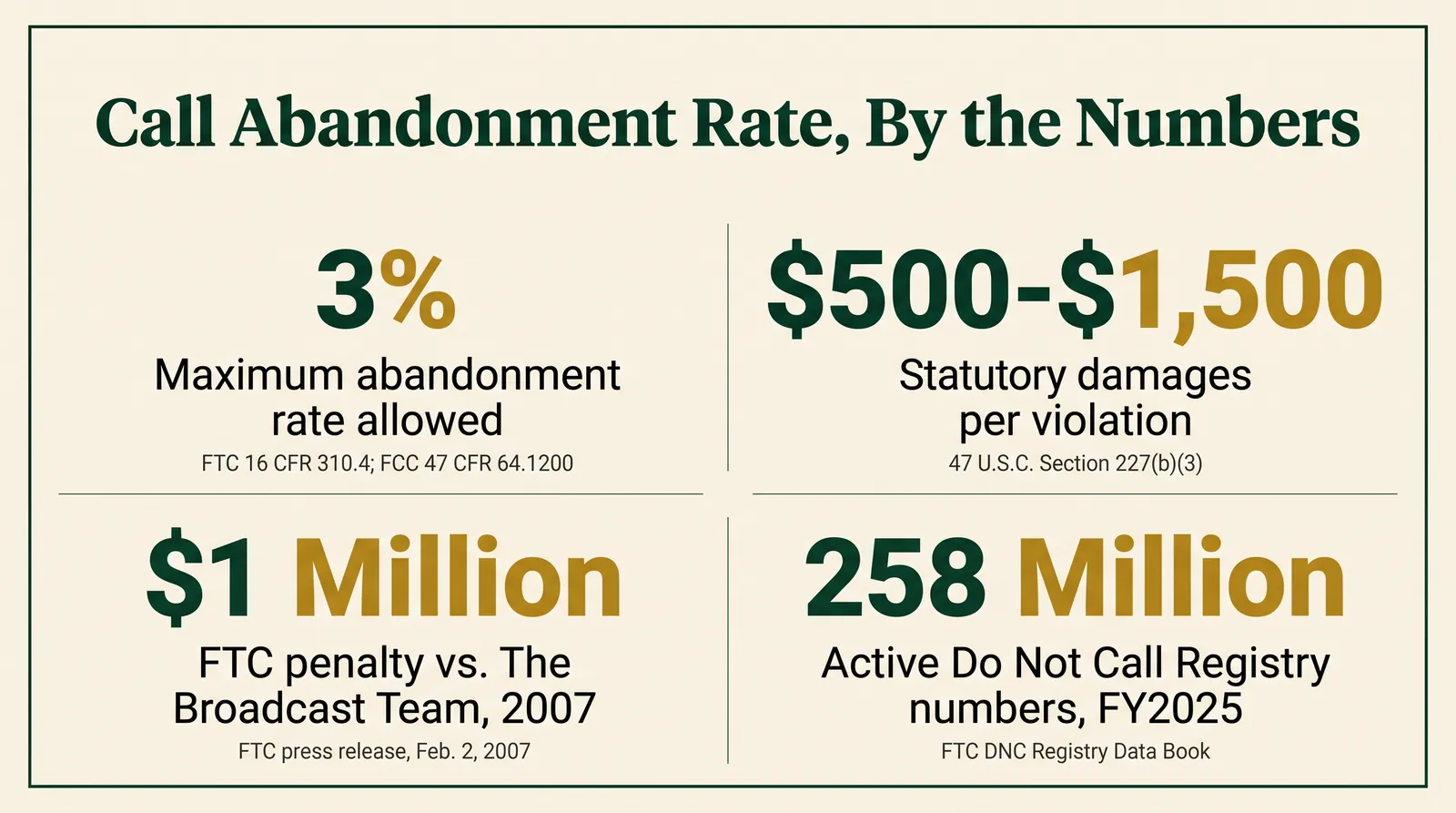
3%
Maximum abandonment rate under both the FTC and FCC rules
Source: 16 CFR 310.4(b)(4)(i); 47 CFR 64.1200(a)(7)
$500-$1,500
TCPA statutory damages, per abandoned-call violation
Source: 47 U.S.C. § 227(b)(3)
$1M
FTC civil penalty against The Broadcast Team, 2007
Source: FTC press release, Feb. 2, 2007
258M
Active Do Not Call Registry numbers, FY2025
Source: FTC National DNC Registry Data Book, FY2025
To see how that scales, walk through a plain illustrative example using only the cited rates, not a claimed real-world outcome. Say a mid-size agency runs a predictive dialer at 2,000 outbound calls a day during a two-week AEP push, and roughly 40% of those calls, 800 a day, get answered by a live person, which is a realistic connect rate for a warm-ish list. A well-tuned dialer sitting right at the 3% cap would abandon 24 of those 800 answered calls a day. If pacing drifts to 6%, twice the legal limit, that is 48 abandoned calls a day, 24 of them over the line, which is 24 separate violations a day, every day the campaign runs at that rate. At the $500 statutory floor alone, ten days of that adds up to $120,000 in theoretical exposure, before anyone asks whether a court would call the conduct willful.
| Abandonment rate | Abandoned calls/day | Calls over the 3% cap/day | Statutory exposure/day (floor) |
|---|---|---|---|
| 3% (at the cap) | 24 | 0 | $0 (inside safe harbor) |
| 5% | 40 | 16 | $8,000 |
| 6% | 48 | 24 | $12,000 |
| 10% | 80 | 56 | $28,000 |
That table is arithmetic, not a prediction of what would actually happen to any specific agency; realized exposure depends on whether anyone ever brings a claim, what a court finds about willfulness, and how the abandonment was actually measured. The point of walking through it is narrower and more useful: it shows how fast the number of separate violations compounds once you cross 3%, because the statute counts by the call, not by the campaign.
How to calculate and monitor your own abandonment rate
You do not need a compliance consultant to find out where your agency actually stands. The formula is public, and most dialer and CRM platforms already log the inputs.
- Pull two counts from your dialer’s reporting for a rolling 30-day window, per campaign: the total number of calls answered by a live person, and, of those, how many connected to an agent (or to a compliant recorded message) within two seconds of the person’s greeting ending.
- Subtract to get abandoned calls. Answered calls minus connected-within-two-seconds calls equals abandoned calls for that window.
- Divide abandoned calls by total answered calls, then multiply by 100. That is your abandonment rate for the period. Do this separately for each campaign, not blended across your whole account, since the rule measures per campaign.
- Check whether your dialer’s connection clock actually starts at “completed greeting.” Some platforms measure from when the call is picked up, not from when the person finishes speaking, which understates true abandonment. If you cannot confirm how your platform times it, ask the vendor directly before trusting the number it reports.
- Re-run the calculation every time you change agent staffing or dialer pacing settings, not just once a quarter. The abandonment rate the FTC and FCC care about is the trailing 30-day figure at the moment a call happens, and pacing changes shift that number within days, not months.
- Keep the underlying records, not just the summary rate. Both 16 CFR 310.4(b)(4)(iv) and 47 CFR 64.1200(a)(7)(iii) require you to retain records establishing compliance, so a dashboard screenshot from six months ago is a weaker position than exportable call logs you can produce on request.
An agency that runs this math once and finds a comfortable 1.5% abandonment rate has actually learned something useful: there is headroom to increase call volume before pacing needs to change. An agency that finds 7% has learned something more urgent, and cheaper to fix before AEP than during it.
Before and after: the same call volume, two different dialer models
What creates abandonment risk
- Dialer places multiple lines per agent based on a predicted, not confirmed, connect rate
- Nobody has calculated the agency's actual trailing 30-day abandonment rate
- Pacing settings unchanged from a normal week even during an AEP or OEP volume spike
- No exportable call-log records tied to the abandonment safe harbor requirements
UnmeasuredWhether the agency is over or under the 3% cap right now
How the mechanism changes
- Each outbound call is placed and answered by the same AI caller, with no queue behind it waiting on a free human agent
- No overdial bet being placed on predicted answer rates, because there is no fixed pool of agents to pace calls against
- Volume scales by adding call capacity, not by dialing further ahead of confirmed availability
- Every call logged automatically, with disposition and transcript, ready to support a compliance record if ever asked
StructuralThe overdial mechanism that creates predictive-dialer abandonment isn't present
That comparison is about mechanism, not a promise. An AI voice agent using an automated dialing system still has to meet the same two-second connection definition and the same 3% cap if it is ever measured, and the disclosure, consent, and Do Not Call obligations do not move an inch. What changes is the specific thing that causes predictive-dialer abandonment in the first place: betting on how many of several simultaneous dials will connect. A setup where the caller answers what it dials, one conversation at a time, does not need to make that bet.
Where TheAffordableAI fits
We are not a compliance product, and nothing here should be read as legal advice about your specific abandonment rate or your specific liability. What TheAffordableAI does is run outbound and inbound calling without the overdial pacing that creates abandonment risk in the first place, because the AI is the agent on every call it places, not a predictive layer sitting in front of a limited pool of humans. Every call gets logged with a disposition and, where applicable, a transcript, synced natively into HighLevel, which is a materially better record to have than a dialer report nobody has looked at since the platform was set up. The features page has the full list of what ships on every plan.
One call, one conversation
No predictive overdial layer betting on a connect rate; the AI answers what it places, which removes the mechanism that creates abandonment at scale.
Volume without a staffing model to re-pace
AEP and ACA open enrollment surges add call capacity instead of forcing a predictive dialer's pacing settings further ahead of confirmed agent availability.
Automatic call logging
Disposition and transcript on every call, synced to HighLevel, giving you exportable records if your own abandonment or consent practices are ever questioned.
Warm transfers and auto-booking
Calls that reach a real prospect get handed to a licensed agent live, or booked against real calendar availability, instead of sitting in a dialer queue.
Hear how it actually connects a call
There is a live demo call on the homepage. Listen to how it answers, then compare that to what your current dialer's abandonment numbers actually look like.
Pricing is published, not quoted privately: a Single Account runs $200 a month plus a $500 one-time setup fee, at $0.20 a minute, down to $0.15 a minute at bulk volume. An Agency plan, which routes to 20-plus agents at once, runs $500 a month plus a $1,000 one-time setup fee, at $0.18 a minute, down to $0.16 a minute at bulk. Both are month to month with no long-term contract. You can also fix a predictive dialer’s pacing yourself, by lowering the dial ratio and re-running the abandonment math after every change, and plenty of call centers do exactly that instead of switching platforms. It is worth pricing both approaches against what a violation, or a lost afternoon of connect rate, actually costs you.
When this is not your problem, and when AI calling is the wrong tool
Be honest about what this article does and does not fix. If your agency dials one number at a time, or uses a simple auto-dialer that never places more lines than you have agents to answer them, you likely do not have a meaningful abandonment-rate exposure in the first place, and nothing here should push you toward new calling infrastructure you do not need. If your actual problem is a predictive dialer misconfigured by a vendor who has not returned your calls about it, the fix is getting that vendor to fix the pacing settings or produce the compliance records 16 CFR 310.4(b)(4)(iv) requires, not layering a second calling system on top of the one you already have. And if your agency is already facing a demand letter or an FTC inquiry over abandoned calls, that is a matter for an attorney who can review your actual dialer logs, not something a blog post, however well sourced, can resolve for you.
Using AI does not transfer liability
The abandonment rate rule, like every other telemarketing and TCPA requirement, stays the responsibility of the licensed agent and agency placing the call, whether a human or an AI is the one on the line. Prior express written consent, Do Not Call compliance, required disclosures, and now abandonment-rate compliance are not obligations that move to a vendor because the vendor's technology happens to avoid one specific failure mode. Medicare campaigns carry CMS's own rules on top of all of this, including the TPMO disclaimer and call-recording retention requirements. An automated caller does not carry any of that responsibility away from you.
The 3% abandonment cap is not a new rule, and it is not going anywhere. What is new is how many insurance agencies are running enough outbound volume, especially seasonally, that the rule actually applies to them in a way it did not five years ago. If you have never pulled your own trailing 30-day abandonment number, that is the single most useful thing to do after reading this, before your next AEP or open enrollment push, not after.
Frequently asked
What is a call abandonment rate?
It is the share of your outbound calls that a person answers but that never reach a live sales representative, or in the case of an artificial or prerecorded voice message, never reach the start of that message, within two seconds of the person finishing their greeting. Federal law, both the FTC's Telemarketing Sales Rule at 16 CFR 310.4(b)(1)(iv) and the FCC's parallel rule at 47 CFR 64.1200(a)(7), defines an 'abandoned call' using that same two-second test, and both cap the abandonment rate at 3% of all calls a live person answers, measured over a rolling 30-day window per calling campaign.
What is the legal limit on call abandonment rate?
Three percent. Both the FTC's Telemarketing Sales Rule (16 CFR 310.4(b)(4)(i)) and the FCC's TCPA rule (47 CFR 64.1200(a)(7)) set the safe-harbor ceiling at no more than 3% of live-answered calls abandoned, measured separately for each successive 30-day period a calling campaign runs. Go over that on a campaign the FTC or FCC examines and the burden shifts to you to show the abandonment happened despite technology and procedures reasonably designed to prevent it.
Does the abandoned call rule apply to a single insurance agent making their own calls, or only to call centers?
It applies to anyone placing outbound telemarketing calls using an automated dialing system or predictive pacing, regardless of company size. A solo agent manually dialing one number at a time, waiting for it to be answered before dialing the next, does not create abandoned calls in the way the rule contemplates, because there is no dialer running ahead of an available rep. The exposure shows up specifically when software is dialing multiple lines per agent, or queuing connected calls, which is exactly what a predictive dialer or an under-staffed AI-dialer setup does.
How do I calculate my agency's abandonment rate?
Divide the number of calls that were answered live by a person but not connected to an agent, or to the start of a compliant message, within two seconds, by the total number of calls answered live by a person in that same 30-day campaign window, then multiply by 100. Calls that go to voicemail, ring unanswered, or hit a disconnected number do not count in either the numerator or the denominator under the FTC's definition. Most dialer platforms, including HighLevel's own call reporting, expose connected-versus-answered counts you can pull this math from directly.
Does a number getting flagged 'Spam Likely' count as call abandonment?
No, those are separate problems with the same root cause. A 'Spam Likely' label comes from carrier analytics scoring your caller ID's dial pattern, not from a federal abandonment-rate calculation. But both problems get worse from the same behavior: a dialer that fires calls faster than you can staff them creates both a higher share of unanswered or hung-up connections that look spammy to carriers and a higher abandonment rate under the FTC and FCC rules. The number-warmup guide on this site covers the carrier-flagging side of that in more depth.
What happens if my agency exceeds the abandonment rate cap?
You lose the safe harbor that 16 CFR 310.4(b)(4) and 47 CFR 64.1200(a)(7) otherwise provide, which means an abandoned call becomes a straightforward rule violation rather than a defensible practice. Each abandoned call is treated as a separate violation. Under the TCPA's private right of action at 47 U.S.C. § 227(b)(3), that is $500 in statutory damages per violation, or up to $1,500 if a court finds the violation willful or knowing, on top of whatever the FTC or a state attorney general might separately pursue. The FTC has pursued abandoned-call cases directly; in 2007 it settled with telemarketer The Broadcast Team for a $1 million civil penalty after the company abandoned more than 64 million calls.
Is the abandoned call rule the same as the FCC's one-to-one consent rule?
No, they are unrelated rules that happen to both live inside TCPA regulations. The one-to-one consent rule, which the Eleventh Circuit vacated in January 2025, was about how many sellers a single consent form could authorize. The abandoned call rule is about dialer pacing: whether your calling technology connects an answered call to a live rep, or to a compliant recorded message, fast enough. You can have perfect consent on every lead you call and still violate the abandonment rule if your dialer outpaces your available agents.
Do AI voice agents have an abandonment rate problem the way predictive dialers do?
Not in the same structural way, because the mechanism that creates abandonment does not exist. A predictive dialer creates abandoned calls by placing more calls than it has confirmed live agents to receive, betting that enough will go unanswered, ring busy, or hit voicemail to make the math work; when the bet is wrong, multiple people answer at once and someone gets connected late or not at all. An AI voice agent that answers every call it places, one call per conversation, does not carry that same overdial risk. It still has to meet the same two-second connection and 3% abandonment definitions if it uses an automated dialing system, and using AI does not exempt an agency from the underlying disclosure, consent, or Do Not Call obligations, which stay with the licensed agent either way.
Sources
- Electronic Code of Federal Regulations — 16 CFR § 310.4, Federal Trade Commission Telemarketing Sales Rule, abandoned call and safe harbor provisions
- Electronic Code of Federal Regulations — 47 CFR § 64.1200(a)(6)-(7), Federal Communications Commission delivery restrictions, abandoned call rule
- Cornell Law School Legal Information Institute — 47 U.S.C. § 227, Telephone Consumer Protection Act, private right of action and statutory damages
- Federal Trade Commission — "Telemarketer Agrees to Stop Improper Use of Prerecorded Messages" press release, The Broadcast Team settlement (published February 2, 2007)
- Federal Trade Commission — National Do Not Call Registry Data Book, Fiscal Year 2025
- TheAffordableAI — Pricing
Put this on your own phone line
See the AI dial, qualify, and warm-transfer a live call in under a minute. No contract, no dev work.
Keep reading

Why Your Outbound Number Says 'Spam Likely' — and How to Get It Clean Again
A flagged number quietly destroys a calling operation. Nobody tells you it happened; the pickups just stop. Here is what causes the label, how carriers decide, and the warmup routine that keeps a number healthy.

Surviving Medicare AEP 2026 Without a Seasonal Hire
Medicare AEP runs October 15 to December 7. Real math on staffing that window without hiring and licensing seasonal reps you don't have time for.

Cost Per Call: Live Agent vs AI Voice Agent in 2026
AI voice agents run about $0.07 to $0.50 a minute in 2026, versus $0.75 to $1.40 for a US live agent. Here is the real cost-per-call math, by volume.