Colorado's AI Act: What It Means for Insurance Agents
Colorado signed SB 26-189 on May 14, 2026, replacing its AI Act. Here's whether it covers your agency's AI caller, and what changes January 1, 2027.

Probably not, if your AI caller’s only job is qualifying a lead, checking a calendar, and booking a licensed agent’s time. Colorado’s new AI law, Senate Bill 26-189, signed by Governor Jared Polis on May 14, 2026, regulates automated systems that make or substantially help make a “consequential decision” about a consumer, and insurance is one of the domains it names. But a consequential decision is specifically about a person’s access to, eligibility for, or cost of coverage, not about whether a call gets scheduled. The law takes effect January 1, 2027. Whether it reaches your calling program at all depends entirely on what the AI is actually deciding, and that’s a narrower question than most of the headlines about it suggest.
The short version
- SB 26-189 repeals and replaces Colorado's original 2024 AI Act before that law ever took effect, and its main obligations start January 1, 2027, per the bill's text at leg.colorado.gov.
- It covers "covered ADMT" making or substantially factoring into a "consequential decision," a defined term that includes insurance eligibility, cost, and access, but not scheduling or lead qualification by itself.
- Most lead-follow-up and appointment-booking AI callers fall outside that definition, because a licensed agent and the carrier's underwriting, not the AI, still decide coverage and price.
- The TCPA applies regardless. The FCC's February 2024 declaratory ruling, FCC 24-17, confirms an AI-generated voice is an "artificial voice" under the TCPA, requiring prior express consent before the call goes out.
- If a covered use does apply, deployers owe consumers notice at the point of interaction, a plain-language explanation within 30 days of an adverse outcome, and at least three years of compliance records, enforced by the Colorado Attorney General.
What Colorado Just Did to Its Own AI Law
Colorado has now written three different versions of this law inside three years, and none of the first two ever actually governed a single call. Understanding why matters, because it tells you how much the ground under this topic is still moving.
Governor Polis signed the original bill, SB 24-205, on May 17, 2024, making Colorado the first state in the country to pass comprehensive legislation regulating high-risk AI systems. It was built around a broad duty of care for both developers and deployers of those systems, with mandatory impact assessments and a wide set of covered domains. Its effective date was set for February 1, 2026. Polis signed it with public reservations, saying in his signing statement that he worried the law was too broad and could slow innovation in the state, a tension that shaped everything that followed.
That tension turned into an actual delay. Facing pushback from tech and business groups ahead of the February 2026 start date, the legislature called a special session and passed SB25B-004, which Polis signed on August 28, 2025, pushing the effective date five months out to June 30, 2026. Lawmakers used the extra runway to keep negotiating a full rewrite rather than a patch.
That rewrite is SB 26-189. Polis signed it May 14, 2026, weeks before the delayed June 30 date would have triggered the original, broader law. SB 26-189 doesn’t amend SB 24-205; it repeals it outright and replaces it with a narrower framework built around “automated decision-making technology,” or ADMT, dropping the original law’s mandatory duty of care and impact assessment requirements for most deployers in favor of a notice-and-disclosure model. The new law’s primary compliance requirements take effect January 1, 2027.
| Date | What happened | Effect on the effective date |
|---|---|---|
| May 17, 2024 | SB 24-205, the original Colorado AI Act, signed | Set to take effect February 1, 2026 |
| Aug. 28, 2025 | SB25B-004 signed in a special session | Delayed SB 24-205 to June 30, 2026 |
| May 14, 2026 | SB 26-189 signed, repealing and replacing SB 24-205 | New effective date: January 1, 2027 |
| Jan. 1, 2027 | SB 26-189's primary compliance requirements begin | First date any version of this law actually governs a call |
Source: Colorado General Assembly, SB26-189 bill page, leg.colorado.gov; Squire Patton Boggs; PYMNTS.
The practical result: no version of Colorado’s AI law has ever actually been enforced against anyone. The original law was replaced before its delayed start date arrived. Every article you’ll find online describing “Colorado’s AI Act” written before May 2026 is describing a law that no longer exists in that form. That’s worth saying plainly, because a lot of what circulates about this topic, including search results an AI assistant might hand you, is now out of date by design.
What Counts as “Covered ADMT” and a “Consequential Decision”
The entire question of whether this law touches your agency comes down to two defined terms, and neither one is obvious from the name of the law.
Define the terms before the mechanism matters
Automated decision-making technology (ADMT): per SB 26-189's own text, "a technology that processes personal data and uses computation to generate output, including predictions, recommendations, classifications, rankings, scores, or other information that is used to make, guide, or assist a decision." A "covered" ADMT is one actually deployed for that purpose in one of the law's named domains. Consequential decision: a determination affecting a consumer's access to, eligibility for, or cost of education, employment, housing, financial services, insurance, healthcare, or government benefits. Deployer: the entity that uses a covered ADMT to make or substantially factor into a consequential decision about a consumer. Developer: the entity that builds or substantially modifies the system itself.
Insurance is named explicitly as a covered domain. That’s the fact that will show up in every headline about this law and insurance agents in the same sentence, and it’s also the fact that, read alone, overstates what the law actually reaches. The definition isn’t “any AI system an insurance business uses.” It’s an AI system that makes or substantially factors into a decision about that specific consumer’s access to, eligibility for, or cost of insurance. A system that schedules a call is not deciding any of those three things. A system that decides who gets quoted and at what price is squarely inside them.
| Domain | What a "consequential decision" looks like | Who usually makes it in an insurance sales flow |
|---|---|---|
| Insurance | Eligibility, coverage terms, or price offered to a specific consumer | Carrier underwriting, or a licensed agent presenting carrier terms |
| Financial services | Credit or lending decisions tied to a premium financing arrangement | Lender or financing partner, not the lead-follow-up system |
| Healthcare | Determinations about access to or cost of a health benefit plan | Carrier, and for Medicare products, CMS marketing rules also apply |
| Employment, housing, education, government benefits | Hiring, tenancy, admissions, or benefit eligibility determinations | Not typically relevant to an insurance agency's own calling program |
Source: Colorado General Assembly, SB26-189 bill page, leg.colorado.gov.
Does Your Lead-Qualification AI Caller Actually Count?
Here’s the honest answer, not the scary one. For the way most independent agencies actually use an AI caller, the answer is no, because the AI isn’t the thing deciding insurance eligibility, coverage, or price. It’s deciding whether to transfer the call, whether a time slot is open, and what question to ask next in a qualification script. Those are scheduling and routing functions. The carrier’s underwriting system, and the licensed agent who actually quotes and binds the policy, remain the ones making the consequential decision the law is written to govern.
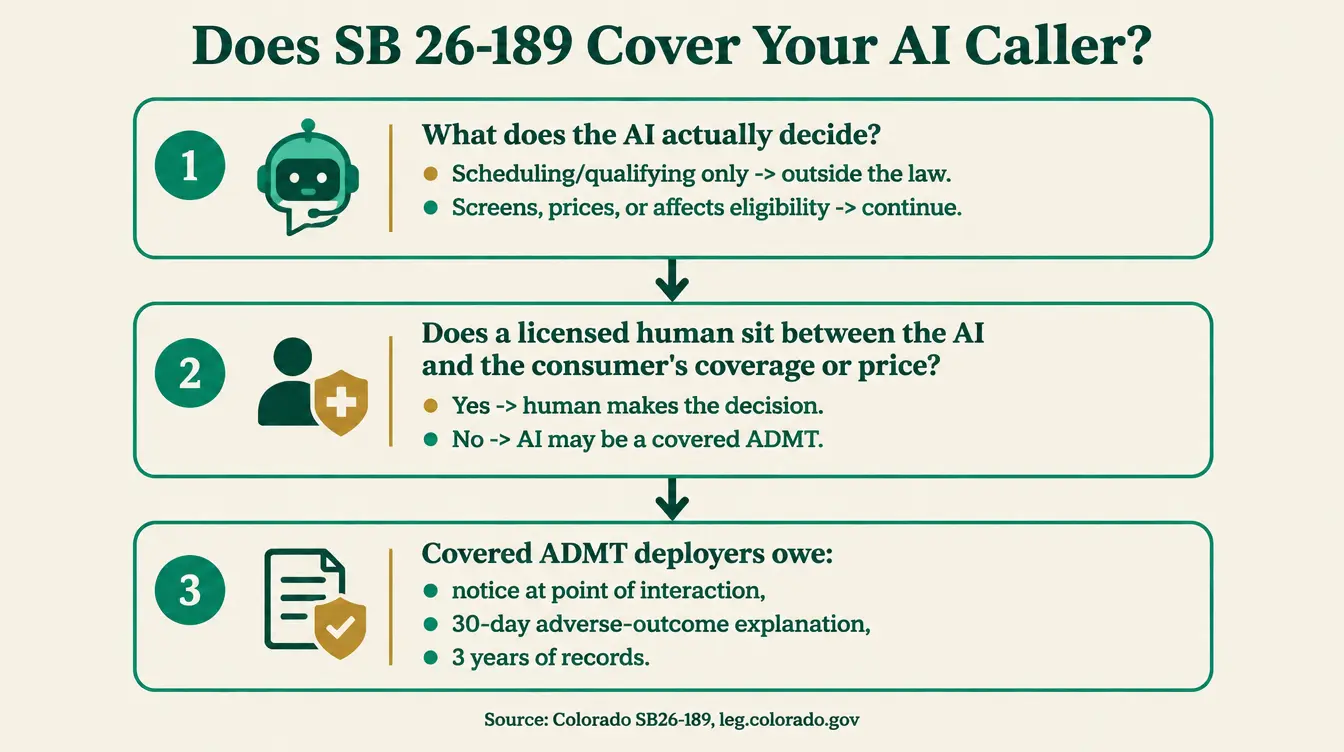
A system that books the appointment is not the system that decides what happens at the appointment.
Mike MooreThat line moves the moment you configure the AI to do more than route and schedule. If you let it screen leads out before a human ever sees them, based on anything that functions like an eligibility filter, you’ve built a system that’s substantially factoring into access to insurance, which is exactly the fact pattern SB 26-189 targets. The same is true if an AI system is ever involved in setting or adjusting a quoted price, or in deciding who gets contacted about a product based on characteristics that look like a proxy for a protected class. None of that is typical for a lead-qualification and warm-transfer tool, but it’s a real configuration choice some agencies could make without thinking of it as “automated decision-making,” and it’s worth checking your own setup against that specific line rather than assuming the category is automatically safe because most uses of it are.
This is not legal advice for your specific agency
This article reflects a reading of SB 26-189's published text as of its publish date. Whether your specific configuration counts as a covered ADMT making a consequential decision depends on facts about how you've built and used it that only you, and your counsel, can evaluate. If any part of your calling program influences eligibility, pricing, or who gets access to a quote, get a lawyer's read on it before assuming either answer.
What’s Already Regulated Separately
SB 26-189 isn’t the only rule touching AI and insurance in Colorado, and it’s worth knowing it sits in a different lane from the state’s insurer-specific algorithm rules. The Colorado Division of Insurance, not the Attorney General, has separately built governance and testing requirements aimed specifically at carriers’ use of external consumer data and predictive models in underwriting, under different statutory authority than SB 26-189. That track is about a carrier’s pricing and underwriting algorithms, enforced by the insurance regulator. SB 26-189 is a general consumer-protection statute, enforced by the Attorney General, that happens to name insurance as one of several covered domains. If you’re an independent agent or agency, not a carrier, the Division of Insurance’s algorithm rules generally aren’t the ones your lead-follow-up calling program needs to worry about; SB 26-189, and whether your use case meets its definitions, is the more relevant question, alongside the federal rules below that apply no matter what Colorado does next.
The TCPA Still Applies, Full Stop
This is the part that gets lost in every conversation about state AI laws, and it’s the compliance question that actually touches nearly every agency running an AI caller, in Colorado or anywhere else: the federal Telephone Consumer Protection Act already governs AI-generated voice calls, and has since February 2024.
The FCC’s Consumer and Governmental Affairs Bureau issued a Declaratory Ruling, docketed as CG Docket No. 23-362 and numbered FCC 24-17, adopted February 2, 2024 and released February 8, 2024. Its holding is direct: “we confirm that the TCPA’s restrictions on the use of ‘artificial or prerecorded voice’ encompass current AI technologies that generate human voices.” The ruling goes on to state that calls using such technologies “therefore require the prior express consent of the called party to initiate such calls absent an emergency purpose or exemption.” The Commission was explicit that it would not allow “any carve out of technologies that purport to provide the equivalent of a live agent.”
| Question | Governed by | Applies to a routine lead-follow-up AI caller? |
|---|---|---|
| Is the AI voice itself legal to use on this call? | FCC declaratory ruling, FCC 24-17, under the TCPA | Yes, prior express consent required, nationwide, regardless of state |
| Does the AI's output decide insurance eligibility, cost, or access? | Colorado SB 26-189, effective January 1, 2027 | Usually no, for scheduling and qualification only; depends on configuration |
Sources: FCC 24-17, CG Docket No. 23-362; Colorado General Assembly, SB26-189.
That means a Colorado agency can clear SB 26-189’s definitions entirely, by running an AI caller that only schedules and qualifies, and still owe prior express consent under the TCPA before that same AI-voiced call goes out. The two obligations don’t overlap in what they regulate, and passing one tells you nothing about the other. Every post on this site about AI calling repeats this same point for a reason: the TCPA doesn’t care what state you’re calling into, doesn’t care whether a state AI law applies to you, and doesn’t go away because a narrower state statute got rewritten in your favor.
If SB 26-189 Does Apply to You: The Obligations
For the agency whose use case does cross into consequential-decision territory, here’s what the bill’s text actually requires, not a vague “be careful” warning.
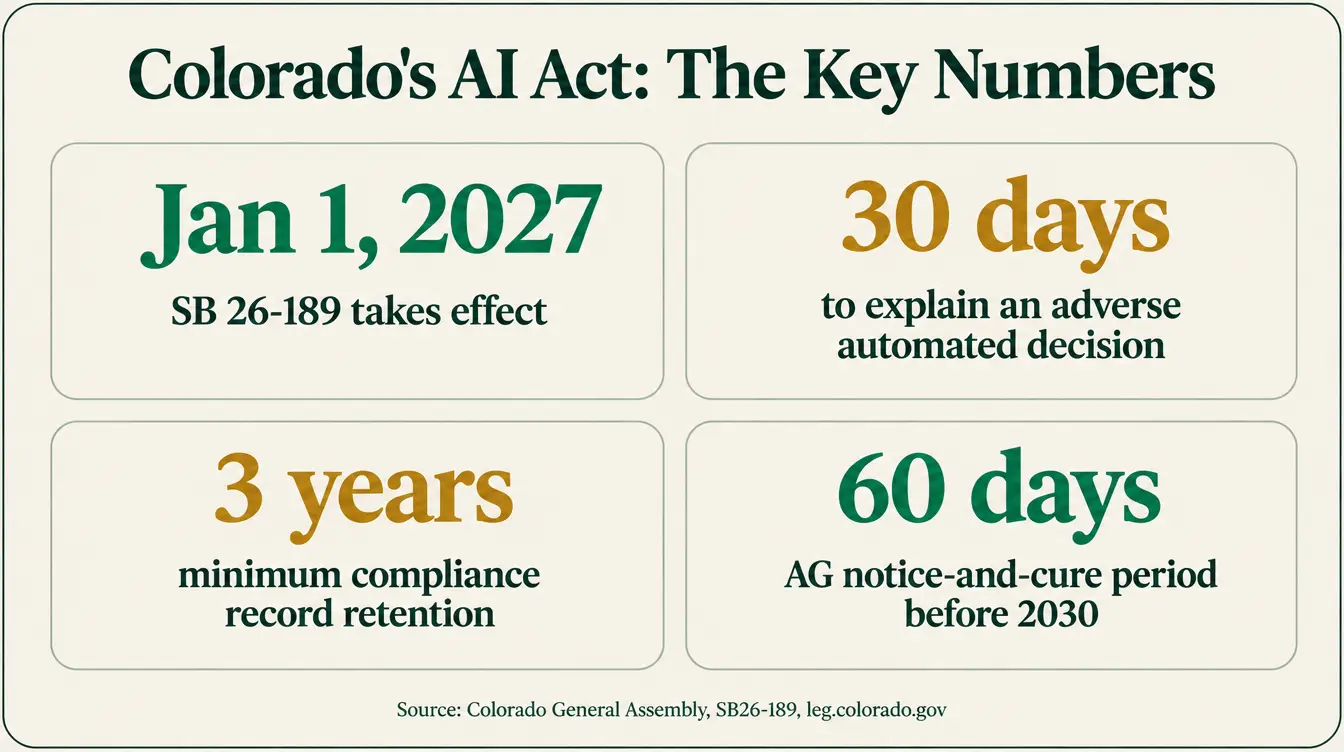
Jan 1, 2027
Date SB 26-189's primary compliance obligations begin
Source: SB26-189, leg.colorado.gov
30 days
Window to provide a plain-language explanation after an adverse outcome
Source: SB26-189, leg.colorado.gov
3 years
Minimum compliance-record retention for deployers and developers
Source: SB26-189, leg.colorado.gov
60 days
Notice-and-cure period the AG must give before enforcement, through 2029
Source: SB26-189, leg.colorado.gov
A deployer, the agency actually using the system, has to give consumers clear and conspicuous notice at the point of interaction that a covered ADMT is in use. If that system produces an adverse outcome for a specific consumer, the deployer then has 30 days to provide a plain-language description of the ADMT’s role in that decision. Consumers get the right to request correction of personal data the system used if it’s factually wrong, and the right to request meaningful human review and reconsideration of an adverse decision. Deployers have to keep compliance records for at least three years.
A developer, the entity that built or substantially modified the system, owes a separate set of obligations: supplying technical documentation covering intended uses, categories of training data, known limitations, and guidance for appropriate use, starting January 1, 2027, plus notifying deployers of material updates and keeping its own three-year compliance record.
Enforcement runs through the Colorado Attorney General under the Colorado Consumer Protection Act, treating a violation as a deceptive trade practice. Through January 1, 2030, the AG has to give 60 days’ notice and a chance to cure a curable violation before bringing an action. The bill does not create a new private right of action, which means the main enforcement risk here runs through the state, not through individual consumer lawsuits, a meaningfully different exposure profile than the TCPA.
Why This Matters Before 2027, Not After
None of this is a 2027 problem to revisit in a year. The agencies building their AI calling stack right now are the ones who’ll either have clean documentation already in place when the law takes effect, or be scrambling to reconstruct it under a deadline.
Independent insurance agencies are adopting AI fast enough that “wait and see” is already the minority position. The Big “I“‘s 2026 Agents Council for Technology Tech Trends Report found that among independent agencies, 33% describe themselves as “just experimenting” with AI, 22% say they’re “using AI in limited areas,” and 8% say AI is “embedded in daily workflows,” against 31% not currently using it at all. Looking forward, 68% of agencies, combining those “very likely” and “somewhat likely,” say they plan to increase their AI use in the next 12 months.
Where independent insurance agencies stand on AI adoption, 2026
Self-reported maturity level among independent agencies surveyed in the Big "I"'s 2026 Tech Trends Report.
Source: Independent Insurance Agents & Brokers of America (Big "I"), 2026 Agents Council for Technology Tech Trends Report.
An agency that documents what its AI caller does and doesn’t decide now, while it’s building the thing, has that answer ready the day a regulator, a carrier compliance audit, or a consumer request for human review actually asks. An agency that configures the system first and asks the compliance question in December 2026 is reconstructing that documentation under a deadline, for a system that’s already been running for a year.
How to Build a Compliant AI Calling Program Now
Here’s the method, whether you build this yourself or buy it from a vendor, including us.
- Write down, in plain language, exactly what your AI caller decides versus what a human decides. If the honest answer is “it schedules and qualifies, a licensed agent quotes and binds,” you’ve just drafted the core of your own compliance position, and it’s worth putting it in writing before you need it.
- Never let the AI be the last stop for a lead before coverage, pricing, or eligibility gets decided. The line between “outside SB 26-189” and “inside it” is whether a human, licensed decision-maker sits between the AI’s output and anything that touches access, cost, or eligibility. Keep that human in the loop by design, not as an afterthought.
- Capture prior express consent before any AI-voiced call goes out, separate from whatever Colorado requires. The FCC’s February 2024 ruling means this obligation exists everywhere you call, under the TCPA, regardless of what state law does or doesn’t say about automated decision-making.
- Disclose that the caller is AI where required, and build the disclosure into the call script itself, not a buried terms page. A verbal disclosure at the start of the call satisfies both the spirit of SB 26-189’s notice requirement and the broader disclosure norms showing up across other states, which is worth reading more on in the disclosure laws roundup on this site.
- Keep full call recordings and transcripts, retained at least three years. That’s the floor SB 26-189 sets for deployers if it applies to you, and it’s a good floor to hold yourself to regardless, since it’s also the raw material a TCPA consent dispute or a CMS marketing audit would ask for.
- If you buy this instead of building it, ask the vendor what documentation they can hand you, not just what the system can do. A developer under SB 26-189 owes deployers documentation on intended uses, training data categories, known limitations, and usage guidance. A vendor who can’t produce anything like that when asked is a vendor who hasn’t thought about this question either.
You can build every piece of this yourself with a compliant dialer and a documented process. Plenty of agencies do, and it’s worth pricing that build against buying it before deciding either way.
How TheAffordableAI Handles This
Scheduling and qualification, not underwriting
The AI qualifies a lead, checks real-time availability, and books a licensed agent's calendar. It doesn't price a policy or decide who gets quoted.
Warm transfer to a human for anything that matters
Calls ring 20+ agents at once, first to answer gets the lead, and the licensed conversation about coverage happens with a person, every time.
Full transcript and recording on every call
Word-for-word transcripts and audio sync automatically, building the documentation trail a consent dispute, a compliance audit, or a human-review request would actually test.
Two-way HighLevel CRM sync
Tags, dispositions, transcripts, and recordings sync natively, not through a fragile webhook chain you have to maintain yourself.
Number warmup and spam defense
Calling volume ramps in weekly stages rather than firing at full volume on day one, which protects the caller ID you're trying to build trust with.
No contracts either way
Single Account runs $200/mo plus a $500 one-time setup at $0.20/min, down to $0.15 at bulk. Agency runs $500/mo plus a $1,000 setup at $0.18/min, down to $0.16 at bulk.
None of this tells you whether your specific configuration counts as a covered ADMT under Colorado law; that’s a question about what you’ve built, not what any vendor sells you. If you want to hear what the disclosure and the warm transfer actually sound like before deciding anything, there’s a live demo call on the homepage. The math above uses $0.20 a minute because that’s the published Single Account rate; run it against your own numbers on the pricing page.
What You Actually Get
Reading SB 26-189 closely instead of reacting to the headline “Colorado passes new AI law” turns a vague worry into an actual checklist: know what your AI decides versus what a human decides, keep a human between the AI and anything that touches eligibility or price, document it in writing, and treat the TCPA’s consent requirement as the floor that applies no matter what Colorado’s AI law ends up covering. Most lead-follow-up and scheduling use cases clear that bar by design, not because the law is weak, but because that’s genuinely not the kind of decision a calling tool makes.
This article reflects a reading of SB 26-189’s published text at leg.colorado.gov, the FCC’s February 2024 declaratory ruling, and the sources cited throughout, as of this article’s publish date. It is general information, not legal advice for your specific agency. The law’s own Attorney General rulemaking is still developing guidance as of this writing, and that guidance could sharpen or shift exactly where the line sits. Talk to counsel before finalizing a compliance position, especially if any part of your AI calling program touches pricing, underwriting, or who gets access to a quote.
Compliance disclaimer
Colorado's SB 26-189 regulates automated decision-making technology used to make or substantially factor into a consequential decision about a consumer, including decisions affecting insurance eligibility, cost, or access, effective January 1, 2027. Separately, the FCC's declaratory ruling in CG Docket No. 23-362 (FCC 24-17) confirms that an AI-generated voice is an "artificial voice" under the TCPA, requiring prior express consent before an AI-voiced call goes out, nationwide, regardless of state law. Any AI caller must disclose that it is AI where required and honor opt-outs immediately. Medicare marketing carries CMS's additional rules, including the TPMO disclaimer and call recording retention requirements, on top of all of the above. Using AI, or any calling platform, does not transfer compliance liability away from the licensed agent or agency placing the calls. This article is general information, reviewed as of its publish date, and not legal advice for your specific situation.
Colorado spent three years and three versions of this law trying to land on the right scope, and landed on one that reaches a lot less than “any AI an insurance business touches.” Know what your system actually decides, keep the record of it, and the law that took three tries to write becomes a short checklist instead of a reason to panic.
Hear what a compliant AI caller actually sounds like
There's a live demo call on the homepage. Listen to the disclosure, the qualification questions, and the warm transfer to a licensed agent end to end.
Frequently asked
What is Colorado's SB 26-189 and when does it take effect?
SB 26-189, titled Automated Decision-Making Technology, is a Colorado law Governor Jared Polis signed on May 14, 2026. It repeals and replaces the state's original 2024 AI Act, and its primary compliance requirements take effect January 1, 2027, per the bill's own text at leg.colorado.gov. It regulates how 'covered ADMT,' automated decision-making technology, can be used to make or substantially assist a 'consequential decision' about a consumer in specified domains, including insurance.
Does SB 26-189 replace the original Colorado AI Act?
Yes, entirely, and before that original law ever took effect. Polis signed the first version, SB 24-205, on May 17, 2024, with an original effective date of February 1, 2026. Lawmakers delayed that date to June 30, 2026 with SB25B-004, signed August 28, 2025. Before that delayed date arrived, SB 26-189 repealed SB 24-205 outright and replaced it with a narrower framework, removing the original law's broad duty of care and mandatory impact assessment requirements for developers and deployers. The current law has never actually been enforced in its original form.
Does SB 26-189 cover the AI caller my insurance agency uses for lead follow-up?
Probably not, for the specific job most agencies use it for, and here's the actual test rather than a guess. The law reaches a 'covered ADMT' that makes, or is a substantial factor in making, a 'consequential decision,' defined as a determination affecting a consumer's access to, eligibility for, or cost of insurance, among other domains. An AI caller that qualifies a lead, checks availability, and books an appointment with a licensed agent isn't deciding anything about that person's insurance eligibility, coverage, or price; a human agent and the carrier's own underwriting still make that call. If you ever configure the AI to screen leads out of ever reaching an agent, auto-decline based on any characteristic, or influence pricing or underwriting, you've crossed into exactly the territory this law is written for, and the analysis changes.
What do I have to do if my AI calling program does count as a covered ADMT?
Under SB 26-189's deployer obligations, you'd need to give consumers clear and conspicuous notice at the point of interaction that a covered ADMT is in use, and if it produces an adverse outcome for that consumer, provide a plain-language description of its role within 30 days. Consumers get the right to request correction of incorrect personal data the system used and to request meaningful human review of an adverse decision. Deployers also have to retain compliance records for at least three years. None of this is legal advice for your specific setup; it's what the bill's text requires as written.
Does Colorado's AI Act change my TCPA obligations for AI voice calls?
No, and this is the compliance question that actually applies to nearly every agency using an AI caller, Colorado or not. The FCC issued a declaratory ruling, FCC 24-17, released February 8, 2024, confirming that the TCPA's restriction on 'artificial or prerecorded voice' calls covers current AI technologies that generate or clone a human voice. That means prior express consent is required before an AI-voiced call goes out, the same as it would be for a prerecorded message, regardless of whether SB 26-189 applies to your use case at all. Colorado's new law and the TCPA are two separate obligations, and clearing one says nothing about the other.
Is there a small-business exemption from SB 26-189?
The bill's text references exemptions for specified entities to the extent they already comply with other legal obligations, but it does not spell out a clean employee-count or revenue threshold the way some other state privacy laws do. Don't assume your agency is automatically out of scope because it's small. Read the bill's definitions against your actual use case, or have counsel do it, rather than relying on agency size alone.
What happens if I ignore this and get it wrong?
The Colorado Attorney General enforces SB 26-189 through the Colorado Consumer Protection Act, treating a violation as a deceptive trade practice. The bill gives deployers and developers a notice-and-cure path before January 1, 2030: the AG must provide 60 days' notice and an opportunity to fix a curable violation before bringing an enforcement action. The law does not create a new private right of action for consumers to sue directly over it, which is a materially different exposure than the TCPA, where a private lawsuit is the main risk. That doesn't make it safe to ignore; it changes who comes after you and how.
Does using a managed AI caller like TheAffordableAI transfer any of this liability?
No, and no vendor can honestly tell you otherwise. A platform can build disclosure language into the call flow, log consent, retain recordings and transcripts, and route anything that looks like an eligibility or pricing decision to a licensed human rather than letting the AI resolve it. None of that moves legal responsibility for compliance with SB 26-189, the TCPA, or any Medicare marketing rule away from the licensed agent or agency placing the calls. That responsibility stays where it's always been, regardless of what technology dialed the number.
Sources
- Colorado General Assembly — SB26-189, Automated Decision-Making Technology (official bill page, signed May 14, 2026)
- Squire Patton Boggs — All Eyes on AI: Colorado Governor Signs First-in-Nation AI Legislation (SB 24-205 signing date and original effective date)
- PYMNTS — Colorado Delays AI Act to June 2026; Businesses Get Breathing Room (SB25B-004, signed August 28, 2025)
- Federal Communications Commission — Declaratory Ruling, Implications of Artificial Intelligence Technologies on Protecting Consumers from Unwanted Robocalls and Robotexts, CG Docket No. 23-362, FCC 24-17 (released February 8, 2024)
- Independent Insurance Agents & Brokers of America (Big "I") — 2026 Agents Council for Technology Tech Trends Report, via Independent Agent
- TheAffordableAI — Pricing (fetched October 6, 2026)
- TheAffordableAI — Features (fetched October 6, 2026)
Put this on your own phone line
See the AI dial, qualify, and warm-transfer a live call in under a minute. No contract, no dev work.
Keep reading

AI Voice Disclosure Laws for Insurance Agents (2026)
Do you have to tell an insurance lead they're talking to AI? What the FCC, Utah, California, and CMS actually require, state by state, verified in 2026.

AI Calling Mistakes Insurance Agencies Make in 2026
Two-thirds of independent agencies plan to expand AI use in 2026, but 55% have no written policy. Seven setup mistakes that turn a caller into a liability.

Build vs Buy: What an AI Voice Agent Costs in 2026
Should your agency build its own AI voice caller or buy one? Real 2026 rates from GoHighLevel, Twilio, Vapi, Bland AI, and Retell, compared line by line.