AI Calling Mistakes Insurance Agencies Make in 2026
Two-thirds of independent agencies plan to expand AI use in 2026, but 55% have no written policy. Seven setup mistakes that turn a caller into a liability.

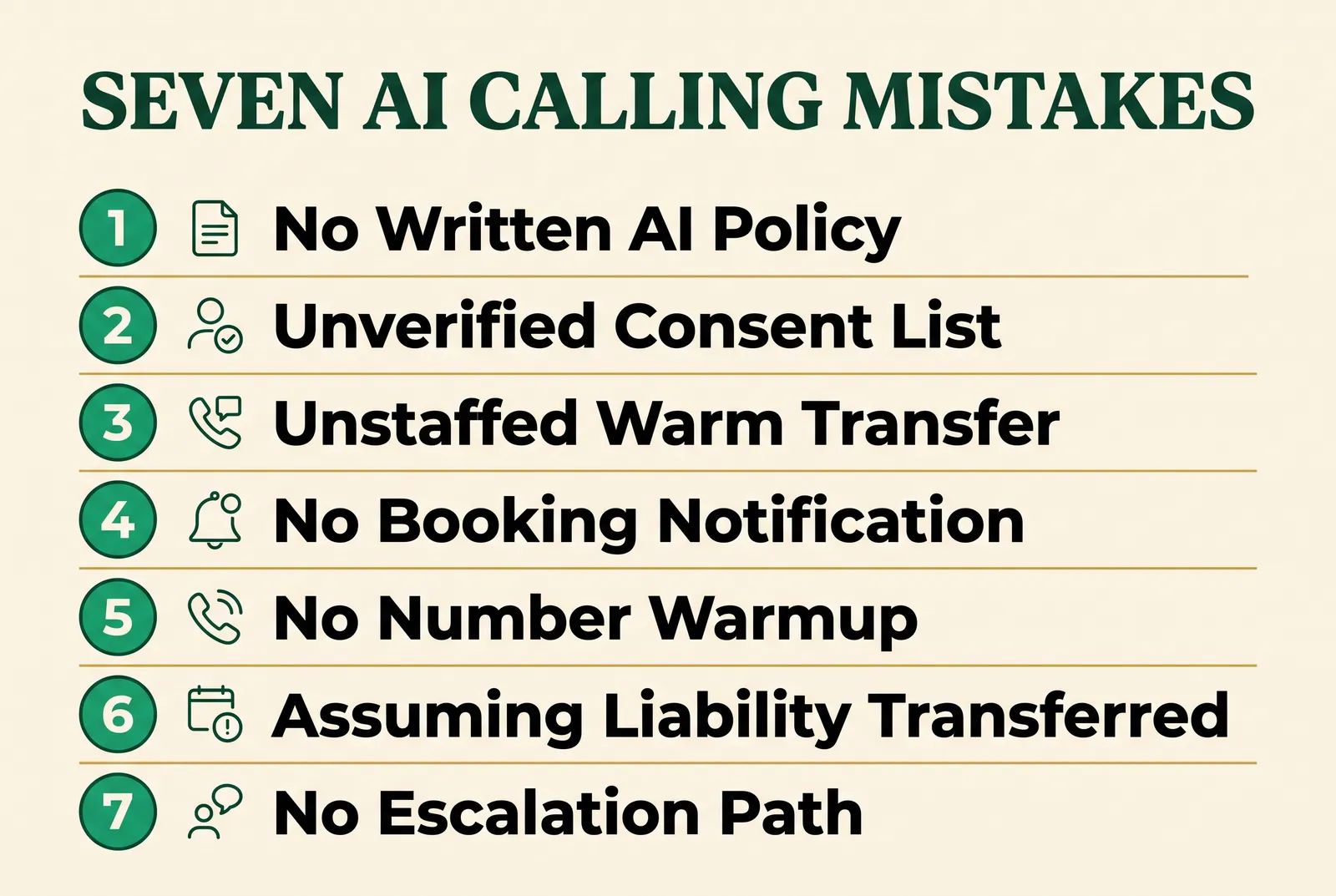
An agency in your position turns on an AI caller, watches it book three appointments in the first afternoon, and feels good about the decision. Two weeks later, someone finally checks the calendar those appointments landed on and finds a handful of slots nobody confirmed, a caller who asked to stop being called and got called again anyway, and a number that’s started going straight to voicemail because it picked up a spam label nobody was watching for. None of that happened because the AI didn’t work. It happened because the parts around the AI, the CRM sync, the consent check, the number hygiene, weren’t built before the first call went out. This piece is a straight list of the mistakes that cause that, in the order agencies actually hit them, with what fixes each one.
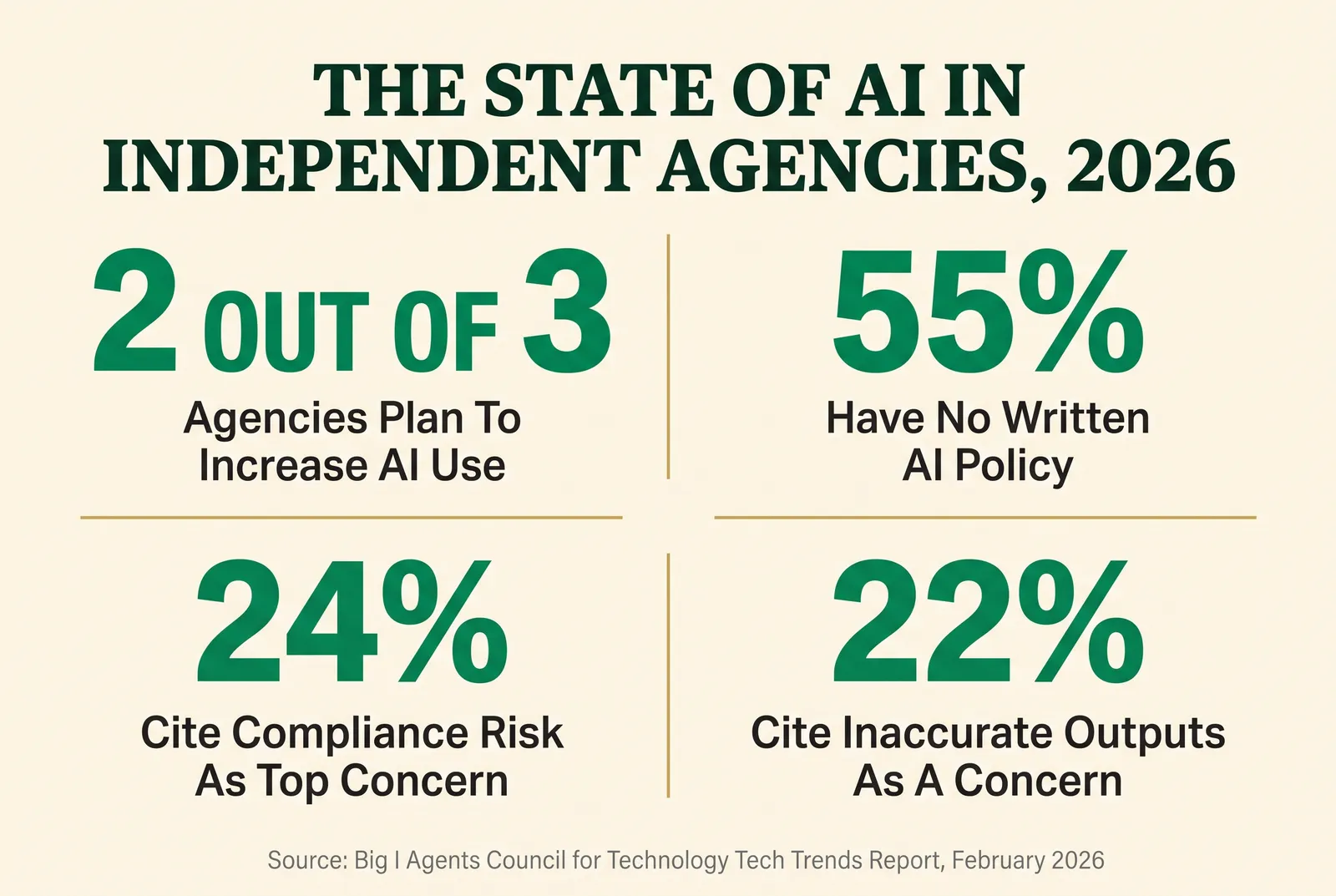
Two-thirds of independent insurance agencies plan to increase their use of AI in the next 12 months, according to the 2026 Big “I” Agents Council for Technology Tech Trends Report, a national survey of Big “I” member agencies released February 19, 2026. Adoption is moving fast. The same report found that 55% of those agencies have no written policy governing how AI gets used, and that data privacy or compliance risk is the single most-cited concern, ahead of cost, ahead of accuracy, ahead of everything else. The gap between “we’re adding this” and “we’ve thought through how” is exactly where the mistakes below live.
The short version
- Two-thirds of independent agencies plan to increase AI use in the next 12 months, but 55% have no written AI policy, per the Big "I" Agents Council for Technology's 2026 report.
- The most common failure isn't the AI misbehaving, it's a booked appointment or a warm transfer that nobody was notified about, because CRM sync and alerting weren't configured.
- The FTC's call-abandonment rule caps abandoned calls at 3% and requires a live connection within two seconds of the greeting, under 16 CFR 310.4(b)(4); an AI warm transfer with no staffed fallback breaks this the same way a predictive dialer does.
- The FCC ruled in February 2024 that AI-generated voices are "artificial voice" under the TCPA (FCC 24-17); using AI does not move consent, disclosure, or opt-out liability off the agency.
- Medicare-touching calls must be recorded and retained for a minimum of six years under 42 CFR 422.2274(g), with the first three years in audio format, a setting most generic voice AI tools don't handle by default.
Why this is happening now, and why it’s mostly a setup problem
AI calling tools got cheap and easy to turn on faster than most agencies built the internal process to turn one on correctly. That’s the pattern the Big “I” data shows plainly: 38% of surveyed agencies said they’re very likely to increase AI use this year, another 30% somewhat likely, against a current adoption picture where 33% describe themselves as just experimenting, 22% using it in limited areas, and only 8% with AI embedded in daily workflows. Most agencies are early, moving fast, and doing it without a document that says who’s allowed to turn a new tool on or what it’s allowed to say.
Where independent agencies actually are with AI right now
Self-reported current adoption stage, national survey of Big "I" member agencies, reported February 19, 2026.
Source: Independent Insurance Agents & Brokers of America, 2026 Agents Council for Technology Tech Trends Report, reported February 19, 2026. Bars scaled relative to the highest figure in this set (experimenting, 33%).
Read those four numbers together and the shape of the problem is obvious: nearly a third of agencies haven’t started, another third are experimenting without a settled process yet, and only 8% have reached the point where AI is a routine, governed part of daily operations. Most of the industry is sitting in the two middle stages right now, exactly where the mistakes in this article do the most damage, because the tool is live enough to matter but the process around it hasn’t caught up.
None of the mistakes in this article are about the underlying technology failing to work. A voice pipeline that recognizes speech, decides what to say, and speaks a response is a solved problem at this point; we’ve written separately about how that pipeline actually works if you want the mechanics. What breaks is everything wired around it: whether a human gets told when the AI hands them something, whether the list being dialed has valid consent behind it, whether a transfer actually lands on a person, and whether anyone wrote down what the AI is and isn’t allowed to do before it started doing it. Every mistake below is an integration or a policy gap, not a technology limitation, which is also why every one of them is fixable without switching platforms.
A word most of this article uses: "trigger"
A trigger is the event that starts an automation, a new contact being created, a call ending, an appointment getting booked. Nothing downstream happens unless something is actually chained to that trigger. Most of the mistakes below come down to a trigger that fires correctly with nothing useful attached to it.
Mistake 1: Turning it on with no written policy
Nobody at most agencies has written down who’s allowed to enable a new AI tool, what it’s permitted to say to a caller, when it has to stop and hand off to a licensed human, and how consent gets checked before a number gets dialed. The Big “I” report puts a number on how common that gap is: 55% of independent agencies have no written AI policy, 23% have one under development, and just 13% have a formal policy in place. Separately, when the same survey asked what worries agencies most about AI, data privacy or compliance risk topped the list at 24%, ahead of inaccurate outputs at 22%, losing human interaction at 17%, and not knowing how to apply it effectively at 16%.
That’s a strange combination to sit with: compliance risk is the top concern, and more than half the industry hasn’t written down the policy that would actually manage it. A written policy doesn’t need to be a legal document. It needs to answer four questions plainly enough that a new hire could read it and know what to do: who can turn on a new automated calling tool, what scripts or topics require a human, what counts as valid consent before a number gets dialed, and what the escalation path is when a call goes sideways. Write that down before the next tool gets enabled, not after something goes wrong with the one that’s already running.
You can write this yourself this week
A one-page policy covering the four questions above, reviewed by whoever handles compliance at your agency, closes most of this gap. It doesn't require a vendor or a consultant. The absence of the document is the actual risk, not the absence of a sophisticated one.
Mistake 2: Automating a list you haven’t checked for consent
An AI caller dials faster and more consistently than a person working the same list by hand, which means a bad list gets worked all the way through before anyone notices the problem, instead of getting caught three calls in when a staffer starts wondering why half the numbers are dead. Automation doesn’t create a consent problem. It removes the slow, uneven pace that used to buy time to catch one.
The relevant standard hasn’t changed: automated or artificial-voice calls to a wireless number require prior express consent under the TCPA, and marketing calls specifically require prior express written consent, per the FCC’s February 2024 ruling confirming that AI-generated voices count as “artificial voice” for this purpose. What has changed is how many agencies are sitting on aged or resold lists where the original consent language is vague, missing, or was captured through a lead source that’s since shut down. Before pointing an AI caller at any list that isn’t fresh, pull the actual consent record for a sample of it. If you can’t produce what was disclosed and what box was checked for a given lead, that lead doesn’t go to automated dialing; route it to a live, manually-dialed call instead, which isn’t subject to the same autodialer and artificial-voice consent standard. We’ve written a full breakdown of what changed with aged lead consent and the Reassigned Numbers Database in our piece on aged insurance leads if your database needs that level of detail.
| Element | What it means in practice |
|---|---|
| Clear disclosure | The consumer was told, in writing, that they'd receive automated or artificial-voice marketing calls at the number given |
| Specific to the seller | Consent names who's calling, not a generic list of "our marketing partners" |
| Signature or equivalent | An electronic signature, checkbox with clear language, or equivalent affirmative act, not a pre-checked box |
| Number still valid | The number hasn't been reassigned to a different person since consent was captured |
Mistake 3: A warm transfer with nobody actually staffed to take it
This is the mistake that produces the caller stuck in dead air. An AI caller qualifies a lead, decides they’re ready to talk to a person, and tries to connect them, and if nobody’s actually available on the other end, the caller either sits on hold or the call drops. This is the same failure mode the Telemarketing Sales Rule was written to prevent for predictive dialers, and it applies just as directly to an AI transfer.
Under 16 CFR 310.4(b)(4), a call is considered abandoned if it isn’t connected to a live sales representative within two seconds of the person’s completed greeting, and a telemarketer’s abandonment rate across a campaign, or a rolling 30-day period, can’t exceed 3% of all calls answered by a person. The rule includes a safe harbor: allow the phone to ring at least 15 seconds or four rings before disconnecting an unanswered call, and if a rep isn’t available within that 2-second window, play a required recorded message rather than leaving dead air. None of that changes because a machine, not a person, initiated the qualifying conversation. If your AI caller’s warm-transfer step routes to a queue that’s frequently unstaffed, you’re running the exact scenario this rule targets, whether you built the dialer yourself or bought it from a vendor.
The fix isn’t a smarter AI. It’s making sure the transfer target is genuinely available, whether that’s a live agent, a round-robin group with real people in rotation, or a clearly defined fallback (book a callback slot, don’t leave the caller hanging) for when nobody’s free. We covered the mechanics of building this correctly in GoHighLevel in our workflow piece on trigger-to-warm-transfer builds, and the broader case for warm transfers over other follow-up methods in our comparison of warm transfers against voicemail drops.
Test the transfer path before real leads hit it
Call your own AI number, get qualified, and see what happens when you ask to speak to someone. Do it during your slowest coverage window, not your best-staffed hour. If the caller you're playing hits dead air or a dropped call, a real lead will too.
Mistake 4: Booking the appointment, telling no one
This is the single most common version of “the handoff dies.” The AI does exactly what it was built to do, qualifies a caller and books them on a calendar or logs a disposition, and the workflow stops there because nothing was configured to tell a human it happened. The lead exists in the system. Nobody’s looking at it.
HighLevel’s own documentation for its Contact Created trigger describes the mechanic plainly: a trigger fires “regardless of how the contact is created, manually, via form submissions, or through integrations,” and from there a workflow can send a notification, assign a user, or update a field, but only if something’s actually chained to that trigger. The gap agencies hit isn’t that the trigger doesn’t fire. It’s that the automation stops at “assign the lead” and never adds the step that makes a specific person’s phone buzz. A contact sitting unassigned, or assigned to someone who was never actually told, produces the exact same outcome as no AI caller at all: a lead that goes cold while everyone assumes someone else has it.
The fix is a five-minute check, not a rebuild: open the workflow that handles a booked appointment or a completed AI call, and confirm there’s an internal notification action, addressed to a specific person or a round-robin group, chained after it. If the workflow ends at “update contact record” and nothing else, that’s the gap. Pair that with a native sync between the AI caller and your CRM, so the transcript, disposition, and outcome land automatically instead of depending on someone remembering to log it by hand.
The booking nobody sees
- AI qualifies the caller and books a calendar slot
- Disposition gets logged to the contact record
- No notification fires to a specific person
- The slot sits until someone happens to check the calendar
SilentThe lead technically converted and nobody knows it
The booking that gets worked
- AI qualifies the caller and books a calendar slot
- Disposition and transcript sync to the CRM automatically
- An internal notification fires to the assigned agent or round-robin group
- A human confirms or follows up within the hour
WorkedThe booking turns into an actual conversation
Mistake 5: Ignoring the number until it’s already flagged
An agency that ramps outbound call volume overnight on a number that’s never made a call before is doing the exact thing that gets numbers flagged. Carriers watch for a sudden jump in outbound volume from a previously quiet number, high rates of unanswered or quickly-hung-up calls, and complaint reports, and none of that cares whether a human or an AI is dialing. Once a number picks up a “Spam Likely” or “Scam Likely” label, pickups drop off a cliff and nobody tells you it happened; the connect rate just quietly falls and stays there until someone investigates.
Number warmup, gradually ramping volume on a new number over days or weeks rather than going from zero to full volume on day one, and ongoing spam monitoring aren’t optional extras on an AI calling setup. They’re the difference between a number that keeps working and one that silently stops. We go deep on how carriers make this determination and the specific warmup routine that keeps a number clean in our piece on number warmup and spam labels; the short version for this article is that if your AI vendor doesn’t mention warmup and ongoing spam defense as a standing part of the service, ask what happens to your connect rate in month two.
Mistake 6: Assuming the AI vendor now owns compliance
This is the mistake with the most expensive downside. An agency turns on an AI caller and, somewhere in that decision, starts treating “the AI handles it” as a substitute for “we’ve confirmed this is compliant.” It isn’t, and no vendor’s marketing copy changes the legal answer.
The FCC settled the core question in its February 2024 declaratory ruling, FCC 24-17: AI-generated and cloned voices fall within the TCPA’s definition of “artificial or prerecorded voice,” which means the same consent, identification, and opt-out requirements that have always applied to automated calling apply in full to an AI caller. A violation, an unconsented call, a missed opt-out, a disclosure that didn’t happen, carries the same exposure it always has: under 47 U.S.C. § 227(b)(3), a consumer can recover actual damages or $500 per violation, whichever is greater, and a court can raise that to as much as $1,500 per violation for a willful or knowing violation. That exposure sits with the licensed agent and agency, not with whoever built the AI platform.
Medicare adds a specific, separate layer on top of general TCPA compliance. Under 42 CFR 422.2274(g)(2)(ii), marketing and sales calls touching Medicare Advantage or Part D have to be recorded in their entirety and retained for a minimum of six years, with the first three years specifically in audio format, not just a transcript. An AI calling platform built generically for restaurants or home services almost certainly isn’t configured to retain recordings that long in that format by default. If your lead flow includes any Medicare-touching contacts, that’s a setting to confirm before the first call, not a gap to discover during an audit.
Using AI does not transfer liability
Consent for outbound calls, honest disclosure, a working opt-out, and CMS's Medicare marketing rules remain the licensed agent's and agency's responsibility regardless of what software placed the call. None of that moves to a vendor because the vendor's platform did the dialing.
If you want to hear how a platform actually handles disclosure and opt-out in a live call before you commit to anything, there’s a demo call on the homepage that walks through exactly that. https://theaffordableai.com/
Mistake 7: No plan for the caller the AI shouldn’t handle
A caller in the middle of a claims dispute, someone who’s clearly upset about a rate increase or a denial, or a question that requires actual coverage advice from a licensed producer, all call for a human who can read tone and use judgment, not a system optimized for working through a qualifying script. An AI caller that pushes forward with its script regardless of what it’s hearing turns a bad moment into a worse one, and it’s a completely foreseeable failure if nobody designed for it.
The fix is a defined escalation path, built and tested before launch: what specific signals should trigger an immediate handoff (explicit distress, a request to speak to a person, a question outside the AI’s scope), what happens when a human is available, and what happens when one isn’t. That last part matters as much as the first two. If a vendor you’re evaluating can’t describe concretely what their system does when a distressed caller can’t reach a person right away, that’s a question worth pushing on before your agency’s name is the one on the call.
None of these seven mistakes are about the AI failing to work. Every one of them is a gap in what was built around it, the notification, the consent check, the staffed transfer, the escalation rule, and every one of them is fixable without touching the underlying technology.
— The pattern across all sevenWhat getting this wrong actually costs
The numbers involved aren’t abstract. A single TCPA violation carries $500 to $1,500 of statutory exposure per call under 47 U.S.C. § 227(b)(3), and a list dialed at AI-caller volume without a consent check can generate that exposure many times over before anyone notices the underlying problem. A flagged number that silently stops connecting doesn’t show up as a line item anywhere; it shows up as a connect rate that quietly drops and a pipeline that quietly thins out. A booked appointment nobody was told about costs exactly what the lead itself cost to acquire, plus whatever that policy would have been worth, for nothing in return.
55%
Independent agencies with no written AI policy
Source: Big "I" ACT Tech Trends Report, Feb 2026
24%
Cite data privacy or compliance risk as their top AI concern
Source: Big "I" ACT Tech Trends Report, Feb 2026
3%
Maximum call-abandonment rate allowed under the FTC's safe harbor
Source: 16 CFR 310.4(b)(4)
$1,500
Maximum per-violation TCPA damages for a willful or knowing violation
Source: 47 U.S.C. § 227(b)(3)
This single Big “I” survey is the clearest current data on how independent agencies are actually approaching AI adoption, and it’s worth being direct that it’s one organization’s self-reported national survey without a second, independently-run dataset measuring the identical question. Treat the specific percentages as a snapshot of one trade association’s membership, not a universal industry constant, while the underlying pattern, fast adoption outpacing written policy, is consistent with what shows up anecdotally across insurance forums and vendor case studies more broadly.
How we build around these seven mistakes
TheAffordableAI is built so most of this list isn’t something an agency has to remember to configure correctly; it’s the default. Warm transfers check real-time calendar and agent availability before attempting the handoff, rather than blind-transferring into a queue that might be empty. Every call, transcript, and disposition syncs natively to HighLevel the moment it happens, so the notification gap in mistake four doesn’t depend on a workflow someone built correctly six months ago and never checked again. Number warmup and spam defense run as a standing part of the service, not a one-time setup step, and multi-calendar intent routing sends a booked appointment to whoever’s actually available rather than one person’s calendar by default.
None of that removes the two mistakes that are genuinely the agency’s job: writing the policy, and verifying consent on the list before it gets dialed. No platform can do those for you, and any vendor implying otherwise is worth being skeptical of. Full detail on what’s included on every plan is on the features page.
Warm transfers check availability first
The system confirms a real person is actually free before attempting a handoff, instead of transferring into an empty queue.
Native HighLevel sync, not a workaround
Calls, transcripts, and dispositions land in the CRM automatically, closing the notification gap that strands most booked appointments.
Number warmup and spam defense, ongoing
A standing routine, not a one-time setup step, built to keep a caller ID from picking up a spam label as volume ramps.
Multi-calendar, round-robin routing
A booked appointment routes to whoever's actually available across the team, not a single point of failure.
Run your own setup against this list
Pull up whatever AI calling tool your agency is using, or evaluating, and check it against the seven mistakes above one at a time. If you want to see how the warm-transfer and CRM-sync pieces work in a live call before deciding anything, there's a demo on the homepage.
Where AI calling is the wrong tool, plainly
It’s worth saying where none of this advice matters because the tool itself is the wrong fit. An agency with a handful of long-tenured client relationships and low call volume doesn’t need a managed AI caller to solve a coverage gap it doesn’t have; the setup and monitoring overhead of doing this correctly costs more than the problem is worth at that scale. A book of business built on clients who expect to reach someone who already knows their history loses something real if the first voice they hear on every call is automated, even briefly, even when it’s configured perfectly.
And if your actual constraint is lead quality rather than follow-up speed or coverage, no amount of AI calling fixes that. A faster, better-covered path to a bad lead is still a bad lead. Diagnose which problem you actually have before buying a tool built to solve a different one.
The seven mistakes and the fix for each, side by side
| Mistake | What causes it | The fix |
|---|---|---|
| 1. No written policy | Tool got turned on before anyone documented scope, escalation, or consent rules | A one-page policy answering who, what, when to escalate, and how consent is verified |
| 2. Unverified consent list | Aged or resold leads dialed at automation speed before consent was checked | Sample and verify consent language before automating; route unclear leads to manual calling |
| 3. Unstaffed warm transfer | Transfer target has no one reliably available to take the handoff | Confirm real-time availability before transferring; define a callback fallback |
| 4. No booking notification | Workflow ends at "update contact record" with nothing chained after it | Add an internal notification to a specific person or round-robin group after every booking |
| 5. No number warmup | Volume ramped instantly on a number with no calling history | Gradual volume ramp plus ongoing spam-label monitoring as a standing routine |
| 6. Assuming liability transferred | Treating "the AI handles it" as a substitute for a compliance check | Confirm consent, disclosure, opt-out, and Medicare retention settings match current rules |
| 7. No escalation path | Script keeps going regardless of distress signals or out-of-scope questions | Define and test the exact handoff trigger and the fallback when no human is free |
The audit to run before you change anything
Before adding, replacing, or expanding an AI caller, walk through the seven mistakes above against your current setup, in order: is there a written policy, has the list being dialed been checked for consent, is the warm-transfer target actually staffed, does a booked appointment trigger a notification to a specific person, is the outbound number on a warmup and monitoring routine, does everyone understand that compliance liability stays with the agency regardless of what tool is calling, and is there a tested plan for the caller the AI shouldn’t handle alone. Most agencies that run through this list find they’ve solved four or five of the seven already and have a genuine, specific gap on the rest. That’s a far more useful starting point than a general sense that “the AI thing” is or isn’t working.
Frequently asked
What's the single most common mistake insurance agencies make when they turn on an AI caller?
Wiring the AI to book appointments and log dispositions without wiring anything to notify the human who's supposed to act on them. The AI does its job, a slot fills on the calendar or a callback gets flagged, and it sits there because no CRM automation, text alert, or assigned-user rule was built to surface it. The agency finds out weeks later when someone finally audits the calendar. This is a configuration gap, not a limitation of the technology, and it's fixable in an afternoon once someone knows to look for it.
Do I need a written AI policy for my agency, or is that overkill for a small shop?
The 2026 Big "I" Agents Council for Technology Tech Trends Report found that 55% of independent agencies have no written AI policy at all, and only 13% have a formal one in place. Size doesn't exempt you from the underlying question a policy answers: who's allowed to turn on a new AI tool, what it's allowed to say, when it has to hand off to a licensed human, and how consent gets verified before it dials. A one-page document that answers those four questions is a policy. It doesn't need to be long to close the gap most agencies are currently running without.
Does using an AI caller transfer any compliance liability away from the licensed agent?
No. The FCC's February 2024 declaratory ruling, FCC 24-17, confirmed that AI-generated voices count as an "artificial voice" under the Telephone Consumer Protection Act, meaning the same prior-consent, identification, and opt-out rules apply whether a human or a machine is speaking. Nothing in that ruling, or in any state or CMS rule, shifts the licensed agent's or agency's responsibility to a software vendor. If the AI dials someone without valid consent, discloses the wrong thing, or ignores an opt-out, that's the agency's exposure, not the vendor's, regardless of what the AI did on its own.
What is the FTC's call-abandonment rule, and how does it break AI-powered warm transfers specifically?
Under 16 CFR 310.4(b)(4), the Telemarketing Sales Rule caps abandoned calls at 3% of all calls answered by a person, measured over a campaign or a rolling 30-day period, and defines an abandoned call as one not connected to a live representative within two seconds of the person's greeting. An AI caller that qualifies a lead and then tries to warm-transfer them to a human breaks this rule the same way a predictive dialer does: if nobody's actually available to take the transfer, the caller sits in dead air or gets dropped, and if that happens often enough, the agency is over the abandonment cap. The fix isn't a smarter AI, it's a transfer queue with real people or a real fallback actually staffed behind it.
How does an aged or resold lead list interact badly with an AI caller specifically?
An AI caller can dial a list far faster and more consistently than a person working it manually, which means a consent problem that might surface slowly with manual dialing shows up immediately and at volume with automation. If a lead list was resold through multiple buyers, or the consent language on file doesn't clearly authorize an autodialed or artificial-voice call, turning an AI caller loose on that list multiplies the number of noncompliant calls made before anyone notices the underlying data problem. Automation doesn't create the consent gap; it removes the natural rate-limiting a slower manual process used to provide.
Do Medicare leads need anything different from an AI caller than ACA or life leads?
Yes. Under 42 CFR 422.2274(g)(2)(ii), marketing and sales calls touching Medicare Advantage or Part D have to be recorded in their entirety and retained for a minimum of six years, with the first three years kept in audio format specifically. An AI caller's call logs and recordings can satisfy that if the platform is actually configured to retain them that long in the right format; a generic voice AI tool built for restaurants or dental offices almost never is, by default. Segment Medicare-touching leads before you automate them, and confirm the retention settings match the rule before the first call goes out, not after an audit asks for a recording that was already deleted.
What should the AI do when a caller is upset, confused, or asking something outside what it's built to handle?
Recognize it and hand off, not push forward with the script. A caller in the middle of a claim dispute, someone who's clearly distressed, or a question that requires actual coverage advice from a licensed producer are all situations where an AI continuing to ask qualifying questions makes the experience worse, not better. Before going live, ask any vendor you're evaluating to show you exactly what the AI does in that moment: does it recognize the signal, does it escalate to a live agent if one's available, and what happens if one isn't. If a vendor can't answer that concretely, that's worth knowing before your name is the one on the call.
How do I test an AI caller before turning it loose on real leads?
Run it against your own team first. Have three or four staff members call the AI's number, or have it call them, using realistic scripts: a straightforward qualifying call, an angry caller, someone who says stop calling mid-conversation, and someone asking a coverage question the AI shouldn't answer. Listen to how it handles each one, specifically whether the opt-out actually works and whether the escalation to a human actually fires. Do this before the first real lead is dialed, not after the first complaint comes in. It takes an afternoon and it's the cheapest insurance this whole rollout gets.
Sources
- Independent Insurance Agents & Brokers of America (Big "I") — 2026 Agents Council for Technology Tech Trends Report, reported February 19, 2026
- Federal Communications Commission — Declaratory Ruling FCC 24-17, CG Docket No. 23-362, AI-Generated Voices and the TCPA (adopted February 2, 2024, released February 8, 2024)
- Cornell Law School Legal Information Institute — 47 U.S.C. § 227, Telephone Consumer Protection Act, statutory damages
- Cornell Law School Legal Information Institute — 16 CFR § 310.4(b)(4), Telemarketing Sales Rule, abandoned-call safe harbor
- Federal Trade Commission — Complying with the Telemarketing Sales Rule
- Cornell Law School Legal Information Institute — 42 CFR § 422.2274(g), Agent, broker, and other third-party requirements, call recording and retention
- HighLevel Support Portal — Workflow Trigger: Contact Created
- TheAffordableAI — Pricing (fetched August 2026)
Put this on your own phone line
See the AI dial, qualify, and warm-transfer a live call in under a minute. No contract, no dev work.
Keep reading
GoHighLevel Insurance Workflows: Trigger to Warm Transfer
Most GoHighLevel insurance workflows stop at 'assign the lead.' Here's the trigger-to-warm-transfer build, GHL's own docs, and where TCPA rules bite.

Warm Transfers vs Voicemail Drops: What Actually Gets an Insurance Prospect on the Phone
Voicemail drops feel productive and cost almost nothing. Warm transfers feel expensive and interrupt your day. Only one of them reliably puts a licensed agent in front of a prospect who is ready to talk.

Aged Insurance Leads in 2026: What's Legal to Call
The FCC's one-to-one consent rule for insurance leads is dead. Here's what changed, what still applies, and how to reactivate an aged database correctly.