Consent Certificates Won't Win Your TCPA Case Alone
A 2026 federal ruling shows TrustedForm and Jornaya records can be thrown out of court. What insurance agents need on file before they trust a certificate.

You bought the lead, your dialer called it fast, and somewhere in your CRM there’s a little green checkmark that says “consent verified.” That checkmark is a TrustedForm or Jornaya certificate, and in August 2026 a federal court in Iowa looked at one of those exact records in a Medicare lead case and refused to even consider it. Not because the certificate was fake. Because nobody at the company could get on the stand and explain, under oath, how it was made.
That’s the pain point under this whole article, stated plainly: the document your agency is counting on to prove you had permission to call is not self-proving. It still needs a human who can authenticate it, and most agencies have never asked their lead vendor who that human is.
The short version
- In Toby Hoy v. Medicare Health Advisors, 2026 WL 2622653 (S.D. Iowa, Aug. 7, 2026), the court refused to weigh a Jornaya-style consent record at summary judgment because the defense offered no witness to authenticate it, per the case summary published by TCPAWorld on September 8, 2026.
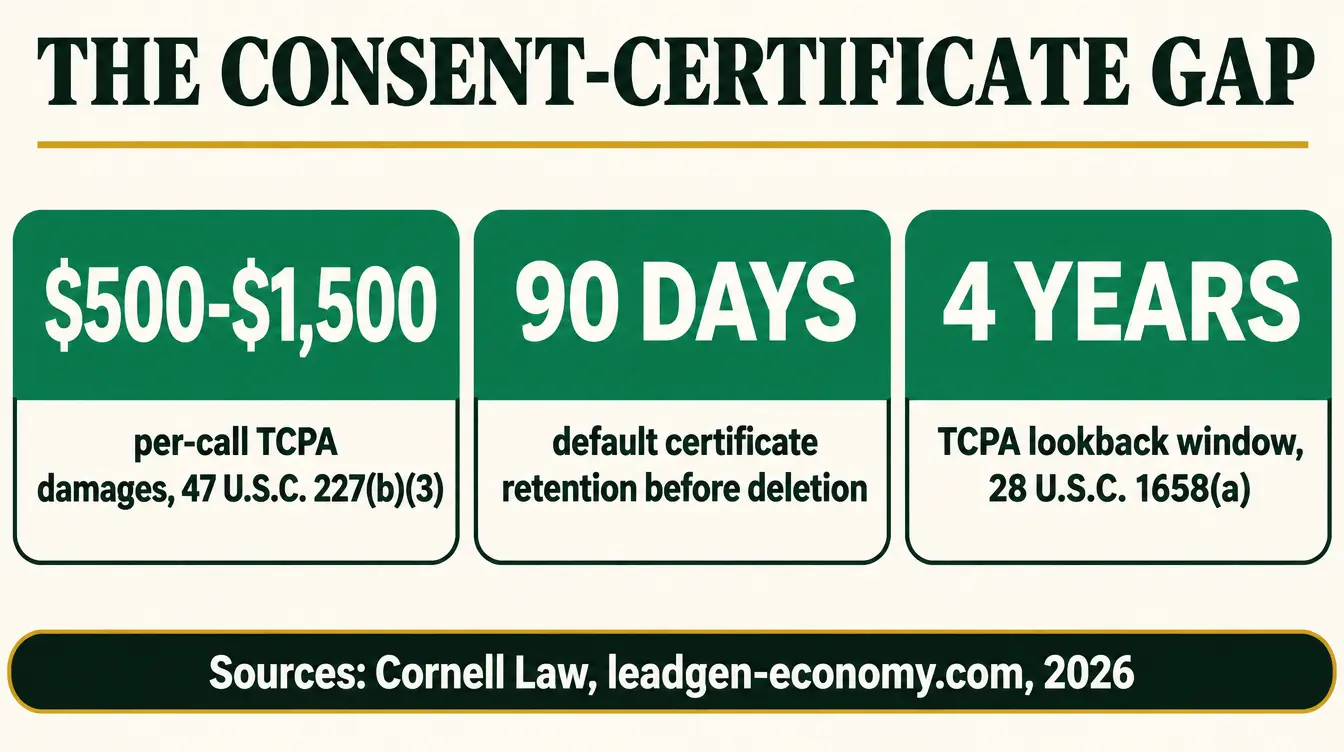
- A standard TrustedForm certificate is deleted after 90 days by default; a paid retention tier extends that to 5 years, per a 2026 TrustedForm-versus-Jornaya comparison from leadgen-economy.com.
- Courts applying the TCPA generally use the four-year federal catch-all limitations period at 28 U.S.C. § 1658(a), per Wellington Homes, Inc. v. West Dundee China Palace Restaurant, Inc., 2013 IL App (2d) 120740. A 90-day certificate is gone long before that window closes.
- Under 47 U.S.C. § 227(b)(3), each unconsented call or text carries $500 in statutory damages, up to $1,500 if a court finds the conduct willful or knowing, with no cap on how many calls can stack into a single claim.
- The fix is not a better certificate. It's a written record of who your lead vendor's custodian is, a retention tier that actually covers the four-year window, and your own internal call log as a second, independent record.
The Pain: A Checkmark That Nobody Can Explain
Ask most agency owners what happens if a purchased lead turns into a TCPA complaint, and the answer is usually some version of “we have a TrustedForm certificate for that.” It sounds like proof. It gets treated like proof. In the vendor’s own dashboard, it even looks like proof, a little badge next to the lead that says consent was documented at a specific timestamp.
Here’s the part that doesn’t show up in the dashboard: a certificate is a record of a web event, not a legal conclusion. It says a form was submitted, with certain disclosure language present on the page, at a certain time. Whether that’s enough to win a lawsuit depends entirely on whether someone can get it admitted as evidence, and that requires a live human, with personal knowledge of how the record was created, willing to sign a declaration or take the stand. Most agencies that buy leads have never asked their vendor who that person is. Most lead vendors, frankly, haven’t thought about it either, until the subpoena arrives.
That’s exactly the gap that opened up under Medicare Health Advisors in August 2026. The agency had the record. It just couldn’t prove the record meant what it said it meant. It’s a different failure mode than the one behind the 2026 Farmers Insurance TCPA settlements, where the problem was never checking the Do Not Call Registry at all. Here, somebody checked. They just couldn’t prove it in a way a court would accept.
Why It Happens: The Mechanism Behind the Gap
Three separate things have to line up for a consent certificate to actually hold up in court, and most agencies only ever think about the first one.
The certificate has to exist. This is the part everyone focuses on, and it’s the easy part. TrustedForm and Jornaya, both ActiveProspect products, generate a timestamped record when a consumer submits a web form, capturing that specific consent language was displayed on the page at that moment. TrustedForm Verify goes a step further and can confirm the approved language was actually present, per ActiveProspect’s own product documentation. If your lead vendor uses either product, a record almost certainly exists somewhere.
The certificate has to be authenticated. This is the part that sank the defense in Hoy. Under the Federal Rules of Evidence, an out-of-court record offered to prove the truth of what it says, that a consumer consented, is hearsay unless it fits an exception. The most common exception for a business record like a consent certificate is Federal Rule of Evidence 803(6), which requires someone with knowledge of how the record was made, kept in the ordinary course of business, to lay that foundation, usually through a sworn declaration. Per the TCPAWorld summary of the Hoy ruling, the defendant “offers no declaration of an individual with knowledge sufficient to lay the foundation for any hearsay exception.” The court noted the record might have qualified under 803(6) if someone had actually made that argument. Nobody did. The court said plainly that it was “precluded from weighing these documents” as a result. Define the term here, because it matters: authentication is the legal step of proving a document is what it claims to be, through a witness, an affidavit, or another recognized method, before a court will consider it as evidence at all.
The certificate has to still exist by the time it’s needed. This is the gap almost nobody plans for. A standard TrustedForm Certify certificate is automatically deleted 90 days after it’s created, unless the agency or vendor has paid for TrustedForm Retain, which extends storage up to 5 years, per a 2026 comparison of the two platforms published by leadgen-economy.com. The same source notes Jornaya’s retention “varies by product,” without a stated default, so that specific claim rests on one source rather than two and should be treated as directional rather than exact. Either way, a default 90-day window is a problem, because the TCPA’s own limitations period runs far longer than that.
Define the terms before you build anything
Consent certificate: a timestamped, third-party record (TrustedForm or Jornaya LeadiD) generated when a consumer submits a web form, documenting that specific consent language was present on the page at that moment. Authentication: the legal step of proving a document is what it claims to be, through a witness with personal knowledge, before a court will weigh it as evidence. Hearsay: an out-of-court statement offered to prove the truth of what it asserts; generally inadmissible unless it fits a recognized exception. Business-records exception (FRE 803(6)): the most common hearsay exception for records like a consent certificate, requiring a knowledgeable custodian to lay the foundation. Records custodian: the specific person at a company who can testify to how a given record was generated and kept, and who would actually be the one to sign a declaration if the record is challenged.
What This Actually Costs
Start with the statute itself, because the dollar figures are what make this worth fixing before it becomes a filing instead of after.
| Violation type | Statutory floor | If willful or knowing | Statute |
|---|---|---|---|
| Autodialed or prerecorded call/text, no valid consent | $500 or actual loss, greater of the two | Up to $1,500 (3x) | 47 U.S.C. § 227(b)(3) |
| Do Not Call Registry violation | $500 or actual loss, greater of the two | Up to $1,500 (3x) | 47 U.S.C. § 227(c)(5) |
Source: 47 U.S.C. § 227, via Cornell Law School Legal Information Institute, current as published. Each unconsented call or text to a distinct number is generally treated as a separate violation.
Run that statute against a size of list that’s ordinary for a purchased-lead campaign, not a hypothetical mega-list, purely as illustrative arithmetic: a campaign of 3,000 calls, if every one of them turned out to lack valid, authenticated consent and a court found the conduct knowing, works out to 3,000 times $1,500, or $4,500,000, at the statutory ceiling. That’s not a prediction that any specific agency will be sued for that amount; it’s the formula the statute itself provides, and it’s the same formula that drove a related 2026 case against Farmers Insurance Exchange to a combined $4.125 million in settlements rather than a jury trial, according to the settlement filings discussed in a related compliance article on this site. The certificate you’re counting on is the only thing standing between “we had consent” and that formula running against you.
Now look at the retention gap itself, because this is the part that turns a defensible case into an indefensible one.
The consent-certificate window problem
How long a certificate typically lasts, against how long a plaintiff can usually still sue.
Sources: leadgen-economy.com, TrustedForm vs Jornaya comparison (2026), for the 90-day default and 5-year paid retention ceiling; 28 U.S.C. § 1658(a) and Wellington Homes, Inc. v. West Dundee China Palace Restaurant, Inc., 2013 IL App (2d) 120740, for the 4-year TCPA lookback window. Bars scaled to 5 years (1,825 days) as 100%.
How to Fix It: The Full Method, No Vendor Switch Required
None of this requires dropping your current lead vendor or buying a more expensive verification product than the one you already have. It requires asking five questions, in writing, and keeping a second record of your own.
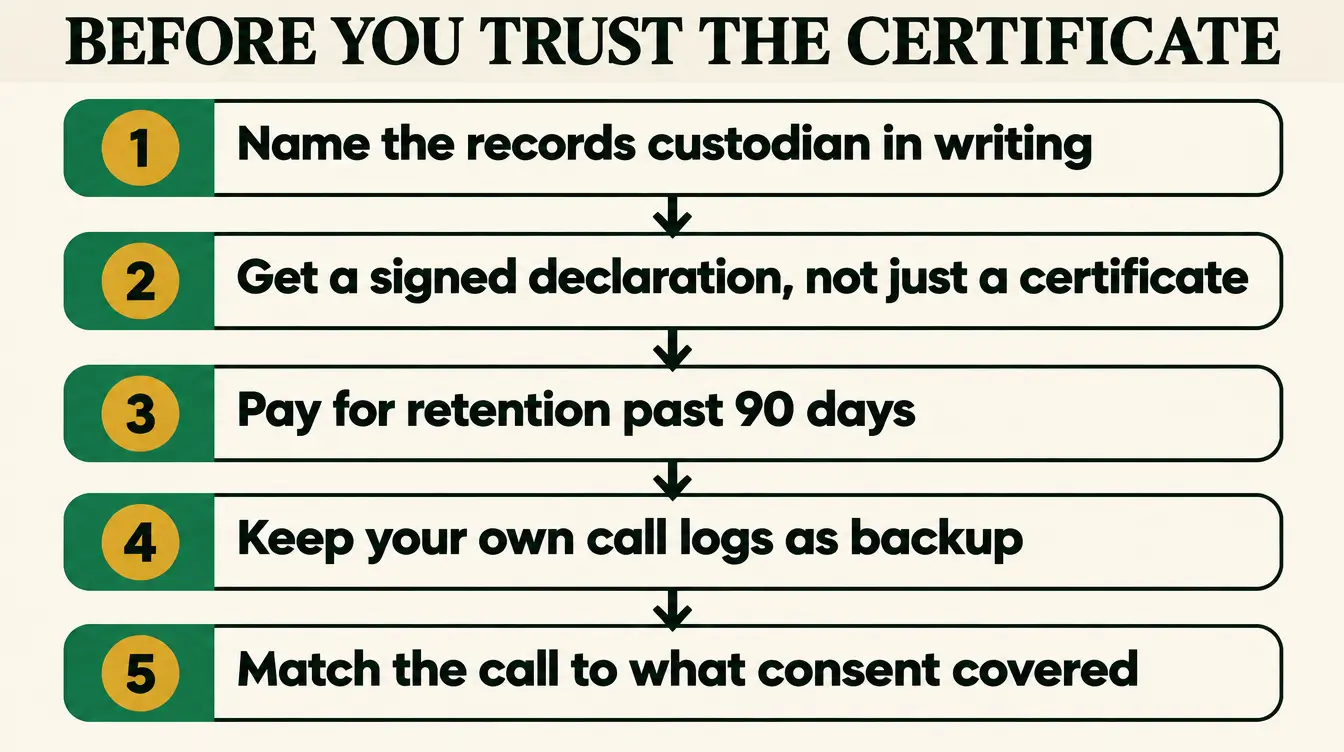
- Get the records custodian’s name in writing, before you buy. Email your lead vendor and ask who, specifically, could sign a declaration or testify about how their consent certificates are generated and stored. If the answer is a department, not a person, push for a name. That name is the difference between an admissible business record and the exact gap that lost the Hoy case.
- Confirm the retention tier that actually applies to your leads. Don’t assume your vendor pays for extended retention. Ask directly whether the certificates behind your specific list are on the 90-day default or the extended tier, and get the answer in writing, not a verbal assurance.
- Pay for retention that covers the real exposure window, not the vendor’s default. A 5-year paid retention tier comfortably covers the 4-year TCPA lookback; the 90-day default does not come close. If your vendor already offers this and you’ve never opted in, that’s a cheap fix compared to the alternative.
- Ask for a standing declaration format, not just a certificate. Some vendors will provide a template affidavit from their records custodian in advance, ready to be finalized and signed if a specific lead is ever challenged. Getting that commitment before you need it is far easier than requesting it for the first time under a subpoena deadline.
- Keep your own internal call log as a second, independent record. A consent certificate documents the lead vendor’s web form. It says nothing about what your agency actually said on the call itself. A timestamped internal record of every call you placed, who answered, what was disclosed, and what happened next, is a second line of defense that doesn’t depend on a third party’s retention policy at all.
- Match what you’re calling about to what the certificate actually authorized. A certificate tied to a specific website and a specific buyer’s consent language doesn’t automatically cover a different campaign, a different product line, or a reseller three steps down the chain. Read the disclosure language your vendor used, not just the existence of a green checkmark.
- Review this once a quarter, not once at onboarding. Vendors change their process, retention products get downgraded or dropped, and a relationship that was airtight in January can quietly stop being documented by October if nobody checks.
You can run this whole checklist without buying anything new
If you already pay for TrustedForm or Jornaya through your lead vendor, the fix is mostly a set of emails: ask who the custodian is, confirm the retention tier, and get a sample declaration format on file. None of that requires switching platforms or spending more money, unless your current retention tier turns out to be the 90-day default, in which case the upgrade is the cheapest insurance you'll buy this year.
If you’d rather see how a managed calling setup logs every one of your own calls automatically, there’s a live demo on the homepage. You can hear exactly what it sounds like before you decide anything. https://theaffordableai.com/
Where TheAffordableAI Fits, and Where It Doesn’t
Be precise about this, because overstating it would repeat the exact mistake this whole article is about. TheAffordableAI does not generate, verify, or extend the retention of a lead vendor’s consent certificate, and it cannot authenticate someone else’s web form record for you. Using a managed calling platform, AI or otherwise, does not transfer the obligation to hold valid, documented consent away from the licensed agent whose name is on the business. That obligation sits with you and your lead vendor, not with the system that happens to place the call.
What it does is make sure your side of the record, the part that’s entirely within your control, is never the weak link. Every outbound and inbound call runs through one managed account instead of scattered across individual producers’ personal phones, with the transcript, timestamp, and disposition synced automatically to the contact record in HighLevel. That’s the second, independent record described in step five above, built in rather than something you have to remember to set up. The full list of what’s included is on the features page.
Every call logged automatically
Transcript, timestamp, and disposition sync to HighLevel the moment a call ends, so your own internal record never depends on an agent's memory or a third party's retention tier.
One managed account, not seven personal phones
Outbound dialing and inbound answering route through a single system your agency controls, so there's one place to review, not seven scattered histories.
Warm transfers keep a licensed human in the loop
A qualified call reaches a live agent or lands on a real calendar slot, so the conversation that actually sells the policy is handled by the person legally responsible for it.
Number warmup and spam defense, standing
A clean outbound caller ID is maintained as a routine, not a one-time fix, regardless of which list or campaign a call came from.
Agency routing across 20+ producers
On the Agency plan, calls route round-robin across your team with availability toggles, so one centralized record covers the whole book, not just one seat.
No contract, cancel anytime
Single Account runs $200/mo plus a $500 one-time setup at $0.20/min, from $0.15 at bulk. Agency runs $500/mo plus a $1,000 one-time setup at $0.18/min, from $0.16 at bulk. Price it against what a fragmented, undocumented calling setup actually risks costing you. https://theaffordableai.com/pricing
What You Actually Get
A lead comes in, the call happens, and the full record, who called, what was said, what disposition it got, lands on one contact record your whole agency can see. That doesn’t fix a lead vendor’s 90-day retention policy, and it doesn’t retroactively authenticate a certificate for a lead you bought eighteen months ago. What it does is make sure that going forward, your own side of the story is never the part that falls apart under a subpoena. If a consent question ever comes up about a call your agency actually placed, the honest answer is a transcript and a timestamp, not a shrug and a guess about which producer handled it.
A certificate is evidence of what happened on a web page. It is not, by itself, a witness who can explain it in court. Know who that witness is before you need one.
Mike MooreDocumented Chain of Custody vs. a Lone Certificate
A green checkmark and nothing else
- Certificate exists in the vendor's dashboard, default 90-day retention
- No named custodian who could authenticate it if challenged
- No internal record of what your agency's own call actually said
- Nobody has checked whether the consent language matches this specific campaign
- If a complaint arrives 18 months later, the certificate may already be deleted
A record someone can actually testify to
- Retention tier confirmed in writing to cover the 4-year TCPA window
- Named records custodian identified before the lead is ever called
- Internal call log, transcript, and disposition kept independently
- Consent language checked against the specific campaign before dialing
- A review has two independent records to check, not one fragile one
Where This Is the Wrong Tool
Be honest about the limits here too. No calling platform, AI-powered or otherwise, can manufacture consent that was never properly documented, authenticate someone else’s web form record for you, or protect your agency from exposure on leads you already called before reading this. If your agency is buying leads from a vendor who can’t name a records custodian or confirm a retention tier, the fix is a vendor conversation, not a piece of software. And if you’re already facing a demand letter or a complaint over past calling activity, that’s a conversation for an attorney who handles TCPA defense specifically, not a blog post.
Compliance doesn't transfer, in any configuration
Prior express written consent for automated or AI-voice marketing calls and texts, clear disclosure, and a working opt-out are required regardless of who or what places the call, and that obligation is the licensed agent's, not a vendor's or a platform's. For Medicare business specifically, which is the context of the 2026 case discussed in this article, CMS marketing rules including the TPMO disclaimer, call-recording retention, and restrictions on unsolicited contact apply on top of the TCPA consent requirements covered here. Using AI, a dialer, or any other calling tool does not transfer liability away from the licensed agent or agency. This article is general information about publicly available case commentary and statutory text, not legal advice; talk to your own counsel about your agency's specific exposure and your specific lead vendor's documentation practices.
Fix your side of the record first
See what a centralized, logged calling setup actually costs against what you're running now. No contract either way, so the only real risk of trying it is one month.
A federal court spent one paragraph taking apart a lead buyer’s entire consent defense in August 2026, not because the certificate was fraudulent, but because nobody could say who made it or how. That’s a fixable gap, and it doesn’t require new software or a new vendor. It requires one written answer to one question: if this lead is ever challenged, who, by name, can explain how we know they said yes.
Frequently asked
What is a TrustedForm or Jornaya consent certificate, and what does it actually prove?
Both are third-party verification products from ActiveProspect. A TrustedForm certificate is a timestamped record generated at the moment someone submits a web form, documenting that a specific consent disclosure was present on the page during that submission; TrustedForm Verify can confirm the approved consent language was actually there, per ActiveProspect's own product page. Jornaya's LeadiD works on a similar principle, tagging the consumer's browsing session. Neither certificate is, by itself, a court ruling that consent was valid. It is evidence of what happened on a web page at a point in time, and like any other business record, it only helps you in court if someone can authenticate it and explain how it was generated. That is the exact step that failed in the 2026 Iowa case discussed in this article.
Why did a federal court refuse to consider a Jornaya record in a 2026 Medicare lead case?
In Toby Hoy v. Medicare Health Advisors, 2026 WL 2622653 (S.D. Iowa, decided August 7, 2026), the defendant had bought leads from a vendor and produced a Jornaya-style consent record to argue the plaintiff had agreed to be called. Per the case summary published by TCPAWorld (Eric Troutman) on September 8, 2026, the court declined to weigh that record at summary judgment because the defense offered no witness with personal knowledge to authenticate it and did not argue a hearsay exception, even though the court noted the records might have qualified under Federal Rule of Evidence 803(6), the business-records exception, if someone had made that argument properly. The record existed. Nobody at the company could explain, under oath, how it was generated. That gap, not the certificate itself, is what sank the defense on that issue.
How long should an insurance agency keep proof of consent for a purchased lead?
Longer than the vendor keeps it by default. Per a 2026 TrustedForm-versus-Jornaya comparison published by leadgen-economy.com, a standard TrustedForm Certify certificate is removed after 90 days unless you pay for TrustedForm Retain, which extends storage up to 5 years; the same source states Jornaya's retention "varies by product" without giving a specific figure, so treat that one claim as resting on a single source rather than two independent ones. Courts applying the TCPA's four-year catch-all limitations period, discussed below, mean a certificate that vanishes at the 90-day mark is gone roughly 44 months before a plaintiff's filing window closes. If your agency or your lead vendor is not paying for extended retention, you may have nothing left to produce by the time a demand letter arrives.
What's the statute of limitations for a TCPA lawsuit?
The TCPA itself, 47 U.S.C. § 227, does not state a limitations period for private claims. Courts have filled that gap with the general four-year federal catch-all at 28 U.S.C. § 1658(a), which applies to claims under federal statutes enacted after December 1, 1990 (the TCPA became law in 1991). The Illinois Appellate Court reached exactly that holding in Wellington Homes, Inc. v. West Dundee China Palace Restaurant, Inc., 2013 IL App (2d) 120740, ruling that Illinois's own two-year penalty period does not govern TCPA claims and that the four-year federal period controls instead. Other state appellate courts have applied the same four-year reading. Practically: a consumer can usually sue over a call placed nearly four years earlier, which is well past the point most lead-verification products keep records by default.
How much can an insurance agent actually owe per call under the TCPA?
Under 47 U.S.C. § 227(b)(3), a person who receives an autodialed or prerecorded call or text without the required consent can sue for actual monetary loss or $500 per violation, whichever is greater, and a court can increase that award up to three times, to as much as $1,500 per violation, if it finds the conduct was willful or knowing. Each distinct call or text to a distinct number is generally its own violation, so a class of a few thousand calls, not an unusual size for a purchased lead campaign, can reach seven figures at the statutory floor before any multiplier is applied. That math is exactly why defendants in TCPA class actions settle as often as they do; a related 2026 case against Farmers Insurance Exchange settled for a combined $4.125 million rather than let a jury apply that formula at trial.
Does a consent certificate protect the agent who calls the lead, or only the company that generated it?
A certificate generated at the moment of a web form submission documents the website event, not any specific caller's right to rely on it. If you bought the lead from a vendor and that vendor's record is the only thing standing between you and a lawsuit, you are depending on a document you did not create, generated by a process you cannot personally describe under oath, held by a company that may or may not keep it past 90 days. The agent who placed the call, not the lead vendor, is usually the one named in the complaint. Ask your vendor, in writing, before you buy: who is the records custodian who will testify if this is challenged, and will they actually show up.
What should an agent ask a lead vendor before buying a list, specifically to avoid this problem?
Four questions, in writing, before you pay: who is the named records custodian who can authenticate a consent record if it is ever challenged in litigation; what retention tier applies to the certificates behind this specific list, and for how long; can the vendor produce a sample declaration or affidavit format they are prepared to sign if subpoenaed; and does the consent language on file actually name the specific caller, campaign, or buyer authorized to place the call, not just "partners" in general. A vendor that cannot answer the first question clearly is not a vendor you want standing behind you in court. A vendor that can is worth paying a little more for.
Does calling with an AI voice agent change any of this, for better or worse?
Neither automatically. Under 47 CFR 64.1200(f)(9), prior express written consent must authorize the seller to deliver autodialed or prerecorded messages, including an AI voice call, to a named number, with a clear and conspicuous disclosure that signing is not a condition of purchase. That requirement, and the consent-documentation problem described in this article, exists the same way whether a human or an AI places the call. Using an AI calling platform does not transfer the compliance obligation away from the licensed agent or agency whose name is on the business, and it does not manufacture consent that was never properly documented in the first place. What a centralized system can do is make sure every call your own agency places is logged, timestamped, and attached to a contact record your team controls, which is a different, narrower problem than whether the lead's original consent will hold up.
Sources
- Toby Hoy v. Medicare Health Advisors, 2026 WL 2622653 (S.D. Iowa, Aug. 7, 2026) — case summary via TCPAWorld (Eric Troutman), Sept. 8, 2026
- 47 U.S.C. § 227 — Restrictions on Use of Telephone Equipment (TCPA), via Cornell Law School Legal Information Institute
- 47 CFR § 64.1200(f)(9) — Definition of Prior Express Written Consent, via GovInfo (Code of Federal Regulations)
- 28 U.S.C. § 1658 — Time Limitations on Commencement of Civil Actions, via Cornell Law School Legal Information Institute
- Wellington Homes, Inc. v. West Dundee China Palace Restaurant, Inc., 2013 IL App (2d) 120740, 984 N.E.2d 554 (Ill. App. Ct., Feb. 4, 2013)
- TrustedForm vs Jornaya: Comparing Consent Verification Platforms (retention periods), leadgen-economy.com, 2026
- ActiveProspect — TrustedForm Certified Leads (what a certificate documents)
- ActiveProspect — Why Obtaining TrustedForm Certificates Is Vital (consent documentation, vendor liability)
- TheAffordableAI — Pricing
- TheAffordableAI — Features
Put this on your own phone line
See the AI dial, qualify, and warm-transfer a live call in under a minute. No contract, no dev work.
Keep reading

Insurance Agent TCPA Settlements Top $4 Million in 2026
Two Farmers Insurance agents settled 2026 TCPA Do Not Call lawsuits for $2.875M and $1.25M. What the filings show, and what agencies should fix first.

Buying Insurance Leads in 2026: The $145M FTC Warning
The FTC just fined two lead-gen firms $145 million for deceptive robocalls tied to consumer leads. Here is what it means for insurance agents who buy leads.

FCC One-to-One Consent Rule Is Dead: Insurance Leads Now
The FCC's one-to-one consent rule is vacated and repealed. Here is what changed, what didn't, and how to vet an insurance lead vendor's consent in 2026.