Insurance Agent TCPA Settlements Top $4 Million in 2026
Two Farmers Insurance agents settled 2026 TCPA Do Not Call lawsuits for $2.875M and $1.25M. What the filings show, and what agencies should fix first.

Two insurance agent TCPA settlements just cost the same carrier $4.125 million in 2026, and neither case ever went to trial. A Missouri circuit court approved notice on two separate Telephone Consumer Protection Act class actions against Farmers Insurance Exchange and its affiliates, both built on the same fact pattern: individual agents, marketing Farmers products, called or texted phone numbers that had been sitting on the National Do-Not-Call Registry the whole time. One settlement, in Spencer Heckathorn v. Farmers Insurance Exchange, covers up to 12,545 people and a $1,250,000 fund. The other, Kimberly Starling v. Farmers Insurance Exchange, covers 8,039 people and a $2,875,000 fund. Farmers denied wrongdoing in both and argued the agents involved were independent contractors it wasn’t responsible for. It paid anyway.
This isn’t a story about a shady lead-gen outfit running a billion spoofed robocalls. It’s a story about licensed insurance agents, doing what every agent is told to do, calling leads fast, who skipped the one list check that would have kept their agency’s name out of a court filing. If your agency’s calling operation runs on seven different producers dialing from seven different phones with no shared system checking the list first, this is what the bill looks like when it comes due.
The short version
- Two 2026 class actions against Farmers Insurance Exchange, both filed over insurance agents calling or texting numbers on the Do Not Call Registry, settled for $1,250,000 (Heckathorn, 12,545 potential class members) and $2,875,000 (Starling, 8,039 class members), per the court-authorized settlement notice and settlement agreement in each case.
- Farmers denied liability in both filings and argued the agents were independent contractors it had no legal responsibility for. It settled both cases rather than litigate that defense to a verdict.
- Under 47 U.S.C. § 227(b)(3), a TCPA violation carries $500 in statutory damages per call or text, trebled to as much as $1,500 for a willful or knowing violation; at the $500 floor, the Heckathorn class's 12,545 potential violations would total $6,272,500 at judgment, which is most of why a defendant settles instead of trying its luck in front of a jury.
- The National Do Not Call Registry held 258,515,050 active registrations as of September 30, 2025, per the FTC's FY2025 Data Book, and organizations must scrub call lists against it at least every 31 days. A list bought or pulled two months ago is already out of compliance with that basic rule.
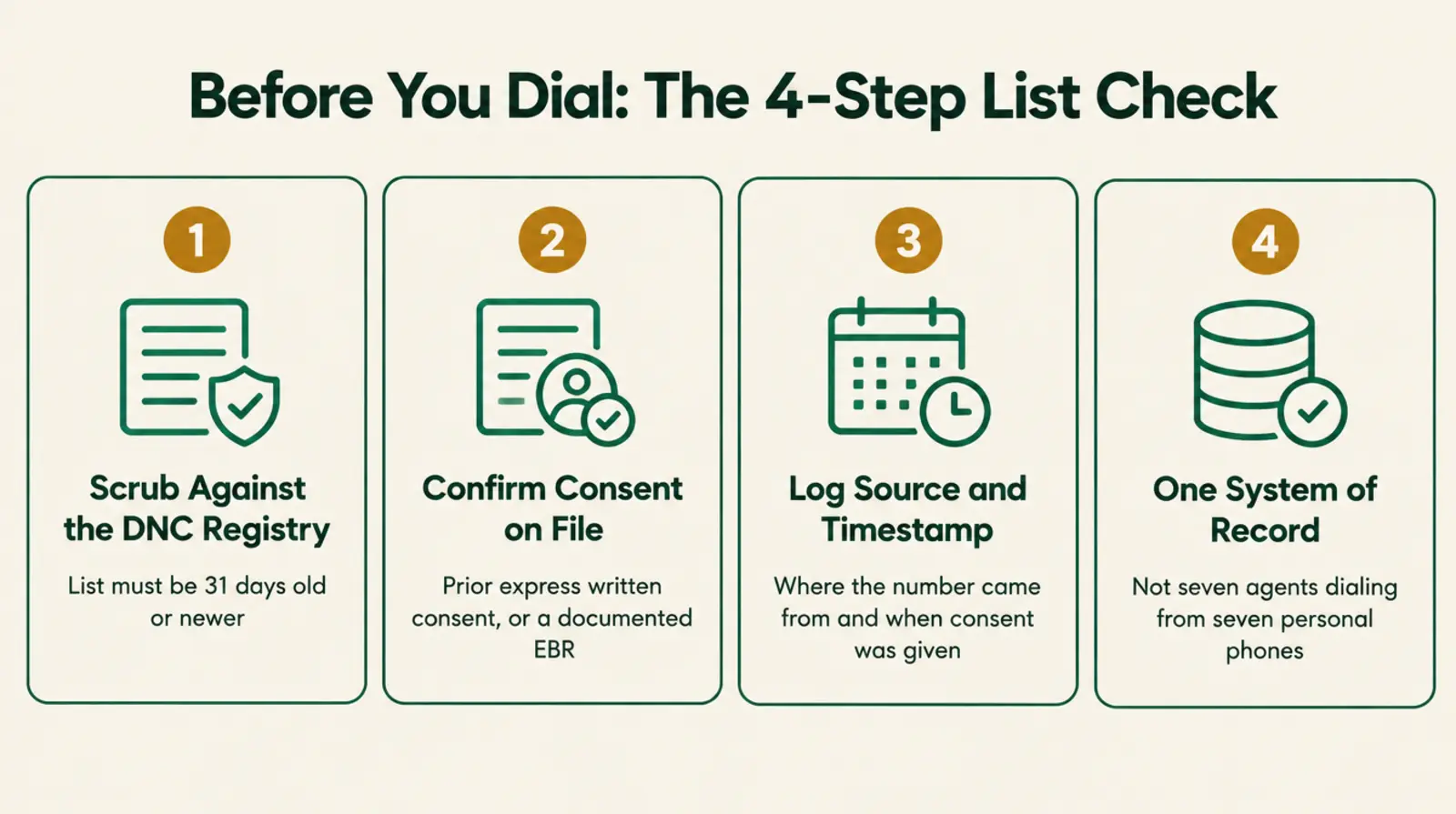
- The fix isn't exotic: scrub the list on a schedule, document consent with a source and timestamp, and stop letting individual producers freelance-dial from personal numbers outside any shared system of record, which is the exact pattern both 2026 cases describe.
The Pain: “I Thought the List Was Clean”
Ask around any agency that buys or builds its own call lists and you’ll hear some version of the same answer when you ask who checks a number against the Do Not Call Registry before it gets dialed: “the vendor does that,” or “I think so,” or silence. Nobody’s being careless on purpose. An agent chasing a quote request from an hour ago isn’t thinking about registry compliance; they’re thinking about getting the prospect on the phone before somebody else does, which is the entire premise of speed-to-lead. That instinct is correct. It’s also exactly how both 2026 Farmers cases say the problem started: producers dialing and texting leads, fast, with nobody in the loop confirming the number hadn’t been on the DNC Registry for months before the first text went out.
The Heckathorn notice alleges that seven named agents, Nickolas Ward, Nate Esparza, Kyle Ryan Gray, Dustin Huffman, Jason Hall, Brian Shirey, and LeNard Rhone, or their individual agencies, sent calls and texts marketing Farmers insurance to as many as 12,545 separate phone numbers that had been registered on the DNC list. The Starling case describes a narrower cast, insurance agent Todd Henderson and the Todd Henderson Insurance Agency, Inc., allegedly texting 8,039 DNC-registered numbers over a four-year window. Different agents, same carrier, same underlying mechanism, same court. Neither filing alleges some sophisticated scheme to evade the law. Both describe ordinary marketing activity, the kind every insurance agency runs every week, aimed at numbers nobody checked first.
That’s the pain in one sentence: an agency can do everything else right, hustle, follow up fast, write good policies, and still end up as a named defendant because list hygiene was nobody’s specific job. The fix doesn’t require slowing down. It requires putting the list check somewhere it can’t get skipped.
Why It Happens: The Mechanism Behind Both Cases
Three things usually have to be true at once for a call list to carry this kind of risk, and each one is a separate, fixable gap.
The list check gets treated as somebody else’s job. A purchased lead often arrives with an implicit assumption that the vendor already scrubbed it against the Do Not Call Registry. Sometimes that’s true. It’s never guaranteed, and an agent calling from an aged database, a referral list, or a prior book of business usually has no vendor in the chain to assume anything about. The Registry itself requires sellers and telemarketers, not just list brokers, to remove DNC-registered numbers from their own call lists at least every 31 days, per the FTC’s own Data Book guidance. That obligation sits with whoever’s dialing, not whoever sold the list.
Individual agents dial from individual numbers, with no shared record of who called whom or why. This is the specific pattern both 2026 cases describe: distinct named agents, each apparently running their own outreach, with Farmers itself arguing in its own settlement filings that it “has no legal liability for any acts or omissions of Todd Henderson, the Henderson Agency, or any other insurance agents, all of whom it contends are independent contractors.” Read that carefully: the carrier’s own defense was that it shouldn’t be on the hook for calls its agents made. It settled anyway, twice, in the same year, in the same court. Whether or not that independent-contractor argument would have held up at trial, nobody found out, because both cases resolved before a judge ruled on it. An agency that lets each producer operate as an island, with no central list, no shared consent record, and no one person responsible for checking before a campaign goes out, is building the exact fact pattern that put Farmers’ agents in these filings.
Consent and Registry status aren’t the same question, and conflating them is where agencies get hurt. A number can be on the Do Not Call Registry and still be legally callable, if the recipient has an established business relationship with the caller or has given prior express written consent for exactly this kind of outreach. Both are real exemptions. Both are narrower than agents often assume. An established business relationship under 16 CFR 310.4 covers a specific, documented relationship, a purchase, an inquiry, an application, within a defined window; it doesn’t cover “the agency has other clients” or “my coworker sold this person a different policy two years ago.” Prior express written consent, defined at 47 CFR 64.1200(f)(9), has to be a signed agreement naming the specific number and disclosing that the signature isn’t a condition of purchase. An agent who assumes a lead is fair game because it “feels warm” is substituting a gut check for a documentation requirement, and the Registry doesn’t care how warm a lead felt.
Define the terms before you build anything
TCPA: the Telephone Consumer Protection Act, 47 U.S.C. § 227, the federal law that creates a private right of action for unwanted calls and texts. DNC Registry: the National Do Not Call Registry, the FTC-maintained national list consumers use to opt out of most telemarketing calls. Established business relationship (EBR): a recognized exemption under 16 CFR 310.4 covering a specific, time-limited relationship between a caller and a consumer who purchased, inquired, or applied. Prior express written consent: a signed agreement, defined at 47 CFR 64.1200(f)(9), naming the number and disclosing the call isn't a purchase condition, required before an autodialed, prerecorded, or AI-voice marketing call to a wireless number. Class action settlement fund: a dollar amount a defendant agrees to make available to resolve claims on behalf of an entire group, without a court ruling on who was actually at fault.
What This Actually Costs: Two Settlements, One Pattern
Start with the two cases themselves. Both moved through the Circuit Court of St. Louis County, Missouri, in 2026, and both resulted in a negotiated fund rather than a trial verdict.
| Case | Settlement fund | Class size | Max per claim |
|---|---|---|---|
| Heckathorn v. Farmers Insurance Exchange (26SL-CC03879) | $1,250,000 | ~12,545 people | $160 |
| Starling v. Farmers Insurance Exchange | $2,875,000 | 8,039 people | $425 |
Sources: Heckathorn court-authorized settlement notice, Case No. 26SL-CC03879, Division 17, Circuit Court of St. Louis County, Missouri (2026); Starling settlement agreement, Circuit Court of St. Louis County, Missouri (2026).
Settlement fund size, two 2026 Farmers TCPA cases
Both resolved in the Circuit Court of St. Louis County, Missouri, over agent calls or texts to Do Not Call Registry numbers.
Sources: Starling settlement agreement (2026); Heckathorn settlement notice, Case No. 26SL-CC03879 (2026). Combined: $4,125,000.
Now look at why a carrier settles instead of litigating. Neither case was decided on the merits, so there’s no judgment to point to, but the TCPA’s own statutory damages explain the incentive. Under 47 U.S.C. § 227(b)(3), a consumer can recover $500 per violation, or their actual loss if higher, and a court may increase that to as much as three times the amount, up to $1,500, for a willful or knowing violation. Apply the statutory floor, as a hypothetical only, to the Heckathorn class’s roughly 12,545 potential violations and you get $6,272,500, just over five times the $1,250,000 the parties actually agreed to. That gap, what a case could cost at judgment versus what it costs to settle, is the entire economic logic behind every one of these filings.
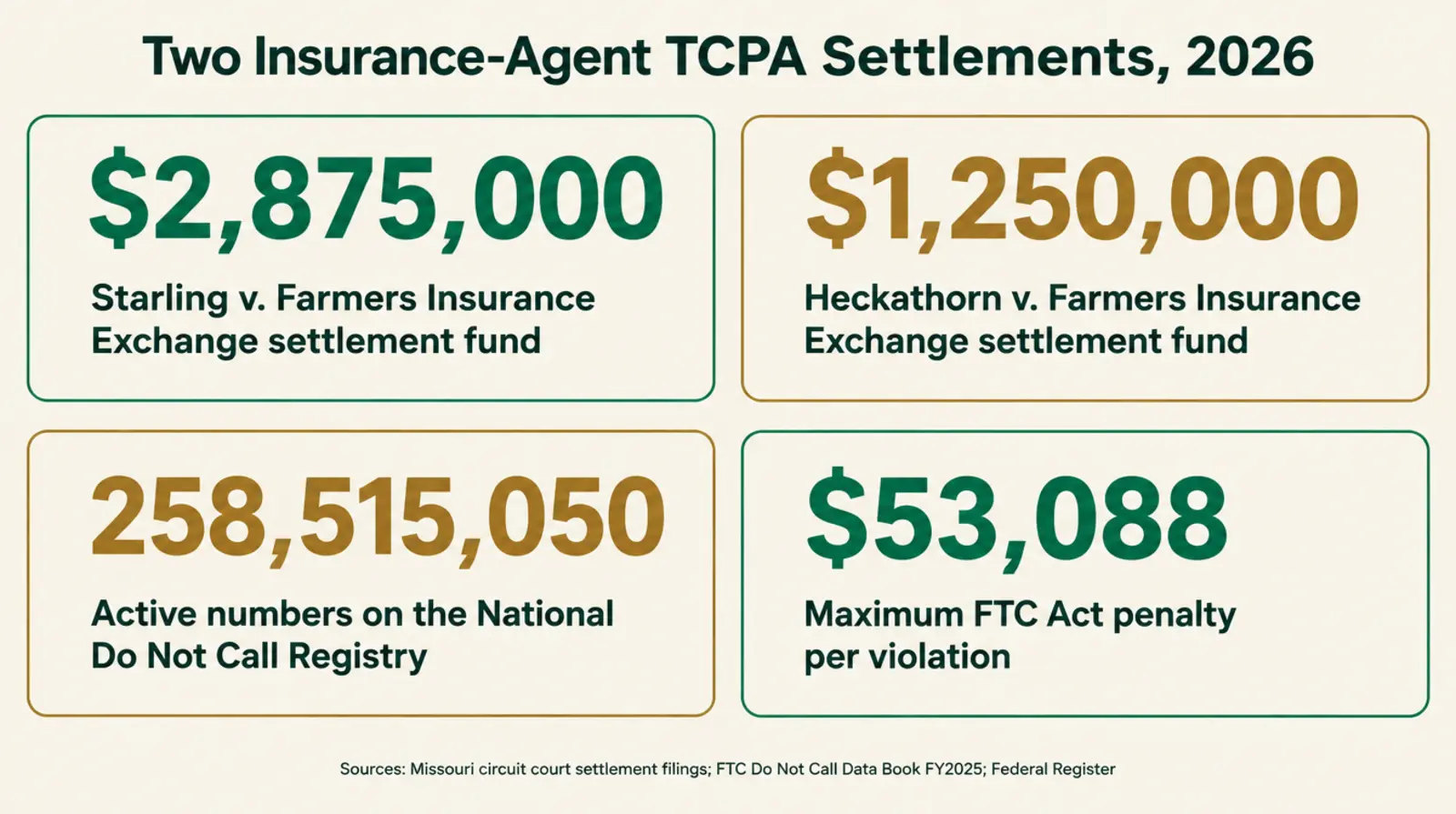
Two separate funds, in two separate cases, against the same carrier, in the same court, in the same year isn’t a coincidence worth shrugging off. It’s a signpost. Plaintiffs’ TCPA counsel found a fact pattern that worked once and went looking for it again. If your agency’s calling operation looks anything like “individual agents texting their own leads with no shared consent record,” you’re not reading about someone else’s problem.
How to Fix It: The Full Method, No New Hire Required
None of this requires new software, a compliance department, or slowing down how fast you call a lead. It requires someone owning the list-hygiene step and actually doing it, every time, on a schedule.
- Pull a fresh Do Not Call Registry check before any list older than 31 days gets dialed. Telemarketers and sellers access the Registry at telemarketing.donotcall.gov; a list from last quarter, or from a campaign you ran two months ago, is stale under the FTC’s own 31-day removal standard and needs to be re-scrubbed, not reused as-is.
- Document the consent basis for every number on an active calling list, not just the warm ones. For each contact, record whether it’s an inbound inquiry, a documented established business relationship, or a signed prior-express-written-consent agreement under 47 CFR 64.1200(f)(9). If none of those apply, that number doesn’t go on an outbound marketing campaign.
- Centralize the calling operation instead of letting each producer freelance from a personal number. Both 2026 Farmers cases describe individually named agents dialing and texting on their own. A shared system, one list, one consent record, one place transcripts and dispositions land, makes it possible to catch a bad number before it’s dialed seven different times by seven different people who don’t know about each other’s calls.
- Put one person in charge of confirming the list is clean before a campaign launches. Not seven people each assuming someone else checked. One name, one sign-off, logged.
- Re-pull the Registry check on a fixed calendar, not just at list purchase. A number can register with the DNC list the day after you bought a lead; your scrub needs to run again, not just once at intake.
- Train every producer on the difference between a warm lead and a documented consent basis. “They seem interested” isn’t a legal standard. A signed form, a logged inbound call, or a documented EBR within its window is.
- Keep records, not memory. If a complaint or a class notice ever arrives, the agency that can produce a timestamped consent record for the number in question is in an entirely different position than the agency that can only say “we probably had permission.”
- Review the whole process after every campaign, not once a year. Staff change, vendors change, and a routine that worked in January can quietly stop working by October if nobody checks it.
You can run every one of these steps yourself
None of this requires buying anything. A shared spreadsheet, a calendar reminder to re-scrub, and one person with the authority to hold a campaign until the list is clean will get you most of the way there. If your agency is already paying for a dialer or a CRM, check whether it already has a Registry-scrub or consent-tagging feature sitting unused; plenty do.
Where TheAffordableAI Fits, and Where It Doesn’t
Be precise about this, because overstating it here would be the same mistake both 2026 cases are about. TheAffordableAI doesn’t scrub your list against the Do Not Call Registry, and it doesn’t replace the agent’s obligation to hold prior express written consent or a documented established business relationship on file before a marketing call goes out. Using any calling platform, AI or otherwise, does not transfer that compliance obligation away from the licensed agent whose name is on the business.
What it does is answer inbound calls and dial outbound the moment a lead is created, from one managed account your agency controls, rather than seven producers each working off their own phone with no shared record of who called whom.
One system, not seven personal phones
Outbound dialing and inbound answering run through a single managed account, the same structural gap both 2026 Farmers cases describe producers operating without.
Every call lands in HighLevel automatically
Transcript, disposition, and timestamp sync to the contact record natively, the kind of record a list-hygiene review, or a class-action document request, actually needs.
Number warmup and spam defense, built in
A standing routine keeps your outbound caller ID clean, regardless of which campaign or list a call came from.
Warm transfers and real-calendar auto-booking
A qualified lead reaches an available licensed agent live, or lands on their calendar, so the human stays in the loop on every call that converts.
Route to 20+ agents, round-robin, on the Agency plan
Distribution runs off one system instead of a spreadsheet, or nothing, governing which producer calls which lead.
No contract, cancel anytime
Single Account runs $200/mo plus a $500 one-time setup at $0.20/min, from $0.15 at bulk; Agency runs $500/mo plus a $1,000 one-time setup at $0.18/min, from $0.16 at bulk. Price it against what your current setup actually costs you, including the risk a fragmented one carries.
If you’d rather hear it than read a spec sheet, there’s a live demo call on the homepage; put a number in and hear it answer, qualify, and offer a transfer in real time. https://theaffordableai.com/
What You Actually Get
A lead comes in. One system dials or answers, logs who it talked to, what was said, and what happened next, on one contact record your whole agency can see, not a text thread on one producer’s personal phone that nobody else has access to. If a DNC complaint or a consent question ever comes up, the honest answer is “here’s the transcript and the timestamp,” not “let me ask whoever took that call.” None of that replaces scrubbing the list first; it just means that once a number clears your own consent check, the call itself happens inside a system built to be reviewed, not reconstructed from memory after the fact.
Centralized Calling vs. Seven Agents, Seven Phones
Each producer dials on their own
- Individual agents call or text from personal numbers, with no shared list
- No one person confirms the list was scrubbed against the DNC Registry before a campaign
- Consent basis lives in an agent's memory, not a record
- A number can get called by more than one producer, unaware of each other
- If a complaint arrives, there's no transcript, just whoever remembers the call
One system, one record, per call
- Outbound and inbound calling runs through one managed account
- One person owns the Registry scrub, on a fixed schedule, before any campaign launches
- Consent basis and source are logged with every contact, not assumed
- Every call, transcript, and disposition lands on one contact record
- A review or a complaint has an actual record to check, not a memory to rely on
A Worked Example: Two Versions of the Same Friday
Picture an agency with seven licensed producers and a purchased list of 400 leads that landed Thursday night. On the fragmented path, each producer grabs a slice of the list Friday morning and starts dialing and texting from their own cell number, trying to get ahead of the weekend. Nobody checked whether the list had been scrubbed against the DNC Registry since the vendor pulled it six weeks earlier. A handful of numbers on that list have been registered the whole time. Three different producers each text the same stale number without knowing a colleague already had. Eight months later, a settlement notice arrives naming the agency and several individual producers, over calls nobody at the agency can now reconstruct, because nothing was logged beyond whatever’s still on someone’s personal phone.
On the centralized path, the same 400-lead list runs through one re-scrub against the Registry Thursday night, the moment it’s loaded, flagging any number registered in the prior 31 days. Every call and text that goes out Friday routes through one system, tagged with its consent basis and logged to a shared contact record. A producer still closes the same leads, just as fast, because the scrub ran automatically before anyone started dialing, not as a manual step someone had to remember. Eight months later, if any question ever comes up about a specific number, the answer is a timestamp and a transcript, not a shrug.
Nothing about the leads changed between the two versions. The only difference was whether the list got checked once, by someone, before seven people started calling it.
Where This Is the Wrong Tool
Be honest about the limits here too. No calling platform, AI-powered or otherwise, checks the Do Not Call Registry for you, confirms your consent basis, or protects your agency from a claim over calls that already went out before you fixed your process. If your agency’s real problem is that nobody has ever owned list hygiene, the fix is a policy and a person, not a piece of software. And if your agency is already facing a complaint or a demand letter over past calling practices, that’s a conversation for an attorney who handles TCPA defense, not a blog post or a vendor’s sales page.
Farmers' own defense was that its agents were independent contractors it wasn't responsible for. It paid twice anyway. Don't build your agency's calling operation on a label you're hoping holds up in court.
Mike MooreCompliance doesn't transfer, in any configuration
Prior express written consent for automated or AI-voice marketing calls and texts, clear disclosure, and a working opt-out are required regardless of who or what places the call, and that obligation is the licensed agent's, not a vendor's. For Medicare business, CMS marketing rules including the TPMO disclaimer, call-recording retention, and restrictions on unsolicited contact apply on top of the TCPA and DNC Registry rules covered here. Using AI, a dialer, or any other calling tool does not transfer liability away from the licensed agent or agency. This is general information about two specific, publicly filed court cases, not legal advice; talk to your own counsel about your agency's specific exposure.
Price the fix before you need it
See what a managed calling setup actually costs against your own numbers, no contract either way, so the only real risk of trying it is one month.
Two agents’ worth of calling practices just cost $4.125 million in settlement funds, over conduct that one fresh Registry check, run on a schedule, would have caught before the first call went out. Your agency doesn’t need to call slower to fix this. It needs one person, one list, one scrub, every time, before seven phones start dialing it.
Frequently asked
What happened in the 2026 Farmers Insurance TCPA settlements?
Two separate class actions against Farmers Insurance Exchange and affiliated entities settled in the Circuit Court of St. Louis County, Missouri in 2026, both over text messages and calls that insurance agents sent to numbers on the National Do-Not-Call Registry while marketing Farmers products. In Spencer Heckathorn v. Farmers Insurance Exchange, et al. (Case No. 26SL-CC03879, Division 17), seven named insurance agents, Nickolas Ward, Nate Esparza, Kyle Ryan Gray, Dustin Huffman, Jason Hall, Brian Shirey, and LeNard Rhone, or their agencies, are alleged to have called or texted roughly 12,545 people whose numbers were on the DNC Registry; Farmers agreed to a $1,250,000 fund, with a final approval hearing set for September 23, 2026. In Kimberly Starling v. Farmers Insurance Exchange, et al., insurance agent Todd Henderson and the Todd Henderson Insurance Agency, Inc. allegedly text-marketed Farmers products to 8,039 DNC-registered numbers; that case settled for a $2,875,000 fund. In both, Farmers denied liability and argued the agents were independent contractors, not its responsibility, then paid anyway rather than litigate that defense to a verdict.
How much can an insurance agent actually be sued for under the TCPA?
Under 47 U.S.C. § 227(b)(3), a consumer can sue and recover $500 per violation, or actual monetary loss if greater, and a court can increase that award to as much as three times the amount, up to $1,500 per violation, if the conduct was willful or knowing. Each unwanted call or text to a distinct number typically counts as its own violation. Run the math on the Heckathorn case as an illustration only, since it settled rather than going to judgment: 12,545 people at the $500 statutory floor comes to $6,272,500, just over five times the $1,250,000 the parties actually agreed to pay. That gap is exactly why defendants settle: a loss at trial can cost far more than a negotiated fund, even before legal fees.
Does it matter that Farmers called its agents independent contractors?
In both 2026 cases, Farmers' position was that it 'has no legal liability for any acts or omissions of Todd Henderson, the Henderson Agency, or any other insurance agents, all of whom it contends are independent contractors,' per the Starling settlement agreement. Farmers never conceded that defense in court; it paid to resolve the case instead. The lesson for an agency owner isn't a legal conclusion about vicarious liability, since neither case reached a ruling on it, it's a practical one: a company's independent-contractor label for its producers didn't keep it out of two separate class actions or off the hook for millions in settlement funds. If you run a captive or independent agency, don't assume your agents' contractor status alone insulates the agency's name from this kind of claim.
How do I check whether a phone number is on the Do Not Call Registry before I call it?
Telemarketers and sellers access the Registry through telemarketing.donotcall.gov, where you can check individual numbers or upload a list, and per the FTC's own National Do Not Call Registry Data Book for Fiscal Year 2025, organizations are required to remove numbers added to the Registry from their call lists at least every 31 days. A list pulled 32, 45, or 90 days ago is stale; re-pull and re-scrub on a fixed schedule rather than once at list purchase, since the Registry gained roughly 4.7 million new active registrations between FY2024 and FY2025 alone.
Does an existing client relationship let me call a number that's on the DNC Registry?
It can, within limits. An established business relationship, built through a purchase, inquiry, or application within a defined window, is a recognized exemption under 16 CFR 310.4, and a prospect's own request to be called falls outside 'unsolicited' entirely. That exemption is narrower and more time-limited than many agents assume, and it covers a specific relationship with a specific consumer, not a lead a client referred to you who's never spoken with you directly. Confirm the current scope and duration with your own compliance counsel or carrier guidance before relying on it to justify a stale list; don't treat 'they're a client of the agency' as automatically covering a number your coworker, not you, actually sold to.
Does calling with an AI voice agent change TCPA exposure, for better or worse?
Neither automatically. Under 47 CFR 64.1200(a)(2), a call placed with an autodialer or an artificial or prerecorded voice to a wireless number for telemarketing, which includes an AI voice agent, requires the same prior express written consent as a prerecorded sales call: a signed agreement naming the number and disclosing that the signature isn't required to buy anything. Using AI to place the call doesn't transfer that obligation, or the DNC-scrubbing obligation, away from the licensed agent or agency whose name is on the resulting business; it also doesn't add legal risk that wasn't already there. What centralizing calling into one logged system can do is make a consistent list-hygiene rule easier to enforce across every call than when individual agents are each dialing from their own personal numbers, which is what both 2026 Farmers cases allege happened.
What's the difference between the TCPA and the FTC's Telemarketing Sales Rule?
The TCPA, 47 U.S.C. § 227, is a federal statute enforced primarily through private lawsuits like Heckathorn and Starling; a consumer who got the call can sue directly, which is how settlements in the hundreds of thousands to millions of dollars happen without any regulator filing a case. The Telemarketing Sales Rule is a separate FTC rule, enforced by the FTC itself through civil penalties under the FTC Act, currently capped at $53,088 per violation as of the Federal Register's most recent adjustment, effective January 17, 2025. A single bad call campaign can trigger exposure under both at once: a private TCPA suit from the people who got the calls, and a separate FTC enforcement action if the agency investigates.
What should an agency owner actually do this week to cut this kind of exposure?
Four things, in order, cost nothing but time: pull a fresh Do-Not-Call Registry check on any list older than 31 days before the next campaign touches it; confirm, in writing, where each number on an active calling list came from and what consent basis applies to it; stop letting individual producers dial marketing calls from personal cell numbers outside any shared system, since that's the exact fact pattern in both 2026 Farmers cases; and put one person, not seven, in charge of confirming the list is clean before any campaign goes out. None of that requires new software. It requires someone actually doing it, on a schedule, instead of assuming the lead vendor or the agent already did.
Sources
- Spencer Heckathorn v. Farmers Insurance Exchange, et al. — Court-Authorized Settlement Notice, Case No. 26SL-CC03879, Division 17, Circuit Court of St. Louis County, Missouri (2026)
- Kimberly Starling v. Farmers Insurance Exchange, et al. — Settlement Agreement, Circuit Court of St. Louis County, Missouri (2026)
- 47 U.S.C. § 227 — Restrictions on Use of Telephone Equipment (TCPA), via Cornell Law School Legal Information Institute
- 47 CFR § 64.1200 — Delivery Restrictions (autodialed/prerecorded consent rules), via Cornell Law School Legal Information Institute
- Federal Trade Commission — National Do Not Call Registry Data Book for Fiscal Year 2025 (December 2025)
- Federal Register — Adjustments to Civil Penalty Amounts, 90 Fed. Reg. 5340 (effective January 17, 2025), via govinfo.gov
- TheAffordableAI — Pricing
- TheAffordableAI — Features
Put this on your own phone line
See the AI dial, qualify, and warm-transfer a live call in under a minute. No contract, no dev work.
Keep reading

Insurance Leads and the Do Not Call Registry in 2026
The Do Not Call Registry topped 258.5 million numbers in FY2025. What the EBR exemption covers, a violation's real cost, and how to call insurance leads fast.

Buying Insurance Leads in 2026: The $145M FTC Warning
The FTC just fined two lead-gen firms $145 million for deceptive robocalls tied to consumer leads. Here is what it means for insurance agents who buy leads.

TCPA Revoke-All Rule 2026: What the FCC Just Adopted
The FCC adopted a new TCPA revocation order on September 30, 2026, months ahead of the 2027 deadline. Here is what changed for insurance agents.