Georgia Telemarketing Law for Insurance Agents (2026)
SB 73 added vicarious liability and class actions to Georgia's telemarketing law. What changed, what a violation costs, and how agents stay compliant.

Yes, it’s still legal for a licensed Georgia insurance agent to call a lead. What changed on July 1, 2024, is who else can now be pursued when a call goes wrong, and how much it can cost. Senate Bill 73 rewrote a piece of Georgia’s telemarketing statute so that a business can no longer point at a vendor and say it didn’t know the calls were non-compliant, and it opened the door to class actions with attorneys’ fees that the old law didn’t allow. Two months before the bill took effect, a Georgia-based final expense and life insurance marketing firm was already in federal court over exactly the kind of calling pattern SB 73 was built to punish. This article covers what actually changed, what it costs when it goes wrong, and how a Georgia agency keeps calling leads without becoming the next case study.
The short version
- Georgia SB 73, signed May 6, 2024 and effective July 1, 2024, amended O.C.G.A. Title 46 to let plaintiffs pursue the business a call was made "on behalf of," not just the party who dialed, and to allow class actions with attorneys' fees.
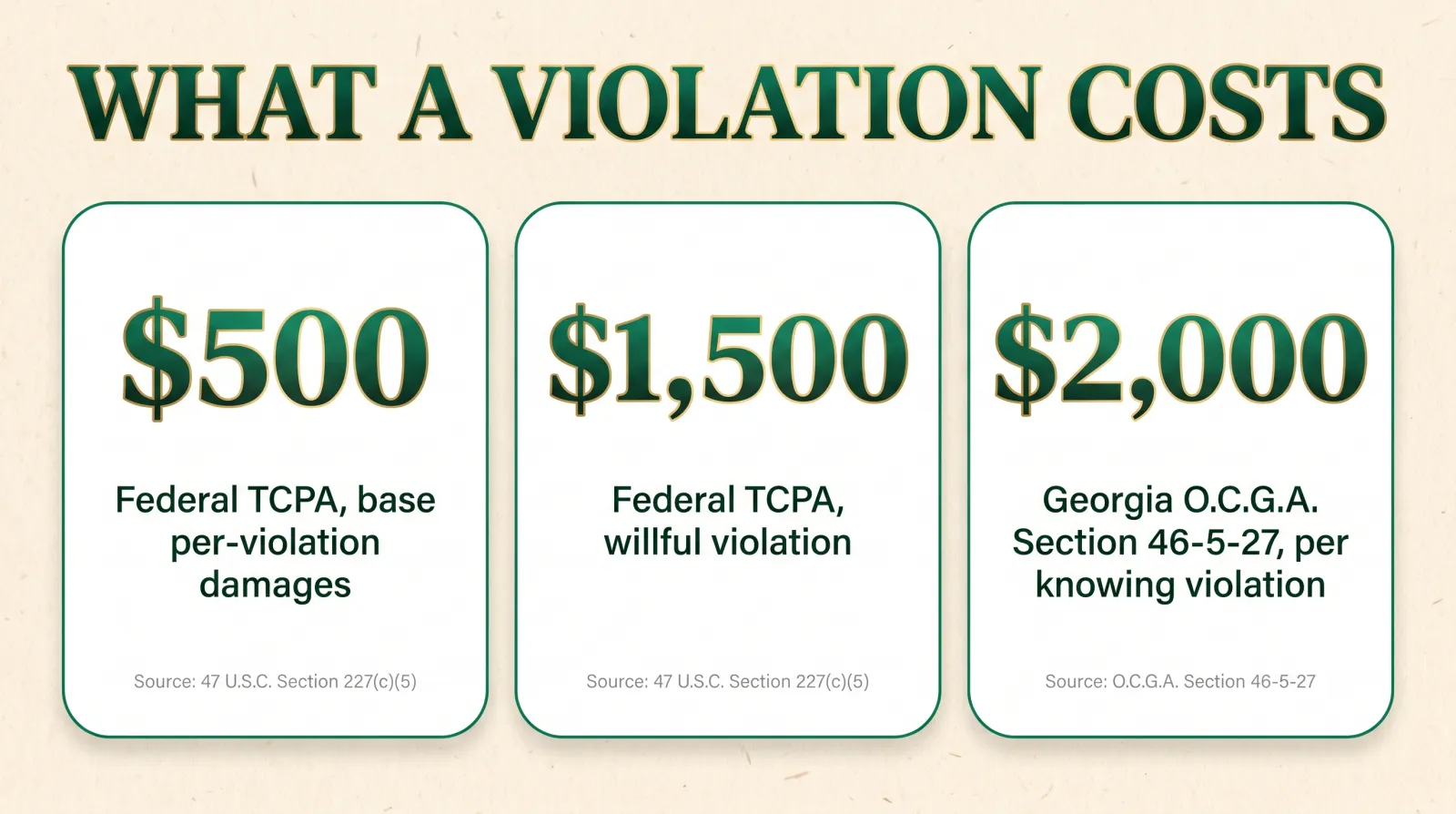
- Federal TCPA damages run $500 to $1,500 per violation under 47 U.S.C. Section 227. Georgia's own statute, O.C.G.A. Section 46-5-27, adds up to $2,000 per knowing violation on top of that, and both can apply to the same call.
- Pinn v. Tarkenton Senior Solutions, LLC (No. 1:24-cv-01962, N.D. Ga.), filed the same day SB 73 was signed, alleges a Georgia insurance marketing firm called a number on the National Do Not Call Registry repeatedly to sell life and final expense products.
- "We didn't know our vendor was doing that" is no longer a reliable defense in Georgia unless the agency had, and actually enforced, written compliance policies before the calls happened.
- Using an AI caller instead of a human doesn't change any of this. Consent still has to exist before the call, and the obligation still belongs to the licensed agent, not the vendor.
What Actually Happened to a Georgia Insurance Marketing Firm in 2024
Start with the case, because it’s easier to take a statute seriously once you’ve seen what it looks like applied to a business that sells the same products you do. On May 6, 2024, Kelly Pinn filed a putative class action against Tarkenton Senior Solutions, LLC in the U.S. District Court for the Northern District of Georgia, case number 1:24-cv-01962, assigned to Judge Amy Totenberg. According to Klein Moynihan Turco’s writeup of the complaint, Pinn alleges she received numerous calls promoting Tarkenton’s life and final expense insurance products between February 23 and March 6, 2024, and that her number had been listed on the National Do Not Call Registry since 2009. She says she never gave consent to be called.
Define the terms before the statute matters
National Do Not Call Registry: the federal database where consumers register a phone number to opt out of most telemarketing calls; it doesn't expire once registered. Private right of action: a legal provision letting an individual consumer, not just a regulator, sue directly over a violation. Vicarious liability: legal responsibility for another party's conduct, here extended by Georgia's amended statute to the business a call was made on behalf of, not only the party that physically dialed. Putative class action: a lawsuit filed on behalf of a proposed group of similarly affected people, pending a court's decision on whether to certify that group as a formal class.
The complaint is a putative class action, which means Pinn isn’t just asking for her own damages. She’s asking the court to certify a class covering everyone in the country whose number was on the National Do Not Call Registry and who received at least two telemarketing calls in a 12-month period from Tarkenton or its vendors, going back four years, per Klein Moynihan Turco’s summary. If that class gets certified, the exposure stops being about one plaintiff’s four calls and starts being about however many thousands of calls the company’s dialing history actually contains. That’s the mechanism a mini-TCPA with a class-action provision is designed to create, and it’s the exact provision Georgia added a few weeks after this case was filed.
Nothing about this case is exotic. It isn’t a rogue actor running an illegal robocall operation from overseas. It’s a licensed insurance marketing business selling a completely legitimate product category, final expense and life insurance, to a lead list that apparently wasn’t scrubbed against a registry that’s been public and free to check for two decades. That’s the ordinary failure mode this article is about, and it’s the one Georgia’s legislature specifically made more expensive to repeat.
Why Georgia Got More Dangerous for Insurance Telemarketing
Georgia’s telemarketing statute isn’t new. O.C.G.A. Section 46-5-27 has required callers to honor a state-maintained do-not-call list, disclose their identity, and avoid blocking caller ID for years, with the state’s Public Service Commission maintaining the registry and, per the commission’s own consumer guidance, restricting live solicitor calls to between 8 a.m. and 9 p.m. What SB 73 did was change who can be held responsible when those rules get broken, and it did it in a way that specifically targets the outsourced-vendor model a lot of insurance marketing runs on.
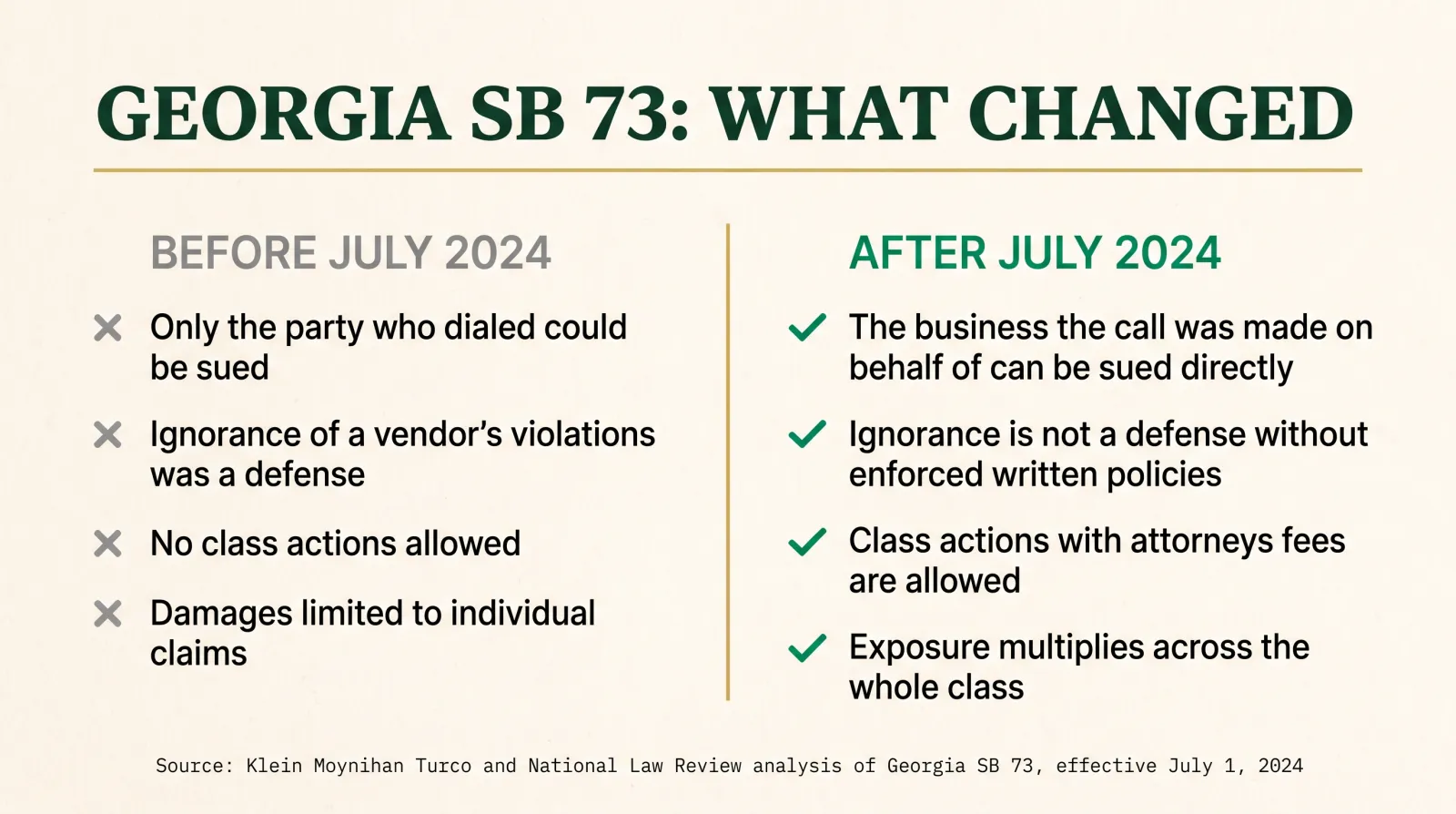
Before the amendment, per Klein Moynihan Turco’s analysis of the bill Governor Kemp signed on May 6, 2024, a business that hired a telemarketing vendor or bought leads from a third-party generator could often defend itself by arguing it hadn’t made the call and wasn’t aware the vendor’s calling practices were non-compliant. That argument required a plaintiff to prove an agency relationship in court, which isn’t always straightforward. SB 73 added language reaching the entity a solicitation was made “on behalf of,” and the National Law Review’s coverage of the bill describes the practical effect plainly: it’s no longer a defense that the defendant didn’t personally make the call or claims not to have known the call violated the statute, unless the business had established and actually enforced written policies and procedures to prevent it. The bill also, per both firms’ coverage, explicitly opened the statute to class actions with attorneys’ fees, which the earlier version of the law didn’t clearly allow.
Put together, that’s three separate changes stacking on top of each other: the party who benefits from the call, not just the party who dials it, can now be sued directly; claiming ignorance about a vendor’s practices stopped being an automatic shield; and a single bad list can now become a class action instead of one plaintiff’s individual claim. Each of those changes independently raises the cost of getting this wrong. Combined, they change the math on whether outsourcing your calling to “someone who says they’re compliant” is actually a way to reduce risk, or just a way to lose visibility into it.
The one real defense that's left
Per the coverage of SB 73's text, a business can still avoid liability for a vendor's non-compliant calls if it can show it had established and enforced actual written policies and procedures to prevent those violations before they happened. That's a meaningfully higher bar than "we had a contract that said the vendor would follow the law." It means a documented internal DNC process, real training, and evidence you followed up on it, not paperwork that existed only to be pointed at after something already went wrong.
What a Violation Actually Costs
Run the two statutes side by side, because they don’t replace each other. They stack.
$500
Federal TCPA base damages per violation
Source: 47 U.S.C. Section 227(c)(5)
$1,500
Federal TCPA damages per willful or knowing violation
Source: 47 U.S.C. Section 227(c)(5)
$2,000
Georgia private right of action, per knowing violation
Source: O.C.G.A. Section 46-5-27
$0.20
Per-minute cost of a managed AI caller, Single Account plan
Source: TheAffordableAI pricing, fetched 2026-08-27
Per-violation exposure, federal vs. Georgia state law
Statutory maximum per individual violation, before any class-action multiplier
Sources: 47 U.S.C. Section 227(c)(5) via Cornell Law School Legal Information Institute; O.C.G.A. Section 46-5-27 via FindLaw. Figures shown are per-violation statutory maximums under a private right of action, not aggregate case outcomes.
Do the arithmetic on a realistic list, not a worst case. Say an agency calls 200 numbers off a list it didn’t scrub against the National Do Not Call Registry, and every one of those numbers turns out to already be registered. Under the federal statute alone, at the $500 base figure, that’s a theoretical exposure of $100,000; at the $1,500 willful figure, $300,000. Layer Georgia’s own $2,000-per-knowing-violation figure from O.C.G.A. Section 46-5-27 on top of the federal number for the same 200 calls, and the state-law exposure alone reaches $400,000, separate from and additional to whatever the federal claim is worth. Add a class action’s attorneys’ fees, which SB 73 now explicitly permits, and the number stops being about 200 calls and starts being about however many calls the same non-compliant list or vendor relationship generated over the four-year lookback period a private right of action typically covers.
None of this means every violation settles at the statutory maximum. Most TCPA cases settle for a fraction of the theoretical ceiling, and Pinn v. Tarkenton Senior Solutions is still pending as of this writing, with no judgment or settlement on the public docket. But the ceiling is what a plaintiff’s attorney is negotiating against, and it’s the number that should be driving how much process an agency puts around its outbound list before the first call goes out, not after a complaint arrives.
| Calls to non-compliant numbers | Federal TCPA, base ($500) | Federal TCPA, willful ($1,500) | Georgia O.C.G.A. 46-5-27 ($2,000) |
|---|---|---|---|
| 10 | $5,000 | $15,000 | $20,000 |
| 50 | $25,000 | $75,000 | $100,000 |
| 200 | $100,000 | $300,000 | $400,000 |
| 1,000 | $500,000 | $1,500,000 | $2,000,000 |
Figures are simple multiplication of the per-violation statutory maximums against 47 U.S.C. Section 227(c)(5) and O.C.G.A. Section 46-5-27; they illustrate statutory ceilings, not typical settlement values, and federal and Georgia exposure can both apply to the same call.
Federal TCPA vs. Georgia’s Mini-TCPA, Side by Side
| Element | Federal TCPA | Georgia O.C.G.A. 46-5-27 |
|---|---|---|
| Covers | Autodialed/prerecorded calls and texts to cells, National DNC registry | Live and prerecorded solicitation calls to Georgia residential, mobile, and wireless lines |
| Registry to check | National Do Not Call Registry | Georgia's own state-maintained no-call database, separate from the national one |
| Calling hours | 8 a.m. to 9 p.m. recipient's local time (FTC Telemarketing Sales Rule) | 8 a.m. to 9 p.m. for live solicitor calls, per Georgia PSC guidance |
| Base damages per violation | $500, up to $1,500 if willful or knowing | Actual loss or up to $2,000 per knowing violation, whichever is greater |
| Who can be sued | The party responsible for the call under general agency principles | The caller and, since SB 73, the business the call was made on behalf of |
| Class actions | Long-established, common in TCPA litigation nationwide | Explicitly allowed with attorneys' fees since SB 73, effective July 1, 2024 |
Sources: 47 U.S.C. Section 227; O.C.G.A. Section 46-5-27 via FindLaw; Georgia Public Service Commission telephone solicitation guidance; Klein Moynihan Turco and National Law Review analysis of SB 73.
The two statutes ask for genuinely different things in a few places, which is exactly why compliance built only around the federal rule leaves a Georgia-specific gap. A national DNC scrub doesn’t automatically cover Georgia’s own state registry. A federal consent record doesn’t automatically satisfy Georgia’s identity-disclosure requirement. An agency that’s confident it’s TCPA-compliant because it uses a reputable dialer platform can still be exposed under O.C.G.A. Section 46-5-27 if nobody separately checked the state list.
The Four Compliance Layers Every Georgia Insurance Call Has to Clear
This is the part worth giving away completely, because none of it requires buying anything. It requires building a process and actually following it, which is the same thing SB 73’s one remaining defense demands anyway.
- Scrub against the National Do Not Call Registry before every campaign, not once. Registration doesn’t expire, and the registry updates constantly. A list scrubbed six months ago is stale. This is table stakes under the federal TCPA regardless of what state you’re calling into.
- Scrub against Georgia’s own state do-not-call database separately. Per the Georgia Public Service Commission’s consumer guidance, this is a distinct list from the national one, and a national-only scrub leaves a real gap for Georgia numbers specifically. If your dialer or CRM only checks one registry, confirm which one, because the answer matters here.
- Capture and store consent with a timestamp, not a checkbox that disappears. If a lead came from a website form, a TrustedForm-style certificate or an equivalent audit trail that proves what the consumer agreed to and when is the difference between a defensible record and a guess. If consent came from an existing customer relationship, document the relationship’s dates, since Georgia’s exemption for prior business relationships has time limits.
- Put your compliance policy in writing, train on it, and keep evidence you enforced it. This is the specific requirement SB 73 raised the bar on. A policy that exists only as a clause in a vendor contract, never trained on internally and never checked, is not what the amended statute treats as a defense. A policy your team can point to, with training records and a documented escalation process for opt-outs, is.
- Vet every vendor and lead source the same way you’d vet your own calling, because Georgia law now can hold you responsible for it. Ask a lead vendor directly how they scrub against both national and Georgia-specific registries, and get it in writing. If they can’t answer specifically, that’s the answer.
- Honor opt-outs immediately and permanently, across every channel a lead can reach you through. A DNC request made on a call has to stop calls, texts, and any other outbound contact from that number going forward, not just future dials from the same list.
- Keep call and consent records for as long as the applicable lookback period runs. Georgia’s own private right of action and the federal TCPA both allow claims that look back years, not weeks. If your records don’t go back that far, you can’t defend a claim that does.
What a non-compliant setup looks like
- A purchased lead list called without a fresh national or state DNC scrub
- No documented consent record for numbers that turn out to already be registered
- Compliance language exists only in a vendor contract, never trained or audited
- Opt-out requests handled inconsistently across calls, texts, and vendors
What the one remaining defense actually requires
- Both national and Georgia DNC registries scrubbed before every campaign
- Timestamped, storable consent evidence for every dialed number
- Written policies, staff training, and records showing they were enforced
- Opt-outs honored immediately across every calling and texting channel
How TheAffordableAI Handles This
Every dial logged automatically
Call attempts, dispositions, and outcomes land on the contact record instead of a spreadsheet nobody can produce if a complaint arrives.
Opt-outs honored immediately
A DNC request stops future contact from that number without relying on a rep to remember to update a list by hand.
Disclosure built into the call
The caller identifies itself where required, consistent with the identification requirements in Georgia's own statute.
HighLevel CRM sync
Consent, call, and disposition history sync to your CRM automatically, which is the audit trail a written compliance policy actually needs behind it.
Number warmup and spam defense
A standing routine that monitors caller reputation, separate from and in addition to your do-not-call and consent process.
No contracts either way
Single Account runs $200/mo plus a $500 one-time setup at $0.20/min, down to $0.15 at bulk. Agency runs $500/mo plus a $1,000 setup at $0.18/min, down to $0.16 at bulk.
None of this replaces the consent and DNC-scrubbing work above. It’s infrastructure that makes that work auditable instead of something you’re reconstructing after a demand letter arrives. If you want to hear what an actual disclosure and call flow sounds like before deciding anything, there’s a demo call on the homepage. You can also build an equivalent process yourself with a compliant dialer, a documented scrub routine, and a CRM that logs consent properly; plenty of agencies do exactly that, and it’s worth pricing against a managed platform before choosing either path.
Where This Isn’t the Right Fix
Be honest about the limits, because a vendor pitch that promises to make legal risk disappear is a bigger red flag than the risk itself. No calling platform, AI or human, removes the requirement that consent exist before a call is placed. No CRM sync substitutes for an agency actually building and enforcing the written compliance policy SB 73’s remaining defense requires; the sync makes an existing policy verifiable, it doesn’t create the policy for you. And if your agency’s real problem is a lead source that was never properly consented in the first place, better call logging just produces a cleaner record of a bad practice rather than fixing it. The fix for that starts upstream, at whoever is generating or selling you the leads, not at the dialer.
Georgia didn't make calling illegal. It made "we didn't know what our vendor was doing" stop working as an excuse.
Mike MooreWhat You Actually Get
Concretely, a documented consent and do-not-call process turns a real, currently-litigated risk, the kind Pinn v. Tarkenton Senior Solutions represents, into a manageable operational cost instead of an open-ended one. It means an opt-out gets honored the moment it’s requested instead of whenever someone updates a list. It means if a complaint ever does arrive, the agency has a timestamped record to produce instead of a shrug.
What it doesn’t do is eliminate the underlying legal obligation or promise a specific outcome in litigation. Every fact pattern is different, statutory damages caps and defenses can shift with future amendments, and this article reflects a review of the cited statutes, regulations, and case filings as published as of the date above; it’s general information, not legal advice for your specific agency. Talk to counsel licensed in Georgia before finalizing a compliance policy, especially the written-policy defense SB 73 now leans on.
Compliance disclaimer
Prior express consent is required for automated or artificial-voice calls and texts to a cell phone under the TCPA, and Georgia's O.C.G.A. Section 46-5-27 imposes separate state-level do-not-call and identification requirements. That obligation belongs to the licensed agent or agency, not to any vendor or platform. Any AI caller must disclose it's AI where required by applicable law and honor opt-outs immediately. Medicare marketing carries CMS's additional rules, including the TPMO disclaimer and call recording retention requirements. Using AI, or any calling platform, does not transfer compliance liability away from the licensed agent or agency. This article is general information based on sources cited above and reviewed as of the publish date, not legal advice for your specific situation.
Georgia’s telemarketing statute didn’t get harder to follow. It got more expensive to ignore, and it started reaching further up the chain than it used to. A documented scrub against both DNC registries, real consent records, and a written policy your team actually follows costs a fraction of what one uncontested class action would, and it’s the same process a well-run agency should be running regardless of which state’s number just lit up on the dialer.
See a compliant call flow before you decide anything
There's a live demo call on the homepage. Listen to the disclosure, the qualifying questions, and the warm transfer end to end.
Frequently asked
Is it illegal for insurance agents to cold call in Georgia?
Not automatically, but it's riskier than it used to be. A call to a number on the National Do Not Call Registry, or an automated or prerecorded call to a cell phone without prior express consent, has always exposed the caller to federal TCPA liability of $500 to $1,500 per violation under 47 U.S.C. Section 227. What changed in Georgia is state-level exposure on top of that: Senate Bill 73, effective July 1, 2024, added a private right of action that can reach the business the call was made on behalf of, not just whoever dialed the phone, and it opened the door to class actions with attorneys' fees. Calling isn't illegal. Calling without a documented consent and do-not-call process is now a materially bigger bet in Georgia than it was two years ago.
What did Georgia SB 73 actually change?
Signed by Governor Brian Kemp on May 6, 2024 and effective July 1, 2024, SB 73 amended Georgia's telemarketing statute in Title 46 of the Official Code of Georgia. According to law firm Klein Moynihan Turco's analysis of the enacted bill, it added language extending liability to the party a telephone solicitation was made "on behalf of," not only the entity that physically placed the call, and removed the ability to claim ignorance of a vendor's non-compliant calling as an automatic defense unless the business had established and enforced real written policies and procedures. The National Law Review's coverage of the bill adds that it explicitly allows plaintiffs to bring claims as a class action and recover attorneys' fees, which was not previously available under the state statute.
What is the Pinn v. Tarkenton Senior Solutions case about?
It's a real, currently pending federal case that shows what this exposure looks like in practice, not a hypothetical. Filed May 6, 2024 in the U.S. District Court for the Northern District of Georgia (Case No. 1:24-cv-01962, Judge Amy Totenberg), the plaintiff, Kelly Pinn, alleges she received numerous calls promoting Tarkenton Senior Solutions' life and final expense insurance products between February 23 and March 6, 2024, despite her number being on the National Do Not Call Registry since 2009 and despite never consenting to the calls, according to Klein Moynihan Turco's writeup of the complaint. It's a putative class action, meaning the plaintiff is asking the court to certify a nationwide class of everyone who received similar calls, which is exactly the exposure SB 73's class-action provision was built to enable.
How much can an insurance agency actually be fined for a DNC violation in Georgia?
Layer the two systems and add them up. Federal TCPA damages under 47 U.S.C. Section 227(c)(5) run $500 per violation, or up to $1,500 if a court finds the violation willful or knowing. Georgia's own statute, O.C.G.A. Section 46-5-27, provides for actual monetary loss or up to $2,000 per knowing violation, per the current codified text and Georgia's Attorney General consumer protection page. A single lead list called without a proper scrub, at even modest volume, multiplies fast: 200 calls to numbers that should have been excluded is a theoretical exposure north of $400,000 under the federal statute alone before Georgia's separate penalty or a class action's attorneys' fees are added. Real settlements vary enormously and most cases settle for less than the statutory maximum, but the ceiling is what a plaintiff's attorney is negotiating against.
Does buying leads from a vendor protect my agency from liability in Georgia?
No, and this is the specific gap SB 73 targeted. Before the amendment, a business that outsourced its calling to a vendor or bought leads from a third party that did the dialing could often argue in court that it wasn't aware of, and wasn't responsible for, how those calls were made. Georgia's amended statute, per Klein Moynihan Turco's and the National Law Review's coverage of the bill, removed that as an automatic defense: a business can now be pursued directly as the entity the call was made "on behalf of," with the only real defense being documented, enforced internal compliance policies. Buying leads from a vendor who says they're TCPA-compliant is not the same as having your own documented process, and Georgia law no longer treats it as one.
What's the difference between the federal TCPA and Georgia's telemarketing statute?
The TCPA is federal, applies nationwide, and covers automated and prerecorded calls and texts to cell phones plus the National Do Not Call Registry, with damages of $500 to $1,500 per violation under 47 U.S.C. Section 227. O.C.G.A. Section 46-5-27 is Georgia's own statute, sometimes called a mini-TCPA, and it runs on a parallel track: it requires callers to check a state-maintained do-not-call database in addition to the national one, restricts live solicitor calls to between 8 a.m. and 9 p.m. per Georgia's Public Service Commission, and, since SB 73, allows a private right of action of up to $2,000 per knowing violation that can reach the business the call was made on behalf of. Neither statute replaces the other. A single non-compliant call to a Georgia resident can trigger both at once.
Do Medicare and ACA producers in Georgia have extra rules on top of this?
Yes. Everything above applies to any insurance calling in Georgia, but Medicare Advantage and Part D marketing carries CMS's own separate marketing rules, including the TPMO disclaimer and multi-year call recording retention requirements, which sit on top of the TCPA and Georgia's statute rather than replacing them. Our [guide to the 2027 CMS Medicare marketing rules](/blog/cms-2027-medicare-marketing-rules/) covers that layer specifically. A Georgia agent selling Medicare Advantage has to clear the federal TCPA, Georgia's SB 73-amended statute, and CMS's marketing rules on the same call.
Does using an AI caller remove an agency's compliance liability in Georgia?
No, and no vendor can honestly claim otherwise. Consent under the TCPA and Georgia's statute has to exist before a call is placed, whether a human or an AI system places it, and that obligation belongs to the licensed agent or agency, not to the technology or the company that built it. What a managed calling platform can do is make the process auditable: every dial logged, every consent timestamp recorded, every opt-out honored automatically and immediately, with the record synced to a CRM instead of scattered across a spreadsheet or a vendor's private dashboard nobody at the agency can pull up during a deposition. That's a real reduction in operational risk. It is not a transfer of legal responsibility, and any claim that it is should be treated as false.
Sources
- O.C.G.A. Section 46-5-27, Telephone Solicitations to Residential, Mobile, or Wireless Subscribers (current codified text, via FindLaw)
- Georgia Attorney General's Consumer Protection Division — Do Not Call Law
- Georgia Public Service Commission — Telephone Solicitation consumer rights (calling hours, live-solicitor and prerecorded-call requirements)
- Klein Moynihan Turco LLP — Revised Georgia Telemarketing Law Takes Effect on July 1, 2024 (SB 73 analysis)
- Klein Moynihan Turco LLP — Insurance Company Hit With Do Not Call Class Action Lawsuit (Pinn v. Tarkenton Senior Solutions)
- National Law Review — Georgia bill allowing class actions and higher per-violation damages against telemarketers and their contractors
- 47 U.S. Code Section 227, Telephone Consumer Protection Act — private right of action and damages, subsections (b)(3) and (c)(5) (via Cornell Law School Legal Information Institute)
- TheAffordableAI — Pricing
Put this on your own phone line
See the AI dial, qualify, and warm-transfer a live call in under a minute. No contract, no dev work.
Keep reading

TCPA Revoke-All Rule 2026: What the FCC Just Adopted
The FCC adopted a new TCPA revocation order on September 30, 2026, months ahead of the 2027 deadline. Here is what changed for insurance agents.

FCC One-to-One Consent Rule Is Dead: Insurance Leads Now
The FCC's one-to-one consent rule is vacated and repealed. Here is what changed, what didn't, and how to vet an insurance lead vendor's consent in 2026.

California Insurance Leads: Call Recording Law
California requires consent from both sides before you record a sales call. Here is what Penal Code 632 demands, what it costs to skip, and how to stay fast.