Google Local Services Ads for Insurance Agents 2026
Google Local Services Ads now covers insurance agents in California and Florida. How lead billing, the responsiveness signal, and the Verified badge work.
Google Local Services Ads is a pay-per-lead advertising product, separate from regular Google Ads, that now lists “Insurance agency” as an eligible category for the first time, in a pilot restricted to California and Florida. You do not bid on keywords. You pass a license and background check, set a weekly budget, and Google shows your ad above the regular search results with your star rating attached, then charges you when a real person calls, texts, or books through it. The twist that matters more than the pilot restriction itself: Google’s own ranking algorithm for these ads runs partly on how fast you answer the phone, and it says so in writing. A missed call is not just a missed lead here. It is a data point Google uses to decide whether your ad shows up for the next one.
That single mechanic is why this is worth understanding even if you are not in California or Florida yet, and even if you already run Facebook or search ads. Everything below comes from Google’s own Local Services Ads help documentation, re-checked this week, plus TheAffordableAI’s own published pricing.
The short version
- "Insurance agency" is one of thirteen Local Services Ads categories currently restricted to a California-and-Florida-only pilot, per Google's own "Getting started with Local Services Ads" page for the United States.
- You are charged per valid lead, not per click: a phone call, a text, a voicemail, or a booking request all count, and message leads are typically, though not always, priced lower than phone leads.
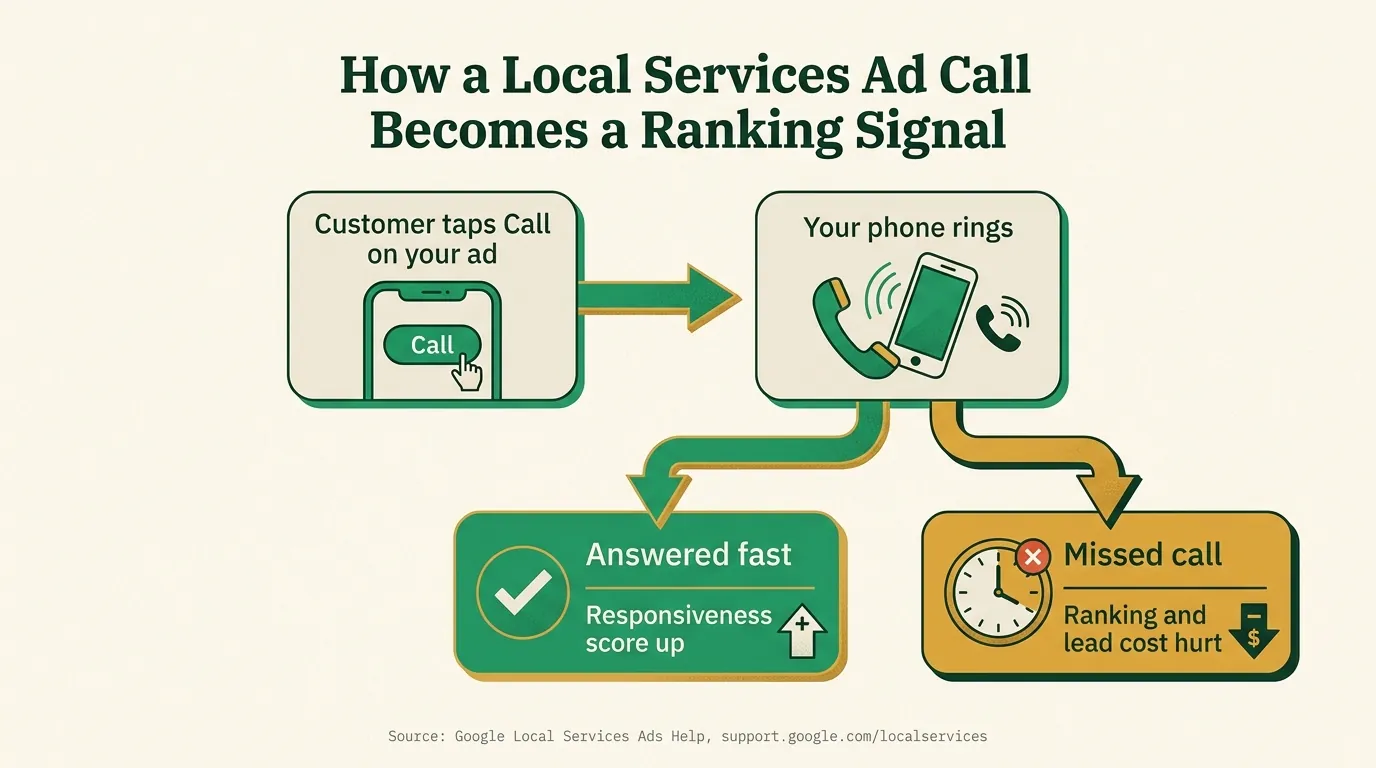
- Google states plainly that "missed calls may negatively affect your responsiveness," and responsiveness is a named ranking factor alongside your bid and profile quality.
- Google retired the Google Guaranteed and Google Screened badges in favor of a single Google Verified badge, and discontinued the Money Back Guarantee that came with Google Guaranteed; the reimbursement window for services booked before the change closed December 7, 2025.
- Poor-quality leads can be auto-credited within 24 hours of being charged, and approved credits typically post to your account balance within 30 days, under Google's automated review system.
What Google Local Services Ads Actually Is
Most insurance agents who have run digital ads know the standard Google Ads model: you pick keywords, you set a bid, you pay when someone clicks, and what happens after the click is entirely on you. Local Services Ads works differently at almost every step. You build a business profile inside the Local Services platform instead of a keyword campaign. Google runs a screening process on your business before you’re allowed to advertise at all, checking, in Google’s own words from its provider-qualification page, that “advertisers hold applicable state, provincial and/or country-level licenses” and that, where required, “each business must be insured.” Once you’re approved, your ad appears in a dedicated block above the regular search results and above standard Google Ads, showing your business name, your star rating, your review count, and either a “Google Verified” badge or nothing, depending on whether you’ve completed the full screening tier.
The part that actually changes your job as an agent is the pricing model. You are not paying for attention or for a click that might go nowhere. Google’s “How leads work” page defines a chargeable event narrowly: you’re charged for each valid lead, and a valid lead is one of a specific list of contact events, not simply an impression or a visit. That list includes a phone call the customer completes with you, a text or email they send, a voicemail they leave, a booking request submitted through the ad, and, notably, a missed call that you personally return by text, email, or phone. In other words, even a call you didn’t answer can still turn into a billable lead the moment you call back, provided you actually connect or leave a message. The mechanic that makes this different from search ads or social lead forms is that Google is watching what happens on your end of the phone, not just measuring clicks.
"Local" doesn't mean hyper-local storefront traffic
Despite the name, Local Services Ads for a licensed professional category like insurance is closer to a phone-and-message lead-gen product than a Google Maps foot-traffic tool. Your ad shows to people actively searching for an insurance agent or agency near a location you serve, and the entire transaction happens by phone, text, or a booking form. There's no storefront visit to track, which is exactly why responsiveness on the phone carries as much ranking weight as it does.
Which States Can Insurance Agents Actually Use It In Right Now
Here is the detail most general marketing guides miss, because most of them are written about home-service trades where Local Services Ads has existed for years: insurance is not yet available nationwide inside this product. Google’s own “Getting started with Local Services Ads - United States” help page lists a specific set of categories that carry a geographic restriction written directly into the category name, and “Insurance agency (California and Florida only)” is one of them.
| Category | Restriction, as published |
|---|---|
| Insurance agency | California and Florida only |
| Architect | California and Florida only |
| Interior designer | California and Florida only |
| Home insulation | California and Florida only |
| Drain expert | California and Florida only |
| Tire shop | California and Florida only |
| Barber shop, hair salon, nail salon, hair removal, piercing studio, tattoo studio | California and Florida only |
| Restaurant, food and beverage, dessert and coffee | Atlanta, Boston, Indianapolis, Miami, and San Jose only |
Two things about that list are worth sitting with. First, insurance is grouped with categories that read like a test batch for entirely new verticals Google is cautious about, not a mature rollout, which tells you this is early. Second, restrictions like this have moved before; food and beverage categories are metro-restricted rather than state-restricted, which is a different kind of pilot boundary than the state-level one insurance sits inside. Neither pattern predicts when, or whether, the insurance category expands past California and Florida. If you are licensed and operating in either state, you can check your eligibility today. If you’re not, the honest answer is to bookmark Google’s own category page and check back, rather than build a 2026 marketing plan around a national rollout that has not happened yet.
If you're a multi-state agency
You can run Local Services Ads for your California and Florida books today, using the same screening and profile setup, while continuing to run standard Google Ads, Facebook lead ads, or database reactivation campaigns for licensed states outside the pilot. There's no rule against running both; they're just billed and ranked under completely different mechanics.
How Billing Actually Works: Calls, Messages, and What Counts as a Valid Lead
Once you’re approved and running, the day-to-day mechanic is simple to state and easy to get wrong in practice. You set a weekly or monthly budget. Google shows your ad to people searching for an insurance agent in your service area. When one of them contacts you in a way that meets Google’s definition of a valid lead, you’re charged, up to your budget cap, and not before.
Google’s own “How leads work” page spells out what counts as valid contact. A completed phone call you answer counts. A text message or email from the customer counts. A voicemail the customer leaves counts, even without you ever speaking to them live. A booking request submitted through the ad counts. And a missed call, one where you never spoke to the customer and they left no voicemail, still counts as a valid lead if you return it, by text, email, or phone, and either speak with them or leave your own voicemail. That last scenario is the one agents miss most often: failing to answer the phone the first time does not exempt you from being charged. It just shifts the responsibility for closing the loop onto whichever channel you use to call back.
On pricing between contact types, Google’s language is deliberately non-committal: message leads are “typically priced lower than the corresponding phone lead price, although that’s not always the case,” and message pricing itself is influenced by the service requested, the message type, and whether the customer also reached out to other advertisers. There is no single flat rate published for insurance leads specifically, and any blog post that quotes you an exact insurance-agent Local Services Ads cost per lead is quoting a number Google has not published for this category. Treat any specific dollar figure you see for this, including on vendor sites, as an estimate from someone’s own account, not a rate you can plan around.
Time windows Google publishes for reviewing and crediting a bad lead
From Google's own "About Automated Local Services Ads lead credits" help page, checked this week.
Source: Google Local Services Ads Help, "About Automated Local Services Ads lead credits". Google's models continue to reassess charged leads over time beyond the initial 24-hour window; these are the two explicit timeframes the page states.
That gap, a same-day flag on the worst leads against a full month before a credit shows up in your balance, matters for how you budget. Do not assume a bad lead nets out to zero cost the day it happens. Plan your weekly budget as if every charged lead is real money spent, and treat any credit that eventually posts as a bonus, not as working capital.
The Ranking Algorithm Punishes Slow Follow-Up, Not Just Bad Reviews
This is the part of Local Services Ads that should change how you think about your phone, and it’s stated plainly enough that there’s no need to speculate about it. Google’s “About ad rankings” help page lists the factors that decide which ads show first and how much they cost per lead: your bid, your responsiveness, your profile quality, and customer feedback. Responsiveness gets its own explicit sentence: “Your responsiveness to customer inquiries and requests: Missed calls may negatively affect your responsiveness.” Profile quality, a separate factor, is defined to include “your rating, number of reviews, average response time, use of high-quality images, the verification checks you have completed, and any other information about your business that may influence user preferences.”
Read those two together and the mechanism is direct. Average response time is not a vanity metric Google shows you in a dashboard for your own curiosity. It’s an input to whether your ad ranks above a competing agent’s ad, and to how much you pay per lead when it does show. A predictive dialer’s overdial problem and a busy agent’s missed-call problem look different on paper, but they land in the same place here: any structural reason your phone goes unanswered gets read by Google as a responsiveness signal, and a bad one compounds. It doesn’t just cost you the one lead that rang through to voicemail. It nudges the algorithm that decides how visible, and how expensive, your next ten leads will be.
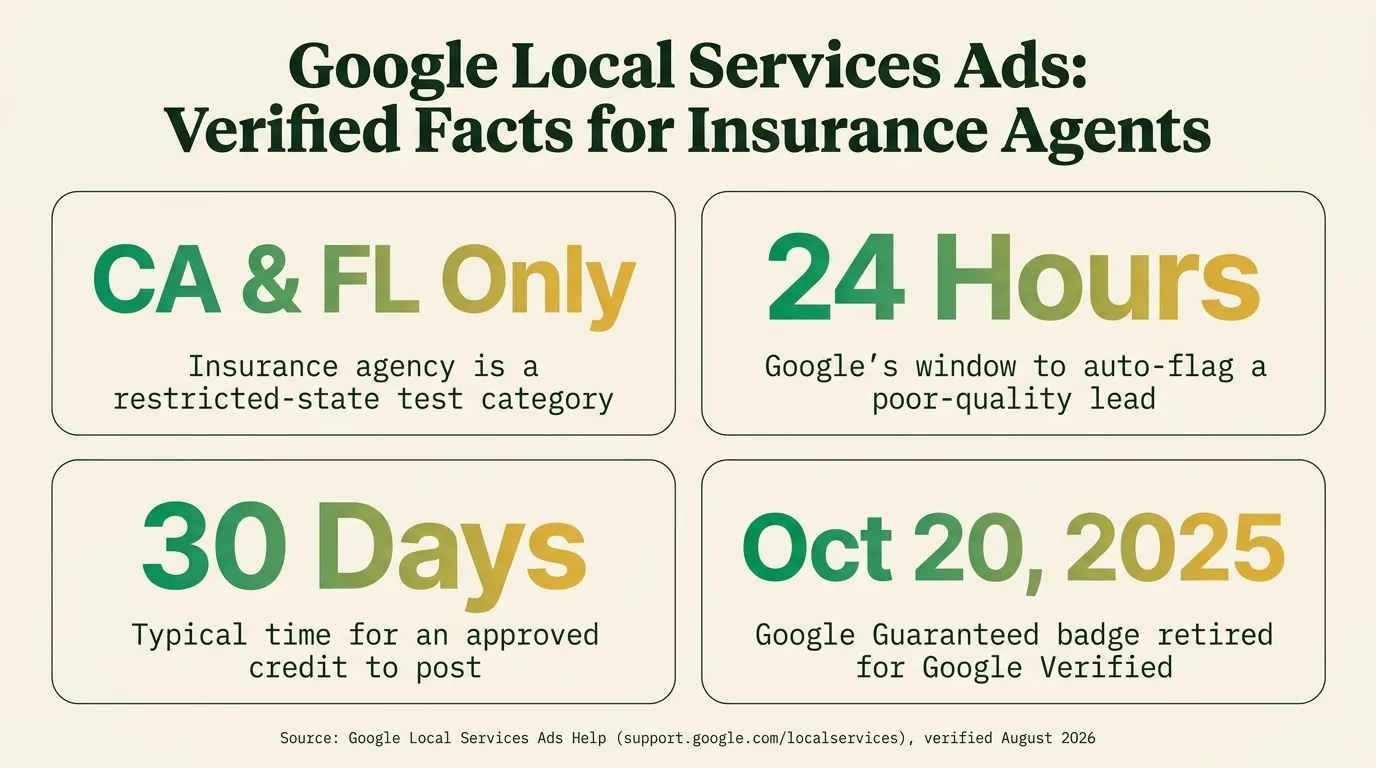
CA & FL
States where "Insurance agency" is an eligible Local Services Ads category
Source: Google Local Services Ads Help, US category list
24 hrs
Window in which a poor-quality lead can be auto-flagged for credit
Source: Google Local Services Ads Help, lead credits page
30 days
Typical time for an approved credit to post to your balance
Source: Google Local Services Ads Help, lead credits page
Oct 20, 2025
Date Google retired the Google Guaranteed badge for Google Verified
Source: Google Local Services Ads Help, Verified badge page
What a Missed Call Actually Costs You Here, Mechanically
Be precise about what can and can’t be claimed here, because this is exactly the kind of spot where a blog post usually invents a number. Google has not published a formula converting “missed calls per week” into “dollars added to your cost per lead,” and no honest source can hand you one. What Google has published is the mechanism, and the mechanism has three stages worth naming separately, because each one is a distinct kind of loss.
The first loss is the one every agent already understands: a paid lead that doesn’t convert because nobody called back in time, or called back to a prospect who had already reached a competitor. That loss existed before Local Services Ads; it’s the same speed-to-lead problem this site covers for Facebook and organic leads too.
The second loss is specific to this platform and easy to miss: Google explicitly states missed calls hurt your responsiveness score, which is a named ranking input separate from your star rating. A bad month of missed calls doesn’t just cost you those specific leads. It can make your ad show less often, or show at a higher cost per lead, for leads you haven’t even received yet. This is the part a standard Facebook or search-ad campaign doesn’t do to you; a missed click on a search ad has no equivalent memory effect on your future cost per click.
The third loss is about the review layer stacked on top of both. Profile quality includes your rating and review count, and reviews on Local Services Ads are tied to real completed leads, so a rough follow-up experience, slow response, no answer, a rushed callback, has a longer tail: it can show up in a review weeks later, which then feeds back into the same ranking factor a missed call already dented.
None of that is a promise about what will happen to any specific agency’s numbers. It’s a description of a feedback loop Google has built and documented, and the reason it’s worth taking seriously without a made-up dollar figure attached.
The Google Guaranteed Badge Is Gone: What Changed for Insurance Agents
If you researched Local Services Ads even a year ago, you likely came across the “Google Guaranteed” badge, a green shield that signaled Google had screened the business and would refund the customer’s money, up to a stated limit, if the job went wrong. That badge, along with a separate “Google Screened” badge used for professional-services categories and a “License Verified by Google” badge, is gone as a distinct product.
Google’s own “About Google Verified badge” help page confirms the consolidation: existing badges are being replaced with a single Google Verified badge, and “existing advertisers who’ve completed verification requirements will automatically earn the new Google Verified badge.” The same page is explicit about the consumer-facing guarantee that came with the old badge: “Google will be discontinuing the Money Back Guarantee associated with the Google Guarantee badge.” Consumers who had services booked before the transition had until a stated cutoff, December 7, 2025, to submit a reimbursement request under the old guarantee.
For an insurance agent weighing whether to advertise here, the practical takeaway is narrower than the headline sounds. The badge itself was always a trust signal aimed at consumers browsing home-service categories, where “will this contractor actually show up and do the job” is the anxiety a money-back guarantee addresses. For a licensed insurance agency, your state license, E&O coverage, and carrier appointments already carry more regulatory weight than a Google refund badge ever did. What actually matters for your ranking and your cost per lead going forward is the underlying screening (license and background checks) and the ongoing responsiveness and review signals, which the badge consolidation doesn’t change. If your website or ad copy still references “Google Guaranteed,” update it; the claim is no longer accurate.
How to Actually Set Up Local Services Ads for Your Agency
Here is the method in full, with nothing held back, because an agent who reads this and decides to run the setup themselves is exactly the kind of buyer who understands the value of what comes next.
- Confirm your category and state eligibility first. Go to Google’s Local Services Ads sign-up flow and check whether “Insurance agency” appears as an option for your business address. If you’re outside California or Florida, don’t spend time on the rest of the setup yet; check back periodically instead.
- Gather your license and insurance documentation before you start the application. Google’s screening checks license status where applicable and, per its own qualification page, may require proof of insurance depending on category and location. Have your state insurance license number and your E&O policy documentation ready so the screening doesn’t stall on paperwork you have to go dig up mid-process.
- Build a complete business profile, not a placeholder one. Profile quality is a named ranking factor, and it explicitly includes “use of high-quality images” and “any other information about your business that may influence user preferences.” A profile with real photos of your office or team, a filled-out service list, and accurate hours will start ahead of a bare-minimum one.
- Set a realistic weekly budget you can actually staff against. You’re charged per valid lead, not per click, so the real constraint isn’t your ad spend, it’s whether you or your team can answer every call that budget generates during business hours. Underbudget on purpose in month one and raise it once you’ve confirmed your answer rate holds up.
- Put a same-day callback process in writing before your first lead arrives. Because a returned missed call still counts as a valid, billable lead, and because responsiveness is scored, decide now who answers, what the backup plan is when that person is unavailable, and what the maximum acceptable callback window is. Write it down; don’t leave it to whoever happens to notice the missed call.
- Ask every closed customer for a review, and respond to every review you get. Reviews and review count feed profile quality directly, and it’s the one ranking input almost entirely in your control after the lead has already converted.
- Re-check your category and profile status monthly. Google has changed badge structures, credit systems, and category rules more than once inside a single year; a page you read in January can be out of date by summer.
Do this before you spend a dollar on the ad itself
Test your own phone answering, honestly, before turning the campaign on. Have three people call your business line at random times over two days: mid-morning, lunch, and end of day. If any of those calls goes to voicemail, you already know where your Local Services Ads responsiveness score is going to take its first hit, and it's cheaper to fix that gap before you're paying for leads that fall into it.
Local Services Ads vs Standard Google Ads vs Facebook Lead Ads
Agencies running paid leads already know Facebook and standard Google search ads behave differently, a comparison this site has covered before. Local Services Ads is a third, distinct mechanic, and the differences matter for how you staff follow-up on each.
| What you're comparing | Local Services Ads | Standard Google Search Ads | Facebook Lead Ads |
|---|---|---|---|
| What you pay for | A valid lead: a call, text, voicemail, or booking | A click, whether or not it converts | A click or a completed instant-form submission |
| Pre-approval required | Yes: license, insurance, and background screening | No screening beyond standard ad policy review | No screening beyond standard ad policy review |
| Insurance availability | California and Florida only, as of this writing | Nationwide, subject to standard Google Ads policy | Nationwide, subject to Meta ad policy |
| Ranking includes response speed | Yes, explicitly, per Google's own ranking-factors page | No; ranking is Quality Score and bid-based | No direct ranking effect from your call-back speed |
| Trust signal shown to the searcher | Star rating, review count, Google Verified badge | None built in beyond ad copy and sitelinks | None built in; depends on your landing page |
The practical read: Local Services Ads is the one channel here where your phone habits are a literal, published ranking input, not just a business best practice. That makes it a poor fit for an agency that can’t commit to answering or returning every call same-day, and a strong fit for one that already has, or is about to build, coverage that doesn’t depend on someone happening to be at their desk.
Where TheAffordableAI Fits
We don’t sell Google Local Services Ads, and nothing above needs a vendor to work; you can run every step yourself with a phone and some discipline about callback timing. What we do is remove the part of this that depends on a human being available at the exact moment a call comes in. TheAffordableAI answers every inbound call, including one Google routes to your business line from a Local Services Ads click, immediately and every time, then either transfers it warm to a licensed agent or books it against real calendar availability if nobody’s free. There’s no version of “the phone rang three times and went to voicemail” once it’s covering that line, which is the specific event Google says hurts your ranking.
Every inbound call answered
No missed-call event for Google's responsiveness signal to catch, on a line that's covering a Local Services Ads number or any other inbound source.
Warm transfer to a licensed agent
A qualified lead reaches a real person live, on the same call, instead of sitting in a queue while your responsiveness clock keeps running.
Auto-booking against real availability
If no agent is free, the caller books directly onto a calendar instead of leaving a voicemail that becomes a same-day callback you have to remember to make.
HighLevel sync, every call logged
Disposition and transcript sync into HighLevel automatically, so nothing about how a lead was handled depends on someone writing it down.
Hear how it answers a call, before you turn on a paid ad
There's a live demo call on the homepage. Listen to how fast it picks up, then decide whether your current setup can match that on every call, every time.
Pricing is published, not quoted privately, and it’s worth checking against the live page before you decide anything: a Single Account is $200 a month plus a $500 one-time setup fee, at $0.20 a minute, down to $0.15 a minute at bulk volume. An Agency plan, which routes to 20-plus agents at once, is $500 a month plus a $1,000 one-time setup fee, at $0.18 a minute, down to $0.16 a minute at bulk. Both are month to month, no long-term contract. You can also just build the discipline yourself: a shared team inbox, a strict same-day callback rule, and someone assigned to own it, is a real answer here too, and plenty of small agencies run exactly that instead of adding software. It’s worth pricing both against what your actual missed-call rate looks like this month.
When This Is Not Your Problem, and When Local Services Ads Is the Wrong Tool
Be honest about the limits of this, on both sides. If you’re not licensed in California or Florida, Local Services Ads for insurance isn’t available to you yet, and there’s no workaround worth chasing; spend the effort on a channel that’s actually open in your state instead. If you are eligible but your agency genuinely cannot commit to same-day, ideally same-hour, phone coverage, this is a channel that will actively punish you for that gap rather than sitting neutral like a search ad would; a Facebook or database-reactivation campaign that doesn’t tie your future cost per lead to your response time might be the better first move. And if you’re already running Local Services Ads well and your bottleneck is lead volume rather than follow-up speed, nothing here changes that; this article is about the mechanic, not a claim that it will fix a demand problem.
Using AI does not transfer liability
Whether a Local Services Ads lead, or any other inbound or outbound contact, is answered by a human or an AI voice agent, the licensed agent and agency stay responsible for disclosure, consent where it applies, Do Not Call obligations, and, for Medicare business, the CMS marketing rules including the TPMO disclaimer and call-recording retention requirements. A vendor's technology does not carry any of that responsibility away from you, and this article is not legal advice about your specific compliance obligations.
Insurance is new to Local Services Ads, and it’s easy to read a two-state pilot and decide it isn’t worth learning yet. The more useful way to read it: Google just told every agent in California and Florida, in writing, exactly which phone behavior it will reward and which it will punish, and it did not bury that in a press release. If you’re eligible, the setup cost is your time and a callback discipline you should probably have anyway. If you’re not eligible yet, the responsiveness math it’s built on will still be true the day the pilot expands to your state.
Frequently asked
What is Google Local Services Ads, and how is it different from a regular Google Ads campaign for insurance agents?
Local Services Ads (LSA) is a separate Google product from standard Search or Display campaigns. Instead of bidding on keywords and paying per click, you set up a business profile, pass Google's license and background screening, and pay only when a real person calls, messages, or books through the ad, appearing above regular search ads with a star rating and review count. Standard Google Ads charges for clicks whether or not anyone ever contacts you; Local Services Ads charges for the contact itself, and Google's own ranking of those ads runs partly on your responsiveness, not just your bid.
Can insurance agents use Google Local Services Ads outside of California and Florida?
Not yet, as of this writing. Google's own 'Getting started with Local Services Ads - United States' help page lists 'Insurance agency' as one of thirteen categories restricted to a two-state pilot, alongside categories like architect, interior designer, and home insulation, each marked '(California and Florida only)'. Google has expanded Local Services Ads into new categories and regions before, so an agent outside those two states should check the current category list periodically rather than assume the restriction is permanent.
How does Google Local Services Ads billing work: do I pay per click or per lead?
Per lead, not per click. Google's 'How leads work' help page states you're charged for each valid lead you receive, and defines a valid lead as a phone call you answer, a text or email from the customer, a voicemail, a booking request, or a missed call that you return by text, email, or phone. Message leads are typically priced lower than the equivalent phone lead, though Google notes that isn't always the case. You set a weekly or monthly budget and are only charged up to that limit.
Does missing a call actually hurt my Local Services Ads ranking?
Yes, by Google's own description of how it ranks ads. Google's 'About ad rankings' page lists responsiveness as a ranking factor and states directly: 'Your responsiveness to customer inquiries and requests: Missed calls may negatively affect your responsiveness.' The same page also lists 'average response time' as part of profile quality, which is a separate ranking input from your bid. A missed call is not just a lost lead in the moment; Google is measuring it and folding it into whether your ad shows up for the next lead.
What happened to the Google Guaranteed badge for Local Services Ads?
Google retired it. Google's 'About Google Verified badge' help page confirms Google is discontinuing the separate Google Guaranteed, Google Screened, and License Verified by Google badges in favor of one combined Google Verified badge, and that 'Google will be discontinuing the Money Back Guarantee associated with the Google Guarantee badge.' The same page states that eligible consumers could submit reimbursement requests for services booked before the change through December 7, 2025. If your marketing still references a 'Google Guaranteed' badge, that language is out of date.
Can I get a credit for a bad Local Services Ads lead?
Sometimes, but the process changed from a manual dispute to an automated review. Google's 'About Automated Local Services Ads lead credits' page says charged leads are reassessed by its models over time, that poor-quality leads may be processed through auto-credits within the first 24 hours, and that approved credits are typically applied to your account balance within 30 days. There's no guarantee a specific lead gets credited; the system is scoring lead quality on its own timeline, not on a dispute you file and argue.
Do I need TCPA consent to call back a Local Services Ads lead?
A Local Services Ads lead is inbound: the consumer found your ad and initiated the contact themselves, which is a materially different starting point than an outbound marketing call or text you place to a purchased list. That said, calling the person back to continue a conversation they started is not the same legal question as an unsolicited sales call, and this article is not legal advice about your specific situation. If your agency also runs outbound follow-up campaigns off any lead source, including Local Services leads, the disclosure, opt-out, and Do Not Call obligations covered elsewhere on this site still apply, and using AI to make those calls does not move that responsibility off the licensed agent.
Is Local Services Ads worth it for a small agency, or only large ones?
Google's own pay-per-lead model and the pilot's two-state restriction make this more of a 'can you actually answer every call' question than a budget-size question. A one-person agency that answers its phone in three rings all day gets the same ranking credit for responsiveness as a twenty-agent shop; a large agency that lets calls roll to voicemail during a busy afternoon gets the same ranking penalty as a solo agent who does the same thing. The deciding factor Google publishes is response behavior, not headcount.
Sources
- Google Local Services Ads Help — "About ad rankings", ranking factors including responsiveness and profile quality
- Google Local Services Ads Help — "How leads work", lead billing, valid lead definitions, phone vs message pricing
- Google Local Services Ads Help — "About Automated Local Services Ads lead credits", 24-hour and 30-day credit timing
- Google Local Services Ads Help — "Getting started with Local Services Ads - United States", eligible categories and state-restricted pilot list
- Google Local Services Ads Help — "About Google Verified badge", badge consolidation, Money Back Guarantee discontinuation, reimbursement deadline
- Google Local Services Ads Help — "How providers qualify for Local Services Ads", license, insurance, and background screening
- TheAffordableAI — Pricing
Put this on your own phone line
See the AI dial, qualify, and warm-transfer a live call in under a minute. No contract, no dev work.
Keep reading

Facebook vs Google Ads for Insurance Leads in 2026
Facebook and Google leads behave differently for insurance agents. Sourced 2026 cost benchmarks and the follow-up system each lead type actually needs.

Speed to Lead in 2026: Why the First 60 Seconds Decides Who Writes the Policy
The lead you paid for is not lost to a better agent. It is lost to a faster one. Here is what response time actually does to contact and conversion rates, and how to get to sixty seconds without hiring a dialer team.
Florida Insurance Leads: Speed to Lead Under the FTSA
Florida sold more 2026 ACA plans than any state, yet its telephone law adds exposure on top of federal TCPA. How agencies follow up fast and compliant.