Homeowners Non-Renewals Are Surging: What Agents Do Now
Homeowner non-renewal rates jumped up to 216% since 2018, per NAIC. Here's how P&C agents should follow up before a lapsing policy runs out.

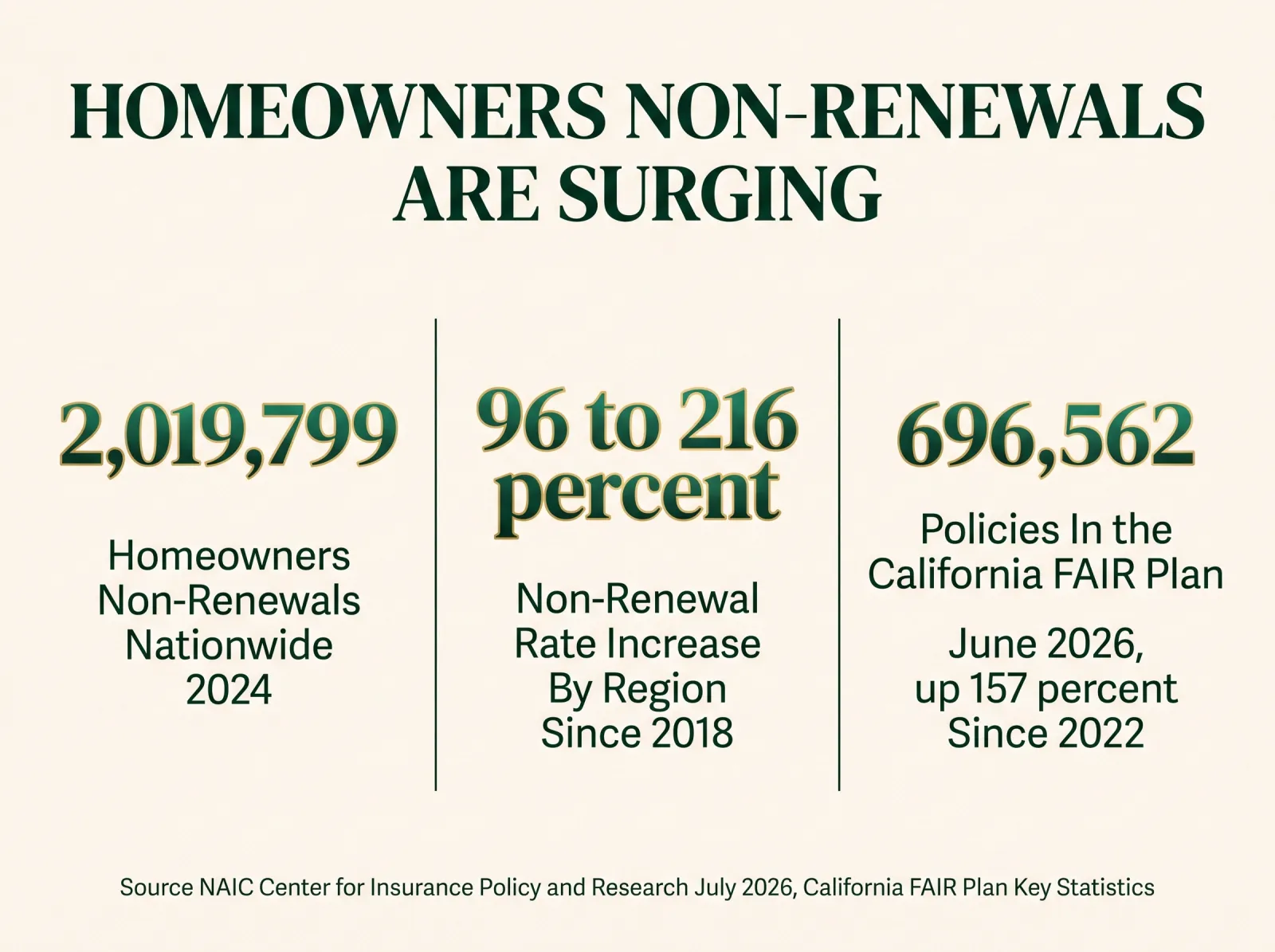
A homeowner opens a letter that says their insurer won’t renew the policy. They have a date, usually somewhere between 45 and 75 days out depending on the state, by which they need new coverage or their mortgage servicer will buy it for them at twice the price. That’s not a routine renewal shopper comparing rates at their leisure. That’s someone on a clock, and right now there are a lot more of them than there used to be: company-initiated homeowners non-renewal rates rose between 96% and 216% across the country from 2018 to 2024, according to a National Association of Insurance Commissioners report published July 31, 2026. If you sell P&C insurance and you’re not treating a non-renewal lead differently from a routine quote request, you’re leaving the most urgent, most motivated buyer on your list to fend for itself.
This article defines what a non-renewal actually is, walks through the NAIC’s own numbers on how fast this has grown and where it’s worst, explains the notice-period mechanics that create a real, dated deadline, and gives you a follow-up method built specifically for a lead type most agencies still handle like any other inbound quote request. It also covers where the compliance rules are identical to any other line of insurance you call, and where a managed AI caller changes the economics of working this list at volume.
The short version
- Company-initiated homeowners non-renewal rates per 1,000 policies rose 96% to 216% across all four NAIC zones from 2018 to 2024, with the Southeast up 216% and the Northeast up 147%, per NAIC's July 2026 report.
- Insurers non-renewed 2,019,799 homeowners policies nationwide in 2024 alone, 42% of them in the Western Zone, per the same report.
- A non-renewal comes with a dated notice window, not open-ended shopping time. California requires at least 75 days' written notice under Insurance Code § 678; other states set their own, often shorter, timelines.
- Miss that window and a homeowner with a mortgage can get force-placed coverage that costs roughly twice as much and protects only the lender, per the CFPB's own consumer advisory.
- California's FAIR Plan, the state's insurer of last resort, had 696,562 policies in force as of June 2026, up 157% since September 2022 — a direct measure of how many homeowners couldn't find coverage anywhere else.
What’s Actually Happening: Non-Renewals, By the Numbers
A non-renewal is different from a cancellation. A cancellation ends a policy mid-term, usually for nonpayment or a specific underwriting issue discovered after the fact. A non-renewal is the insurer declining to offer a new term when the current one runs out, which means the policyholder did nothing wrong mid-term; the insurer simply decided it no longer wants that risk on its books, or in that zip code, at the price regulators will let it charge. For an agent, both produce the same customer: someone who needs a new policy on a deadline. But non-renewal is the one that’s grown sharply enough to be its own trend, not just an occasional file.
The NAIC’s Center for Insurance Policy and Research pulled seven years of state-reported Market Conduct Annual Statement data, 2018 through 2024, covering all 50 states except Puerto Rico and North Dakota, and published the results on July 31, 2026. The topline number: insurers reported 2,019,799 company-initiated homeowners non-renewals nationwide in 2024. Because raw counts don’t account for how many total policies each region has, the report normalizes to a rate per 1,000 policies in force, and that’s where the trend gets clear.
| Zone | Non-renewals, 2024 | Rate per 1,000 policies | Change since 2018 |
|---|---|---|---|
| Western | 852,019 | 25.1 | Within 96%–216% range |
| Southeast | 630,551 | 22.0 | +216% (largest) |
| Midwest | 352,847 | 14.2 | Within 96%–216% range |
| Northeast | 184,382 | 11.7 | +147% |
Source: NAIC Center for Insurance Policy and Research, "Examining Homeowner Property Insurance Market Dynamics: An Assessment of Countrywide State-Level Data From 2018 to 2024," published July 31, 2026. The report states the increase across all four zones ranges from 96% to 216% and names the Southeast (216%) and Northeast (147%) explicitly as the largest and next-largest increases; it does not break out the exact figure for the Midwest or Western zones individually.
Add the four zones’ policies-in-force figures from that same table and you get just over 103 million homeowners policies nationwide covered by the report, against just over 2 million non-renewals in a single year. That’s roughly 1 in 51 homeowners policies losing its renewal in 2024 alone, nationally, and the rate is meaningfully higher than that in the Western and Southeast zones specifically.
Why Insurers Are Pulling Back on Renewals
The NAIC report doesn’t hand you a single cause and stop there, but it does document the financial pressure underneath the pattern. Even after insurers pulled back on renewals in the highest-risk areas, real, inflation-adjusted average premium per policy still climbed 18.3% in the Northeast to 43.3% in the Western Zone from 2018 to 2024. Non-inflation-adjusted premium growth was steeper still: total direct premium written rose 55% to 90% across zones over the same period. Insurers raised prices sharply and still chose to shed policies in the hardest-hit areas, which is the signature of a market where claims costs are outrunning what regulators will let a carrier recover through rate alone.
Trade coverage of the same NAIC release points to the mechanism agents already see on the ground: increasingly costly natural disasters, higher rebuilding expenses, and climate-related risk that concentrates hard in specific zip codes rather than spreading evenly across a state. A single wildfire, hurricane, or hail season doesn’t just generate claims; it changes how a carrier’s actuaries model every property nearby for years afterward, non-renewal included. This is why the trend is so unevenly distributed. A homeowner three miles from a burn scar or a coastline can face a very different renewal outcome from one thirty miles inland, even in the same rating territory on paper.
This is a P&C trend, not a Medicare or ACA one
Everything in this report covers homeowners property insurance. It has nothing to do with Medicare Advantage, Part D, or ACA marketplace plans, and none of CMS's Medicare-specific marketing rules, the TPMO disclaimer, the Scope of Appointment, or CMS's call-recording retention schedule apply to a homeowners policy. The general telemarketing rules covered later in this article, the TCPA and the FTC's Telemarketing Sales Rule, apply to any line of insurance sold by phone, homeowners included.
The Clock: How a Notice Turns Into a Deadline
Here’s the part that matters most for how you work these leads: a non-renewal isn’t an open-ended shopping decision. It comes with a legally required notice period, and once that clock starts, the homeowner has a specific, dated reason to act now rather than eventually.
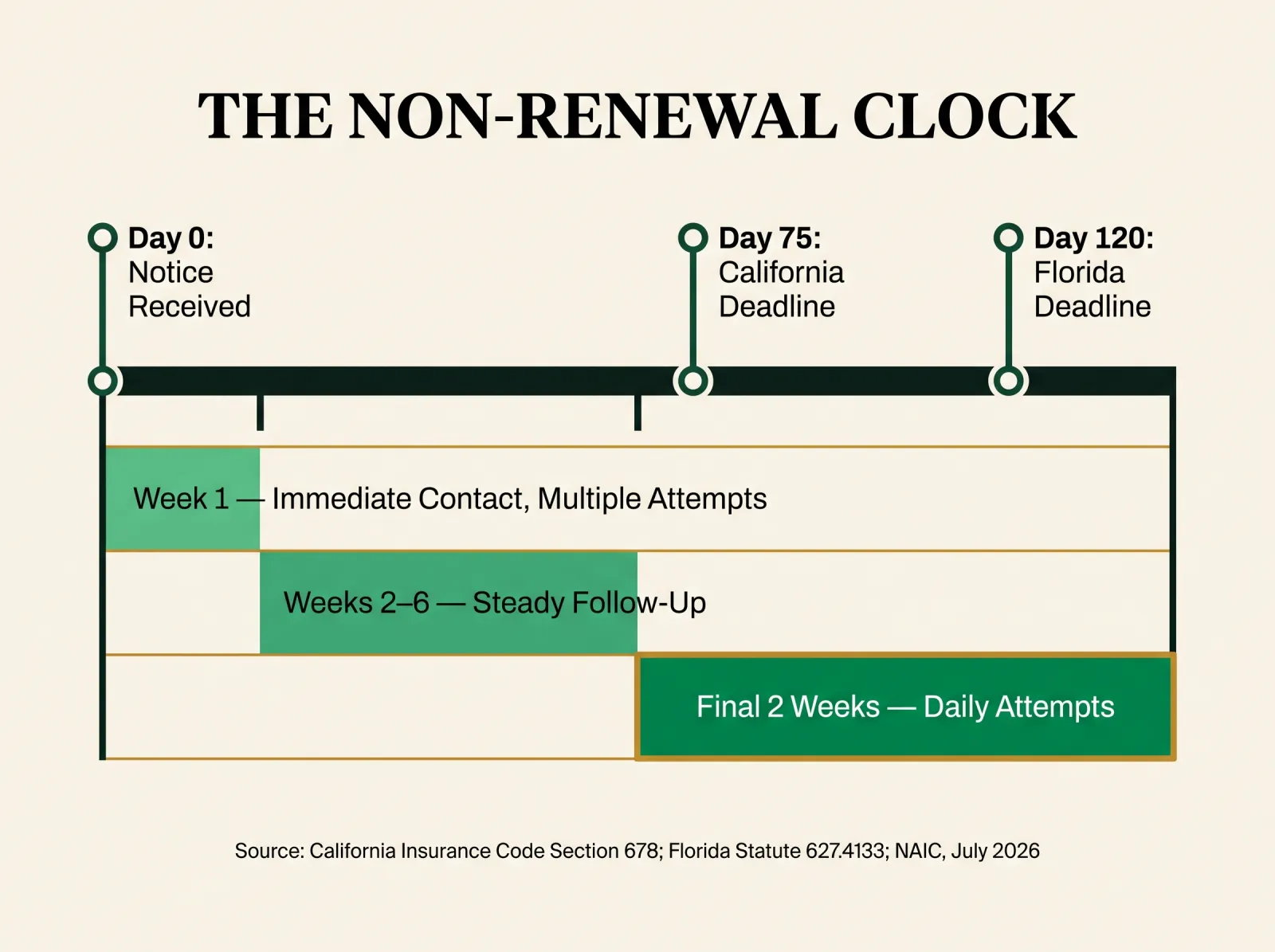
California sets the requirement at a minimum of 75 days before the policy’s expiration date, under California Insurance Code Section 678(c)(1), for residential property insurance policies expiring on or after July 1, 2020. The statute has teeth: if the insurer doesn’t deliver that 75-day notice, the existing policy stays in force, unchanged, for 75 days from whenever the notice actually does go out. Florida, one of the hardest-hit markets in the NAIC’s own Southeast Zone data, sets its window longer still: at least 120 days before the effective date of nonrenewal for homeowners and residential property policies, under Florida Statute 627.4133(2)(b), with shorter carve-outs for nonpayment (10 days) and early cancellation in the first 60 days of a new policy (20 days). Other states set their own notice periods, and they don’t all match either of these two, so confirm the specific requirement in whatever state your leads live in rather than assuming a single national number.
| State | Minimum notice before nonrenewal | Statute |
|---|---|---|
| California | 75 days | Cal. Ins. Code § 678(c)(1) |
| Florida | 120 days | Fla. Stat. § 627.4133(2)(b) |
Source: California Legislative Information, Insurance Code § 678; Florida Legislature, Fla. Stat. § 627.4133. Confirm the current requirement in your own state before relying on either figure elsewhere.
What’s consistent across states, even with different exact numbers, is the shape of the problem: a fixed, dated window between “insurer says no” and “coverage actually ends,” inside of which the homeowner has to shop, apply, get approved, and bind a new policy, or fall back on whatever their mortgage servicer arranges instead.
That structure is exactly why a non-renewal lead behaves differently from a routine shopping lead. A homeowner comparison-shopping ahead of a normal renewal has slack; if this week doesn’t work out, next week is fine. A homeowner working against a 75-day notice, especially one who waited a few weeks before starting to look, has none. Every day an agent doesn’t reach them is a day closer to a forced fallback option that costs more and covers less.
What it looks like
- Lead sits in the same queue as routine renewal shoppers and cold quote requests
- One or two attempts, then it ages out with everything else
- No tracking of how many days are left before the old policy actually lapses
- Agent finds out the homeowner already went with someone else, or got force-placed
What it looks like
- Notice date and expiration date logged the moment the lead enters the CRM
- Call attempts front-loaded, then continued on a cadence tied to days remaining
- Cadence tightens automatically as the expiration date approaches
- Homeowner reached with time to actually apply and bind before the deadline
What Happens If Nobody Reaches Them in Time
The consequence of a missed non-renewal window isn’t abstract. If the homeowner has a mortgage, and most do, the loan servicer is required to maintain continuous property insurance on the home, and if the homeowner doesn’t secure it, the servicer will buy a policy on their behalf and bill them for it. The Consumer Financial Protection Bureau’s own consumer advisory is direct about what that costs: force-placed insurance “usually costs twice as much as you’d regularly pay for insurance,” and it typically protects only the lender’s interest in the property, not the homeowner’s belongings, additional living expenses, or liability exposure. Federal rules do require the servicer to give at least 45 days’ notice before charging for force-placed coverage, which is a second clock running in parallel with the insurer’s own non-renewal notice, but it does not change the outcome: the homeowner ends up paying more for less.
For homeowners who don’t have a mortgage, or who exhaust the standard market entirely, the fallback is usually a state’s insurer of last resort, a FAIR Plan or similar residual market mechanism, which typically offers narrower coverage at a higher price than the standard market would. California’s FAIR Plan is the clearest published measure of how many homeowners are landing there: 696,562 policies in force as of June 2026, according to the FAIR Plan’s own published statistics, up 157% since September 2022. That’s not a rounding change. That’s hundreds of thousands of California homeowners who either couldn’t get standard coverage or couldn’t get to it before their previous policy ran out, and every one of them was, at some point in that process, a live insurance lead that either got worked fast enough or didn’t.
None of this is a reason to pressure a homeowner into a decision. It’s the actual, dollars-and-cents cost of a lead that doesn’t get a fast, real conversation, and it’s worth saying plainly in that conversation: waiting past the notice window has a specific, documented downside, not a vague one.
Where These Leads Actually Come From
Non-renewal leads reach an agency through a few distinct channels, and the channel usually determines how much runway is left by the time you see the lead.
Your own expiring book. If you already write homeowners business, your management system knows every renewal date on your book, and a policy heading toward non-renewal from your own carrier is the first place to look. This is the freshest possible version of this lead type, because you can flag it the moment the carrier’s non-renewal notice is issued rather than waiting for the homeowner to shop elsewhere first.
Referral relationships with mortgage brokers and loan officers. Because a lender has to know about a borrower’s insurance status to protect the collateral, loan officers and mortgage brokers are often among the first people to hear that a client’s policy is being non-renewed, well before the homeowner has started calling around. Agencies with active referral relationships in that world often see these leads earlier than any purchased list would deliver them.
Third-party lead vendors selling trigger or notice-based data. A number of lead generation companies specifically package non-renewal, cancellation, or “at-risk” homeowner data for P&C agents, sourced from public filings, direct consumer outreach, or licensed data partnerships. Lead quality and true freshness vary a lot by vendor here, the same caution that applies to any purchased insurance lead list, so verify how a vendor is actually sourcing and dating its non-renewal claims before paying a premium for supposed urgency that may not be real.
Inbound shopping activity you can tag as non-renewal-driven. A homeowner who calls or fills out a form specifically asking about coverage because their current policy isn’t renewing is telling you directly what kind of lead this is. The mistake here is letting that context get lost in a generic CRM field instead of being captured as the notice date and expiration date that actually drive how fast you need to move.
Whichever channel a lead comes from, the notice date and expiration date are the two facts that matter most, and they’re worth confirming directly with the homeowner on the first call even when a vendor or referral source claims to already know them.
The Method: How to Work a Non-Renewal Lead
Here’s a follow-up method built for this specific lead type, and you can run every part of it by hand before spending anything on automation.
Step 1: Capture the notice date and the expiration date at intake, not just “non-renewal” as a tag. A lead marked “non-renewal, expires in 68 days” tells you something a generic tag doesn’t: exactly how much runway is left to work with. Most agencies that buy or generate these leads don’t track the actual date, which means every non-renewal lead gets the same treatment regardless of whether it’s fresh or nearly out of time.
Step 2: Call within the first day, and plan for multiple attempts in the first week. A homeowner who just opened a non-renewal letter is thinking about it right now, the same way a fresh web-form lead is thinking about the ad they just saw. This isn’t a lead to let sit in a queue behind other work; the notice itself already did the hard part of creating urgency, and a slow follow-up wastes it.
Step 3: Open with specificity, not a generic pitch. “I understand your current carrier isn’t renewing your homeowners policy, and I wanted to make sure you have time to get quotes before it lapses” does two things a vague opener doesn’t: it proves you know why you’re calling, and it puts the actual deadline in the conversation immediately, which is the thing most likely to get a callback commitment.
Step 4: Tighten the cadence as the expiration date approaches, instead of spacing every lead the same way. A lead with 60 days left can take a normal multi-touch cadence over a couple of weeks. A lead with 12 days left needs same-day, repeated attempts, because there’s no more slack to spread the outreach across.
Step 5: Route underwriting-specific questions, coverage details, price quotes, and the actual application to a licensed producer every time. Qualifying interest and confirming the notice date and expiration date is one thing; binding coverage is a licensed function, and having a non-licensed process, human or automated, make judgment calls there is a compliance and E&O problem waiting to happen.
Step 6: Log every consent basis and honor opt-outs immediately, exactly as you would on any other calling campaign. A non-renewal lead being genuinely urgent doesn’t change what’s required to call it; it changes how fast you should act once you have the legal basis to.
An agent reading this and thinking “I could track notice dates and re-cadence by hand with a spreadsheet” is right, and for a smaller book, that’s a reasonable way to run it. The real cost is the discipline it takes to keep every lead’s clock current and act on it consistently, every day, especially during the weeks when other work is also busy.
What Slow Follow-Up Actually Costs, Worked Two Ways
Say your agency buys or generates 300 non-renewal leads over a quarter, evenly spread across notice windows from fresh to nearly expired. Working that list by hand means someone checking notice dates, prioritizing the leads closest to expiration, and making repeated attempts on a tightening schedule, which is a genuinely different workload from working a flat list of routine quote requests in date order. This next part is a modeling assumption, not a sourced benchmark: assume a producer can place somewhere around 15 to 20 dials an hour once voicemail, no-answers, and note-taking are factored in, the same working assumption used across our other lead-volume math on this site. Getting every one of 300 leads three to five attempts across its remaining window, weighted toward the leads with the least time left, runs somewhere around 900 to 1,500 total dials, or roughly 60 to 100 hours of dial time for one person working the list alone.
Run that same 900 to 1,500 dials through a managed AI caller at TheAffordableAI’s published Single Account rate of $0.20 a minute, assuming a conservative average of 45 seconds per attempt across dials that ring out, hit voicemail, or connect briefly before a decision to continue: that’s $0.15 a dial, or roughly $135 to $225 in usage against the $200 monthly fee and the one-time $500 setup fee. On the Agency plan’s bulk rate of $0.16 a minute, the same volume runs closer to $108 to $180 in usage. Neither figure is a promise about how many of those 300 leads convert to a bound policy; it’s the cost of making sure every lead in the batch gets its full, deadline-appropriate number of attempts instead of the one call a busy office defaults to when the list is long and the calendar is full.
Non-Renewal Rate Growth by NAIC Zone, 2018–2024
Percent change in company-initiated non-renewals per 1,000 policies in force
Source: NAIC Center for Insurance Policy and Research, "Examining Homeowner Property Insurance Market Dynamics," published July 31, 2026. The report confirms all four zones rose within a 96%–216% range and names Southeast and Northeast explicitly; the Midwest and Western bar reflects the reported floor of that range, not a zone-specific figure.
You can build a version of this yourself with a dialer, a shared spreadsheet tracking notice dates, and a VA checking it daily. Plenty of agencies run exactly that setup. The comparison worth making before committing to either approach is the same one that applies to any lead-volume decision: hours of staff time against a usage bill in the low hundreds of dollars on a plan you can cancel after one month if it doesn’t pencil out.
The Compliance Layer
Calling a non-renewal lead is still a telemarketing call, and none of the urgency changes what’s legally required before you make it. The Telephone Consumer Protection Act, at 47 U.S.C. § 227, requires prior express consent for automated or artificial-voice calls to a wireless number, and a consumer who wasn’t properly called can recover $500 per violation, or actual damages if greater, with courts able to triple that award to as much as $1,500 per violation for willful or knowing conduct. That framework doesn’t soften because the lead came with a documented deadline; if anything, a large batch of time-pressured leads called at volume without solid consent records is exactly the kind of pattern that draws regulatory and plaintiff’s-bar attention.
The FTC’s Telemarketing Sales Rule layers on top of that: telemarketers have to check outbound numbers against the National Do Not Call Registry and purge matches from their calling lists, and every call has to open with express, informed disclosure of who’s calling and why before any pitch begins. None of that is unique to non-renewal leads specifically; it’s the same standard that applies to any insurance line sold by phone, and it’s worth restating here because a homeowner shopping under a real deadline can be an easy audience to want to move fast on, which is exactly when compliance discipline matters most, not least.
AI does not transfer liability
Using a voice AI caller to work a non-renewal list faster does not shift responsibility for TCPA consent, Do Not Call compliance, or the accuracy of anything said about coverage or price away from the licensed agent and agency. The technology can be configured to check consent basis, log every call, and route anything underwriting- or price-specific to a licensed producer, but the agent of record carries the liability for the call regardless of what placed it.
How We Solve It
TheAffordableAI is a managed AI caller built to work exactly this kind of dated, perishable lead without someone manually re-checking notice dates every morning. It fires outbound calls the moment a fresh non-renewal lead lands in your CRM, whether that’s a lead vendor feed or a HighLevel workflow, and it can be configured to tighten its own follow-up cadence as an expiration date gets closer instead of treating every lead in the queue identically. Full feature details are on the features page. Warm transfers and multi-calendar intent routing mean that the moment a homeowner is ready to talk coverage, price, or the application itself, the call hands off live to a licensed producer instead of a script pushing forward on its own. Built-in number warmup and spam defense matter here the same way they do on any outbound campaign: a caller ID that’s landed “Spam Likely” doesn’t reach anyone, deadline or not.
If you want to hear what a call like this actually sounds like before you decide anything, there’s a demo call on the homepage: https://theaffordableai.com/
What You Get
Worked this way, the leads that used to age out quietly get a real shot instead: notice dates tracked from the moment they enter your pipeline, call attempts weighted toward whichever leads have the least runway left, and a licensed producer brought in the moment a conversation turns toward actual coverage. Homeowners who’d otherwise drift toward a force-placed policy or a residual-market plan get reached by an agent, not a system that quietly deprioritized them behind fresher-looking leads.
The math above uses TheAffordableAI’s published rates; run it with your own lead volume and average call length. https://theaffordableai.com/pricing
Edge Cases the Basic Method Doesn’t Cover
A few situations come up often enough in non-renewal work that they’re worth naming, even where the numbers above don’t apply directly.
Condo, renters, and mobile home policies. The NAIC’s July 2026 report focuses on homeowners policies specifically, and the FAIR Plan and force-placed insurance figures cited above are about owner-occupied property. Condo association master policies, individual HO-6 condo unit policies, renters insurance, and mobile home coverage all have their own non-renewal dynamics and, often, their own notice-period rules under state law. Confirm the applicable statute for the specific policy type before assuming the homeowners timeline applies.
A non-renewal that’s actually a full market withdrawal. Sometimes a carrier isn’t just declining to renew one policy; it’s exiting a state or a line of business entirely, which can mean the homeowner’s existing agent is also losing the ability to write with that carrier at all. That’s a different conversation from a single non-renewal, since it may mean re-shopping the account across multiple new carriers rather than a straightforward switch.
A homeowner who’s already been non-renewed more than once. A property with two or more non-renewals in its recent history is a harder underwriting case almost everywhere, and it’s worth setting expectations early rather than promising a fast, easy placement. This is a case where routing quickly to a licensed producer who can assess real options, including surplus lines or the local FAIR Plan or residual market, matters more than speed alone.
Licensing across state lines. As with any purchased or referred lead list, an address on a non-renewal lead doesn’t guarantee the agent working it is licensed and appointed to write property business in that state. Confirm licensing before quoting, not after building rapport on a call.
Where This Method Doesn’t Apply
If your P&C book is small and mostly renewal business you already write every year, this entire problem is rare for you; a handful of non-renewal notices a year doesn’t need a dated-cadence system to manage by hand. This method earns its keep specifically for agencies buying or generating non-renewal leads at real volume, where tracking dozens or hundreds of individual expiration dates by memory or sticky note has already started to fail. It’s also worth saying plainly: no calling system, AI or human, changes whether a given homeowner can actually get approved for new coverage in a hard market. What it changes is whether that homeowner gets a real conversation with you before the clock runs out, instead of after.
See how a non-renewal lead gets worked, start to finish
Watch how a fresh non-renewal lead gets dialed, how the cadence tightens as the expiration date closes in, and how a warm transfer hands the call to a licensed producer the moment coverage comes up.
Frequently asked
What is a homeowners insurance non-renewal, and how is it different from a cancellation?
A non-renewal is when an insurer decides not to offer a new policy term when the current one expires; a cancellation ends coverage mid-term. Both leave a homeowner needing new coverage, but non-renewal is the one insurers are using at scale right now to reduce exposure in higher-risk areas. Insurers reported 2,019,799 company-initiated homeowners non-renewals nationwide in 2024, according to the National Association of Insurance Commissioners' Center for Insurance Policy and Research, in a report published July 31, 2026.
How much have homeowners insurance non-renewals actually increased?
Company-initiated non-renewal rates per 1,000 policies in force rose between 96% and 216% across the four NAIC zones from 2018 to 2024, with the Southeast Zone up 216% and the Northeast Zone up 147%, per the NAIC's July 2026 report. By 2024, the Western Zone had the highest rate at 25.1 non-renewals per 1,000 policies, followed by the Southeast at 22.0, the Midwest at 14.2, and the Northeast at 11.7.
How much advance notice does an insurer have to give before non-renewing a homeowners policy?
It varies by state, so confirm the specific requirement where your client lives. California requires at least 75 days' written notice before the policy's expiration date for residential property insurance, under California Insurance Code Section 678(c)(1); if the insurer misses that window, the existing policy stays in force, unchanged, for 75 days from whenever the notice actually goes out. Florida requires at least 120 days' notice under Florida Statute 627.4133(2)(b), with shorter windows for exceptions like nonpayment. Other states set their own timelines, so treat both figures as state-specific data points, not a national standard.
Why are insurers non-renewing so many homeowners policies right now?
The NAIC's July 2026 report doesn't assign a single cause, but it documents the financial pressure driving the pattern: real, inflation-adjusted average premium per policy still rose 18.3% to 43.3% across zones from 2018 to 2024 even as insurers pulled back on renewals, which points to underwriting losses outpacing what regulators would let insurers recover through rate alone in the hardest-hit areas. Trade coverage of the same report attributes the pattern to increasingly costly natural disasters, higher rebuilding costs, and climate-related risk concentrating in specific zip codes.
What happens if a homeowner can't find new coverage before their old policy lapses?
Two things, neither good. If they have a mortgage, the servicer can force-place a policy on their behalf, and the Consumer Financial Protection Bureau's own consumer advisory states that force-placed insurance usually costs twice as much as a homeowner's own policy while protecting only the lender, not the homeowner, with the servicer required to give at least 45 days' notice before charging for it. Absent that, many non-renewed homeowners land in a state's insurer of last resort; California's FAIR Plan alone had 696,562 policies in force as of June 2026, up 157% since September 2022, according to the FAIR Plan's own published statistics.
Does the TCPA apply to calling homeowners insurance non-renewal leads the same way it applies to health or Medicare leads?
Yes, in full. The Telephone Consumer Protection Act's consent, disclosure, and opt-out requirements at 47 U.S.C. § 227 don't change based on the line of insurance; the same prior-express-consent standard, the same National Do Not Call Registry obligations under the FTC's Telemarketing Sales Rule, and the same statutory damages of $500 to $1,500 per violation apply whether you're calling about a Medicare Advantage plan or a lapsing homeowners policy. What doesn't apply here is anything CMS-specific: the TPMO disclaimer, the Scope of Appointment, and CMS's call-recording retention rules are Medicare marketing rules, not general P&C rules.
How fast should an agent follow up on a non-renewal lead?
As close to receipt of the notice as you can get, and repeatedly through the window, not once. A homeowner who just opened a non-renewal letter has a hard, dated deadline and every reason to start comparing options immediately, which is a different psychology from a routine renewal shopper. Treat it with the same urgency you'd give any fresh, high-intent lead, then keep working it on a cadence that matches how much of the notice window is left, tighter as the expiration date gets closer.
What does it cost to call a batch of non-renewal leads with a managed AI caller versus doing it by hand?
At TheAffordableAI's published Single Account rate of $0.20 a minute, calling 300 non-renewal leads with an average 3-minute call runs about $180 in usage on top of the $200 monthly fee and a one-time $500 setup fee. At the Agency plan's bulk rate of $0.16 a minute, the same 300 calls run about $144 in usage on top of $500 a month. Both plans are month-to-month with no long-term contract, so testing this against a single batch of non-renewal leads is capped at one month's subscription plus usage.
Sources
- NAIC Center for Insurance Policy and Research — Examining Homeowner Property Insurance Market Dynamics: An Assessment of Countrywide State-Level Data From 2018 to 2024 (Final Research Report, published July 31, 2026)
- California FAIR Plan — Key Statistics & Data (as of June 2026)
- California Legislative Information — California Insurance Code Section 678, notice of nonrenewal
- Online Sunshine (Florida Legislature) — Florida Statute 627.4133, Notice of premium increase, coverage changes, cancellation, and nonrenewal
- Consumer Financial Protection Bureau — Consumer advisory: Take action when home insurance is cancelled or costs surge (published August 30, 2023)
- Cornell Law School Legal Information Institute — 47 U.S.C. § 227, Telephone Consumer Protection Act (current text)
- Federal Trade Commission — Complying with the Telemarketing Sales Rule
- TheAffordableAI — Pricing
Put this on your own phone line
See the AI dial, qualify, and warm-transfer a live call in under a minute. No contract, no dev work.
Keep reading
Speed to Lead in 2026: Why the First 60 Seconds Decides Who Writes the Policy
The lead you paid for is not lost to a better agent. It is lost to a faster one. Here is what response time actually does to contact and conversion rates, and how to get to sixty seconds without hiring a dialer team.

The True Cost of a Missed Insurance Lead in 2026
A missed insurance lead is not a mystery cost. It is a paid-for lead, a forgone commission CMS puts a real number on, and a seat nobody was watching.

Cost Per Call: Live Agent vs AI Voice Agent in 2026
AI voice agents run about $0.07 to $0.50 a minute in 2026, versus $0.75 to $1.40 for a US live agent. Here is the real cost-per-call math, by volume.