Illinois Call Recording Law for Insurance Agents (2026)
Illinois requires all-party consent to record a call, with no insurance exemption. What the eavesdropping test actually checks, and what a felony costs.
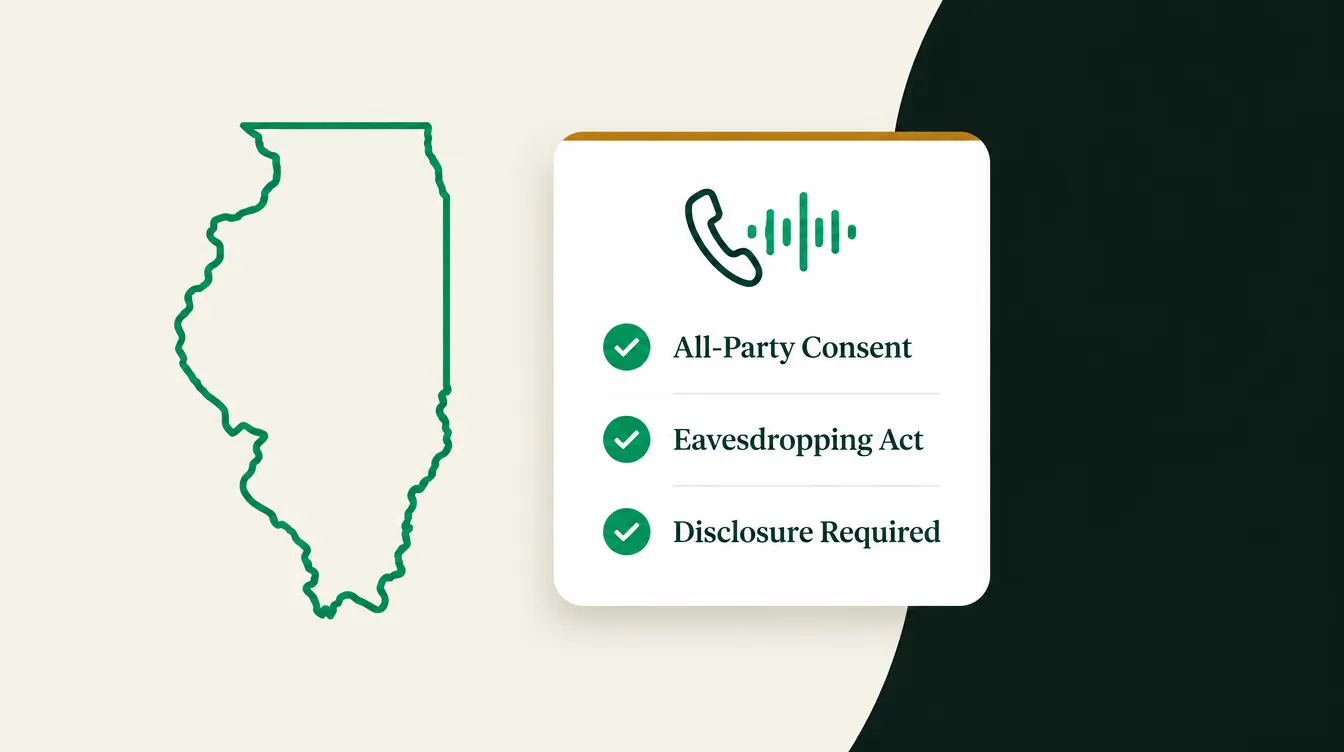
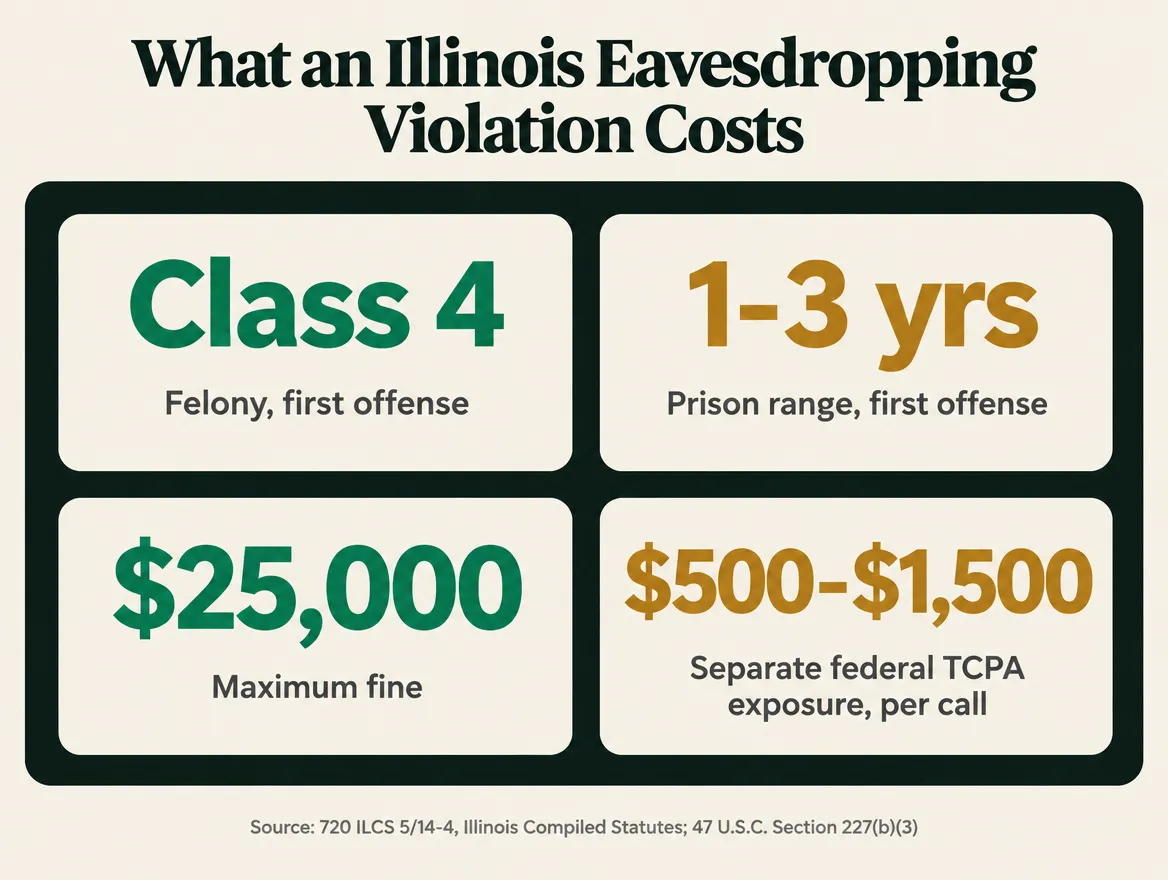
Yes. Illinois is an all-party consent state, and its eavesdropping statute, 720 ILCS 5/14-2, does not carve out an exception for a licensed insurance agent the way some state telemarketing laws do. If your dialer, human or AI, records a call into an Illinois number without the other party’s consent and that call turns out to be a “private conversation” under the statute’s own definition, the exposure isn’t a warning letter or a small civil fine. It’s a Class 4 felony on the first offense, with a sentencing range of one to three years and a fine of up to $25,000, under 720 ILCS 5/14-4.
That sentence tends to get an agency’s attention faster than any TCPA number does, and it should. But it’s also easy to overreact to, because the statute isn’t a blanket ban on recording sales calls in Illinois. It’s a two-part test, and one of the two parts is something you control completely: whether the recording is disclosed. Get the disclosure right, on every call, and most of what makes this statute frightening on first read stops applying to your calls at all. This article walks through what the law actually says, what triggers it, what it costs, and how to build a calling practice around it, whether you’re running the calls yourself or through an AI voice agent.
The short version
- Illinois requires consent from every party to record a private conversation, under 720 ILCS 5/14-2, and its exemptions in 720 ILCS 5/14-3 do not include licensed insurance agents.
- A violation requires two things at once: the recording has to be surreptitious (hidden from the other party) and the conversation has to be "private" under 720 ILCS 5/14-1(d). If either element is missing, there's no violation.
- An audible, upfront disclosure that the call is being recorded removes the surreptitious element, which is the single most effective and cheapest compliance step available.
- A first offense is a Class 4 felony (one to three years, up to $25,000 fine) under 720 ILCS 5/14-4, with a separate civil cause of action available under 720 ILCS 5/14-6 regardless of any criminal charge.
- None of this replaces federal TCPA consent requirements, which stack on top and carry their own $500 to $1,500 statutory damages per call under 47 U.S.C. Section 227(b)(3).
What Illinois’s eavesdropping statute actually prohibits
Illinois doesn’t have a “call recording law” in the sense of a single, insurance-specific statute the way some states have written a telemarketing carve-out. What it has is a criminal privacy statute, 720 ILCS 5/14-2, sitting inside the Illinois Criminal Code, and it applies to recording a phone call the same way it applies to recording any other conversation. A person commits eavesdropping when they knowingly and intentionally use an eavesdropping device, which the statute treats broadly enough to include a phone system’s own recording feature, in a surreptitious manner to overhear, transmit, or record all or part of a private conversation without the consent of all the parties to it. It’s also eavesdropping to record a conversation you’re personally part of, surreptitiously, without the other party’s consent, and separately to intercept or record a private electronic communication the same way.
Two words in that description carry the entire legal weight of the statute, and they’re both doing narrower, more specific work than a first read suggests: surreptitious and private conversation.
Terms worth knowing
Surreptitious: done secretly, without the other party's knowledge. A recording the other party is told about, even briefly and even by an automated message before the call connects, is not surreptitious. Private conversation: under 720 ILCS 5/14-1(d), an oral communication where one or more of the parties intended it to be private, under circumstances that reasonably justify that expectation. Eavesdropping device: the statute defines this broadly enough to cover a phone system's built-in call-recording feature, not just a separate wiretap or hidden microphone. All-party consent: the shorthand for Illinois's rule, distinct from a "one-party consent" state where only one person on the call, including the person doing the recording, has to agree to it.
Illinois hasn’t always applied this statute the way it does today. In 2014, the Illinois Supreme Court struck down the prior version of the law on First Amendment grounds, because it criminalized recording a conversation even when nobody on the call had any expectation of privacy at all, a public street argument, a police officer performing a traffic stop in plain view. The Legislature rewrote the statute that same year to require both elements, surreptitious recording and a genuinely private conversation, rather than criminalizing recording as a category. That’s the version in force now, and it’s meaningfully narrower than the “Illinois bans recording calls” version that circulates informally.
| Element | What it means | What defeats it |
|---|---|---|
| Surreptitious | The recording happens without the other party's knowledge, per 720 ILCS 5/14-2 | An audible disclosure the other party actually hears before the recorded portion of the call, or knowledge of the recording by any other means |
| Private conversation | A party intended the conversation to be private, under circumstances that objectively support that expectation, per 720 ILCS 5/14-1(d) | Circumstances where no reasonable expectation of privacy exists; this element is harder to control on your side of the call and is not something a script can reliably defeat |
Source: 720 ILCS 5/14-1(d) and 5/14-2, Illinois Compiled Statutes.
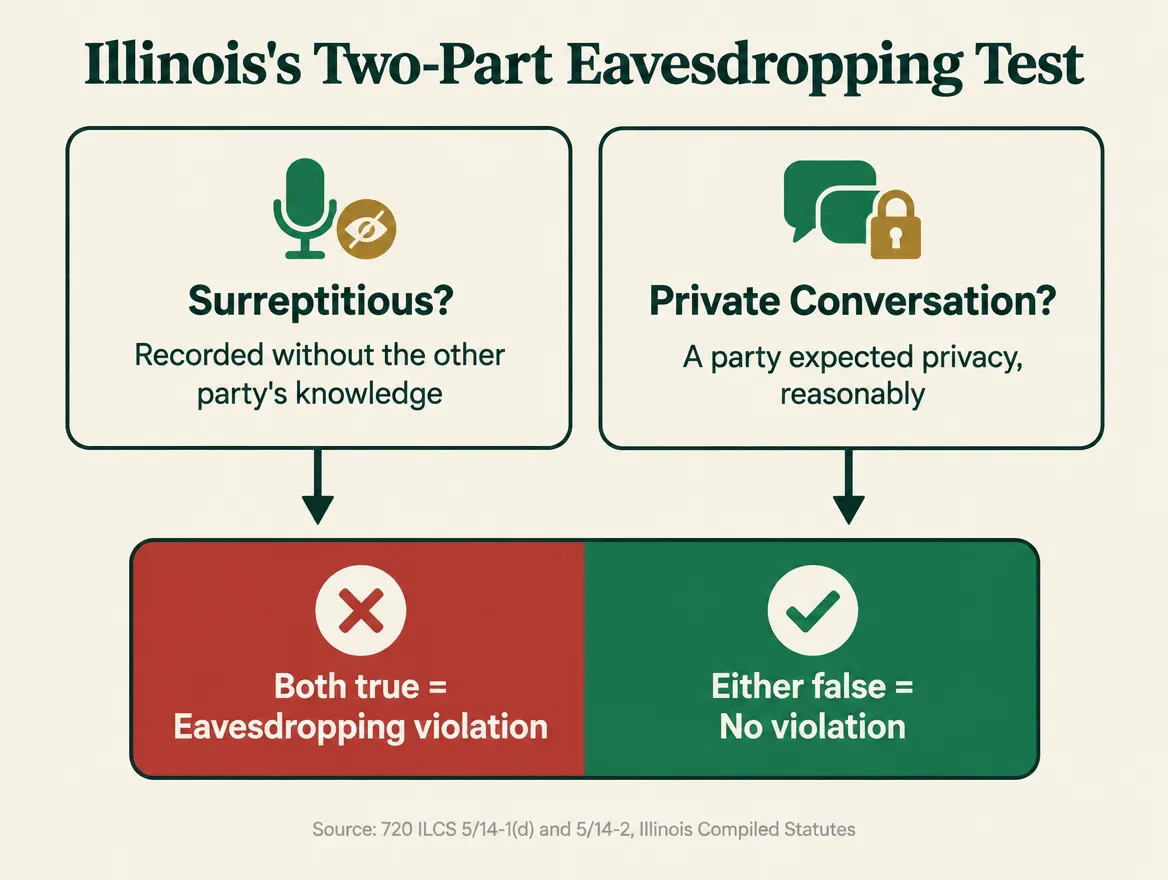
A phone call between an insurance agent and a prospective client is, realistically, almost always going to satisfy the “private conversation” element; a one-on-one call discussing someone’s health, income, or coverage needs is exactly the kind of conversation Illinois courts treat as private. That means the element you actually control, on every single call, is the first one: surreptitious. Make the recording known, and the statute’s core prohibition doesn’t reach the call, regardless of how private the subject matter is.
Why Illinois doesn’t exempt insurance agents the way some states exempt telemarketing
If you’ve read about Oklahoma’s Telephone Solicitation Act of 2022 or Georgia’s telemarketing statute, both of which name licensed insurance producers directly in their exemption lists, it’s worth being precise about why Illinois’s eavesdropping law doesn’t work the same way. Those are telemarketing statutes: they regulate the act of soliciting by phone, and several states have decided that an industry already licensed and supervised by its own insurance regulator doesn’t need a second, generic telemarketing statute stacked on top.
Illinois’s eavesdropping statute isn’t a telemarketing law at all. It’s a criminal privacy statute that predates modern telemarketing regulation by decades and has nothing to do with who’s calling or why. Its own exemptions, in 720 ILCS 5/14-3, are built around a completely different logic: law enforcement acting under a proper court-authorized interception order, equipment manufacturers and suppliers in the ordinary course of business, penal institution employees conducting authorized investigations, and recording a public official performing official duties in a public place. None of those categories has anything to do with an insurance sales call, and there’s no version of “licensed insurance producer” hiding in that list the way there is in Oklahoma’s or Georgia’s telemarketing statutes. A licensed producer calling an Illinois number is inside the general rule, full stop, the same as any other caller recording any other private conversation in the state.
What “surreptitious” defeats, and what it doesn’t
The practical upside of the two-element test is that the fix for most of an agency’s exposure is cheap and doesn’t require legal creativity: say, out loud, at the start of the call, that it’s being recorded, before the substantive conversation happens. Once the other party has heard that, the recording is no longer secret from them, and the “surreptitious” element the statute requires is gone. This isn’t a workaround or a technicality; it’s the actual legal mechanism the statute uses to distinguish an eavesdropper from an ordinary business call center that happens to record its calls, the same way a “this call may be recorded for quality purposes” announcement functions for a bank or an airline.
What disclosure doesn’t do is eliminate the “private conversation” element, and it’s worth being honest about the limits here rather than overselling one fix as a complete shield. A disclosure defeats surreptitiousness. It doesn’t change whether the underlying conversation, someone’s health history, someone’s income, someone’s existing coverage, counts as private; that element was almost certainly already going to be satisfied on a real sales call regardless of what you say at the top of it. The reason disclosure still solves the practical problem is that Illinois’s statute requires both elements together. Knock out either one and there’s no eavesdropping violation under 720 ILCS 5/14-2, and disclosure is the element you can reliably knock out on every call, every time, without depending on a judgment call about the conversation’s subject matter.
"A person commits eavesdropping when he or she... knowingly and intentionally uses an eavesdropping device, in a surreptitious manner, for the purpose of overhearing, transmitting, or recording all or any part of any private conversation."
720 ILCS 5/14-2(a)(1), Illinois Criminal CodeTwo things about actually building this into a calling operation are easy to get wrong. First, disclosure has to happen before the recorded, substantive part of the call, not buried in a post-call summary text or a privacy policy nobody read. Second, saying it isn’t the same as proving it happened. If a lead later disputes ever hearing a disclosure, the strongest position isn’t “the script says we always say it”; it’s a timestamped log showing the disclosure audio actually played on that specific call, tied to that specific lead record. A script is a policy. A per-call log is evidence.
What one violation actually costs
Illinois doesn’t treat a first eavesdropping violation as a fine-and-move-on matter. Under 720 ILCS 5/14-4, it’s a Class 4 felony, carrying one to three years in prison and a fine of up to $25,000, and a second or subsequent offense steps up to a Class 3 felony. Recording a law enforcement officer, a state’s attorney, the Attorney General, or a judge performing official duties, without authorization, carries its own enhanced tier: Class 3 for a first offense, Class 2 for a repeat one. None of that requires a prosecutor to prove the recording was ever used maliciously; the statute criminalizes the unauthorized recording itself.
Separately, 720 ILCS 5/14-6 gives the person whose conversation was recorded a civil cause of action, independent of any criminal case: injunctive relief to stop it, actual damages, and punitive damages. A civil plaintiff doesn’t need a criminal conviction, or even a criminal charge, to bring that claim.
One undisclosed, recorded call: the stacked exposure
Illustrative: what a single non-compliant call can carry under Illinois's eavesdropping statute alone, separate from the federal TCPA exposure that applies regardless of state law.
Call cost per TheAffordableAI's published Single Account rate. TCPA figures per 47 U.S.C. Section 227(b)(3), Cornell Law School Legal Information Institute. Illinois figure per 720 ILCS 5/14-4. The Illinois felony fine is separate from, and can stack with, both the criminal sentencing range and any civil damages under 720 ILCS 5/14-6, and is independent of federal TCPA exposure on the same call.
Run the arithmetic the way you would for any other compliance question: a three-minute call at TheAffordableAI’s published Single Account rate of $0.20 a minute costs 60 cents to place. If that same call turns out to have been recorded surreptitiously and the conversation was private, the fine ceiling alone is roughly 41,000 times the cost of the call, before counting the prison exposure or a separate civil claim under 720 ILCS 5/14-6. That asymmetry is the whole argument for building the disclosure step into the call flow as a system rule rather than trusting it to a script someone might skip under pressure to get through a list.
Class 4
Felony classification, first eavesdropping offense
Source: 720 ILCS 5/14-4
1-3 years
Prison sentencing range, first offense
Source: 720 ILCS 5/14-4
$25,000
Maximum fine, first offense
Source: 720 ILCS 5/14-4
$500-$1,500
Separate federal TCPA exposure, per call
Source: 47 U.S.C. Section 227(b)(3)
Calling Illinois from outside Illinois
A question that comes up constantly for agencies running a national or regional book: if your calling operation is based in a one-party consent state, does Illinois’s rule even reach you? The honest answer is that interstate call recording doesn’t have one clean, universally settled rule the way a single state’s own statute does; courts have taken different approaches depending on where the recording device physically sits, where each party is located, and which state’s law a given court applies. What compliance guidance in this area consistently recommends, absent a definitive ruling for your exact fact pattern, is the conservative default: when the parties are in states with different consent standards, treat the stricter state’s rule as controlling. If the person you’re calling is in Illinois, whatever state your dialer or your AI calling platform happens to sit in, disclose the recording as though Illinois’s all-party rule governs the call. It’s simpler to run one disclosure standard across your whole outbound operation than to build logic that guesses which state’s rule wins for every individual lead, and it’s the version of the policy that actually protects you if a court ends up applying Illinois’s law to a specific call.
This is also where an AI calling platform’s area-code and geography data earns its keep in a way a manual dialer’s memory doesn’t. A system that treats every 217, 312, 618, 630, 708, 773, 815, and 847 area code, and any lead flagged with an Illinois mailing address regardless of area code, as an all-party-consent call by default doesn’t need a human operator to remember which of fifty states requires the extra disclosure line on a given call.
Hear the disclosure line in a real call
Put your own number in on the homepage and the AI calls you in seconds, so you can hear exactly where the recording disclosure sits in the script before you build a compliance policy around it.
Building the compliance step, without buying anything
None of this requires new software. Every step below runs on a script change, a CRM tag, and a decision you document once.
- Add an audible, upfront disclosure to every Illinois-bound call. Something as plain as “just so you know, this call is recorded for quality and training” before the substantive conversation starts is enough to defeat the surreptitious element. Put it at the top of the script, not buried after the pitch.
- Log the disclosure event, not just the script. A policy document saying agents disclose recording is not the same evidence as a timestamped log showing the disclosure audio played on a specific call to a specific lead. If your dialer or CRM can attach that event to the call record automatically, use it.
- Treat any Illinois-area-code or Illinois-address lead as all-party consent by default, regardless of where your own calling operation is based, per the interstate guidance above.
- Extend the same disclosure standard to every other all-party consent state you call into, not just Illinois. California, Florida, Maryland, Massachusetts, Montana, Nevada, New Hampshire, Pennsylvania, and Washington are commonly treated as all-party or all-party-leaning jurisdictions in compliance guidance; building one disclosure standard that covers the strictest state in your calling footprint is simpler than maintaining a state-by-state exception list.
- Keep federal TCPA consent on file separately. Illinois’s eavesdropping statute governs recording. It has nothing to do with the federal TCPA’s own consent requirement for placing an autodialed or artificial-voice call in the first place, under 47 U.S.C. Section 227. You need both: consent to call, and disclosure that the call is recorded.
- Separate this from your CMS obligations if any part of your book is Medicare. CMS’s own Medicare marketing rules carry a separate call-recording retention requirement on top of everything in this article, and Illinois’s statute doesn’t replace it.
You can run all six steps with a spreadsheet and a CRM tag field, and plenty of agencies do exactly that.
Where TheAffordableAI fits
Whether a specific recorded call satisfies Illinois’s “private conversation” element, and whether your specific script’s disclosure language is legally sufficient for your specific calling method, are judgment calls for your own counsel, not something any vendor, including us, can certify for you. Where a managed AI caller helps is in making the mechanical part of this reliable: the disclosure line plays the same way on every single call rather than depending on a dialer operator remembering it under volume, and every call logs its disposition, consent status, and the fact that the recording disclosure played, against the lead’s record automatically. That log syncs natively with HighLevel, so the evidence exists somewhere durable instead of sitting in a dialer’s local call history that nobody exports until a dispute forces the question.
Consistent per-call disclosure
The same recording disclosure plays on every call into an all-party consent state, rather than depending on an operator remembering a script line at volume.
Native HighLevel CRM sync
Disposition, consent status, and the disclosure event land in the CRM automatically, the documentation trail a dispute would actually ask you to produce.
Number warmup and spam defense
A fully compliant call still has to land as a real call, not "Spam Likely," before any of this matters. Warmup and defense run as a standing routine.
Warm transfers and auto-booking
Once a compliant, recorded, disclosed call turns into a qualified conversation, it books against real calendar availability or transfers live to a licensed agent.
Price it against your own Illinois list
A Single Account runs $200 a month plus a $500 one-time setup fee, at $0.20 a minute, down to $0.15 a minute at bulk volume. An Agency plan runs $500 a month plus a $1,000 one-time setup fee, at $0.18 a minute, down to $0.16 a minute at bulk. No long-term contract either way. See pricing.
Where this article stops, and a lawyer starts
It would undersell the risk to pretend disclosure resolves every hard question here. Whether a given conversation counts as “private” under 720 ILCS 5/14-1(d) is a fact-specific question this article can’t settle for your exact calls, and the interstate choice-of-law question doesn’t have one universally binding answer the way a single statute’s text does. If your agency runs a meaningful volume of Illinois calls, or calls into any other all-party consent state, having counsel who has actually read 720 ILCS 5/14-1 through 5/14-6 review your specific script and call flow is worth the hour it takes, especially before you scale a campaign rather than after a dispute over one call forces the question.
If your agency already discloses recording clearly on every call as a matter of habit, because you sell into other all-party states already, you likely don’t need to change much specifically for Illinois beyond confirming the disclosure actually plays before the substantive conversation and that it’s logged per call. Spending money on new tooling to fix a gap you’ve already closed isn’t a good trade, and it’s worth ruling that out before assuming a bigger system is the answer.
Using AI does not transfer liability
A faster, better-logged calling setup is a real operational benefit. It is never a transfer of legal liability. Consent to record under Illinois's all-party rule, disclosure that a caller is an AI where required, federal TCPA consent, Do Not Call compliance, and CMS's separate Medicare marketing rules where applicable all remain the responsibility of the licensed agent and agency, whether a human or an AI voice places the call. An automated caller does not carry any of that responsibility away from you. This is general information, not legal advice; verify current requirements against the statutes themselves and your own counsel before running a large outbound push into Illinois or any other all-party consent state.
Illinois really does treat an undisclosed recording of a private conversation as a felony, and its eavesdropping statute really doesn’t carve out an exception for a licensed insurance producer the way a handful of state telemarketing laws do. What it also does, though, is build the fix directly into the statute’s own two-part test: disclose the recording, out loud, before the substantive call happens, and log that it happened, and the element that turns a routine sales call into a criminal exposure is gone. That’s a cheaper problem to solve than the felony classification makes it sound, as long as you actually solve it on every call instead of assuming a script nobody’s checking is doing the job.
Frequently asked
Is Illinois an all-party consent state for recording phone calls?
Yes. Illinois's eavesdropping statute, 720 ILCS 5/14-2, makes it a crime to use a device in a surreptitious manner to record any part of a private conversation without the consent of all parties to it, not just one. That covers a phone call the same way it covers an in-person conversation. There is no general business exception and no insurance-industry exception written into the statute.
Do licensed insurance agents get an exemption from Illinois's eavesdropping law the way they do from some state telemarketing laws?
No. Several state telemarketing statutes, Oklahoma's and Georgia's among them, carve out a specific exemption for licensed insurance producers soliciting within the scope of their license. Illinois's eavesdropping statute, at 720 ILCS 5/14-2, is a different kind of law, a criminal privacy statute inside the Illinois Criminal Code, and its exemptions in 720 ILCS 5/14-3 cover law enforcement acting under a court order, equipment manufacturers, penal institution staff conducting authorized investigations, and recording a public official performing public duties in public. None of those categories describe a licensed insurance agent recording a sales call.
What makes a recorded call 'surreptitious' under Illinois law?
Illinois courts require two things to be true at once for a recording to violate 720 ILCS 5/14-2: it has to be surreptitious, meaning made without the knowledge of the other party, and it has to capture a 'private conversation' as defined in 720 ILCS 5/14-1(d), one where at least one party had a reasonable expectation of privacy. A recording made openly, where the other party knows it's happening, is not surreptitious, and the eavesdropping statute's core prohibition does not reach it, regardless of the subject matter.
Does saying 'this call may be recorded' at the start of the call satisfy Illinois law?
A clear, audible disclosure at the start of the call, one the other party actually hears before the substantive conversation begins, removes the surreptitious element that 720 ILCS 5/14-2 requires. That is the single cheapest, most effective compliance step available to an agency calling into Illinois, and it costs nothing to add to a script. This is general information, not a legal opinion on your specific call flow; if a lead disputes ever hearing the disclosure, the question becomes evidentiary, which is exactly why logging the disclosure event, not just scripting it, matters.
What are the actual criminal penalties for violating Illinois's eavesdropping statute?
Under 720 ILCS 5/14-4, a first offense is a Class 4 felony, and a second or subsequent offense is a Class 3 felony. A Class 4 felony in Illinois carries a sentencing range of one to three years in prison and a fine of up to $25,000. Recording a law enforcement officer, state's attorney, the Attorney General, or a judge while performing official duties, without authorization, carries an enhanced penalty: a Class 3 felony for a first offense and a Class 2 felony for a subsequent one.
Can I be sued civilly in Illinois for an undisclosed recording, separate from any criminal charge?
Yes. 720 ILCS 5/14-6 gives a person whose private conversation was recorded in violation of the statute a civil cause of action for injunctive relief, actual damages, and punitive damages, and that civil claim runs independently of whether a prosecutor ever files a criminal charge over the same recording.
My agency is based in a one-party consent state and calls Illinois leads. Which state's law applies?
The safest operating assumption, and the one compliance guides to interstate calling generally recommend, is that the stricter jurisdiction's rule controls when the parties are in different states with different consent standards. If your dialer is in a one-party state but the person you're calling is physically in Illinois, treat the call as subject to Illinois's all-party consent rule. Building your disclosure practice around the strictest state you call into is simpler than trying to track which specific state a given cell number's owner is standing in when the phone rings.
Does using an AI voice agent instead of a human caller change any of this liability?
No. Consent to record, audible disclosure, and Do Not Call and TCPA compliance stay the responsibility of the licensed agent and agency, whether a human or an AI voice places the call. The FCC's February 8, 2024 declaratory ruling already confirmed that an AI-generated voice counts as an 'artificial' voice under the federal TCPA, so an AI caller is not a lighter-touch category there either. What a well-configured AI calling setup can do is play the same disclosure on every single call without a dialer operator ever forgetting a line in the script, and log that the disclosure played, with a timestamp, against the lead's record.
Sources
- Illinois Compiled Statutes, 720 ILCS 5/14-2 — Elements of the offense of eavesdropping (via FindLaw)
- Illinois Compiled Statutes, 720 ILCS 5/14-4 — Eavesdropping; criminal penalties (via FindLaw)
- Ogletree Deakins — Amendments to Illinois's Eavesdropping Statute Signed Into Law (2014 post-Melongo amendment, 'private conversation' definition)
- RecordingLaw.com — Illinois Audio Recording Laws (civil remedy under 720 ILCS 5/14-6, fine amount, interstate-call guidance)
- Federal Communications Commission — FCC Makes AI-Generated Voices in Robocalls Illegal (Declaratory Ruling FCC 24-17, CG Docket No. 23-362, adopted and released February 8, 2024)
- Wiley Rein — FCC Extends Regulatory Reach Over AI: Announces TCPA Restrictions Cover AI-Generated Voices in Outbound Calls
- Cornell Law School Legal Information Institute — 47 U.S.C. Section 227, Telephone Consumer Protection Act
- TheAffordableAI — Pricing
- TheAffordableAI — Home, live demo call
Put this on your own phone line
See the AI dial, qualify, and warm-transfer a live call in under a minute. No contract, no dev work.
Keep reading
California Insurance Leads: Call Recording Law
California requires consent from both sides before you record a sales call. Here is what Penal Code 632 demands, what it costs to skip, and how to stay fast.

Florida Telephone Solicitation Act: Agent Guide 2026
Florida's FTSA does not exempt licensed insurance agents. Here is what a violation costs in 2026, what changed in 2023, and how to stay compliant.
TCPA Revoke-All Rule 2026: What the FCC Just Adopted
The FCC adopted a new TCPA revocation order on September 30, 2026, months ahead of the 2027 deadline. Here is what changed for insurance agents.