The Insurance Lead Follow-Up Cadence That Works (2026)
Most agents quit after two calls. Here is the insurance lead follow-up cadence backed by real response-time data, and how to automate every attempt.

Most insurance agents call a new lead once, maybe twice, and then move on to the next name on the list. That is the wrong call. The most rigorously documented dataset on this exact question, a study of more than 100,000 real call attempts across six companies run by InsideSales.com with Dr. James Oldroyd of MIT’s Sloan School of Management, found that reaching a lead in five minutes instead of thirty changes your odds by two orders of magnitude, and a separate 495-company survey from the same research found that firms which push persistence past the industry’s usual quitting point report higher close rates. An insurance lead follow-up cadence that actually works runs six to eight touches across call, text, and email over ten to fourteen days, not two calls and a shrug. Here is what the data says about how many times to call, when to call, what skipping the cadence costs, and how to build the sequence without hiring anyone new.
The short version
- Most agencies stop after one or two attempts. A meaningful share of the leads you can still reach need five to eight.
- Speed decides whether you get the first swing. Persistence decides whether you get the contact.
- Day of week and time of day move contact odds by double digits in the one large dataset that has measured it.
- There is a real stopping point. Calling past roughly 20 hours of unproductive attempts on the same push correlated with worse outcomes, not better ones.
- Running the full cadence by hand costs real payroll minutes. Running it on a per-minute AI caller costs cents per touch, once you are running it across your whole pipeline and not one lead at a time.
How many times should you call an insurance lead before giving up?
Plan for six to eight touches over ten to fourteen days, because the honest answer is that most agencies quit long before that and the available research says quitting early costs them.
In 2007, Dr. James Oldroyd, then finishing his PhD at Kellogg School of Management at Northwestern University, ran a survey of 495 companies across more than 40 industries for InsideSales.com, asking marketing and sales leaders how they actually manage lead follow-up. One question asked how many call attempts a company recommends before a rep abandons a lead. Among the firms that actually tracked the number, 60.4% said four to five attempts or fewer.
| Recommended attempts before abandon | Share of respondents |
|---|---|
| 1 to 3 attempts | 14% |
| 4 to 5 attempts | 21% |
| 5 to 7 attempts | 12% |
| More than 7 attempts | 11% |
| Don't know or don't measure | 42% |
Source: InsideSales.com / MarketingSherpa, Lead Response Management research report (Oct. 16, 2007), Kellogg Lead Response Management Survey.
Two findings sit next to that table that most people quoting the “call more” advice leave out. First, when Oldroyd regressed the recommended abandon-point against reported close rates, every additional tier of attempts a company said it allowed before quitting correlated with a 2.08% increase in close rate. Second, and more telling, the companies that answered “don’t know or don’t measure” reported close rates 8.83% lower than firms that had an actual number, whatever that number was. Not measuring the thing was worse than any specific policy on it.
This is a single study from 2007, and I have not found an independent large-sample replication of it. Treat the exact percentages as directional, not as a promise for your book. What has not changed since 2007 is the mechanism: a producer who quits at two attempts and does not track the number is guessing, and the survey’s own respondents who guessed did worse than the ones with a stated policy, correct or not.
Why follow-up dies after two attempts
It dies because the second unanswered dial looks like closure, and closure is what a busy calendar rewards.
Here is the mechanism. You dial a fresh lead, it rings out, and your CRM logs a disposition, meaning the outcome tag a rep or system assigns to a call, such as “no answer” or “left voicemail.” You try again the next morning, same result, same disposition. At that point the lead looks “worked” in every system you look at, even though nobody has actually spoken to the person. Your attention, understandably, moves to the newer leads sitting in the queue, because those feel more urgent than a name you have already tried twice.
Meanwhile the lead has not gone anywhere. They may be at work, asleep, screening an unknown number, or simply in the shower when you called. None of that means they are uninterested. It means your first two attempts landed at the wrong moment, and the fix for wrong moments is more moments, spread out and mixed across channels, not fewer.
A few terms are worth defining once here, since they show up through the rest of this piece. Speed to lead is the time between when a lead is created and when the first outbound attempt fires. Warm transfer is connecting a qualified, willing prospect to a live licensed agent while they are still on the phone, instead of leaving them a callback promise. Round robin is a distribution method that assigns leads to agents in rotating order rather than by who happens to be free. Prior express written consent is the specific written permission the TCPA requires before you can make an automated or prerecorded marketing call or text to a cell phone. Each of those pieces matters for a cadence that runs on its own instead of one that depends on a person remembering.
There is a second, quieter reason follow-up dies: a single channel runs out of road fast. If the only tool in the sequence is a phone call, you have exactly one way to reach someone who has already decided not to pick up an unknown number twice in a row. Adding a text does not just add a touch, it adds a different door. A prospect who screens calls will often still read and answer a text within the hour, and a prospect who ignores both will sometimes open an email days later when they have a spare minute at a desk instead of a car. None of that shows up in a cadence built around a single channel repeated eight times, because repeating the same door eight times just gets eight identical no-answers.
What the data says about when to call, not just how often
The InsideSales.com and MIT study went further than the Kellogg survey by measuring what actually happened, not what companies said they did. Over three years, researchers pulled data from six companies generating and responding to web leads: over 15,000 leads and more than 100,000 individual call attempts, run through InsideSales.com’s own dialing and CRM platform.
Two patterns came out clean. Day of week mattered, and time of day mattered more.
Odds of contacting a lead, by hour since it was created
Relative to the first hour, based on the study's raw dial counts that resulted in contact (12,700 in hour one, falling to 1,190, 299, 119, and 62 in hours two through five)
Source: InsideSales.com / MIT Lead Response Management Study (2007). Illustrative of the shape of the decay, not a guarantee for any specific book of leads.
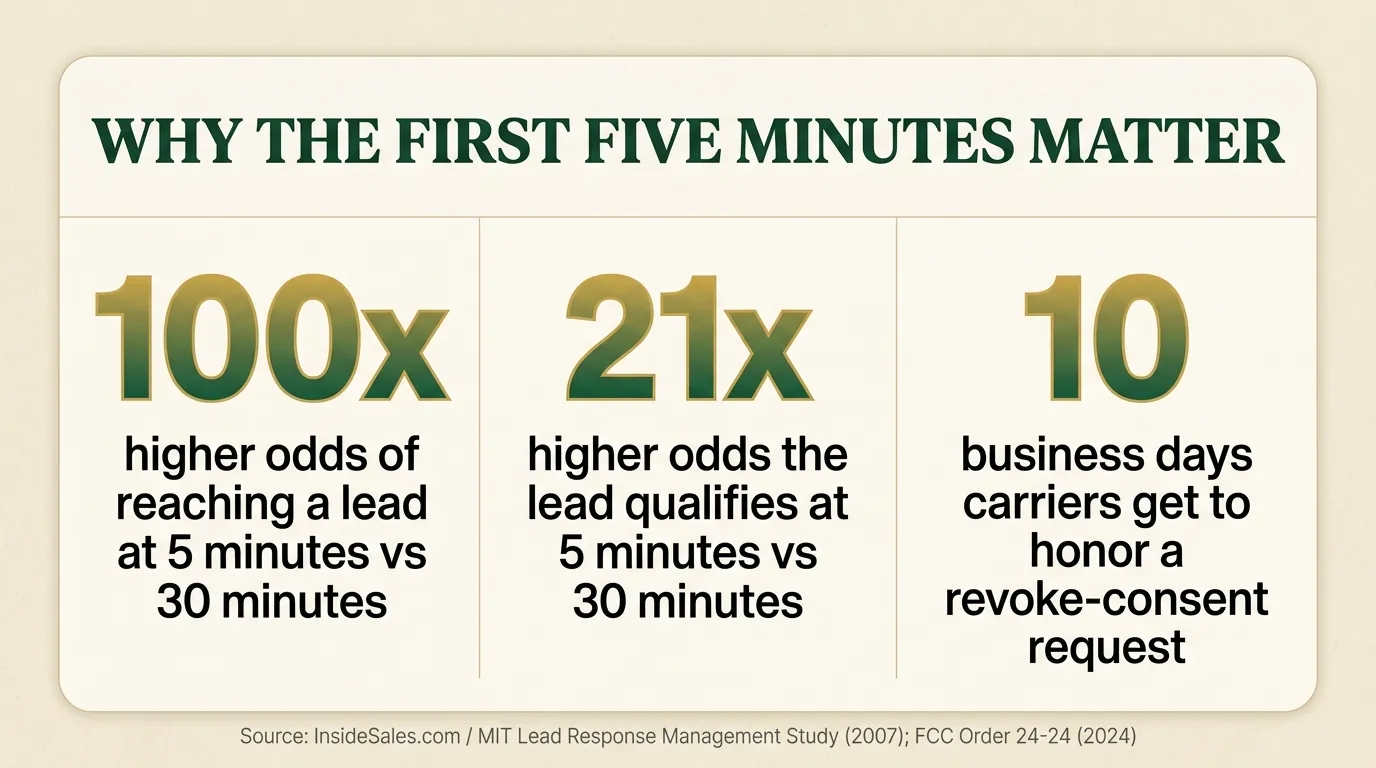
Sliced into five-minute increments instead of hours, the drop is just as steep at the front end: the study found the odds of contacting a lead fall by a factor of 100 when the gap between form-submit and first dial stretches from five minutes to thirty, and the odds of that contact turning into a qualified lead fall by a factor of 21 over the same window. Waiting even five extra minutes, from five to ten, cut contact odds by roughly five times. That single dataset is the origin of the “call fast” advice you have probably already heard; it is worth knowing where it comes from and that it is one dataset, not an industry consensus.
The timing findings past that first hour are just as concrete. Wednesday and Thursday produced the best contact rates, with Thursday beating the worst day, Tuesday, by 49.7%. Wednesday produced the best qualification rate, beating the worst day, Friday, by 24.9%. For time of day, calling between 4pm and 6pm produced the best contact rates, 114% better than calling between 11am and noon, and calling at 8am to 9am or 4pm to 5pm produced the best qualification rates, 164% better than calling right after lunch at 1pm to 2pm.
There is a stopping point too, and it is easy to miss. The same study found that after about 20 hours of unproductive dialing on the same lead, additional attempts correlated with lower odds of eventually qualifying it, not higher ones. Persistence has a shape: aggressive in the first hours and days, then tapering, then stopping and moving the lead to a slower track rather than continuing the same push indefinitely.
One study, not a law of nature
These are the largest published numbers on this question I could find with a stated methodology, but they come from one research effort run in 2007 across six companies. I have not located an independent replication with a comparable sample size. Use the shape of the pattern, run your own numbers, and do not treat any single percentage here as a guarantee.
What it costs when the cadence does not run
It costs payroll minutes that go to waste and leads that were reachable and never got reached, and both of those have a real, calculable price.
Start with the labor. The U.S. Bureau of Labor Statistics reports a median hourly wage of $21.53 for customer service representatives as of May 2025. Say a producer or a CSR runs the cadence above by hand: five call attempts, two texts, one email, spread across ten days. Even at an optimistic two minutes of actual work per touch, meaning dial, wait, disposition, and note, that is 16 minutes of labor per lead, or roughly $5.74 in payroll cost at the BLS median wage, for one single lead that may or may not ever answer. Multiply that by a book of even a few hundred fresh leads a month and the arithmetic gets uncomfortable fast, and that number does not include the far more common real-world failure mode: the touches that were supposed to happen on day four and day seven and never did, because the rep was busy, or on vacation, or simply forgot.
| Approach | Assumption | Cost per lead |
|---|---|---|
| Manual, staff time only | 8 touches × 2 min at $21.53/hr (BLS median, May 2025) | ≈ $5.74 |
| Managed AI caller, calls only | 5 calls × 90 sec at $0.20/min (Single Account rate) | ≈ $1.50 |
| Managed AI caller, at bulk volume | 5 calls × 90 sec at $0.15/min (bulk rate) | ≈ $1.13 |
Illustrative math using a stated 2-minute manual handling assumption and a stated 90-second average AI call length; neither assumption is a benchmark, only a worked example. Wage source: U.S. Bureau of Labor Statistics, Occupational Outlook Handbook, May 2025. Rate source: theaffordableai.com/pricing, verified Sept. 28, 2026. Manual figure excludes benefits, overhead, and the missed touches that never happen at all; per-lead AI figure excludes the $200/mo platform fee and $500 one-time setup, which is why this only gets cheap once it runs across a whole pipeline instead of one lead.
That last line matters. A Single Account costs $200 a month plus a $500 one-time setup, so for one lead the platform fee dwarfs the usage cost. The math flips once you are running the cadence across dozens or hundreds of leads a month, because the platform fee is fixed and the marginal cost of the next call is just the per-minute rate. If you are only ever going to run this on a handful of leads, the honest answer is that a disciplined human with a shared calendar reminder can do it, and paying a platform fee is not worth it yet.
The cadence that actually works
Build it around three ideas: fast on the first touch, persistent through day ten to fourteen, and mixed across channels so no two touches look identical to someone who has already ignored the first one.
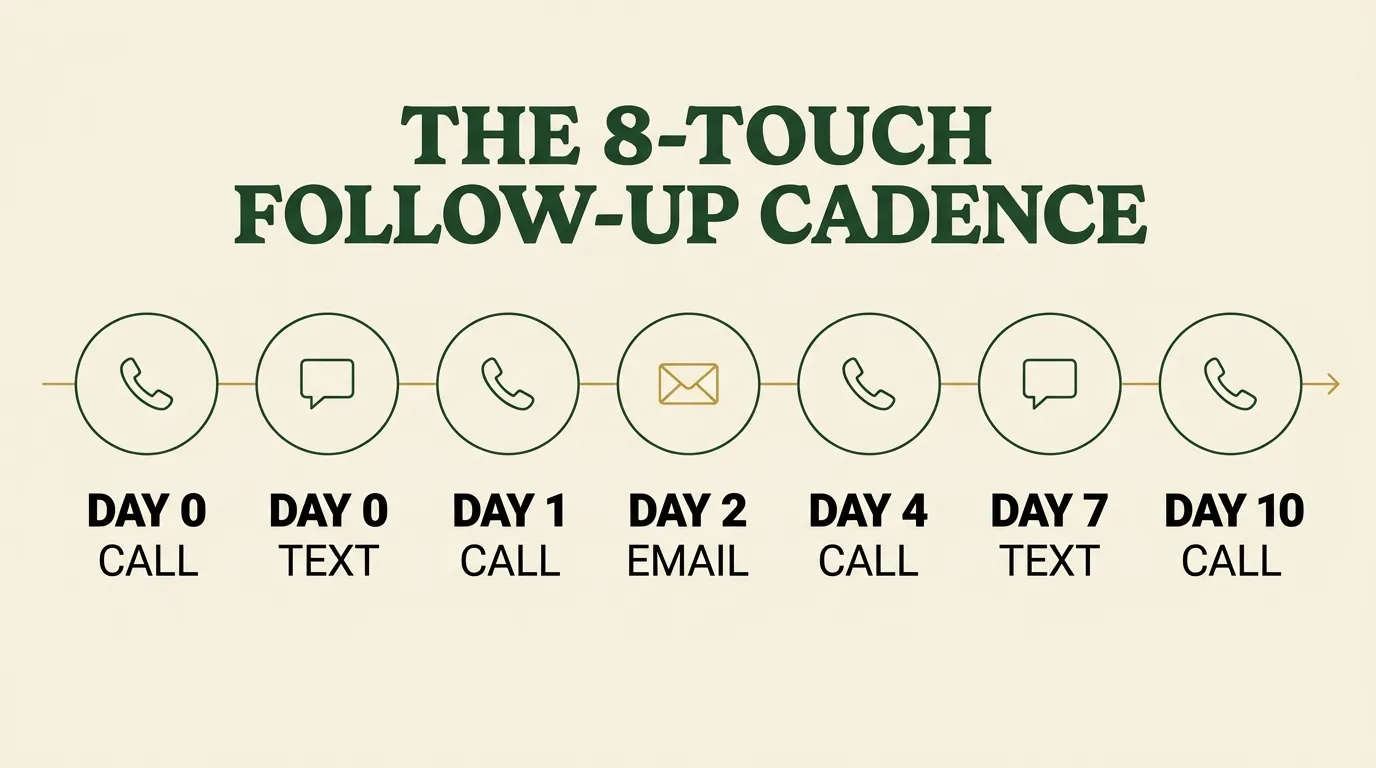
| When | Channel | Why this slot | Who does it |
|---|---|---|---|
| 0 to 5 minutes | Call | The window where contact odds are highest, before the lead moves on to something else | AI |
| Same day, no answer | Text | Different channel reaches people who screen unknown calls | AI |
| Day 1 | Call | A second time-of-day attempt, ideally in the 4 to 6pm window | AI |
| Day 2 | A written option for the lead who reads before they call back | AI | |
| Day 4 | Call | Wednesday or Thursday if the calendar allows it | AI |
| Day 7 | Text | A short check-in, low pressure, easy to answer from a phone | AI |
| Day 10 to 14 | Call | The last scheduled attempt before the lead moves to a slower track | AI |
| On contact, any step | Warm transfer | Advice, plan selection, and enrollment, the part that requires a license | Licensed agent |
Notice what the licensed human does in that table: one thing, the thing only a licensed agent can legally and usefully do. Everything above it is mechanical, repeatable, and does not require judgment beyond “did the lead answer, and did they say yes.”
Test it like you mean it
Run this cadence on one lead source for thirty days and hold everything else constant: same source, same script, same offer. Compare contact and qualification rates against whatever you were doing before. If you change the source, the cadence, and the script at once, you will not know what actually moved the number, and you will not be able to defend the change to anyone who asks.
Manual cadence
- Attempts one and two happen if the rep has time that day
- Attempts three through eight rarely happen at all
- Channel is whatever is fastest to open, usually a call or nothing
- No record of which time of day already failed
- A busy week means the whole cadence quietly stops
1 to 2Typical real attempts before a lead is abandoned
Automated cadence
- Every scheduled touch fires whether or not anyone remembers
- Channel alternates on purpose across call, text, and email
- The sequence runs the same way for lead one and lead one thousand
- Transcript, disposition, and consent status sync to the CRM
- A qualified, willing lead reaches a licensed human while still on the phone
6 to 8Touches that actually happen, every time
What to actually say on each touch
Keep every message short, name the reason you are reaching out, and give one clear next step, because the goal of touches two through seven is not to close anything, it is to earn touch eight or the callback.
A first-call voicemail, when you leave one at all, should run 15 to 25 seconds: your name, the company, the specific thing they asked about, and one way to reach you back. Longer than that and most people stop listening before the callback number arrives. A same-day text after a missed first call should name the reason for the call without sounding like a form letter, something closer to “Hi [name], this is [agent] following up on the [coverage type] request you submitted. Call or text back anytime, or reply STOP to opt out.” The email on day two is the one place you can afford more than a sentence: explain what happens next, link to a scheduling page if you have one, and repeat the opt-out language.
By day seven, the tone should shift from “checking in” to “closing the loop.” Something like “Hi [name], I have tried reaching you a few times about your [coverage type] request. I will follow up one more time on [date], then assume you have it handled unless I hear from you.” That single message does two things at once: it explains why you have been persistent, which some prospects genuinely appreciate once it is named, and it sets an honest expectation for when the outreach ends, which is also the point where the cadence in the table above moves the lead to a slower track.
None of this requires fake urgency or a countdown. The lead already knows they filled out a form. The job of the cadence is to be the one company that actually followed through on it, at a normal, professional cadence, across the channels they are most likely to actually see.
Hear the cadence run
There is a live demo call on the homepage. Put your own number in and the AI will call you in seconds, so you can hear the first touch of a cadence like this one before you decide anything.
How we solve it
TheAffordableAI runs the mechanical half of this cadence so it actually happens on schedule, every time, without a rep having to remember day four or day seven.
The AI caller dials the moment a lead is created, mixes in texts on the schedule you set, and keeps attempting across the window you choose, all while number warmup and spam defense work in the background so the calls keep landing instead of showing up as “Spam Likely.” The moment a lead is qualified and willing to talk, it warm-transfers the call to a live licensed agent, or books it against real calendar availability if nobody is free right that second, and the transcript, disposition, and consent record sync to your HighLevel CRM automatically. A Single Account runs $200 a month plus a $500 one-time setup at $0.20 a minute, down to $0.15 at bulk volume; an Agency plan that routes to 20 or more agents at once runs $500 a month plus a $1,000 one-time setup at $0.18 a minute, down to $0.16 at bulk. Both are month to month, no contracts, cancel anytime. You can build a version of this yourself with a dialer and a spreadsheet reminder. Plenty of agencies do. It is worth pricing both before you decide.
What you get
8+
Touches that run on schedule, every lead, no reminders needed
24/7
Coverage, including the nights and weekends a manual cadence skips
$0.20/min
Single Account rate, down to $0.15 at bulk volume
theaffordableai.com/pricing, verified Sept. 28, 2026
20+
Agents ringable on a single warm transfer under the Agency plan
The lead did not go cold because nobody wanted it. It went cold because attempt three never happened.
Mike MooreThe compliance part, said plainly
Running eight touches on a lead does not put the rules on pause, and “the AI did it” is not a defense if something in the cadence breaks a rule.
Before you automate a single cadence
- Automated or prerecorded calls and texts to a cell phone require prior express written consent for marketing, captured and stored with the lead record before the first touch fires.
- Under the FCC's 2024 order (CG Docket 02-278, adopted Feb. 15, 2024), a consumer can revoke consent through any reasonable means, including replying "STOP" to a text, and you have to honor that revocation within a reasonable time not exceeding ten business days. Revoking consent on one channel revokes it for calls from the same caller too, so the cadence needs one kill switch, not a separate opt-out per channel.
- Several states cap the number of calls allowed per day regardless of consent; check the rules for the states you call into before you set the cadence's frequency.
- For Medicare, CMS marketing rules layer on additional requirements, including the TPMO disclaimer where it applies and specific call recording retention obligations. Review the current CMS Medicare Communications and Marketing Guidelines before running any Medicare-related cadence.
- The AI qualifies, books, and hands off. A licensed agent gives advice and completes the sale. Using AI to run the dialing does not transfer that liability away from the licensed producer.
- Honor the National Do Not Call Registry and any internal do-not-call list, and never build a cadence around cold calling; every touch in this sequence assumes the person is already a lead who asked for contact, not a cold prospect.
This is general information, not legal or compliance advice. Verify against current FCC and CMS guidance, and your own carrier and state requirements, before you launch anything.
The questions this raises next
What about leads that are already 30, 60, or 90 days old? Treat them as a separate motion. The eight-touch cadence above is for fresh leads. An aged lead needs a lighter, longer-interval sequence, because the urgency that made speed matter on day zero is gone; what is left is a database worth reactivating on its own schedule, not a continuation of the same push.
What if every attempt goes straight to voicemail? Keep the scheduled cadence running rather than adding extra ad hoc calls. The InsideSales.com data on attempts past 20 unproductive hours suggests that piling on more dials outside the planned schedule does not help and may hurt. A short, specific voicemail on one or two of the scheduled attempts, not every one, is enough; a mailbox full of six identical messages reads as spam to the person checking it.
Do I need a different cadence for Medicare Advantage leads during AEP? The channel mix and timing logic hold, but the compliance layer gets heavier during the Annual Enrollment Period, October 15 through December 7, because of the CMS marketing rules noted above. Build the cadence the same way, then run it past your compliance checklist specifically for the Medicare rules before the season starts, not after.
Should the first touch always be a call? For a lead that just filled out a form, yes, because the response-time data above is specifically about calls. For a lead you are reactivating from an old database, a text or email as the opener is often a gentler re-entry point, since a cold call to a name that has not heard from you in three months can land as unexpected in a way a text does not.
Does this apply to commercial lines, not just personal ACA, Medicare, and life leads? The mechanism is the same, but the pace usually needs to slow down. A business owner shopping a BOP or workers’ comp policy is often comparing quotes on their own schedule between meetings, not sitting by the phone the way a consumer shopping for a Medicare Supplement plan might be. Keep the same six-to-eight-touch structure, but stretch it over three to four weeks instead of ten to fourteen days, and lean more on email, since that is the channel most business owners actually check during work hours.
How do I know if my cadence is actually running, or just supposed to be? Pull a report, not a vibe. For a sample of leads from the last 30 days, check whether every scheduled touch has a logged timestamp and disposition, not just the first one. Most agencies who believe they run a full cadence discover, once they look, that the sequence quietly stops after attempt two or three for a meaningful share of leads, which is exactly the gap this article is about closing.
Follow-up dies at the second attempt because the second attempt looks like enough. It is not. The data on this, dated as it is, has not been contradicted by anything more recent that I could find, and the mechanism behind it has not changed: a reachable lead needs more than two tries, spread across more than one channel, on a schedule that runs whether or not anyone remembers. Build that schedule once, automate the parts that do not need a license, and let the licensed human do the one thing only they can do.
Frequently asked
How many times should I try to reach an insurance lead before giving up?
Plan on six to eight touches spread across call, text, and email over ten to fourteen days, not two calls in one afternoon. A 2007 survey of 495 companies by Dr. James Oldroyd of the Kellogg School of Management found 60.4% of the firms that tracked the number told reps to quit at four to five attempts or fewer, but the same survey found that companies who pushed persistence further reported higher close rates, and companies who did not measure the number at all reported close rates 8.83% lower.
What is the best day and time to call an insurance lead?
In the InsideSales.com and MIT behavioral study of over 100,000 real call attempts, Wednesday and Thursday produced the highest contact and qualification rates, and calling between 4pm and 6pm produced contact rates 114% better than calling at 11am to noon. This is a single dataset from 2007, so treat it as a starting point to test against your own book, not a guarantee.
Does texting a lead count as one of my follow-up attempts?
Yes, and it should be part of the mix rather than a separate track. The cadence in this article alternates channels on purpose: call, text, call, email, call, text, call. Mixing channels reaches people who screen calls but read texts, and it keeps every touch from looking identical to a lead who has already ignored two calls.
Is it legal to call and text an insurance lead eight times?
It depends on consent, timing, and your state. Automated or prerecorded calls and texts to a cell phone require prior express written consent for marketing under the TCPA, and several states cap the number of calls per day regardless of consent. There is no federal ceiling on total attempts, but a consumer can revoke consent through any reasonable means at any time, and under the FCC's 2024 order you have to honor that revocation within a reasonable time not exceeding ten business days.
What happens if a lead asks to stop being contacted partway through the cadence?
Every future touch on every channel stops. The FCC's 2024 order made clear that revoking consent on one channel, for example replying STOP to a text, revokes consent for calls from that same caller too. The cadence should have a single kill switch that removes the lead from every remaining step the moment an opt-out request comes in, not a per-channel toggle someone has to remember to flip.
Should the AI make every call, or just the first one?
The AI should run the mechanical attempts, meaning every dial, text, and voicemail across the full cadence, and hand off the moment the lead is live and willing to talk. A licensed agent still has to give advice, quote a plan, and complete the sale. Using AI to dial does not transfer that liability to the AI or to us; the licensed producer stays responsible for the parts of the conversation that require a license.
How much does it cost to run a full follow-up cadence with TheAffordableAI?
A Single Account is $200 a month plus a $500 one-time setup, billed at $0.20 a minute (as low as $0.15 at bulk volume). An Agency plan is $500 a month plus a $1,000 one-time setup at $0.18 a minute (as low as $0.16 at bulk volume). Both include warm transfers, number warmup, and HighLevel CRM sync, with no contracts and cancel-anytime terms. Re-check theaffordableai.com/pricing before you budget; the live page is the source of truth.
What if a lead never answers after eight touches?
Retire it from the active cadence and move it to a slower, longer-interval nurture track instead of deleting it. The same InsideSales.com data found that dialing a lead more after about 20 hours of unproductive attempts actually correlated with lower qualification odds, which is a useful signal that persistence has a natural stopping point. An aged-lead reactivation pass every 60 to 90 days is a separate, lighter-touch motion, not a continuation of the same eight-touch push.
Sources
- InsideSales.com & MIT Sloan — Lead Response Management Study (Oldroyd & Elkington, presented Oct. 16, 2007)
- InsideSales.com / MarketingSherpa — full Lead Response Management research report and data tables
- FCC — Report and Order, CG Docket 02-278 (FCC 24-24), TCPA consent revocation rules, adopted Feb. 15, 2024
- U.S. Bureau of Labor Statistics — Occupational Outlook Handbook, Customer Service Representatives (May 2025 wage data)
- CMS — Medicare Communications and Marketing Guidelines
- TheAffordableAI — Pricing (verified Sept. 28, 2026)
Put this on your own phone line
See the AI dial, qualify, and warm-transfer a live call in under a minute. No contract, no dev work.
Keep reading

Speed to Lead in 2026: Why the First 60 Seconds Decides Who Writes the Policy
The lead you paid for is not lost to a better agent. It is lost to a faster one. Here is what response time actually does to contact and conversion rates, and how to get to sixty seconds without hiring a dialer team.
After-Hours Insurance Leads: The 128-Hour Gap
An agency staffed 9 to 5 on weekdays is unstaffed 128 hours a week. Here is what that costs in after-hours insurance leads, and how to close the gap in 2026.

The True Cost of a Missed Insurance Lead in 2026
A missed insurance lead is not a mystery cost. It is a paid-for lead, a forgone commission CMS puts a real number on, and a seat nobody was watching.