Insurance Lead Routing: Round-Robin vs Skill-Based
Round-robin, skill-based, and first-to-answer routing compared for insurance agencies: how each works, what breaks, and how to build a fair one in 2026.

Round-robin, skill-based, and first-to-answer are the three insurance lead routing methods agencies actually use to decide which producer gets a lead, and the right one depends on what you’re optimizing for: fairness of volume, fit to the lead, or raw speed. Round-robin rotates leads evenly regardless of who’s free. Skill-based routes by license state, product line, or track record. First-to-answer rings everyone eligible at once and hands the lead to whoever picks up first. Most agencies default to round-robin because it’s the one their CRM ships with a button for, and then wonder why leads still sit for twenty minutes with a producer who’s on another call while someone free at the next desk never got the chance.
If you’ve got more than one producer taking leads, you already have a routing method, whether you designed it or not. It might be “whoever’s turn it is.” It might be “the top of the list, every time, because nobody’s edited the automation since it was built.” It might be a spreadsheet a sales manager updates by hand on Monday mornings. Every one of those is a routing decision, made or defaulted into, and it’s worth being honest about which one you’re actually running before you decide whether to change it.
The short version
- Round-robin optimizes for equal volume across producers. Skill-based optimizes for fit (license state, product line). First-to-answer optimizes for speed. Pick the one that matches your actual bottleneck, not the one your CRM defaults to.
- GoHighLevel's round-robin calendar runs two distinct modes, "optimize for availability" and "optimize for equal distribution," and the equal-distribution mode caps the gap between producers at three appointments before it starts hiding the leader's availability, per HighLevel's own support documentation.
- TCPA rules govern the outbound call or text itself, not which internal method picked the receiving producer. Routing logic is an operational choice; consent and disclosure obligations attach to the contact, per 47 U.S.C. Section 227.
- The failure mode that actually costs agencies leads isn't the wrong rotation model, it's no fallback for when the assigned person doesn't answer. Every routing method needs one.
- An AI caller can ring 20 or more agents at once in a genuine first-to-answer race and, per TheAffordableAI's own features page, resume the conversation and book the appointment itself if nobody answers, rather than leaving the lead parked with one person.
What “lead routing” means once you have more than one producer
Lead routing is the set of rules that decides which producer a given lead or inbound call reaches, and it only becomes a real problem the moment a second person is available to take it. A solo agent doesn’t route anything; every lead already goes to the only person who can take it. The instant an agency adds a second producer, “who gets this lead” stops being automatic and becomes a design decision, made explicitly or defaulted into by whatever the CRM does out of the box.
Three terms get used loosely here, so it’s worth being precise about each:
Round-robin assigns leads in strict or near-strict rotation, so that over time every producer in the pool receives roughly the same number of leads. It says nothing about whether that producer is free, licensed for the lead’s state, or the best fit for the product. It only promises an even split.
Skill-based routing assigns by attribute instead of rotation: license state, product specialty, language, or historical close rate on a given lead source. A skill-based rule might say “ACA leads from Texas go to producers licensed in Texas,” which a pure round-robin can’t guarantee, since a strict rotation will eventually hand that lead to whoever’s next regardless of licensing.
First-to-answer routing, sometimes called a simultaneous ring or a race, doesn’t pre-assign the lead to one producer at all. It rings every eligible, available producer at once and connects the caller to whichever one answers first. Nobody is “assigned” until someone actually picks up.
A few more terms this article uses
Availability toggle is a setting a producer flips to mark themselves in or out of the routing pool in real time, distinct from a fixed schedule. Speed to lead is the elapsed time between a lead's first contact and the agency's first response. Fallback is whatever happens when the routing method's first choice doesn't answer; not every setup has one.
None of these methods is universally correct. Round-robin is the fairest on paper and the worst at speed when the “next in line” producer happens to be tied up. Skill-based is the most precise and the hardest to keep current as licenses and specialties change. First-to-answer is the fastest and the one most likely to concentrate leads with whoever’s fastest to the phone, which raises its own fairness questions on a commission-driven team. The right call depends on which failure mode actually costs your agency more: a lead that waited because the “fair” producer wasn’t free, or a producer who feels like the fast responders always win.
Why agencies end up with a broken default instead of a chosen method
Nobody sits down and decides “we’ll use whatever the CRM ships with.” It happens because setting up lead routing is usually a fifteen-minute task handled once, early, by whoever configured the CRM, and then never revisited as the team grows. A two-producer agency assigns leads to whoever’s turn it is because two people is small enough that it barely matters. That same rotation, unexamined, is still running at six producers, where the gap between a busy top performer and a free newer hire actually shows up in how fast leads get worked.
The result is usually one of three failure patterns. The first is a rotation that ignores availability entirely, so leads land with producers who are on another call, at lunch, or out sick, and just sit there until that person is free, even though someone else on the team could have taken it immediately. The second is a routing rule that never accounts for licensing or specialty, so a Medicare lead ends up with a producer who only sells final expense, and the lead either gets manually reassigned, adding a delay, or gets worked badly by someone outside their expertise. The third, and the one that costs the most, is no fallback at all: the assignment happens, the assigned producer doesn’t answer, and nothing else happens, because the automation’s job was “assign,” not “make sure it gets answered.”
What most multi-producer agencies actually have
- A rotation set up once, years ago, by whoever onboarded the CRM
- No distinction between an available producer and a busy one
- No licensing or product-specialty filter on the assignment
- No fallback when the assigned producer doesn't answer
DefaultWhoever's turn it is, whether they're free or not
What a designed routing system does instead
- A method picked deliberately: round-robin, skill-based, or first-to-answer
- Availability checked at the moment of assignment, not assumed
- Licensing and specialty rules applied before rotation, not after
- A defined fallback for the no-answer case, every time
DesignedThe method that matches what's actually slowing leads down
The staffing backdrop makes this worse than it looks on a whiteboard. The U.S. Bureau of Labor Statistics puts total employment for insurance sales agents at 568,800 in 2024, with about 47,000 openings projected each year on average through 2034 as the occupation grows a modest 4 percent over that decade, according to the BLS Occupational Outlook Handbook. That’s a labor market where filling an open producer seat competes with tens of thousands of other openings nationally every year; an agency can’t simply route around a routing problem by hiring its way to more available producers on short notice. Whatever routing method you run has to work with the headcount you actually have, not the headcount you wish you had.
The three methods, compared directly
| Method | Optimizes for | Where it breaks | Best fit |
|---|---|---|---|
| Round-robin | Equal lead volume per producer over time | Ignores real-time availability; can hand a lead to someone busy while someone free waits their turn | Small teams with similar licensing and product mix, where fairness of volume matters more than raw speed |
| Skill-based | Matching the lead to the right producer by license, product, or track record | Rules go stale as licenses and specialties change; needs upkeep or it misroutes silently | Multi-state or multi-line agencies where licensing or specialty genuinely changes who can legally or effectively work a lead |
| First-to-answer | Speed: connecting the lead to whoever is actually available right now | Can concentrate leads with the fastest responders; raises its own fairness question on a commission team | Teams where speed to lead is the dominant priority and volume is high enough that concentration evens out or is managed separately |
Most agencies that are unhappy with their routing aren’t actually unhappy with the method; they’re running a method that doesn’t match their real priority. An agency obsessed with speed to lead but running strict round-robin will keep watching leads sit with a busy producer while someone free waits their turn. An agency running first-to-answer with wide variance in producer response speed will keep hearing from newer producers that they never get a fair shot. Naming which problem you actually have, slow first contact or an unfair split, is the step most setups skip.
The rotation isn't broken. It's just answering a different question than the one you're actually asking.
— Why most routing complaints aren't really about the routing methodHow GoHighLevel’s round-robin calendar actually works
Since a large share of agencies running any kind of automated routing are doing it inside GoHighLevel, it’s worth being precise about what the platform actually does, rather than what agencies assume it does. HighLevel’s own support documentation describes two distinct distribution modes for a round-robin calendar, and they behave very differently.
Optimize for availability assigns the incoming booking or lead to whichever team member is actually free at the requested time. If more than one person is available, the system checks a priority setting first: producers marked High Priority get selected before Medium, and Medium before Low. This mode is built for speed, not strict fairness.
Optimize for equal distribution instead tracks how many bookings each team member has received within a rolling one-month window and assigns the next lead to whoever has the fewest, using the team’s predefined order to break ties. HighLevel enforces a hard cap on the resulting gap: per its support documentation, no team member can be more than three appointments ahead of another, and once someone crosses that threshold, the system temporarily hides their availability from new bookings until the rest of the team catches up. Add or remove a team member, or switch between the two modes, and the running count resets for everyone.
Which mode should you actually run?
If your bigger risk is a lead sitting unanswered, run "optimize for availability" and accept some unevenness in volume. If your bigger risk is a producer-fairness complaint over who's getting more shots, run "optimize for equal distribution" and accept that some leads will wait slightly longer for the "fair" producer to be free. Running neither deliberately means you're getting whichever one someone picked by default when the calendar was first built.
Walk through what that cap actually does with a small example. Say a five-producer team runs equal-distribution round-robin and, by the middle of the month, one producer has closed out 14 bookings while the rest of the team sits at 10 or 11. That producer is three ahead of the pack, right at HighLevel’s threshold, so the system hides their availability from new bookings; the next lead skips them even if they’re sitting free, and goes to whoever’s lowest in the count instead. That’s the mechanism working as designed, and it’s also exactly the moment a team’s fastest, most available producer stops getting new leads for a stretch, purely on volume math, not on anything about the lead itself. Knowing that’s coming, rather than discovering it mid-month when a top producer asks why their queue went quiet, is the difference between a routing rule you chose and one that surprised you.
Two things this native feature doesn’t solve on its own are worth naming plainly. First, licensing and product-specialty filtering isn’t automatic inside a round-robin calendar; that has to be built as a separate rule, typically a workflow filter that sorts leads into different calendars or user groups before the round-robin logic ever runs. Second, and this is the one that costs agencies the most leads in practice, neither mode has a built-in answer for “the assigned producer’s phone just rings and rings.” The calendar assigns the appointment slot; it doesn’t guarantee a human picks up the resulting call. That gap is where a defined fallback step, not a smarter rotation, does the actual work.
If you’re setting up the underlying automation that fires when a new lead comes in and triggers this assignment in the first place, we’ve written the full trigger-to-warm-transfer build separately, including the specific workflow trigger and assign-user action HighLevel’s documentation describes. This piece assumes that automation exists and focuses on the decision underneath it: which method decides who the lead goes to, and what happens when they don’t answer.
What it actually costs when routing is broken
The clearest cost of a broken routing setup is the same one that shows up whenever any lead sits too long: it goes cold, gets worked by a competitor, or the prospect simply stops answering unfamiliar numbers. We’ve quantified that specific cost in detail elsewhere, including what a missed insurance lead is actually worth; this section focuses narrowly on the costs unique to routing itself.
The most concrete one is compliance exposure, and it’s worth stating precisely rather than vaguely. Routing logic itself, meaning which internal method decided which producer receives a lead, isn’t what the TCPA regulates. What it regulates is the outbound call or text: whether it had valid prior consent, whether required disclosures were made, and whether opt-outs are honored. Under 47 U.S.C. Section 227(b)(3), a violation carries statutory damages of $500 per violation, or actual monetary loss if greater, and a court can increase that to as much as three times the amount, up to $1,500, for a willful or knowing violation. That exposure attaches to the contact itself and doesn’t change based on whether the receiving producer was picked by rotation, skill match, or a first-to-answer race. Where routing does intersect with TCPA risk is when the routing tool itself triggers automated outbound contact, in which case that automation is subject to the same consent rules as any other automated call or text.
What's fixed by regulation vs. what's an internal operating choice
Consent and disclosure obligations attach to the outbound contact itself. Which producer receives the resulting lead is an agency decision the law doesn't dictate.
Regulatory basis: 47 U.S.C. Section 227 (TCPA private right of action and statutory damages) and FCC Declaratory Ruling FCC 24-17 (AI-generated voices), both fetched August 2026. Routing-method classification reflects that neither statute nor ruling addresses internal lead-assignment logic.
The AI-voice question deserves its own line, since more agencies are routing at least some of the initial contact through an automated caller. The FCC’s February 2024 declaratory ruling, FCC 24-17, confirmed that an AI-generated voice used on a call counts as an “artificial voice” under the TCPA, meaning the same prior-consent and disclosure requirements apply whether a human or a machine is speaking. That ruling governs the call itself; it says nothing about, and doesn’t need to say anything about, which producer the AI hands the call to once a live transfer is warranted. The routing decision and the consent decision are separate questions, and treating them as the same one is a common source of confusion.
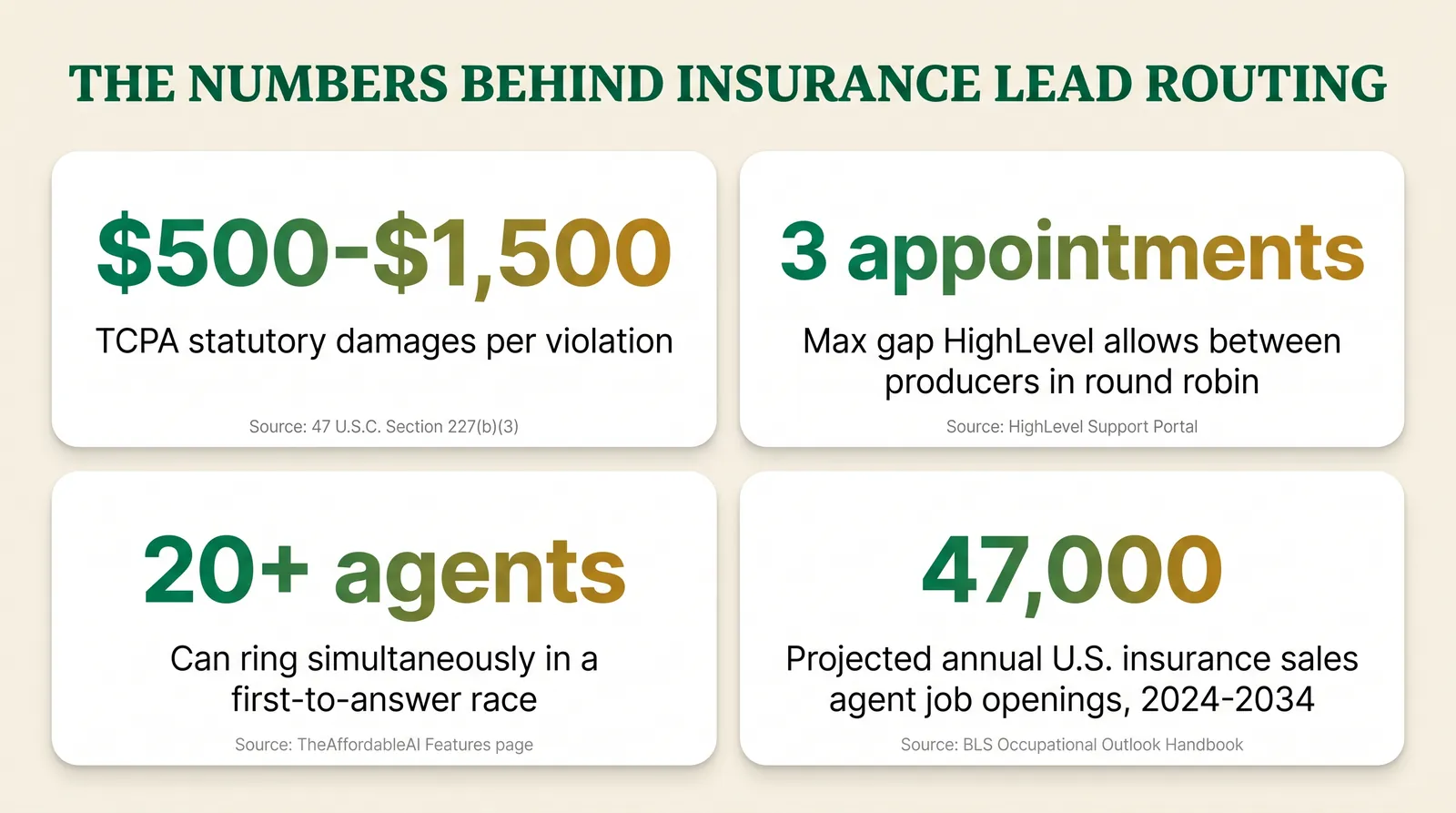
$500
Statutory TCPA damages per violation, or actual loss if greater
Source: 47 U.S.C. Section 227(b)(3)
$1,500
Maximum per-violation damages for a willful or knowing violation
Source: 47 U.S.C. Section 227(b)(3)
3 appts
Max gap HighLevel allows between producers before hiding the leader's availability
Source: HighLevel Support Portal
47,000
Projected annual U.S. job openings for insurance sales agents, 2024–2034
Source: BLS Occupational Outlook Handbook
How to build a fair routing system yourself, in full
None of this requires new software to start. Here’s the method, complete, whether you’re building it in a spreadsheet, in your CRM’s native tools, or handing pieces of it to an AI caller later.
1. Name your actual priority. Decide, honestly, whether speed to lead or fairness of volume is the bigger risk for your team right now. You can’t optimize for both at once with a single method; every setup below trades one for the other to some degree.
2. Segment before you rotate. Apply licensing and product-specialty filters first, so a Texas ACA lead only enters a pool of producers actually licensed in Texas, and a Medicare inquiry only enters a pool that sells Medicare. Rotation or racing happens inside that filtered pool, never across the whole team unfiltered.
3. Pick one method deliberately. If speed is the priority, use an availability-based assignment or a first-to-answer race. If fairness of volume is the priority and your team’s response times are reasonably even, use equal-distribution round-robin. Write down which one you picked and why, so the next person who touches the CRM doesn’t have to guess.
4. Build the no-answer fallback before you launch anything. This is the step that actually determines whether leads get lost. Decide explicitly: does the lead reassign to the next person in the pool after a fixed number of minutes? Does it escalate to a manager? Does an automated system keep the conversation going and book an appointment directly? A routing method without an answer to “what if nobody picks up” isn’t finished, no matter how well-designed the rotation logic is.
5. Give producers real-time control over their own availability. A toggle a producer flips when they step away, rather than a fixed schedule that assumes they’re always at their desk during business hours, keeps the routing pool honest. Leads shouldn’t wait on someone who’s actually unavailable just because the calendar thinks they’re on shift.
6. Review the distribution monthly, not never. Pull the actual count of leads each producer received and how fast each one got a first response. If one method is producing a lopsided result, either the filtering rules need adjusting or the method itself doesn’t fit the team anymore.
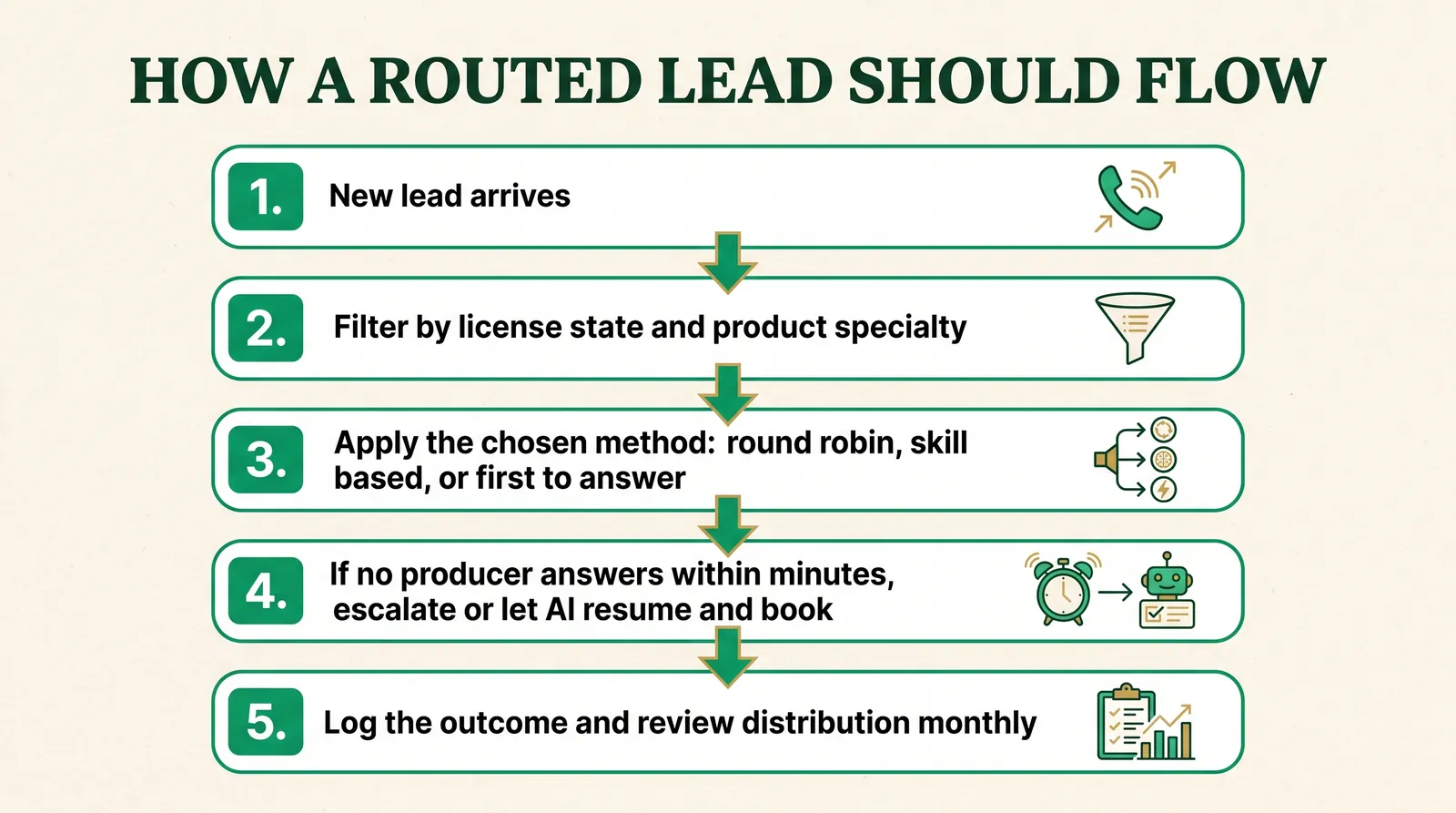
You can run every one of those six steps by hand with a spreadsheet and a team that actually maintains it, and small agencies do exactly that for a while. It holds up fine at two or three producers. Past that, especially once step four, the no-answer fallback, has to fire dozens of times a week instead of occasionally, doing it manually starts costing real hours, and those are hours pulled directly from working today’s leads instead of yesterday’s routing exceptions.
Where AI calling changes the routing math
This capability is specific to TheAffordableAI’s Agency plan, currently $500 a month plus a $1,000 one-time setup fee, at $0.18 per minute with bulk rates down to $0.16, according to TheAffordableAI’s own pricing page. That’s the plan built for a team, distinct from the Single Account plan meant for one producer taking a direct transfer.
TheAffordableAI’s Agency plan handles the routing decision differently from a calendar tool assigning one appointment slot at a time. Per its own features page, a qualified lead triggers a simultaneous ring to up to 20 or more agents at once, described as a first-to-answer race: whichever producer picks up first gets the live caller, already carrying the context the AI gathered during qualification. If nobody answers, the AI doesn’t drop the lead or leave it parked with whoever was “assigned”; per the same page, it resumes the conversation itself and books the appointment against real-time availability. Producers control their own participation with an availability toggle, and multi-calendar intent routing sends the booking to the right calendar automatically, an ACA inquiry to the ACA calendar, a Medicare inquiry to the Medicare calendar, per the how-it-works page. Every call, transcript, and disposition syncs back to HighLevel two-way, so the routing outcome is visible in the CRM without anyone re-entering it. That’s a genuinely different mechanic from a producer being handed a single voicemail drop and hoping they call back; we’ve compared warm transfers against voicemail drops directly if that’s the piece of the handoff you’re evaluating.
That model sidesteps two of the failure points covered above by design. Licensing and specialty filtering happens through intent routing before a human is ever rung. And the no-answer fallback, the step most manual setups skip building, is handled by default: the AI keeps working the lead instead of the call simply going unanswered.
Genuine simultaneous ring, not sequential
Up to 20+ agents ring at once on a qualified lead; the fastest to answer gets the live transfer with context attached.
No-answer fallback is the default, not an extra step
If nobody picks up, the AI keeps the conversation going and books the appointment instead of leaving the lead parked.
Multi-calendar intent routing
The AI detects what the caller needs and routes the booking to the matching calendar automatically.
Two-way HighLevel sync
Tags, fields, pipeline stage, transcript, and recording write back automatically, so the routing outcome doesn't require manual entry.
None of that replaces the segmentation work in steps two and three above. Deciding which producers are licensed for which states and which product lines they sell is still the agency’s job, and the AI routes within whatever pool of eligible producers you define; it doesn’t determine licensing eligibility for you. What it changes is the mechanics of steps three through five: the race itself runs automatically, the fallback fires without anyone having to remember to build it, and the sync means a manager can see the actual distribution without pulling a manual report.
If you want to hear what a call and a live transfer actually sound like before deciding anything, there’s a demo on the homepage. https://theaffordableai.com/ And since the routing capability specifically is an Agency-plan feature, the pricing page has the current per-minute rate and setup cost if you want to run the math against your own team size.
What you get from a routing system that’s actually designed
The practical outcome of fixing routing isn’t a single dramatic metric; it’s fewer of the specific failures each broken pattern produces. Leads stop sitting with a busy producer while someone free waits their turn, because availability gets checked at the moment of assignment instead of assumed. Licensing mismatches stop happening silently, because the filter runs before the rotation does. And the no-answer case, the one that quietly costs the most leads in most agencies, has a defined next step instead of ending in a lead that simply never gets a first contact.
You also get something less obvious: a real answer the next time a producer asks why they got fewer leads last month, or a manager asks why response times are inconsistent across the team. “We run equal-distribution round-robin with a three-appointment cap” or “we run first-to-answer with a five-minute reassignment fallback” is a defensible, checkable answer. “Whatever the CRM does by default” isn’t.
Where round-robin isn’t worth building
It’s worth saying plainly where a formal routing system doesn’t pay off. A single producer has nothing to route; every lead already has exactly one place to go, and building rotation logic for a team of one is wasted effort. A two-person team where both producers sell the same products, hold the same licenses, and sit at their desks during the same hours can usually get by on a simple manual split for quite a while before the complexity of a formal system earns its keep. And an agency whose real problem is lead quality, not lead distribution, won’t fix anything by routing bad leads faster or more fairly; a well-designed rotation just gets a poor-fit lead to “no” more efficiently, which isn’t the win it looks like on paper.
Diagnose before you rebuild
If leads are converting fine once a producer actually reaches them, and the complaint is really about which producer gets first crack, that's a routing problem. If leads aren't converting regardless of who calls them, that's a lead-source or offer problem, and no routing method fixes it.
The audit to run before you touch your routing setup
Walk through this in order before changing anything: which method are you actually running today, chosen deliberately or defaulted into; does it filter by license state and product specialty before it rotates or races; does it check real-time availability or assume a fixed schedule; what happens, specifically, when the assigned or first-ringed producer doesn’t answer; and when did anyone last pull the actual distribution numbers to check whether the method is producing the result you think it is. Most agencies that run through this list find they’ve never actually chosen a method at all, just inherited whatever was configured first, and that the no-answer fallback question has no answer yet.
Pull your actual routing numbers this week
Check how many leads each producer received last month and how long the average one waited for a first response. If the pattern doesn't match what you'd design on purpose, it's worth fixing before the next volume spike. There's a demo call on the homepage if you want to see how the routing and warm-transfer piece works in practice.
Frequently asked
What's the actual difference between round-robin and skill-based lead routing for an insurance agency?
Round-robin assigns leads in rotation so every producer gets a roughly equal number over time, regardless of what the lead needs or how busy that producer already is. Skill-based routing assigns by attribute instead: which producer is licensed in the lead's state, which one sells Medicare versus ACA versus final expense, or who's had the best close rate on that lead source. Round-robin optimizes for fairness of volume. Skill-based optimizes for fit. Most agencies that run into trouble are using round-robin for something that actually needs skill-based rules, like state licensing, where an equal split can hand a Florida lead to a producer who isn't licensed in Florida.
How does GoHighLevel's round-robin calendar actually decide who gets the next lead?
HighLevel's own support documentation describes two modes. 'Optimize for availability' assigns the appointment to whoever is free at the requested time, prioritizing team members marked higher priority if more than one is free. 'Optimize for equal distribution' instead balances the count of bookings across the team over a rolling one-month window, with a hard rule that no team member can be more than three appointments ahead of another; once someone hits that gap, the system hides their availability until the rest of the team catches up. If you add or remove a team member, or switch between the two modes, the running count resets for everyone.
Does round-robin lead distribution slow down speed to lead?
It can, and that's the real trade-off, not a hypothetical one. A pure equal-distribution round-robin will sometimes route a lead to a producer who's on another call or away from their desk, purely because it's their turn in the rotation, while a producer who's sitting free gets skipped because they're already three appointments ahead for the month. HighLevel's own 'optimize for availability' mode exists specifically because agencies asked for a way to prioritize speed over strict fairness. There's no universally correct answer; it depends on whether your bigger risk is a slow first contact or a producer who feels the rotation is stacked against them.
Is there a legal difference between round-robin and first-to-answer routing under TCPA?
No. The Telephone Consumer Protection Act and the FCC's rules govern how the lead was contacted and what consent covers, at 47 U.S.C. Section 227, not which internal method decided which producer picks up the resulting call. Routing logic is an operational choice inside the agency; consent, disclosure, and opt-out obligations attach to the outbound call or text itself, and they don't change based on whether the receiving producer was chosen by rotation, skill match, or a race to answer first. Where it does matter is if the routing tool itself places or triggers automated calls or texts, in which case the same TCPA rules apply to that automation as to any other automated contact.
How many producers can one AI caller actually route a warm transfer to?
That depends on the platform. TheAffordableAI's Agency plan rings up to 20 or more agents simultaneously when a lead qualifies, described on its own features page as a first-to-answer race: whichever producer picks up first gets the live caller with the qualifying context already attached, and if nobody answers, the AI resumes the conversation and books the appointment itself rather than dropping the lead. That's a materially different mechanic from a calendar tool ringing one person at a time in sequence, which is how a lot of manual round-robin setups actually work in practice even when the agency thinks of it as simultaneous.
What happens when a routed lead calls in and literally nobody answers?
That's the scenario every routing method has to have an answer for, and it's where most manual setups fail silently. A spreadsheet-based rotation has no fallback: the assigned producer misses it, and the lead sits until someone notices. A calendar tool with no answer, no cover configured, does the same. The fix is a defined fallback step, not a better rotation: an AI caller that keeps the conversation going and books the appointment when no human responds, or at minimum an escalation rule that reassigns after a set number of minutes instead of leaving the lead parked with one person indefinitely.
Should a solo producer with no team worry about any of this?
No. Routing logic exists to solve the problem of more than one person being able to take a call, and a solo producer doesn't have that problem; every lead already goes to the only person who can take it. Round-robin, skill-based routing, and first-to-answer racing all become relevant the moment a second producer joins, because that's the moment 'who gets this lead' stops being an automatic answer and starts being a decision someone has to design.
How do I set up fair lead routing without buying new software?
You can build a basic version with what most agencies already have. A shared spreadsheet with a rotation column and a timestamp works for a small team if someone actually maintains it, which is the part that usually fails. Most CRMs, including GoHighLevel, HubSpot, and Salesforce, have a native round-robin or lead-assignment feature already included in the plan agencies are already paying for; the gap is almost never the absence of a tool, it's that nobody configured the fallback for when the assigned person doesn't answer. Start there before buying anything new.
Sources
- HighLevel Support Portal — Appointment Distribution Logic for Round Robin Calendars
- Cornell Law School Legal Information Institute — 47 U.S.C. Section 227, Telephone Consumer Protection Act, private right of action and statutory damages
- Federal Communications Commission — Declaratory Ruling FCC 24-17, CG Docket No. 23-362, AI-Generated Voices and the TCPA (adopted February 2, 2024, released February 8, 2024)
- U.S. Bureau of Labor Statistics — Occupational Outlook Handbook, Insurance Sales Agents (data as of May 2024, projections 2024-2034)
- TheAffordableAI — Features (fetched August 2026)
- TheAffordableAI — How It Works (fetched August 2026)
- TheAffordableAI — Pricing (fetched August 2026)
Put this on your own phone line
See the AI dial, qualify, and warm-transfer a live call in under a minute. No contract, no dev work.
Keep reading

GoHighLevel Insurance Workflows: Trigger to Warm Transfer
Most GoHighLevel insurance workflows stop at 'assign the lead.' Here's the trigger-to-warm-transfer build, GHL's own docs, and where TCPA rules bite.

Warm Transfers vs Voicemail Drops: What Actually Gets an Insurance Prospect on the Phone
Voicemail drops feel productive and cost almost nothing. Warm transfers feel expensive and interrupt your day. Only one of them reliably puts a licensed agent in front of a prospect who is ready to talk.

The True Cost of a Missed Insurance Lead in 2026
A missed insurance lead is not a mystery cost. It is a paid-for lead, a forgone commission CMS puts a real number on, and a seat nobody was watching.