Life Insurance Lapses: Call Before the Grace Period Ends
The industry lapse ratio hit 5.6% in 2025, and state grace periods run 30 to 60 days. Here's how to call policyholders before a policy lapses, and why.

A life insurance policy doesn’t lapse the day a payment is missed. It lapses on day 30, or day 31, or day 60, depending on the state, because every state requires a grace period, a window after the due date during which the policy stays fully in force. That window is the entire opportunity. A policyholder who misses a payment because a card expired, a bank account changed, or a bill got lost under a stack of mail is usually one short phone call away from staying covered. The agent who makes that call on day 5 saves the policy in two minutes. The agent whose billing system quietly ages the same account to day 29 is making a much harder call, if anyone makes it at all.
This article is about that window: how long it actually runs state by state, how often policies lapse for nonpayment right now, what the call looks like that catches it in time, and the specific compliance questions that come up when the person you’re calling is already your customer rather than a new lead.
The short version
- Grace periods run 30 to 60 days depending on the state and policy type, and the policy stays in force the entire time. A lapse is not instant.
- The U.S. individual life lapse ratio was 5.6% in 2025, down from 7.0% in 2024, per AM Best's 2026 Best's Rankings release, the only published figure for that period at this writing.
- Most grace-period lapses trace back to a payment-method problem, not a decision to drop the coverage, which is exactly why a call during the window can fix them.
- Calling an existing policyholder about an existing bill is generally treated differently under the TCPA than calling a new sales lead, but it is not a blanket exemption, and the agent carries the liability for every call either way.
What a grace period actually is, and how long it runs
A grace period is a statutory requirement, not a courtesy the carrier can choose to extend or skip. Every state’s insurance code requires life insurance policies to include a provision keeping the policy in force for a set number of days after a premium due date passes unpaid. The policyholder owes the premium during that window, and if they die during it, the overdue premium is typically deducted from the death benefit rather than the claim being denied outright. What changes by state is how many days that window runs, and in a few states, whether the insurer has to send a separate lapse-pending notice before it can terminate coverage.
| State | Grace period | Statute |
|---|---|---|
| Texas | At least 1 month | Tex. Ins. Code § 1101.005 |
| California | 60 days, plus a 30-day written lapse notice | Cal. Ins. Code § 10113.71 |
| New York | 31 days standard; 61 days flexible-premium | N.Y. Ins. Law § 3203(a)(1) |
| Florida | At least 30 days | Fla. Stat. § 627.453 |
Notice the spread. California gives a policyholder twice as long as Florida, and layers on a written notice requirement California’s insurer has to send before it can terminate for nonpayment, a step that isn’t present in the same form in every state’s statute. New York splits the difference by policy design: a standard whole life or term policy gets 31 days, but a flexible-premium universal life policy, where the amount and timing of premiums can vary, gets 61 days, because the insurer first has to determine the policy’s cash value can’t cover the cost of insurance for another month before the clock even starts. An agency writing business across state lines cannot run one national grace-period calendar. A policy issued in Florida and a policy issued in California, both missing a payment on the same calendar day, don’t lapse on the same calendar day.
This matters operationally, not just legally. If your calling cadence assumes a 30-day window because that’s what most of your book looks like, every California policy in that book is getting called too late relative to its actual deadline, and every policy you think you have 30 days to save, you may only have 30 days to save in some states and twice that in others. The fix isn’t complicated: pull the grace period length by state into whatever system flags missed payments, and sequence your outreach against the real deadline for that specific policy, not a single assumed number.
This is not an exhaustive 50-state table
These four states illustrate the range, not the full picture. Every state sets its own grace period, and some vary it further by policy type, such as flexible-premium universal life. Confirm the exact requirement for the state where a given policy was issued before building a calling calendar around it, and treat any number you haven't verified against the current statute as provisional.
How often this is actually happening
“Lapse” is a specific industry term, not a vague description of a policy going away. AM Best, which publishes an annual ranking of U.S. individual life insurers built from each company’s reported experience, defines the lapse ratio as the share of a company’s in-force policies terminated for nonpayment of premium over the course of the year. It is a different number from a surrender, where the policyholder actively cashes out the policy’s value, and different again from a straightforward nonrenewal.
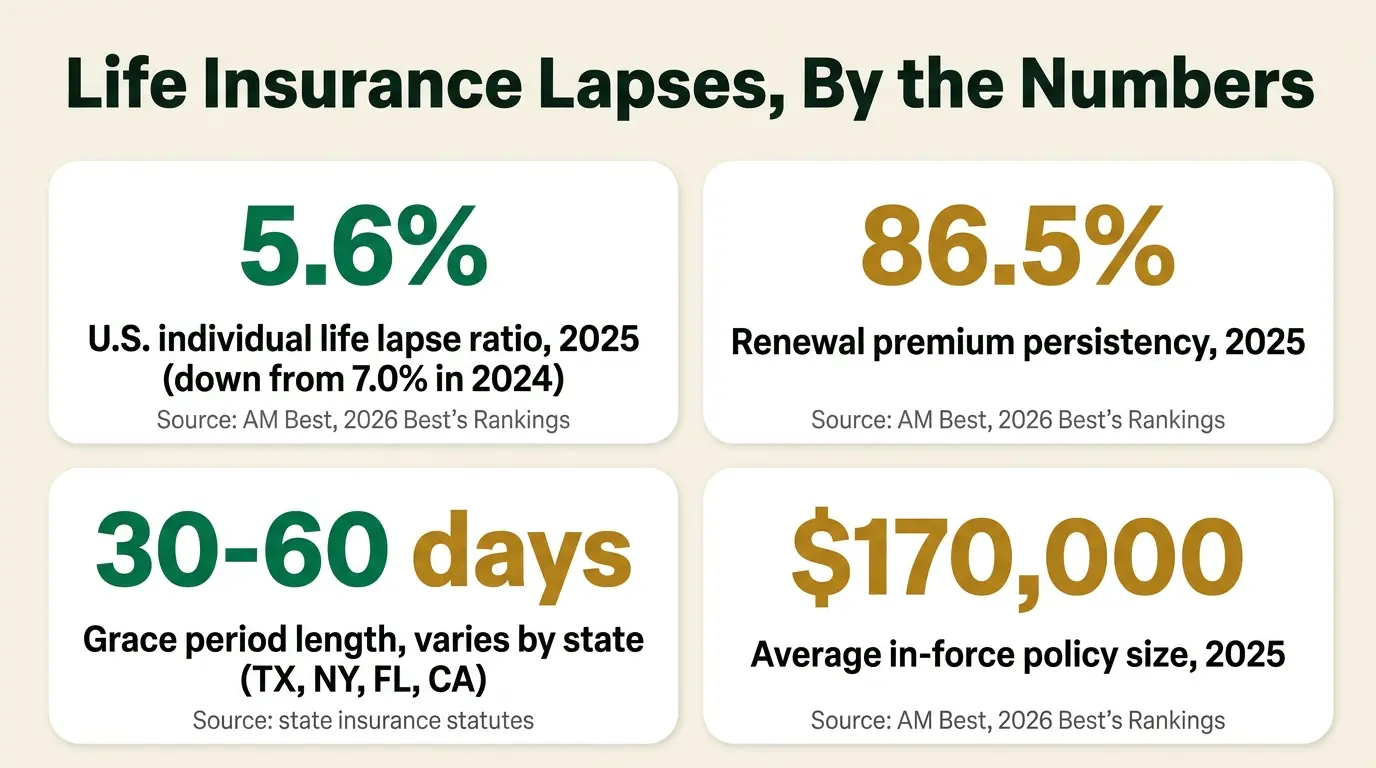
5.6%
U.S. individual life industry lapse ratio, 2025
Source: AM Best, 2026 Best's Rankings
7.0%
Same measure, 2024, the prior year's figure
Source: AM Best, 2026 Best's Rankings
86.5%
Renewal premium persistency, 2025
Source: AM Best, 2026 Best's Rankings
$170,000
Average in-force policy size, 2025, down from $189,000 in 2024
Source: AM Best, 2026 Best's Rankings
The 2025 number is an improvement on 2024, but it’s worth sitting with the shape of that trend rather than just the direction. The ratio jumped from 5.1% in 2023 to 7.0% in 2024, the single largest year-over-year move in the three years AM Best’s release tracks, and then fell back to 5.6% in 2025, still above the 2023 floor. A ratio bouncing around in that range, rather than settling at a stable number, is consistent with a lapse rate that is sensitive to short-term financial pressure on households, exactly the kind of pressure that shows up as a declined card or a skipped payment rather than a considered decision to drop coverage.
U.S. individual life lapse ratio, 2023 to 2025
Share of in-force policies terminated for nonpayment of premium, AM Best Best's Rankings releases.
2023 and 2024 figures per AM Best's prior-year Best's Rankings releases, as cited in the 2026 release covering 2025. Bar widths are scaled to the 2024 figure as 100%.
One important caveat on all four AM Best figures above: this is currently a single published source for this specific period. LIMRA, the other major industry research body that tracks life insurance persistency, has an active research pipeline on exactly this subject, but its most recently published lapse and surrender study covers calendar years 2015 through 2022, which predates the 2025 figure and can’t serve as independent confirmation of it. Where this article states the 2025 or 2024 lapse ratio, treat it as AM Best’s figure, sourced to one organization, not as a cross-validated industry consensus.
Put a sample book against that 5.6% figure and the scale becomes concrete. An agency carrying 500 individual life policies, applying the national average as a rough reference point rather than a prediction for any specific book, would see on the order of 28 policies a year move toward a lapse for nonpayment. For a 2,000-policy book, that’s roughly 112 a year, or close to ten a month, arriving on no predictable schedule and usually with no advance warning beyond whatever your billing system catches on the day the payment fails.
Why this is a different problem than a cold lead
A new lead that goes cold is a failure to start a relationship. A policyholder sliding toward a lapse is a failure to maintain one that already exists, and the reasons it happens are mechanically different from the reasons a fresh lead goes uncontacted.
The card on file expired. This is the single most common and most fixable cause. A premium is set to autopay, the card on file hits its expiration date, and the charge fails silently. Nobody decided to stop paying. The payment method just stopped working, and unless something flags it, the policyholder may not even know until a lapse notice arrives, if one arrives at all.
The bank account changed. Same mechanism, different payment method. A person switches banks, closes an old checking account, and forgets that a life insurance premium was still drafting from it.
The bill got buried. For policies not on autopay, a paper or emailed invoice competes with everything else landing in a mailbox or inbox that month. This is more common on older policies, where the policyholder set up manual payment years ago and the habit has simply slipped.
The household hit a genuinely hard month. Sometimes the missed payment is a real financial decision, a choice to let one bill go unpaid while triaging several others. This is the one category where a call may not save the policy, but it’s still worth the call: a payment plan, a reduced paid-up option, or converting to a smaller policy the household can actually afford is a far better outcome for everyone than a full lapse with the death benefit gone entirely.
In three of those four cases, the fix is a two-minute conversation: update a card, confirm a bank account, or process a one-time payment over the phone. None of it requires underwriting, a medical exam, or anything resembling a new sale. It requires someone calling the right person within the grace period, before day 30 or day 60 becomes day 31 or day 61 and the policy is gone.
A lapsed policy is rarely a decision. It's usually a payment method that stopped working, and nobody called before the window closed.
What actually gets lost when a policy lapses
The policyholder loses coverage, obviously, and for a household that bought life insurance specifically to protect dependents, that loss is the real one. But there’s a second, narrower loss that belongs to the agent, and it’s worth naming plainly because it’s the reason this problem deserves a standing process rather than an occasional effort.
Many life insurance commission contracts include a chargeback provision: if a policy lapses or is surrendered within a defined window after issue, commonly ranging from a few months to roughly a year depending on the carrier and the specific contract, the carrier can reclaim some or all of the commission it already advanced to the agent. The exact percentage, the exact window, and whether it scales down over time or applies in full regardless of when the lapse happens are all terms set by the individual carrier contract, not by a single industry-wide standard, which is why this article isn’t putting a specific number on it. What’s consistent is the direction: a lapse inside that window is not just a lost future renewal commission, it can claw back money the agent already received for selling the policy in the first place. Check your own carrier contracts for the exact terms that apply to your book.
That gives a grace-period call two separate payoffs. It can save the death benefit for a household that still wants and needs the coverage. And for a policy still inside its chargeback window, it can prevent a lapse from turning into a direct deduction from the agent’s own paycheck, on top of the lost future renewal commission a persisting policy would otherwise have continued paying.
Why October through December is the riskiest stretch to let this slip
Grace-period calls don’t stop needing to happen just because the calendar gets busier, but that’s exactly when they’re most likely to get skipped. The Medicare Annual Enrollment Period runs October 15 through December 7 every year, and for an agency that writes both Medicare and life business, that ten-week stretch pulls every available hour toward AEP call volume. The missed-payment report for the existing life book doesn’t stop generating new entries during those ten weeks. It just stops getting opened as often.
This is a scheduling problem, not a skill problem, and it’s worth naming as its own failure mode separate from the four payment-method causes above. A policy that misses a payment on November 3 is on exactly the same 30-to-60-day clock it would be on in June. What’s different is whether anyone on the desk has twenty minutes free that week to notice the flag and make the call. A grace-period process that depends on spare capacity at the desk is, by construction, going to fail hardest during the exact weeks when spare capacity is scarcest, which is also when a large share of the year’s total lead and renewal volume is concentrated. Separating the lapse-prevention calling list from whatever’s absorbing the AEP surge, rather than letting the busier queue quietly starve the other one, is a scheduling decision worth making before October arrives, not during it.
A worked example, run on a mid-size book
Here’s how the pieces fit together on a book that’s easier to reason about than an abstract percentage. Treat every number in this section as an illustration built from the sourced figures above, not a forecast for any specific agency.
| Line item | Value | Note |
|---|---|---|
| Individual life policies in force | 1,200 | Illustrative book size |
| Policies moving toward a lapse this year, at the 2025 industry rate | ~67 (5.6%) | AM Best, 2026 Best's Rankings; applied as a reference rate, not a prediction |
| Roughly per month, spread evenly | ~5 to 6 | 67 ÷ 12, smoothed; real months will run higher or lower |
| Cost of a same-day call attempt on each flagged account | Minutes, not dollars-per-lead | No new lead purchase; this is an existing customer on the books already |
| Managed AI caller, Single Account | $200/mo + $500 setup, $0.20/min | TheAffordableAI published pricing |
The arithmetic that matters isn’t the monthly fee against the count of at-risk policies, it’s the monthly fee against what even one saved policy is worth: a renewal commission stream that keeps paying as long as the policy stays in force, and on any policy still inside its carrier’s chargeback window, the avoided clawback of a commission already paid. A single Single Account plan, run exclusively against this one use case, has to save a small handful of policies a year, out of the roughly five or six a month this illustrative book would otherwise be at risk of losing, before the math tips in its favor. Whether your own book clears that bar depends on your own lapse rate, your own commission schedule, and your own chargeback terms, which is exactly why this section is a worksheet to rerun with your numbers, not a number to copy.
How to fix it, without buying anything
None of this requires new technology. It requires a process that runs every single time, on a schedule tighter than most agencies currently manage.
- Get a daily or weekly missed-payment report. Most carrier portals and policy administration systems can flag a failed autopay or an unpaid invoice within a day or two of the due date. If your agency isn’t pulling this report on a fixed schedule, start there before anything else.
- Call within 48 hours of the flag, not at the end of the grace period. The earlier the call happens, the more runway is left if the first attempt doesn’t connect, and the more likely the fix is a quick card update rather than a payment-plan negotiation against a closing deadline.
- Build the cadence around the state’s actual grace period, not a single assumed number. A California policy gives you roughly twice the runway of a Florida policy. Use that difference instead of treating every account the same.
- Make the ask specific. “Your payment on policy number X didn’t go through, can we update the card on file right now” closes faster than a vague check-in call, and it respects the person’s time by getting straight to the one thing you’re calling about.
- Have a real fallback for households that genuinely can’t pay. A reduced paid-up option, a shorter grace extension if the carrier allows one, or simply a clear, honest explanation of what happens if the policy lapses, is a better outcome than silence followed by a lapse notice the household didn’t see coming.
You can run this entire process manually, with a spreadsheet pulled from a carrier portal and a dedicated hour of calling each morning, and plenty of agencies do. The real question is whether that hour happens every single day, including the Mondays after a long weekend and the weeks when Medicare AEP volume is eating every spare minute on the desk. A process that works nine months a year and quietly slips the other three is still a process that’s losing policies in those three months, just not in a way anyone notices until the chargeback or the renewal shortfall shows up.
The default outcome when the desk is busy
- A missed payment sits unflagged until the carrier's own lapse notice arrives, often well into the grace period
- The first the agent hears of it is a lapse confirmation, not a chance to fix it
- A policy inside its chargeback window lapses, and the commission already paid gets reclaimed on top of the lost renewal
- The household loses coverage over a card update that would have taken two minutes
0 callsMade before the window closed
Same missed payment, a real chance to fix it
- The card or bank account gets updated while there's still weeks of grace period left, not days
- A household having a genuinely hard month gets a payment-plan conversation instead of silence
- The policy stays in force, the renewal commission keeps paying, and the chargeback risk closes
- The call itself is short: confirm the problem, fix the payment method, done
WeeksOf runway still left when the call happens early
Where an AI caller fits
The method above doesn’t require buying anything, but it does require capacity: someone pulling the report, someone dialing, every day, for every policy in the book, on top of everything else the desk is already doing. That’s the specific gap a managed AI caller is built to close. TheAffordableAI can place the day-1 or day-2 call the moment a missed payment is flagged, make repeat attempts through the grace period on a schedule tied to the actual state deadline, and warm-transfer a policyholder who’s ready to update their payment information straight to a licensed agent or to the agency’s billing line, live, instead of leaving a voicemail that competes with everything else in someone’s inbox.
Outbound on the day the payment fails
The call fires when the missed payment is flagged, not whenever someone on the desk gets a free hour between everything else on the calendar.
Warm transfers to a licensed agent
A policyholder ready to update a card or discuss a payment plan gets connected live, instead of parked in a callback queue until the grace period runs out.
Every attempt lands in the CRM
Native HighLevel sync means the call outcome, the callback time, and the disposition are recorded automatically, so a missed connection doesn't disappear into a report nobody checks.
Volume that doesn't depend on who's on shift
Ten grace-period calls a month or a hundred, the calling capacity doesn't change based on who's in the office or what week of AEP it is.
Hear what a grace-period call actually sounds like
There's a demo call on the homepage, or you can compare the published per-minute pricing against what your own book's lapse exposure is worth.
Pricing is published, not quoted privately. A Single Account runs $200 a month plus a $500 one-time setup fee, at $0.20 a minute, down to $0.15 a minute at bulk volume. An Agency plan, built for routing calls across a full team, runs $500 a month plus a $1,000 one-time setup fee, at $0.18 a minute, down to $0.16 a minute at bulk. Both are month to month with no long-term contract, so testing this against your own book’s lapse rate costs, at most, one month either way.
You can also build a version of this yourself with a dialer, a VA, and a disciplined daily habit of pulling the missed-payment report. Plenty of agencies do exactly that. The honest comparison isn’t “AI versus nothing,” it’s what a dedicated hour of calling every single day, with no exceptions for a busy week, actually costs you to staff against what a per-minute rate costs. It’s worth pricing both before deciding.
The compliance layer, specific to calling your own book
Calling an existing policyholder about an existing bill raises a different question than calling a brand-new lead, and it’s worth walking through carefully rather than assuming either “it’s fine, they’re already our customer” or “it’s exactly the same as a cold lead” without checking.
The TCPA’s prior-express-written-consent standard, set out at 47 CFR § 64.1200(a)(2), applies specifically to calls or texts made using an autodialer or an artificial or prerecorded voice for telemarketing or advertising purposes to a wireless number. A call about a missed payment on a policy the person already owns is, on its face, closer to an account-servicing or billing communication than it is to an advertisement for a new sale, and the FCC has drawn that distinction in other contexts. That distinction matters because non-telemarketing calls are generally held to a different, less demanding consent standard than telemarketing calls under the same regulation. It is not, however, a blanket exemption that makes every call to an existing customer automatically safe, and the line between “servicing an existing account” and “marketing” can blur fast if the call pivots into selling additional coverage, a rider, or a new product in the same conversation.
The Do Not Call Registry raises a related but separate question. The established business relationship exemption has historically let a company call an existing customer even if that customer’s number sits on the National Do Not Call Registry, though the exemption works differently for texts than for calls and it does not override a specific do-not-call request a customer has made directly to your agency. If a policyholder has already told you or your agency not to call them, honor that immediately, in full, regardless of what the EBR exemption would otherwise allow.
This is a framework, not a legal opinion for your agency
Both of the distinctions above, the servicing-versus-telemarketing line and the established business relationship exemption, have real exceptions and depend on the specific facts of the call: what's said, what consent is already on file, and how your state's own telemarketing statute layers on top of the federal rule. Confirm the classification of your specific grace-period calling program with counsel before building it, rather than relying on this article as the final word.
Using AI does not transfer liability
A faster, more consistent way to reach a policyholder before a grace period closes is a real operational benefit. It is never a transfer of licensing liability. The licensed agent of record stays accountable for the advice given and the payment or coverage decisions made on that call, regardless of whether a human or an AI voice placed it.
Running the numbers for your own book
The formula scales with whatever you’re carrying, and it’s worth running with your own figures rather than the illustrative ones above. Pull your policy count by state, since the grace period length changes the calendar you’re working against. Apply your own historical lapse rate if you have one tracked, or use the 5.6% industry figure from AM Best’s 2025 data as a starting reference point, understanding it’s a national average pulled from one source and not a prediction for your specific book. Multiply that against your average commission per policy, factoring in whether a lapse inside the chargeback window on your carrier contracts would also claw back a commission already paid, not just cost you a future renewal.
Re-run it every few months, not once. Lapse ratios move year to year, as the jump from 5.1% in 2023 to 7.0% in 2024 and back to 5.6% in 2025 shows plainly, and your own book’s composition, how many policies are inside a chargeback window, how many are on autopay versus manual billing, changes as you write new business and as older policies age past their own chargeback periods. A grace-period calling process set up once and never revisited will drift out of date exactly like any other part of the book it’s meant to protect.
The uncomfortable part of this exercise, for most agencies that run it honestly for the first time, isn’t the math. It’s realizing how many of last year’s lapses were sitting in a report somewhere, flagged by the carrier’s own system, for days or weeks before anyone called. The grace period was doing its job. Nobody used it.
Frequently asked
What happens if I miss a life insurance premium payment?
The policy doesn't cancel the day the payment is missed. Every state requires a grace period, a set window after the due date during which the policy stays fully in force even though the premium is late. How long that window runs depends on the state and the policy type. Texas requires at least one month under Tex. Ins. Code § 1101.005. New York requires 31 days for a standard policy and 61 days for a flexible-premium policy under N.Y. Ins. Law § 3203(a)(1). Florida requires at least 30 days under Fla. Stat. § 627.453. California requires at least 60 days under Cal. Ins. Code § 10113.71, plus a separate 30-day written notice before the insurer can terminate for nonpayment. If the premium still isn't paid by the end of that window, the policy lapses, meaning coverage ends, and in most cases any death benefit ends with it.
Can an agent actually save a policy that's about to lapse?
Often, yes, and that's the whole point of calling during the grace period instead of after it closes. Most lapses for nonpayment aren't a decision to drop the coverage. They're an expired card on file, a bank account that closed, an autopay that silently failed, or a bill that got buried under everything else that month. A call that catches the problem on day 5 or day 10 of a 30-to-60-day window is usually a two-minute fix: update the card, confirm the bank account, or set up a short payment plan if the carrier allows one. A call that happens on day 29, if it happens at all, is a much harder conversation, and a call that never happens isn't a conversation at all.
Does calling my own policyholders require the same consent as calling a new lead?
The legal framework is the same statute, but the type of call matters. The TCPA's prior-express-written-consent requirement, set out in 47 CFR § 64.1200(a)(2), applies specifically to calls or texts that use an autodialer or a prerecorded or artificial voice for telemarketing or advertising purposes to a wireless number. A call to an existing policyholder about a payment that's already due on an existing policy is commonly treated as a non-telemarketing, account-servicing communication rather than an ad for a new sale, which changes what consent standard applies. That distinction has real teeth and real exceptions, it is not a blanket exemption, and the content of the call, not just who it's directed at, is what a court or the FCC looks at. Confirm the classification with counsel before you build a grace-period calling campaign, and keep records of the original consent your agency or carrier already has on file for that relationship regardless of which standard applies.
Is a missed-payment call to a current customer still subject to the Do Not Call Registry?
The established business relationship exemption has historically allowed calls to a customer with an existing relationship even if their number is on the National Do Not Call Registry, though that exemption is narrower for text messages and does not override a lead's or customer's own do-not-call request to you directly. If a policyholder has told you or your agency not to call them, that request controls regardless of any EBR exemption, and it has to be honored immediately. Treat the EBR exemption as a starting point for research, not as a finished legal conclusion for your agency's specific situation.
How many days before a policy lapses should the first call go out?
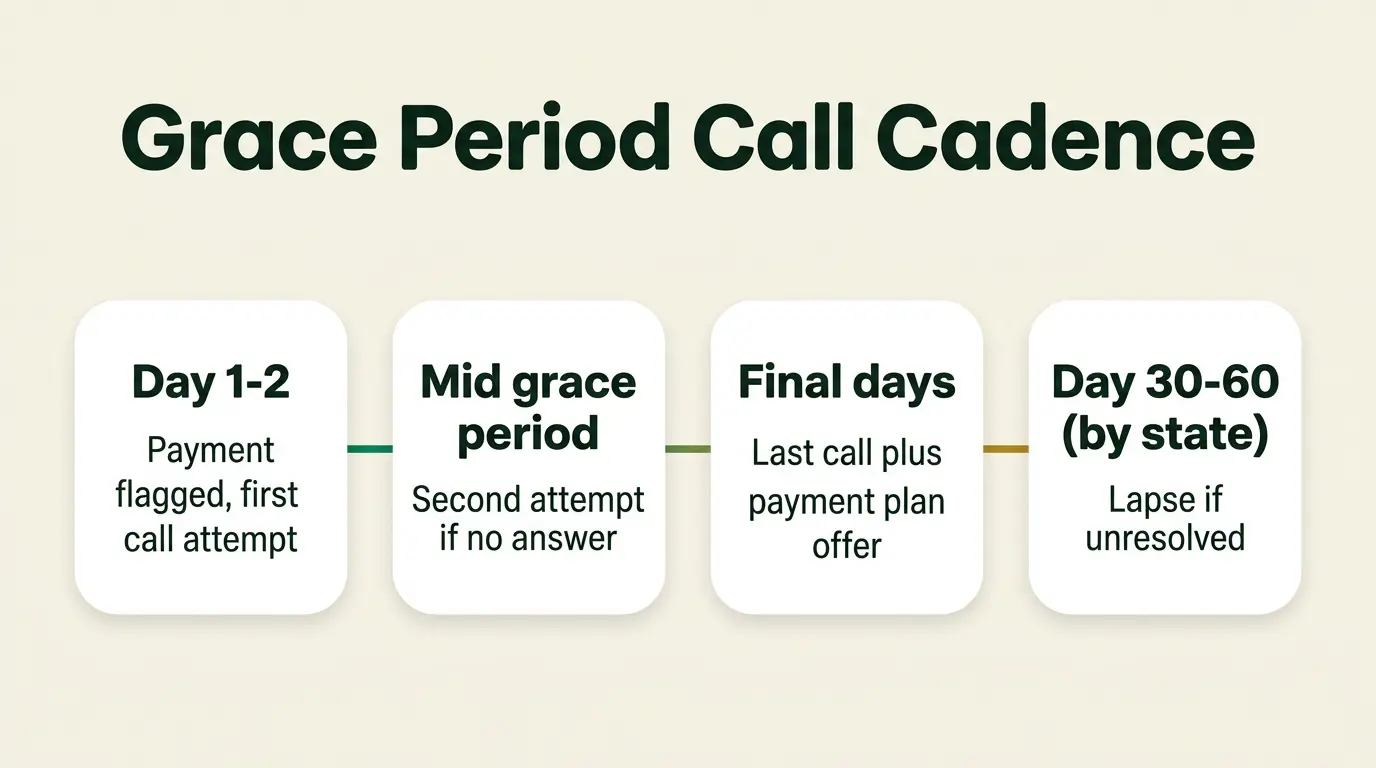
As early as your billing or policy administration system can flag the missed payment, which for most carriers is within a day or two of the due date. Waiting until the grace period is half over erases most of the cushion a 30-to-60-day window is designed to give you. A reasonable cadence is a call attempt within 48 hours of the missed payment, a second attempt around the midpoint of the grace period if the first didn't connect, and a final attempt in the last several days before the deadline, paired with a text and an email using whatever contact consent you already have on file.
Does using an AI caller for lapse-prevention calls change who's liable if something goes wrong?
No. Using AI to make the call faster, or to make more attempts than a small team could make manually, does not transfer licensing liability away from the agent of record. If a policyholder is given wrong information about their coverage, their payment options, or what happens if the policy lapses, the licensed agent is still the one accountable for that advice, not the software that placed the call. An AI caller is a tool for reaching more people in the grace period before it closes. It is not a substitute for a licensed agent handling the actual payment or coverage conversation.
What's the real industry lapse rate right now?
AM Best's 2026 Best's Rankings release puts the U.S. individual life insurance industry lapse ratio, the share of policies terminated for nonpayment of premium, at 5.6% for 2025, down from 7.0% in 2024 and up from 5.1% in 2023. Renewal premium persistency, the share of premium retained year over year, was 86.5% in 2025, down slightly from 87.6% in 2024. This is currently a single-source figure. LIMRA's most recent published lapse and surrender study covers 2015 through 2022 and predates this period, so it can't be used as a second, independent confirmation of the 2025 number specifically.
Is it worth building a lapse-prevention calling program if my book is small?
Scale changes the math, not the logic. A book of 200 life policies at a 5.6% industry-average lapse ratio implies roughly 11 policies a year moving toward lapse for nonpayment, using the 2025 AM Best figure as a reference point and not a guarantee for any specific book. Even a small agency can build a simple version of this manually: a monthly report from the carrier or policy administration system flagging missed payments, and a standing habit of calling that list within 48 hours. The capacity question, whether a two- or three-person agency can consistently make every one of those calls on day 1 or 2 of every grace period, every month, including during AEP season when attention is elsewhere, is what usually decides whether the manual version actually holds up past the first few months.
Sources
- AM Best — 2026 Best's Rankings: US Individual Life Lapse Ratios Dropped to 5.6 in 2025
- Texas Insurance Code § 1101.005 — Grace Period
- California Insurance Code § 10113.71 — Grace Period and Lapse Notice
- New York Insurance Law § 3203(a)(1) — Grace Period
- Florida Statutes § 627.453 — Grace Period
- Cornell Law School Legal Information Institute — 47 CFR § 64.1200
- TheAffordableAI — Pricing
Put this on your own phone line
See the AI dial, qualify, and warm-transfer a live call in under a minute. No contract, no dev work.
Keep reading

Insurance Lead Database Reactivation Guide 2026
Your CRM has leads you already paid for and never worked. Here's how to legally reactivate an insurance lead database in 2026, and what it's actually worth.

The True Cost of a Missed Insurance Lead in 2026
A missed insurance lead is not a mystery cost. It is a paid-for lead, a forgone commission CMS puts a real number on, and a seat nobody was watching.

Life Insurance Leads: Why the First Call Wins
Life insurance leads run $0.60 to $160 each, and they decay fast. Here's what 2026 pricing and sales data actually show, and how to fix follow-up.