Medicare Supplement Leads: Why They Don't Wait for AEP
Medigap has no annual enrollment period. 16 states run birthday-rule windows year-round, and leads don't wait for AEP. What they cost and how to follow up.

A Medicare Supplement lead is not a seasonal event. Medicare Advantage and Part D have the Annual Enrollment Period every October through December and a shorter Open Enrollment Period into March, and agencies staff up for both. Medigap doesn’t work that way. Per Medicare.gov’s own guidance, most people get exactly one federally guaranteed window to buy a Medigap policy without medical underwriting: a one-time six-month period starting the month they turn 65 and enroll in Part B. After that, whether someone can switch plans without answering health questions depends entirely on their state and, in 16 states as of mid-2026, on their birthday. That means Medicare Supplement opportunities don’t cluster in Q4. They show up on a Tuesday in February, a Thursday in June, and every other day of the year, one birthday at a time, and an agency that only builds calling capacity for AEP is going to miss most of them. This article covers what actually triggers a Medigap opportunity outside AEP, what 2026’s state-law changes did to that calendar, what leads cost right now, and how to build follow-up that doesn’t go quiet for nine months of the year.
The short version
- The federal Medigap Open Enrollment Period is a one-time 6-month window, not an annual one, per Medicare.gov. There is no federal fall re-enrollment for Medigap the way there is for Medicare Advantage and Part D.
- 16 states now run a "birthday rule" or similar annual guaranteed-issue window, per medicareresources.org's July 3, 2026 tracking, with a 17th, New Mexico, set to join in 2027. Every one of those windows runs on the client's birthday, not a shared calendar date.
- Minnesota added its own annual open-enrollment law effective August 1, 2026, after a one-year delay, covering an estimated 207,000 Medicare Supplement members statewide, per a Minnesota House committee record.
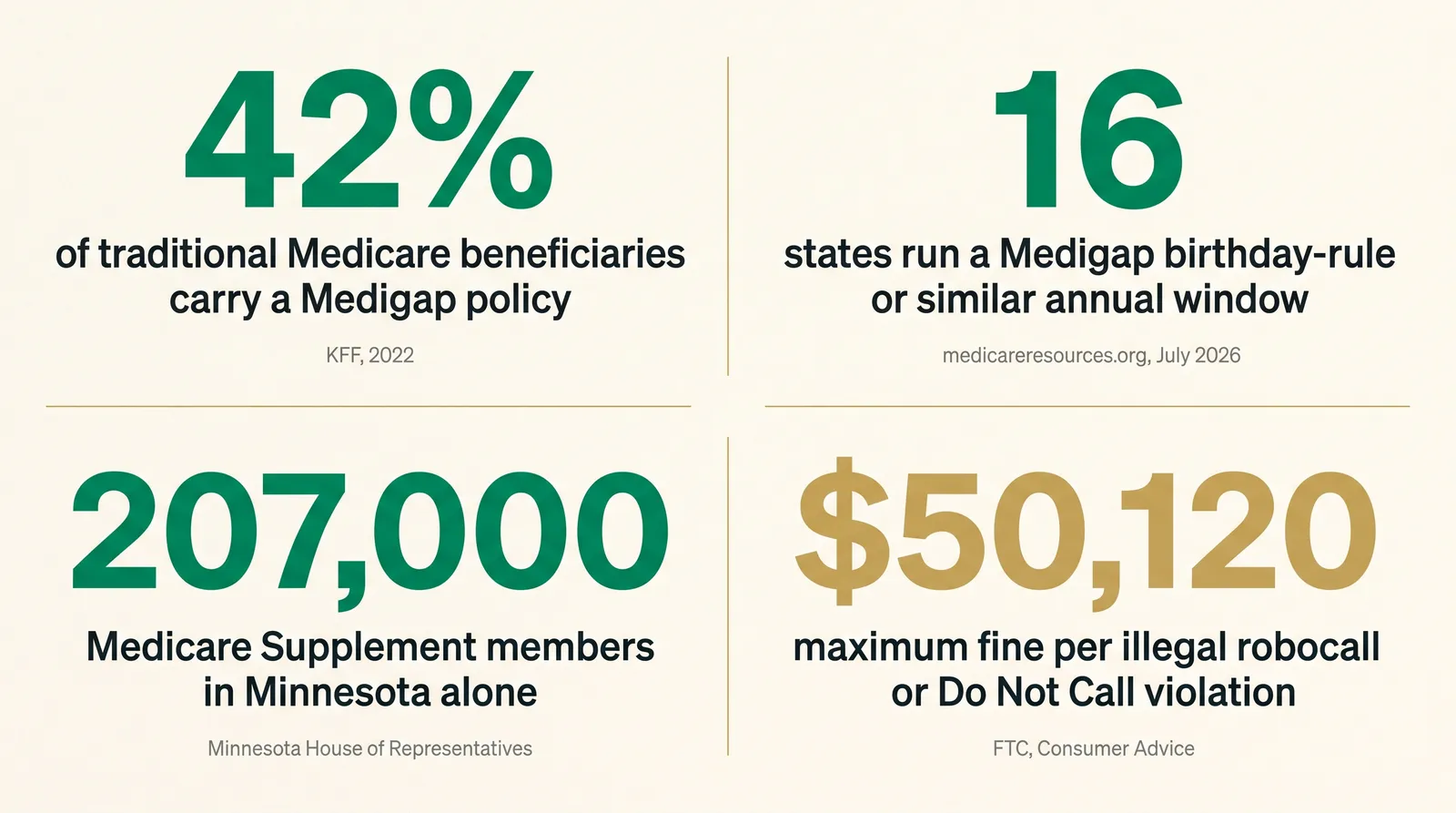
- 42% of people in traditional Medicare, about 12.5 million people, carried a Medigap policy as of 2022, per KFF, ranging from 9% of beneficiaries in Hawaii to 67% in Iowa.
- Medicare leads run anywhere from pennies for an aged record to $125 for an interest-verified live transfer, per two vendors' own published 2026 pricing. An AI caller working that volume year-round, rather than just at AEP, is what actually catches a birthday-triggered window before it closes.
What a Medicare Supplement Lead Actually Is, and Why It’s Different
A Medicare Supplement, or Medigap, policy is private insurance that pays some or all of the cost-sharing traditional Medicare leaves behind: deductibles, copayments, and coinsurance. It’s sold alongside Original Medicare, not instead of it, and it’s a different product from a Medicare Advantage plan, which replaces Original Medicare with a private plan that typically bundles in Part D and extra benefits. That distinction matters for lead follow-up because the two products run on completely different clocks.
Medicare Advantage and Part D both get an annual reset: the Annual Enrollment Period every October 15 through December 7, plus the Medicare Advantage Open Enrollment Period from January 1 through March 31 for people who want to make one additional switch. Agencies know this, and most build seasonal capacity around it, sometimes hiring temporary staff or leaning hard on a vendor for those months. Medigap has no equivalent. Per Medicare.gov’s own page on when someone can buy a Medigap policy, the federal guarantee is a single six-month window: “the 6-month period that starts the first day of the month you’re 65 or older and signed up for Part B.” It happens once. There’s no fall re-open. Medicare.gov states plainly what happens after: “After this period, your options to buy a Medigap policy may be limited and the policy may cost more,” and outside that window, “there’s no federal guarantee that an insurance company will sell you a Medigap policy.”
That one-time structure means a huge share of Medigap-related contact volume, someone wanting to compare rates, switch plan letters, or shop after a premium increase, happens whenever it happens to the person, not on a shared industry calendar. A prospect who bought a Medigap policy at 65 and is unhappy with a rate increase at 71 isn’t waiting for October. They’re calling, or filling out a form, the week they open the renewal notice, and if your agency’s calling capacity is built around AEP, that call lands in a slow month with nobody dialing it back quickly.
Terms worth defining before you build a script
Guaranteed issue means an insurer must sell a Medigap policy to an eligible applicant and can't deny coverage or charge more based on health history. Medical underwriting is the opposite: the insurer can ask health questions and use the answers to price, limit, or deny the application. Whether a given Medigap shopper gets guaranteed issue or faces underwriting depends on whether they're inside a federal or state-protected window at the moment they apply, which is the entire mechanism this article is about.
The Birthday Rule: Why 2026 Made This More Urgent, Not Less
Outside the one-time federal window, some states layer their own guaranteed-issue protections on top, and the most common version is the birthday rule: a recurring window, typically 30 to 63 days and tied to the individual’s own birthday, during which an existing Medigap policyholder can switch to a different insurer’s plan with equal or lesser benefits without medical underwriting. Per medicareresources.org’s tracking, last updated July 3, 2026, 16 states have adopted some form of it: California, Delaware, Idaho, Illinois, Indiana, Kentucky, Louisiana, Maryland, Nevada, Oklahoma, Oregon, Utah, Virginia, West Virginia, and Wyoming, with New Mexico’s version signed into law and set to take effect in 2027. Seven of those states, per the same tracking, added or updated their rule specifically in the 2025-to-2026 legislative cycle: Kentucky, Utah, Virginia, Indiana, Wyoming, Delaware, and West Virginia. That’s the fastest run of new birthday-rule states the tracking has recorded, which is worth knowing if you sell across state lines and haven’t rebuilt your compliance checklist since last year.
California’s version is worth looking at directly because it’s codified, not just described secondhand. California Insurance Code Section 10192.11 states that “an individual shall be entitled to an annual open enrollment period lasting 60 days or more, commencing with the individual’s birthday,” during which they can move to a policy with equal or lesser benefits regardless of health, and the same section requires the issuer to notify the policyholder of that right “at least 30 and no more than 60 days before the beginning of the open enrollment period.” That’s a 60-day floor, once a year, tied to a date that’s different for every single one of your California Medigap clients.
| State / trigger | Window | Basis |
|---|---|---|
| Federal (all states) | One-time, 6 months from Part B enrollment | Medicare.gov, federal guarantee |
| California | 60+ days annually, from policyholder's birthday | Cal. Ins. Code § 10192.11 |
| Oregon | Roughly 60 days, spanning 30 days before/after birthday | State law, per medicareresources.org tracking |
| Minnesota (new) | Annual open enrollment window, statewide, effective Aug. 1, 2026 | 2023 MN law, delayed to Aug. 1, 2026; MN House committee record |
| Delaware, Indiana, West Virginia (new for 2026) | Birthday-tied windows, 45-60 days depending on state | 2025-2026 legislation, per medicareresources.org tracking |
Sources: Medicare.gov; California Legislative Information, Cal. Ins. Code § 10192.11; medicareresources.org, updated July 3, 2026; Minnesota House of Representatives committee record on HF 2335. State rules change; verify the current window and eligibility rules for any specific state directly before relying on this table operationally. The 16-state count for birthday-rule-style laws currently rests on this one aggregated tracking source; we could not independently verify every individual state's statute text for this article and are flagging that rather than treating the count as double-sourced.
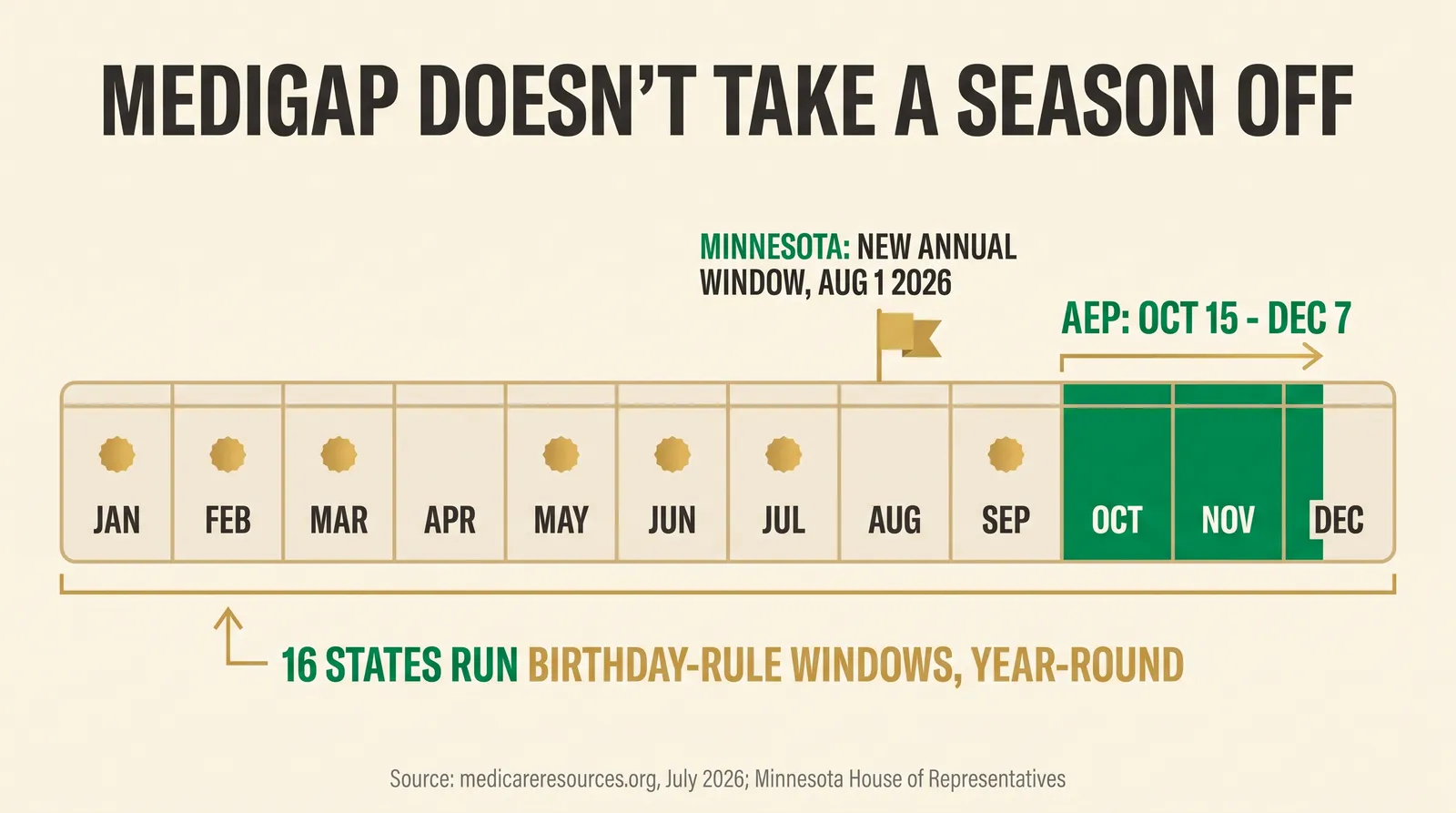
Minnesota didn’t adopt a birthday rule; it did something broader. Per a Minnesota House of Representatives Commerce Finance and Policy Committee record on HF 2335, a 2023 Minnesota law created “an annual open enrollment period that would allow individuals to make an annual plan selection to enroll in a Medicare Supplement without a health history,” plus continuous open enrollment periods in certain situations. The law was originally supposed to take effect August 1, 2025; state lawmakers pushed that back a year specifically to study the market impact, and it took effect August 1, 2026. The same committee record puts real numbers on the size of that market: roughly 207,000 Medicare Supplement members statewide in Minnesota, with Blue Cross Blue Shield of Minnesota alone holding about 70% of that market, more than 145,000 members. Whatever you think of the policy debate in that record (insurers argued it would destabilize premiums; AARP Minnesota and consumer advocates argued it protected access), the operational fact for an agency selling Medigap in Minnesota is simple: as of August 2026, there is a new annual door open to switch plans that didn’t exist before, and every Minnesota Medigap client now has a shot at using it.
What the Market Looks Like Underneath All This
The reason this is worth building real capacity around, rather than treating it as a compliance footnote, is the size of the pool. Per KFF’s most recent comprehensive figures, 12.5 million people, 42% of everyone in traditional Medicare, carried a Medigap policy as of 2022. That share varies enormously by state: as low as 9% of beneficiaries in Hawaii and as high as 67% in Iowa, per KFF’s 2023 state-level data, which tells you Medigap penetration is not evenly distributed and a national script won’t perform the same everywhere. Plan G was the most-held plan type in 2023, at 39% of policyholders, or nearly 5.3 million people, with the now-closed-to-new-enrollees Plan F still second at 36%, or 4.9 million people.
Scale that against the total Medicare population. Per KFF’s Medicare Advantage 2026 enrollment update, published June 5, 2026 and updated July 1, 2026, there are 64.2 million Medicare beneficiaries with both Part A and Part B, with 35.2 million (55%) enrolled in Medicare Advantage and the remaining 28.9 million (45%) in traditional Medicare. Medigap only sells alongside that 45% traditional-Medicare slice, roughly 29 million people nationally, of whom KFF’s 2022 figure suggests about 4 in 10 already own a policy. The remaining 6 in 10 in traditional Medicare without one, plus everyone who already has a policy and is inside a switch window, is the addressable pool a Medigap-focused agency is working, and none of that pool moves on the AEP calendar.
Where a $100 Medicare Supplement lead budget goes, by lead type
Approximate leads purchased per $100, using the lower end of each published range
Source: The Leads Warehouse's own published Medicare lead pricing, lower end of each range ($0.50 aged, $2 co-reg, $20 real-time form, $40 inbound call), fetched September 2026. Illustrative arithmetic, not a vendor-published conversion table; actual lead counts depend on state, filters, and vendor minimums.
That chart is the same trade-off you’d see in any lead category: cheap leads buy volume, expensive ones buy pre-qualified conversations. The Medigap-specific wrinkle is that a large share of the “expensive” leads, the ones from someone actively shopping mid-year because a birthday window just opened or a rate increase just landed, are time-limited in a way an aged auto or life lead simply isn’t. A cheap aged lead can sit in a queue for a week and still be worth calling. A live Medigap inquiry sitting in the same queue during someone’s 45-day Illinois birthday window is burning a clock that doesn’t reset.
What It Actually Costs to Move Slowly Here
Put a real price on a Medigap lead next to what it costs to call it. Per InsureLeads’ own published Medicare leads page, an aged lead starts around $5, an exclusive web lead runs $70, delivered within roughly 30 seconds of the consumer submitting a form, and an interest-verified live transfer, where the vendor’s own team has confirmed the person is real and interested before connecting the call, runs $125. Volume discounts start at $5,000 a month in spend, and the same page states that pricing during AEP typically runs 30 to 50% above baseline, a detail worth internalizing since it means the fall surge everyone plans for is also the most expensive time to be buying leads at all, while the other eight or nine months, when birthday windows are opening quietly across 16 states, are comparatively cheap to work.
A second vendor, The Leads Warehouse, in a pricing guide published May 5, 2026, prices Medicare leads separately from ACA leads across the same four tiers: aged leads at pennies to $0.50, real-time co-registration leads at $0.50 to $2, real-time form leads at $20 to $60, and inbound calls at $40 to $120, consistently priced higher than the equivalent ACA tier because, as the guide states, Medicare leads carry higher consumer intent and higher agent commissions.
| Lead type | InsureLeads | The Leads Warehouse |
|---|---|---|
| Aged lead | from $5 | pennies-$0.50 |
| Real-time co-reg / shared lead | not separately published | $0.50-$2 |
| Real-time form / exclusive web lead | $70 | $20-$60 |
| Inbound call / live transfer | $125 | $40-$120 |
Source: InsureLeads (GetInsureLeads.com), Medicare Leads pricing page, and The Leads Warehouse, How Much Do Medicare and ACA Leads Cost in 2026, published May 5, 2026. Both fetched September 2026. Prices are set by the vendors, vary by state and filters, and are subject to change; re-check before budgeting.
Now put a call cost against that. At TheAffordableAI’s published Single Account rate of $0.20 a minute (from $0.15 at bulk volume), a three-minute qualifying call, long enough to confirm interest and check basic eligibility, costs about 60 cents. Against a $125 live transfer, that’s a rounding error. Against a $5 aged lead, it’s more than the lead itself, which is exactly why aged Medigap leads only make sense to call at volume, not one at a time with the same care you’d give a live transfer. The real cost of moving slowly isn’t the call; it’s the guaranteed-issue window that closes while the lead sits in a queue. A prospect who called during a 45-day Illinois birthday window and didn’t hear back for three weeks now has three weeks left, not 45, and if your process doesn’t flag that, nobody on your team knows the clock is running at all.
This is not legal or insurance advice
Guaranteed-issue rules, birthday-rule eligibility, and underwriting exposure vary by state, by carrier, and by the specific plan letters involved, and several states have changed their rules within the past two years. Confirm current eligibility and window length for any specific state and client situation with your compliance department, your carrier partners, or counsel before relying on anything in this article to advise a client.
How to Build Follow-Up That Doesn’t Go Quiet Nine Months a Year
Here’s the actual method, and none of it requires buying anything.
- Stop treating Medicare calling capacity as a Q4-only staffing problem. If your dialing team, seasonal hires included, ramps down after AEP and OEP, you’re structurally unavailable for the birthday-rule and mid-year switch volume that runs the other eight or nine months.
- Track guaranteed-issue eligibility as a field, not a memory. For every existing Medigap client, record their state, their specific birthday-rule window (if any) with start and end dates for the current year, and whether that state’s rule lets them switch carriers or only within their current insurer’s plans. That single field is the difference between calling a client with real urgency and calling them with none.
- Trigger outreach off the calendar, not off a campaign launch. A birthday-based window means the trigger date is different for every single client. Build (or buy) a system that fires a call attempt automatically as each client’s window approaches, rather than relying on someone remembering to check a spreadsheet.
- Call new inbound Medigap leads the moment they arrive, every time. A lead who’s shopping mid-year, outside AEP noise, is very likely inside some kind of window right now, whether that’s the one-time federal period, a state birthday rule, or a rate-increase-triggered shop. Treat every non-AEP Medigap inquiry as time-sensitive by default.
- Keep a state-by-state compliance reference current, not a one-time document. Seven states changed or added birthday-rule laws in the 2025-2026 cycle alone, per medicareresources.org’s tracking. A reference built in 2024 is already out of date for California-adjacent states like Nevada and clearly out of date for the newcomers.
- Log every disposition, answered, not interested, callback requested, window confirmed or expired, both for follow-up quality and as your compliance record of who was called, when, and why.
- Scrub every list against the National Do Not Call Registry and your internal do-not-call list before every calling session, regardless of how time-sensitive the lead feels. Urgency is never a reason to skip consent verification.
An agency that reads this and thinks “we can build a birthday-tracking field in our CRM and set reminders” is right, and for a smaller book of business, that’s a reasonable approach. The tradeoff is the same one it always is: doing it well at volume, with retries, consistent disposition logging, and coverage across all twelve months instead of three, is a staffing commitment, not a one-time setup task.
Capacity matches the calendar, not the client
- Dialing staff scales up for AEP/OEP and scales back down after March 31
- Birthday-rule windows tracked informally, if at all, outside the busy season
- Mid-year inbound Medigap leads sit in the same queue as everything else
- New state law changes discovered when a client mentions one
Capacity matches when clients actually become eligible to switch
- Outbound calling runs at whatever volume the pipeline requires, every month
- Each client's guaranteed-issue window is a tracked field with a start and end date
- Every new lead, in any month, triggers an attempt on arrival
- Compliance reference reviewed on a schedule, not discovered reactively
Hear how the follow-up actually sounds
There's a live demo call on the homepage if you want to hear an AI caller dial, qualify, and hand off a warm transfer before you decide anything.
Where a Managed AI Caller Fits, and Where It Doesn’t
This is the one section making a product claim, and it’s kept to what’s actually documented. TheAffordableAI is a managed AI caller: it dials outbound the moment a lead is created and answers every inbound call in under a second, which matters specifically for a product category where “the moment a lead is created” can mean any day of the year rather than a predictable fall surge, per TheAffordableAI’s own published Features page. It hands qualified, interested prospects to a licensed agent on a warm transfer, ringing 20-plus agents at once so the first one available takes the call, and if nobody’s available inside a few rings, it resumes the conversation itself and books a meeting against real-time calendar availability. It syncs natively, two-way, with HighLevel, so a client’s state, plan details, and any custom field you build for tracking a birthday-rule window land in the CRM you’re probably already running.
Because the pricing is per-minute rather than per-seasonal-hire, the same setup that covers your AEP surge keeps running in February when a California client’s birthday window opens, or in September when a Minnesota client calls in under the state’s new annual enrollment right, without a second hiring or ramp-down cycle. It runs a staged number warmup, so a Medigap-focused outbound number ramps up gradually rather than dialing at full volume from day one, which matters because this population skews older and is, per general carrier spam-filtering behavior, no less likely than any other demographic to have their carrier flag an unfamiliar number.
Calling capacity that isn't seasonal
Outbound fires the moment a lead lands, in any month, instead of scaling to a Q4-only staffing plan.
Warm transfer to a licensed agent
A qualified, interested prospect gets handed to a human live, while the guaranteed-issue window is still open.
HighLevel sync for state and window tracking
Custom fields for a client's state and switch-window dates land in the CRM you're already running, natively.
What it does not do, and should never claim to: compare Medigap plan letters, explain underwriting exposure, or recommend a specific policy. Those require a licensed producer who knows the client’s health history, state rules, and carrier options, and they are not decisions a voice AI can responsibly make. TheAffordableAI’s role stops well short of that: it dials at scale, confirms real interest, tracks the basics, and gets a licensed human on the line while the window is still open.
A Medigap lead that calls in June is running on the exact same clock as one that calls in November. Only one of those months has a staffing plan built around it.
The pricing is worth restating since the year-round argument depends on it: Single Account runs $200 a month plus a $500 one-time setup fee, at $0.20 a minute (from $0.15 at bulk volume). Agency runs $500 a month plus a $1,000 one-time setup fee, at $0.18 a minute (from $0.16 at bulk volume), and adds routing to 20-plus agents, round robin across numbers, and team availability toggles, useful when Medigap volume from multiple states, each with its own window rules, is landing at once. Both plans are month to month with no long-term commitment, per TheAffordableAI’s own pricing page, fetched for this article; bulk minutes carry over rather than expiring at month’s end, and voicemails or unanswered calls aren’t billed. You can build a version of the tracking-and-outreach piece yourself with a CRM field, a set of reminders, and staffed hours spread across the calendar instead of concentrated in Q4. Plenty of agencies do exactly that, and it’s worth pricing both approaches against your own Medigap book before deciding which one fits.
What You Get When Tracking and Speed Work Together
Handled well, accurate window-tracking and fast follow-up reinforce each other. Knowing that a specific Illinois client’s birthday window opened nine days ago and closes in 36 more days is only useful if the outreach actually happens inside that stretch; a perfect compliance spreadsheet attached to a slow dial queue just moves the failure point from “we didn’t know the window existed” to “we knew and still missed it.” Conversely, fast dialing without accurate window data means treating every Medigap lead the same, which either wastes urgency on someone who has months to decide or, worse, fails to prioritize someone with eleven days left because nobody flagged the date.
A Worked Example: One Book, Twelve Months
Picture an agency with 400 existing Medigap clients spread across California, Oregon, Illinois, and Minnesota, plus a steady trickle of new inbound leads averaging 15 a week year-round. In a seasonal-only setup, the team’s real calling attention concentrates on AEP and OEP, roughly five months a year; the other seven months, birthday-window reminders get checked when someone remembers, and new inbound leads get worked whenever staff has spare time between other priorities. Across a full year, that agency’s California clients alone represent 400 times whatever share holds a California address, each with a 60-day annual window that opens on a different date for every person, and most of those windows pass with no proactive outreach at all unless the client calls in first.
In a year-round setup, each client’s state and window dates live as tracked fields, outreach triggers automatically as each window approaches, and the same 15-a-week inbound trickle gets a same-day call attempt every week of the year, not just during AEP. The total client list and total lead volume for the year are identical in both scenarios. What changes is how many of those 400 birthday windows and 780 annual inbound leads actually got a conversation while the guaranteed-issue clock was still running, instead of after it had already closed.
Compliance Notes That Apply Regardless of How You Call
A few standing rules apply to every outbound and inbound call your agency places for Medicare Supplement leads, and they belong here explicitly. Automated or prerecorded calls and texts to a cell phone for marketing purposes are restricted under the TCPA’s consent requirement, codified at 47 U.S.C. § 227(b)(1)(A)(iii); obtaining and documenting valid consent is the agent’s obligation and does not transfer to any vendor or platform. Under 47 U.S.C. § 227(b)(3), a consumer can recover $500 per violation, or actual damages if greater, with courts able to raise that to $1,500 for a willful or knowing violation, per Cornell Law School’s Legal Information Institute. Separately, companies that call numbers on the National Do Not Call Registry or place illegal robocalls can currently be fined up to $50,120 per call, and the FTC states telemarketers who made illegal calls have paid the agency more than $290 million in judgments.
Medigap is medical supplement insurance, and it is regulated primarily at the state level alongside the federal consumer protections Medicare.gov describes, which is a different rule set than the CMS Medicare Communications and Marketing Guidelines and TPMO disclaimer requirements built around Medicare Advantage and Part D marketing. That distinction doesn’t loosen anything: TCPA consent, Do Not Call obligations, and state telemarketing statutes still apply in full to Medigap calls, and any call using an AI voice should disclose that fact where required and honor opt-out requests immediately. Using AI to place or answer a call does not transfer liability for TCPA consent, Do Not Call compliance, or any state insurance disclosure or suitability requirement away from the licensed producer whose name is on the sale. None of this article promises a close rate, a conversion lift, or an income outcome, and any vendor who does is worth treating with real skepticism.
Frequently asked
Is there an annual enrollment period for Medicare Supplement plans, like there is for Medicare Advantage?
No, not at the federal level. Medicare.gov's own guidance describes the Medigap Open Enrollment Period as a one-time 6-month window that starts the first day of the month someone is 65 or older and enrolled in Medicare Part B. After that window closes, there is no federal guarantee an insurer will sell that person a Medigap policy, and unlike Medicare Advantage or Part D, there's no annual do-over every fall. Any recurring opportunity to switch without medical underwriting after that comes from state law, not federal law, which is why the rules vary so much by where the lead lives.
What is the Medigap birthday rule?
It's a state law, not a federal one, that gives existing Medigap policyholders a recurring window, usually 30 to 63 days long and tied to their birthday, to switch to a plan with equal or lesser benefits without answering health questions or going through medical underwriting. As of medicareresources.org's July 3, 2026 tracking, 16 states have adopted some version of it, with New Mexico's law signed and set to take effect in 2027. California's version, codified at California Insurance Code Section 10192.11, guarantees at least 60 days starting on the policyholder's birthday.
What happens if a Medigap lead's guaranteed-issue window closes before an agent calls back?
The prospect's options narrow considerably. Outside a federal or state guaranteed-issue window, an insurer is generally allowed to ask health questions and can decline the application or price it based on the answers, per Medicare.gov's own explanation of what happens after the one-time federal window ends. A lead who called in week one of a 30-to-63-day state window and doesn't hear back until week seven has, in a lot of cases, lost the guaranteed-issue right entirely, not just lost some urgency.
How much does a Medicare Supplement lead cost in 2026?
It depends heavily on format. Per The Leads Warehouse's own pricing page, published May 5, 2026, aged Medicare leads run pennies to $0.50, real-time co-registration leads run $0.50 to $2, real-time form leads run $20 to $60, and inbound calls run $40 to $120. InsureLeads' own published Medicare leads page prices an aged lead from $5, an exclusive web lead at $70, and an interest-verified live transfer at $125, with volume discounts starting at $5,000 a month in spend and AEP pricing running 30 to 50% above baseline during the fall surge.
Did Minnesota really pass a new Medicare Supplement enrollment law in 2026?
Yes. Per a Minnesota House Commerce Finance and Policy Committee record on HF 2335, a 2023 Minnesota law creates an annual open enrollment period allowing Medigap enrollees to switch plans without a health history, plus continuous open enrollment in certain situations. It was originally set to take effect August 1, 2025, was delayed a year for further study, and took effect August 1, 2026. The same record states Minnesota has roughly 207,000 Medicare Supplement members statewide, with Blue Cross Blue Shield of Minnesota alone holding about 70% of that market, or more than 145,000 members.
Can an AI voice agent actually sell someone a Medicare Supplement policy?
No, and it shouldn't try to. Comparing plan letters, explaining medical underwriting exposure, and walking a prospect through a guaranteed-issue window are judgment calls that belong to a licensed agent who knows the client's health history and state rules. What a managed AI caller can do is call the moment a lead comes in, work a volume of Medigap inquiries that would otherwise sit in a queue, and warm-transfer an interested, qualified prospect to a licensed human while they're still on the phone. The comparison, the recommendation, and the sale stay entirely human.
Does Medicare marketing compliance apply the same way to Medicare Supplement calls as it does to Medicare Advantage calls?
Not identically. CMS's Medicare Communications and Marketing Guidelines and the TPMO disclaimer requirements are built around Medicare Advantage and Part D marketing rules. Medigap is medical supplement insurance regulated primarily at the state level, alongside the federal consumer-protection floor Medicare.gov describes. That does not remove TCPA consent requirements, state telemarketing statutes, or Do Not Call obligations from a Medigap calling program; it just means the specific CMS marketing rule set that governs Medicare Advantage calls is not the same rule set that governs a Medigap conversation. Confirm which rules apply to your specific call type with your compliance team before building a script around any of this.
Does using an AI caller transfer any compliance liability away from the licensed agent?
No. Using AI to place or answer a call does not transfer liability for TCPA consent, Do Not Call compliance, or any state insurance disclosure requirement away from the licensed producer. The agent whose license is attached to the eventual sale stays responsible for consent, disclosure, and suitability, regardless of what software placed or answered the call.
Sources
- Medicare.gov — When can I buy a Medigap policy?
- KFF — Key Facts About Medigap Enrollment and Premiums for Medicare Beneficiaries (published October 18, 2024)
- KFF — Medicare Advantage in 2026: Enrollment Update and Key Trends
- California Legislative Information — California Insurance Code Section 10192.11
- medicareresources.org — The 'birthday rule': a gift to Medigap enrollees? (updated July 3, 2026)
- Minnesota House of Representatives — Commerce Finance and Policy Committee record on HF 2335 (Medicare Supplement open enrollment)
- Federal Trade Commission — National Do Not Call Registry FAQs (Consumer Advice)
- Cornell Law School Legal Information Institute — 47 U.S. Code § 227, Telephone Consumer Protection Act
- InsureLeads (GetInsureLeads.com) — Medicare Leads pricing page
- The Leads Warehouse — How Much Do Medicare and ACA Leads Cost in 2026 (published May 5, 2026)
- TheAffordableAI — Pricing
- TheAffordableAI — Features
Put this on your own phone line
See the AI dial, qualify, and warm-transfer a live call in under a minute. No contract, no dev work.
Keep reading

Surviving Medicare AEP 2026 Without a Seasonal Hire
Medicare AEP runs October 15 to December 7. Real math on staffing that window without hiring and licensing seasonal reps you don't have time for.

CMS 2027 Medicare Rules: The 48-Hour Wait Is Gone
CMS eliminated the 48-hour Scope of Appointment wait, changed the TPMO disclaimer timing, and cut call retention to 6 years ahead of AEP 2027.
Medicare OEP 2027: What Agents Can (and Can't) Do
Medicare's Open Enrollment Period runs January 1 to March 31 and bans unsolicited marketing. Here's what agents can legally do, and why every call matters.