The NFIP Deadline Is September 30: What Agents Do Now
NFIP's authorization expires September 30, 2026. Here's what a lapse means for new policies and closings, and how fast agents need to work their flood book.
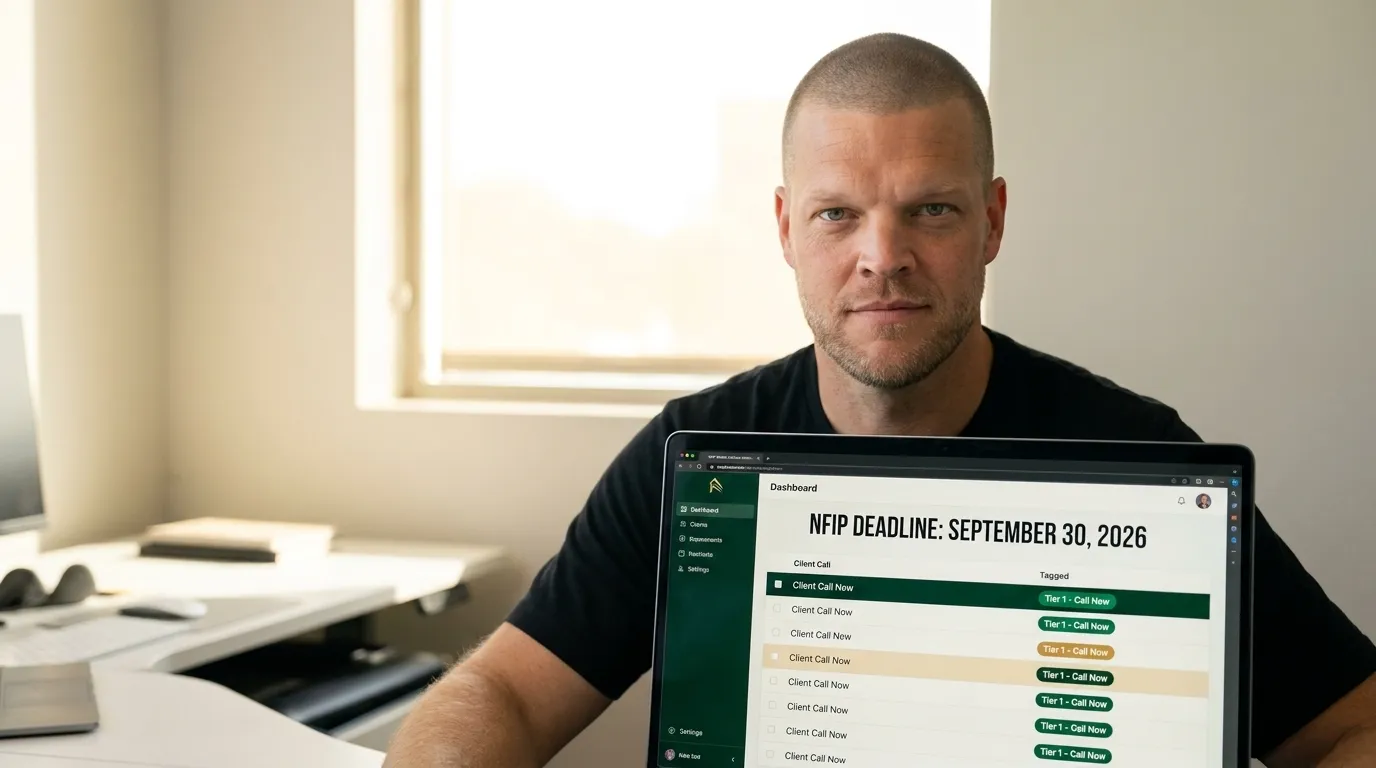
The National Flood Insurance Program’s authorization runs out on September 30, 2026. If Congress doesn’t act by 11:59 p.m. that night, FEMA stops selling new flood insurance policies and stops renewing the ones already on the books, though it keeps paying valid claims on policies already in force, according to FEMA’s own reauthorization page. That’s not a hypothetical, and it’s not distant history. The program has already lapsed twice in the last twelve months: a 43-day gap that ran October 1 through November 12, 2025, tied to the federal government shutdown, and a shorter lapse from February 1 to 3, 2026, both documented in the Congressional Research Service’s tracking of the program. Every time this happens the damage lands on the same two groups: policyholders whose renewal date falls inside the gap, and pending home sales that can’t close without a flood policy in place.
If you write or service flood insurance, in Florida, Louisiana, Texas, or anywhere else with a Special Flood Hazard Area, you have a fixed, countable list of clients whose renewal dates fall in the next few weeks, plus every pending closing on your desk that needs a new policy before it can fund. That list doesn’t grow. It just gets more urgent every day you haven’t called it.
The short version
- NFIP's authorization expires September 30, 2026. Congress last extended it through the Consolidated Appropriations Act, 2026, signed February 3, 2026.
- If it lapses, FEMA stops writing new policies and stops renewing existing ones, but keeps paying claims already owed on policies in force.
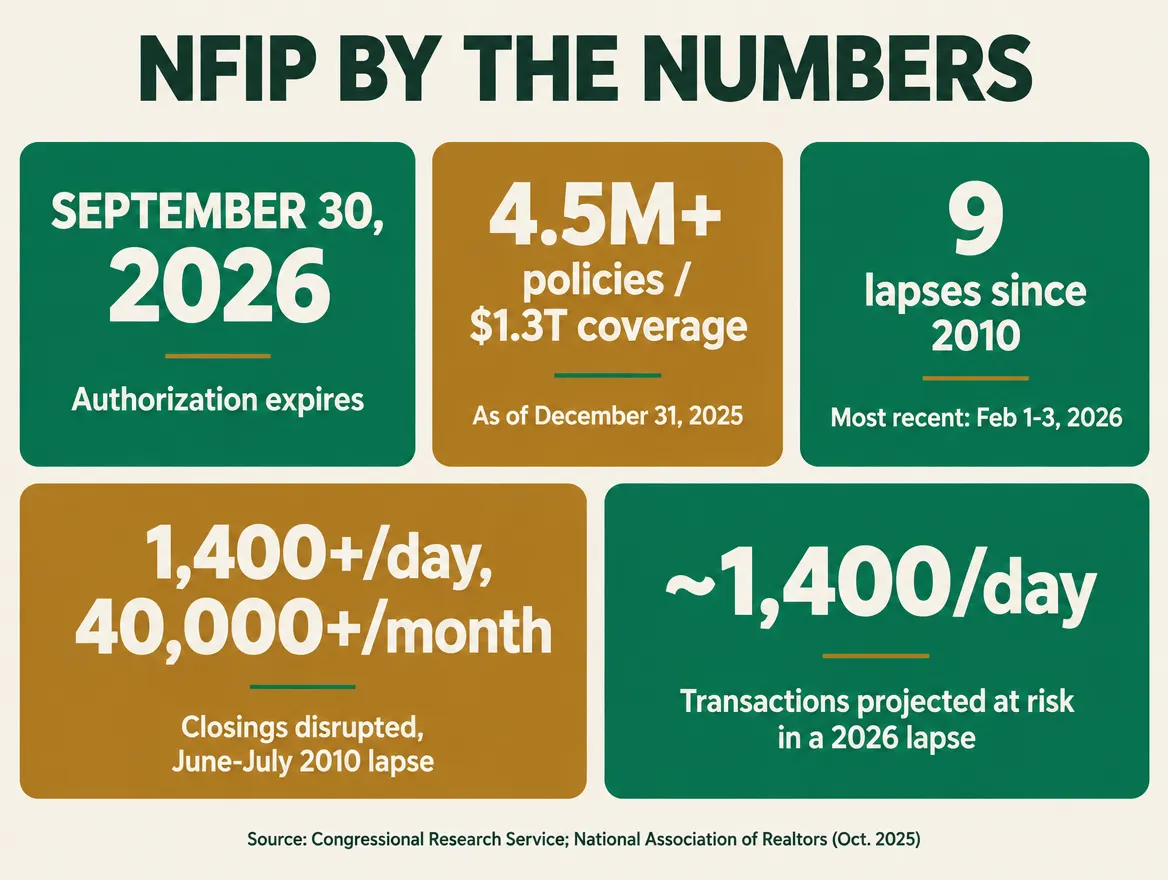
- The program has already lapsed nine times since 2010, including twice in the last year: 43 days from October 1 to November 12, 2025, and again from February 1 to 3, 2026. The June–July 2010 lapse is documented as canceling or delaying more than 1,400 home closings a day, over 40,000 a month.
- Every client on your book with a renewal date near or after September 30, and every pending closing that needs a flood policy, is a fixed list you can build and call today.
- An AI caller can work that whole list in days instead of weeks, at a per-minute cost you can calculate before you spend it.
What actually happens if the NFIP lapses
FEMA’s authority to write flood insurance comes from Congress, and that authority has an expiration date attached to it. Right now that date is September 30, 2026, set when the president signed the Consolidated Appropriations Act, 2026 on February 3, 2026, extending an authorization that had already lapsed once during the fall 2025 government funding fight and again briefly at the start of February, according to FEMA’s reauthorization page. Congress has to act again, by extending it, replacing it, or letting it run out, before that date arrives.
If the clock runs out with no action, three things happen at once, all confirmed directly on FEMA’s own page. First, FEMA stops issuing new flood insurance policies, full stop, anywhere in the country. Second, FEMA stops renewing existing policies, which means a policy up for renewal during the lapse can’t be renewed until Congress acts. Third, and this is the part people get wrong, FEMA keeps paying valid claims on policies that were already in force before the lapse, using whatever funds are available. A lapse doesn’t cancel anyone’s existing coverage or their right to file a claim on it. It freezes new business.
That distinction matters for how you triage your book. A client whose policy is paid up and not up for renewal for another eight months isn’t at risk from a September lapse. A client whose renewal falls on September 28, or a buyer whose closing is scheduled for October 3 and needs a new flood policy to fund the loan, is sitting directly in the blast radius.
Who actually needs a flood policy
Federal law requires flood insurance as a condition of any mortgage that a federal agency, a federally regulated lender, or a government-sponsored enterprise makes, guarantees, or purchases on a property in a Special Flood Hazard Area, according to the Congressional Research Service's overview of the program. That's the mandatory purchase requirement, and it's the reason a lapse doesn't just inconvenience existing policyholders, it can stop a closing cold if the property needs flood coverage and none is available to write.
Why this keeps happening, and why it’s getting more frequent
The NFIP isn’t a permanent program the way Social Security or Medicare is. It runs on a fixed authorization that Congress has to renew, and it has run on short-term patches for most of the last two decades rather than a long-term reauthorization. The program covers over 4.5 million policies providing over $1.3 trillion in coverage, as of December 31, 2025, according to the Congressional Research Service’s introduction to the program; FEMA’s own flood insurance overview page, as it stood when checked for this article, separately cites roughly 4.7 million policyholders across more than 22,600 participating communities. A program that size, running on an expiration date Congress has to remember to extend, is a structural risk, not a one-time event.
It’s also politically easy to let slide to the last minute, because the immediate cost of inaction doesn’t show up on a bill anyone has to vote against. Nobody’s premium goes up when the authorization lapses. What breaks is quieter: a renewal that can’t process, a closing that can’t fund, a policyholder who finds out their coverage didn’t renew only when they need to file a claim. That’s exactly the kind of cost that’s easy for Congress to defer and easy for an agent to underestimate until it’s their client on the phone asking why the closing fell through.
Congress has let this exact thing happen nine times now, and the pace has picked up. Four separate lapses ran between 2010 and 2011: March 1 to 2, 2010; March 29 to April 15, 2010; June 1 to July 2, 2010; and October 1 to 5, 2011, according to the Congressional Research Service’s Insight on what happens when the NFIP lapses. Then it went quiet for years before two more short lapses hit in 2018 (January 20 to 22, and an 8-hour gap on February 9), a thirteen-hour lapse on March 23, 2024, and then two lapses inside a single twelve-month stretch: 43 days from October 1 to November 12, 2025, tied to the federal government shutdown, and another gap from February 1 to 3, 2026, resolved when the Consolidated Appropriations Act, 2026 was signed. None of those nine lapses were resolved by careful planning. Every one was resolved when Congress finally passed an extension, sometimes retroactively, after the disruption had already happened.
A lapse doesn't cancel anyone's existing coverage. It freezes new business, at exactly the moment your book needs a renewal or a closing needs a policy.
Mike MooreWhere your flood policies actually come from
Most agents who sell flood coverage aren’t dealing with FEMA directly day to day. The large majority of NFIP policies, roughly 87.6 percent, are sold and serviced through the Write Your Own program, known as WYO: private insurance companies that issue and service NFIP-backed flood policies under their own name, using their own agents and their own paper, while the federal government sets the rates and backs the risk, according to the Congressional Research Service’s introduction to the program. The remainder runs through FEMA’s direct servicing arrangement. If you quote flood coverage through a carrier’s own portal rather than a federal one, you’re very likely working inside the WYO system already, whether or not anyone at your agency has ever used that term.
That structure is exactly why a lapse ripples further than a single federal office running out of money. When the authorization lapses, every WYO carrier loses the ability to bind, renew, or increase an NFIP policy through the exact same system your agency uses to write one, on the same day, for the same reason. It isn’t a paperwork slowdown at one office. It’s every WYO carrier’s flood-policy pipeline going dark at once. The Congressional Research Service’s Insight on NFIP lapses notes that the largest WYO insurer at the time left the program entirely in 2011, citing the administrative burden of repeated short-term reauthorizations and lapses, a reminder that carriers, not just policyholders, absorb real cost every time this happens.
Terms worth knowing before you build your call list
Special Flood Hazard Area (SFHA): the flood zones FEMA designates as having at least a 1 percent annual chance of flooding, sometimes called the 100-year floodplain. This is the zone where the mandatory purchase requirement applies. Write Your Own (WYO): the private-insurer program most NFIP policies are actually sold and serviced through, described above. Mandatory purchase requirement: the federal rule, described by the Congressional Research Service, that any mortgage a federal agency, a federally regulated lender, or a government-sponsored enterprise makes, guarantees, or purchases on a property in an SFHA must carry flood insurance as a condition of the loan.
What a lapse actually costs, in transactions you can count
The clearest documented case is the June to July 2010 lapse, the longest and most damaging of the nine. During that roughly 32-day gap, the Congressional Research Service’s Insight cites a 2012 academic analysis finding that more than 1,400 home sale closings were canceled or delayed every day, representing upward of 40,000 sales a month, because lenders could not close federally backed mortgages secured by property in a flood zone without a flood policy in place. Commercial properties were affected the same way.
That’s history, not a prediction. For what a 2026 lapse specifically could look like, the National Association of Realtors published an analysis in October 2025 estimating that roughly 1,400 property transactions a day would be at risk if the NFIP lapses, a projection built on the same mechanism the 2010 lapse actually produced. That is NAR’s own projection, not an independently corroborated figure, and it’s worth reading as an association’s estimate rather than a certainty, since no one can know in advance exactly how long a 2026 lapse would run or how markets would adjust in the meantime. NAR’s analysis also frames the program’s ordinary annual footprint: it estimates the NFIP underpins close to half a million home sales a year, supports roughly a million jobs tied to those transactions, and contributes an estimated $70 billion to the economy annually. Those three figures come from the same single NAR analysis and haven’t been independently verified elsewhere, so treat them as one association’s own modeling rather than a government-confirmed number.
Transactions at risk per day: 2026 projection vs. the documented 2010 lapse
NAR's October 2025 projection for a future lapse, set against what the Congressional Research Service documents actually happened during the June–July 2010 lapse.
Sources: National Association of Realtors, "NFIP by the Numbers" (October 7, 2025); Congressional Research Service Insight IN10835 (updated September 11, 2026). Monthly totals: over 40,000 documented for June–July 2010; NAR does not publish a separate 2026 monthly projection.
| Transaction | Before the deadline | After a lapse |
|---|---|---|
| New flood policy | Available, normal underwriting | FEMA stops issuing new policies |
| Policy renewal | Processes on schedule | Cannot renew until Congress acts |
| Claim on an existing policy | Paid per policy terms | Still paid, using available funds |
| Closing requiring flood coverage in an SFHA | Closes on schedule | Waits; cannot fund without a policy |
| Coverage increase on an existing policy | Processes normally | Cannot process until Congress acts |
Hear it call you
Put your own number in and the AI will call in seconds. It's the fastest way to understand what your flood book would experience if you pointed it at this list today.
Nine lapses, one pattern
The pattern across every lapse, from 2010 through this February, is the same: a short-term authorization expires, Congress doesn’t act in time, and the disruption falls on whoever has a transaction pending at that exact moment.
| Dates | Length | What's documented |
|---|---|---|
| March 1–2, 2010 | 2 days | Short lapse; new business paused |
| March 29–April 15, 2010 | 18 days | New business and renewals paused |
| June 1–July 2, 2010 | ~32 days | 1,400+ closings/day disrupted, 40,000+/month |
| October 1–5, 2011 | 5 days | Short lapse; new business paused |
| January 20–22, 2018 | 3 days | Tied to a federal government shutdown |
| February 9, 2018 | ~8 hours | Brief funding-bill gap |
| March 23, 2024 | ~13 hours | Brief funding-bill gap |
| October 1–November 12, 2025 | 43 days | No new policies sold or renewed; reauthorized retroactively |
| February 1–3, 2026 | ~3 days | Resolved by the Consolidated Appropriations Act, 2026 |
Source: Congressional Research Service Insight IN10835, "What Happens If the National Flood Insurance Program (NFIP) Lapses?" (updated September 11, 2026), via EveryCRSReport.com.
Notice the shape of that list: two lapses inside the last twelve months alone, after years of relative quiet. Nobody knows in advance which kind of lapse they’re planning around, if there’s a lapse at all, and the last two both landed while Congress was fighting over an unrelated funding deadline rather than flood insurance specifically. That uncertainty is exactly why the right move isn’t to guess how long a gap might run. It’s to make sure your book is already called before the deadline arrives, so the length of any lapse stops being your problem.
How to fix it: build the list and work it in order
This part doesn’t require anything exotic. It requires pulling the right list and calling it in the right order, and you can do this yourself with a spreadsheet and a phone, an AI caller, or a mix of both.
- Pull every flood policy with a renewal date between now and December 31, 2026. Your book of business report or your carrier portal can generate this. Sort it by renewal date, soonest first. Anyone renewing in the next two weeks is your first call list; anyone renewing in 60 to 90 days is your second.
- Pull every pending transaction that needs a new flood policy to close. This is the purchase side: buyers under contract on a property in a Special Flood Hazard Area who don’t have a flood policy bound yet. If their closing date is anywhere near or after September 30, they need to hear from you now, not when the title company calls asking where the policy is.
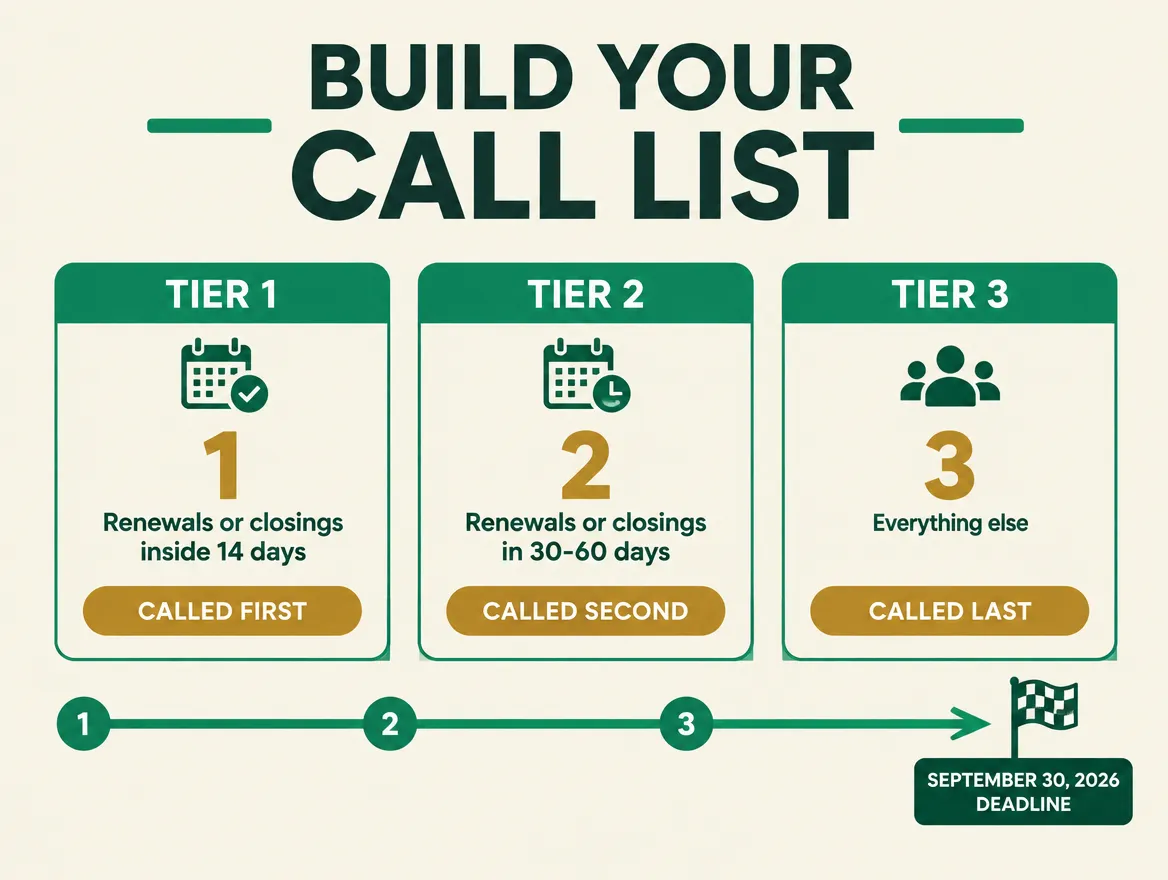
- Split each list into three urgency tiers. Renewing or closing in the next two weeks; renewing or closing in 30 to 60 days; everyone else. The first tier gets called first, full stop, even if it’s a shorter list.
- Write one script for the conversation and use it on every call. Something close to: “Your flood policy renews on [date]. I want to make sure it’s processed before any possible gap in the federal program’s authorization. Here’s what that means and what I need from you.” Consistency here matters more than eloquence; every client should hear the same accurate explanation.
- Call the highest-urgency tier first, then work backward. An agent working this list manually can realistically make 25 to 40 calls a day between everything else on the calendar. If your urgent tier is 150 names, that’s four to six days of nothing but this, assuming nothing else interrupts you. If it’s 500, you’re not finishing before the deadline without help.
Run the arithmetic on your own book before you decide how to staff this. Say your two-week urgent tier is 420 names, and a check-in call averages three minutes once you count the hold time and the voicemails. At 30 dials a day, one person clears that list in fourteen working days, which may not exist between now and the deadline once you subtract weekends and everything else already on the calendar. The same 420 names, called by an AI caller at three minutes each, runs 1,260 minutes of talk time. At the Single Account rate of $0.20 a minute, that’s $252 in usage to clear the entire tier, plus the $500 one-time setup if you’re starting from zero. At the Agency plan’s bulk rate of $0.16 a minute, the same 1,260 minutes runs $202. Neither number is the point by itself. The point is that you can price this against your actual list before you commit to anything, and both plans are month to month, so the most you’re risking to test it is a single month’s subscription.
You can do this yourself
None of the five steps above require anything you don't already have. A CRM export, a sorted spreadsheet, and a phone will get you through a book of a hundred or so clients before the deadline if you clear your calendar for it. Where it breaks down is volume: past a few hundred names in a three-week window, the math stops working for one person with a phone.
What to actually say on the call
Give the client the real reason for the call and the real state of things, not a script that dodges the uncertainty. Something close to this covers the two situations you’ll hit most:
For a straightforward renewal. “I’m calling about your flood policy renewing on [date]. There’s a federal deadline on September 30 where Congress has to reauthorize the flood insurance program or FEMA can’t process new business, including renewals, until they do. Your policy isn’t at risk today, and I want to get your renewal filed well ahead of that date so it’s not caught up in anything if there’s a gap. Can I confirm a few details and get this moving now?”
For a pending purchase that needs a new policy. “Your closing on [date] needs a flood policy in place before the loan can fund, since the property’s in a flood zone with a federally backed mortgage. There’s a federal deadline September 30 that could pause new flood policies if Congress doesn’t act. I want to get your policy bound well before that date so your closing isn’t the one waiting on Washington. Let’s get this started today.”
Two things make both scripts work. First, neither one promises an outcome about what Congress will do, because nobody can promise that truthfully. Second, both give the client something to do right now, which is the actual point of the call. A client who hangs up with a clear next step is a client you’ve served; a client who hangs up mildly alarmed and still doesn’t have a renewal date on your calendar is a wasted call.
The objection you'll hear most
"Congress always fixes this at the last minute, so why does it matter right now?" That's a fair read of the pattern, and it's also true that the June 2010 lapse ran thirty-two days before Congress acted, long enough to disrupt more than 40,000 closings in a single month, per the Congressional Research Service, and that the most recent lapse before this deadline ran 43 days. The honest answer isn't "it definitely won't get fixed in time." It's "neither of us knows how long a gap would run if one happens, and getting your renewal filed before September 30 makes the question irrelevant for you either way."
Where the math stops working, and what we do about it
If your urgent tier is small, work it yourself. If it’s not, this is where an AI caller earns its cost. TheAffordableAI runs outbound calling that fires down a list the same day you upload it, not whenever a producer gets a free hour, and it can work a few hundred or a few thousand names in days instead of weeks. Number warmup and spam defense keep those calls from landing as “Spam Likely” on a list this time-sensitive, where a client who doesn’t pick up because your number looks like a robocaller is a renewal you might miss entirely. When a client wants to talk to a person, the call transfers warm to whoever on your team is available, and the disposition, transcript, and any notes sync back to your CRM, including HighLevel, automatically. The full rundown of what’s included, warm transfers, multi-calendar routing, number warmup, and CRM sync, is on the features page.
Working the deadline manually
- 25 to 40 calls a day per producer, on top of everything else
- A 500-name urgent tier takes two to three weeks per caller
- After-hours and weekend renewals sit until Monday
- Notes live in whoever made the call, not always in the CRM
WeeksTo clear a large urgent tier by hand
AI calls the list, agent closes what's live
- The full urgent tier gets called within days of upload
- Nights and weekends covered the same as weekdays
- Warm transfer to a human the moment a client wants one
- Every call, disposition, and note lands in the CRM automatically
DaysTo clear the same list with AI calling
Price it against your own book
The math above uses $0.20 a minute because that's what a Single Account costs, and $0.18 a minute, down to $0.16 at bulk, for an Agency account. Run it with your own list size and average call length before you decide anything. See pricing.
What you get
$0.20
Per-minute rate, Single Account, from $0.15 at bulk
20+
Agents a warm transfer can ring on the Agency plan
24/7
Coverage, including nights and weekends before the deadline
0 mo
Contract length required. Cancel anytime.
Same-day list upload
Upload the urgent tier and calling starts the same day, not on next week's onboarding call.
Number warmup and spam defense
A high-volume push over a few weeks is exactly the pattern that gets a number flagged without warmup running underneath it.
Warm transfer
A client who wants to talk it through gets handed to a live person on your team while they're still on the phone.
HighLevel CRM sync
Disposition, transcript, and tags land on the contact record automatically, so nothing gets worked twice or missed.
The compliance part, said plainly
Working fast is not a reason to skip the rules, and a September deadline doesn’t change what the law requires.
Before you point a dialer at your flood book
- Automated or prerecorded calls, including AI-generated voice, to a wireless number require the called party's prior express consent under 47 U.S.C. Section 227, the TCPA. An existing client relationship doesn't automatically satisfy that requirement for an automated call.
- Disclose what the call is about and honor an opt-out immediately, on every channel.
- National and internal Do Not Call obligations still apply, deadline or no deadline. A client who previously asked not to be called about renewals doesn't lose that status because the calendar got urgent.
- Using an AI caller doesn't transfer liability. The licensed agent and agency remain responsible for consent, disclosure, and the advice given on the call.
This is general information, not legal advice. Verify current requirements against the FCC's rules and your own carrier and state obligations before you run a large outbound push.
Where this isn’t the right tool
An AI caller is built for volume and speed against a list you already have. It isn’t a substitute for the actual conversation a client needs when their flood risk, their coverage limits, or their mortgage requirement genuinely changed and they need advice, not just a renewal confirmation. If your flood book is small enough to call yourself in a few afternoons, do that; the cost of a platform isn’t worth it for forty names. And if a lapse does happen and drags on, the honest answer for an affected buyer is that no caller, human or AI, can make FEMA issue a policy it isn’t currently authorized to write. What you can do is reach every client and every pending closing before the deadline, so a lapse, if it happens, catches as few of them as possible mid-transaction.
It’s also worth saying that an AI caller can’t tell a client whether Congress will act in time, and it shouldn’t try to. What it can do is get the accurate, calendar-driven message in front of everyone on your list while there’s still time for them to act on it, and hand off to a licensed person the moment the conversation needs judgment instead of a status update.
Where to start this week
- Pull the two lists today. Renewals in the next 90 days, and pending closings that need a flood policy. Sort both by date.
- Call or queue the two-week tier first. Whatever gets you to that group fastest, your own dial time or an AI caller, do it before you touch the 60-to-90-day tier.
- Watch the calendar, not the news cycle. Whether Congress reauthorizes early, late, or not at all by September 30, your list and your call order don’t change. Work it the same way regardless of what happens in Washington.
If you want to hear it before you decide anything
There's a demo call on the homepage. Put your own number in and the AI calls you in seconds, so you can hear exactly what your flood clients would hear if you pointed this at the list today. Hear a demo call, or go straight to pricing if you already know what you're testing.
Congress may still reauthorize the NFIP before September 30, extend it again at the last minute, or let it lapse the way it has nine times before. Nobody outside the Capitol knows which for certain, and neither do we. What’s certain is the list: every client on your book with a renewal date near that line, and every closing that needs a flood policy to fund. That list is countable today. Call it before the deadline decides for you.
Frequently asked
What happens to flood insurance if the NFIP lapses on September 30, 2026?
FEMA stops selling new flood insurance policies and stops renewing existing ones, per FEMA's own reauthorization guidance. FEMA retains the authority to pay valid claims on policies already in force using available funds, so a policy written before the lapse keeps paying claims. What stops is anything that requires a new transaction: a new policy, a renewal, or an increase in coverage on an existing policy. Congress has to act, by extending the authorization or letting it expire outright, before those transactions can resume.
Will my clients' existing flood insurance policies stop working if the NFIP lapses?
No. A policy that's already in force stays in force and FEMA continues paying valid claims on it. The problem shows up at the next transaction: that same client can't renew the policy while it's lapsed, and if their policy's renewal date falls inside a lapse, they can end up with a coverage gap they didn't create and may not notice until they try to file a claim or close on a new mortgage.
How many times has the NFIP actually lapsed before, and what happened?
Nine times since 2010, according to the Congressional Research Service's Insight on the program, updated September 11, 2026. Four ran in 2010 to 2011: March 1 to 2, 2010; March 29 to April 15, 2010; June 1 to July 2, 2010; and October 1 to 5, 2011. Two more hit in 2018: January 20 to 22, and an 8-hour gap on February 9. A thirteen-hour lapse followed on March 23, 2024. Then two lapses hit inside the last twelve months alone: October 1 to November 12, 2025, a 43-day gap tied to the federal government shutdown, and a shorter lapse from February 1 to 3, 2026, before Congress signed the extension that runs out on September 30, 2026. The longest of the nine, the June 2010 lapse, is documented as canceling or delaying more than 1,400 home sale closings a day, upward of 40,000 a month, because lenders couldn't close federally backed mortgages in flood zones without a flood policy in place.
Can a home sale still close without flood insurance if the program lapses?
Not if the property sits in a Special Flood Hazard Area and the loan is federally backed. Federal law requires flood insurance as a condition of any mortgage that a federal agency, a federally regulated lender, or a government-sponsored enterprise makes, guarantees, or purchases, per the Congressional Research Service's overview of the NFIP. If FEMA isn't issuing new policies during a lapse, that condition can't be met, and the closing waits, exactly what happened to an estimated 1,400-plus closings a day during the June 2010 lapse.
Is an AI caller allowed to call my existing clients about their flood policy renewal?
It depends on how the call is placed and to what number. Calls that use an autodialer or an artificial or prerecorded voice, including AI-generated voice, to a wireless number require the called party's prior express consent under 47 U.S.C. Section 227, the TCPA. That applies to an existing client the same as a new prospect unless a specific exemption applies. Document consent, disclose what the call is, and give a clean opt-out on every call, whether the caller is a person or an AI.
What should I do with my flood insurance book before September 30?
Pull every policy in your book with a renewal date in the next 60 to 90 days and every pending closing that needs a new flood policy, then call the ones closest to the deadline first. That's a triage problem, not a mystery: the client whose renewal falls on September 29 needs a call this week, not next month. A full method for building that list and working it is laid out further down in this article.
What would it cost to call my whole flood insurance book with an AI caller before the deadline?
Using TheAffordableAI's published Single Account rate of $0.20 a minute, a 3-minute renewal check-in call runs about $0.60, or roughly $300 to call 500 policyholders once. At the Agency plan's bulk rate of $0.16 a minute, the same 500-client pass runs about $240. Both plans are month to month with no long-term contract, so testing this against a hard deadline costs one month's subscription plus usage, not a commitment.
Is the NFIP actually going to lapse this time, or will Congress reauthorize it again?
Unknown as of this writing, and worth saying plainly rather than guessing. The program already lapsed twice in the last twelve months: a 43-day gap from October 1 to November 12, 2025, tied to the federal government shutdown, and a shorter lapse from February 1 to 3, 2026, both according to the Congressional Research Service. Congress ended that second lapse when the president signed the Consolidated Appropriations Act, 2026 on February 3, 2026, extending authorization to the current September 30, 2026 deadline, per FEMA's own reauthorization page. Whether Congress reauthorizes again, lets it lapse, or passes a short-term patch is a live legislative question. What isn't in question is the September 30 deadline itself and what happened to transactions the last several times this exact thing occurred.
Sources
- FEMA — Congressional Reauthorization for the National Flood Insurance Program
- FEMA — Flood Insurance (program overview, policyholder count, mandatory purchase requirement)
- Congressional Research Service — IN10835, What Happens If the National Flood Insurance Program (NFIP) Lapses? (updated September 11, 2026), via EveryCRSReport.com
- Congressional Research Service — R44593, Introduction to the National Flood Insurance Program (NFIP), via EveryCRSReport.com
- National Association of Realtors — NFIP by the Numbers: The Economic Ripple Effect of a Lapse (published October 7, 2025)
- Cornell Law School Legal Information Institute — 47 U.S.C. Section 227, Telephone Consumer Protection Act
- Insurance Journal — NFIP Reauthorized With Passage of Funding Bill to End Government Shutdown (published November 13, 2025)
- TheAffordableAI — Pricing
Put this on your own phone line
See the AI dial, qualify, and warm-transfer a live call in under a minute. No contract, no dev work.
Keep reading

Homeowners Non-Renewals Are Surging: What Agents Do Now
Homeowner non-renewal rates jumped up to 216% since 2018, per NAIC. Here's how P&C agents should follow up before a lapsing policy runs out.

The True Cost of a Missed Insurance Lead in 2026
A missed insurance lead is not a mystery cost. It is a paid-for lead, a forgone commission CMS puts a real number on, and a seat nobody was watching.

ACA Open Enrollment 2027: 31 Fewer Days to Save Your Book
CMS cut the ACA open enrollment window from 76 days to 45 starting with plan year 2027. Here's what that compression means for your renewal calls.