North Carolina Telemarketing Law for Insurance Agents
North Carolina already fines do not call violations up to $5,000 each call. A stalled bill would add written consent for AI calls. Here's what applies now.

Is it legal to cold call an insurance lead in North Carolina? Mostly, yes, if the number isn’t on the National Do Not Call Registry or you can document an exemption, your calling window sits between 8:00 a.m. and 9:00 p.m., and your opening disclosure covers who you are and who you’re calling for. North Carolina’s telephone solicitation law, Article 4 of Chapter 75, doesn’t ban selling insurance by phone. It regulates how that call has to happen, with penalties running $500, $1,000, and $5,000 per violation that climb with each repeat offense within two years. There’s also a second, bigger story sitting on top of the current law right now: House Bill 936 would redefine a robocall to explicitly cover AI-generated voice messages and would require prior express written consent before any telephone solicitation, a real shift from today’s looser “invitation or permission” standard. The bill passed the House 110-0 in 2025, passed an amended Senate version 32-15 in June 2026, then stalled when the House declined to concur and sent it to a conference committee that hasn’t reported back. It is not law. This article works through exactly what North Carolina’s current statute requires, what the stalled bill would change if it ever clears that conference committee, how the state’s one-party recording-consent rule interacts with calls to stricter states, and what the real penalty exposure looks like today, all verified against North Carolina’s own statutory text and the federal government’s current filings as of October 25, 2026.
The short version
- N.C. Gen. Stat. §75-102 bars calls to National Do Not Call Registry numbers absent a documented exemption, restricts calling hours to 8:00 a.m. to 9:00 p.m. under §75-102(f), and requires caller identification. There is no general insurance-agent exemption anywhere in Article 4.
- Penalties climb with repeat violations: $500 for a first offense, $1,000 for a second, and $5,000 for a third or later within two years, available both to the Attorney General under §75-105(a)(1) and to the individual subscriber under §75-105(b)(2).
- House Bill 936 would redefine "robocall" to explicitly cover AI-generated and artificial voice messages and would require prior express written consent for any telephone solicitation. As of this article it has stalled in a House-Senate conference committee since June 24, 2026, and has not been enacted.
- North Carolina is a one-party consent state for call recording under §15A-287, but a caller in a two-party state can still bind the call to the stricter rule, and the federal TCPA's written-consent standard for autodialed or AI-voiced calls already applies regardless of what North Carolina's own pending bill eventually does.
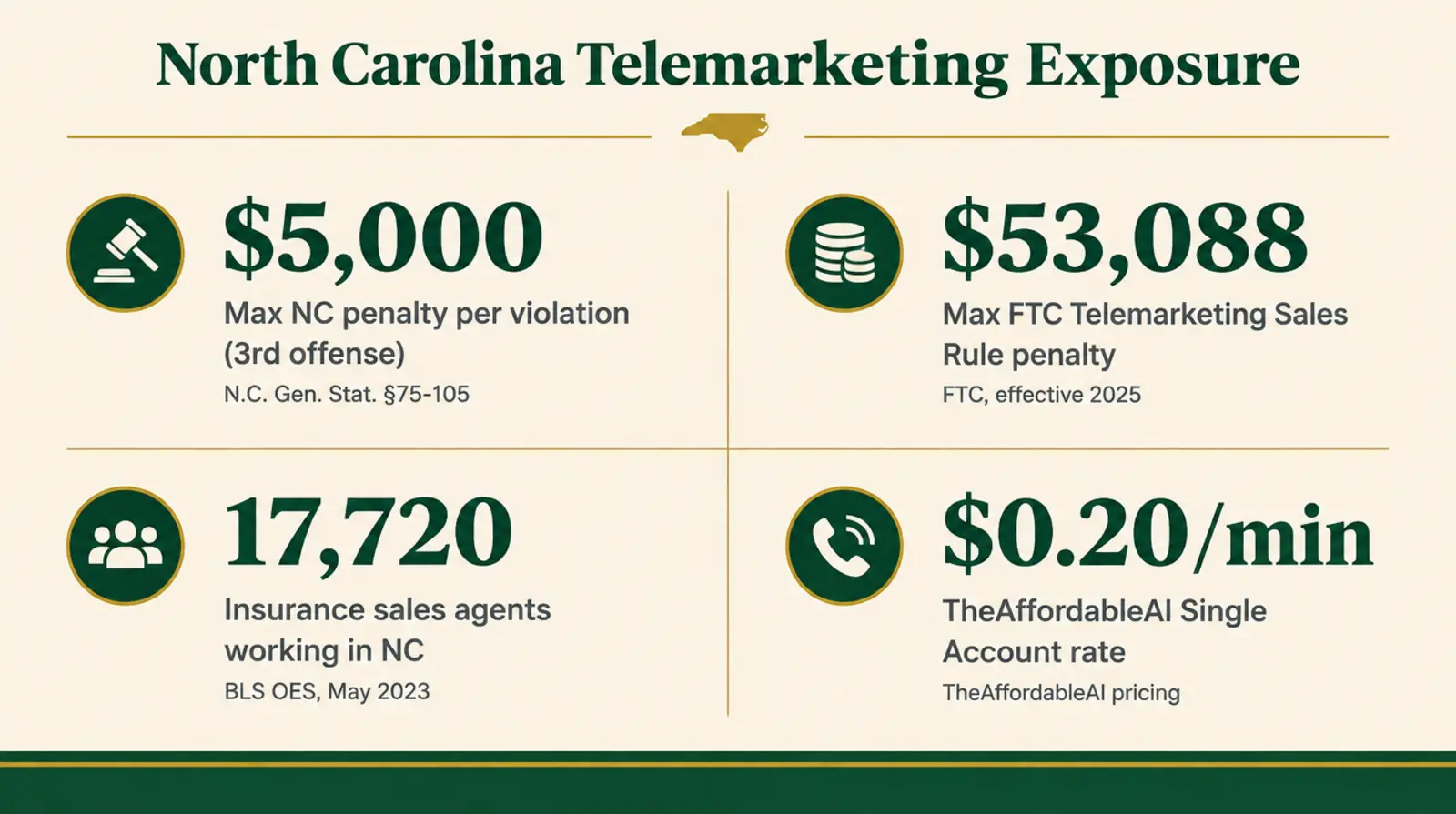
- North Carolina employed 17,720 insurance sales agents as of May 2023, per the U.S. Bureau of Labor Statistics, a large enough book of working agents that a single list-hygiene mistake can scale into real exposure fast.
What North Carolina’s Current Telephone Solicitation Law Actually Requires
North Carolina’s telephone solicitation law lives in Article 4 of Chapter 75 of the General Statutes, and it’s older and plainer than the AI-era rules some agents expect. A telephone solicitor, under §75-101(10), is any individual or business doing business in the state that makes telephone solicitations, directly or through agents or salespeople. That definition catches an insurance agency the same way it catches a window-replacement company; there’s no licensed-professional carve-out anywhere in the article. A telephone solicitation, under §75-101(9), is a live or prerecorded voice communication, or a fax, made to sell or promote property, goods, services, investments, or charitable donations. A quoting call to a prospect who’s never spoken with your agency is squarely inside that definition.
The core restriction sits in §75-102. A solicitor can’t call a number on the current National Do Not Call Registry, unless one of the exemptions in §75-103 applies. A solicitor also can’t call a number whose owner has separately told that specific solicitor to stop calling, a rule that operates on top of and independent from the national registry. §75-102(c) requires the solicitor to identify themselves at the start of the call and to honor an internal do-not-call request within 30 business days. §75-102(d) requires written procedures and staff training to keep calls off listed numbers in the first place, not just a promise to try. §75-102(f) sets the calling window: no telephone solicitation before 8:00 a.m. or after 9:00 p.m.
North Carolina's window is a state floor, not a replacement for the federal one
The FTC's Telemarketing Sales Rule separately restricts calls to the same 8:00 a.m. to 9:00 p.m. window, measured in the called party's own time zone. North Carolina's statute doesn't specify whose clock its version runs on with the same explicit language, so the safer, and simpler, practice is to build your dialing window around the lead's local time every time, which satisfies both rules at once instead of treating them as two separate checks to reconcile.
Where North Carolina gives real room to work is its exemption list. §75-103(a) pulls several categories of calls out of the Do Not Call Registry restriction entirely: calls made with the subscriber’s prior express invitation or permission; calls to a number with which the caller has an established business relationship, defined under §75-101(5) as a purchase, lease, or financial transaction within the preceding 18 months, or an inquiry or application within the preceding 3 months; calls by or for a tax-exempt nonprofit; calls from a business with fewer than 10 employees that averages no more than 10 solicitation calls a week; calls made only to arrange a later in-person meeting without completing a sale on the call itself; and calls selling newspaper subscriptions.
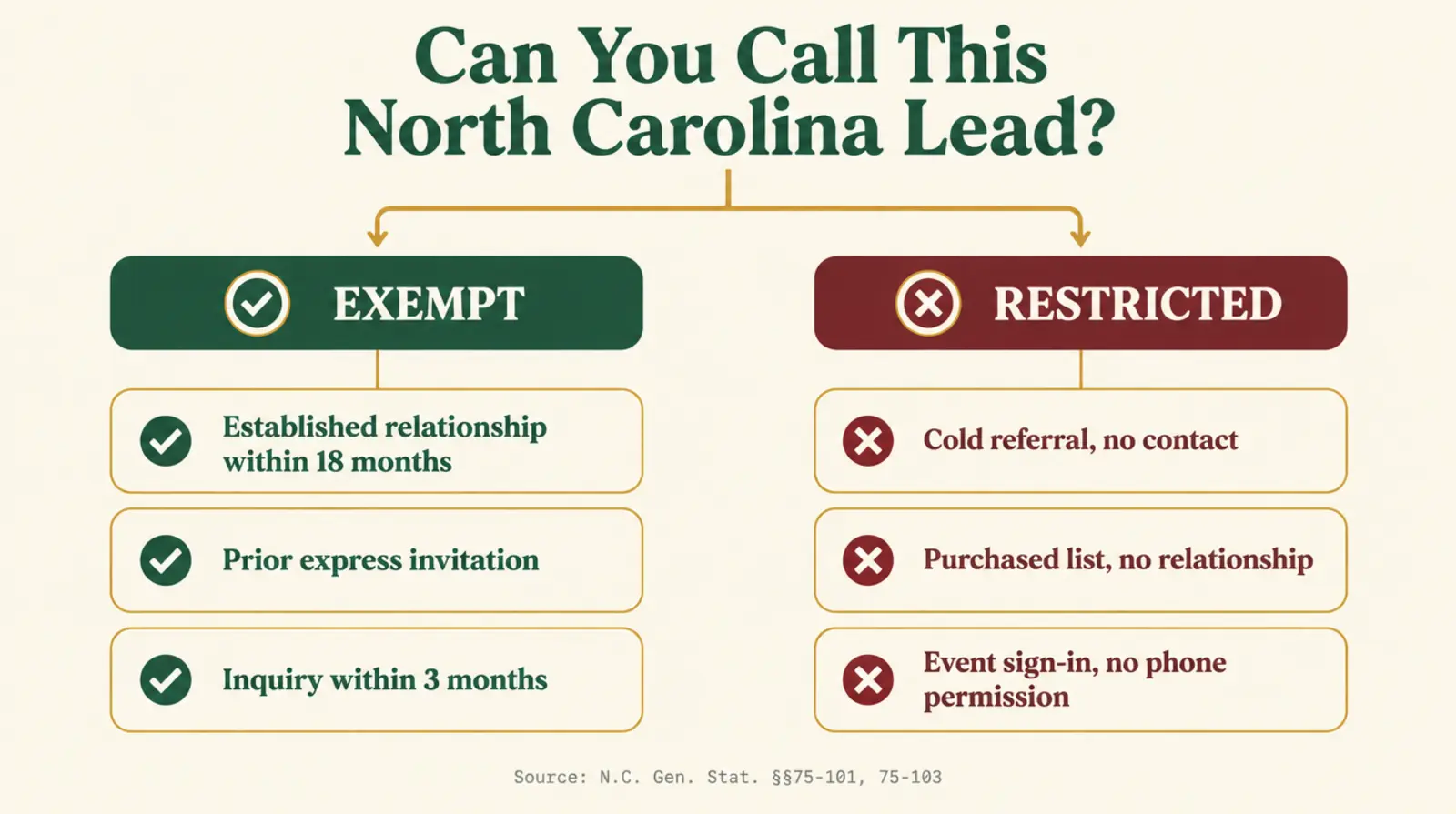
The exemption that matters most to an insurance agency’s day-to-day book is the established-business-relationship rule, and it’s also the one most likely to get stretched past where the statute actually puts it. An existing policyholder renewing coverage sits cleanly inside the 18-month window. A prospect who filled out a quote request three weeks ago sits inside the 3-month inquiry window. A referral that same client hands you, someone who has never transacted with or inquired to your agency directly, does not qualify, no matter how warm the introduction felt or how closely related the referred person is to an existing client. The relationship belongs to the person who built it, and North Carolina’s statute doesn’t let it transfer by word of mouth.
| Lead type | Exempt or restricted | Why |
|---|---|---|
| Current policyholder renewing within 18 months of last transaction | Exempt | Established business relationship, §75-101(5) |
| Prospect who submitted a quote request 3 weeks ago | Exempt | Inquiry within the 3-month EBR window, §75-101(5) |
| Lead who checked a box inviting a follow-up call | Exempt | Prior express invitation or permission, §75-103(a)(1) |
| Current client's referred neighbor, never contacted you | Restricted | No independent EBR or invitation from that specific person |
| Purchased list, no documented relationship or invitation | Restricted | Must be scrubbed against the National Do Not Call Registry |
| Name from a prior client's policy that lapsed 2 years ago | Restricted | Falls outside the 18-month EBR window |
Source: North Carolina General Assembly, N.C. Gen. Stat. §§75-101, 75-102, 75-103.
The Pending Robocall Bill: What HB 936 Would Change, and Why It Isn’t Law
Here’s the part of North Carolina’s telemarketing picture that’s genuinely in motion. House Bill 936, titled “Robocall Solicitation Modifications,” would rewrite large sections of Article 4 to deal specifically with modern calling technology, and it would hit an AI voice calling operation harder than the current statute does.
The bill would amend §75-101 to add a defined term for “robocall” that explicitly covers artificial or artificially generated voice messages, soundboard technology, ringless voicemail, and spam or scam text messages, replacing the older, narrower “automatic dialing and recorded message player” language the current statute uses. More consequentially, it would replace the existing “prior express invitation or permission” standard, the looser bar that today’s §75-103(a)(1) exemption runs on, with a defined “prior express written consent” requirement: a signed agreement, electronic signatures permitted where state law recognizes them, that names the called party’s phone number and discloses that signing isn’t a condition of purchase. That’s the TCPA’s own written-consent standard, imported directly into state law. The bill would also add a new prohibition on caller ID spoofing and impersonating a government official during a solicitation, and it would let a subscriber sue a robocaller directly under the same $500, $1,000, and $5,000 tiered-damages structure the current statute already uses for ordinary violations.
This bill is not current law
According to the North Carolina General Assembly's own bill-history page for House Bill 936, the House passed its original version 110-0 on May 7, 2025. The Senate adopted an amended committee substitute 32-15 on June 17, 2026. The House declined to concur in that Senate version by a 112-0 roll call on June 23, 2026, and a conference committee was appointed the next day to reconcile the two chambers' versions. No further action, ratification, or governor's signature appears in the bill's recorded history as of this article. Nothing in HB 936 is enforceable today.
One detail is worth flagging specifically because it’s the kind of thing that trips up anyone reading the bill text cold: the current engrossed version of HB 936 states an effective date of October 1, 2026, applying to causes of action arising on or after that date. That date has already passed, while the bill itself sits unresolved in conference committee. If the two chambers eventually reconcile their versions and the bill becomes law, that specific effective-date language will almost certainly need to move forward again before signing, since a statute can’t retroactively create new civil liability for conduct that already happened under the old rule. Until that happens, the operative written-consent standard for an AI voice call to a North Carolina number isn’t coming from state law at all. It’s coming from the TCPA, which already applies today regardless of what North Carolina’s legislature eventually decides.
Not legal advice
North Carolina statutory law, the federal TCPA, the FTC's Telemarketing Sales Rule, and your own carrier agreements each carry separate standards, and how they apply to a specific lead or call depends on facts this article can't see: the lead's documented source, your consent records, and the current status of pending legislation that may have changed since this was published. Confirm current requirements with your compliance department or counsel before building a calling process around anything here.
Why North Carolina’s One-Party Consent Rule Isn’t the Full Answer on Recording
North Carolina follows a one-party consent rule for recording phone calls. Under N.C. Gen. Stat. §15A-287(a), it’s a Class H felony to intercept a wire, oral, or electronic communication without the consent of at least one party to it, which means a participant on the call, the agent taking it, can lawfully record without separately notifying or obtaining consent from the other party. That’s a materially different posture from two-party states like California, Florida, and Illinois, where every party on the line has to consent before a recording is legal.
The practical risk isn’t North Carolina’s own rule. It’s forgetting that the other party on the call might not be sitting in North Carolina. An agency licensed and operating out of Raleigh that records every outbound call by default, relying on the state’s one-party rule, is still exposed the moment that call reaches someone physically located in a stricter state, because courts in two-party-consent states have applied their own recording law to calls received there regardless of where the calling party sat. The safer baseline for any agency calling leads across multiple states, which is most agencies working digital lead sources, is to script the recording disclosure for your highest-risk caller’s state, not your home state’s floor. A one-party-consent home base doesn’t buy you anything on a call to a two-party-consent number.
What Getting This Wrong Actually Costs
Put the exposure side by side, because “probably fine” isn’t a compliance strategy and most carrier agreements make the agent financially responsible for marketing conduct that traces back to their own calls.
North Carolina’s own statute, under §75-105(a)(1), lets the Attorney General pursue a civil penalty of $500 for a first violation, $1,000 for a second, and $5,000 for a third or later violation within a two-year period measured from the first. §75-105(b)(2) hands an individual subscriber the identical tiered amounts in a private lawsuit, and §75-105(d) opens the door to attorneys’ fees if the violation was willful. A narrower $100 penalty applies under §75-105(a)(2) for a good-faith mistake made while relying on one of the listed exemptions or following the required do-not-call procedures, which rewards an agency that’s actually built the compliance process the statute asks for.
That’s before federal exposure stacks on top. The FTC’s Telemarketing Sales Rule carries a civil penalty of up to $53,088 per violation, a figure that took effect January 17, 2025, and that the FTC has confirmed, per a Federal Register notice tracked under document number 2026-18853, will remain unchanged through 2026 after the Office of Management and Budget canceled that year’s scheduled inflation adjustment. Separately, under 47 U.S.C. §227(b)(3), a consumer’s private TCPA lawsuit can recover $500 in statutory damages per violation, or up to three times that, $1,500, if a court finds the violation willful or knowing. None of these three exposure layers, North Carolina’s statute, the FTC’s rule, and the TCPA’s private right of action, substitutes for the other two. A call can clear one and still violate another.
Maximum civil penalty per violation, by legal layer
North Carolina statutory tier vs. federal exposure, current as of October 2026
Sources: N.C. Gen. Stat. §75-105(a)(1), (b)(2); 47 U.S.C. §227(b)(3); FTC, effective Jan. 17, 2025, unchanged through 2026 per Federal Register Doc. 2026-18853. Figures are statutory maximums, not predictions of any specific outcome.
Run that against actual list size, because the exposure scales with volume the same way a bulk text blast’s TCPA exposure does. An agency working a purchased list of 500 North Carolina numbers with no established-business-relationship documentation, and no scrub against the current National Do Not Call Registry, has created up to 500 separate potential violations the moment an automated system dials the full list, before accounting for whichever federal layer also applies to the same calls. The fix isn’t a bigger legal budget. It’s tagging the relationship basis for every number before it ever reaches a dialer.
How to Build the Compliance Check Yourself
None of this requires buying software. It requires tagging the relationship basis for every North Carolina number at the moment it enters your system, and routing the call channel off that tag before volume makes manual judgment calls unreliable.
- Record the specific basis for contact at intake, not after the fact. “Quote request, 10/4/2026, requested a callback” is a usable tag. “North Carolina lead” with no source field is not, and it’s the first thing an investigator or a plaintiff’s attorney will ask for.
- Run every non-exempt number against a current National Do Not Call Registry pull before it reaches a dialer. North Carolina’s statute doesn’t specify its own registry-refresh interval the way some federal rules do, so sync on the federal cadence the FTC’s Telemarketing Sales Rule already requires, and treat that as your floor everywhere.
- Separate the 18-month purchase/lease/financial-transaction window from the 3-month inquiry window, since §75-101(5) treats them differently, and a lead that cleared one two months ago may have already fallen out of the other.
- Exclude referral-only names from your automated call queue entirely. A referral establishes a relationship between your client and the person they mentioned, not between your agency and that person, and §75-103(a)(2)‘s exemption doesn’t reach it.
- Build your calling-hours logic off the lead’s area code or known location, not your office clock, so a single national campaign doesn’t accidentally call an early riser in one time zone before 8:00 a.m. local.
- Keep a separate, explicit TCPA written-consent flag for any number that will be autodialed, prerecorded, or AI-voiced. North Carolina’s current EBR and invitation exemptions don’t substitute for that federal requirement, and if HB 936 eventually becomes law, the state’s own standard will converge toward the same written-consent bar.
- Watch HB 936’s status before assuming today’s looser invitation standard is permanent. A bill that’s already passed one chamber twice, in two different forms, is not a bill agencies should assume will quietly die; build your consent records now to the standard it would require, and the eventual change costs you nothing.
An agency that builds a required “contact basis” field into its CRM intake, with four or five valid values and nothing else accepted, has built the actual fix. That’s a spreadsheet column and a staff habit enforced consistently, not a technology purchase. What doesn’t scale by hand is applying that same check, correctly, to several hundred North Carolina numbers a week pulled from three or four different lead sources, every time, without someone eventually grabbing the referral list because the queue backed up.
Every North Carolina number looks equally callable
- Purchased lists get loaded into the automated dial queue with no registry scrub
- Referral names get called the same day a client mentions them
- Nobody tracks whether a lead's EBR window is the 18-month kind or the 3-month kind
- After a complaint, nobody can show which numbers were actually exempt and why
The lead's own documented basis decides the channel
- Only tagged, scrubbed, exemption-documented numbers enter the automated queue
- Referral names route to a separate list, called manually or not at all without their own contact
- Each EBR tag carries its own expiration date, 18 months or 3 months as applicable
- Every call traces back to a logged reason it wasn't a restricted contact
A Worked Example: 400 Numbers, One Afternoon
An agency buys a list of 400 North Carolina consumers who requested auto insurance quotes from a lead aggregator’s website sometime in the past year. No field in the export says exactly when, or whether the person who filled out the form actually consented to a call back versus just a price estimate by email.
Run it with no contact-basis check: the full 400 go into the automated dialer the same afternoon. Some fraction cleared an inquiry within the past 3 months and legitimately sit inside §75-101(5)‘s established-business-relationship window. The rest, anyone whose form submission is older than 3 months and who never transacted, sit outside every exemption in §75-103(a), and if their number is on the National Do Not Call Registry, each call is a separate potential violation under §75-102(a), stacking at $500, $1,000, then $5,000 per occurrence within the two-year window.
Run it with the tag built in: the export gets a required “inquiry date” field before it ever reaches the dialer. Numbers with an inquiry inside 3 months route to the automated queue. Numbers outside that window, with no other documented exemption, route to a manual, DNC-scrubbed list instead, or get dropped from the automated channel entirely. Same 400 leads, a smaller automated batch, and a legitimate reason attached to every call that goes out.
How We Solve It
TheAffordableAI is a managed AI caller, not a compliance platform, and it doesn’t replace the work of tagging a North Carolina lead’s actual contact basis at intake. What it does, per TheAffordableAI’s own Features page: fires outbound within seconds of a lead landing in your CRM, so a North Carolina prospect who just submitted a quote request, the cleanest kind of inquiry-based exemption under §75-101(5), gets reached while that 3-month window is freshest, not weeks later when someone finally works down the list. It answers every inbound call the same way, so a current client calling in with a renewal question, squarely inside the established-business-relationship exemption, doesn’t sit on hold or hit voicemail. And it syncs two-way with HighLevel, writing the disposition, transcript, and call recording back into the contact record automatically, which is exactly where a contact-basis tag and its expiration date belong once you’ve built the field the compliance work above calls for.
Hear how fast a solicited North Carolina lead can get a real call
There's a live demo call on the homepage if you want to hear an AI caller handle a fresh quote-request lead and hand off a warm transfer before you decide anything.
Outbound within seconds of a fresh North Carolina inquiry
A quote-request lead's 3-month inquiry window under §75-101(5) is the cleanest exemption in the statute, and also the one most worth reaching before it goes cold.
Every inbound call answered, day or night, inside the legal window
A current client calling in with a question is squarely inside the established-business-relationship exemption. Missing that call wastes the exact lead type the rule leaves you free to call.
HighLevel sync for the contact-basis record
Every call's disposition, transcript, and recording write back automatically, feeding the same record where an EBR expiration date and a TCPA consent flag both belong.
North Carolina's statute doesn't ask where the lead came from or what it cost. It asks whether this specific number has a documented relationship or invitation on file. Build that question into intake, and the conference-committee bill sitting in Raleigh stops being something to worry about later.
Pricing, since the arithmetic above leans on it: Single Account runs $200 a month plus a $500 one-time setup fee, at $0.20 a minute, dropping toward $0.15 at bulk volume. Agency runs $500 a month plus a $1,000 one-time setup fee, at $0.18 a minute, dropping toward $0.16 at bulk volume, and adds routing to 20-plus agents at once, useful for an agency splitting North Carolina’s exempt and non-exempt lists across different team members. Both plans run month to month with no long-term contract, per TheAffordableAI’s pricing page, fetched for this article today. You can build the contact-basis tagging and routing logic yourself with a CRM custom field and a disciplined intake habit; plenty of agencies do. It’s worth pricing that build against a managed option before HB 936, or whatever replaces it next session, forces the sequencing decision for you.
Where This Doesn’t Fix Anything
Say it plainly: no calling platform, AI or human, turns a restricted contact into an exempt one. If a lead’s inquiry is 14 months old with no transaction behind it, the fix is a fresh, documented invitation before the next call, not faster dialing software applied to the same stale record. A speed advantage only helps once a number has already cleared North Carolina’s own exemption test; it does nothing for the ones that haven’t. And if your North Carolina volume is small enough that one person can scrub and tag every lead by hand in a few minutes a day, the automation in this article may not move your numbers much. Weigh your own lead volume and sourcing mix against the rule above before assuming otherwise.
What You Get When the Tagging Is Right
A documented relationship or invitation, not lead cost or list size, decides what North Carolina’s statute lets you do by phone. Skip that check, and an agency can build a fast, well-funded calling operation that’s quietly generating restricted contacts by the dozen every week without anyone noticing until a complaint lands or HB 936 finally clears conference and raises the bar everywhere at once. Get the tagging right, and speed stops competing with compliance: an inquiry that’s three weeks old is exactly the lead worth calling fastest, and it’s also the one North Carolina’s own exemption already protects. The 400-number example above didn’t cost that agency speed. It cost them the fraction of the list that was never legally theirs to dial on autopilot, and left them faster on the rest.
Frequently asked
Does North Carolina's telemarketing law apply to insurance agents?
Yes. N.C. Gen. Stat. §75-101(10) defines a telephone solicitor as any individual or business doing business in the state that makes telephone solicitations directly or through agents, with no exemption written in for insurance producers. Article 4 of Chapter 75 is North Carolina's general telephone solicitation law, and the only insurance-specific carve-out anywhere in it is §75-104(b)(6), which permits automated recorded calls from a health insurer to its own covered members about their benefits, as long as no part of the call is a solicitation. An agent selling or prospecting by phone doesn't fall under that narrow exception and is a telephone solicitor like any other business calling North Carolina numbers.
What are the penalties for violating North Carolina's do not call law?
Under N.C. Gen. Stat. §75-105(a)(1), the Attorney General can pursue a civil penalty of $500 for a first violation, $1,000 for a second, and $5,000 for a third or later violation within two years of the first. §75-105(b)(2) gives an individual subscriber the same tiered amounts in a private lawsuit, and §75-105(d) allows attorneys' fees if the violation was willful. A reduced $100 penalty applies under §75-105(a)(2) when the solicitor made a good-faith mistake while relying on one of the law's listed exemptions or following its required do-not-call procedures. None of these state penalties replace federal exposure, which sits on top: the FTC's Telemarketing Sales Rule carries a civil penalty of up to $53,088 per violation, and a private TCPA suit can recover $500, or up to $1,500 for a willful violation, per call.
What hours can I legally call a North Carolina lead?
N.C. Gen. Stat. §75-102(f) bars a telephone solicitor from calling before 8:00 a.m. or after 9:00 p.m. That's narrower than the federal Telemarketing Sales Rule's 8:00 a.m. to 9:00 p.m. window measured in the called party's own time zone, so the two overlap but aren't identical in every edge case. Build your dialing window around the called party's local clock, not your agency's, since both North Carolina's statute and the federal rule anchor to the person being called, not the person calling.
Can I record a sales call with a North Carolina client without telling them?
Legally, yes, in most cases. N.C. Gen. Stat. §15A-287(a) requires the consent of only one party to a call to lawfully record it, and as a participant on the call, the agent's own consent satisfies that requirement under the statute's plain language. Recording without any party's consent is a Class H felony under the same subsection. That one-party floor is North Carolina's own rule, not the full analysis: if the person on the other end is calling from a two-party-consent state like California, Florida, or Illinois, that state's stricter rule can still reach the same call, so script your recording disclosure around your highest-risk caller, not North Carolina's minimum.
Does an existing client relationship let me call a North Carolina number freely?
Within limits. N.C. Gen. Stat. §75-103(a)(2) exempts calls to a number with which the caller has an established business relationship from the Do Not Call Registry restriction, and §75-101(5) defines that relationship as a purchase, lease, or financial transaction within the prior 18 months, or an inquiry or application within the prior 3 months. A current policyholder calling in with a question, or a client who applied three weeks ago, sits inside that window. A referral from that same client, who has never transacted with you directly, does not; the relationship belongs to the client, not to the person they mentioned.
What is North Carolina's pending robocall bill, and has it become law?
House Bill 936, titled 'Robocall Solicitation Modifications,' would redefine a robocall under Article 4 to explicitly include artificial and AI-generated voice messages, soundboard technology, and ringless voicemail, and would replace the statute's current 'express invitation or permission' standard with a defined 'prior express written consent' requirement modeled on the TCPA's. As of the North Carolina General Assembly's own bill-history page, the House passed its version 110-0 on May 7, 2025, the Senate passed an amended committee substitute 32-15 on June 17, 2026, the House declined to concur in that Senate version on June 23, 2026, and a conference committee was appointed the following day. No further floor action, ratification, or governor's signature had been recorded as of this article. It is not current law. The bill's own text sets an effective date of October 1, 2026, for causes of action arising on or after that date, a date that has already passed while the bill remains stalled in conference, which means that specific date will need to move if the bill is ultimately enacted.
Does calling with an AI voice agent instead of a human change what North Carolina law requires?
Under the current statute, no. Article 4 regulates the call and the caller's conduct, not the specific technology dialing the number, and nothing in the existing text treats an AI-generated voice differently from a human one for Do Not Call Registry or calling-hour purposes. Separately, under federal law, the TCPA's heightened prior-express-written-consent standard at 47 CFR §64.1200(a)(2) is triggered by an autodialer or an artificial or prerecorded voice calling a wireless number, which already covers an AI voice agent today, regardless of whether North Carolina's own pending robocall bill ever passes. Using AI to place the call doesn't move the consent, disclosure, or recordkeeping obligation off the licensed agent or agency whose name is on the resulting business, in North Carolina or anywhere else.
What should I actually check before dialing a North Carolina lead?
Four things, in order: whether the number carries a documented established business relationship or express invitation under §75-103(a), since without one it has to be checked against the National Do Not Call Registry; whether your calling window falls between 8:00 a.m. and 9:00 p.m. in the lead's own time zone; whether your opening disclosure identifies you and the entity you're calling for, as §75-102(c) requires; and, if the call is autodialed, prerecorded, or AI-voiced, whether you hold prior express written consent under the TCPA, which North Carolina's current statute doesn't substitute for either way. A lead that fails any one of those checks belongs on a different channel, mail or a manually dialed call with a thin consent record, until the gap is closed.
Sources
- North Carolina General Assembly — N.C. Gen. Stat. Chapter 75, Article 4, Telephone Solicitations (§§75-100 to 75-105)
- North Carolina General Assembly — House Bill 936 (2025-2026 Session), Robocall Solicitation Modifications, Fifth Edition Engrossed
- North Carolina General Assembly — Bill Lookup and action history, House Bill 936
- North Carolina General Assembly — N.C. Gen. Stat. §15A-287, Article 16, Chapter 15A (Electronic Surveillance)
- Cornell Law School Legal Information Institute — 47 CFR §64.1200, Delivery restrictions and consent requirements
- Cornell Law School Legal Information Institute — 47 U.S. Code §227, Telephone Consumer Protection Act
- Federal Trade Commission — FTC Publishes Inflation-Adjusted Civil Penalty Amounts for 2025
- Federal Register (public inspection) — Federal Trade Commission, Civil Penalty Inflation Adjustments, Doc. 2026-18853
- U.S. Bureau of Labor Statistics — Occupational Employment and Wage Statistics, May 2023, Insurance Sales Agents (SOC 41-3021)
- TheAffordableAI — Pricing
- TheAffordableAI — Features
Put this on your own phone line
See the AI dial, qualify, and warm-transfer a live call in under a minute. No contract, no dev work.
Keep reading

Insurance Leads and the Do Not Call Registry in 2026
The Do Not Call Registry topped 258.5 million numbers in FY2025. What the EBR exemption covers, a violation's real cost, and how to call insurance leads fast.
TCPA Revoke-All Rule 2026: What the FCC Just Adopted
The FCC adopted a new TCPA revocation order on September 30, 2026, months ahead of the 2027 deadline. Here is what changed for insurance agents.

STIR/SHAKEN Attestation: Why Insurance Calls Show as Spam
Carriers score every call by its STIR/SHAKEN attestation level. Here's how that decides whether your insurance agency's calls say Spam Likely in 2026.