Oregon Telemarketing Law 2026: Insurance Agent Guide
Oregon's HB 3865 caps telemarketing calls and texts at 8am-8pm and 3 a day. What changed, what a violation costs, and how insurance agents comply.

Yes, it’s still legal to call an insurance lead in Oregon, but as of January 1, 2026, the legal window got a lot narrower and a lot wider at the same time. Narrower, because House Bill 3865 now bars any telephone solicitation, call or text, outside 8 a.m. to 8 p.m., or more than three separate contacts to the same person in 24 hours. Wider, because that rule no longer applies only to autodialers and prerecorded messages the way Oregon’s old law did; it applies to every telephone solicitation, including a licensed agent manually dialing from a spreadsheet. Insurance marketing didn’t get an exemption the way debt collection did. This article covers exactly what HB 3865 changed, what a violation costs under Oregon’s consumer protection statute, how it stacks with the federal TCPA, and how an Oregon agency keeps calling and texting leads without stepping outside the new window.
The short version
- Oregon House Bill 3865, signed July 24, 2025 and effective January 1, 2026, makes it an unlawful practice under ORS 646.563(1)(b) to initiate a telephone solicitation outside 8 a.m. to 8 p.m., or more than three times to the same party in 24 hours, unless an established business relationship exists.
- The law now defines "telephone solicitation" to include text messages, not just calls, under ORS 646.561(4)(a), so an automated text sequence has to respect the same hours and frequency cap a phone call does.
- A violation is actionable under Oregon's Unlawful Trade Practices Act: actual damages or $200 statutory damages, whichever is greater, plus possible punitive damages and attorney fees to a prevailing plaintiff, under ORS 646.638.
- Federal TCPA damages of $500 to $1,500 per violation, under 47 U.S.C. Section 227, apply on top of Oregon's own exposure, not instead of it.
- Insurance sales calls got no carve-out the way debt collection did. An "established business relationship" exemption exists, but only for a transaction within the preceding 18 months.
What Oregon’s House Bill 3865 Actually Changed
House Bill 3865, according to the enrolled bill’s own text, amended five sections spanning two different parts of Oregon law: ORS 646.561 and 646.563, which define unlawful trade practices generally, and ORS 646A.370, 646A.372, and 646A.374, which govern automatic dialing and announcing devices specifically. Before this amendment, those two tracks did different jobs. The general unlawful-practices section covered misrepresentation and a called party’s request not to be contacted again, but carried no blanket calling-hours restriction of its own. The automatic-dialing section did carry hours, 9 a.m. to 9 p.m., but only for calls placed through an automated device, not a human dialing by hand.
Define the terms before the statute matters
Telephone solicitation: under the amended ORS 646.561(4)(a), a call or text message made to a party to encourage them to buy real estate, goods, or services, or to make a donation. Automatic dialing and announcing device (ADAD): a device that dials numbers and plays a prerecorded or synthesized voice or text message, defined in ORS 646A.370(1). Established business relationship: a previous transaction between the caller and the party within the 18 months before the call, per ORS 646.561(2). Unlawful practice: Oregon's term, under the Unlawful Trade Practices Act, for conduct that gives a consumer a private right to sue; HB 3865 makes a non-compliant telephone solicitation one.
HB 3865 rewrote both tracks. On the general side, the amended ORS 646.563(1)(b) now states plainly that a person engages in an unlawful practice if they initiate “a telephone solicitation outside the hours of 8 a.m. to 8 p.m.” or initiate “a solicitation more than three separate times to a party within a 24-hour period,” unless an established business relationship exists. That rule doesn’t mention autodialers, AI, or any particular technology. It applies to the telephone solicitation itself, which means a human insurance agent manually working a call list from a laptop is bound by it exactly the same as an automated system would be. On the automated-device side, ORS 646A.372(5)(a) separately tightened the automatic dialing and announcing device window from the old 9 a.m.-to-9 p.m. standard down to 8 a.m.-to-8 p.m., matching the new general rule.
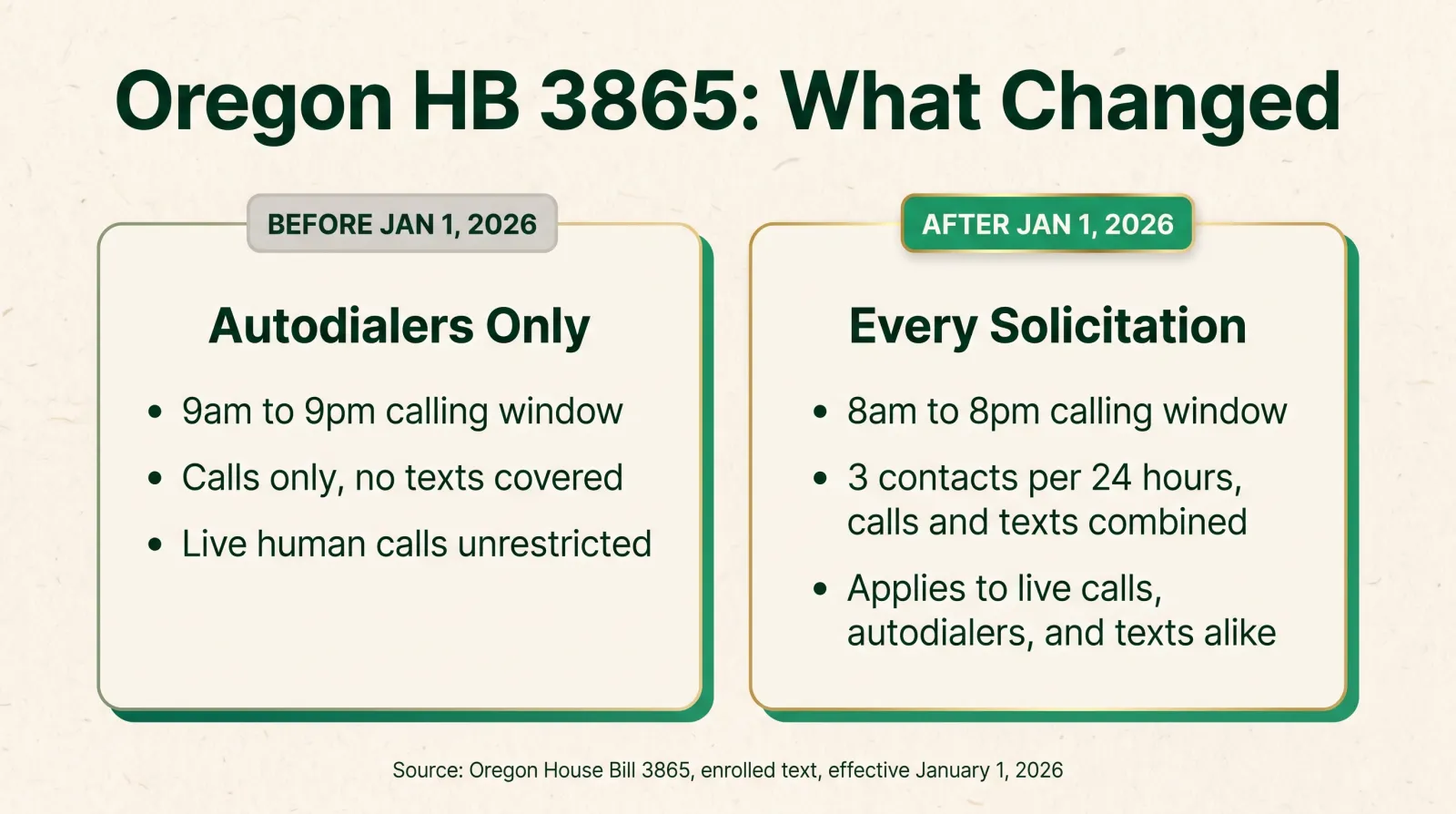
Both changes matter for different reasons. The narrower autodialer hours are a straightforward tightening, one hour off each end of the day. The new general rule is the bigger deal, because it closes a gap that used to exist for live, human-dialed calls. An agent who called a purchased lead list at 8:30 p.m. by hand, without an autodialer, wasn’t clearly breaking Oregon’s old telemarketing statute. Under the amended ORS 646.563(1)(b), that same call now is, regardless of whether a machine or a person placed it.
Text Messages Are Telephone Solicitations Now
The second structural change is the one most agencies miss, because it doesn’t sound like a calling-hours rule at all: Oregon redefined what counts as a “telephone solicitation” in the first place. The amended ORS 646.561(4)(a) defines it as a solicitation made to a party “by means of: (A) A call on a telephone or telephone line; or (B) A text message.” The parallel definition in ORS 646A.370(2), covering automatic dialing devices, adds the same language to what counts as a “call.” A text message isn’t treated as a separate, lighter-touch channel under Oregon law anymore. It’s the same regulated act as a phone call.
What that means for an automated follow-up sequence
If your agency's lead follow-up includes an automated text drip, a "still interested?" nudge, a reminder about a quote, alongside calls, that sequence is now doing the same thing calls do under ORS 646.563(1)(b): it can't fire outside 8 a.m. to 8 p.m. Oregon time, and it can't be the fourth contact, call or text combined, to the same person inside 24 hours. A sequence built around "call, then text an hour later, then call again" has to count all of those touches against the same three-contact ceiling.
The bill also extended the misrepresentation ban and the opt-out honoring requirement to texts specifically. Under the amended ORS 646.563(1)(a), if “the called or texted party states a desire not to be called or texted again” and the solicitor “makes a subsequent telephone solicitation of the called or texted party at that number,” that’s its own separate unlawful practice, on top of whatever the hours or frequency violation would be. And under the amended ORS 646A.374(2), a caller using an automatic dialing device can’t misrepresent their identity or purpose “in any text message to the subscriber,” language that didn’t exist in the statute before this amendment.
What a Violation Actually Costs
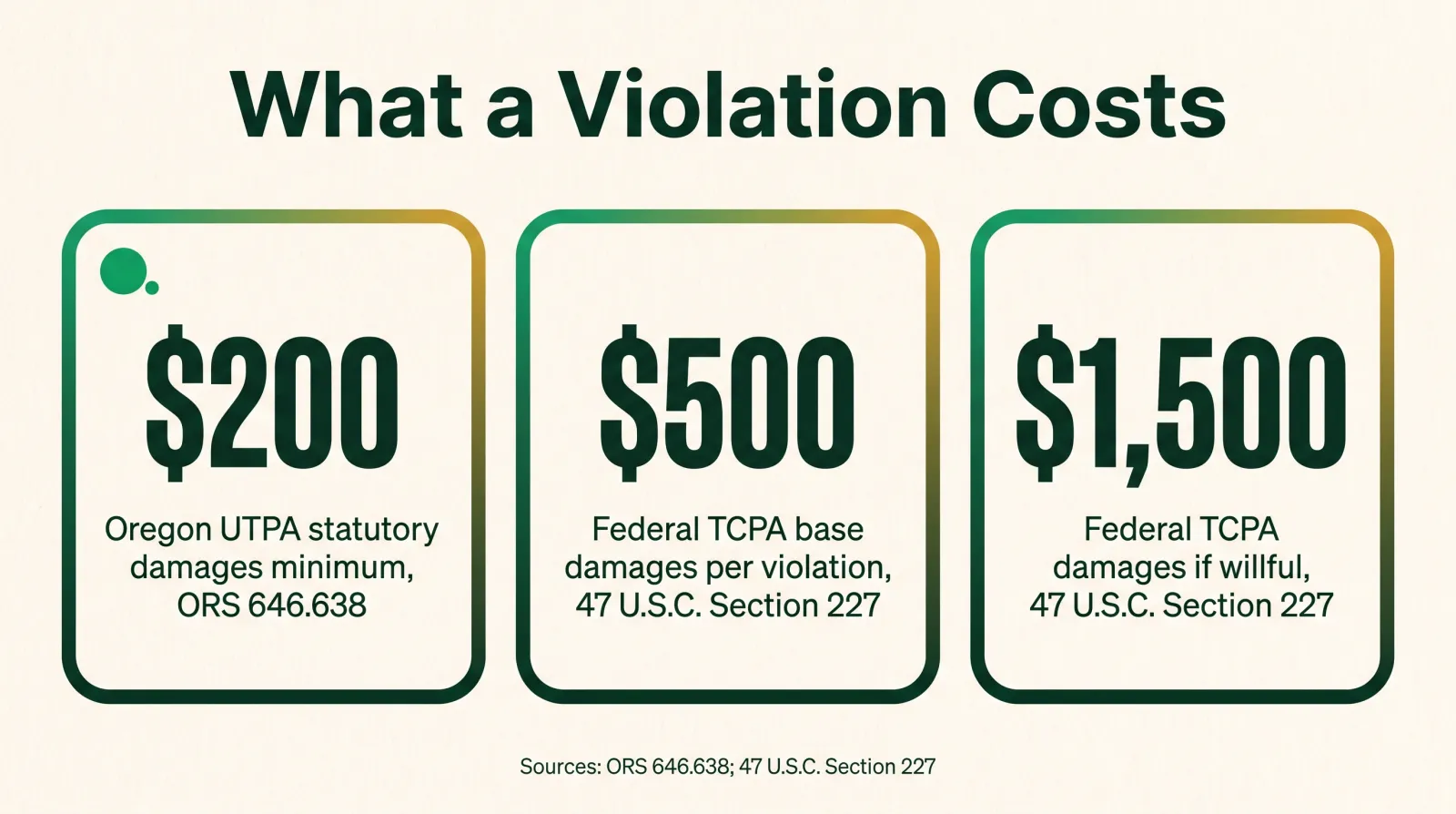
HB 3865 didn’t write a new penalty schedule. Instead, per the enrolled bill’s own text, a violation of the amended ORS 646.563 is itself defined as “an unlawful practice,” which routes straight into Oregon’s existing Unlawful Trade Practices Act and the private right of action in ORS 646.638. That statute lets an injured party “recover actual damages or statutory damages of $200, whichever is greater,” and lets the court award punitive damages, equitable relief, and reasonable attorney fees to a prevailing plaintiff. A claim has to be brought within one year of discovering the violation, per the same section.
$200
Oregon UTPA statutory damages, actual damages if greater
Source: ORS 646.638
$500
Federal TCPA base damages per violation
Source: 47 U.S.C. Section 227
$1,500
Federal TCPA damages, willful or knowing violation
Source: 47 U.S.C. Section 227
$0.20
Per-minute cost of a managed AI caller, Single Account plan
Source: TheAffordableAI pricing, fetched 2026-08-29
Unlike the flat per-violation figures in Georgia’s or Virginia’s telemarketing statutes, Oregon’s own text doesn’t spell out whether the $200 statutory floor multiplies across every non-compliant call, or attaches once per lawsuit. What the statute does establish clearly is that each call or text outside 8 a.m. to 8 p.m., or beyond the third contact in 24 hours, is independently defined as its own unlawful practice under ORS 646.563(1). Treating each one as a separately actionable event, which is how Oregon’s UTPA class-action provision in ORS 646.638(8) is written, that section requires class members to show an “ascertainable loss” from a “reckless or knowing use,” a standard tied to individual instances of the practice, not a single lump claim.
| Non-compliant calls or texts | Oregon UTPA floor ($200 each) | Federal TCPA, willful ($1,500 each) |
|---|---|---|
| 10 | $2,000 | $15,000 |
| 50 | $10,000 | $75,000 |
| 200 | $40,000 | $300,000 |
Figures are simple multiplication of each statute's per-violation minimum against a hypothetical count of non-compliant contacts; they illustrate statutory ceilings, not typical settlement values or a court's actual per-call ruling. Sources: ORS 646.638; 47 U.S.C. Section 227.
None of this is a prediction that a specific number of after-hours calls resolves at these figures. It’s the ceiling a plaintiff’s attorney negotiates against, and Oregon’s statute specifically authorizes recovering reasonable attorney fees on top of it, which is exactly the kind of provision that makes even a modest individual claim worth filing.
Oregon’s Statute vs. the Federal TCPA, Side by Side
| Element | Federal TCPA | Oregon ORS 646.563 / 646A.372 (post-HB 3865) |
|---|---|---|
| Calling hours | 8 a.m. to 9 p.m., recipient's local time, per the FTC Telemarketing Sales Rule | 8 a.m. to 8 p.m., no exception for local time zones stated |
| Daily contact cap | Not directly capped by number per day; DNC and consent rules govern instead | 3 contacts per party in 24 hours, calls and texts combined |
| Covers live, human-dialed calls | Mainly regulates autodialed and prerecorded calls; live calls are lightly touched outside DNC | Yes, ORS 646.563(1)(b) applies to any telephone solicitation, live or automated |
| Covers text messages | Yes, treated as calls under FCC interpretation of the TCPA | Yes, added explicitly by HB 3865 to ORS 646.561 and 646A.370 |
| Per-violation damages | $500, up to $1,500 if willful, per 47 U.S.C. Section 227 | Actual damages or $200, whichever is greater, per ORS 646.638 |
| Attorney fees to plaintiff | Governed by general federal fee-shifting rules, case-specific | Explicitly authorized for a prevailing plaintiff under ORS 646.638 |
Sources: 47 U.S.C. Section 227 via Cornell Law School Legal Information Institute; Federal Trade Commission, Complying with the Telemarketing Sales Rule; enrolled Oregon House Bill 3865; ORS 646.638 via Oregon Public Law.
The gap that matters most for an agency that already thinks of itself as TCPA-compliant is the “covers live, human-dialed calls” row. The federal TCPA’s teeth are mostly aimed at autodialers, prerecorded messages, and the Do Not Call Registry. A licensed agent dialing a purchased list by hand at 8:15 p.m., without an autodialer and without calling anyone on the DNC registry, isn’t clearly breaking federal law. Under Oregon’s amended ORS 646.563(1)(b), that same call is a state-law violation, full stop, unless an established business relationship covers it. The two statutes overlap in places and diverge in others; a call can clear one and fail the other.
Daily calling window, before and after HB 3865
Hours in a day a telephone solicitation can legally reach an Oregon consumer
Sources: Federal Trade Commission, Complying with the Telemarketing Sales Rule (8 a.m.-9 p.m., a 13-hour window); enrolled Oregon House Bill 3865, ORS 646A.372(5)(a) redline showing the prior automatic dialing and announcing device window of 9 a.m.-9 p.m. (12 hours); ORS 646.563(1)(b), the new 8 a.m.-8 p.m. window (12 hours) that as of January 1, 2026 applies to every telephone solicitation, not only automated ones. The window length is unchanged from the old ADAD-only rule; what changed is which calls it covers and that it now starts and ends an hour earlier.
The Established Business Relationship Exemption, and Its Limits
Give this the attention it deserves, because it’s the one thing in HB 3865 that actually creates room to keep calling. ORS 646.561(2) defines an established business relationship as “a previous transaction or series of transactions between a caller and a party that occurred within the 18 months that preceded a call.” Where that relationship exists, the calling-hours and three-contact cap in ORS 646.563(1)(b) doesn’t apply. The parallel provisions in ORS 646A.372 extend the same exemption to the automatic-dialing rules on hours, the do-not-call list check, and, for callers with an established relationship, even the opt-out mechanism requirement.
What qualifies as a transaction isn’t defined further in the statute, but the ordinary reading covers a sold policy, a completed quote request the person actually submitted, a renewal, or an active client relationship. What doesn’t qualify: a name and number bought from a lead aggregator who never transacted with your agency directly, a scraped list, or a client relationship that ended more than 18 months before the call. The clock resets from the call date backward, not from when the relationship began, so a client who last renewed 20 months ago no longer falls inside the exemption even if they’ve been with the agency for a decade.
A purchased or aged lead list
- No prior transaction between the agency and the person
- Full 8 a.m.-8 p.m. window and three-contact cap apply
- Text follow-up counts against the same three-contact limit as calls
- No exemption from the opt-out and misrepresentation rules either
An existing client within 18 months
- A real prior transaction, policy sale, quote, or renewal, on file
- Calling-hours and frequency cap in ORS 646.563(1)(b) don't apply
- Automatic-dialing hours and DNC-list check exemption may also apply under 646A.372
- Opt-out requests must still be honored the moment they're made
The established-business-relationship exemption never touches the misrepresentation ban or the requirement to stop contacting someone who has asked not to be contacted again. Those apply regardless of the relationship. It’s a narrow exemption for hours and frequency, on a specific list of people your agency can actually document a transaction with, not a general pass for existing customers on everything the statute covers.
How Insurance Agents in Oregon Stay Compliant
None of this requires a new vendor. It requires knowing which calls need the exemption and which don’t, and building the schedule around the actual window instead of the old one.
- Confirm your dialer and text platform enforce 8 a.m. to 8 p.m., not 9 a.m. to 9 p.m. If your CRM or dialer was configured to the old Oregon or federal TSR window, it’s now sending calls or texts into an hour on each end that’s no longer legal for a non-exempt contact.
- Count texts against the same three-contact cap as calls. A sequence built as “call, then text, then call again” is three touches under ORS 646.563(1)(b), regardless of channel. A fourth touch to the same person inside 24 hours is a violation whether it’s a call or a text.
- Tag every lead with whether an established business relationship actually exists, and when the underlying transaction happened. A CRM field that just says “existing client” isn’t enough if it doesn’t also track the date, since the 18-month window is measured from the call date, not from account creation.
- Treat a purchased or aggregated lead list as outside the exemption by default. Unless your agency can point to its own transaction with that specific person inside the last 18 months, the full hours and frequency cap applies, and no vendor assurance that the lead “opted in somewhere” changes that.
- Log every attempt with a timestamp, not just outcomes. If a complaint or a claim ever arrives, the question will be whether a specific call or text landed inside the 8 a.m.-8 p.m. window and within the three-contact cap. A call log that only shows “dialed” without a time isn’t a record that can answer that.
- Honor a “don’t contact me again” request across every channel immediately. Under the amended ORS 646.563(1)(a), a subsequent solicitation after someone states that they don’t want to be called or texted again is its own separate unlawful practice, on top of any hours or frequency issue.
- Don’t rely on the identity-misrepresentation ban being a technology-specific rule. ORS 646.563(1)(c) and ORS 646A.374(2) both bar misrepresenting who’s calling or texting and why, whether the message came from a person, a script, or an AI system. Accurate caller ID and an honest stated purpose aren’t optional based on which technology placed the contact.
Where Oregon’s Law Doesn’t Reach
Be straight about what HB 3865 doesn’t do. It doesn’t touch federal TCPA consent requirements, so a call or text that’s fine under Oregon’s hours and frequency rule can still need prior express consent, or prior express written consent for a marketing message, under 47 U.S.C. Section 227. It doesn’t create a state Do Not Call registry check separate from the National Do Not Call Registry the way some states’ statutes do; the automatic-dialing provisions in ORS 646A.372(4) reference an “official list that a government agency compiled,” but the bill doesn’t stand up a new Oregon-specific registry of its own. And it doesn’t say anything about AI disclosure specifically; an AI caller in Oregon has to follow the same hours, frequency, and identity rules a human caller does, but Oregon’s telemarketing statute isn’t the source of any separate AI-disclosure obligation the way Utah’s or California’s AI disclosure laws are.
If your agency’s actual problem is a lead source that never captured real consent in the first place, tightening your calling hours to 8 a.m.-8 p.m. doesn’t fix that. The consent question and the hours-and-frequency question are separate obligations that both apply on the same call.
How TheAffordableAI Handles This
Calling windows enforced automatically
Outbound attempts respect the hours you configure, so a schedule built around 8 a.m.-8 p.m. doesn't depend on a rep remembering the clock changed.
Every dial and timestamp logged
Attempt counts and contact times land on the record automatically, which is what actually answers whether a specific call fell inside the window.
Opt-outs honored immediately
A "don't contact me again" request stops future outreach from that number without relying on someone updating a list by hand.
Accurate identity and purpose, every call
The caller identifies itself and the reason for the call consistently, the same standard ORS 646.563(1)(c) and ORS 646A.374(2) hold a human caller to.
HighLevel CRM sync
Call history, dispositions, and consent records sync automatically, which is the audit trail a documented compliance process needs behind it.
No contracts either way
Single Account runs $200/mo plus a $500 one-time setup at $0.20/min, down to $0.15 at bulk. Agency runs $500/mo plus a $1,000 setup at $0.18/min, down to $0.16 at bulk.
None of this replaces knowing which leads carry an established business relationship and which don’t. A managed caller can enforce a schedule; it can’t tell you whether a purchased list actually has a documented transaction behind it. If you want to hear what an actual disclosure and call flow sounds like before deciding anything, there’s a live demo call on the homepage. You can also build an equivalent scheduling and logging process yourself with a compliant dialer and a CRM field that actually tracks transaction dates; plenty of agencies do exactly that, and it’s worth pricing against a managed platform on the pricing page before choosing either path.
What You Actually Get
Concretely, knowing the actual window, 8 a.m. to 8 p.m., three contacts a day, calls and texts counted together, turns a rule an agency could easily get wrong by an hour or a channel into something a dialer and a CRM field can enforce without a human double-checking the clock every afternoon. It means a text follow-up sequence gets built against the same cap the calls already respect, instead of accidentally becoming the fourth touch of the day. It means an established-business-relationship claim is something the agency can actually point to a transaction date for, rather than a category on a spreadsheet nobody can defend if it’s ever questioned.
What it doesn’t do is eliminate the underlying legal obligation, or promise a specific outcome if a dispute arises. Every fact pattern is different, and this article reflects a review of the cited statutes and coverage as of the publish date; it’s general information, not legal advice for your specific agency. Talk to counsel licensed in Oregon before finalizing a compliance policy built around these rules.
Oregon didn't ban calling leads. It made the clock and the channel both count against the same three strikes.
Mike MooreCompliance disclaimer
Prior express consent is required for automated or artificial-voice calls and texts to a cell phone under the federal TCPA, and Oregon's amended ORS 646.563 and 646A.372 add a separate 8 a.m.-8 p.m. calling window and three-contact daily cap covering calls and texts alike, with no industry-specific exemption for insurance marketing. That obligation belongs to the licensed agent or agency, not to any vendor or platform. Any AI caller must disclose it's AI where required by applicable law and honor opt-outs immediately. Medicare marketing carries CMS's additional rules, including the TPMO disclaimer and call recording retention requirements, on top of both the TCPA and Oregon's statute. Using AI, or any calling platform, does not transfer compliance liability away from the licensed agent or agency. This article reflects a review of the cited statutes, regulations, and legal analysis as of the publish date and is general information, not legal advice for your specific situation.
Oregon’s telemarketing statute used to leave a real gap for a human dialing by hand instead of an autodialer. HB 3865 closed it, narrowed the clock by an hour on each end, and pulled text messages into the same rule calls already lived under. None of that requires new software to follow. It requires a dialer and a CRM that actually enforce 8 a.m. to 8 p.m., count texts against the same three-contact cap as calls, and know the difference between a documented 18-month relationship and a list someone else compiled.
See a compliant call flow before you decide anything
There's a live demo call on the homepage. Listen to the disclosure, the qualifying questions, and the warm transfer end to end.
Frequently asked
Is it illegal for an insurance agent to call a lead in Oregon?
Not automatically, but Oregon narrowed the legal window for doing it. As of January 1, 2026, House Bill 3865 makes it an unlawful practice under ORS 646.563(1)(b) to initiate a telephone solicitation, meaning any call or text encouraging someone to buy insurance, outside 8 a.m. to 8 p.m., or more than three separate times to the same person in 24 hours, unless you have an established business relationship with them. That's on top of the federal TCPA's own consent and Do Not Call rules. Calling a lead in Oregon is still legal. Calling outside that window, or hammering the same number more than three times a day, now carries its own state-law exposure separate from anything federal law already covered.
What did Oregon House Bill 3865 actually change?
According to the enrolled bill text, HB 3865 amended five sections of Oregon's telemarketing statutes, ORS 646.561, 646.563, 646A.370, 646A.372, and 646A.374. It added text messages to the legal definition of "telephone solicitation" and "call," created a new general rule barring any telephone solicitation, live or automated, outside 8 a.m. to 8 p.m. or more than three times in 24 hours (ORS 646.563(1)(b)), and separately tightened the hours automatic dialing and announcing devices may call from 9 a.m.-9 p.m. down to 8 a.m.-8 p.m. (ORS 646A.372(5)(a)). Governor Tina Kotek signed the bill on July 24, 2025, according to Troutman Pepper Locke's Consumer Financial Services Law Monitor, and it took effect January 1, 2026, per Postscript's coverage of the law.
Does Oregon's telemarketing law apply to text messages now?
Yes, and this is the change most agencies miss. The amended ORS 646.561(4)(a) defines "telephone solicitation" as a solicitation made to a party "by means of: (A) A call on a telephone or telephone line; or (B) A text message." A marketing text sent to an Oregon lead outside 8 a.m. to 8 p.m., or a fourth text in the same 24-hour period, is now the same unlawful practice as a non-compliant phone call under ORS 646.563(1)(b). If your agency's follow-up sequence includes an automated text drip alongside calls, that sequence needs to respect the same hours and frequency cap the calls do.
What does a violation of Oregon's telemarketing law actually cost?
Oregon's Unlawful Trade Practices Act, which HB 3865 folds telemarketing violations into, lets a private plaintiff recover actual damages or statutory damages of $200, whichever is greater, under ORS 646.638, plus the court may award punitive damages, equitable relief, and reasonable attorney fees to a prevailing plaintiff. That's separate from and in addition to federal TCPA exposure, which runs $500 to $1,500 per violation under 47 U.S.C. Section 227. A claim under Oregon's statute must be brought within one year of discovering the violation. Most cases don't settle at the statutory ceiling, but the ceiling, plus attorney fees the statute specifically authorizes, is what a plaintiff's lawyer is negotiating against.
What is the 'established business relationship' exemption, and does it cover my agency?
It might, but only for a defined window. ORS 646.561(2) defines an established business relationship as "a previous transaction or series of transactions between a caller and a party that occurred within the 18 months that preceded a call." If your agency has a genuine prior transaction with the person, an active policy, a completed quote, a renewal, within the last 18 months, the calling-hours and frequency cap in ORS 646.563(1)(b) doesn't apply to that contact. A cold lead you bought from a vendor, or a client whose last transaction was two years ago, doesn't qualify. The exemption is measured from the call date backward, not from when the relationship first began.
Are insurance agents exempt from Oregon's telemarketing law the way debt collectors are?
No. HB 3865 carved out specific exemptions from parts of ORS 646A.372 for collection agencies, debt buyers, debt collectors regulated under the Fair Debt Collection Practices Act, public safety and law enforcement representatives, and school district representatives contacting their own students or families. Insurance sales and marketing calls aren't on that list. An insurance agency calling or texting a prospect about a policy is squarely inside the definition of "telephone solicitation" the law regulates, with no industry-specific carve-out the way debt collection got one.
How is Oregon's law different from the federal TCPA?
The federal TCPA, per 47 U.S.C. Section 227, mainly targets automated or prerecorded calls and texts to cell phones without consent, plus the National Do Not Call Registry. Oregon's ORS 646.563(1)(b), after HB 3865, applies to any telephone solicitation, live or automated, human-dialed or AI-placed, whether or not it uses an autodialer. A licensed agent manually dialing a lead from a spreadsheet, something the TCPA barely touches unless the number is on the DNC registry, is still bound by Oregon's 8 a.m.-8 p.m. window and three-call cap. The two statutes stack. A call can clear the TCPA and still violate Oregon's.
Does using an AI caller instead of a human change my compliance obligations under Oregon's law?
No. ORS 646.563 doesn't mention AI, autodialers, or any particular technology; it regulates the telephone solicitation itself, whoever or whatever places it. An AI caller has to respect the same 8 a.m.-8 p.m. window, the same three-contact cap, and the same ban on misrepresenting identity or purpose that a human caller does. What a managed platform can do is enforce the schedule automatically instead of relying on a rep to check the clock, and log every attempt so the agency can show, if it's ever asked, exactly when and how many times a number was contacted. That's a reduction in operational risk. It doesn't change who's legally responsible for the call.
Sources
- Oregon State Legislature — Enrolled House Bill 3865 (HB 3865-C), 83rd Oregon Legislative Assembly, 2025 Regular Session, amending ORS 646.561, 646.563, 646A.370, 646A.372, and 646A.374
- Oregon Legislative Information System (OLIS) — HB 3865 Measure Overview, 2025 Regular Session (official digest, chapter status)
- Oregon Public Law — ORS 646.638, Civil Action by Private Party (statutory damages, attorney fees, one-year limitations period)
- Troutman Pepper Locke, Consumer Financial Services Law Monitor — Oregon Passes New Telephone Solicitation Law (signing date, calling-hours and frequency-cap summary)
- Postscript — What's Changing in Oregon and How Postscript's Solving For It (HB 3865 effective date and SMS-specific requirements)
- Ecommerce Innovation Alliance — HB 3865 Moves Forward in Oregon (comparison of HB 3865's consent standard to the federal TCPA)
- 47 U.S. Code Section 227, Telephone Consumer Protection Act — private right of action and damages, subsections (b)(3) and (c)(5) (via Cornell Law School Legal Information Institute)
- Federal Trade Commission — Complying with the Telemarketing Sales Rule (federal calling-hours restriction, 8 a.m. to 9 p.m.)
- TheAffordableAI — Pricing
Put this on your own phone line
See the AI dial, qualify, and warm-transfer a live call in under a minute. No contract, no dev work.
Keep reading

Virginia Telemarketing Law 2026: Insurance Agent Guide
Virginia's telemarketing law changed January 1, 2026: new opt-out rules, caller ID standards, and joint liability. Here's what insurance agents must do.
Pennsylvania Telemarketing Law 2026: Insurance Agent Guide
Pennsylvania's Act 47 of 2026 narrows telemarketing hours to 9am-7pm, bans Sunday calls, and adds new consent rules for insurance agents by October 18, 2026.
FCC One-to-One Consent Rule Is Dead: Insurance Leads Now
The FCC's one-to-one consent rule is vacated and repealed. Here is what changed, what didn't, and how to vet an insurance lead vendor's consent in 2026.