Virginia Telemarketing Law 2026: Insurance Agent Guide
Virginia's telemarketing law changed January 1, 2026: new opt-out rules, caller ID standards, and joint liability. Here's what insurance agents must do.

A Virginia lead who filled out a form for a Medicare Advantage quote on a Tuesday afternoon doesn’t care what statute governs the callback. But the agency calling them back does, or should, because as of January 1, 2026, the rules for that call changed. Virginia’s Telephone Privacy Protection Act, amended by Senate Bill 1339, narrows when you can call, requires you to honor an opt-out for a full decade, and for the first time makes the seller, not just the person dialing, answerable for the call. Eight months into the new law, most of the insurance agencies working Virginia leads still haven’t looked at what it actually says.
This piece walks through exactly what changed, what counts as a telephone solicitation under Virginia’s statute, the calling window, the opt-out and caller ID rules, what the new joint liability provision means if you buy leads from a vendor, what a violation costs, and the full method for building a Virginia-compliant, fast follow-up system, whether you build it yourself or use something that builds it in.
The short version
- Virginia's Telephone Privacy Protection Act (VTPPA) was amended by Senate Bill 1339, enacted as Chapter 626 of the 2025 Acts of Assembly, effective January 1, 2026. It's a state statute, separate from the federal TCPA, and insurance agencies calling Virginia numbers have to satisfy both.
- Calls are restricted to 8:00 a.m. to 9:00 p.m. local time under Code of Virginia Section 59.1-511, the same window as the federal Telemarketing Sales Rule at 16 CFR Section 310.4(c).
- An opt-out, spoken or texted as STOP or UNSUBSCRIBE, has to be honored for at least 10 years under Section 59.1-514, not purged on a rolling annual cycle.
- Section 59.1-514.1 makes sellers and telephone solicitors jointly and severally liable, with a rebuttable presumption that a call selling a seller's product was made on that seller's behalf, whether or not a formal agency relationship exists.
- Violations run $500 for a first offense, $1,000 for a second, and $5,000 for each one after that, up to $5,000 per violation if a court finds it willful, under Sections 59.1-515 and 59.1-517.
What Changed in Virginia’s Telemarketing Law on January 1, 2026?
Virginia’s Telephone Privacy Protection Act isn’t new; it’s been on the books since 2001. What changed is Senate Bill 1339, patroned by state Sen. Dave Marsden and signed into law as Chapter 626 of the 2025 Acts of Assembly, which took effect January 1, 2026, after passing with bipartisan support. According to McGuireWoods Consulting’s review of the bill, the amendments were written to close ambiguities in the existing statute, particularly around opt-out timing and caller identification, that had generated a wave of technical, loophole-driven lawsuits against businesses that were largely trying to comply.
For an insurance agency, the practical effect is threefold: the opt-out duration is now explicit rather than implied, caller ID requirements got sharper teeth, and a new joint liability section changes who’s on the hook when a call goes out on your behalf but isn’t dialed by your own staff. None of that touches the calling-hours rule, which was already in the statute and already matched federal law; what’s genuinely new is what happens after a Virginia consumer says no, and who besides the dialer can be sued for it.
Define the terms before you build anything
Telephone solicitor: under Virginia law, any person who makes, initiates, or causes another person to make or initiate a telephone solicitation, for their own benefit or a seller's. Seller: the person on whose behalf or for whose benefit the solicitation is made. Telephone solicitation: a call or text to a Virginia resident's phone offering property, goods, or services for sale, lease, or credit. Established business relationship: a prior transaction within the last 18 months, or an inquiry or application within the last 3 months, which exempts certain contact from parts of the statute. Joint and several liability: a legal standard under which either party, alone, can be sued for the full amount owed, regardless of how responsibility is actually divided between them.
That last definition, established business relationship, matters more than it looks. An 18-month transaction window or a 3-month inquiry window is a specific, checkable date, not a vibe. If your CRM doesn’t record the exact date of a prior sale or the exact date a Virginia consumer first inquired, you can’t actually tell whether a given lead still falls inside that relationship or has aged out of it.
Who Counts as a “Telephone Solicitor” Under Virginia’s Law?
Virginia’s statute answers this broadly on purpose: a telephone solicitor is anyone who makes or causes a telephone solicitation, on their own behalf or a seller’s, and a telephone solicitation is any call or text to a Virginia number offering insurance, or any other property or service, for sale. That definition, in Code of Virginia Section 59.1-510, doesn’t carve out an exception for licensed insurance producers, captive agents, independent marketing organizations, or the vendor who sold you the lead in the first place. If the call offers coverage for sale to a Virginia consumer, it’s a telephone solicitation under this statute, full stop.
The definition does carve out an exemption that matters for follow-up work: an established business relationship, defined as a transaction within the past 18 months or an inquiry or application within the past 3 months, changes what’s required for certain contact, though it doesn’t override a prior opt-out request. In practice, that means a client you wrote a policy for 14 months ago is on different legal footing than an aged lead who inquired about a quote 11 months ago and never became a client. One is inside the relationship window; the other isn’t.
Check this before you dial an aged Virginia list
Pull the exact date of last transaction or last inquiry for every Virginia record before a reactivation push, not an approximate one. "Sometime last year" isn't a defensible answer if a call ever gets questioned; a stored date field is.
The Calling Window: 8 AM to 9 PM, and Why It’s Not Actually New
Code of Virginia Section 59.1-511 prohibits a telephone solicitor from calling a Virginia number “at any time other than between 8:00 a.m. and 9:00 p.m. local time at the contacted person’s location,” unless the solicitor already has that person’s consent to call outside the window. That’s the entire rule: no calls before 8 a.m., none after 9 p.m., measured by the recipient’s clock, not yours.
If that window sounds familiar, it should. The federal Telemarketing Sales Rule, at 16 CFR Section 310.4(c), sets the identical restriction: telemarketing calls to a residence are prohibited outside 8:00 a.m. to 9:00 p.m. local time at the called person’s location. Virginia didn’t tighten the clock past what federal law already required; it wrote the same window into state statute, which means a violation can now be pursued under Virginia’s civil remedy structure in addition to whatever federal exposure already existed.
| Requirement | Federal (TCPA / TSR) | Virginia (VTPPA, amended 2025 c. 626) |
|---|---|---|
| Calling hours | 8:00 a.m.–9:00 p.m. local time (16 CFR § 310.4(c)) | 8:00 a.m.–9:00 p.m. local time (§ 59.1-511) — same window |
| Opt-out honored for | No fixed statutory minimum stated in the TSR itself; DNC registration is indefinite unless the number is disconnected | At least 10 years from the request (§ 59.1-514) |
| Caller ID | Must not be misleading or blocked under FCC rules (Truth in Caller ID Act) | Must transmit accurate solicitor phone number and name, with a number that accepts opt-out requests (§ 59.1-513) |
| Who can be liable | Primarily the party that initiated or is responsible for the call under FCC precedent | Seller and telephone solicitor jointly and severally liable, with a rebuttable presumption against the seller (§ 59.1-514.1) |
| Private right of action | Yes, statutory damages under 47 U.S.C. § 227 | Yes, $500/$1,000/$5,000 tiered damages plus attorney fees (§ 59.1-515) |
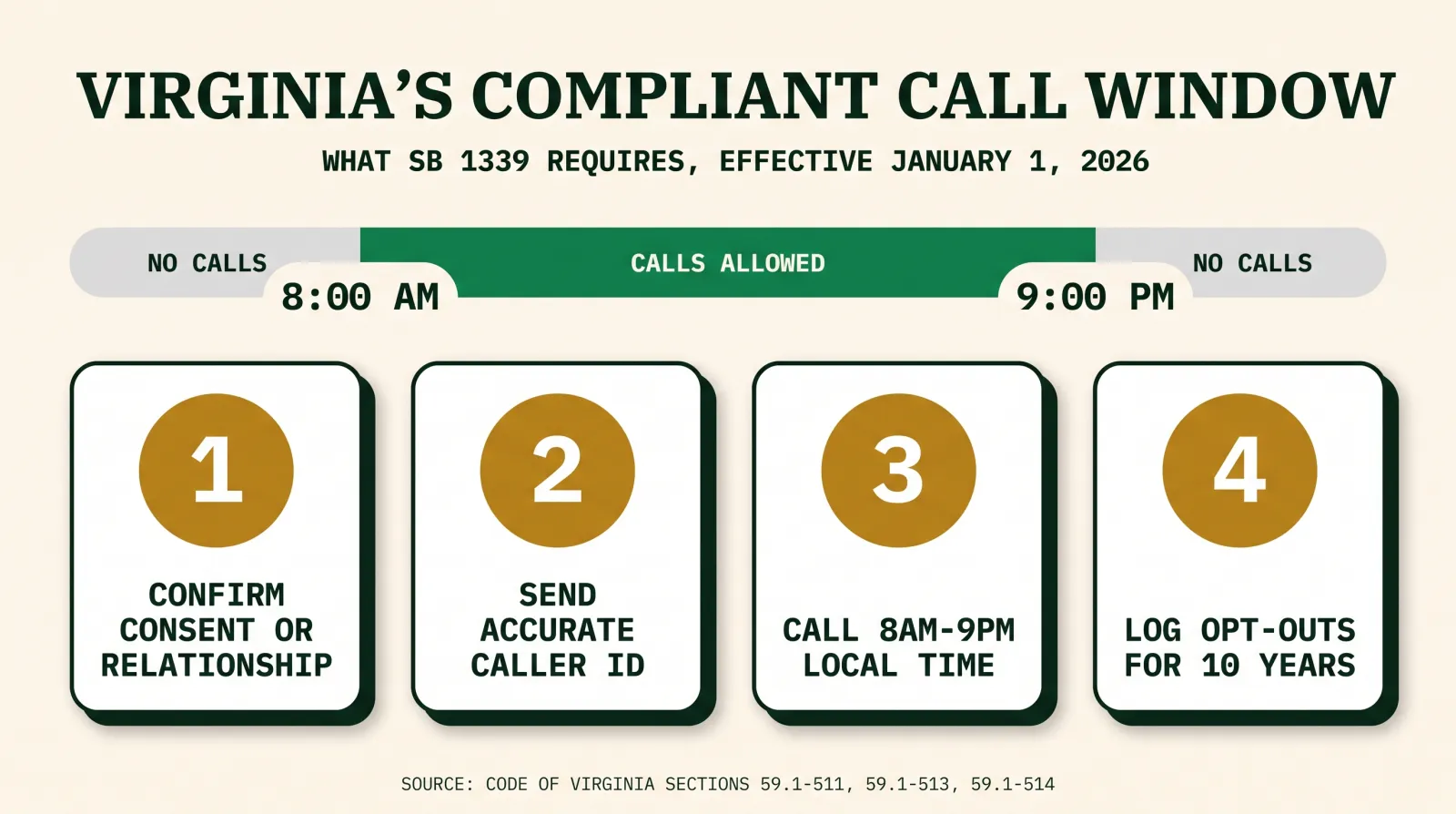
The practical read: the clock rule almost certainly isn’t your exposure if you were already following the TCPA and TSR. What changed is everything downstream of that clock, the opt-out duration, the identification standard, and above all, who can be sued when something goes wrong.
Opt-Outs Now Last a Decade — What That Means for Your CRM
Section 59.1-514 requires a telephone solicitor to honor a request not to be called “for at least 10 years from the time such request is made.” That applies to a spoken opt-out on a call and to a text reply of STOP or UNSUBSCRIBE. The statute also gives solicitors an affirmative defense if they can show they maintained a version of the National Do Not Call Registry no older than 31 days and used reasonable practices to prevent unlawful contact, but that defense is about process, not a substitute for tracking an individual’s own opt-out.
Ten years is a long time in CRM terms. Most contact-suppression logic defaults to something shorter, or worse, ties suppression to a record’s active status rather than a durable flag that survives a contact being merged, archived, or re-imported from a new list purchase. If your suppression list can be accidentally cleared by a database cleanup, a CRM migration, or someone re-uploading an old spreadsheet, it doesn’t actually meet a 10-year standard no matter what your written policy says.
Test your own suppression list today
Pick a contact who opted out of your Virginia calling more than a year ago. Confirm, right now, that the suppression flag is still active, that it would survive a re-import of that same phone number from a new lead file, and that whatever system dials on your behalf actually checks it before placing a call. Most agencies have never tested this from the failure-mode side.
Caller ID Can’t Lie Anymore
Section 59.1-513 requires a telephone solicitor to transmit its phone number and, where available through the carrier, its name, and that transmitted number has to accept opt-out requests during business hours. The statute separately prohibits intentionally blocking or falsifying caller ID information, though it does allow a solicitor calling on a client’s behalf to substitute the client’s own name and customer service number instead of its own, which is directly relevant if you’re a marketing vendor or IMO placing calls that benefit a licensed agency’s book of business.
For an agency working with an outside dialer, lead vendor, or BPO, this section is worth reading literally: whatever number shows up on a Virginia consumer’s phone has to actually route to something that can process an opt-out during business hours. A caller ID that displays a working agency number but routes replies to a disconnected line, an unmonitored voicemail box, or a vendor’s internal extension nobody checks doesn’t satisfy the requirement just because the number itself is technically accurate.
Hear how a compliant call actually sounds
There's a live demo call on the homepage. Put your number in and hear an AI voice agent identify itself, ask what you need, and offer a transfer, in real time, on your own phone.
Joint and Several Liability: Why “That’s My Vendor’s Problem” Doesn’t Work Anymore
This is the section of the amended statute that actually changes an insurance agency’s risk calculus, more than the calling hours or even the opt-out duration. Section 59.1-514.1 makes the seller and the telephone solicitor jointly and severally liable for violations of the chapter, and it creates a rebuttable presumption that a telephone solicitation offering a seller’s property or services was made on that seller’s behalf, whether or not any agency relationship actually exists between the two.
Read plainly, that means if a lead vendor, call center, or independent marketing organization places a call selling your agency’s coverage and that call violates the statute, wrong hours, no working opt-out, misleading caller ID, the presumption runs against you as the seller, not for you. The vendor being the one who actually dialed the phone doesn’t automatically shield the agency whose product was being sold. Overcoming that presumption requires clear and convincing evidence that you neither retained nor requested the solicitor and had no knowledge of or control over the calls, which is a real defense but not a low bar, and not one you want to be building for the first time after a complaint arrives.
What this means for vendor relationships
If your agency buys leads or outsources any calling to a third party that solicits Virginia consumers on your behalf, get specific about their calling hours, their opt-out process, and their caller ID setup before you sign anything, and put it in writing. "The lead vendor handles compliance" is not a defense under a joint liability statute; it's the exact arrangement the presumption is written to catch.
What a Violation Actually Costs
Under Section 59.1-515, an individual harmed by a violation can sue to enjoin the conduct and recover damages: $500 for a first violation, $1,000 for a second, and $5,000 for each one after that, plus reasonable attorney fees and court costs. A court can raise damages for a willful violation to as much as $5,000 for a first or second offense at its discretion. Separately, Section 59.1-517 gives the Attorney General, Commonwealth’s attorneys, and local attorneys authority to bring their own enforcement actions, recover the same tiered civil penalties, and additionally recover the government’s investigation and litigation costs; penalties from state actions go to Virginia’s Literary Fund, and penalties from local actions go to that locality’s general fund.
$500
Minimum private-action damages for a first violation
Source: Code of Va. § 59.1-515
$5,000
Damages per violation after the second, or for any willful violation
Source: Code of Va. §§ 59.1-515, 59.1-517
10 years
Minimum time an opt-out must be honored
Source: Code of Va. § 59.1-514
4,300+
Certified insurance agents and assisters across Virginia's Insurance Marketplace
Source: Virginia SCC, Oct. 2025
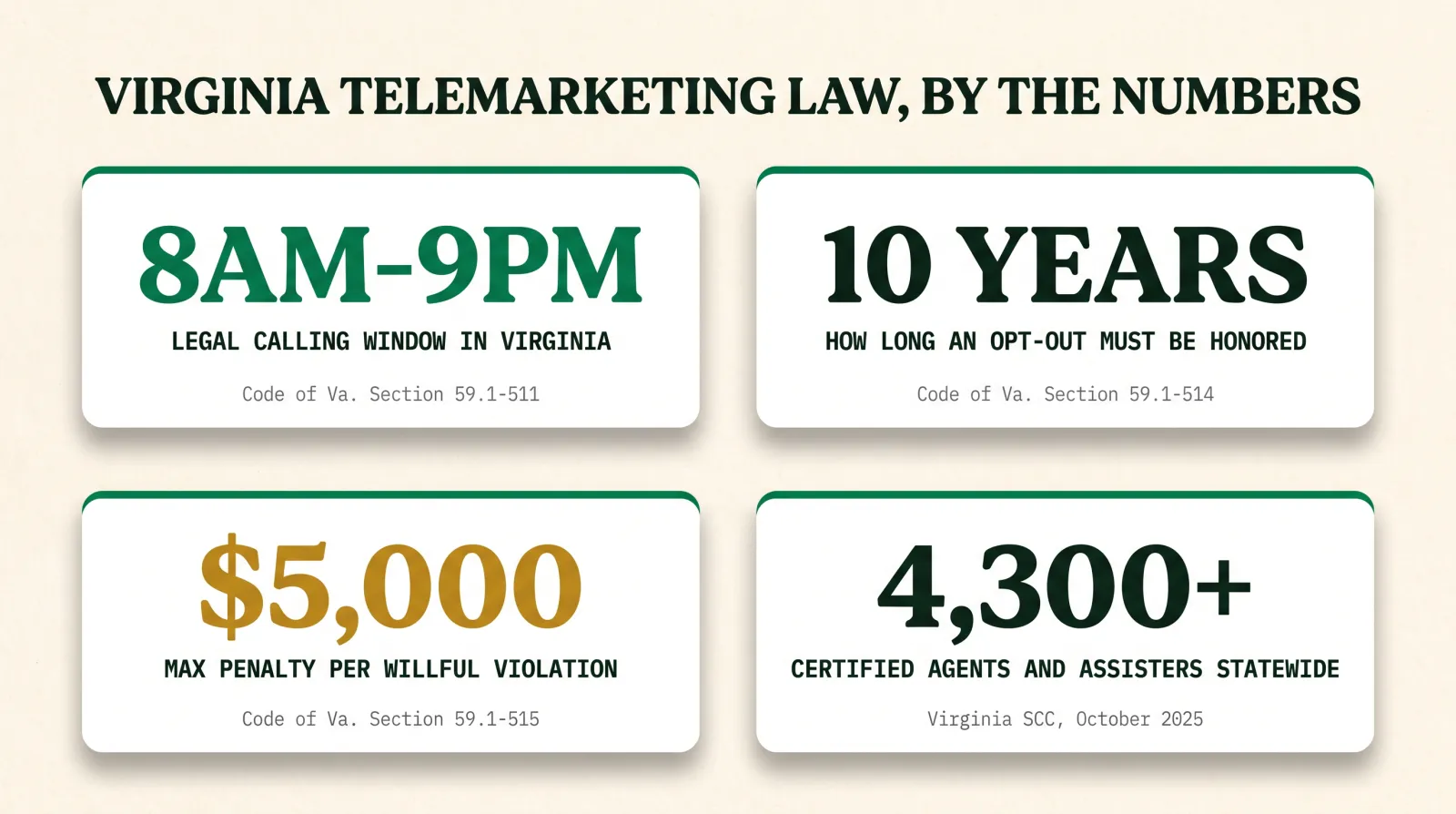
Multiply the low end of that tier by even a modest run of complaints and the numbers stop looking like rounding error. A single willful violation carries the same maximum, $5,000, as a monthly Agency plan’s minute allowance would cost at roughly 27,000 minutes of AI-answered calls at $0.18 a minute; put differently, one avoidable statutory violation can cost more than a full month of managed calling at scale. That’s not a reason to panic, it’s a reason to make the compliance mechanics boring and automatic rather than something a busy team remembers to do most of the time.
Does This Apply to Medicare and ACA Calls Specifically?
Yes, without any product-line exception written into the statute. Virginia’s definition of telephone solicitation covers a call or text offering property, goods, or services for sale, and insurance coverage, Medicare Advantage, ACA marketplace plans, life, final expense, all of it, fits that definition the same way a home warranty pitch or a solar sales call would. There’s no carve-out in Chapter 44 for licensed insurance producers or the products they sell.
For Medicare specifically, Virginia’s rules stack on top of, rather than replace, CMS’s Medicare Communications and Marketing Guidelines, which separately require the TPMO disclaimer, govern unsolicited contact, and set call recording and retention requirements for Medicare-related sales calls. An agency working Virginia’s Medicare market in 2026 has three layers to satisfy at once: the federal TCPA and TSR, Virginia’s amended VTPPA, and CMS’s Medicare-specific marketing rules. None of the three substitutes for the others, and a call that’s clean under one can still violate another.
Compliance disclaimer
Prior express written consent is required for automated or prerecorded marketing calls and texts to a cell phone under the TCPA, and that consent obligation belongs to the licensed agent, not to any vendor or platform. Any caller must disclose it's an AI where required and honor opt-outs immediately. Medicare marketing carries CMS's additional rules, including the TPMO disclaimer and call recording retention requirements. This article is general information, not legal advice for your specific setup; confirm your exact obligations with counsel licensed in Virginia. Using an AI voice agent does not transfer compliance liability away from the licensed agent or agency.
How to Build a Compliant Speed-to-Lead System in Virginia
None of this requires buying anything. Here’s the full method for building compliant, fast follow-up on Virginia leads, whether you do it by hand or with a platform that automates the mechanics.
- Record the exact date on every Virginia contact. Store the date of last transaction and the date of first inquiry as real fields, not notes, so you can actually calculate whether a lead sits inside the 18-month or 3-month established-relationship window before you call it.
- Build a suppression list that can’t be accidentally cleared. An opt-out flag needs to survive a CRM migration, a duplicate merge, and a fresh import of the same phone number from a new lead file, for a full 10 years, not until the next database cleanup.
- Gate every outbound call through the suppression list and the clock, automatically. Don’t rely on a human remembering to check the time or the opt-out status before dialing; build the gate into the dialer or workflow itself so a call outside 8 a.m.–9 p.m. or to a suppressed number simply can’t fire.
- Confirm your caller ID actually routes somewhere staffed. Whatever number displays on the call has to reach a line that can process an opt-out during business hours, whether that’s your own number or, per Section 59.1-513’s exception, a client’s number you’re authorized to substitute.
- Get vendor calling practices in writing before you sign. If a lead vendor, IMO, or BPO calls Virginia consumers on your agency’s behalf, put their calling-hour compliance, opt-out handling, and caller ID setup in the contract, and ask for evidence, not just a promise.
- Update the National Do Not Call Registry on a schedule, and document it. Pulling a version no older than 31 days and keeping a record that you did is the statute’s own affirmative defense; treat it as a monthly task with a paper trail, not an occasional one.
- Log every opt-out with a timestamp, immediately, at the point of contact. Whether it comes by voice or text, the record needs to exist the moment the request is made, not after a batch review days later.
- Audit your own list once a quarter from the caller’s side. Pull a sample of Virginia contacts, confirm suppression flags held, confirm caller ID resolves correctly, and confirm nothing outside the 8-to-9 window went out. A written policy that’s never been tested against your actual system is a guess, not a control.
Where TheAffordableAI Fits
We don’t write your compliance policy and we’re not a law firm; the method above works whether you build it in-house or not. What we run is the calling layer underneath it: an AI voice agent that dials and answers within the hours you configure, checks a suppression list before every call, and logs every disposition, including an opt-out, to the contact record the moment it happens.
Calling-window rules built into the schedule
Set the hours once and outbound calls simply don't fire outside them, no manual check required on every dial.
Opt-outs logged the moment they happen
A spoken or texted opt-out is captured and tagged on the contact record immediately, not batched for later review.
Native HighLevel sync
Transcript, disposition, and suppression status land on the contact record automatically, on the same CRM your compliance records already live on.
Warm transfers to a licensed agent
Rings 20+ agents at once on the Agency plan; the mechanical part of the call is automated, the advice and the sale still go to a human.
Number warmup and spam defense
A flagged caller ID doesn't just hurt answer rates, it undermines the identification requirement itself; we run warmup as a standing routine.
No contracts either way
Single Account runs $200 a month plus a $500 one-time setup at $0.20 a minute, down to $0.15 at bulk; Agency runs $500 a month plus a $1,000 setup at $0.18 a minute, down to $0.16 at bulk. Cancel anytime.
What You Actually Get
A Virginia lead comes in at 7:52 on a Tuesday morning. Instead of a rep manually checking the clock and a spreadsheet before dialing, the system already knows the window doesn’t open for eight more minutes and holds the call until 8:00 sharp. When it fires, the caller ID resolves to a real, staffed number, the AI identifies itself, asks what the caller needs, and if they say stop at any point in that conversation or in a later text, the suppression flag is set immediately, before the next contact attempt could ever go out. None of that requires a person to remember a rule; the rule is the system.
What “Good” Compliance Coverage Looks Like
Typical Virginia calling setup
- Reps eyeball the clock before dialing, sometimes off their own time zone by mistake
- Opt-outs get written in a notes field someone might see later
- Suppression status doesn't survive a fresh list import
- Vendor calling practices were never actually verified in writing
- Nobody's checked the DNC registry update date in months
System-enforced compliance
- Calls are gated to 8 a.m.–9 p.m. local time automatically, no manual check
- An opt-out sets a durable suppression flag the instant it's spoken or texted
- That flag survives a CRM migration or a re-imported list, for the full 10 years
- Vendor and CRM sync means one suppression list, not three disconnected ones
- DNC registry updates and audits happen on a documented schedule
Where This Is the Wrong Tool
Be straight about the limits here. If your Virginia call volume is small, a handful of leads a week, a manual checklist and a disciplined team member checking the clock and a suppression spreadsheet by hand may genuinely be enough, and paying a monthly platform fee plus a per-minute rate is more infrastructure than the problem justifies. And no calling system, AI or human, fixes a legal problem that already exists in how your leads were sourced or consented; if the underlying list itself was built without proper consent, the fix is upstream of anything a dialer can do. This piece is about how you call once you have a legitimate lead. If the lead itself is the problem, look there first, and talk to counsel before you dial anything.
The clock rule was already the law. What changed is who else can be sued when nobody checked it.
Mike MooreVirginia’s amended telemarketing law didn’t move the calling-hour goalposts insurance agencies were already supposed to be following under federal law. What it did was make the opt-out duration explicit, sharpen the caller ID standard, and, with the new joint liability provision, put the seller, not just whoever dialed the phone, on the hook for getting it wrong. If your agency works Virginia leads at any real volume, the fix isn’t a new policy document nobody reads twice; it’s a system where the calling window, the suppression list, and the opt-out log are enforced automatically instead of remembered occasionally. Price that against a $500 first violation and a $5,000 willful one, and decide from there.
Put a compliant calling window on your own phone line
See the AI dial within your configured hours, check a suppression list, and warm-transfer a live Virginia call in under a minute. No contract, no dev work.
Frequently asked
What is Virginia's Telephone Privacy Protection Act, and what changed on January 1, 2026?
The Virginia Telephone Privacy Protection Act (VTPPA), codified at Code of Virginia Chapter 44 of Title 59.1, is the state's own telemarketing statute, separate from the federal TCPA. Senate Bill 1339, chief patroned by Sen. Dave Marsden and enacted as Chapter 626 of the 2025 Acts of Assembly, took effect January 1, 2026. It clarified that opt-out requests, including text replies of STOP or UNSUBSCRIBE, must be honored for at least 10 years, tightened caller identification requirements, and made sellers and telephone solicitors jointly and severally liable for violations made on the seller's behalf.
What hours can an insurance agent legally call a Virginia lead?
Code of Virginia Section 59.1-511 restricts telephone solicitation calls to between 8:00 a.m. and 9:00 p.m. local time at the called person's location, unless the solicitor has the person's prior consent to call outside that window. That matches the federal Telemarketing Sales Rule's calling-hour restriction under 16 CFR Section 310.4(c), so Virginia didn't invent a new window, it just added its own state-level enforcement and penalties on top of the existing federal one.
How long must an opt-out request be honored under Virginia's law?
At least 10 years from the time the request is made, under Code of Virginia Section 59.1-514. That applies whether the person says stop on a call or replies STOP or UNSUBSCRIBE to a text solicitation. A suppression list that only holds opt-outs for a year or purges on a rolling schedule doesn't meet the state standard, even if it happens to satisfy a shorter internal policy.
Does Virginia's joint liability rule mean I'm responsible for my lead vendor's calls?
It can be. Code of Virginia Section 59.1-514.1 makes sellers and telephone solicitors jointly and severally liable for violations, and creates a rebuttable presumption that a solicitation offering a seller's product or service was made on that seller's behalf, whether or not a formal agency relationship exists. An agency can overcome that presumption with clear and convincing evidence it neither retained nor requested the calls and had no knowledge of them, but the default assumption in the statute runs against the business the calls are selling for, not for it.
What happens if an agency violates Virginia's telemarketing law?
Under Code of Virginia Sections 59.1-515 and 59.1-517, an individual can sue for $500 for a first violation, $1,000 for a second, and $5,000 for each one after that, plus attorney fees and court costs; a court can raise willful violations to as much as $5,000 each. The Attorney General, Commonwealth's attorneys, and local attorneys can separately bring enforcement actions and recover investigation costs on top of those civil penalties.
Does this apply to Medicare and ACA marketing calls specifically?
Yes, if the call is a telephone solicitation to a Virginia number offering insurance for sale, it falls under the VTPPA's calling-hour, identification, and opt-out rules regardless of product line. Medicare marketing calls also carry CMS's separate marketing guidelines, including the TPMO disclaimer and call recording retention rules, on top of Virginia's statute and the federal TCPA. The rules stack rather than replace one another.
Is Virginia's law the same as the federal TCPA?
No, they're separate statutes an agency has to satisfy at the same time. The TCPA is a federal law enforced primarily through FCC rulemaking and federal private rights of action, focused heavily on automated dialing and prerecorded or artificial voice calls. The VTPPA is Virginia's own civil statute, enforceable through Virginia courts, and it regulates telephone solicitation more broadly, covering live calls and texts made by a person as well as automated ones. Complying with the TCPA does not automatically mean an agency is compliant with the VTPPA, and vice versa.
Does using an AI voice agent change who's liable under Virginia's law?
No. Whether a call is placed by a live caller, a dialer, or an AI voice agent, the entity the solicitation is made for stays on the hook under Virginia's joint liability provision, and the licensed agent and agency remain responsible for consent, disclosure, and honoring opt-outs. Choosing AI calling technology doesn't transfer that responsibility to a vendor; it changes who's dialing, not who's answerable for the call.
Sources
- Code of Virginia — Section 59.1-510, Definitions (Virginia Telephone Privacy Protection Act, amended 2025 c. 626)
- Code of Virginia — Section 59.1-511, Solicitation Time Restrictions
- Code of Virginia — Section 59.1-513, Transmission of Solicitor Identification Information Required
- Code of Virginia — Section 59.1-514, Unwanted Telephone Solicitations Prohibited
- Code of Virginia — Section 59.1-514.1, Joint Liability of Seller and Telephone Solicitor; Rebuttable Presumption
- Code of Virginia — Section 59.1-515, Individual Action for Damages
- Code of Virginia — Section 59.1-517, Enforcement; Civil Penalties
- Electronic Code of Federal Regulations — 16 CFR Section 310.4, Telemarketing Sales Rule, Abusive Telemarketing Acts or Practices (restricted calling hours)
- Cornell Law School Legal Information Institute — 47 U.S.C. Section 227, Telephone Consumer Protection Act, statutory damages
- CMS — Medicare Communications and Marketing Guidelines
- Virginia State Corporation Commission — Virginia's Insurance Marketplace Guides Residents Through 2026 Open Enrollment (published October 31, 2025)
- McGuireWoods Consulting — Hold The Line: Virginia Telemarketer Law Addresses Excessive E-Commerce Lawsuits (published May 13, 2025)
- TheAffordableAI — Pricing
Put this on your own phone line
See the AI dial, qualify, and warm-transfer a live call in under a minute. No contract, no dev work.
Keep reading

Florida Insurance Leads: Speed to Lead Under the FTSA
Florida sold more 2026 ACA plans than any state, yet its telephone law adds exposure on top of federal TCPA. How agencies follow up fast and compliant.

Pennsylvania Telemarketing Law 2026: Insurance Agent Guide
Pennsylvania's Act 47 of 2026 narrows telemarketing hours to 9am-7pm, bans Sunday calls, and adds new consent rules for insurance agents by October 18, 2026.
Speed to Lead in 2026: Why the First 60 Seconds Decides Who Writes the Policy
The lead you paid for is not lost to a better agent. It is lost to a faster one. Here is what response time actually does to contact and conversion rates, and how to get to sixty seconds without hiring a dialer team.