Outsourcing Insurance Follow-Up Calls: What Doesn't Transfer
Outsourcing your calls can cost $8 to $11.50 each and still leave your agency holding TCPA liability. The FCC rule, real cost math, and a vendor checklist.

You’re short-staffed, the leads keep landing, and someone on a sales call tells you the fix is easy: hire an outsourced call center, hand them the list, and the phones get covered. It sounds like the problem is solved. It isn’t, not the whole thing. Outsourcing your dialing can take the physical work off your desk. It does not, by itself, take the legal responsibility for that dialing off your agency, and that gap is where a lot of agencies get surprised later, usually by a demand letter instead of a phone bill.
This is about what actually transfers when you outsource lead follow-up calls, what doesn’t, what it costs using real published numbers instead of guesses, and how to vet a vendor, or an AI platform, so you’re not the one holding the bag for someone else’s dialing habits.
The short version
- Outsourcing moves who dials the phone. It does not automatically move who's liable if that dialing breaks the TCPA.
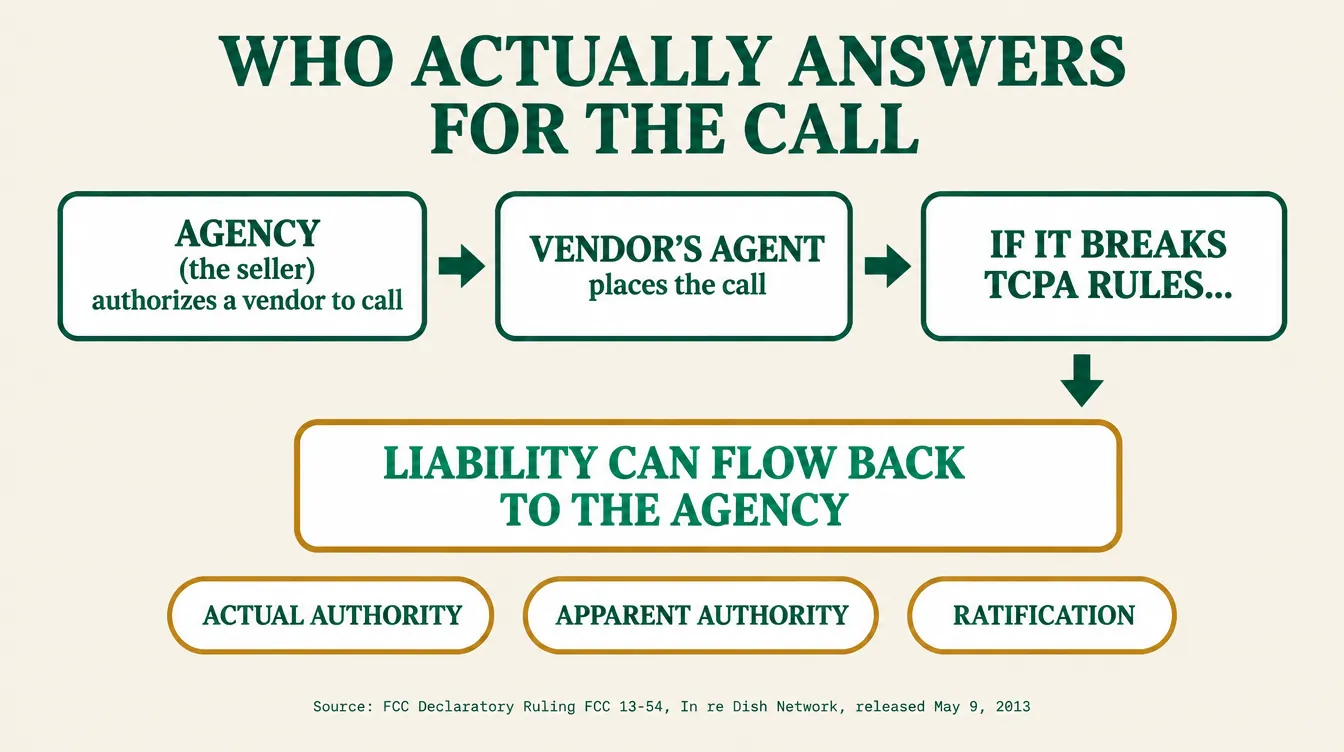
- The FCC's 2013 Dish Network ruling (FCC 13-54) lets a seller be held vicariously liable for a third-party vendor's calls under federal common law agency principles, actual authority, apparent authority, or ratification.
- Live-staffed answering service pricing is public: Smith.ai runs $300 to $2,100 a month depending on tier, with per-call overage of $8.50 to $11.50, for answering and routing, not outbound dialing or qualifying.
- A written vendor agreement covering consent capture, call recordings, opt-out handling, and who's contractually on the hook is the actual fix, whether the vendor is a BPO, an answering service, or an AI platform.
- A managed AI caller doesn't remove the liability question either. What it can do is put every call, script, and consent record in one system you can audit yourself instead of a vendor you can't see into.
What “outsourcing your follow-up calls” actually means
The phrase covers three different arrangements, and agencies often don’t realize which one they’ve bought until something goes wrong.
A live-staffed answering service. A company like Smith.ai or a similar virtual receptionist provider answers your inbound calls under your business name, screens callers, and either handles simple requests or routes the call to your team. This is almost always inbound-only or lightly outbound (callbacks, appointment confirmations), billed per call or per minute with a monthly base.
A BPO seat lease. You rent one or more dedicated agents, typically overseas, who work your list on your schedule using your scripts, your CRM, and your phone numbers. This is the arrangement that looks most like hiring, because in practice it functions like hiring, just without the agency being the direct employer. It’s also the arrangement where the vicarious liability question is sharpest, because these agents are placing outbound calls, often at volume, on your behalf.
A staffing agency placing phone-only workers. Functionally similar to a BPO seat, but the workers may be domestic, and the staffing agency is the employer of record while you direct the day-to-day work. The legal analysis is closer to having an employee than a fully independent vendor, but the paperwork often doesn’t reflect that clearly.
| Arrangement | What it does | What it doesn't do |
|---|---|---|
| Live answering service | Answers inbound calls, screens, routes, light callbacks | Outbound speed-to-lead dialing at volume; deep CRM qualification |
| BPO seat lease | Dials your list, follows your script, works your CRM | Automatically assume your TCPA and consent obligations |
| Staffing agency placement | Phone-only labor you direct day to day | Function as a true independent vendor for liability purposes |
None of these are wrong tools by default. The mistake is treating any of them as a complete answer to “I don’t have enough people to call my leads,” when what they actually solve is narrower than that, and what they don’t solve, consent, disclosure, documentation, stays exactly where it was.
Why agencies reach for outsourcing first
The reasoning is understandable. Licensed producer roles are slow to fill; a CSR-style phone role draws from a bigger labor pool but still takes weeks to hire and train. BLS’s May 2025 data puts the median wage for a customer service representative at $21.53 an hour, $44,770 a year, nationally. That’s before payroll taxes, benefits, a phone system, a manager, and the ramp-up time before a new hire is actually productive on your scripts and your carriers. Against that backdrop, a vendor who says “we already have trained agents, ready this week” sounds like it solves two problems at once: the empty seat and the training curve. If your agency’s staffing gap looks like the one covered in our piece on the 2026 insurance hiring shortage, outsourcing looks like the fast exit from that math.
It can be. The part that gets skipped is the paperwork that determines who’s actually responsible when the vendor’s agent, whether in Manila, Boise, or a staffing agency’s roster, makes a call that violates the TCPA, doesn’t honor an opt-out fast enough, or can’t produce a consent record when asked. That responsibility question doesn’t disappear because you didn’t personally dial the number.
The liability that doesn’t leave with the vendor
Here’s the mechanism, defined plainly, because the term gets thrown around loosely.
Vicarious liability means a principal, your agency, can be held legally responsible for the acts of its agent, the vendor, even though the principal didn’t personally commit the act. This is a general concept in the federal common law of agency, not something unique to insurance or to telemarketing.
The FCC applied this directly to the TCPA in a 2013 declaratory ruling, FCC 13-54, issued in the Dish Network matter (CG Docket No. 11-50, released May 9, 2013). The Commission held that a seller, meaning the business whose product or service is being sold, can be vicariously liable for a third-party telemarketer’s TCPA violations under federal common law agency principles, even where the seller itself never dialed a phone. The Commission was explicit that this isn’t unlimited: it rejected the idea that a seller is automatically liable just because a call happened to benefit it. The standard instead runs through classic agency-law tests:
- Actual authority. You told the vendor, explicitly or through your instructions, to make these calls this way.
- Apparent authority. You let the vendor represent itself to consumers as acting on your behalf, your business name, your script, your offer, even if you didn’t sign off on every detail of how it was executed.
- Ratification. You accepted the benefit of the vendor’s work after the fact, for example keeping and working a lead the vendor generated through a call that didn’t have valid consent, which can count as adopting the vendor’s conduct as your own.
Any one of those three can be enough to reach the seller, not just the dialer. In practice, that means the burden lands on your agency to show a court that the vendor was acting outside its authority, not on the vendor to prove it was acting within it. “We hired a call center and didn’t know what they were doing on our list” is a fact pattern that often points toward vicarious liability, not away from it, because it suggests you handed over authority without controlling how it was used.
This isn’t a reason to never use a vendor. It’s a reason to treat the vendor relationship the way you’d treat hiring: with a written agreement that spells out who does what, and documentation you can actually produce if a regulator or a plaintiff’s attorney asks for it.
Using a vendor does not transfer liability, and neither does using AI
Whether the calls are made by an overseas BPO seat, a domestic answering service, a temp staffer, or an AI voice platform, prior express consent, clear disclosure, and a working opt-out remain the licensed agency's obligation. None of that responsibility moves to the tool or the vendor because the vendor made the calls faster or cheaper.
What outsourcing actually costs in 2026
Real numbers instead of a range someone quoted you on a sales call. Smith.ai, a live-staffed virtual receptionist and answering service, publishes its pricing: the Starter plan runs $300 a month for 30 calls, the Basic plan $810 a month for 90 calls, and the Pro plan $2,100 a month for 300 calls, with per-call overage running from $11.50 down to $8.50 as you move up tiers. Extra features, appointment booking, CRM integration, bilingual coverage, run additional per-call or per-month fees on top of that base.
That’s for answering and routing. It’s not outbound speed-to-lead dialing the moment a form posts, and it’s not warm-transferring a qualified prospect into a real appointment slot. A BPO seat lease built for outbound dialing at volume is priced separately, and the quotes vary widely enough by agency, region, and included management overhead that there isn’t a single public number worth citing here without misleading you. What is worth citing is the shape of the comparison: live-staffed, per-call pricing in the range Smith.ai publishes, against the in-house wage math from BLS above, against a per-minute platform rate.
| Option | Published rate | What it buys |
|---|---|---|
| In-house CSR hire | $21.53/hr median (BLS, May 2025) | Full control, full employment overhead, weeks to hire and train |
| Live answering service (Smith.ai) | $300-$2,100/mo base; $8.50-$11.50/call overage | Live human answering and routing; not outbound dialing |
| TheAffordableAI, Single Account | $200/mo + $500 setup; $0.20/min ($0.15 at bulk) | Outbound + inbound, warm transfer, auto-booking, HighLevel sync |
Sources: U.S. Bureau of Labor Statistics, Occupational Outlook Handbook (May 2025); Smith.ai published pricing (fetched September 2026); TheAffordableAI pricing page (fetched September 2026). Figures are each vendor's own published rate, not a claimed savings comparison; average handle time and call mix vary by agency.
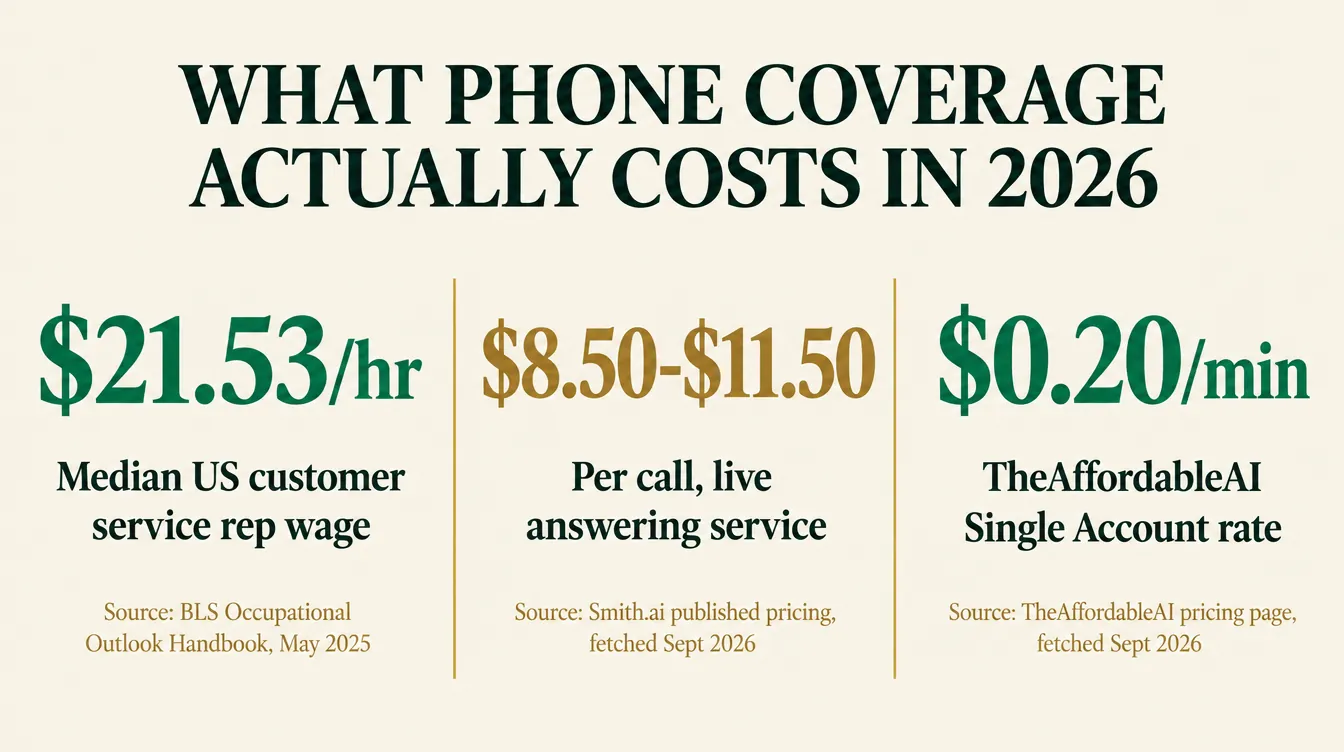
Run your own numbers against your own average handle time and call volume before deciding anything. A shop doing 40 calls a month looks completely different on this math than one doing 4,000.
A worked example, using published rates
Take an agency handling 500 calls a month between inbound answering and outbound follow-up. Using Smith.ai’s published Pro-tier structure as the answering-service benchmark, 300 calls are covered by the $2,100 monthly base and the remaining 200 fall into overage at $8.50 each, for roughly $2,100 + $1,700 = $3,800 a month, and that figure only covers answering and routing, not outbound dialing the moment a lead posts. Staffing that volume in-house with one full-time CSR at the BLS median wage of $21.53 an hour runs about $3,730 a month in wages alone, before payroll taxes, benefits, a phone system, or management time, and it still leaves outbound speed-to-lead dialing as a separate problem to solve, because one person can’t dial instantly on every new lead while also answering the phone.
On TheAffordableAI’s Single Account plan, the same 500 calls at a four-minute average handle time work out to roughly 2,000 minutes, or $400 at the $0.20-a-minute rate, plus the $200 monthly subscription, landing around $600 to $625 for the month depending on exact call length, covering both inbound and outbound in one system. None of these numbers include your setup time, your management overhead, or your own agency’s specific call mix, and none of them are a promise about what your agency will actually spend. They’re each vendor’s own published rate, run against the same illustrative call volume, so you can see the shape of the comparison before you price your own numbers against it.
| Option | Approx. monthly cost | What's included |
|---|---|---|
| In-house CSR (BLS median wage) | ~$3,730 | One FTE, wages only, no benefits/overhead added |
| Live answering service (Smith.ai Pro tier) | ~$3,800 | Live human answering/routing, no outbound dialing |
| TheAffordableAI, Single Account | ~$600-$625 | Outbound + inbound, warm transfer, auto-booking, CRM sync |
Illustrative arithmetic on each vendor's own published rate at an assumed 500 calls/month and a 4-minute average handle time for the per-minute platform. Not a guarantee of any agency's actual spend; run it with your own call volume and average handle time.
The licensing wrinkle nobody puts in the contract
There’s a second risk that outsourcing conversations rarely surface: what happens when a BPO agent, trying to be helpful or trying to close, drifts from “let me confirm your information and get you on the calendar” into actually answering a coverage question. The moment a caller is quoting, binding, or advising on specific coverage, that’s regulated producer activity in most states, and an unlicensed BPO agent doing it, even accidentally, even with good intentions, creates exposure that has nothing to do with the TCPA. It’s an unauthorized-practice-of-insurance problem layered on top of the vicarious liability one.
This is a scripting and monitoring problem as much as a legal one. A tightly scoped script, confirm details, check basic eligibility, book the calendar slot, hand off anything substantive, keeps a vendor’s agents inside the lane they’re actually allowed to operate in. A vague script, or a vendor incentivized on conversion rather than clean handoffs, pushes agents toward exactly the kind of improvisation that creates this exposure. Ask a vendor directly what their agents are trained to say when a caller asks a coverage question they’re not licensed to answer, and ask to see the actual script, not a paraphrase of it.
The vendor-vetting checklist that actually protects you
If you’re going to outsource any part of your calling, in-house hire, BPO, answering service, or AI platform, this is the diligence that matters. None of it costs anything beyond the time to ask.
- Get consent capture in writing. How does the vendor document that a lead gave prior express consent before an autodialed or AI-voice call goes out? Ask for the actual field or timestamp they log, not a verbal assurance that “we handle that.”
- Require access to raw call recordings and scripts, not just summaries. A vendor who will only show you dashboards and call counts, not the underlying audio and the actual script being read, is a vendor you can’t audit if a complaint comes in.
- Put liability allocation in the contract, not just an assumption. Who is contractually responsible if the vendor’s agent violates the TCPA while working your list? Indemnification language should exist and should be specific, not a vague mutual-hold-harmless clause.
- Confirm opt-out handling and timing. Ask how fast a “stop” or “remove me” request gets honored across the vendor’s entire system, not just on the one call where it was said.
- Ask whether agents disclose who they’re calling for. A consumer receiving a call should be able to tell it’s connected to your agency, not a generic, unnamed call center, both as a trust matter and because misrepresenting the caller can itself violate the TSR’s prohibition on deceptive telemarketing acts.
- For Medicare-related calls, confirm CMS marketing rule compliance specifically. A generic BPO built for retail or SaaS lead gen usually isn’t built for the TPMO disclaimer, recording retention, and marketing rules CMS applies to Medicare Advantage and Part D calls. Ask directly whether the vendor has ever handled Medicare-regulated calling, not just insurance calling broadly.
- Decide who owns the data afterward. If you end the contract, do you get your call recordings, transcripts, and consent records, or do they stay with the vendor? Get that in writing before you sign, not after you need it.
A vendor who answers all seven clearly, in writing, might be a reasonable choice. A vendor who waves off two or three of these with “don’t worry about it, we’ve got you covered” is telling you something true: you’re the one who’ll be covering it, later, without documentation.
Per-call cost, by coverage option (illustrative, using each vendor's own published rate)
Assumes a 4-minute average call for the per-minute platform rate, a common handle-time assumption for qualify-and-schedule calls.
Sources: Smith.ai published pricing, fetched September 2026 (live answering, not outbound dialing). TheAffordableAI pricing page, fetched September 2026. The two products aren't a direct like-for-like swap, Smith.ai is live-staffed inbound answering; the per-minute figure is illustrative outbound/inbound platform cost on an assumed 4-minute call. Compare against your own call mix.
Where a managed AI caller fits, honestly
TheAffordableAI doesn’t remove the liability question above. Nothing legitimately can, short of never delegating any calling to anyone. What it changes is where the visibility sits. Every outbound dial, every inbound answer, every disposition, and every consent capture lands in your own HighLevel CRM in real time, not in a vendor’s internal system you have to request access to after something’s already gone wrong. The scripts and consent language are set with your agency directly, not handed to an offshore team you’ve never spoken with. Full detail on what’s included, number warmup, spam defense, multi-calendar routing, is on the features page. You can also build a version of this yourself with a dialer and a BPO seat; plenty of agencies do, and the checklist above is exactly what to run through either way. If you’d rather hear it than read another comparison table, there’s a demo call on the homepage.
One system, not a vendor you can't see into
Every call, transcript, and disposition syncs to your own HighLevel CRM the moment it happens.
Consent and disclosure stay auditable
Scripts and consent language are set with your agency, not delegated to a team you've never spoken to.
Live this week, not after a vendor onboarding cycle
No seat lease negotiation, no multi-week BPO ramp. White-glove setup is included on every plan.
Warm transfers to a licensed human
A qualified lead reaches a real, licensed agent live. The AI never gives coverage advice or closes the sale.
Calls happen somewhere you can't see
- Consent records exist, if they exist, inside a system you don't have direct access to
- Scripts can drift from what you approved without you knowing until a complaint arrives
- A liability question means requesting records from a vendor under no urgency to produce them fast
- Ending the relationship can mean losing access to your own call history
OpaqueYou find out what happened after it's already a problem
Calls happen where you can see them
- Every call, transcript, and consent capture syncs to your own CRM in real time
- Scripts and disclosure language are set with your agency directly
- Records are yours, pulled from your own system, not requested from a third party
- No contract lock-in if you decide it's not the right fit
AuditableYou can answer a liability question from your own records
Price it against what you're already paying
If you're already outsourcing calls or pricing out a BPO seat, run the vendor checklist above against your current contract before renewing it. If you want to see what a managed AI caller sounds like on a live call first, there's a no-pressure demo on the homepage.
When outsourcing, or AI, is the wrong call
Some of this work genuinely needs a human with judgment, and neither an overseas BPO seat nor an AI platform is the right fix for it. A client disputing a claim, a nuanced coverage comparison across three carriers, a renewal conversation with someone who’s been with your agency for a decade, those need a licensed person who knows the account. Volume tools, human or AI, are built for the repetitive first-touch layer: dialing the moment a lead comes in, qualifying basic details, booking a real calendar slot, and getting a ready prospect to a licensed human fast. Pushing complex, relationship-dependent conversations through any high-volume tool, live BPO agents included, tends to produce worse outcomes, not better ones, because the tool is optimized for throughput, not judgment.
If your actual bottleneck is that your producers already have qualified leads sitting in their calendar and no time to close them, more first-touch calling capacity makes that backlog worse. That’s a closing-capacity problem, and no amount of outsourced dialing fixes it.
There’s also a volume floor worth being honest about. If your agency handles 40 or 50 calls a month, the fixed monthly base on most answering services or BPO seat leases, and the setup overhead of a managed AI platform, may simply not be worth it yet compared to your existing staff absorbing the load directly. Every option in this article, human or AI, has a volume where it starts paying for itself and a volume below which it’s solving a problem you don’t have yet. Know which side of that line your agency is on before you sign anything.
The compliance layer, regardless of who’s dialing
Automated, autodialed, or AI-generated-voice calls to a wireless number require prior express consent under the Telephone Consumer Protection Act, 47 U.S.C. § 227, full stop, regardless of whether the call was placed by an employee, a BPO seat, an answering service, or a platform like ours. Disclosure has to be clear, and an opt-out has to be honored immediately once it’s requested, in whatever channel it comes through. Medicare-related calling carries CMS marketing rules on top of that, including required disclaimers, and those rules don’t relax because the call came from a vendor instead of your own staff.
The FTC’s Telemarketing Sales Rule adds its own layer on the deceptive-practices side: a caller can’t misrepresent who they’re calling on behalf of, and sellers who use third-party telemarketers still carry obligations around recordkeeping and truthful representations under the rule. Call recording adds a state-law layer on top of the federal one. Some states require every party’s consent before a call can be recorded at all, which matters directly if your BPO vendor records calls by default as part of its own quality process; we’ve covered the recording-consent side of this in detail in our piece on California’s call recording rules, and the same question, does the vendor’s recording practice match the law in the state your lead lives in, applies to any outsourced calling arrangement, not just one state.
None of this is a reason to avoid outsourcing calling work. It’s the reason the vendor checklist above exists, and the reason “we hired someone else to make the calls” has never been a complete answer to a compliance question, whether that someone else sits in your office, overseas, or inside a software platform.
Price out your options with the actual published numbers above, run the checklist against whoever you’re considering, human or AI, and make the call that fits your volume and your risk tolerance, not the one a sales pitch made sound simplest.
Frequently asked
What does 'outsourcing my lead follow-up calls' actually mean?
In practice it's usually one of three arrangements: a live-staffed answering service that picks up and screens calls under your business name, a BPO (business process outsourcing) seat lease where you rent dedicated overseas agents who dial and answer on your behalf, or a temp staffing agency that places phone-only workers on your payroll indirectly. All three take the physical act of dialing or answering off your team's plate. None of them, by themselves, take the legal responsibility for how that calling is done off your agency's plate.
If I hire an outsourced call center, does that transfer TCPA liability away from my agency?
No, not automatically, and often not at all. The FCC's 2013 declaratory ruling in the Dish Network matter (FCC 13-54) held that a seller can be vicariously liable under federal common law agency principles for a third-party telemarketer's TCPA violations, even when the seller didn't make the call itself. The question courts ask isn't who dialed the phone, it's whether the vendor had actual authority, apparent authority, or had its conduct ratified by the business it was calling on behalf of. Hiring a vendor to make your calls doesn't erase that question; it creates it.
What is vicarious liability under the TCPA, in plain terms?
It means you can be held responsible for what your vendor does on your behalf, using the same legal tests courts use for any principal-agent relationship: did you give the vendor authority to act for you (actual authority), did you let the vendor appear to consumers as though it were acting for you (apparent authority), or did you accept the benefit of the vendor's calls after the fact, like keeping a lead the vendor generated through a bad call (ratification). Any one of those three can be enough. 'We didn't know what the call center was doing' is a defense you have to prove, not a shield that applies automatically.
How much does outsourcing phone answering actually cost in 2026?
Using Smith.ai's published rates as one real, current benchmark for a live-staffed US answering service: the Starter plan is $300 a month for 30 calls, the Basic plan is $810 a month for 90 calls, and the Pro plan is $2,100 a month for 300 calls, with overage running $8.50 to $11.50 per call depending on the tier. That's for live human agents answering and routing calls, not outbound dialing, qualifying against your criteria, or warm-transferring into a real appointment. Add those capabilities through a separate BPO seat lease and the monthly number moves higher.
Does using an AI caller instead of a BPO eliminate the compliance risk?
No. The same vicarious liability question applies to any vendor acting on your behalf, AI platform included, and consent, disclosure, and opt-out obligations under the TCPA stay with the licensed agency no matter what's doing the dialing. What changes with a managed AI platform is visibility: every call, script, consent capture, and disposition lives in one system you can pull up and audit, instead of trusting an outside vendor's own internal process that you often can't see into.
What should I ask a call center or BPO vendor before signing a contract?
Get in writing: how they capture and timestamp prior express consent before an autodialed or AI-voice call goes out; whether they'll give you raw call recordings and scripts on request, not just summary reports; who is contractually responsible for a TCPA violation the vendor commits while working your list; how fast they honor an opt-out and how they prove it; and whether their agents disclose they're calling on your agency's behalf and, for Medicare-related calls, follow current CMS marketing rules. If a vendor won't put any of that in writing, that's the answer.
When is outsourcing to a live answering service or BPO still the right call?
When the work genuinely needs human judgment at a lower volume than justifies a full hire, after-hours emergency claims triage, bilingual support for a specific book, or overflow coverage during a predictable seasonal spike, a live answering service or a well-vetted BPO can be the right tool. The problem isn't outsourcing itself. It's outsourcing high-volume, repetitive first-touch dialing without doing the vendor diligence the liability actually requires.
Is a managed AI caller legal to use for insurance lead follow-up?
It can be, if it's used the way the law requires regardless of vendor: prior express consent for automated or AI-voice calls to a wireless number, clear disclosure, and an opt-out that's honored immediately. Medicare-related calls carry CMS's marketing rules on top of that, including required disclaimers. None of that is unique to AI, it's the same standard that applies to a live agent, a BPO seat, or an answering service, and it's the licensed agent's and agency's responsibility to meet it no matter which one is dialing.
Sources
- FCC — Declaratory Ruling, In the Matter of the Joint Petition Filed by Dish Network, LLC, et al., FCC 13-54, CG Docket No. 11-50 (released May 9, 2013)
- U.S. Bureau of Labor Statistics — Occupational Outlook Handbook: Customer Service Representatives (data as of May 2025)
- Smith.ai — Virtual Receptionist Pricing (live published rates, fetched September 2026)
- FTC — Complying with the Telemarketing Sales Rule
- Cornell Law School Legal Information Institute — 47 U.S.C. § 227, Telephone Consumer Protection Act
- TheAffordableAI — Pricing
Put this on your own phone line
See the AI dial, qualify, and warm-transfer a live call in under a minute. No contract, no dev work.
Keep reading

Insurance Agency Staffing Shortage 2026: The Real Numbers
Insurance agencies can't hire fast enough in 2026. Real BLS, SHRM, and NFIB data on hiring delays, and how to cover lead follow-up while a seat sits open.

Cost Per Call: Live Agent vs AI Voice Agent in 2026
AI voice agents run about $0.07 to $0.50 a minute in 2026, versus $0.75 to $1.40 for a US live agent. Here is the real cost-per-call math, by volume.

AI Calling Mistakes Insurance Agencies Make in 2026
Two-thirds of independent agencies plan to expand AI use in 2026, but 55% have no written policy. Seven setup mistakes that turn a caller into a liability.