Shared vs Exclusive Insurance Leads: What Wins in 2026
A shared insurance lead can ring at five other agents at once. How the ping-post auction works, what it costs, and how to win the call anyway.

You fill out a lead order, the CRM pings, and a new contact drops in with a phone number and a coverage type. You call it. It rings twice and picks up mid-sentence: “yeah, I just talked to somebody about this.” You are not the first call. You may not even be the second. A shared insurance lead is, by design, sold to more than one buyer at close to the same moment, and whoever gets a live human on the phone first usually wins the conversation, not the deal, just the conversation, which is the thing you need to have at all.
This article walks through what “shared” actually means mechanically, how many buyers a shared lead really goes to, what that costs you in plain contact-rate terms, when paying more for an exclusive lead is worth it and when it isn’t, and a straight framework for deciding between the two instead of guessing. It also covers where a managed AI caller changes the math, and where it doesn’t.
The short version
- A shared lead is typically sold to more than one buyer through a real-time "ping-post" auction; a documented real-world test found insurance and mortgage leads going to four to seven different agents at once.
- The odds of contacting a lead dropped roughly 100 times between a 5-minute callback and a 30-minute one, and the odds of qualifying it dropped roughly 21 times, per the 2007 InsideSales.com/MIT Lead Response Management Study — the most rigorous public test of this we could find, now nearly two decades old.
- Exclusive leads remove the multi-buyer race but cost more per lead; they earn that premium when your team genuinely can't call inside a few minutes, not as a default.
- A managed AI caller at $0.20 a minute (TheAffordableAI, Single Account) changes which strategy is cheaper by removing the human bottleneck on first-call speed, not by changing consent or licensing obligations.
- Consent, not sharing itself, is where the legal exposure lives — a $145 million FTC settlement against two lead-generation firms turned on exactly that question.
What “Shared” Actually Means: Inside the Ping-Post Auction
A shared lead isn’t a mistake or a data leak. It’s a deliberate auction, and the mechanism has a name: ping-post. Most consumer-facing insurance lead forms, whether run by an aggregator, an affiliate site, or a lead-gen network, sell into a system built to sell the same inquiry to more than one buyer on purpose, in real time, before the consumer has even finished reading the confirmation page.
Here’s how it works, according to Boberdoo, a company that builds and documents this exact software for the lead industry. When a consumer submits a form, the system sends out a “ping”: partial, non-identifying information, things like a zip code, a coverage type, or an age range, to a list of potential buyers at once. That ping excludes personally identifiable information on purpose, so a buyer can evaluate interest without getting the contact details for free. Buyers respond with a bid, or they pass. The system collects every response and works out, in the seconds before the consumer’s browser even redirects, whether one exclusive sale or a combination of shared sales produces the better return. Only then does it “post” the full lead, name, phone number, and all, to whoever won.
That last part is the piece most agents never see: the decision to sell your lead once or five times isn’t random, and it isn’t about you. It’s a revenue-optimization calculation the seller runs on every single form submission, and a shared sale to four buyers at a lower price each can outearn one exclusive sale at a higher price, depending on demand that day. You don’t find out which one happened until the lead lands in your CRM, and the lead itself doesn’t tell you how many other calls are already inbound to that same phone number.
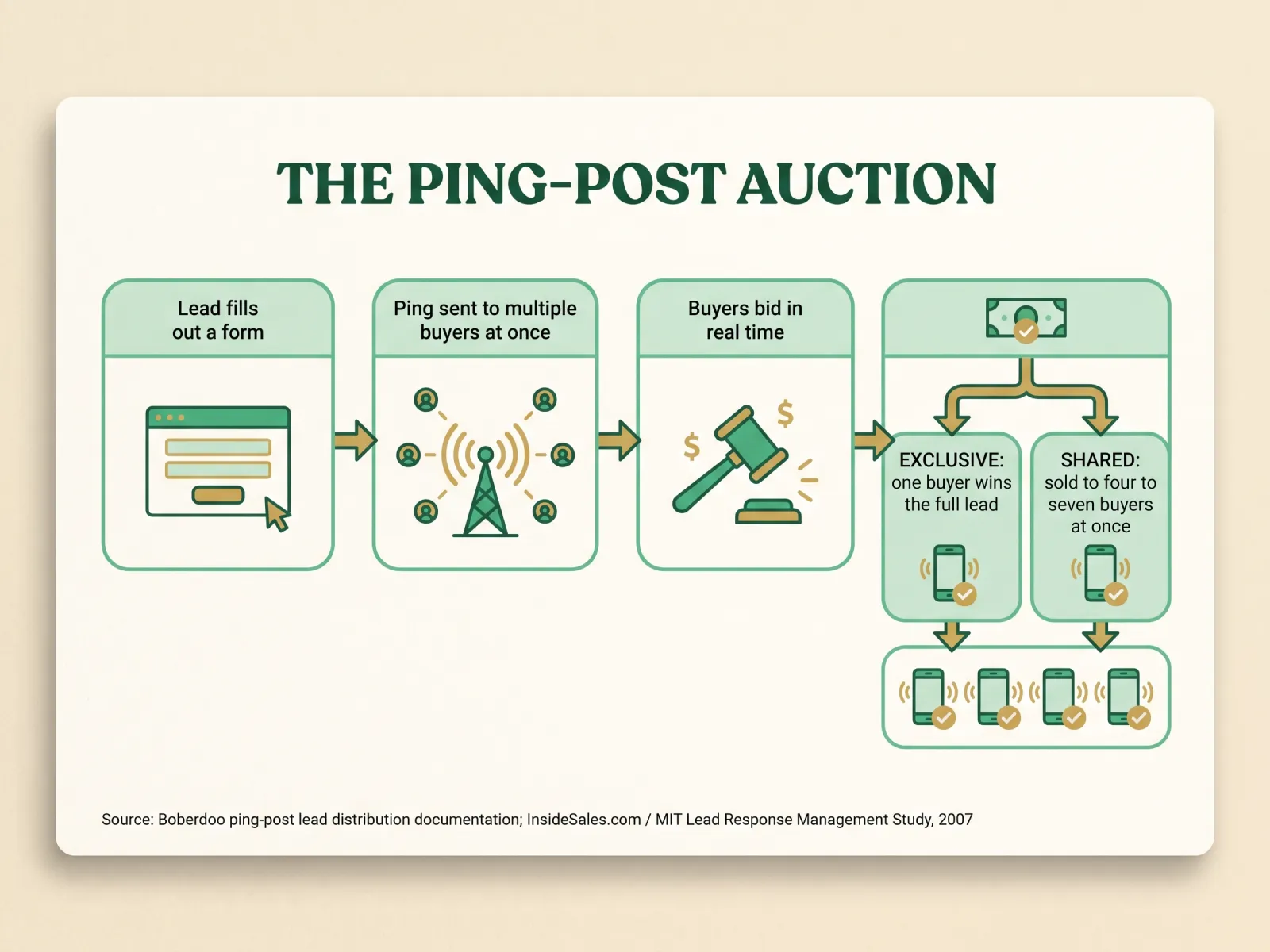
Two terms are worth defining plainly, since vendors use them loosely. Exclusive means the seller stops the auction after one buyer and posts the lead nowhere else. Shared (sometimes called “non-exclusive,” “premium shared,” or just left unlabeled) means the same submission is posted to more than one buyer, and every one of those buyers gets the real name and number, not a masked version. Nothing about the word “shared” tells you the count. It could be two buyers. Per the closest real-world data available, it’s often more.
How Many Agents Actually Get the Same Lead?
Lead vendors rarely publish an exact buyer count for a shared product, which is itself worth knowing before you assume “shared” means “a little competition.” The most concrete public data point we could find comes from a 2007 study that, unusually, tested this directly rather than just describing it.
InsideSales.com, a sales software company, partnered with Dr. James Oldroyd, then a faculty fellow at MIT’s Sloan School of Management, to study how response speed affects contact and qualification rates. The underlying analysis covered three years of data across six companies, more than fifteen thousand leads, and over one hundred thousand call attempts. As a real-world addendum to that data, the study’s authors signed up for lead forms themselves in the mortgage and insurance industries and logged exactly what happened next.
| Who signed up | First call | What happened |
|---|---|---|
| Sales manager, filled out form at 4 p.m. | Next day, noon | No call at all the first day; first of five total calls came roughly 20 hours later, near the worst time slot the same study identified for reaching someone |
| Rep, filled out form at 8:30 a.m. | 1 minute | Second call at 3 minutes, third call an hour and 45 minutes later |
| Rep, filled out form at 8:30 a.m. | 2 minutes | Two more calls the following day |
| Rep, filled out form at 10 a.m. | 2 hours | No additional calls noticed after that |
Source: InsideSales.com / MIT Lead Response Management Study, Dr. James Oldroyd, presented October 16, 2007. The study describes the leads it tested as going to "anywhere from four to seven customers based on how many called us back." This is a single documented test from 2007, the only one of its kind we found with actual logged outcomes; we are not aware of a comparable independent replication, so treat the exact buyer count as illustrative of the mechanism, not a current industry-wide figure.
Two things stand out. First, the buyer count in that test, four to seven, lines up with what vendor sites vaguely describe as “shared” without ever naming a number. Second, and more useful for anyone deciding how to run a lead program today, the timing of the first call mattered more than anything else in the table. The rep who got called in one minute heard from the vendor’s follow-up system three separate times in under two hours. The sales manager who filled out an identical kind of form at a worse time of day got nothing for almost a full day. That gap wasn’t about lead quality. It was entirely about which buyer’s system reacted first.
Ask the vendor directly
Since most lead vendors don't publish a buyer count for their shared product, ask before you buy: how many buyers per lead, and does the count change by state or line of business? A vendor that won't answer that question in plain terms is telling you something.
What Sharing Actually Costs You in Contact Rate
Here’s the part every agent already feels but rarely sees quantified: on a shared lead, you’re not just competing on price or pitch. You’re competing on the clock, against buyers you can’t see, who may already be talking to the same person while your CRM is still routing the lead to a queue.
The same 2007 study measured this directly, and the numbers are stark enough that they’re worth citing carefully, with the caveat attached. Researchers compared how a lead’s callback time affected the odds of making contact at all, and separately, the odds of qualifying that contact into a real sales conversation.
Relative odds of contacting a lead, by callback delay
Indexed to the 5-minute callback as baseline, using the study's own stated multiples
Source: InsideSales.com / MIT Lead Response Management Study, 2007. The study reports odds of contact fell 5 times from 5 to 10 minutes, and 100 times from 5 to 30 minutes; bars are indexed to those stated multiples, not a raw percentage the study itself published.
100x
Drop in the odds of contacting a lead, called at 5 minutes vs. 30 minutes
Source: InsideSales.com/MIT study, 2007
21x
Drop in the odds of qualifying a lead over the same 5-to-30-minute window
Source: InsideSales.com/MIT study, 2007
10x+
Drop in contact odds if the first attempt waits a full hour instead of minutes
Source: InsideSales.com/MIT study, 2007
$0.20
Per-minute cost of a managed AI caller, Single Account plan
Source: TheAffordableAI pricing, fetched 2026-09-01
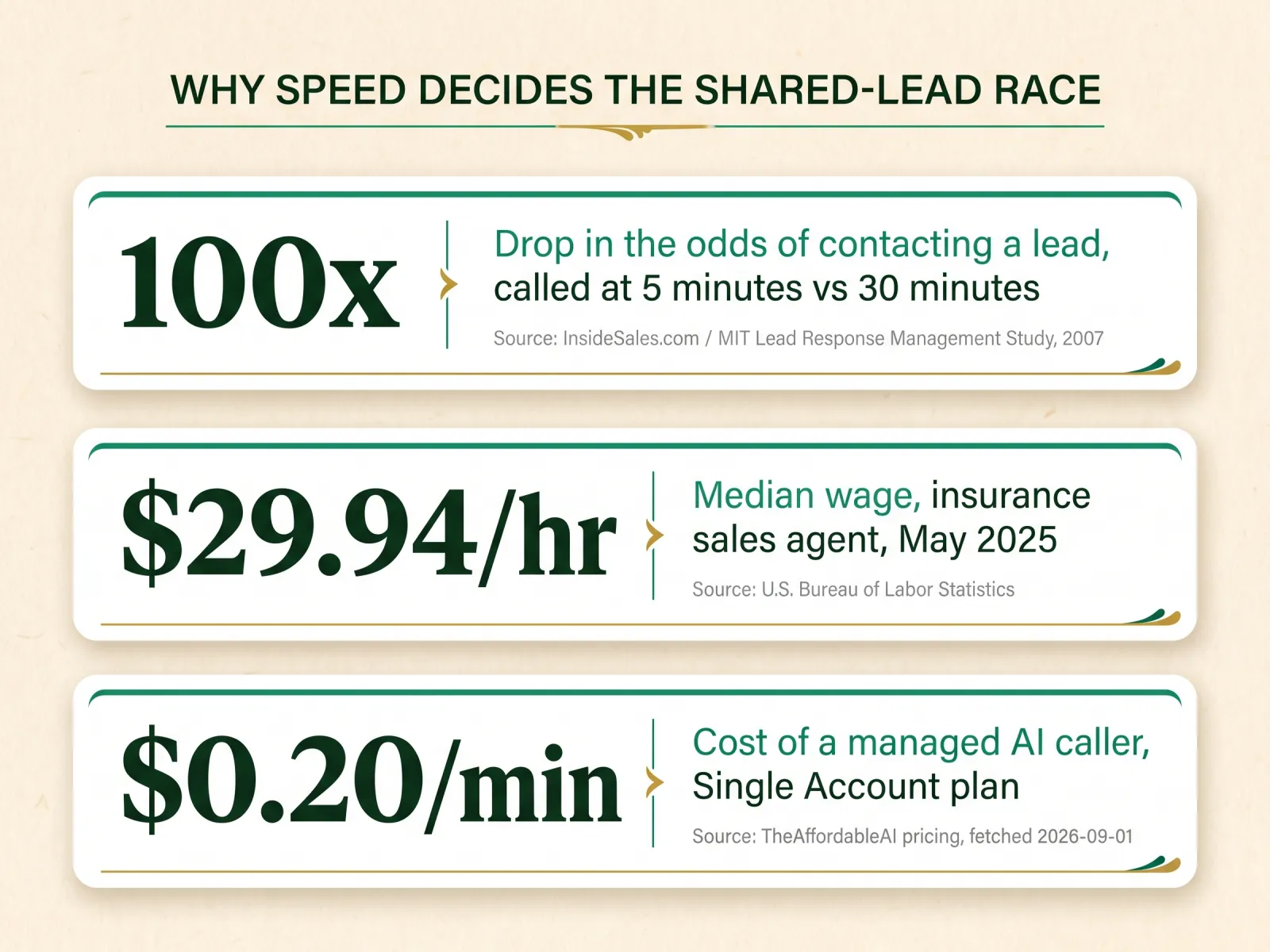
We’re citing this one study carefully on purpose. It’s from 2007, it’s the only rigorous, methodologically described test of this exact question we could locate with a real, checkable source behind it, and we did not find an independent replication with a comparable sample size. Treat the exact multiples, 100 times, 21 times, as directional rather than a number you should plug into a business case verbatim. What doesn’t need a caveat is the shape of the finding: on a shared lead, where more than one buyer is racing to the same phone number, the buyer who calls inside minutes is playing a completely different game than the one who calls in half an hour, and the gap between those two outcomes is not small.
Put plainly: a shared lead isn’t inherently a bad lead. It’s a lead where speed carries more of the outcome than it does on an exclusive one, because you’re not just beating your own follow-up habits, you’re beating whichever other buyer’s system reacts first.
Exclusive Leads: What You’re Actually Paying For
An exclusive lead removes the race. The seller stops the ping-post auction after your bid wins, and nobody else gets that consumer’s contact information from that vendor for that inquiry. You’re still competing with whatever else is going on in that person’s life, another agent they found on their own, a policy they already have coming up for renewal, but you’re not competing with three or four other buyers who got the same phone number in the same sixty seconds you did.
That’s a real, structural advantage, and it’s worth paying for in specific situations:
- Your follow-up is genuinely slow and you can’t fix it fast. If your team’s actual first-call time, measured, not guessed, runs an hour or more, exclusivity buys you time you’re not otherwise going to get. A slow call on an exclusive lead still has a real shot. The same slow call on a shared lead usually doesn’t.
- The line of business has a long sales cycle anyway. Some products don’t live or die on the first sixty seconds the way a fast-moving ACA or Medicare shopper does. If your typical sale involves multiple touches over days regardless, the shared-lead speed penalty matters less.
- Your volume is low enough that each lead has to count. At five leads a week, losing three of them to a faster competitor’s phone call is a bigger relative hit than it is at two hundred a week, where the math evens out across volume.
And here’s the part that’s easy to skip past: if you can already hit a fast, consistent first-call time on every lead, the case for paying a premium for exclusivity gets a lot weaker. You’re paying to remove a problem, speed to the phone, that you’ve already solved a different way. In that situation, the extra dollars per lead on exclusivity often buy less than the same money would buy spent on more shared leads called faster and more consistently. Nobody sourced a universal per-lead price gap between shared and exclusive that we could verify this session, since vendor pricing varies by line of business, state, and demand, so run this comparison with your own vendor’s actual quote, not a number from a blog post, ours included.
Speed is solved
- Every lead gets a first call attempt inside a few minutes, 24/7, no exceptions for nights or weekends
- Volume is high enough that a per-lead loss to a faster competitor evens out across the book
- Budget is better spent on more attempts and faster response than on fewer, pricier leads
Speed isn't solved yet
- Real, measured first-call time still runs 30+ minutes and there's no near-term fix
- Volume is low enough that losing individual leads to a faster buyer is expensive per-unit
- The sales cycle is long enough that a slower start doesn't cost the deal outright
Does the Line of Business Change the Calculation?
Yes, and it changes it more than most agents assume when they’re comparing “insurance leads” as one category. The shared-lead speed penalty bites hardest where the buying decision itself moves fast and where a consumer is likely to have submitted more than one form in the same session.
ACA and short-term health shoppers are often price-comparing across two or three sites in a single sitting, especially during open enrollment, so a shared ACA lead is frequently a genuinely multi-buyer race the moment it’s submitted. Speed matters more here than almost anywhere else in the industry, which is also why the FCC’s now-vacated one-to-one consent rule and the ongoing state-level mini-TCPA activity both concentrate so heavily on this line.
Medicare carries an extra wrinkle on top of the speed question: CMS marketing rules govern how and when a Medicare lead can be contacted at all, including the TPMO disclaimer and documentation requirements that apply regardless of whether the lead was shared or exclusive. A fast call to a Medicare lead that wasn’t properly scoped or disclosed doesn’t become compliant because it was fast. Speed and compliance are separate problems here, and fixing one doesn’t fix the other.
Final expense and life leads, especially for older consumers who may have filled out a single mailer response or a slower-loading form, don’t always move at ACA speed, but the same ping-post mechanism still applies when the lead comes through a digital aggregator rather than a mailer. If your final expense volume comes mostly from direct mail response cards rather than web forms, the shared-lead dynamic described in this article may not apply to you at all, since ping-post is specifically a real-time web auction mechanism, not a mail-response one.
P&C (auto and home) leads tend to run through the largest, highest-volume aggregators, where a consumer requesting a quote is almost always aware they’re about to get more than one call, since that expectation is baked into how comparison-shopping sites present themselves. The speed penalty is real here too, but the consumer’s tolerance for multiple calls is generally higher going in, since they asked for a comparison, not a single quote.
The practical takeaway: before applying any of the framework in this article, know which line of business you’re actually buying leads for, and know whether your lead source is a real-time web form (where ping-post applies) or a static list, mailer response, or referral (where it doesn’t). Treating every lead type as if it faces the identical multi-buyer race leads to spending on speed where speed isn’t the actual bottleneck.
The Worked Example: Same Budget, Two Strategies
Numbers make this concrete faster than argument does, so here’s one worked through using only figures we can stand behind: our own verified per-minute pricing and the U.S. Bureau of Labor Statistics’ median wage for an insurance sales agent, $29.94 an hour as of May 2025, with 572,600 people holding the job and 3% projected growth from 2025 to 2035. We’re not going to invent a specific per-lead price for shared versus exclusive leads, since that number moves by vendor, state, and line of business, and we couldn’t verify a single figure this session that would hold up across the industry. Substitute your own vendor’s real quote into this structure.
Say a licensed producer is the one making every outbound call, paid at something close to the BLS median. A ten-minute call, whether it connects or not, costs roughly $4.99 in that producer’s time. Now say that same agency runs a managed AI caller at $0.20 a minute instead for the initial outbound attempt: the same ten minutes costs $2.00, and the AI doesn’t need to be sitting idle waiting for the next lead to land, it dials the moment the CRM receives it, at 2 a.m. or 2 p.m.
| Who's calling | Rate | Cost for 10 minutes |
|---|---|---|
| Licensed producer, BLS median wage | $29.94/hour | ≈ $4.99 |
| Managed AI caller, Single Account | $0.20/minute | $2.00 |
| Managed AI caller, Agency plan | $0.18/minute | $1.80 |
Sources: U.S. Bureau of Labor Statistics, Occupational Outlook Handbook (median wage, insurance sales agents, May 2025); TheAffordableAI pricing, fetched 2026-09-01. This compares raw call-time cost only, not close rates or results, and doesn't account for the producer's time being worth more spent on calls the AI has already qualified and transferred.
Now apply that to the ping-post math above. On a shared lead, the entire advantage of an exclusive purchase is removing the multi-buyer race. If the actual bottleneck was never lead quality but how fast a human could pick up the phone, then the cheaper fix isn’t necessarily buying fewer, pricier exclusive leads. It’s making sure every shared lead you already bought gets its first call attempt inside minutes, every time, at a cost per attempt that’s lower than a producer’s own time. That’s the specific gap a managed AI caller is built to close: it doesn’t make a lead more exclusive, but it makes your response to a shared lead as fast as the fastest buyer in that ping-post auction, every single time, without asking anyone to sit by a phone at 11 p.m. on a Saturday.
A shared lead isn't a bad lead. It's a lead where the buyer who answers the phone first usually gets the conversation. Fixing that is a speed problem, not a lead-quality problem, and it's a cheaper problem to fix than most agencies assume.
Mike MooreA Simple Decision: Which One Should You Buy?
Give this away completely, because deciding correctly doesn’t require buying anything new:
- Measure your real first-call time, not the one you assume. Pull the last 90 days of leads and log two timestamps: when the lead arrived, and when your team’s first outbound attempt actually went out. Get the median and the 90th percentile, not just the average.
- If your median is already under a few minutes, buy shared and put the savings into volume or attempts. You’ve already solved the problem exclusivity is priced to solve.
- If your median is 30 minutes or worse and you can’t fix that soon, exclusive is the more honest buy right now. Don’t pay a premium for speed you’re not delivering on the shared side either; pay it to remove the race you’re currently losing.
- If the gap is fixable, fix the gap before you fix the budget. A dialer with better routing, an on-call rotation, or a managed AI caller that dials on lead creation can close a 30-minute median down to under a minute without changing which leads you buy at all. Try that first, on one lead source, and remeasure in 30 days.
- Re-run the math with your actual vendor’s shared and exclusive prices, not a number from any article, this one included, since per-lead pricing varies by vendor, state, and line of business.
- Keep the consent question separate from the speed question. Whether a lead was validly consented to be called by you is a compliance issue that exists independent of how fast you call it. Calling faster doesn’t fix a bad consent chain; it just surfaces the problem sooner.
You can run this whole framework yourself with a spreadsheet and your CRM’s timestamps, no new tool required. If the honest answer is that your team can’t hit a consistent few-minute response no matter what you try, that’s worth knowing before you spend more on lead exclusivity than on fixing the actual bottleneck.
Where a Managed AI Caller Fits
If the measurement above shows your real bottleneck is speed, not lead quality, this is the specific job TheAffordableAI is built to do: answer the shared-lead race with the fastest possible first call, every time, without needing a person to be sitting by the phone.
Outbound on lead creation
The AI dials a new lead, shared or exclusive, the moment it lands in the CRM, not whenever a person gets to the queue.
Every inbound call answered
If a shared lead calls back after a text or ringless voicemail, the line doesn't go to voicemail at 9 p.m. or on a Saturday.
Warm transfers to a licensed agent
Once a shared or exclusive lead is live and qualified, the call hands to a person while the prospect is still on the line.
Number warmup and spam defense
High call volume on shared leads is exactly the pattern that gets a number flagged; warmup and spam defense run standing, not as a one-time fix.
HighLevel CRM sync
Dispositions and transcripts land on the same contact record where the lead source and consent documentation already live.
No contracts either way
Single Account runs $200/mo plus a $500 one-time setup at $0.20/min, down to $0.15 at bulk. Agency runs $500/mo plus a $1,000 setup at $0.18/min, down to $0.16 at bulk. Cancel anytime.
There’s a live demo call on the homepage if you want to hear an actual answered call before deciding anything, and the full feature list is on the features page. You can also build a version of this yourself with a dialer, a shared inbox, and someone on call, plenty of agencies do exactly that; it’s worth pricing both before you decide either way.
What You Actually Get
Concretely: a shared lead gets a first call attempt in seconds instead of whenever your queue gets to it, which is the single variable the 2007 study found mattered most. An inbound callback at 9 p.m. gets answered instead of going to voicemail. A qualified, interested caller gets warm-transferred to a licensed agent while still on the line, rather than booked into a slot a producer discovers hours later, by which point the same person may already be signed with whichever other buyer on that ping-post auction called first.
What you don’t get, and shouldn’t expect from any AI calling product: a guaranteed close rate, a promised conversion lift, or a change in who’s legally responsible for the call. Consent, disclosure, and CMS marketing rules for Medicare still belong to the licensed agent, exactly as before AI was involved. Faster calling changes who reaches the prospect first. It does not change who’s accountable for how that prospect was contacted in the first place.
Where This Is the Wrong Fix
Be straight about the limits, because this isn’t a fix for every kind of lead problem. If your leads are shared and you’re already calling inside a minute or two, consistently, and conversion is still weak, the problem almost certainly isn’t speed, and buying an AI caller or an exclusive lead won’t touch it. Look at lead quality upstream, your pitch, or the source itself.
If your volume is low, a handful of leads a week, the arithmetic in the worked example above may not clear the $200 monthly base on a Single Account plan; run your own numbers before assuming a managed caller is the cheaper option at your volume. And no calling tool, AI or human, fixes a consent problem. If a lead was never validly opted in to be called by your agency specifically, the fix is upstream, in how the lead was sourced and what consent language the form actually carried, not in how quickly you call the number once it lands in your CRM. Our recent look at the $145 million FTC settlement against two insurance lead-generation firms covers exactly that risk in more depth.
Compliance disclaimer
Prior express consent is required for automated or artificial-voice calls and texts to a cell phone under the TCPA, regardless of whether the lead was shared or exclusive, and that obligation belongs to the licensed agent, not to any lead vendor or calling platform. Any AI caller must disclose it's AI where required by applicable law and honor opt-outs immediately. Medicare marketing carries CMS's separate rules, including the TPMO disclaimer and call recording retention requirements. Using AI for calling does not transfer compliance liability away from the licensed agent or agency. This article reflects a review of the cited sources as of the date published and is general information, not legal or business advice for your specific setup.
A shared lead isn’t a worse lead than an exclusive one. It’s a lead where the outcome depends more heavily on something almost entirely within your control: how fast your system reacts the moment it lands. The 2007 data on that point is old, and we’ve said so plainly throughout this piece, but the mechanism it documented, a ping-post auction sending the same inquiry to several buyers who then race to the same phone number, hasn’t changed. What’s changed is how cheaply and consistently an agency can win that race without staffing it around the clock.
Answer the shared-lead race before the other buyer does
There's a live demo call on the homepage. Put your number in and listen to how fast it actually answers.
Frequently asked
What's the difference between a shared and an exclusive insurance lead?
A shared lead is the same consumer inquiry sold to more than one agent at roughly the same time, commonly four to seven buyers according to a real-world test run by InsideSales.com and MIT in 2007. An exclusive lead is sold to exactly one buyer, so you're the only agent calling that person. Shared leads cost less per lead; exclusive leads cost more because the vendor is giving up the revenue of selling that same inquiry multiple times.
How many agents actually get the same shared insurance lead?
It varies by vendor and isn't publicly standardized, but the closest real-world data point comes from the 2007 InsideSales.com/MIT Lead Response Management Study, where researchers signed up for insurance and mortgage lead forms themselves and were contacted by four to seven different agents on the same submission. Most lead vendors don't publish an exact buyer count, and the honest answer is: ask before you buy, because 'shared' can mean two buyers or eight.
Is it legal for a lead vendor to sell my inquiry to multiple insurance agents?
Selling the same consumer inquiry to multiple buyers is standard practice in the lead industry and isn't illegal by itself. What matters legally is whether the consumer gave valid consent to be contacted by the specific company that ends up calling them, which is a live issue after a $145 million FTC settlement against two lead-generation firms over exactly this question. The compliance risk sits in the consent chain, not in the fact of sharing.
Are exclusive insurance leads worth the extra cost?
Sometimes. Exclusive leads remove the multi-agent race, so a slower call still has a shot. They make the most sense when your team genuinely can't call inside the first few minutes, no exceptions. If you can already hit a fast, consistent first-touch time, the extra dollars per lead on exclusivity may buy you less than spending that same money on faster, more consistent follow-up across a larger volume of cheaper shared leads.
What is a ping-post auction and how does it decide who gets a lead?
A ping-post system sends a 'ping,' meaning partial, non-identifying details about a new lead like a zip code or coverage type, to multiple potential buyers at once. Buyers respond with a bid. The system compares exclusive offers against combinations of shared offers and posts the full lead, with contact information, to whichever buyer or buyers produce the best return for the seller, according to Boberdoo's own documentation of how its lead distribution software works.
How fast do I actually need to call a shared lead to have a shot?
As fast as your system allows, measured in minutes, not hours. The 2007 InsideSales.com/MIT study found the odds of making contact with a web-submitted lead dropped roughly 100 times when the first call came at 30 minutes instead of 5, and the odds of qualifying that lead dropped roughly 21 times over the same window. That's one study, now nearly two decades old, but the underlying logic, that a shared prospect who is already talking to someone stops being reachable, hasn't changed.
Can AI calling make shared, cheaper leads worth buying again?
That's the specific bet behind using a managed AI caller on a shared-lead strategy: if the deciding factor is who calls first, and an AI caller dials on lead creation instead of whenever a human gets to the list, the cost gap between a $0.20-a-minute AI call and a producer's own hourly cost changes which leads are worth buying. It doesn't change consent or licensing requirements, and it doesn't guarantee a result, but it directly attacks the timing problem that makes shared leads underperform.
Does using an AI caller on shared leads change who's liable for TCPA compliance?
No. Prior express consent for automated or artificial-voice calls to a cell phone is required under the TCPA regardless of who or what places the call, and that obligation belongs to the licensed agent or agency, not to a lead vendor or a calling platform. Using AI to call faster doesn't transfer that responsibility. If the lead's consent to be contacted by you specifically is questionable, calling it faster doesn't fix that; it just means you find out faster.
Sources
- U.S. Bureau of Labor Statistics — Occupational Outlook Handbook: Insurance Sales Agents (median wage, employment, and 2025-35 projections, May 2025 data)
- InsideSales.com / MIT Sloan School of Management — Lead Response Management Study (Dr. James Oldroyd, presented October 16, 2007)
- Boberdoo — Ping Post Software documentation (how ping-post lead auctions and shared vs. exclusive distribution work)
- TheAffordableAI — Pricing
- TheAffordableAI — Buying Insurance Leads in 2026: The $145M FTC Warning
Put this on your own phone line
See the AI dial, qualify, and warm-transfer a live call in under a minute. No contract, no dev work.
Keep reading
Speed to Lead in 2026: Why the First 60 Seconds Decides Who Writes the Policy
The lead you paid for is not lost to a better agent. It is lost to a faster one. Here is what response time actually does to contact and conversion rates, and how to get to sixty seconds without hiring a dialer team.

Buying Insurance Leads in 2026: The $145M FTC Warning
The FTC just fined two lead-gen firms $145 million for deceptive robocalls tied to consumer leads. Here is what it means for insurance agents who buy leads.

Cost Per Call: Live Agent vs AI Voice Agent in 2026
AI voice agents run about $0.07 to $0.50 a minute in 2026, versus $0.75 to $1.40 for a US live agent. Here is the real cost-per-call math, by volume.