Should You Call, Text, or Email a New Insurance Lead First?
Calling and texting a new insurance lead trigger TCPA consent rules that email never does. Here's the legally compliant sequence that's also the fastest one.
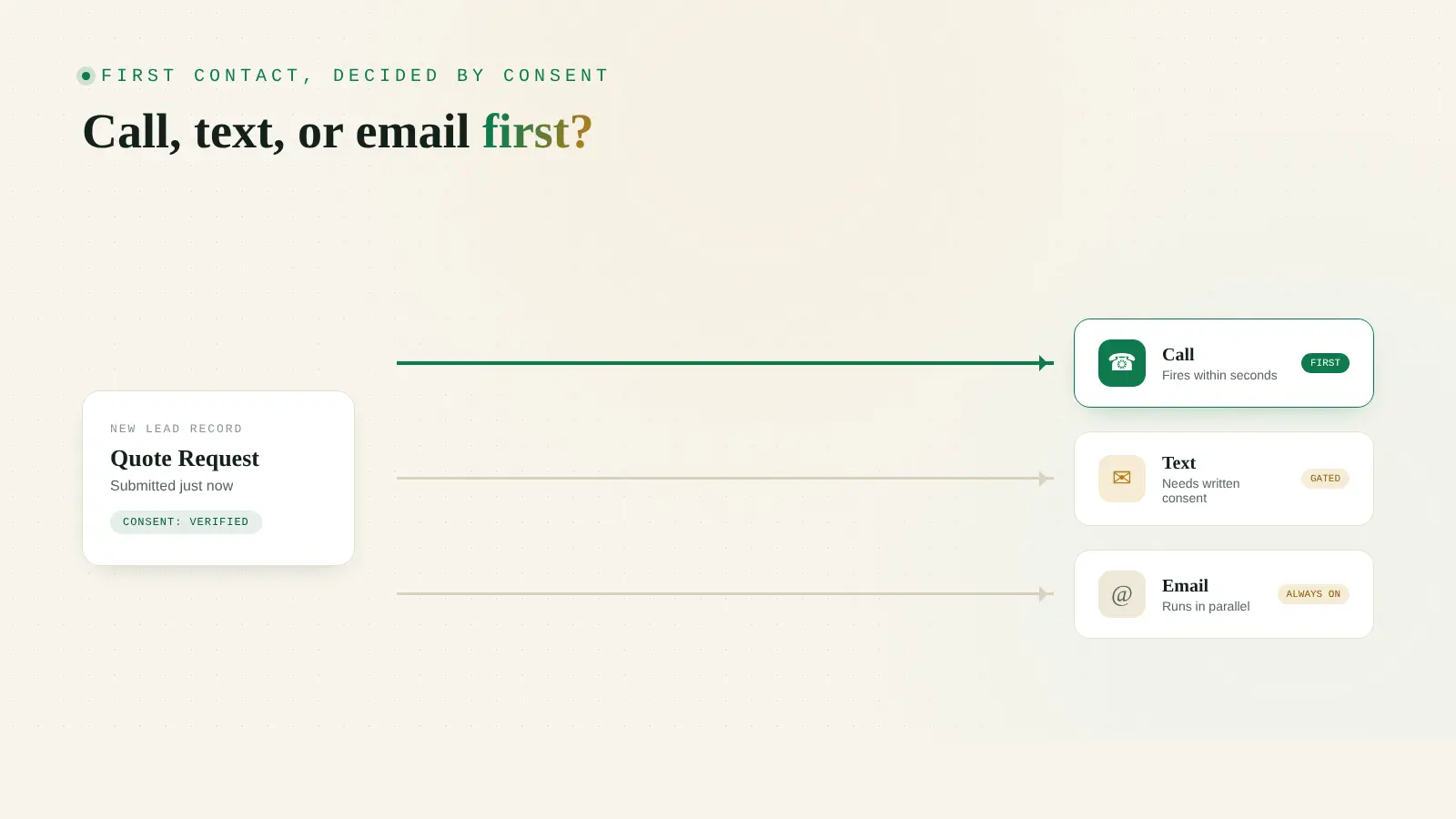
Call first, if your consent record allows it, because a phone call is the only one of the three channels that doesn’t require written proof of consent before a human places it manually. A text message does. So does any automated or AI-placed call. Email doesn’t, which is exactly why it’s the channel everyone defaults to and the one least likely to move a lead who’s filling out three other agencies’ forms in the same ten minutes. Most agencies pick a first-contact channel by habit, whichever tool is open, whoever’s turn it is, not by what the lead’s actual consent record allows or what gets a live conversation fastest. That habit is where the exposure lives, and it’s also where the speed gets lost. This article works through what the TCPA and the CAN-SPAM Act actually require for each channel, what a wrong-channel mistake costs when it’s enforced, and the sequence that’s both compliant and fast, verified against each law’s primary text and TheAffordableAI’s own pricing, this session, on October 17, 2026.
The short version
- Automated and AI-placed calls, and text messages, both require prior express written consent under 47 CFR Section 64.1200. The FCC's 2015 Omnibus Declaratory Ruling, FCC 15-72, states directly that "text messages are 'calls' subject to the TCPA."
- Email requires no prior consent at all under the CAN-SPAM Act. It's an opt-out regime: you must honor a stop request within 10 business days and disclose the message is an ad, per the FTC's own compliance guide, but you don't need permission to send the first one.
- A TCPA violation on a call or text runs $500 per violation, up to three times that for a willful violation, per 47 U.S.C. Section 227(b)(3)(B). A CAN-SPAM violation runs up to $53,088 per email. A National Do Not Call Registry violation runs up to $50,120 per call, per the FTC.
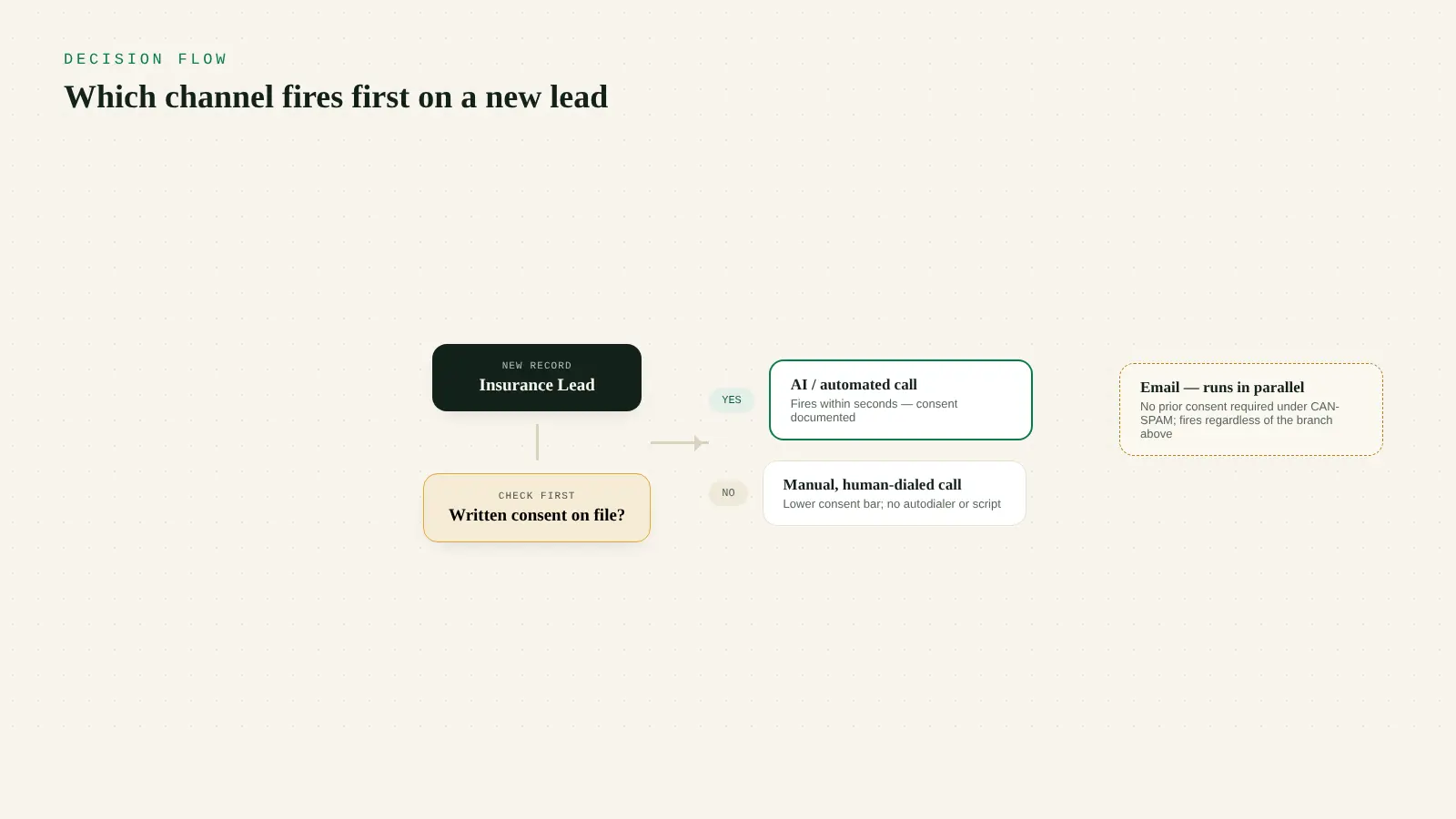
- A manually dialed call from a live person carries a lower consent bar than an autodialed or AI-placed call, because the heightened written-consent rule in Section 64.1200(a)(2) is triggered by the dialing method, not by who eventually talks to the lead.
- The sequence that's both legal and fast: verify consent first, let a compliant call fire within seconds if consent allows it, follow with a compliant text only where consent covers it, and run email in parallel the whole time since it never needed permission in the first place.
What “First Contact” Actually Decides, Legally, Before It Decides Anything About Speed
The channel you fire first on a brand-new lead isn’t a style choice. It’s a decision about which federal statute applies to that specific message, and the two statutes that cover these three channels don’t treat consent the same way at all.
A handful of terms do real work here, so define them before anything else. An autodialer, formally an automatic telephone dialing system, is equipment that can dial numbers from a list or in sequence without a person manually pressing each digit. An artificial or prerecorded voice is any call where the voice on the other end isn’t a live human speaking in real time, which includes an AI voice agent. Prior express written consent is a specific, defined legal term, not a general sense that someone “wants to be contacted”; under 47 CFR Section 64.1200(f)(9), it means a signed agreement, which can be an electronic signature, that clearly authorizes a named party to deliver automated calls or texts to a specific number, with a clear statement that agreeing isn’t a condition of any purchase. CAN-SPAM is the federal law governing commercial email, built on an opt-out model instead of the TCPA’s opt-in model.
That last distinction is the one most agencies get backwards. They treat email as the channel that needs the most care, because it feels the most “official,” and treat texting as the fast, low-friction option, because it feels the most casual. The law runs the opposite direction. Email needs no prior permission to send the first message. A text message, legally, is a call.
The one line that resolves most of this confusion
The FCC's 2015 Omnibus Declaratory Ruling and Order says it without qualification: "Text messages are 'calls' subject to the TCPA, as previously determined by the Commission." Every consent rule that applies to an automated phone call to a cell number applies to an automated text to that same number. There is no separate, lighter consent standard for SMS.
Why a Text Feels Like the Obvious First Move, and Why That’s the Riskiest Assumption in This Whole Decision
A text is cheap, fast to write, and doesn’t require anyone to pick up a phone. For an agency drowning in new leads, firing an automated “Thanks for your interest, when’s a good time to talk?” text the second a form submits feels like the responsible move, not the risky one. It’s also the move most likely to be running on a consent record that doesn’t actually cover it.
Here’s the mechanism. Under 47 CFR Section 64.1200(a)(2), initiating a call that includes an advertisement or constitutes telemarketing, using an automatic telephone dialing system or an artificial or prerecorded voice, to a wireless number requires “the prior express written consent of the called party.” The FCC’s 2015 ruling folds SMS directly into that same rule: “The TCPA’s consent requirement applies to short message service text messages (‘SMS’ or ‘text message’) in addition to voice calls.” A text sent automatically by your CRM the moment a new-lead workflow fires, to every number that comes in, is functionally identical to an autodialed call for consent purposes. If the written consent on file for that lead doesn’t specifically authorize automated calls and texts, from your agency, to that number, texting it first isn’t a shortcut around the call’s consent requirement. It’s the same requirement, just paid less attention.
This is where lead source matters more than most agencies account for. A lead who filled out your own website’s quote form, with a clear checkbox authorizing automated calls and texts from your agency specifically, has a clean consent record. A lead bought from a third-party aggregator, where the consent language was buried in a privacy policy covering “our marketing partners,” is a much murkier record, and murky is exactly where a plaintiff’s attorney or a state attorney general looks first.
| Channel | Consent needed before sending | Governing rule |
|---|---|---|
| Live person, manually dialing one number | General TCPA consent; DNC Registry and internal DNC still apply | 47 U.S.C. § 227(b); not subject to § 64.1200(a)(2)'s written-consent trigger |
| Automated or AI-placed voice call | Prior express written consent, signed, naming automated calls | 47 CFR § 64.1200(a)(2) and (f)(9) |
| Automated or bulk text message | Same written consent standard as an automated call | 47 CFR § 64.1200; FCC 15-72 (texts are "calls") |
| Commercial email | None required before the first message; opt-out must be honored after | CAN-SPAM Act; FTC Compliance Guide for Business |
Sources: Cornell Law School Legal Information Institute, 47 U.S.C. § 227 and 47 CFR § 64.1200; FCC, Omnibus Declaratory Ruling and Order, FCC 15-72 (July 10, 2015); FTC, CAN-SPAM Act Compliance Guide for Business.
Why Email Feels Safe, and Why That Safety Is Also Its Weakness
Email is the channel every agency can fire without a second thought, and that’s not wrong. The CAN-SPAM Act doesn’t ask for the recipient’s permission before the first commercial email lands in their inbox. Per the FTC’s own CAN-SPAM Act Compliance Guide for Business, the requirements kick in around what the message looks like and what happens after it’s sent, not before: accurate “From,” “To,” and routing information, a subject line that isn’t deceptive, a clear and conspicuous disclosure that the message is an advertisement, a valid physical postal address, and a working opt-out mechanism that you must honor within 10 business days of a request. None of that is a consent gate. It’s a conduct standard for a message you were already allowed to send.
That’s precisely why email can’t be your only first move on a new lead who’s actively shopping right now. There’s no equivalent of answering the phone with email. A lead comparing three agencies in the same sitting reads whichever response puts a real person, voice or text, in front of them fastest, and an email sitting in an inbox competes with every other unread message already there. Email’s strength, that it requires nothing from you to send it, is also why it carries no weight as a standalone first touch. It belongs in the sequence as the channel that always fires, not as the channel that has to work alone.
Why a Phone Call Is the Legally Simplest Channel, and the Operationally Hardest to Scale by Hand
Here’s the part that surprises most agency owners: a manually dialed phone call, a live person picking up a handset and dialing one number, carries a lower consent bar than either an automated text or an AI-placed call. The reason is mechanical, not a loophole. Section 64.1200(a)(2)‘s written-consent requirement is triggered by the method of dialing: “using an automatic telephone dialing system or an artificial or prerecorded voice.” A human dialing one number at a time, with no autodialer and no prerecorded script, isn’t making that kind of call, so that specific written-consent trigger doesn’t apply to it. The general TCPA consent requirement under 47 U.S.C. Section 227(b) still applies, along with the National Do Not Call Registry and your agency’s own internal do-not-call list, but you’re not required to produce a signed, specific authorization before a live person can manually place that first call.
That’s exactly why, when a lead’s consent record is thin, vague, or missing, the safest first move isn’t to skip contact. It’s to route that lead to a manual call instead of an automated text or an autodialed call. The call still has to happen inside the TCPA’s general rules and the Do Not Call Registry, but it doesn’t need the signed, written authorization an automated channel requires.
The operational problem is obvious the moment you try to run this at volume. A licensed producer or a staff member manually dialing every new lead, checking each one’s consent record first, scales to maybe a few dozen leads a day before something gives, usually either the consent-checking step or the speed. That’s the actual tradeoff this article is building toward: the channel with the lowest consent bar is the one that doesn’t scale without automated dialing, and the channel that scales effortlessly, an automated text, is the one with the highest consent bar.
An AI voice agent doesn't get a different rule
Using an AI voice agent to place that first call doesn't move it back to the lower manual-call standard. An AI-placed call is an automated call for TCPA purposes, full stop, which means it needs the same prior express written consent as any other autodialed or prerecorded call under Section 64.1200(a)(2). The AI doesn't carry a lighter consent bar, and using it doesn't transfer the consent obligation, or any other compliance liability, away from the licensed agent and agency whose name ends up on the policy.
What Getting the Sequence Wrong Actually Costs
Put real numbers against each mistake, because the dollar figures are what make “we’ll figure out consent later” an expensive habit rather than a harmless shortcut.
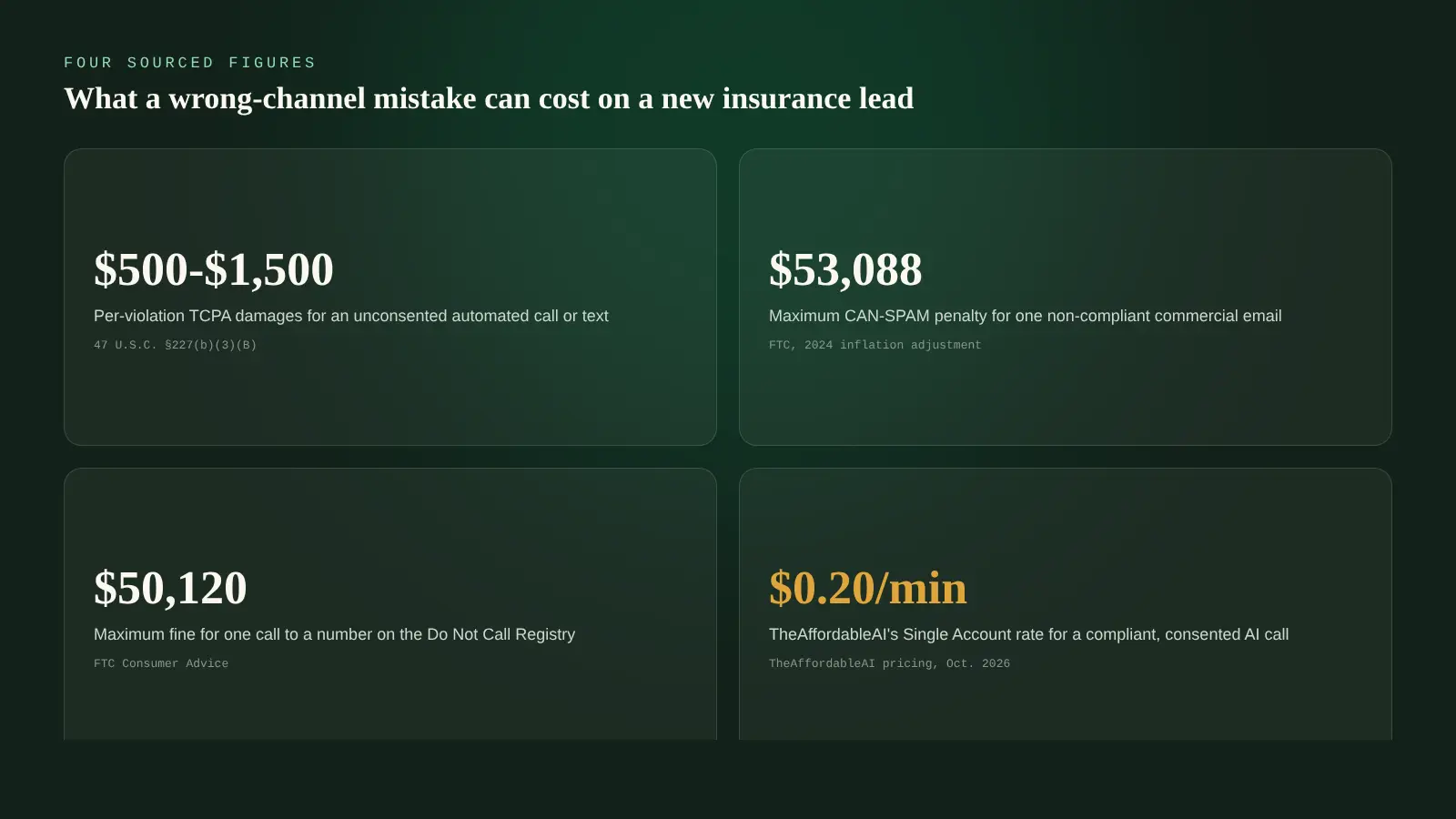
A TCPA violation on an unconsented automated call or text carries $500 in statutory damages per violation, or actual losses if higher, under 47 U.S.C. Section 227(b)(3)(B), and a court can raise that to as much as three times that amount, up to $1,500, for a violation it finds willful or knowing. That’s per message. A single automated text campaign sent to 300 numbers without verified written consent isn’t one violation if it goes wrong; it’s as many as 300, each carrying its own exposure.
A National Do Not Call Registry violation runs up to $50,120 per call, per the FTC’s own Consumer Advice page, and the agency notes telemarketers who made illegal calls have paid it more than $290 million in judgments to date. A CAN-SPAM violation, the one channel that didn’t need consent to begin with, still carries real exposure if the message itself breaks the conduct rules: up to $53,088 per email, per the FTC’s 2024 inflation-adjusted figure, for something as straightforward as a missing physical address or an opt-out that doesn’t actually work within 10 business days.
Maximum per-violation exposure, by channel mistake
Statutory maximums for a single violation of each rule
Sources: 47 U.S.C. § 227(b)(3)(B) (Cornell Law School Legal Information Institute); FTC, National Do Not Call Registry FAQs; FTC, CAN-SPAM Act Compliance Guide for Business (2024 inflation-adjusted maximum). Figures are statutory maximums per violation, not predictions of what any specific agency will be assessed.
| Mistake | Rule violated | What triggers it |
|---|---|---|
| Automated call or text with no valid written consent | $500-$1,500/violation | 47 U.S.C. § 227(b)(3)(B); consent record doesn't name automated contact |
| Calling a number on the Do Not Call Registry | Up to $50,120/call | FTC DNC rules; number was never scrubbed against the Registry |
| Non-compliant commercial email | Up to $53,088/email | CAN-SPAM Act; missing ad disclosure, address, or working opt-out |
Sources: Cornell Law School Legal Information Institute, 47 U.S.C. § 227(b)(3)(B); FTC, National Do Not Call Registry FAQs; FTC, CAN-SPAM Act Compliance Guide for Business.
Run the TCPA number at the scale an actual bulk text blast operates at. A purchased list of 400 numbers, texted automatically by a workflow with no per-number consent verification, where even a conservative quarter of those contacts, 100 numbers, turn out to lack valid written consent for automated contact, carries $50,000 in statutory exposure at the $500 floor, before any court even considers whether the conduct was willful. That’s exposure math, not a claim that any specific agency will be sued or that a lawsuit is likely; it’s the arithmetic worth doing before the campaign sends, not after a demand letter arrives.
Compare that to what it costs to do the compliant version properly. At TheAffordableAI’s published Single Account rate of $0.20 a minute, fetched from the pricing page for this article, a two-minute compliant qualifying call, made only to numbers with documented consent covering automated contact, costs about 40 cents. The compliant path isn’t the slow or expensive one here. It’s the cheap one. What’s expensive is skipping the consent check to save the handful of minutes it takes to do it.
Not legal advice
TCPA, CAN-SPAM, and state-level telemarketing and texting rules vary by state and change over time, and the specific requirements that apply to a given lead depend on its source, its documented consent, and your state's own statutes on top of the federal baseline covered here. Confirm current requirements with your compliance department, your carrier partners, or counsel before building a contact-sequencing process around anything in this article.
How to Build the Sequence Yourself, Step by Step
None of this requires buying anything. It requires treating the consent record as the first thing you check on a new lead, not an afterthought you clean up if someone complains.
- Pull the actual consent language for the lead source before any channel fires, not after. A lead from your own website’s form with a specific, named authorization for automated calls and texts is a clean record. A lead from a third-party aggregator with vague “marketing partner” language is not, and you should know which one you’re looking at before deciding what fires first.
- If written consent clearly covers automated calls and texts to that number, let a call fire first, as fast as your system allows. This is the channel most likely to produce a real conversation, and a documented, properly consented automated call is legally sound to fire within seconds of lead creation.
- If consent is thin, vague, or limited to something narrower than automated contact, route that lead to a live, manually dialed call instead of an automated text or autodialed call. The lower consent bar for a manual call exists precisely for this situation.
- Reserve the automated text for leads whose consent record specifically names it, and treat it as a follow-up to the call, not a replacement for one. A text can confirm an appointment or restate a callback time well; it’s a weak tool for a first qualifying conversation.
- Let email run in parallel on every single lead, regardless of consent status, since it never needed permission to begin with. Use it to send what the call or text already covered: a confirmation, a link to pricing, a next step. It’s your lowest-risk channel and your weakest-urgency channel at the same time; use it that way.
- Log which channel actually reached the lead, and whether consent was verified before each attempt, both for follow-up quality and as your own compliance record if a consent question ever comes up later.
- Scrub every new number against the National Do Not Call Registry and your internal do-not-call list before any automated channel touches it, consent or not. Consent and DNC status are separate checks; passing one doesn’t clear the other.
An agency that reads this and thinks “we can build a consent-tagging field in our CRM and a routing rule off it ourselves” is right. That’s a real, buildable process with a spreadsheet or a CRM custom field and some staff discipline. The part that doesn’t scale by hand is doing the consent check and firing the right channel within the first couple of minutes of every single lead landing, all day, including the ones that land at 9 p.m.
Whichever channel is open gets used first
- A new lead gets an automated text by default because it's the fastest thing to click
- Consent language gets checked only after a complaint, if at all
- Email gets treated as a backup, sent hours later, after the text and call attempts stall
- No record of which channel's consent was actually verified before it fired
The consent record decides the channel, not habit
- A documented, consented call fires within seconds of lead creation
- Thin-consent leads route to a manual call instead of an automated text
- Email runs in parallel immediately, since it never needed permission
- Every attempt logs which channel fired and what consent justified it
A Worked Example: 250 New Leads in a Week, Three Different Sources
Picture an agency pulling in 250 new leads in a week from three sources: 100 from its own website’s quote form, with a specific checkbox authorizing automated calls and texts; 100 from a purchased aggregator list with vague, bundled marketing-partner consent language; and 50 referrals, phoned in or walked in, with no digital consent record at all because nobody filled out a form.
Run it with no sequencing rule, and the instinct is to blast an automated “thanks for your interest” text to all 250 the moment they land in the CRM, because it’s the single fastest action available. That means the 100 clean website leads get a legally sound text. It also means the 100 aggregator leads get an automated text riding on consent language that may not specifically cover automated contact from your agency, and the 50 referrals, who never signed anything at all, get an automated text with no written consent record whatsoever behind it.
Run it with consent-first sequencing instead: the 100 website leads get a compliant AI-placed call within seconds, since their consent record supports it, with a text follow-up close behind. The 100 aggregator leads route to a live, manually dialed call, since their consent record is too thin for automated contact, while email runs for all of them in parallel regardless. The 50 referrals get a manual call too, since a referral with no digital form was never going to have a written automated-contact authorization on file in the first place. Every one of the 250 leads gets a fast, real attempt. None of them gets an automated channel their own consent record doesn’t support.
How We Solve It
TheAffordableAI is a managed AI caller, not a consent-verification service, and it doesn’t replace the work of knowing what a given lead’s consent record actually says. What it does, per TheAffordableAI’s own published Features page: fires outbound within under a second of a new lead landing in your CRM, around the clock, so the compliant call in the sequence above doesn’t depend on a human being at a desk when the lead arrives. It answers every inbound call the same way, warm-transfers an interested prospect to a licensed agent live, and syncs two-way with HighLevel, writing a disposition, a call summary, the transcript, and the recording back into the contact record, which is also where a consent tag belongs if you’re building the routing logic in step 1 above.
Hear how a compliant first call actually sounds
There's a live demo call on the homepage if you want to hear an AI caller handle a brand-new lead and hand off a warm transfer before you commit to anything.
Outbound within seconds, any hour
A consented lead gets the fastest channel in the sequence immediately, not whenever staff next check the queue.
Warm transfer to a licensed human
A qualified, interested lead reaches a licensed agent live, on the call, instead of waiting for a callback.
HighLevel sync for the consent trail
Every call's disposition, transcript, and recording write back automatically, feeding the exact record a consent dispute would ask for.
The compliant channel and the fast channel are usually the same channel. The expensive mistake isn't choosing wrong between them; it's never checking which one your consent record actually allows.
Pricing, since the math above depends on it: Single Account runs $200 a month plus a $500 one-time setup fee, at $0.20 a minute, dropping toward $0.15 at bulk volume. Agency runs $500 a month plus a $1,000 one-time setup fee, at $0.18 a minute, dropping toward $0.16 at bulk volume, and adds routing to 20-plus agents at once, useful if different consent-tier leads need different licensed agents picking up the warm transfer. Both plans run month to month with no long-term commitment, per TheAffordableAI’s pricing page fetched for this article. You can build the consent-tagging and routing logic yourself in a CRM with a custom field and a disciplined team; plenty of agencies do. It’s worth pricing that build against a managed option before your next bulk lead buy forces the sequencing decision for you.
Where This Doesn’t Fix Anything
Say this plainly: no calling platform, AI or human, fixes a consent problem that exists upstream of it. If a lead’s number was never validly, specifically authorized for automated contact, and your lead source can’t produce that authorization, the fix is in how you sourced the lead or in routing it to a manual, non-autodialed call, not in which software eventually dials or texts it. A sequencing rule tells you which legal channel to use once consent is known; it can’t manufacture consent that was never captured. And if your agency’s volume is small enough that a disciplined person can check a consent field and pick up the phone for every new lead inside a couple of minutes, the automation in this article may not move the needle much. Run your own volume against the numbers above before assuming otherwise.
What You Get When the Sequence Is Right
A lead’s consent record decides what you’re legally allowed to do before speed ever enters the picture, and getting that order backwards, checking speed first and consent later, is how a fast agency turns into an exposed one. Get the order right, and the two goals stop competing: the channel with the cleanest consent record is usually also the one that reaches a shopping lead fastest, because a documented, properly consented call or a manual dial both outrun an email sitting in an inbox. The 250-lead example above didn’t trade compliance for speed in either direction. It got both, by checking the one thing, the consent record, before deciding anything else.
Frequently asked
Should you call, text, or email a new insurance lead first?
Call, if you can do it inside the consent rules below, because a phone call is the one channel that doesn't require written proof of consent before a human dials it manually. An automated or AI-placed call, and any text message, both require prior express written consent under 47 CFR Section 64.1200 before you send them, per Cornell Law School's Legal Information Institute. Email requires no prior consent at all under the CAN-SPAM Act, but it carries no urgency signal and routinely sits unread for hours. The practical sequence: a manually dialed call or a properly consented automated call fires first, a compliant text follows if you have documented consent for that channel, and email runs in parallel as a paper trail, never as the lead's first real contact.
Do you need consent to text a new insurance lead?
Yes, if the text is automated, sent in bulk through a platform, or counts as telemarketing. The FCC's 2015 Omnibus Declaratory Ruling and Order, FCC 15-72, states plainly that "text messages are 'calls' subject to the TCPA" and that "the TCPA's consent requirement applies to short message service text messages ('SMS' or 'text message') in addition to voice calls." That means the same prior express written consent standard in 47 CFR Section 64.1200 that governs an autodialed phone call also governs an automated marketing text to that same cell number. A single, manually typed and sent text from a human, to one number, is a different risk profile, but most CRM-triggered "new lead" texts are automated by definition.
Is it legal to send an automated text to a lead before you've called them?
It can be, but only if you already have prior express written consent on file for that exact number and that exact kind of message. Consent isn't channel-specific in a way that lets you skip it for texts and keep it for calls; under 47 CFR Section 64.1200(f)(9), prior express written consent is defined as a signed agreement authorizing automated calls or texts, and the FCC's 2015 ruling treats texts as calls for this purpose. If a lead's intake form only checked a box about being "contacted," with no specific authorization for automated or prerecorded calls and texts, texting them first on the strength of that checkbox is exactly the kind of gap that creates exposure.
Does email require the same consent as a call or text?
No, and that's the most important distinction in this whole decision. The CAN-SPAM Act, enforced by the FTC, does not require a recipient's prior consent before you send a commercial email; it's an opt-out regime, not an opt-in one. What it does require is that you honor an opt-out request within 10 business days, disclose clearly that the message is an advertisement, include a valid physical postal address, and use accurate header and subject-line information, per the FTC's own CAN-SPAM Act Compliance Guide for Business. That makes email the easiest channel to fire legally, and also the one with the least power to move a lead who is actively comparing agencies right now.
What happens if you send a bulk text blast to a purchased lead list?
You inherit whatever consent gap exists in that list, and the penalty is per message, not per campaign. Under 47 U.S.C. Section 227(b)(3)(B), a consumer can recover $500 in damages for each violation, or actual losses if higher, and a court can increase that to as much as three times that amount for a willful or knowing violation, per Cornell Law School's Legal Information Institute. A purchased list of a few hundred numbers with unclear or absent written consent for automated texts isn't a bargain if even a fraction of those contacts turn into documented violations; run that arithmetic before a single message goes out, not after.
Can a human agent manually call a lead without the same consent requirements as an AI caller?
The consent bar is lower for a manual call, not absent. 47 CFR Section 64.1200(a)(2) specifically requires prior express written consent for a call that uses an automatic telephone dialing system or an artificial or prerecorded voice. A live person, manually dialing one number at a time with no autodialer or prerecorded script, isn't making that kind of call, so the heightened written-consent bar doesn't apply to that specific call. The general TCPA consent requirement, the National Do Not Call Registry, and your own internal do-not-call list still apply regardless of who or what dials the number.
Does using an AI voice agent change which consent rule applies?
No. An AI voice agent placing an outbound call is an automated call for TCPA purposes, which means it needs the same prior express written consent as any other autodialed or prerecorded call under 47 CFR Section 64.1200(a)(2). Using AI to place or answer the call does not transfer that consent obligation, or any other compliance liability, away from the licensed agent and agency whose name is on the eventual policy. The AI doesn't get a lighter standard, and it doesn't get a heavier one either; it gets the exact standard a human using an autodialer would get.
What's the safest sequence for a brand-new lead with unknown consent status?
Treat the consent record as the first thing you check, before any channel fires. If the lead's documented consent clearly covers automated calls and texts, an AI-placed call can fire within seconds, with a compliant text as a fast follow-up and email running in parallel. If the consent record is missing, vague, or limited to something narrower than automated contact, route that lead to a live, manually dialed call instead of an automated text or an autodialed call, and let email run alongside it regardless, since email never needed that consent in the first place.
Sources
- Cornell Law School Legal Information Institute — 47 U.S. Code Section 227, Telephone Consumer Protection Act
- Cornell Law School Legal Information Institute — 47 CFR Section 64.1200, Delivery restrictions and consent requirements
- Federal Communications Commission — In the Matter of Rules and Regulations Implementing the TCPA, Omnibus Declaratory Ruling and Order, FCC 15-72 (released July 10, 2015)
- Federal Trade Commission — CAN-SPAM Act: A Compliance Guide for Business
- Federal Trade Commission — National Do Not Call Registry FAQs (Consumer Advice)
- TheAffordableAI — Pricing
- TheAffordableAI — Features
Put this on your own phone line
See the AI dial, qualify, and warm-transfer a live call in under a minute. No contract, no dev work.
Keep reading

Speed to Lead in 2026: Why the First 60 Seconds Decides Who Writes the Policy
The lead you paid for is not lost to a better agent. It is lost to a faster one. Here is what response time actually does to contact and conversion rates, and how to get to sixty seconds without hiring a dialer team.

The Insurance Lead Follow-Up Cadence That Works (2026)
Most agents quit after two calls. Here is the insurance lead follow-up cadence backed by real response-time data, and how to automate every attempt.

A2P 10DLC for Insurance Agents: Why Texts Get Blocked
Unregistered business texts get blocked outright, not delayed. Here's what A2P 10DLC requires, what it costs, and how to register an agency in 2026.