Texas No-Call List Rules for Insurance Agents (2026)
Texas exempts insurance agents from its No-Call List, but only without an autodialer. What changes when you add AI calling, and what SB 140 adds on top.

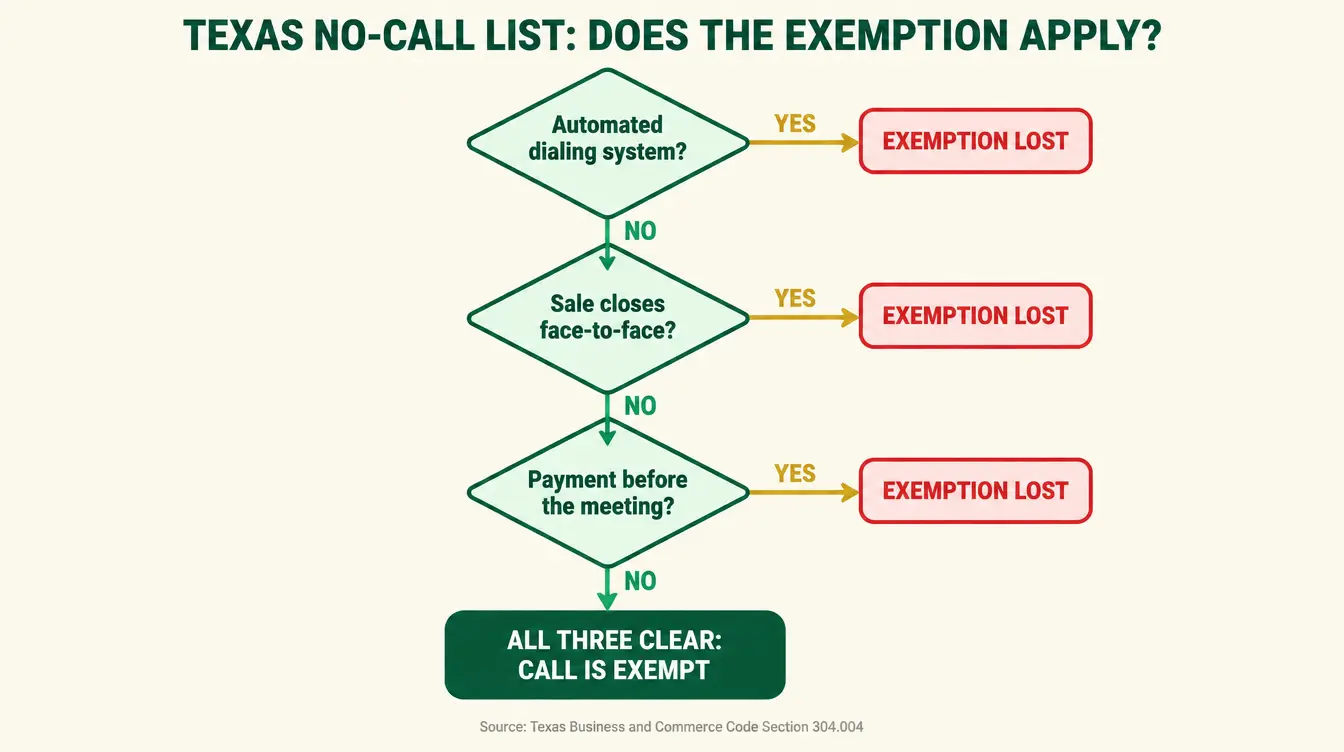
Yes, Texas insurance agents are exempt from the state’s own No-Call List, but the exemption has three conditions, and the first one is the one an AI voice caller or predictive dialer breaks automatically. Texas Business and Commerce Code Section 304.004 excuses a licensed agent from Section 304.052’s no-call-list prohibition only when the call isn’t made by an automated telephone dialing system, the sale doesn’t close until a face-to-face meeting, and the consumer isn’t asked to pay until after that meeting. A manual dial from a spreadsheet, closed in person, clears all three. An AI voice agent dialing the same list doesn’t clear the first one, full stop, and that single word, “automated,” is the difference between an agency that’s exempt from Texas’s state no-call database and one that has to scrub against it like anybody else.
The short version
- Texas Business and Commerce Code Section 304.004 exempts a licensed insurance agent from the Chapter 304 no-call-list prohibition, but only when the call isn't automated, the sale closes face-to-face, and payment waits until after that meeting.
- Adding an AI voice caller or a predictive dialer breaks the first condition immediately, which puts every Texas number back under Section 304.052 and the Texas no-call list's 60-day scrub rule, separate from the national Do Not Call Registry.
- Chapter 304's "telephone call" definition already covers text and image messages to a mobile number, so an automated SMS follow-up sequence loses the exemption the same way an automated voice campaign does.
- Senate Bill 140, effective September 1, 2025, didn't touch the exemption's wording, but it made violations of Chapter 302 and Chapter 304 a deceptive trade practice under Texas's DTPA, opening the door to treble damages, mental anguish damages, and mandatory attorney's fees.
- A federal district court in Texas dismissed a mini-TCPA claim against a licensed life insurer in June 2026 on the strength of this exact kind of insurance-licensee exemption, so the exemption is tested law, not a theory.
What the Texas No-Call List Actually Is
Texas runs its own do-not-call database, separate from the FTC’s National Do Not Call Registry, under Business and Commerce Code Chapter 304, titled the state’s telemarketing law. Section 304.051 directs the state to maintain “a database to compile a list of names, zip codes, and telephone numbers of consumers in this state who object to receiving telemarketing calls or other unsolicited telephone calls.” That list isn’t built from scratch: it combines every Texas consumer who requested to be added directly with “each person in the portion of the national do-not-call registry maintained by the United States government that relates to this state,” so a Texas number already on the federal registry lands on the state list too, automatically.
Define the terms before the exemption matters
Telephone call: under Section 304.002, this is defined broadly as a call or other transmission to or received at a telephone number, and it explicitly includes "a transmission of a text or graphic message or of an image" to a mobile number, not just voice calls. Automated telephone dialing system: the technology the exemption turns on; the statute doesn't carve out a narrower definition for AI-generated speech, so a real-time conversational AI caller reads as automated dialing the same way a predictive dialer does. State licensee: a person licensed by a Texas state agency, which includes an agent or producer holding a license under the Texas Insurance Code. Telemarketer: the party Chapter 304 regulates by default, before any exemption is applied.
The practical prohibition sits in Section 304.052: “A telemarketer may not make a telemarketing call to a telephone number published on the Texas no-call list more than 60 days after the date the telephone number appears on the current list.” That list republishes four times a year. Per Section 304.051, updates and publication happen “January 1, April 1, July 1, and October 1,” which means the file an agency is scrubbing against today, October 2026, was refreshed on October 1 and is good until the January 1 update, not indefinitely.
The Insurance-Agent Exemption, and the Catch
Section 304.004 lists several categories of calls the chapter doesn’t reach at all, including consumer-initiated calls, established business relationships, and business-to-business solicitations unless the business itself opts out. Buried in that same list is the one that matters most for a licensed producer: a call made by a state licensee is exempt from Section 304.052’s no-call-list prohibition, but only when every one of three conditions holds. The statute’s own language, read directly: “the call is not made by an automated telephone dialing system,” “the solicited transaction is not completed until a face-to-face sales presentation by the seller occurs,” and “the consumer is not required to pay or authorize payment until after the presentation.”
Read those three together and the exemption describes a specific, old-fashioned sales motion: an agent picks up a phone, dials a Texas lead by hand, has a live conversation, and if the lead is interested, closes the sale in person at a later meeting where the actual paperwork and payment happen. That’s the only shape of call Section 304.004 was written to excuse. It wasn’t written with a managed AI voice platform in mind, and it doesn’t bend to accommodate one.
A Texas federal court has already tested a close cousin of this exemption in practice. In Sutton v. Senior Life Insurance Company, decided by the U.S. District Court for the Western District of Texas on June 1, 2026, the plaintiff alleged the defendant made telephone solicitation calls without the registration certificate Chapter 302 normally requires. The court dismissed the claim because the defendant held a Texas life insurance license and the calls concerned life insurance products, which brought it inside the separate Insurance Code licensee exemption at Section 302.053. That case tested the registration exemption, not the no-call-list exemption at Section 304.004 specifically, but it establishes the same underlying point a plaintiff’s attorney has to grapple with: Texas courts are willing to enforce these insurance-specific carve-outs as written when a licensed carrier or agent actually fits inside them.
Fitting "inside" the exemption is the whole fight
Sutton won because the defendant's calls matched what its licensing and its sales process actually looked like. An agency that assumes it's covered because it holds an insurance license, while actually running automated or AI-voice outbound, is reasoning backward: the license alone satisfies neither Section 304.004's dialing-method condition nor Section 302.053's registration exemption on its own. The conditions attach to how the call is made, not just to who's making it.
What Changes the Moment You Add an Autodialer or AI Caller
Here’s the mechanism, stated plainly: an agency currently exempt under Section 304.004 because it manually dials and closes face-to-face loses that exemption entirely for any call it routes through automation instead. There’s no partial exemption, no grandfathering of some numbers and not others based on history. The question Section 304.004 asks is how this specific call was made, not how the agency usually operates.
Once the exemption is gone, three things follow immediately. First, every Texas number in the calling list has to be checked against the current Texas no-call list file, the one the state republishes every January 1, April 1, July 1, and October 1, not just the national Do Not Call Registry a CRM might already be scrubbing by default. Second, Section 304.052’s 60-day clock applies: a number that’s been on the current Texas list for more than 60 days can’t be called, a timing rule with no equivalent inside the national registry’s own framework. Third, the underlying federal TCPA consent requirement, which never went away even while the state exemption applied, now sits alongside a second, state-specific list an agency has to actually hold and check.
| Statute | What it regulates | Insurance-specific exemption? | Per-violation exposure |
|---|---|---|---|
| Chapter 304 (No-Call List) | Calling a number on the Texas no-call list, Section 304.052 | Yes, Section 304.004, but only for non-automated, face-to-face-close calls | Up to $500/violation if willful or knowing, Section 304.257 |
| Chapter 302 (Registration) | Making telephone solicitations without a Secretary of State registration | Yes, Section 302.053, for Insurance Code licensees | Up to $5,000/violation; injunction violations up to $25,000/$50,000, Section 302.302 |
| Chapter 305 (Mobile Consent) | Sales calls to a mobile number without consent, Section 305.001 | None specific to insurance licensees | Greater of actual damages or $500/violation, up to $1,500 if knowing, Section 305.053 |
Sources: Texas Business and Commerce Code Sections 304.004, 304.052, 304.257, 302.053, 302.302, 305.001, and 305.053.
Notice that Chapter 305, the statute that most resembles the federal TCPA’s own cell-phone consent rule, carries no insurance-specific exemption at all. Being a licensed agent exempts a call from Chapter 304’s no-call-list prohibition and from Chapter 302’s registration requirement under the right conditions. It does nothing for Chapter 305’s separate requirement that a sales call to a mobile number have the called party’s consent in the first place. An agency can be fully inside the Section 304.004 exemption and still violate Section 305.001 on the same call if consent isn’t documented.
What a Violation Actually Costs
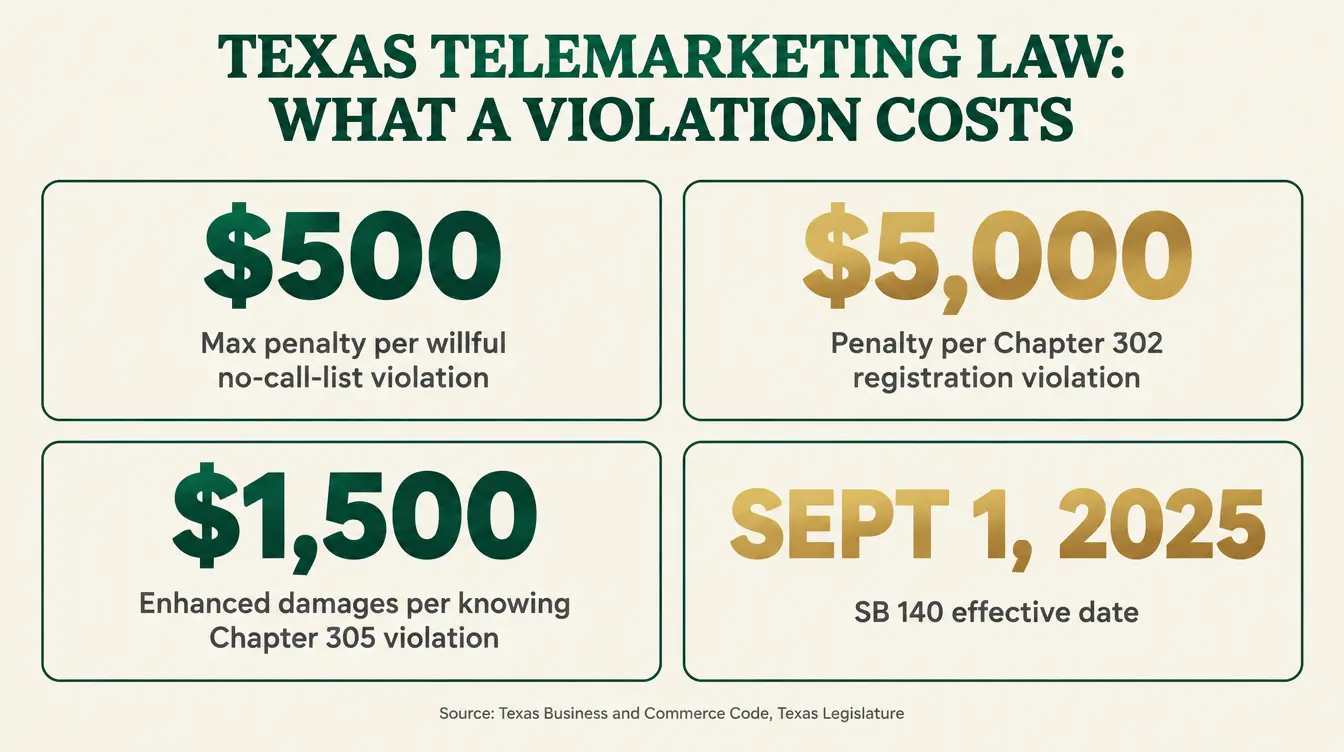
The dollar figures above look small individually next to a campaign that might touch thousands of numbers, and that’s exactly the trap. These are per-violation figures, not per-campaign caps, and Texas’s 2025 amendments gave every one of them a second, larger track to run on.
$500
Max civil penalty per willful Texas no-call-list violation
Source: Bus. & Com. Code Section 304.257
$5,000
Civil penalty per Chapter 302 registration violation
Source: Bus. & Com. Code Section 302.302(a)
$1,500
Enhanced damages per knowing Chapter 305 mobile-consent violation
Source: Bus. & Com. Code Section 305.053
$0.20
Per-minute cost of a managed AI caller, Single Account plan
Source: TheAffordableAI pricing, fetched 2026-10-04
Run the arithmetic the way a plaintiff’s attorney would. A Chapter 305 claim alone, filed by one consumer over one call, is worth up to $1,500 if the violation is found knowing, plus the consumer’s attorney’s fees are a live possibility once Section 17.50’s DTPA machinery is in play for a related Chapter 302 or 304 claim on the same facts. A single automated campaign that dials even a few hundred numbers still on the Texas no-call list, without the state-licensee exemption to fall back on, isn’t exposed to one violation; it’s exposed to one violation per number, and Section 17.50 allows that per-violation economic damage figure to be tripled for a knowing violation, on top of mental anguish damages and mandatory attorney’s fees for a prevailing consumer. None of this requires a regulator to act first. Chapter 304’s Section 304.257 and Chapter 305’s Section 305.053 both let an individual consumer sue directly, and SB 140 extended that same private right of action to Chapter 302 as well.
The penalty that doesn't show a number
Section 304.254 lets the Public Utility Commission impose its own administrative penalty for a no-call-list violation, calculated case by case from "the seriousness of the violation," any history of prior violations, and "the amount necessary to deter a future violation," among other factors. The statute sets no fixed dollar ceiling for that administrative track, which makes it harder to arithmetic around than the civil penalties above, not easier to ignore.
SB 140: The Risk Layered on Top
Senate Bill 140, passed by the 89th Texas Legislature and effective September 1, 2025, didn’t rewrite Section 304.004’s exemption language at all. What it did was close a gap that had let a specific kind of telemarketer slip past Chapter 302 entirely, and it raised the stakes for violating either Chapter 302 or Chapter 304 regardless of who’s doing the violating.
The gap: Chapter 304 had defined “telephone call” to include text and image messages to a mobile number since the statute was first enacted, but Chapter 302, the registration chapter, never adopted that same broad definition on its own. A 2022 case, Powers v. One Technologies, found that a company sending text messages didn’t qualify as a telemarketer under Chapter 302 specifically, because that chapter’s own text didn’t contemplate text messages at all. SB 140’s bill analysis, prepared for the Texas Legislature, describes the fix directly: the bill “amends Chapter 302 of the Business and Commerce Code to add the definition of ‘telephone call,’ as found in Chapter 304,” closing the loophole by importing the same broad definition into the chapter that had been missing it.
The second change matters more for exposure than for coverage. SB 140 declared that a violation of Chapter 302 or Chapter 304 is, by itself, “a false, misleading, or deceptive act or practice” under Subchapter E of Chapter 17, the Texas Deceptive Trade Practices-Consumer Protection Act. Before that, a Chapter 304 no-call-list violation was capped at Section 304.257’s own civil-action figure. After September 1, 2025, the same violation can also support a DTPA claim, and Section 17.50 lets a court award treble economic damages for a knowing violation, damages for mental anguish on top of that, and mandatory court costs and attorney’s fees for the prevailing consumer. That’s a materially larger number than $500 or $5,000 per violation, and it attaches automatically to the same underlying facts, not as a separate thing a consumer has to prove from scratch.
SB 140 didn't change who's exempt in Texas. It changed what happens to everyone who isn't.
Mike MooreDoes This Cover Text Messages Too?
Yes, and the mechanism is the same one that governs voice calls, not a separate text-specific rule bolted on. Section 304.002 defines “telephone call” for the entire chapter, including the no-call-list prohibition in Section 304.052 and the state-licensee exemption in Section 304.004, to include “a transmission of a text or graphic message or of an image” to a mobile telephone number. That definition predates SB 140; SB 140’s contribution was importing the same language into the separate registration chapter, Chapter 302, which had been missing it.
Practically, this means an automated SMS follow-up sequence to a Texas lead, sent by a platform rather than typed and sent by hand, is “automated” in the same sense an AI voice call is, and it loses the Section 304.004 exemption the same way. A text-based drip campaign that doesn’t scrub against the current Texas no-call list, or that keeps texting a number more than 60 days after it appears on the published list, is exposed under Section 304.052 exactly like an unscrubbed voice-dial list would be. Agencies that have built careful voice-calling compliance while treating texting as a lighter-touch, lower-risk channel are applying an assumption Chapter 304’s own definition doesn’t support.
How Insurance Agents Calling Texas Leads Stay Compliant
None of this means automation is off the table in Texas. It means the exemption an agency may have relied on without thinking about it doesn’t travel with the switch to automated calling, and the compliance work that follows has to be built deliberately rather than assumed.
- Decide, honestly, whether your current process actually clears all three Section 304.004 conditions. If a human dials by hand and the sale closes in a later, in-person meeting with payment collected there, the exemption applies. If any part of that is automated, including a dialer that auto-connects an agent only after detecting a live answer, get a specific answer on whether that still counts as “not made by an automated telephone dialing system” before assuming it does.
- Pull the actual Texas no-call list file, not just the national registry. Section 304.051’s state-maintained database republishes January 1, April 1, July 1, and October 1. A CRM or dialer that only scrubs against the federal Do Not Call Registry by default isn’t checking the state list, and the two aren’t identical even though the state list incorporates the federal one.
- Rebuild your suppression schedule around the 60-day clock in Section 304.052, not just whatever refresh cadence the national registry uses. A number that cleared the national scrub can still be too old against the Texas-specific list if more than 60 days have passed since it last appeared.
- Treat automated text sequences with the same scrutiny as automated voice calls. Section 304.002’s broad “telephone call” definition means an SMS drip to a Texas number carries the identical no-call-list exposure a robocall would.
- Document consent for every Texas mobile number independently of the Section 304.004 exemption question. Chapter 305 has no insurance-specific carve-out, so clearing Chapter 304 and Chapter 302 says nothing about whether a specific call to a cell number had the consent Section 305.001 and the federal TCPA both require.
- Keep the DTPA exposure in mind when deciding what “low risk” means. A violation that used to cost, at most, a few hundred or a few thousand dollars per instance now carries a plausible path to treble damages, mental anguish damages, and the other side’s attorney’s fees, which changes the math on how carefully a dial list needs to be scrubbed before it goes out.
- Don’t assume a license alone protects an automated campaign. Sutton shows Texas courts will enforce these insurance-specific exemptions as written, but Sutton’s defendant fit the exemption’s actual conditions. A license is necessary for several of these carve-outs; by itself, it isn’t sufficient.
Where Texas Law Doesn’t Reach
Be precise about the limits here, the same way it’s worth being precise about the exemption. Section 304.004 is narrow by design: it excuses a specific, old-fashioned sales motion from one specific prohibition, Section 304.052. It says nothing about the federal TCPA’s own consent requirements, which apply to a Texas call exactly as they apply anywhere else, exemption or no exemption. A manually dialed, face-to-face-closed call that’s fully exempt from the Texas no-call list can still violate the federal TCPA if it’s placed to a number on the national registry outside an applicable exemption there, or if it’s an autodialed or artificial-voice call made without the called party’s prior express consent.
The exemption also doesn’t touch Chapter 305 at all. An agency that’s correctly exempt under Section 304.004 and correctly exempt under Section 302.053’s registration carve-out can still be the defendant in a Chapter 305 claim if a specific call to a mobile number lacked documented consent. Three statutes, three separate questions, and clearing two of them answers nothing about the third.
How TheAffordableAI Handles This
Suppression lists kept current
Numbers flagged for do-not-call status, state or national, stop getting dialed without a rep having to remember to update a list by hand.
Every call timestamped and logged
A record of when and to whom a call went out is the raw material behind proving which calls were inside any exemption window and which weren't.
Opt-outs honored immediately
A stop request halts future outreach to that number across voice and text, rather than depending on someone manually propagating it across channels.
HighLevel CRM sync
Dispositions and consent records sync automatically, building the documentation trail a Chapter 305 consent question or a DTPA claim would actually test.
Warm transfers and number warmup
Scrubbing a list carefully doesn't have to mean fewer connected conversations on the numbers that remain eligible to call.
No contracts either way
Single Account runs $200/mo plus a $500 one-time setup at $0.20/min, down to $0.15 at bulk. Agency runs $500/mo plus a $1,000 setup at $0.18/min, down to $0.16 at bulk.
None of this decides, for your agency, whether your current process actually clears Section 304.004’s three conditions, or whether a specific Texas number has the consent Chapter 305 requires. A platform can surface the suppression list and the consent timestamp; it can’t tell you whether switching from manual dialing to an AI voice caller is worth losing an exemption you may not have realized you were relying on. If you want to hear what an actual AI call and its disclosure sound like before deciding anything, there’s a live demo call on the homepage. You can also build your own scrub-and-suppress process against a compliant dialer without a managed platform; plenty of agencies do, and it’s worth pricing that build against the pricing page either way.
What You Actually Get
Concretely, knowing the actual mechanism, three conditions, one state list, a 60-day clock, turns a rule an agency could blow past without noticing into something a dial list and a scrub step can check before a single number gets called. It means an agency deciding whether to automate Texas outbound can ask the right question first: are we currently relying on the Section 304.004 exemption, and if so, what does losing it actually require us to build? It means an automated text sequence gets evaluated under the same no-call-list standard as an automated voice campaign, instead of being treated as lower-risk by habit.
It doesn’t answer every open question. Whether a specific hybrid process, say, an AI caller that only qualifies leads before handing off to a human who closes face-to-face, still counts as “not made by an automated telephone dialing system” for Section 304.004’s purposes hasn’t been tested in a reported Texas decision that this article found. This article reflects a review of the cited statutes, legislative history, and the Sutton decision as described by the cited secondary source, as of the publish date; it’s general information, not legal advice for your specific agency. Talk to counsel licensed in Texas before finalizing a compliance policy built around these provisions.
Compliance disclaimer
Prior express consent is required for an automated or artificial-voice call to a cell phone under the federal TCPA, 47 U.S.C. Section 227, regardless of any Texas-specific exemption. Texas Business and Commerce Code Section 304.004 exempts a licensed insurance agent from the Chapter 304 no-call-list prohibition only when the call isn't automated, the sale closes face-to-face, and payment waits until after that meeting; adding an autodialer or AI voice caller removes that exemption for the calls it places. Chapter 305's mobile-number consent requirement carries no insurance-specific exemption at all. That compliance obligation belongs to the licensed agent or agency placing the calls, not to any vendor or platform. Any AI caller must disclose that it's AI where required by applicable law and honor opt-outs immediately. Medicare marketing carries CMS's additional rules, including the TPMO disclaimer and call recording retention requirements, on top of all of the above. Using AI, or any calling platform, does not transfer compliance liability away from the licensed agent or agency. This article reflects a review of the cited statutes and case reporting as of the publish date and is general information, not legal advice for your specific situation.
Texas didn’t ban automated insurance calling, and it didn’t close the state-licensee exemption that’s let agents manually dial leads for years. What changed, or more precisely what was always true but easy to miss, is that the exemption is conditional on the dialing method, not on the license. An agency that’s been calling Texas leads by hand under Section 304.004’s protection and is now looking at an AI voice caller isn’t losing a right the state took away. It’s trading one compliance obligation, calling manually, for a different one, scrubbing and documenting, that the exemption was never going to cover either way.
See how scrubbing and disclosure actually work before you decide anything
There's a live demo call on the homepage. Listen to the disclosure, the qualifying questions, and the warm transfer end to end.
Frequently asked
Are insurance agents exempt from the Texas No-Call List?
Yes, conditionally. Texas Business and Commerce Code Section 304.004 exempts a state licensee, which includes an agent licensed under the Texas Insurance Code, from the Chapter 304 no-call-list prohibition in Section 304.052, but only when three things are all true: the call is not made by an automated telephone dialing system, the solicited transaction is not completed until a face-to-face sales presentation occurs, and the consumer is not required to pay or authorize payment until after that presentation. An agent who manually dials a Texas lead and closes in person clears all three conditions. Drop any one of them and the exemption is gone for that call.
Does the exemption still apply if I use an AI voice caller or a predictive dialer?
No. Section 304.004's first condition is that "the call is not made by an automated telephone dialing system." An AI voice agent that dials and converses without a human on the line is automated dialing technology by definition, however natural it sounds, and so is a predictive dialer. The moment an agency routes outbound through either one, calls to Texas numbers lose the state-licensee exemption and fall back under Section 304.052's no-call-list prohibition, meaning those numbers have to be scrubbed against the Texas list the same way any non-exempt telemarketer's would.
What's the difference between the Texas No-Call List, the Texas telemarketing registration law, and the federal TCPA?
They are three separate statutes a single outbound call has to clear independently, and none of them substitutes for the others. Chapter 304 is the Texas No-Call List itself, a state-run do-not-call database with its own insurance-licensee exemption. Chapter 302 is a different statute requiring telephone solicitors to register with the Texas Secretary of State, with its own separate exemption for Insurance Code licensees under Section 302.053. Chapter 305 is Texas's own private-right-of-action statute barring unconsented sales calls to a mobile number, with no insurance-specific exemption at all. The federal TCPA, 47 U.S.C. Section 227, sits on top of all three and requires prior express consent for an autodialed or artificial-voice call to a cell phone regardless of what Texas law says.
What does Texas Senate Bill 140 actually change about any of this?
SB 140, effective September 1, 2025, left Section 304.004's no-call-list exemption wording untouched. What it changed sits in Chapter 302 and in how violations of Chapters 302 and 304 are treated going forward. It imported Chapter 304's existing definition of "telephone call," which already covered text and image messages to a mobile number, into Chapter 302, closing a gap a 2022 court decision had exposed for text-only telemarketers. It also declared that a violation of Chapter 302 or Chapter 304 is a false, misleading, or deceptive act or practice under the Texas Deceptive Trade Practices Act, opening the door to treble damages, mental anguish damages, and mandatory attorney's fees for a consumer who sues, not just the narrower remedies each chapter specified on its own.
What does actually violating these rules cost in Texas?
It depends on which statute gets violated, and the numbers stack rather than substitute for each other. A willful or knowing violation of the no-call-list prohibition under Section 304.052 can draw a civil penalty of up to $500 per violation under Section 304.257. A Chapter 302 registration violation carries a civil penalty of up to $5,000 per violation under Section 302.302, with injunction violations running up to $25,000 per violation and $50,000 total. A Chapter 305 violation, calling a mobile number for a sale without consent, carries the greater of actual damages or $500 per violation, rising to $1,500 if the court finds the violation knowing or intentional, under Section 305.053. Layer in SB 140's DTPA tie-in and a knowing violation can also draw treble economic damages, mental anguish damages, and the consumer's attorney's fees under Section 17.50.
Do I have to scrub against the Texas No-Call List separately from the national Do Not Call Registry?
Yes, operationally, even though the two overlap. Section 304.051 directs the state to maintain a database combining Texas consumers who requested to be listed with the Texas portion of the national registry, republished every January 1, April 1, July 1, and October 1. Scrubbing only against the national registry, which many dialers do by default, is not the same as pulling and scrubbing against the actual Texas no-call list file, and Section 304.052 bars calling a number more than 60 days after it appears on the current Texas list, a clock that runs independently of the national registry's own rules.
Does any of this apply to text message follow-up, not just voice calls?
Yes, and this is the detail most agencies miss. Section 304.002 defines "telephone call" for the entire chapter to include "a transmission of a text or graphic message or of an image" to a mobile telephone number, which means an automated SMS sequence to a number on the Texas no-call list can violate Section 304.052 exactly the way an automated voice call would. The Section 304.004 exemption's automated-dialing condition applies to that same broad definition, so an automated text drip loses the state-licensee exemption the same way an AI voice campaign does.
Does using a managed AI calling platform shift who's liable for any of this?
No. Nothing in Chapter 302, 304, or 305 shifts responsibility to a vendor, and nothing in the federal TCPA does either. The licensed agent or agency placing, or directing, the call is the party these statutes regulate. A platform can scrub a dial list against the current Texas no-call list file automatically and log consent on every call, which removes the manual error that causes most violations. It doesn't transfer the legal obligation for which numbers get called, or the decision to automate in the first place, away from the agency whose license is on the line.
Sources
- Texas Business and Commerce Code, Chapter 304, Section 304.004 — Exemptions (the state-licensee no-call-list exemption)
- Texas Business and Commerce Code, Section 304.002 — Definitions ("telephone call" includes text and image messages to a mobile number)
- Texas Business and Commerce Code, Section 304.051 — Texas No-Call List database and quarterly publication
- Texas Business and Commerce Code, Section 304.052 — Prohibition on calling a number on the Texas no-call list
- Texas Business and Commerce Code, Section 304.257 — Civil action for a no-call-list violation (up to $500 per violation)
- Texas Business and Commerce Code, Section 302.053 — Exemptions from the Chapter 302 registration requirement (Insurance Code licensees)
- Texas Business and Commerce Code, Section 302.302 — Civil penalties (up to $5,000 per violation; injunction penalties up to $25,000/$50,000)
- Texas Business and Commerce Code, Section 305.001 and Section 305.053 — Prohibited calls to a mobile number and civil action ($500, up to $1,500 if knowing)
- Texas Business and Commerce Code, Section 17.50 — Deceptive Trade Practices Act relief (treble damages, mental anguish, attorney's fees)
- Texas Legislature, 89th Regular Session (2025) — Senate Bill 140 Bill Analysis (effective September 1, 2025)
- Independent Insurance Agents of Texas — Do Not Call Laws (state-licensee exemption summary for Texas agents)
- Mintz — The Texas Mini-TCPA's Exemptions Aren't Just Theoretical: Sutton Proves It (Sutton v. Senior Life Insurance Company, W.D. Tex., decided June 1, 2026)
- 47 U.S. Code Section 227, Telephone Consumer Protection Act — private right of action, subsection (b)(3) (via Cornell Law School Legal Information Institute)
- TheAffordableAI — Pricing
Put this on your own phone line
See the AI dial, qualify, and warm-transfer a live call in under a minute. No contract, no dev work.
Keep reading
Insurance Leads in Texas: How High-Volume Agencies Follow Up
Texas insurance leads move fast in 2026. See how high-volume agencies handle speed to lead, the Mini-TCPA, and follow-up across DFW, Houston, and Austin.

Insurance Leads and the Do Not Call Registry in 2026
The Do Not Call Registry topped 258.5 million numbers in FY2025. What the EBR exemption covers, a violation's real cost, and how to call insurance leads fast.

TCPA Revoke-All Rule 2026: What the FCC Just Adopted
The FCC adopted a new TCPA revocation order on September 30, 2026, months ahead of the 2027 deadline. Here is what changed for insurance agents.