Annuity Leads: Why Speed to Contact Still Wins
Annuity leads cost $12 to $275 each and decay fast. Here's what slow follow-up costs, what NAIC's Best Interest rule requires, and how to fix both.

An annuity lead can cost anywhere from $12 to $275 depending on where you bought it and how many other agents also got a copy, and the answer to “does speed to contact matter” is yes, more than it does for almost any other line you sell, because the leads themselves are worth more and the sales process that follows is more heavily regulated than a term life or ACA quote. This article breaks down what annuity leads actually cost right now, why the expensive ones decay just as fast as the cheap ones, what the NAIC’s Best Interest standard actually requires once you get someone on the phone, and where a managed AI caller does and does not belong in that process.
The short version
- Exclusive annuity leads run $125 to $275 each, and aged shared leads start around $12, per two lead vendors' own published pricing pages fetched for this article.
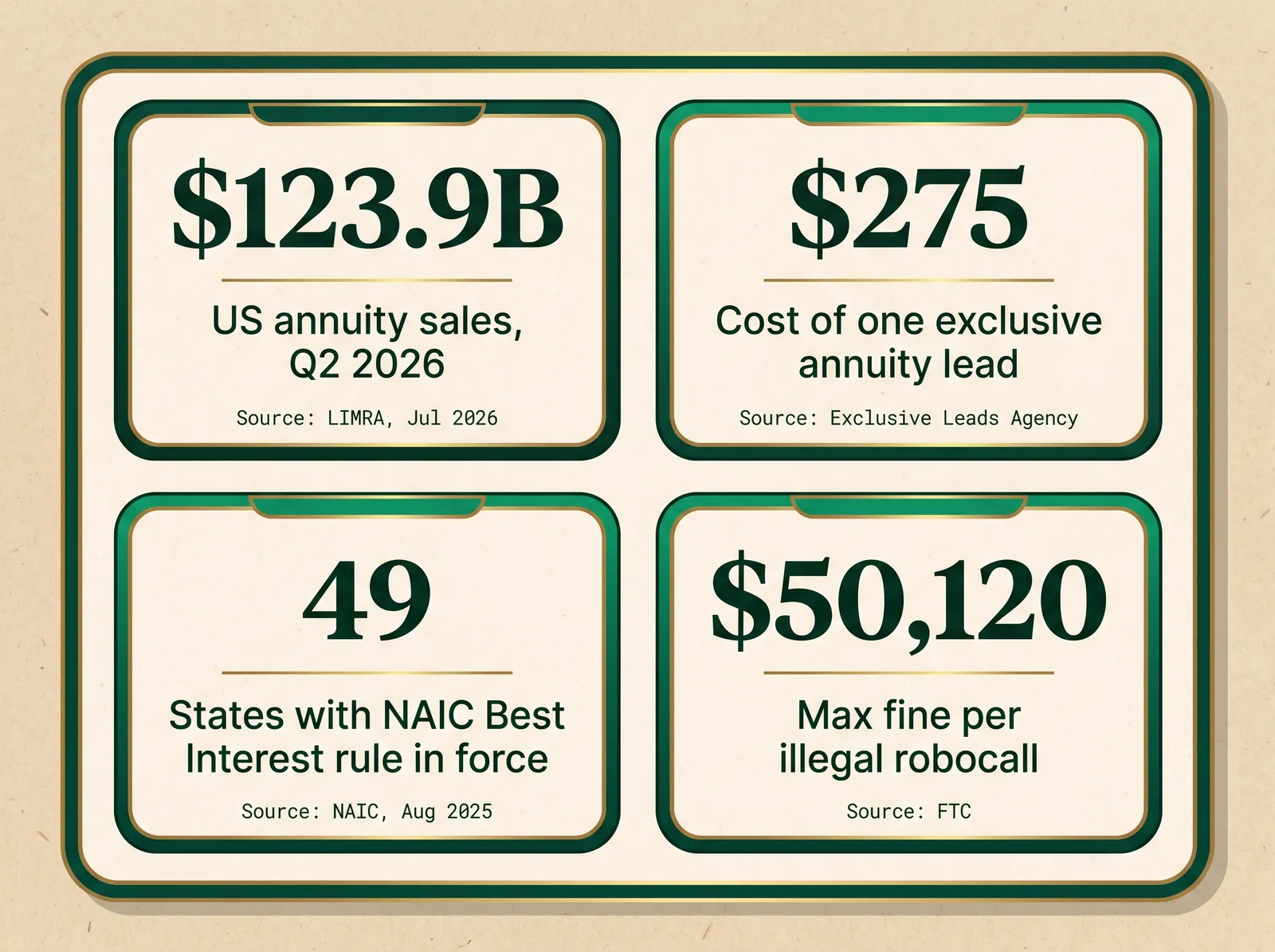
- U.S. annuity sales hit $123.9 billion in Q2 2026, up 4% year over year, and $231.3 billion for the first half of 2026, a first-half record, per LIMRA's own July 27, 2026 release.
- The NAIC's Suitability in Annuity Transactions Model Regulation (#275), revised in 2020 to add a Best Interest standard, is now implemented in 49 jurisdictions as of the NAIC's own August 2025 brief. It imposes a care, disclosure, conflict-of-interest, and documentation obligation on every recommendation.
- Prerecorded sales calls without prior written consent, or calls to numbers on the Do Not Call Registry, can draw fines up to $50,120 per call, per the FTC's own consumer guidance.
- An AI caller can get the phone answered and warm-transfer a live, interested lead to a licensed agent. It cannot run the suitability conversation itself, and no legitimate vendor should tell you otherwise.
What an Annuity Lead Actually Costs You
Start with the number that makes the rest of this article worth reading: annuity leads are expensive, and the range is wide enough that “a lead is a lead” is a bad way to think about your pipeline. According to InsureLeads’ own published rates, aged annuity leads, meaning older records sold on a shared, resold basis, start around $12 each. Real-time exclusive web leads, sold to one agent only, run about $125 each on the same page. Interest-verified live transfers, where the vendor’s own call center has already confirmed interest before connecting you, run roughly $300 a call. A second vendor, Exclusive Leads Agency, prices its exclusive annuity leads at $275 each with a 50-lead minimum order, meaning a single order commits you to at least $13,750 before you’ve dialed anyone.
| Lead type | Price | Exclusivity | Source |
|---|---|---|---|
| Aged lead | from $12 | Shared, resold | InsureLeads |
| Real-time exclusive web lead | $125 | One agent | InsureLeads |
| Exclusive lead, 50-lead minimum | $275 | One agent | Exclusive Leads Agency |
| Interest-verified live transfer | $300 | One agent | InsureLeads |
Source: InsureLeads (GetInsureLeads.com) and Exclusive Leads Agency, own published pricing pages, fetched September 2026. Prices are set by the vendors and subject to change; re-check before budgeting.
Compare that to the market those leads are chasing. U.S. annuity sales totaled $123.9 billion in the second quarter of 2026 alone, a new quarterly record and 4% higher than the same quarter a year earlier, according to LIMRA’s own July 27, 2026 release, which represents the large majority of the U.S. annuity market. First-half 2026 sales reached $231.3 billion, also a record for that period. Registered index-linked annuities, a newer product category, set their own quarterly record at $23.3 billion, up 22% year over year. This is not a shrinking category where leads are cheap because demand is soft. It’s the opposite: demand is strong enough that lead vendors can charge $275 a name and still sell out their inventory.
That combination, real demand plus a genuinely expensive lead, is exactly why the pain point here is sharper than it is for a $10 shared Medicare lead. When a $10 lead goes cold, you’re out $10 and some dial time. When a $275 exclusive lead goes cold because you called it two days late, you’ve lost a lead you paid a meaningful amount of money for, on a product where the average sale is a multi-year commitment for the client and a real commission for you.
Run this math with your own numbers
Take whatever you actually pay per annuity lead this month and divide it by how many minutes it typically takes you to reach someone on a fresh, uncalled lead. That's your real cost of a slow callback, not a marketing statistic. If a $275 lead sits for six hours before anyone dials it, ask honestly what percentage of your leads are actually still exclusive by the time you call.
Why Annuity Leads Go Cold Fast, Even the Expensive Ones
“Speed to lead” is the industry term for how quickly a sales organization contacts a new lead after it’s generated, and it matters here for a mechanical reason that has nothing to do with annuities specifically: a lead is a live person who just took an action, usually filling out a form or requesting information, and that person’s attention and intent are highest in the minutes right after they act. Every hour that passes after that moment, the odds go up that they’ve been contacted by someone else, lost interest, or simply moved on with their day.
For a genuinely exclusive lead, meaning the vendor sold it to you and only you, the decay is about attention: the prospect’s interest cools, and if they filled out more than one form, which is common, a “first-come, first-served” competitor working a similarly-sourced list can still reach them first even though your copy of the record is exclusive. Exclusive Leads Agency’s own pricing page says as much, describing its leads as delivered on a “first-come, first-served basis” for a given territory, which only means something if you’re actually first.
For a shared or aged lead, the decay is worse and more literal: the same record has been sold to multiple agents, sometimes multiple times over its life, and every one of them got the same phone number at close to the same time. An aged $12 lead isn’t cheap because it’s a worse prospect. It’s cheap because the vendor has already resold it, possibly several times, and whoever calls first this round has the only real shot.
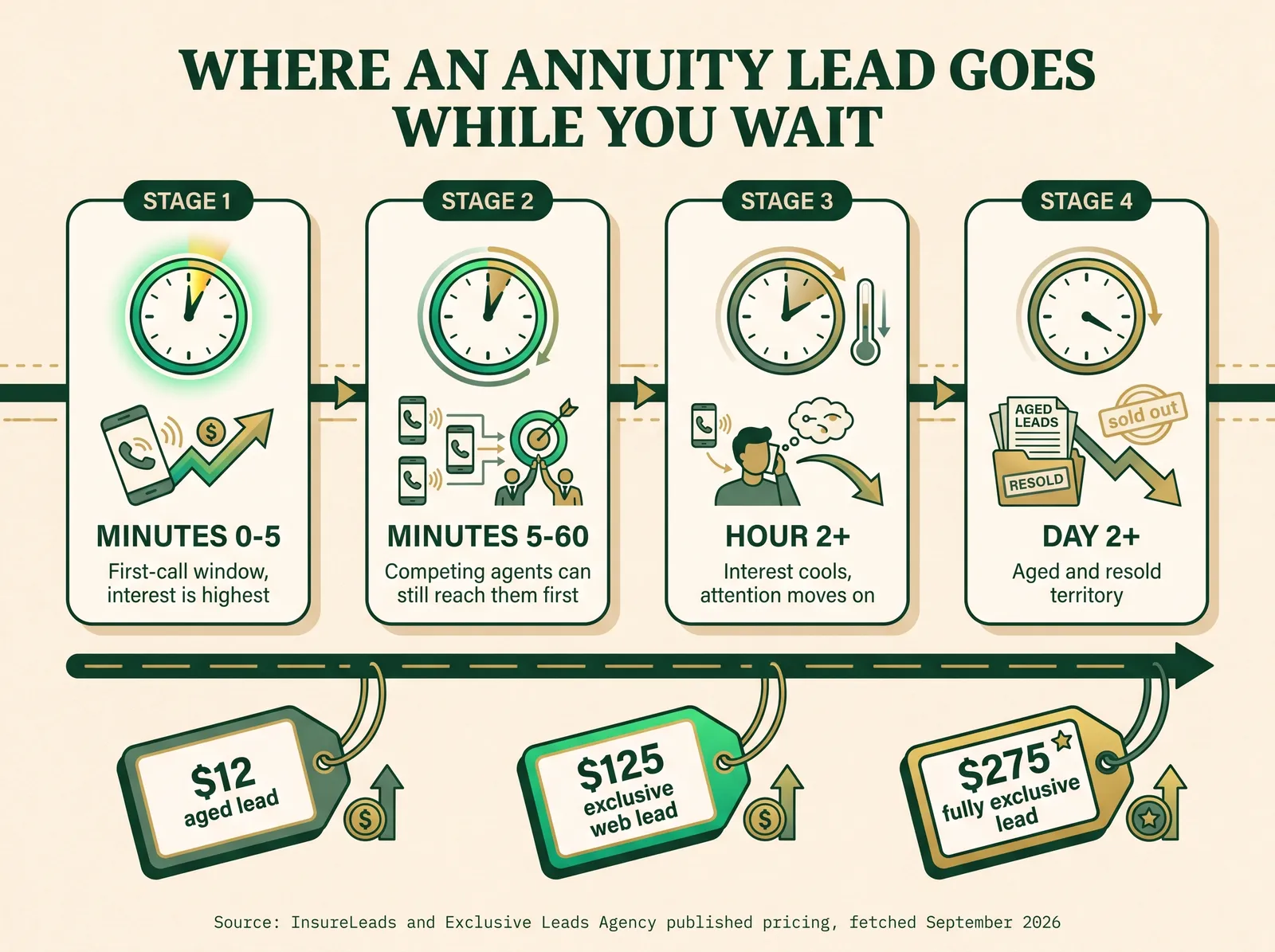
Two more terms matter here because they show up in almost every conversation about fixing this. A warm transfer is when a call gets handed live, mid-conversation, from whoever answered or dialed first to the person who’ll actually work the sale, so the prospect never has to hang up and wait for a callback. Number warmup is the practice of gradually increasing a new outbound number’s daily call volume, rather than blasting hundreds of calls from a brand-new number on day one, specifically so carriers don’t flag the number as spam before you’ve placed a hundred legitimate calls on it. Neither term is annuity-specific. Both determine whether the fast callback you’re trying to make actually rings through and gets answered.
Run the arithmetic on a realistic order size and the exposure gets easier to see. Exclusive Leads Agency’s own 50-lead minimum means a single order runs at least $13,750 before you’ve dialed the first name. If your agency’s callers can personally reach 20 of those 50 leads the same day they land and the other 30 slip to the next morning, you’ve effectively let $8,250 worth of paid-for leads sit overnight in a category where the buyer already has options and other agents chasing similarly-sourced lists. None of that is a guess about conversion; it’s just the sticker price of the leads themselves, multiplied by how many of them didn’t get a same-day call.
Same-day contact rate falls fast
- New leads sit in an inbox or spreadsheet until someone has a free hour
- Exclusive and aged leads mixed in one undifferentiated queue
- No consistent disposition log, so nobody knows what was already tried
- New outbound number dials at full volume from day one
First call happens while interest is still live
- New leads trigger an outbound call the moment they land
- Exclusive, higher-cost leads called ahead of aged, resold ones
- Every attempt logged: answered, voicemail, callback, not interested
- New numbers ramp up gradually to protect caller ID reputation
The NAIC Best Interest Rule Changes What “Fast” Has to Mean
Here’s where annuities genuinely diverge from most of the other lines your agency sells. The Suitability in Annuity Transactions Model Regulation, known in the industry as NAIC Model #275, was first adopted by the National Association of Insurance Commissioners in 2003 and revised in February 2020 to add what’s called a best interest standard of care. As of the NAIC’s own August 2025 State Legislative Brief, 49 jurisdictions have implemented the 2020 revisions; New York regulates annuity recommendations under its own separate rule, Regulation 187, which the NAIC’s brief describes as consistent with or exceeding the model’s protections. Functionally, that means some version of this standard applies almost everywhere you’re licensed to sell.
The revised model requires producers and insurers to satisfy four specific obligations, per the NAIC’s own brief: a care obligation, meaning the recommendation has to be based on the consumer’s actual financial situation, needs, and objectives, not just what pays the best commission; a disclosure obligation, meaning the agent has to disclose their role in the transaction and how they’re compensated; a conflict-of-interest obligation, meaning the consumer’s interest has to come ahead of the agent’s or carrier’s financial interest; and a documentation obligation, meaning the recommendation and the reasoning behind it have to be put in writing. The model was written to be consistent with the SEC’s Regulation Best Interest, finalized in 2019, so if you’ve heard advisors on the securities side talk about “Reg BI,” this is the insurance-side equivalent.
| Obligation | What it requires |
|---|---|
| Care | Recommendation must fit the consumer's actual financial needs, situation, and objectives |
| Disclosure | Agent discloses their role in the transaction and how they're compensated |
| Conflict of interest | Consumer's interest placed ahead of the agent's or carrier's financial interest |
| Documentation | Recommendation and its justification recorded in writing |
Source: National Association of Insurance Commissioners, Annuity Suitability "Best Interest" Model Regulation, State Legislative Brief, August 2025.
None of those four obligations happen on the first call. Nobody documents a suitability recommendation while introducing themselves. But the first call is where the relationship, and the fact pattern you’ll eventually document, actually starts, and a delayed first call doesn’t just risk losing the lead to a competitor: it risks you having a stale, rushed version of that conversation later because you’re now racing a clock the lead vendor set, not one you set. An agent who reaches a prospect while their interest, and their recollection of their own financial situation, is fresh is in a better position to do a careful care-obligation conversation than one scrambling to catch up two days later. That’s a reasoned consequence of slow follow-up, not a rule the NAIC has written down, and we want to be clear about that distinction rather than dress it up as regulatory language it isn’t.
This is not legal advice, and it isn't the same everywhere
State adoption of Model #275's 2020 revisions is not universal in its exact language, and New York's Regulation 187 is a genuinely separate rule. Confirm your specific state's current annuity suitability requirements with your compliance department or state insurance department before relying on anything here for a real transaction.
What Slow Follow-Up Actually Costs
Put the two numbers from this article next to each other and the stakes get concrete fast. A managed AI caller, at TheAffordableAI’s published Single Account rate of $0.20 a minute (from $0.15 a minute at bulk volume), costs about 33 cents for a two-minute qualifying call. An exclusive annuity lead, per Exclusive Leads Agency’s own pricing, costs $275. The call that determines whether that $275 lead gets worked while it’s still yours costs less than a dollar to place. The math isn’t close, and it’s the same reason speed to lead matters everywhere, just with a much bigger number on one side of the ledger here than it is for a $10 aged Medicare lead.
What you're risking per lead type if the first call is late
Published per-lead price vs. the cost of a single 2-minute qualifying call at $0.20/min
Lead prices: InsureLeads and Exclusive Leads Agency published pricing pages, fetched September 2026. Call cost: TheAffordableAI Single Account rate, $0.20/min, fetched from theaffordableai.com/pricing September 2026.
There’s a compliance-side cost too, separate from the sales-side one, and it’s worth naming plainly rather than folding it into the sales math. Prerecorded sales calls placed without the recipient’s prior written permission, or calls to a number on the National Do Not Call Registry, can draw fines up to $50,120 per call, according to the FTC’s own consumer guidance. That’s per call, not per campaign, and it applies regardless of how good your intentions were or how quickly you were trying to reach someone. Speed is never a reason to skip consent verification or list scrubbing; it’s an argument for doing both faster, not for doing either less carefully.
How to Fix This Yourself, No Vendor Required
You can run a version of this without buying anything. Here’s the actual method, not a teaser for it.
- Route new leads to a live person or dialer the moment they arrive, not on a schedule. If your CRM or lead vendor can fire a webhook or a notification the second a lead comes in, use it. Batch-checking a lead inbox every hour is the single biggest source of avoidable delay.
- Call in the first five minutes if you possibly can, and treat anything past sixty minutes as a lead you’re now racing to save, not one you’re calmly working. This isn’t an annuity-specific number; it’s the same logic every speed-to-lead conversation in sales runs on, applied to a lead that happens to cost more than most.
- Separate your exclusive leads from your aged leads in your workflow, and call the exclusive ones first. A $275 exclusive lead sitting behind three $12 aged leads in your call queue is a decision you’re making without meaning to.
- Keep a real-time disposition log: answered, voicemail, callback requested, not interested, do-not-call. This is also the raw material for the documentation obligation later; a clean record of when you first reached someone and what they said supports the care and documentation obligations rather than fighting against them.
- Scrub every list against the National Do Not Call Registry and your own internal do-not-call list before you dial, every time, not once when you bought the list. This is non-negotiable regardless of how the leads were sourced or how fast you’re moving.
- If you’re staffing this manually, use a second line for outbound, and increase its daily call volume gradually rather than dialing hundreds of numbers on a brand-new line in week one. That’s the number warmup practice described above, and it protects the number’s caller ID reputation whether you build it yourself or buy it as a feature.
- Document the actual conversation, not just the outcome, as close to real time as you can manage. “Discussed liquidity needs and existing IRA balance, recommended fixed indexed annuity based on stated 10-year time horizon” is a documentation-obligation record. “Sold” is not.
An agent who reads this and thinks “I can do all seven of these with a spreadsheet and a personal cell phone” is right, and should. The tradeoff is time: doing this consistently, on every lead, at scale, with proper number rotation and disposition tracking, is a full staffing commitment, not a side task.
Hear how the first call actually sounds
There's a live demo call on the homepage if you want to hear an AI caller qualify a lead and hand off a warm transfer before you decide anything.
Where a Managed AI Caller Fits, and Where It Doesn’t
This is the one section making a product claim, and we’re keeping it to what’s actually documented. TheAffordableAI is a managed AI caller: it dials outbound the moment a lead is created, answers every inbound call, and hands qualified, interested prospects to a licensed agent on a warm transfer, with multi-calendar intent routing so a booking lands on the right calendar for the right line of business. It runs a staged number warmup, ramping a new number’s daily call volume in stages rather than starting at full volume, and layers in spam and voicemail defense. It syncs natively with HighLevel, so tags, fields, transcripts, and recordings land in the CRM you’re probably already using. Everything above is drawn from TheAffordableAI’s own published Features page, fetched for this article.
Fires on lead creation
Outbound calling starts the moment a new lead lands, not whenever someone gets to the list.
Warm transfer to a licensed agent
A qualified, interested prospect gets handed to a human live, while they're still on the line, not queued for a callback.
Number warmup and spam defense
New outbound numbers ramp up gradually instead of starting at full volume from day one.
What it does not do, and should never claim to: the actual suitability conversation. The care, disclosure, conflict-of-interest, and documentation obligations under NAIC Model #275 require a licensed producer’s judgment about a specific person’s financial situation, needs, and objectives. That is not a decision tree a voice AI can responsibly run, and TheAffordableAI’s role stops well short of it: it gets the phone answered, confirms real interest, and gets a licensed human on the line fast. The suitability work happens entirely after that handoff, entirely by a person, exactly as the regulation requires. If a vendor tells you their AI can close and document an annuity recommendation on its own, that’s a claim worth being skeptical of regardless of who’s making it.
The pricing itself is worth restating plainly, since the math above depends on it: Single Account runs $200 a month plus a $500 one-time setup fee, at $0.20 a minute (from $0.15 a minute at bulk volume). Agency runs $500 a month plus a $1,000 one-time setup fee, at $0.18 a minute (from $0.16 a minute at bulk volume), and adds routing to 20-plus agents, round robin across numbers, and team availability toggles. Both plans are month to month, with no long-term contract, per TheAffordableAI’s own pricing page, fetched for this article. You can build a version of the fast-callback piece yourself with a dialer, a disposition sheet, and staffed hours. Plenty of agencies do exactly that. It’s worth pricing both approaches against your actual lead cost before deciding which one fits.
A $275 lead and a $12 lead decay at the same speed. The only thing that changes is how much it costs you to find that out.
What You Get When Both Halves Work Together
Handled well, the two threads in this article reinforce each other instead of pulling against each other. Fast first contact means you’re talking to a prospect while their interest and their recollection of their own finances are still fresh, which makes the actual Best Interest conversation easier to have well, not just faster to start. Clean disposition and consent records mean that when you do document a recommendation, you’re not reconstructing a week-old conversation from memory. Neither piece replaces the other. A fast callback into a sloppy suitability conversation is still a compliance problem, and a careful suitability process built on a lead you called four days too late is a compliance process working on a lead that’s already gone.
Your Aged Database Is an Annuity Lead Source Too
Everything above assumes you’re buying fresh leads, but the same speed logic applies to a list you already own: past clients, old quote requests, and prospects who went quiet months ago. That list doesn’t decay the way a freshly-sold vendor lead does, but it isn’t free either. Every name on it represents time or money you already spent once, and a database that just sits there is the same problem as a slow callback, stretched out over months instead of hours.
The difference with an aged internal database is that consent and list hygiene matter even more, not less, because you can’t lean on “they just filled out a form requesting information” the way you can with a fresh lead. If someone’s on your list from a policy application two years ago, revisit whether you still have a valid basis to call or text them under current consent rules before you resume outreach, and scrub the list against the National Do Not Call Registry again rather than assuming an old scrub still holds. A database reactivation campaign, meaning a structured effort to call back through an aged list on a schedule rather than all at once, works the same speed-and-documentation logic as a fresh lead: call promptly once you decide to reach out, log every attempt, and keep the same care-obligation record for any annuity conversation that results.
How This Plays Out on a Real Day
Picture a Tuesday where 12 exclusive annuity leads land between 9 a.m. and 3 p.m., spread across the day as people fill out forms. In the manual-queue version above, they collect in a shared inbox and get worked in batches whenever someone has a gap between other calls, so the 9:05 a.m. lead and the 2:50 p.m. lead both wait roughly the same amount of time: until the next batch. In the structured version, each one triggers a call attempt within minutes of arriving, so the 9:05 a.m. lead gets reached around 9:10 and the 2:50 p.m. lead around 2:55, each while their own intent is still fresh, rather than all 12 getting worked together at 4 p.m. after the batch piles up. The total number of calls placed that day doesn’t have to change for that shift to matter; what changes is how much of each lead’s attention window you’re actually calling into.
Compliance Notes That Apply Regardless of How You Call
A few standing rules apply to every outbound and inbound call your agency places, annuity or otherwise, and they belong here explicitly rather than assumed. Automated or prerecorded calls and texts to a cell phone for marketing purposes require the recipient’s prior express written consent; obtaining and documenting that consent is the agent’s obligation, and it does not transfer to any vendor or platform. Any call using an AI voice should disclose that fact where required, and honor opt-out requests immediately. Internal do-not-call lists and the National Do Not Call Registry both apply regardless of lead source, and violations can draw per-call fines, as detailed above. Using AI to place or answer a call does not transfer liability for TCPA consent, Do Not Call compliance, or NAIC Best Interest suitability obligations away from the licensed producer whose recommendation is on the record. None of this article promises a close rate, a conversion lift, or an income outcome, because no legitimate source can promise you one, and you should treat any vendor who does with real skepticism.
Frequently asked
What does an annuity lead actually cost?
It depends entirely on the source and exclusivity. Aged annuity leads start around $12 each, sold on a shared, resold basis. Real-time exclusive web leads run about $125 each, sold to one agent only, according to InsureLeads' own published rates. A fully exclusive lead with a 50-lead minimum order runs $275 each through Exclusive Leads Agency's own pricing page. Interest-verified live transfers sit around $300 a call. That is five to twenty times what a shared ACA or Medicare lead typically costs, which changes the math on every minute you let one sit uncalled.
What is the NAIC Best Interest standard, and does it apply to every annuity sale?
It's the Suitability in Annuity Transactions Model Regulation, known as NAIC Model #275, revised in February 2020 to add a best interest standard of care. As of the NAIC's own August 2025 legislative brief, 49 jurisdictions have implemented the revised model; New York regulates annuities separately under its own Regulation 187, which the NAIC describes as meeting or exceeding the model's protections. If you sell annuities anywhere in the country, some version of this standard almost certainly applies to you.
What are the four obligations under the NAIC Best Interest rule?
Per the NAIC's own August 2025 brief, the revised model requires producers and insurers to satisfy a care obligation, a disclosure obligation, a conflict-of-interest obligation, and a documentation obligation. In plain terms: recommend based on the consumer's actual financial needs, situation, and objectives; disclose your role and compensation; put the consumer's interest ahead of your own; and put the recommendation and its justification in writing. None of that happens in the first phone call, but the first phone call is what starts the clock on all of it.
Does calling a lead back faster actually change whether a sale happens?
We're not going to hand you an invented conversion number, because nobody has published one specific to annuity leads that we could verify this session. What we can say, sourced: annuity leads are sold as exclusive or first-come, first-served by the vendors that sell them, and shared or aged leads are explicitly resold to multiple buyers. A lead a competing agent reaches first is a lead you were never going to write, regardless of how good your pitch would have been.
Can an AI caller handle the actual annuity suitability conversation?
No, and we'd tell you that even if you didn't ask. The care, disclosure, conflict-of-interest, and documentation obligations under NAIC Model #275 require a licensed producer's judgment; they are not a script a voice AI can run. What a managed AI caller can do is get the phone answered fast, confirm interest, and hand the person to a licensed agent on a warm transfer while they are still on the line. The suitability conversation itself stays entirely human, by design and by law.
Does using an AI caller transfer any compliance liability away from the licensed agent?
No. Using AI to dial or answer a call does not transfer liability for TCPA consent, Do Not Call compliance, or NAIC Best Interest suitability obligations away from the licensed producer. The agent whose license is on the recommendation stays responsible for the recommendation, the disclosure, and the documentation, regardless of what software placed the call.
What's the actual TCPA and Do Not Call risk if I get this wrong?
Companies that call numbers on the National Do Not Call Registry, or place prerecorded sales calls without the recipient's prior written permission, can face fines up to $50,120 per call, according to the FTC's own consumer guidance. That number is per call, not per campaign, which is why consent and list hygiene matter as much as speed.
Is it worth paying more for exclusive annuity leads instead of buying them cheap and aged?
That depends on your close rate and your calling capacity, and we won't invent a number to answer it for you. What the pricing itself tells you: an aged lead at $12 has already been sold and called by someone else, maybe several times. An exclusive lead at $125 to $275 has not. Run your own numbers against your own results before deciding, the same way you'd underwrite any other spend.
Sources
- LIMRA — U.S. Annuity Sales Set New Quarterly Record, Totaling $123.9 Billion in the Second Quarter of 2026 (published July 27, 2026)
- NAIC — Annuity Suitability "Best Interest" Model Regulation, State Legislative Brief (August 2025)
- InsureLeads (GetInsureLeads.com) — Annuity Leads pricing page
- Exclusive Leads Agency — Annuity Leads pricing page
- Federal Trade Commission — National Do Not Call Registry FAQs (Consumer Advice, published September 2023)
- TheAffordableAI — Pricing
- TheAffordableAI — Features
Put this on your own phone line
See the AI dial, qualify, and warm-transfer a live call in under a minute. No contract, no dev work.
Keep reading
Speed to Lead in 2026: Why the First 60 Seconds Decides Who Writes the Policy
The lead you paid for is not lost to a better agent. It is lost to a faster one. Here is what response time actually does to contact and conversion rates, and how to get to sixty seconds without hiring a dialer team.

Shared vs Exclusive Insurance Leads: What Wins in 2026
A shared insurance lead can ring at five other agents at once. How the ping-post auction works, what it costs, and how to win the call anyway.

The True Cost of a Missed Insurance Lead in 2026
A missed insurance lead is not a mystery cost. It is a paid-for lead, a forgone commission CMS puts a real number on, and a seat nobody was watching.