Arizona Telemarketing Law for Insurance Agents (2026)
Arizona's do-not-call law covers texts, carries a $1,000 penalty per violation, and exempts real estate agents, not insurance producers.

Yes, Arizona’s do-not-call statute applies to insurance agents, it covers text messages as well as calls since a 2023 amendment, and it offers no exemption for insurance producers the way it does for real estate licensees. A.R.S. §44-1282 bars a “seller, solicitor, or anyone acting on their behalf” from initiating an outbound telephone solicitation call or text message to any number on the National Do Not Call Registry, and the Arizona Attorney General can pursue a civil penalty of up to $1,000 per violation. That’s state law, running on top of the federal Telephone Consumer Protection Act, not instead of it, and most agencies working Arizona leads are only thinking about one of the two.
The gap is understandable. Arizona’s statute is short, mechanical, and doesn’t get the same coverage as, say, Florida’s Telephone Solicitation Act or Texas’s no-call list. But it’s enforceable, it’s specific about who’s exempt, and the 2023 amendment that added text messages to the prohibition changed what “compliant” means for any agency that texts leads, renewals, or quotes into the state. What follows is what the statute actually says, who it reaches, what a violation costs when you stack the state penalty on top of federal exposure, how to build a list that’s actually clean, and where an AI caller fits once compliance and speed stop being a tradeoff.
Key takeaways
- A.R.S. §44-1282 bars an outbound telephone solicitation call or text message to a number on the National Do Not Call Registry, with a civil penalty of up to $1,000 per violation under §44-1531.
- The text-message coverage is recent. It was added by House Bill 2498, Chapter 41 of Arizona's 2023 session laws, approved by the governor April 12, 2023.
- The statute's only calling exemptions apply to sellers or solicitors licensed under Title 32, Chapter 20, Arizona's real estate licensing chapter. Insurance producers are licensed under Title 20 and get no equivalent carve-out.
- Arizona compliance and federal TCPA compliance are two separate obligations. Satisfying one doesn't satisfy the other, and both apply to the same call.
- The National Do Not Call Registry held roughly 259 million active registrations as of September 30, 2025, per the FTC's own Data Book, and sellers must re-scrub a calling list against it at least every 31 days.
What Arizona’s Telephone Solicitation Statute Actually Says
Arizona regulates telemarketing through Title 44, Chapter 10 of its revised statutes, and two sections matter most for an insurance agency: §44-1271, which defines the terms the rest of the chapter uses, and §44-1282, which sets the do-not-call prohibition and its penalty.
§44-1271 defines “telephone solicitation” broadly: “any voice communication from a live operator, announcing device or otherwise” that offers merchandise for sale or rent, placed to or from a person located in Arizona. That definition doesn’t distinguish between a live agent dialing from a script, a predictive dialer, or an AI voice agent placing the call. “Merchandise” under the same section covers physical items, intangibles, real estate, securities, and services, which is broad enough to include an insurance policy, a quote, or a plan comparison. If you’re calling someone in Arizona to offer them coverage, you’re almost certainly placing a “telephone solicitation” as the statute defines it, regardless of how the call gets dialed.
§44-1282 is where the actual prohibition lives, and its current text, as amended by House Bill 2498 in 2023, is specific:
| Provision | What it requires | Citation |
|---|---|---|
| Core prohibition | A seller, solicitor, or anyone acting on their behalf may not initiate an outbound telephone solicitation call or text message to a number on the National Do Not Call Registry | §44-1282(A) |
| Federal law carve-out | The prohibition doesn't apply where federal law or regulation separately authorizes or permits the solicitation | §44-1282(A) |
| Real estate licensee exemption | Calls by or for a seller or solicitor licensed under Title 32, Chapter 20 (real estate), limited to calls about a past or present employment agreement, a personal referral, or the consumer's own request | §44-1282(A)(1)-(3) |
| Enforcement | A violation is an unlawful practice under §44-1522; the Attorney General may investigate and pursue civil penalties under §44-1531 | §44-1282(B) |
| Civil penalty | Up to $1,000 per violation, in addition to any other remedy available under state law; collected amounts go to the state general fund | §44-1282(B), §44-1531 |
| Definition tie-in | "Do-not-call implementation act" is defined by reference to P.L. 108-10 (117 Stat. 557), enacted March 11, 2003, the federal act that created the national registry framework | §44-1282(C) |
Source: Arizona State Legislature, 2023 Session Laws, Chapter 41 (House Bill 2498), amending A.R.S. §44-1282, approved by the governor and filed with the Secretary of State April 12, 2023.
Read the exemption language carefully, because it’s the detail most agents miss. The carve-out in §44-1282(A)(1) through (3) doesn’t exempt “insurance agents” or “licensed professionals” in general. It names a specific licensing chapter: Title 32, Chapter 20, which is real estate brokers and salespersons. Arizona’s insurance producers are licensed under an entirely different part of the code, Title 20, the insurance title. There’s no equivalent paragraph in §44-1282 naming Title 20 licensees. If you’re an Arizona-licensed insurance agent calling a number on the national registry, the statute’s own exemption list simply doesn’t include you, the way it includes a real estate agent calling about a past listing agreement.
The exemption question agents get backwards
Agents sometimes assume a professional-licensing exemption exists somewhere in state telemarketing law by analogy, because real estate, insurance, and lending all get bundled together as "licensed professional" industries in casual conversation. Arizona's statute doesn't work that way. It names one specific licensing chapter and limits the exemption to specific call purposes within it. Nothing in §44-1282 extends that same treatment to Title 20 insurance producers, so don't assume parity that the text doesn't grant.
Why the Text Message Change Actually Matters
Before House Bill 2498 took effect in April 2023, §44-1282 addressed telephone solicitation calls. A text pitching a quote or a policy to a number on the registry sat in a genuine gray area under the old statutory language, even if federal law already had something to say about it. The 2023 amendment closed that gap at the state level by rewriting the prohibited conduct to explicitly include “a text message,” using the same statutory machinery, the same registry, and the same $1,000-per-violation penalty that already applied to calls.
That’s a mechanism worth understanding on its own, not just a footnote to the call rule. A2P text campaigns, drip sequences, and automated SMS follow-ups have become standard tools for insurance lead follow-up precisely because they’re fast and cheap to send at volume. The same qualities that make text effective for speed to lead make a non-compliant blast expensive to run in Arizona: every text to a registered number is now its own potential $1,000 exposure under state law, stacked on whatever the number of texts actually sent works out to.
What the statute covered
- Outbound telephone solicitation calls to a number on the National Do Not Call Registry
- No explicit statutory language addressing SMS or text-based solicitation under §44-1282
- Agencies that shifted volume from calls to texts had a plausible, if untested, argument that the specific statute didn't reach text campaigns
What changed
- Outbound telephone solicitation calls or text messages to a registered number are both prohibited under identical statutory language
- The same $1,000-per-violation penalty and same Attorney General enforcement path apply to a non-compliant text exactly as they apply to a non-compliant call
- Shifting volume from calls to texts no longer moves a campaign outside the statute's reach
How Arizona Stacks on Top of Federal Law
This is the piece that actually drives cost exposure, and it’s where most of the real risk hides, because Arizona’s law and federal law are answering two different questions with two different penalty schedules, and both apply to the exact same phone call.
The federal Telephone Consumer Protection Act, codified at 47 U.S.C. §227, makes it unlawful to place a call using an automatic telephone dialing system or an artificial or prerecorded voice to a cell phone without the called party’s prior express consent, with narrow exceptions for emergencies and certain debt collection calls. Enforcement runs through a private right of action: a consumer can sue for an injunction, actual monetary loss, or $500 per violation, whichever is greater, and a court can treble that figure to $1,500 per violation for a willful or knowing violation. That’s federal law, enforced by whoever received the call, independent of Arizona’s registry rule.
Arizona’s §44-1282 asks a narrower, different question: was this specific number on the National Do Not Call Registry, and did a seller or solicitor without an applicable exemption call or text it anyway? That’s a state-law violation enforced by the Arizona Attorney General, capped at $1,000 per violation under §44-1531, regardless of whether the call also happened to comply with the TCPA’s separate consent rules.
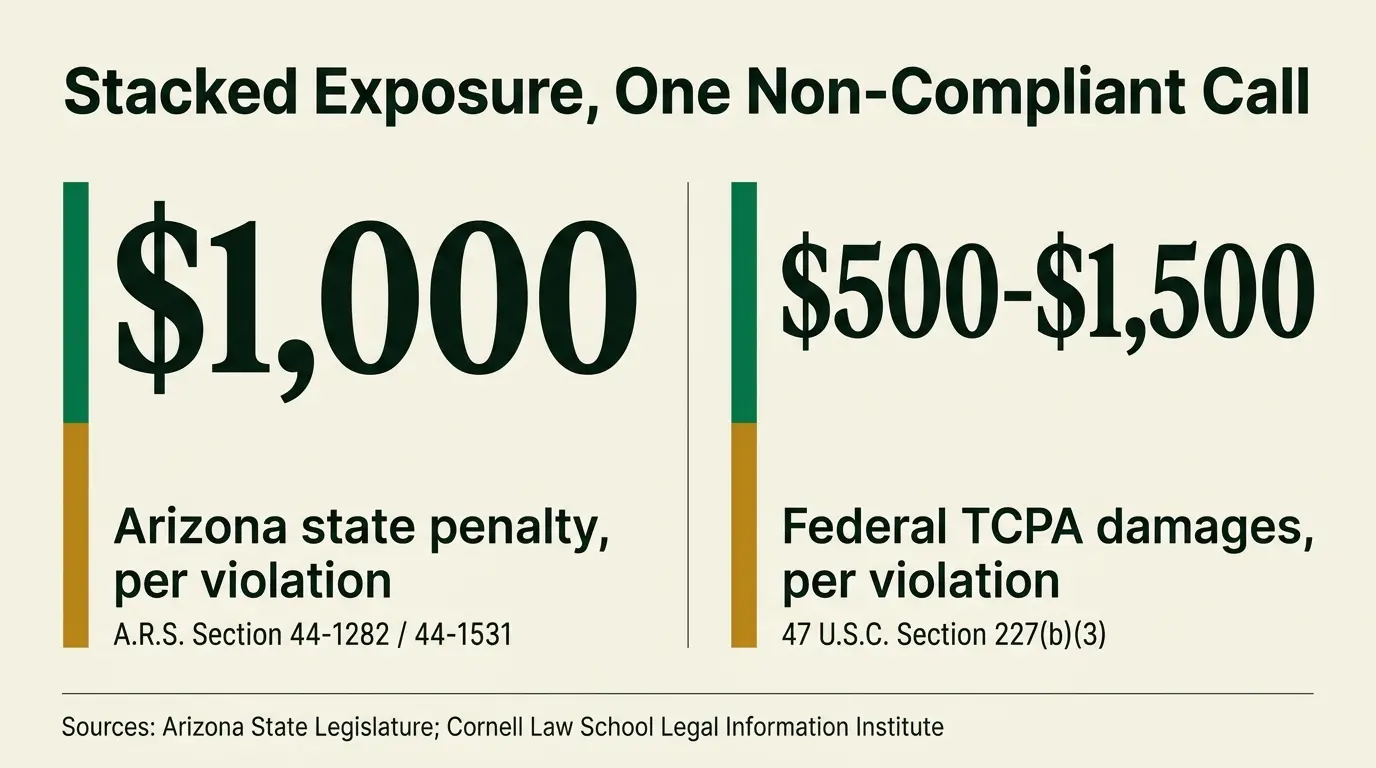
Stack the two and a single non-compliant call to a registered Arizona number, placed without consent and without an applicable exemption, can carry state exposure up to $1,000 and separate federal exposure of $500 to $1,500, from two different enforcement bodies, for the same ten seconds of dialing. That’s not a reason to panic over any one dial. It’s the reason “we’re TCPA compliant” and “we’re compliant in Arizona” are two separate sentences that both need to be true, not one sentence that implies the other.
Arizona's statute and the federal TCPA are answering different questions about the same call. Getting one right doesn't answer the other.
What It Actually Costs to Get This Wrong
There’s no published figure for “average Arizona insurance agency telemarketing exposure,” and this piece won’t invent one. What’s real and sourced is the scale of the registry itself and the maintenance burden that creates for any agency calling or texting into the state.
The FTC’s Do Not Call Data Book 2025, published December 2025 with data as of September 30, 2025, states plainly that the registry has continued to grow since its 2003 launch and held roughly 259 million active registrations as of that date. The same document is explicit about the scrubbing obligation: “Telemarketers and sellers must remove numbers added to the Registry from their call lists at least every 31 days.” A purchased lead list, an aged database being reactivated, or a referral list built from past clients all need to run through that same 31-day scrub, every time, for the life of the campaign, not once at intake.
Set that against the economics of the people doing the dialing. The U.S. Bureau of Labor Statistics puts the median annual wage for insurance sales agents nationally at $62,280, or about $29.94 an hour, based on May 2025 data, with roughly 572,600 people employed in the occupation. That’s the cost of the staff time spent building, scrubbing, and re-scrubbing a compliant calling list by hand, on a 31-day cycle, on top of actually making the calls. A missed scrub cycle isn’t just a compliance question; it’s that same producer’s time being spent on cleanup instead of calls, the same tradeoff that shows up every time manual compliance work competes with manual selling work for the same hours.
Who Actually Carries the Risk: Agency, Vendor, or Both
§44-1282’s prohibition reaches a “seller, solicitor, or anyone acting on their behalf,” which is deliberately wide language. It’s not limited to whoever physically places the call. An agency that buys a list from a lead vendor, hands it to a call center, or runs it through a third-party dialer hasn’t moved the compliance obligation off its own books just because someone else is doing the dialing. “Acting on their behalf” is built to catch exactly that arrangement.
This matters most in three common insurance-agency setups:
Buying shared or aged leads from a vendor. If the vendor’s own consent documentation is thin, missing, or simply unverifiable, you’ve bought someone else’s compliance gap along with the lead. The agency calling the number carries the practical exposure, whatever the vendor’s lead-gen page claims about its own consent process.
Outsourcing follow-up to a call center or virtual assistant team. Whoever actually dials still needs a clean, re-scrubbed list and a documented lawful basis for each call. Handing a list to an outside team doesn’t create a new exemption; it just adds a layer between the agency and the dial that still needs to be accountable for the same statute.
Running a multi-producer agency where different people pull from the same database. A shared contact list that one producer scrubbed last month and another producer is now dialing from isn’t “scrubbed” in any way that protects the second producer’s calls. The 31-day clock runs against the list as it’s actually used, not against whoever happened to run the last export.
The practical takeaway
If you can't point to who scrubbed a specific list, against what registry snapshot, and on what date, you don't actually know whether the calls being placed from it are compliant, regardless of how many steps removed you are from the person dialing.
How to Build a Compliant Arizona Calling List Yourself
This part is worth doing properly even if you never touch an AI caller, because the underlying discipline is the same regardless of who’s dialing.
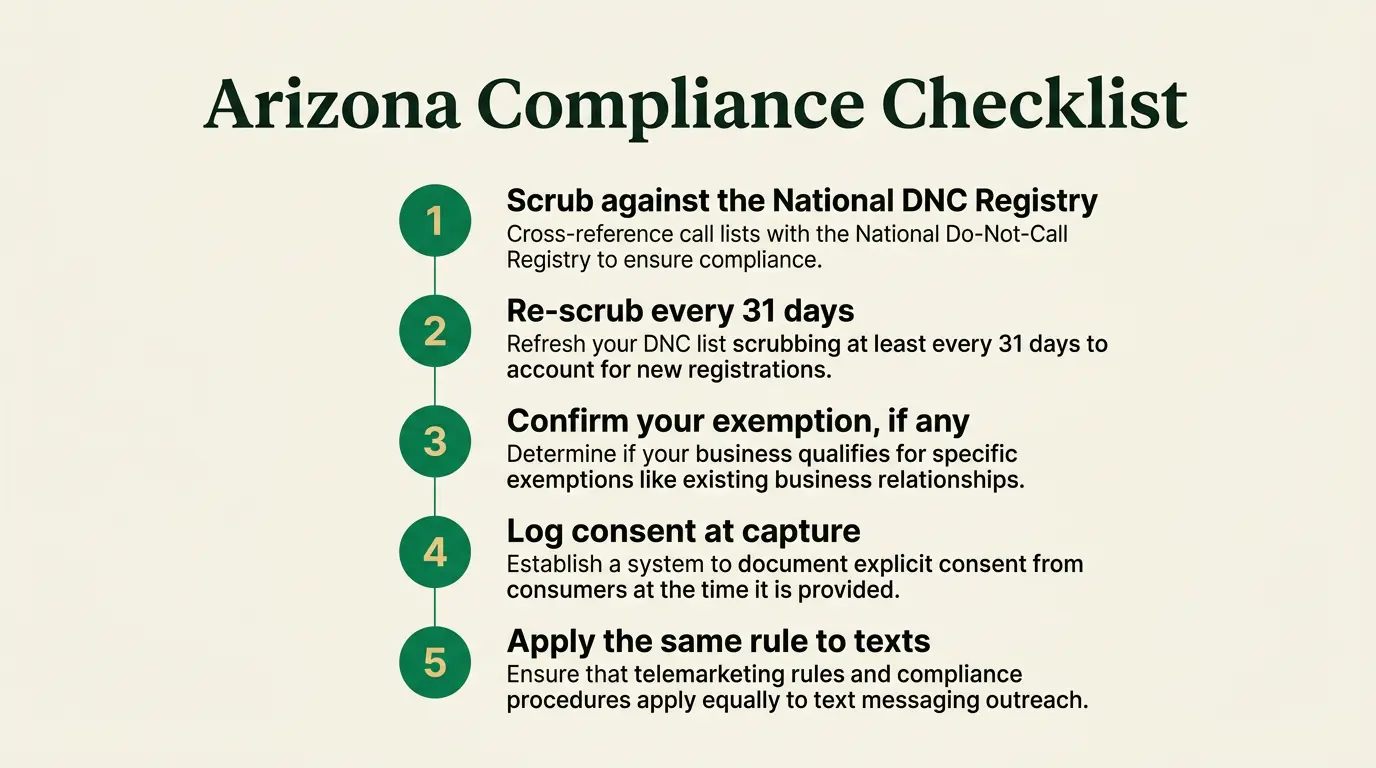
Step 1: Treat the National Do Not Call Registry as the floor, not the whole picture. Arizona’s §44-1282 incorporates the federal registry directly, so your scrub needs to check the actual national database, not a state-specific or locally-maintained list that might be stale or incomplete. Telemarketers access the registry through the FTC’s own telemarketing.donotcall.gov portal.
Step 2: Re-scrub on a cycle no longer than 31 days, for the life of the campaign. The FTC’s own guidance sets this as a hard maximum, not a best practice. A campaign that runs for three months needs at least three scrubs, timed to the calendar, not just one scrub at the start.
Step 3: Know exactly which exemption, if any, actually applies to your call. Don’t rely on an assumed professional-courtesy carve-out. If you’re not licensed under Title 32, Chapter 20, the real estate exemption in §44-1282(A)(1)-(3) doesn’t apply to you. The call needs a different lawful basis: the consumer’s own prior express request, an applicable federal authorization, or documented consent that satisfies the TCPA separately.
Step 4: Log consent at the point of capture, not after the fact. A lead form, a quote request, or a referral that includes a clear, timestamped consent record is the asset that lets you call or text a number even if the number happens to be on the registry, because consent is the actual legal basis the exemptions and federal law both turn on. A list without that record has no way to tell a legitimate exception from a straightforward violation after the fact.
Step 5: Apply the same discipline to text as to calls. Since the 2023 amendment, there’s no lighter-touch version of this rule for SMS. If your agency runs text-based follow-up sequences into Arizona numbers, those sequences need the identical registry scrub and consent record that an outbound calling campaign would need.
| Requirement | Applies to calls | Applies to texts |
|---|---|---|
| National DNC Registry scrub, every 31 days | Yes | Yes, since April 2023 |
| Title 32, Ch. 20 exemption available | Only to real estate licensees | Only to real estate licensees |
| $1,000 per-violation state penalty exposure | Yes, §44-1282(B) | Yes, §44-1282(B), same section |
| Separate federal TCPA consent requirement | Yes, for autodialed/prerecorded calls to cells | Yes, text messages are treated as calls under the TCPA's definitions |
Compiled from A.R.S. §44-1282 (Arizona 2023 Session Laws, Chapter 41) and 47 U.S.C. §227 (Cornell Law School Legal Information Institute, current text).
If you want to see how a consent-aware calling and texting workflow is actually built end to end, see how it works.
How TheAffordableAI Handles This
TheAffordableAI’s managed AI caller runs outbound campaigns through a fleet of warmed Twilio numbers, rotating round-robin so no single number carries disproportionate volume, and syncs every call’s tags, disposition, transcript, and recording back to HighLevel automatically, per the platform’s own how-it-works and features pages. That operational discipline, built for number health and spam avoidance, is the same infrastructure a registry scrub and consent-logging workflow needs to run on: a system that already treats call pacing, number reputation, and record-keeping as first-class problems rather than afterthoughts.
Call data stays with the record
Qualifying answers, the transcript, and the recording write back to the contact in HighLevel, attached to the call, not scattered across a separate spreadsheet. Confirming consent itself still stays the agent's responsibility.
Warmed number fleet
Numbers ramp in weekly stages, roughly 10, 20, 30, then 40 calls a day, before reaching full volume, instead of a brand-new number going straight to high volume.
Warm transfers, first to answer
The AI rings 20+ available agents at once; the first to pick up gets the live caller with context already attached.
Two-way HighLevel sync
Tags, pipeline stage, transcript, and recording write back to the contact record the moment a call ends.
No contracts
Single Account and Agency plans are both month to month; cancel anytime.
Usage-based pricing
$0.20/min on Single Account (from $0.15 at bulk) or $0.18/min on Agency (from $0.16 at bulk), billed per minute, not per seat.
None of this replaces the registry scrub itself or the Attorney General’s enforcement authority. What it removes is the operational excuse: “we didn’t have time to re-scrub this month” stops being a believable reason once the scrubbing, pacing, and record-keeping are built into the platform doing the dialing rather than depending on someone remembering to run it manually every 31 days.
If you want to hear what this actually sounds like before you decide anything, there’s a demo call on the homepage. theaffordableai.com
Compliance, stated plainly
Using an AI caller or any other automated system doesn't transfer TCPA, Arizona state-law, or CMS compliance liability away from the licensed agent and agency. Automated or prerecorded calls and texts to a cell phone require prior express consent under the TCPA, and that consent obligation is the agent's, not the vendor's. Nothing in this article is legal advice; confirm your specific obligations under A.R.S. §44-1282 and 47 U.S.C. §227 with your own counsel before building a campaign around it.
What You Get
A compliant Arizona calling program isn’t more complicated than a non-compliant one, it just has an extra, recurring step: knowing that Title 20 insurance licensure doesn’t buy you the same exemption Title 32 real estate licensure does, and treating the National Do Not Call Registry scrub as a 31-day recurring obligation rather than a one-time intake task. Get that right and you can call and text an Arizona list as aggressively as the lead flow justifies, with the state-law and federal exposure both accounted for instead of assumed away.
The math changes once that discipline is built into the system placing the calls, rather than depending on a producer remembering to run a scrub on schedule. The math above uses $0.20 a minute because that’s what a Single Account costs. Run it with your own numbers. See current pricing.
Frequently Asked Questions
Does Arizona's do-not-call law apply to insurance agents?
Does the Arizona do-not-call rule cover text messages, or just phone calls?
What's the actual penalty for violating Arizona's do-not-call statute?
If I'm complying with the federal TCPA, am I automatically compliant with Arizona's law too?
Does Arizona's registry rule only cover residential or landline numbers?
How often do I need to re-scrub my calling list against the Do Not Call Registry?
Does calling my own existing clients in Arizona avoid this rule?
Does using an AI caller change who's liable for a violation in Arizona?
Sources
- Arizona State Legislature — 2023 Session Laws, Chapter 41 (House Bill 2498), amending A.R.S. §44-1282, approved April 12, 2023
- Arizona Revised Statutes §44-1271 — Definitions
- Arizona Revised Statutes §44-1531 — Civil penalty cap (confirms the $1,000-per-violation cap set specifically by §44-1282(B))
- Federal Trade Commission — National Do Not Call Registry Data Book 2025
- Cornell Law School Legal Information Institute — 47 U.S.C. §227
- U.S. Bureau of Labor Statistics — Occupational Outlook Handbook, Insurance Sales Agents
- TheAffordableAI — How It Works
- TheAffordableAI — Features
- TheAffordableAI — Pricing
Call and text Arizona leads without guessing at the scrub
No contracts either way, so the risk of trying it is one month. Pricing runs $200/mo plus a one-time $500 setup for a Single Account, or $500/mo plus $1,000 setup for Agency, both billed per minute with no long-term commitment.
Frequently asked
Does Arizona's do-not-call law apply to insurance agents?
Yes. A.R.S. §44-1282 prohibits a seller, solicitor, or anyone acting on their behalf from initiating an outbound telephone solicitation call or text message to a number listed on the National Do Not Call Registry. The statute's exemptions are narrow and specific: they cover sellers or solicitors licensed under Title 32, Chapter 20, which is Arizona's real estate licensing chapter, calling about a past or present real estate employment agreement, a personal referral, or a call the consumer asked for. Insurance producers are licensed under Title 20, not Title 32, Chapter 20, so that exemption does not reach them. An insurance agent calling a number on the registry needs a different lawful basis for the call, such as the consumer's express request or an existing exemption under federal law, not this state carve-out.
Does the Arizona do-not-call rule cover text messages, or just phone calls?
Both, since 2023. Before House Bill 2498, Chapter 41 of the 2023 session laws, A.R.S. §44-1282 only addressed telephone solicitation calls. The amendment, approved by the governor and filed with the Arizona Secretary of State on April 12, 2023, rewrote the prohibition to bar an outbound telephone solicitation call or text message to a registered number. A text that pitches a policy, a quote, or a renewal to a number on the National Do Not Call Registry is now covered by the identical state-law prohibition and the identical penalty structure as a call would be.
What's the actual penalty for violating Arizona's do-not-call statute?
A.R.S. §44-1282(B) makes a violation an unlawful practice under §44-1522, and the Arizona Attorney General can pursue a civil penalty under §44-1531 of up to $1,000 per violation, on top of any other remedy available under state law. That penalty applies per violation, not per complaint or per case, so a short list of improperly dialed numbers can add up in a way a single number doesn't suggest.
If I'm complying with the federal TCPA, am I automatically compliant with Arizona's law too?
No, and this is the mistake that catches agencies off guard. The federal Telephone Consumer Protection Act (47 U.S.C. §227) and Arizona's statute are two separate laws enforced by two separate bodies, with two separate penalty structures and two separate scrubbing obligations. Complying with the TCPA's prior-express-consent requirement for an autodialed or prerecorded call to a cell phone doesn't automatically satisfy A.R.S. §44-1282's prohibition on calling or texting a number on the national registry, and the reverse is also true. Both run at the same time, for the same call, against the same number.
Does Arizona's registry rule only cover residential or landline numbers?
No. A.R.S. §44-1282 applies to any telephone number entered in the National Do Not Call Registry, and the federal registry itself allows both landline and wireless numbers to be registered. The Federal Trade Commission's own Do Not Call Data Book, published December 2025, puts active registrations at roughly 259 million numbers nationwide as of September 30, 2025, the large majority of which are cell numbers given how few households keep landlines. Agencies that only scrub a list against a legacy local do-not-call file, and treat the federal registry as a separate, optional step, are working from an outdated model of what the registry actually is.
How often do I need to re-scrub my calling list against the Do Not Call Registry?
The FTC's own Data Book states that telemarketers and sellers must remove numbers added to the Registry from their call lists at least every 31 days. A list pulled and scrubbed once at the start of a campaign, then dialed for weeks afterward without a refresh, is out of compliance with that federal maintenance requirement well before the campaign ends, independent of anything specific to Arizona.
Does calling my own existing clients in Arizona avoid this rule?
Not automatically. A.R.S. §44-1282's registry prohibition doesn't carve out an existing-customer exception the way some federal rules historically have discussed one. If a current client's number is on the registry, calling or texting them a sales pitch, a cross-sell, or an unsolicited renewal reminder framed as a solicitation can still trigger the statute. A service call clearly tied to an existing policy the client already holds sits on different footing than a sales solicitation, but the line between the two is about the content and purpose of the call, not simply who's on the other end.
Does using an AI caller change who's liable for a violation in Arizona?
No. Using an AI voice agent, a predictive dialer, or any other automated system to place the call doesn't transfer responsibility for A.R.S. §44-1282 compliance, TCPA consent, or CMS Medicare marketing rules away from the licensed agent and agency. The vendor can build in Do Not Call Registry scrubbing, consent logging, and call-time controls, but the legal obligation to actually comply sits with whoever is licensed to sell the policy.
Sources
- Arizona State Legislature — 2023 Session Laws, Chapter 41 (House Bill 2498), amending A.R.S. §44-1282 (approved and filed April 12, 2023)
- Arizona Revised Statutes §44-1271 — Definitions, 'telephone solicitation' (current text, Arizona State Legislature)
- Federal Trade Commission — National Do Not Call Registry Data Book 2025 (published December 2025, data as of September 30, 2025)
- Cornell Law School Legal Information Institute — 47 U.S.C. §227, Telephone Consumer Protection Act
- U.S. Bureau of Labor Statistics — Occupational Outlook Handbook, Insurance Sales Agents (wage data May 2025, employment 2025)
- TheAffordableAI — How It Works (fetched October 22, 2026)
- TheAffordableAI — Features (fetched October 22, 2026)
- TheAffordableAI — Pricing (fetched October 22, 2026)
- Arizona Revised Statutes §44-1531 — Civil penalty cap for unlawful practices (current text, Arizona State Legislature)
Put this on your own phone line
See the AI dial, qualify, and warm-transfer a live call in under a minute. No contract, no dev work.
Keep reading
Georgia Telemarketing Law for Insurance Agents (2026)
SB 73 added vicarious liability and class actions to Georgia's telemarketing law. What changed, what a violation costs, and how agents stay compliant.

Insurance Leads and the Do Not Call Registry in 2026
The Do Not Call Registry topped 258.5 million numbers in FY2025. What the EBR exemption covers, a violation's real cost, and how to call insurance leads fast.

TCPA Revoke-All Rule 2026: What the FCC Just Adopted
The FCC adopted a new TCPA revocation order on September 30, 2026, months ahead of the 2027 deadline. Here is what changed for insurance agents.