Dental Insurance Leads: Why Agents Let Them Go Cold
24% of Americans have no dental coverage, per the ADA. Here's why dental insurance leads decay as fast as any other line, and how agents fix follow-up.

Twenty-four percent of the country has no dental coverage at all, the highest-quality current figure for that number, from the American Dental Association’s Health Policy Institute. Applied to the Census Bureau’s most recent population estimate, that works out to somewhere around 82 million people. That’s not a niche market. It’s roughly one in four adults you’d meet walking down any street in the country, and a meaningful share of them are actively shopping right now, whether through a Marketplace stand-alone dental plan, an employer’s open enrollment, or a direct individual policy.
And yet dental insurance leads get treated like an afterthought. They show up bundled with a health or Medicare inquiry, they sit behind the “real” sale, and by the time anyone calls, the shopper has already picked a different agent, or given up and gone without coverage. This article is about why that happens, what it actually costs, and how to fix the part that’s fixable.
The short version
- 24% of Americans have no dental coverage as of 2023, per the American Dental Association's Health Policy Institute, roughly 82 million people against the Census Bureau's 2025 population estimate.
- Total U.S. dental benefits enrollment fell 2.3% in 2024, per the National Association of Dental Plans, meaning the overall market is shrinking while the uninsured pool stays enormous.
- A stand-alone dental plan can't be bought alone; HealthCare.gov requires a health plan purchase in the same transaction, which means every SADP lead is also a health plan shopper.
- Insured people visit a dentist at nearly double the rate of the uninsured, 58% versus 28% in 2023, per the same ADA data, which is the real-world cost of a lead that never gets called.
- Dental leads decay on the same clock as every other insurance lead. Nothing about the product makes it immune to slow follow-up.
What a dental insurance lead actually is
A “dental insurance lead” isn’t one thing. It’s at least four different shoppers who end up in the same CRM tag, and mixing them up is where a lot of agencies lose the thread before they’ve made a single call.
Marketplace stand-alone dental plan (SADP) shoppers. These are people buying dental coverage through the ACA Marketplace alongside a qualified health plan (QHP), the underlying medical policy that satisfies Marketplace eligibility rules. HealthCare.gov is direct about the mechanics: you can’t buy a Marketplace dental plan unless you’re buying a health plan at the same time. That single rule matters more than it looks. It means every SADP lead is, structurally, also a health insurance shopper in the same sitting, so a dental-only follow-up script misses half the opportunity in the room.
Embedded dental shoppers. Some Marketplace health plans build dental coverage into the medical premium instead of selling it separately. HealthCare.gov’s own comparison notes that once a shopper picks an embedded plan, dental coverage isn’t a standalone toggle. They can’t remove it without switching the entire health plan. A lead who says “I already have dental through my health plan” isn’t necessarily wrong, and isn’t necessarily a dead end either. Ask what plan and what it actually covers before you write them off.
Employer group renewal leads. Most dental coverage in the country still runs through the workplace. Employer-sponsored plans account for 51% of dental benefits coverage, according to the National Association of Dental Plans’ most recent enrollment report, and a rising share of those group plans are self-insured, 46% as of the latest reporting period, up from 44% the year before, per the same NADP data. Self-insured group plans change every renewal cycle, and that renewal window is a predictable, calendar-driven lead source most agencies never systematize.
Direct individual and Medicare Advantage dental shoppers. Outside the Marketplace, individual dental plans get sold direct, and dental has become a standard add-on inside Medicare Advantage plan comparisons, where a senior evaluating one MA plan against another is frequently also evaluating the dental benefit bundled into each option. The ADA’s own data shows how much that bundling matters: dental care utilization for seniors jumps from 53.3% overall to 79.9% when they’re on a Medicare Advantage dental plan specifically, a nearly 27-point difference driven entirely by which plan they picked.
Terms worth knowing
Stand-alone dental plan (SADP): a dental policy sold separately from a health plan, with its own premium, purchasable only alongside a qualified health plan on the Marketplace, per HealthCare.gov. Embedded dental: dental coverage built into a health plan's premium as a single bundled product. Essential health benefit (EHB): a category of coverage the ACA requires for certain populations; dental is an EHB for anyone 18 or younger, but not for adults, per HealthCare.gov. Qualified health plan (QHP): a Marketplace-certified medical plan meeting ACA coverage standards.
Why dental leads go cold faster than agents expect
Here’s the mechanism, and it isn’t complicated. A shopper fills out one form, or clicks through one aggregator page, and depending on the source, that single action can generate a health inquiry, a dental inquiry, and sometimes a life or Medicare inquiry at the same time. The agent who receives all three doesn’t usually work them in parallel. They work the highest-commission line first, close it or lose it, and circle back to dental whenever there’s a gap in the calendar.
That gap is often hours. Sometimes it’s days. And the dental insurance leads Reddit posts and industry lead-cost roundups keep landing on aren’t unusually resistant to sales, they’re the same shoppers as everyone else, given a slower response. The lead didn’t get harder to close. It got older.
This is also where shared distribution makes the problem worse. Dental leads sourced through comparison sites and lead aggregators commonly move through the same ping-post distribution model used across the insurance industry, where a single form submission generates simultaneous leads to multiple agents. If you’re buying dental leads from a shared source, you should assume, by default, that at least one other agent has the identical name, the identical phone number, and the identical clock running the moment the form submits.
The lead didn't get harder to close. It got older. That's the entire mechanism, and it applies to dental exactly as much as it applies to auto, life, or Medicare.
Mike MooreThe coverage gap, in real numbers
Start with the uninsured pool, because it’s the clearest evidence that dental isn’t a saturated, low-opportunity line. As of 2023, the most recent year in the ADA’s dataset, 24% of the U.S. population carried no dental insurance of any kind, down from 33% in 2002 but still a massive standing gap. Applying that 24% rate to the Census Bureau’s July 2025 national population estimate of 341.8 million people puts the uninsured pool at roughly 82 million. That’s a calculation built from two separately sourced figures, not a single published headcount, and it’s worth being upfront about that rather than presenting it as an official government number.
That gap isn’t evenly spread. Age drives a lot of it: 7% of children are uninsured for dental, against 21% of working-age adults and 38% of seniors when Medicare Advantage dental plans are factored into the accounting, per the ADA’s breakdown. Race and income drive more of it: uninsured rates run highest among the Hispanic population at 27% and lowest among the Asian population at 17%, and, counterintuitively, households between 100% and 400% of the federal poverty level show higher uninsured rates (28% to 30%) than households below 100% FPL (23%), likely reflecting Medicaid eligibility cutoffs at the very bottom of that range.
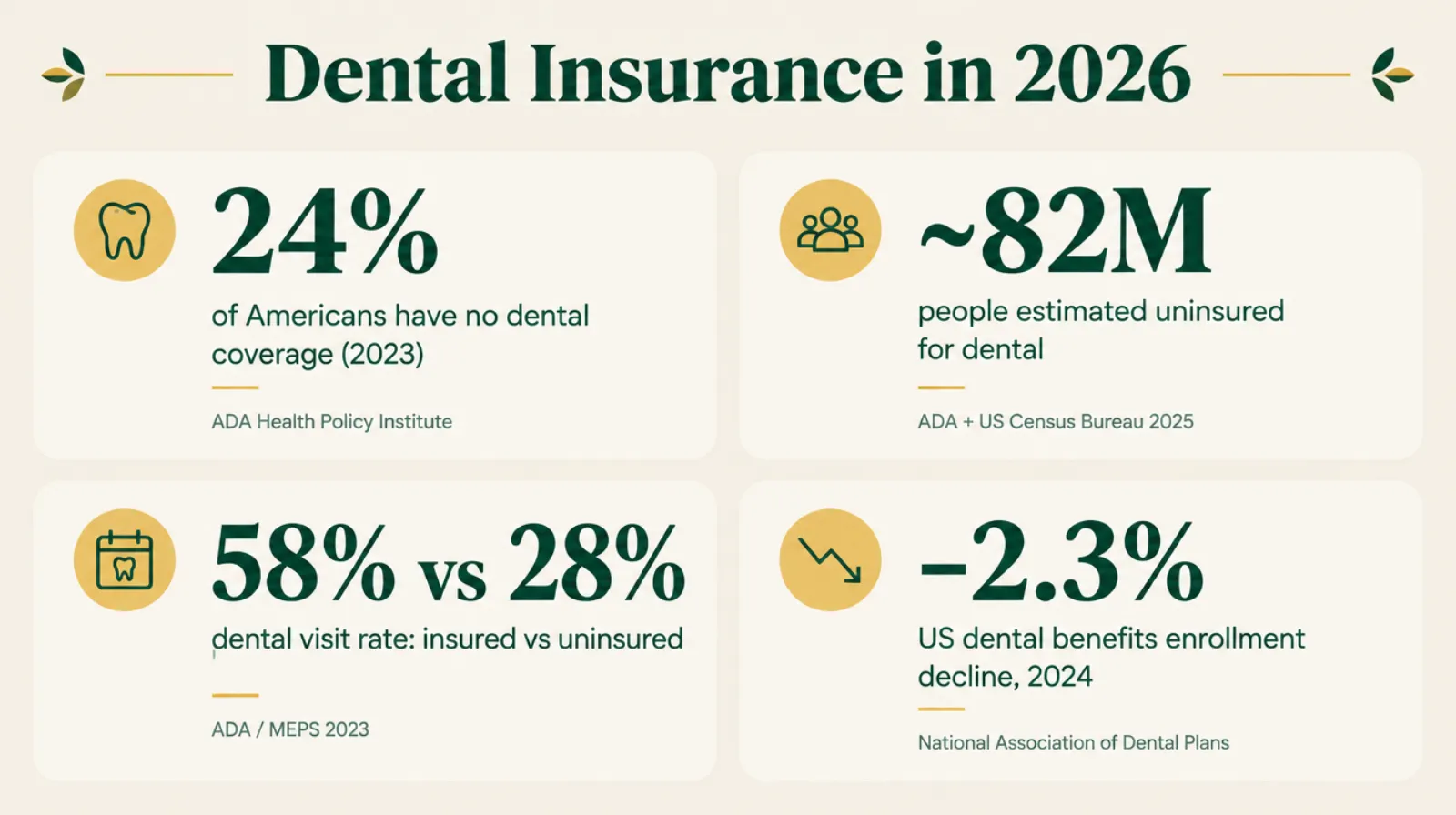
Here’s what that gap costs in practice, not in theory: insured people use dental care at nearly double the rate of the uninsured. In 2023, 58% of people with private dental insurance saw a dentist, compared to 28% of the uninsured, according to the ADA’s Health Policy Institute using Medical Expenditure Panel Survey data. That’s not a preference gap. It’s what happens when the price of a checkup stops being an out-of-pocket decision made one visit at a time.
| Coverage status | Share of population | Visited a dentist in the past year |
|---|---|---|
| Privately insured | ~56% | 58% |
| Publicly insured (Medicaid/CHIP) | ~20% | 32.1% |
| Uninsured | 24% | 28% |
Source: American Dental Association Health Policy Institute, National Trends in Dental Care Use, Dental Insurance Coverage, and Cost Barriers (updated April 2026), data from the Medical Expenditure Panel Survey, 2023.
The market those numbers sit inside is shrinking, which is the part most agents miss. Total U.S. dental benefits enrollment fell 2.3% in 2024 versus 2023, per the National Association of Dental Plans’ December 2025 report, with commercial plan enrollment down 2.0% and publicly funded benefits down 3.0% over the same period. A shrinking pool of covered lives means fewer easy renewals sitting on your book and more of your growth depending on winning the individual and Marketplace shoppers who are actively out there comparing options today. Those are exactly the leads that decay the fastest if nobody calls them within the hour.
Where dental leads actually come from, and how to prioritize them
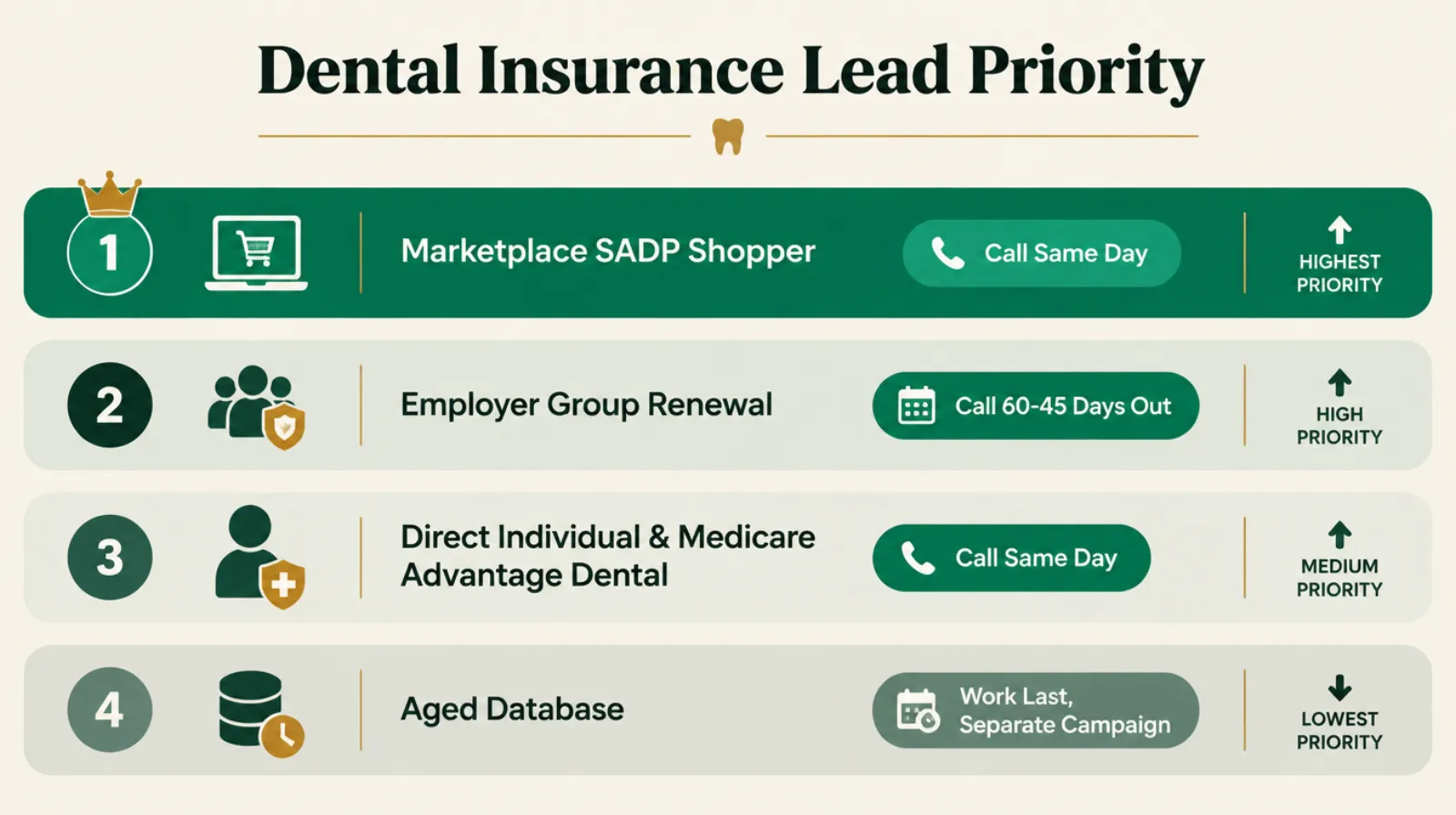
Not every dental lead deserves the same urgency, and treating them all the same is its own kind of slow follow-up. Sort by source first.
| Source | What's actually happening | Call priority |
|---|---|---|
| Marketplace SADP shopper | Comparing dental plans alongside an active health plan decision, inside a fixed enrollment window | Highest — same-day, they're also a health lead |
| Employer group renewal | HR or an owner evaluating group dental options ahead of a known renewal date | High — calendar-driven, plan around the date |
| Direct individual shopper | Comparing standalone individual dental policies outside the Marketplace | High — usually shared with competing agents |
| Medicare Advantage dental add-on | Senior comparing MA plans where dental benefit differs by plan | High during AEP/OEP, moderate otherwise |
| Aged dental database | Previously quoted or previously covered, no recent activity | Lower — reactivation campaign, not urgent |
The highest-priority row on that table is the one agents most often mishandle: the Marketplace SADP shopper. Because HealthCare.gov requires the health plan and the stand-alone dental plan to be purchased in the same transaction, a dental lead from this source is never really “just” a dental lead. If your workflow routes it to a dental-only queue and routes the health inquiry somewhere else, you’ve split one shopper’s decision into two separate, poorly coordinated conversations, and whichever conversation happens second is the one you’re most likely to lose.
You can build this list yourself
Pull your last 90 days of dental-tagged leads out of your CRM and sort by source using the table above. Anyone tagged as a Marketplace or SADP lead gets called today, full stop, even if your queue says something else is more urgent. This costs nothing but the time to run the export and sort it.
What slow follow-up on a dental book actually costs
Run the arithmetic the same way you’d run it for any other line, because the underlying mechanics don’t change just because the average commission is smaller. Say your agency generates 300 dental leads a month across all four sources above, and historically you’ve called 60% of them within 48 hours and the rest whenever someone got to them, sometimes a week later. A shopper who submitted a form for a Marketplace SADP alongside a health plan has, by definition, already started a conversation with whichever health agent responded first, the same speed dynamic covered in depth in our guide to speed to lead. If that’s not you, you’ve likely lost the dental line item too, since most shoppers prefer bundling both purchases with one agent rather than splitting the transaction.
Dental leads on the low-priority queue
- Dental leads called only after health and Medicare lines are worked
- Marketplace SADP leads split from the paired health inquiry
- Employer renewal dates tracked informally, if at all
- After-hours dental submissions sit until the next business day
DaysTypical gap before a dental lead gets called
Dental leads called on arrival
- Every dental-tagged lead calls out the same day it lands
- SADP leads routed with, not separate from, the paired health inquiry
- Group renewal dates tracked and queued automatically ahead of time
- Nights and weekends covered without a dedicated on-call schedule
MinutesTypical gap with automated outbound calling
Hear it call a lead
Put your own number in and the AI calls you in seconds, so you can hear what a Marketplace SADP shopper would hear if you pointed this at your dental queue today.
Now price the fix against a real list size. Using TheAffordableAI’s published Single Account rate of $0.20 a minute, a 300-lead monthly dental queue at a 3-minute average qualifying call runs 900 minutes, or $180 a month in usage, plus the $500 one-time setup if you’re starting from zero. At the Agency plan’s bulk rate of $0.16 a minute, the same 900 minutes runs $144. Neither number is the point in isolation. The point is that you can run this math against your own actual lead volume before committing to anything, and both plans are month to month, so the cost of testing it is one month’s subscription plus usage, not a long-term contract.
How to fix it: build the list and route it correctly
None of this requires new software before you decide whether an AI caller is worth adding. You can do the first four steps with a CRM export and a spreadsheet.
- Tag every dental lead by source. Marketplace SADP, embedded, employer group renewal, direct individual, Medicare Advantage add-on, or aged database. Most CRMs already capture this in a form or campaign field; the work is making sure the tag actually gets set, not building something new.
- Never split a paired SADP lead. If a shopper submitted for a health plan and a stand-alone dental plan in the same session, route both to the same agent and the same call, not two separate queues. HealthCare.gov’s own rule, that a stand-alone plan can’t be bought without a health plan in the same transaction, means this pairing isn’t optional context. It’s the actual shape of the sale.
- Calendar your group renewal dates. Pull every employer group’s renewal date for the next 90 days and queue outreach 60 to 45 days ahead of it, the same triage logic that works for any renewal-driven book.
- Call the highest-priority row first, every day. Use the source table above as your literal call order, not a reference document you glance at once.
- Reactivate the aged database last, and separately. An old dental quote that never converted is a real opportunity, but it’s not time-sensitive the way a live Marketplace shopper is. Work it as its own campaign so it doesn’t crowd out today’s live leads.
The script difference that matters most
For a Marketplace SADP lead, don't open with a dental-only pitch. Open with, "I see you're looking at both a health plan and dental coverage together, let's walk through both so they fit your budget as one decision," because that's structurally what HealthCare.gov requires them to be doing anyway. Treating it as two separate conversations is where agents lose the second sale without realizing they split one shopper in half.
Where the math stops working, and what we do about it
If your dental lead volume is small enough that you can call every one within the hour yourself, do that. The cost of adding a platform isn’t worth it against fifteen leads a month. Past a few hundred a month across four different sources, each needing a different routing rule and a different sense of urgency, the math stops working for a person answering a phone between everything else on the calendar.
TheAffordableAI runs outbound calling that fires when a lead lands, not when a producer finds a gap, and it can carry SADP, employer renewal, and Medicare Advantage dental volume in parallel instead of forcing them through the same single queue. Number warmup and spam defense keep those calls landing as more than “Spam Likely,” which matters more on dental leads than most agents expect, since a shopper who’s also fielding a call from a health agent at the same time won’t wait around for a number that looks like a robocaller. When a shopper wants to talk specifics, the call transfers warm to whoever on your team is available for that line, and disposition, transcript, and source tags sync back to your CRM, including HighLevel, automatically. The full breakdown of routing, warm transfers, and CRM sync lives on the features page.
Price it against your own dental book
The math above uses $0.20 a minute because that's what a Single Account costs, down to $0.16 a minute at Agency bulk rates. Run it with your own lead volume and average call length before you decide anything. See pricing.
What you get
$0.20
Per-minute rate, Single Account, from $0.15 at bulk
20+
Agents a warm transfer can ring on the Agency plan
24/7
Coverage across every dental lead source at once
0 mo
Contract length required. Cancel anytime.
Source-aware routing
SADP, employer renewal, and aged database leads can run as separate campaigns instead of one undifferentiated queue.
Number warmup and spam defense
Standing routine, not a one-time fix, so calls into a competitive dental-plus-health decision actually get answered.
Warm transfer
A shopper ready to talk specifics gets handed to a live agent on your team while they're still on the phone.
HighLevel CRM sync
Disposition, transcript, and source tags land on the contact record automatically, so a paired SADP lead doesn't get split between two reps.
The compliance part, said plainly
Dental insurance leads don’t get a pass on the rules that apply to every other line.
Before you point a dialer at a dental lead list
- Automated or prerecorded calls, including AI-generated voice, to a wireless number require the called party's prior express consent under 47 U.S.C. Section 227, the TCPA, per Cornell Law School's Legal Information Institute. A dental-specific opt-in on a lead form does not automatically satisfy this for every subsequent call type.
- Disclose what the call is about and honor an opt-out immediately, on every channel.
- National and internal Do Not Call obligations apply the same as they do to health, life, or Medicare leads.
- Using an AI caller does not transfer liability. The licensed agent and agency remain responsible for consent, disclosure, and the advice given on the call.
This is general information, not legal advice. Verify current requirements against the FCC's rules and your own state and carrier obligations before running a large outbound push.
Where this isn’t the right tool
An AI caller is built for volume and speed against a list you already have, and it works best when the list is genuinely large enough that a person can’t call every lead inside the window that matters. If your agency generates a handful of dental leads a month, call them yourself; the platform cost isn’t worth it at that volume, and a small list rewards a human conversation more than automation anyway.
It also can’t fix a routing problem by itself. If a Marketplace SADP shopper’s dental inquiry and health inquiry land in two different systems with two different owners, a faster caller on one side of that split doesn’t put the two halves of the sale back together. Fix the routing first, then decide whether speed is still the bottleneck once the plumbing is right.
If you want to hear it before you decide anything
There's a demo call on the homepage. Put your own number in and the AI calls you in seconds, so you can hear exactly what a dental lead would hear if you pointed this at your queue today. Hear a demo call, or go straight to pricing if you already know what you're testing.
The uninsured pool sitting behind that 24% figure isn’t going away on its own, and the shrinking, more competitive market documented in NADP’s own numbers means the shoppers who are out there comparing plans right now are worth more per lead than they were two years ago, not less. None of that matters if the dental tag in your CRM is the one queue nobody clears by the end of the day. Fix the routing, call the SADP leads with the health inquiry they’re actually paired with, and the rest of this stops being a mystery cost and starts being a list you can count and clear.
Frequently asked
What percentage of Americans don't have dental insurance in 2026?
As of 2023, the most recent year available, 24% of the U.S. population was uninsured for dental coverage, down from 33% in 2002, according to the American Dental Association's Health Policy Institute using Medical Expenditure Panel Survey data. Applied to the Census Bureau's July 2025 population estimate of 341.8 million, that rate points to roughly 82 million people with no dental coverage at all, a rough calculation using two separate sourced figures rather than a single published count.
Can someone buy a stand-alone dental plan on the ACA Marketplace without a health plan?
No. HealthCare.gov states plainly that you can't buy a Marketplace dental plan unless you're buying a health plan at the same time. A stand-alone dental plan (SADP) is purchased alongside a qualified health plan during the same enrollment window, not on its own, which is why every SADP lead is also, by definition, a health plan shopper.
Why do dental insurance leads go cold faster than agents expect?
Dental leads frequently arrive bundled with a health or Medicare inquiry, and agents work the higher-commission line first, leaving the separate dental follow-up for later. That delay is a workflow-priority problem, not a technology problem, and it costs the same way slow follow-up costs on any other line: the shopper who filled out one form usually filled out several, and whoever calls first tends to write the policy.
Is calling a dental insurance lead with an AI caller legal under the TCPA?
It depends on consent and the number type. Automated or prerecorded calls, including AI-generated voice, to a wireless number require the called party's prior express consent under 47 U.S.C. Section 227, the Telephone Consumer Protection Act, per Cornell Law School's Legal Information Institute. That requirement applies to a dental insurance lead the same as any other insurance lead. Document consent, disclose what the call is, and honor opt-outs immediately.
How much does it cost to call a dental insurance lead list with an AI caller?
Using TheAffordableAI's published Single Account rate of $0.20 a minute, a 3-minute qualifying call runs about $0.60, or roughly $300 to call 500 dental leads once. At the Agency plan's bulk rate of $0.16 a minute, the same 500-lead pass runs about $240. Both plans are month to month with no long-term contract, so testing the math against your own list costs one month's subscription plus usage.
Are dental insurance leads shared with multiple agents the way ACA leads are?
Often, yes. Dental leads generated through online aggregators and comparison sites commonly run through the same shared, ping-post style distribution used for other insurance verticals, where several agents can receive the same contact at once. If you buy dental leads from a shared source, assume a competing agent has the same name and the same clock running.
What's the difference between embedded and stand-alone dental coverage on the Marketplace?
Embedded dental coverage is built into a health plan's premium, so you can't remove it without switching health plans, per HealthCare.gov. A stand-alone dental plan (SADP) carries its own separate premium and is sold alongside, not instead of, a health plan. SADPs can also carry waiting periods before they cover adult services, which embedded plans typically don't.
Is the dental insurance market growing or shrinking in 2026?
Shrinking overall, at least for the most recent measured year. Total U.S. dental benefits enrollment fell 2.3% in 2024 compared to 2023, with commercial plans down 2.0% and publicly funded benefits down 3.0%, according to the National Association of Dental Plans' December 2025 enrollment report. A shrinking pool of covered lives makes every individual and Marketplace lead more worth calling first, not less.
Sources
- American Dental Association Health Policy Institute — National Trends in Dental Care Use, Dental Insurance Coverage, and Cost Barriers (updated April 2026, data from MEPS/NHIS 2002-2023)
- National Association of Dental Plans — NADP Report Shows Continued Decline in Dental Benefits Enrollment (published December 4, 2025)
- HealthCare.gov — Dental Coverage in the Health Insurance Marketplace
- U.S. Census Bureau — U.S. Population Growth Slows Due to Historic Decline in Net International Migration (published January 27, 2026, Vintage 2025 estimate)
- Cornell Law School Legal Information Institute — 47 U.S.C. Section 227, Telephone Consumer Protection Act
- TheAffordableAI — Pricing
Put this on your own phone line
See the AI dial, qualify, and warm-transfer a live call in under a minute. No contract, no dev work.
Keep reading

ACA Open Enrollment 2027: 31 Fewer Days to Save Your Book
CMS cut the ACA open enrollment window from 76 days to 45 starting with plan year 2027. Here's what that compression means for your renewal calls.

Shared vs Exclusive Insurance Leads: What Wins in 2026
A shared insurance lead can ring at five other agents at once. How the ping-post auction works, what it costs, and how to win the call anyway.

Speed to Lead in 2026: Why the First 60 Seconds Decides Who Writes the Policy
The lead you paid for is not lost to a better agent. It is lost to a faster one. Here is what response time actually does to contact and conversion rates, and how to get to sixty seconds without hiring a dialer team.