Final Expense Insurance Leads: A Different Playbook
Final expense insurance leads skew older, and FTC data shows elder scam-wariness is real and rising. Here's a follow-up cadence built for that, not for ACA.

You buy a batch of final expense insurance leads, TV call-ins, direct mail response cards, maybe an aged file you got cheap because nobody else worked it. You dial. Half don’t pick up. Of the ones who do, a few hang up the second you say “insurance,” because to a 68-year-old who’s fielded three scam calls this month, you sound exactly like the last one. This isn’t the same problem as an ACA lead going cold in twenty minutes. It’s a different clock, a different buyer, and a follow-up method built for someone in their 30s filling out a subsidy form doesn’t transfer cleanly to someone in their 60s or 70s who picked up a phone to ask about burial costs.
This article defines final expense insurance in plain terms, walks through the three lead channels that feed it and why each one needs a different call cadence, puts real numbers on the size and shape of this market, and gives you a calling method you can run by hand before you ever look at automating it. It also covers where a managed AI caller changes the economics, and where a human still has to be the one on the phone.
The short version
- Final expense buyers are 63.5 years old on average, per a Life Insurers Council survey of 2020 sales — older than the typical ACA or even Medicare Advantage shopper, and that age gap changes how fast, and how, you should call.
- The market is growing fast: new annualized premium hit $1.05 billion in 2024, up 16% year over year, on 1.06 million policies sold, up 10%, per the Life Insurers Council's June 2025 survey.
- 86% of final expense policies in 2024 sold through independent distribution, not captive agents or direct-to-consumer channels, per the same survey. This is an independent-agent market.
- Fraud losses reported by adults 60 and older rose from roughly $600 million in 2020 to $2.4 billion in 2024, a fourfold increase, per the FTC's own December 2025 report to Congress. Scam-wariness among your buyers is documented, not a guess.
- CMS's Medicare marketing rules don't apply to final expense, but the TCPA's consent, disclosure, and opt-out rules apply in full, with statutory damages of $500 to $1,500 per violation under 47 U.S.C. § 227(b)(3).
What Final Expense Insurance Actually Is
Final expense insurance is a small whole life policy, usually $5,000 to $25,000 in face value, sold specifically to cover funeral, burial, and other end-of-life costs so the expense doesn’t land on a family member’s credit card. It’s whole life, meaning it’s permanent coverage with a level premium and a cash value component, not term insurance that expires. It’s also sometimes called burial insurance or, when sold through a funeral home to prepay a specific funeral contract, preneed insurance, which is a related but distinct product category with its own separate sales data.
Two underwriting paths dominate the category, and the difference between them matters for how you sell and how you follow up. Simplified issue final expense asks a short list of health questions on the application; no medical exam, but the answers determine price and eligibility, and if approved, coverage is active immediately with no waiting period. Guaranteed issue final expense skips health questions entirely; anyone in the eligible age range gets approved, but it carries a mandatory waiting period, commonly two years, during which a death from natural causes returns only the premiums paid plus a modest interest amount rather than the full face value. Simplified issue is cheaper because the insurer knows more about the applicant’s health; guaranteed issue costs more per dollar of coverage because the insurer is taking on unknown risk.
Per the Life Insurers Council’s June 2025 survey of 28 life insurance companies covering 2024 sales, simplified issue made up 85% of final expense policies sold, with an average face value of $14,535. Guaranteed issue was the remaining 15%, averaging $9,786 in face value. That split matters operationally: a simplified issue sale requires a licensed human to walk through health questions that carry underwriting consequences, while a guaranteed issue sale is closer to a pure paperwork-and-payment transaction once eligibility (usually an age band) is confirmed.
| Feature | Simplified issue | Guaranteed issue |
|---|---|---|
| Share of 2024 policies sold | 85% | 15% |
| Average face value | $14,535 | $9,786 |
| Health questions on application | Yes, a short list | None |
| Waiting period for natural-cause death | None if approved | Typically 2 years |
| Who should ask the qualifying questions | Licensed agent (underwriting-adjacent) | Can be closer to a scripted eligibility check |
Source: LIMRA / Life Insurers Council, "Final Expense Insurance: New Annualized Premium Increased 16% in 2024," published June 12, 2025, survey of 28 life insurance companies covering 2024 sales.
The buyer profile is older than most agents expect if they’re used to ACA or Medicare Advantage prospects. The Life Insurers Council’s survey of 2020 sales, published by LIMRA and LOMA, put the average age of a final expense buyer at 63.5, for both simplified and guaranteed issue policies. That’s below Medicare eligibility for many buyers and well above the median ACA marketplace shopper. It also means the “buy final expense to cover a parent’s funeral” instinct is often backwards: a meaningful share of buyers are purchasing coverage on themselves, in their early-to-mid 60s, ahead of Medicare, not shopping for an aging parent.
The Three Lead Channels, and Why Each One Needs a Different Clock
Final expense leads don’t come from one place, and the channel a lead came from tells you almost everything about how fast you need to call it and how the person on the other end is likely to react. Per the Life Insurers Council’s 2024 data, 86% of final expense policies sold through independent distribution, meaning independent agents and agencies working leads from multiple sources, versus 10% through affiliated (captive) channels and 4% direct-to-consumer. This is fundamentally an independent-agent business, which is exactly the audience buying leads from multiple vendors and juggling multiple channels at once.
TV and call-in leads. A consumer sees a commercial, often featuring a well-known spokesperson, and calls a toll-free number or fills out a web form immediately after. This is the freshest, highest-intent channel, functionally identical in urgency to the speed-to-lead problem in any other insurance line: the person is thinking about it right now, and a callback within minutes has the best shot at a live, engaged conversation.
Direct mail leads. A postcard or letter goes out, and the consumer mails back a response card or calls a number printed on it, days or weeks after receiving it. The lag between “generated” and “returned to the vendor” is already built in, so by the time it reaches you, the buyer’s moment of interest may have cooled somewhat, but they took a deliberate action (writing, mailing) that generally signals more durable intent than a one-click web form.
Telemarketed and aged internet leads. These are gathered by an outbound telemarketing operation confirming interest live, or scraped from older web form submissions and resold, sometimes 30, 60, or 90-plus days after the original inquiry. This is the channel where “the buying trigger has faded” is most likely to be true, and where a single fast call matters less than a patient, multi-touch cadence that doesn’t assume the person remembers filling anything out. It overlaps heavily with the broader question of what’s still legal to call on an aged lead, which comes down to consent, not the lead’s age.
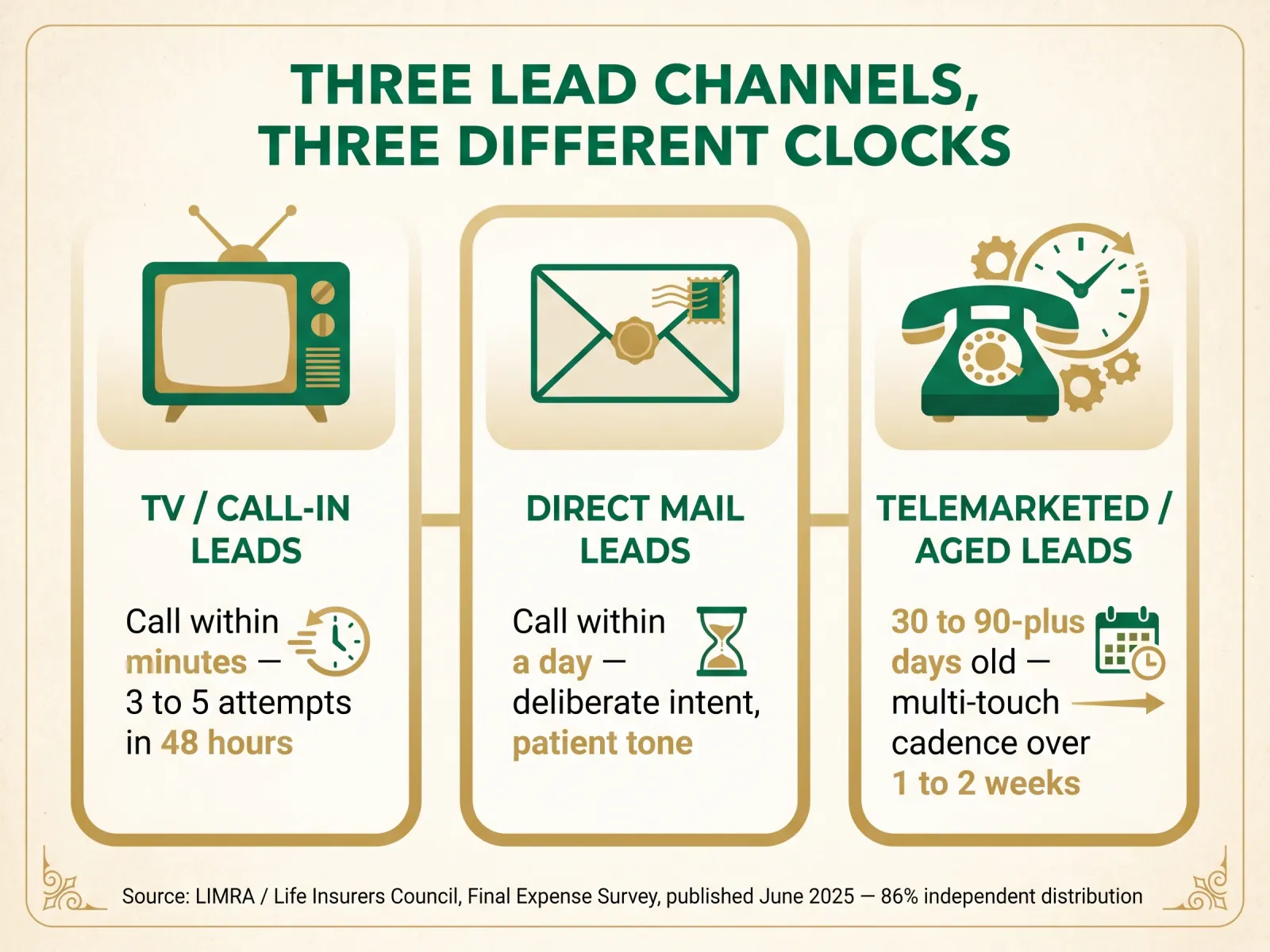
The mistake we see most often is agencies running one script and one cadence across all three channels, because the CRM treats every inbound record the same way regardless of source. A TV lead called on the same seven-day drip as an aged internet lead wastes the TV lead’s urgency. An aged lead called once, immediately, and marked dead when it doesn’t answer wastes the only real chance it had, since the buyer likely doesn’t remember the inquiry and needs more than one touch to recognize the callback as legitimate.
Why the FTC’s Own Data Says Scam-Wariness Is Real, Not an Excuse
Here’s a specific answer: adults 60 and older reported roughly $600 million in fraud losses in 2020, rising to $2.4 billion in 2024, a fourfold increase over four years, according to the FTC’s own annual report to Congress on protecting older adults, published in December 2025. That’s general fraud, not final expense insurance specifically, since the FTC’s public reporting doesn’t break out an insurance-telemarketing category separately, but it establishes the underlying fact directly: the demographic buying final expense insurance has become a documented, growing fraud target over exactly the years this market has grown.
This isn’t a detour from the sales conversation. It’s the actual mechanism behind low answer rates and quick hang-ups on final expense calls. A 65-year-old who has read local news coverage of grandparent scams, tech-support scams, and government-impersonation calls targeting people their age has good reason to be suspicious of an unfamiliar number opening with anything vague. The FTC’s own consumer guidance repeatedly tells this exact demographic to hang up on unsolicited calls and verify independently before engaging, which means your legitimate call is competing against advice the person has been given for their own protection.
The practical implication is that the opening seconds of a final expense call need to do more identification work than an ACA or Medicare call typically does: state your name, the specific company or agency you’re calling from, and the specific product, immediately, rather than leading with a vague “I’m calling about the information you requested.” Vagueness reads as evasive to someone primed to expect a scam. Specificity, even boring specificity, reads as legitimate.
What This Actually Costs: The Market Size and the Compliance Exposure
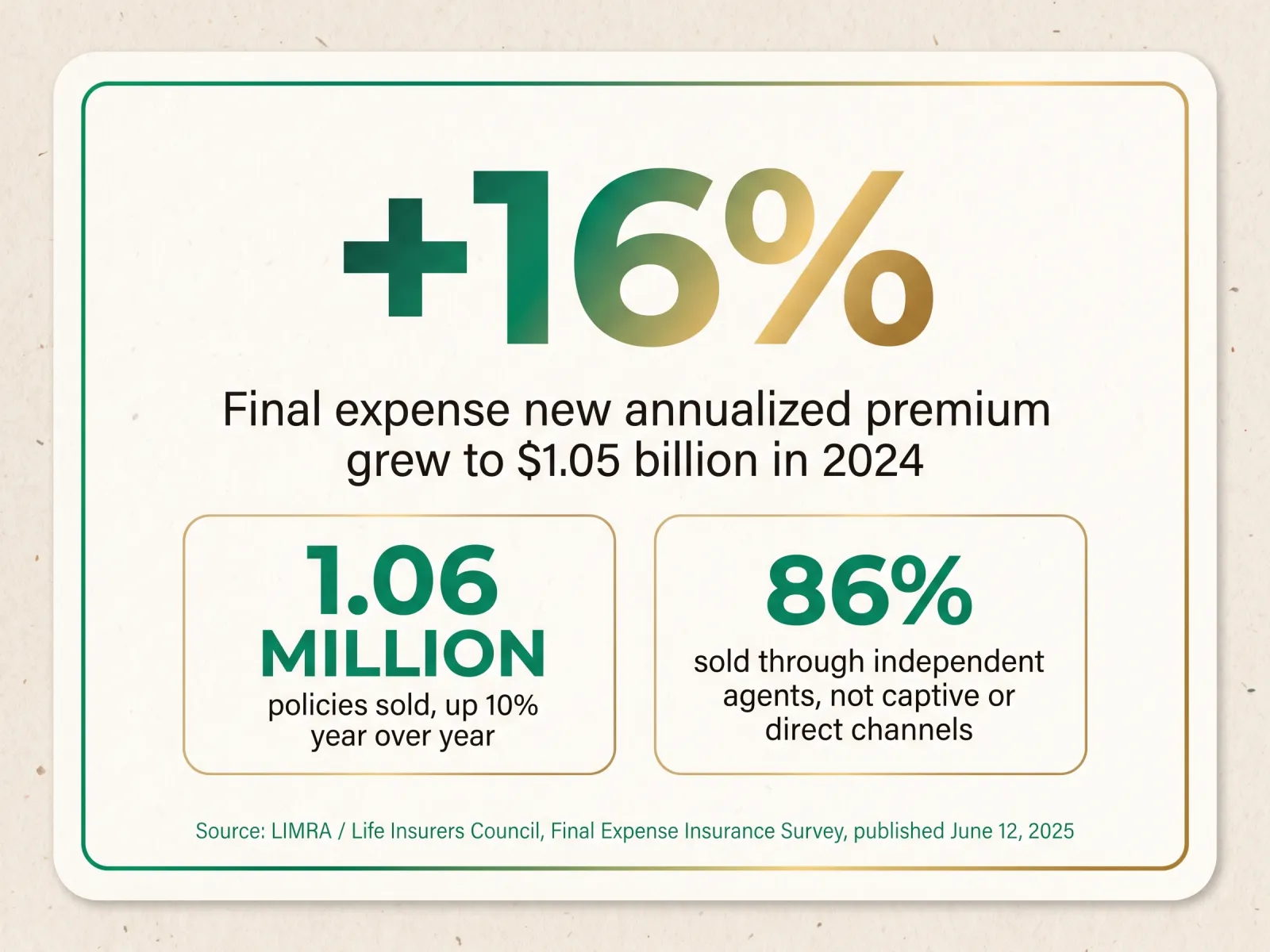
The final expense market is not a niche backwater. New annualized premium reached $1.05 billion in 2024, up 16% year over year, on 1.06 million policies sold, up 10% year over year, according to the Life Insurers Council’s June 2025 survey of 28 life insurance companies. That growth sits inside a broader life insurance boom: total individual life new premium hit $17.5 billion in 2025, up 10% year over year and the fourth sales record in five years, with whole life new premium climbing 7% to $6.4 billion and representing 37% of the total market, per LIMRA’s own reporting on full-year 2025 results. LIMRA specifically attributes part of that whole life strength to final expense product sales driving growth for five consecutive quarters.
Final Expense Insurance Growth, 2024
New annualized premium and policy count, year over year
Source: LIMRA / Life Insurers Council, "Final Expense Insurance: New Annualized Premium Increased 16% in 2024," published June 12, 2025.
That’s the upside. The exposure side is the same TCPA framework that applies to every other insurance line sold by phone, and it doesn’t get lighter because the product is final expense rather than Medicare. Under 47 U.S.C. § 227(b)(3), a consumer can recover $500 in statutory damages for each TCPA violation, or their actual monetary loss if greater, and a court can increase that award to as much as three times the base amount, up to $1,500 per violation, if the violation was willful or knowing. That’s per call or text found in violation, not per lawsuit, and it applies whether the underlying issue is missing consent, a call outside permitted hours, or a failure to honor an opt-out. A telemarketing operation dialing thousands of aged leads without solid consent records is exposing itself to that multiplier at scale.
One thing final expense marketing does not carry that Medicare marketing does: CMS’s Third-Party Marketing Organization disclaimer, its mandatory call-recording and 10-year retention rule, and its restrictions on unsolicited contact during specific enrollment windows are all Medicare-specific and don’t apply to a whole life policy. That’s a genuine compliance simplification, but it’s easy to over-read: the TCPA, the National Do Not Call Registry, and any applicable state telemarketing law (several of which we’ve covered state by state on this blog) apply in full regardless of product line. Removing CMS from the picture removes one layer, not the whole stack.
How to Fix It: A Channel-Matched Calling Method
Here’s the method, and you can run every piece of it by hand before spending anything on automation.
Step 1: Tag every lead by channel and age at the moment it enters your CRM. Not “insurance lead,” but “TV call-in, 0 days old” or “telemarketed, 47 days old.” This single field determines everything downstream, and most of the agencies we’ve talked to don’t track it, which is why one generic cadence gets applied to leads that need three different approaches.
Step 2: For same-day TV, web, or direct-mail-response leads, call within minutes, not hours, and plan for three to five attempts across the first 48 hours. The person is either still thinking about the ad they just saw or actively wondering whether they’ll hear back from mailing in a card. This part of the method is identical in spirit to any speed-to-lead approach: fast first contact wins more live conversations, full stop.
Step 3: Open every call with your name, your company or agency name, and the specific product, before anything else. Given the documented rise in fraud targeting this age group, a vague opener is the single biggest reason a legitimate call gets treated like a scam. “Hi, this is [name] with [company], calling about the final expense coverage information you requested” beats any softer, vaguer opening for this specific audience, even if it feels less smooth.
Step 4: For aged leads (30-plus days old), switch to a longer, lower-pressure cadence spread over one to two weeks instead of a compressed same-day push. Assume the person doesn’t remember the original inquiry. Reference the channel plainly (“you responded to a mailer a while back about final expense coverage”) rather than assuming recognition, and don’t burn all your attempts in the first 24 hours on a lead that’s already a month old, since the urgency that justified rapid-fire dialing on a fresh lead doesn’t apply here.
Step 5: Route anything touching health questions or the actual application to a licensed agent, every time, on every simplified issue sale. This is true whether a human or an AI made the first qualifying call. The health questions on a simplified issue application carry underwriting consequences, and having a non-licensed process, human or automated, make judgment calls there is an E&O and compliance problem waiting to happen.
Step 6: Log every consent basis, timestamp, and opt-out request, and honor opt-outs immediately. If you can’t show when and how a specific number consented to be called, you’re exposed to the $500-to-$1,500-per-violation framework in 47 U.S.C. § 227(b)(3) regardless of how the lead entered your pipeline.
An agent who reads this and thinks “I could run this by hand with a spreadsheet and some discipline” is right; plenty of agencies do exactly that. The honest tradeoff is time: tagging, timing, and re-cadencing hundreds of leads across three different channels, by hand, every day, is a real job, and it’s the job that tends to slip first when call volume spikes or someone’s on vacation.
What it looks like
- Every lead gets the same script, regardless of channel or age
- Aged leads get one call, then get marked dead
- TV leads sit in the same queue as everything else, with no urgency flag
- Health questions get asked by whoever picks up first
What it looks like
- Fresh TV/web leads called within minutes, 3-5 attempts in 48 hours
- Aged leads worked on a patient 1-2 week multi-touch schedule
- Every opener states name, company, and product up front
- Health and application questions route to a licensed agent every time
A Worked Example: The Math on 500 Aged Leads
Say you buy a batch of 500 aged final expense leads, telemarketed or scraped internet forms, averaging 60 days old, at whatever per-lead price your vendor quotes. Working that list by hand on the channel-matched cadence above means one to two attempts per week per lead over roughly two weeks, so figure four to six total dial attempts per lead across the batch, or 2,000 to 3,000 total dials. This next part is a modeling assumption, not a sourced benchmark: assume a producer can realistically place somewhere around 15 to 20 dials an hour once voicemail, no-answers, and note-taking are factored in. On that assumption, working the batch once by hand costs roughly 100 to 200 hours of dial time, not counting the calls that connect and turn into real conversations.
Run the same 2,000 to 3,000 dials through a managed AI caller at TheAffordableAI’s published Single Account rate of $0.20 a minute, assuming a conservative average of 30 seconds per attempt across dials that ring out, hit voicemail, or connect briefly before a decision to continue: that’s $0.10 a dial, or $200 to $300 in usage against the $200 monthly fee and the one-time $500 setup fee. On the Agency plan’s bulk rate of $0.16 a minute, the same volume runs closer to $160 to $240 in usage. Neither number is a promise about how many of those 500 leads convert to a sale; it’s simply the cost of getting every lead in the batch its full, channel-appropriate number of attempts instead of the one-and-done call a busy producer defaults to when the list is long and the day is short.
You can build a version of this yourself with a dialer and a virtual assistant. Plenty of agencies do, and for a smaller batch, that’s a completely reasonable way to run it. The comparison worth making before you commit either way is dollars against hours: what 100-plus hours of dial time costs you in producer time or a hired VA’s wages, against a usage bill in the low hundreds of dollars on a month-to-month plan with no early-termination penalty.
How We Solve It
TheAffordableAI is a managed AI caller built to run exactly this kind of channel-matched cadence without someone manually re-tagging leads every morning. It fires outbound calls the moment a fresh lead lands, whether that’s a TV call-in or a direct-mail response synced through HighLevel, and it can run a separate, slower database reactivation sequence against an aged list instead of treating every record the same way. Full feature details are on the features page. Multi-calendar intent routing and warm transfers mean that the moment a call touches anything underwriting-adjacent, a health question, a price discussion, the application itself, it hands off live to a licensed agent instead of letting a script push forward on its own. Built-in number warmup and spam defense matter more here than in most verticals, since final expense outbound volume can look, to a carrier’s spam filter, a lot like the pattern used by the scam operations this same audience has been warned about.
None of that changes who’s responsible for TCPA consent, for CMS rules on any Medicare-adjacent products in the same book, or for the licensed judgment calls a simplified issue application requires. Using AI to call faster and more consistently doesn’t transfer that liability; the agent and agency carry it, same as always.
If you want to hear what a call like this actually sounds like before you decide anything, there’s a demo call on the homepage: https://theaffordableai.com/
What You Get
Run this correctly, whether by hand or with help, and here’s what changes: fresh leads get called while the ad is still fresh in the buyer’s mind instead of sitting in a queue behind older records. Aged leads that would otherwise get one dismissive call and a “dead” tag get a real multi-touch shot instead, on a cadence that matches how long ago the interest was actually expressed. Every call opens with the specific identification that a fraud-wary 65-year-old needs to hear before they’ll keep listening. And every health question, every application detail, lands with a licensed human who’s supposed to be making that call, not a script guessing at it.
The math above uses $0.20 a minute because that’s what a Single Account costs today; run it with your own lead volume and average call length. https://theaffordableai.com/pricing
Edge Cases the Basic Method Doesn’t Cover
A few situations show up often enough in final expense work that they’re worth naming even though none of them have a clean, sourced statistic behind them.
The adult child answers, not the buyer. Because the buyer skews older, it’s common for a call to reach a son, daughter, or caregiver screening calls on the buyer’s behalf. Treat that person as a real gatekeeper, not an obstacle: they often have legitimate power of attorney or health-care proxy authority, and a respectful, specific explanation of what you’re calling about (not a pressured pitch) is far more likely to get you a callback window with the actual buyer than trying to talk past them.
Spanish-language and other non-English leads. Final expense marketing runs in Spanish-language media in many markets, and a lead generated in Spanish who then gets a follow-up call in English is functionally a dropped lead, regardless of how fast you called. If any portion of your lead sources targets a non-English-speaking audience, your calling capacity, human or automated, needs to match that language, not translate the script after the fact.
Licensing across state lines. A lead vendor doesn’t know or care what states you’re licensed in. An aged or resold lead can easily list an address in a state where the agent working it isn’t appointed to sell. Confirm licensing before the call, not after a sale attempt, since writing business in a state where you’re not licensed is a separate and serious problem from anything covered above.
Where This Doesn’t Apply
If your final expense book is small, mostly warm referrals and repeat clients you already have a relationship with, none of this channel-matching problem exists in the same way, and adding a calling platform on top of a handful of warm conversations a week probably isn’t worth the setup. This method earns its keep specifically when you’re buying leads across multiple channels at real volume and the manual tagging-and-re-cadencing work has already started to slip. Know which one you are before you spend money on either a spreadsheet system or a platform to run it.
See a final expense call flow, start to finish
Watch how a fresh lead gets dialed, how an aged database lead gets a different cadence, and how a warm transfer hands off to a licensed agent the moment health questions come up.
Frequently asked
What is a final expense insurance lead?
A final expense lead is a consumer inquiry for whole life insurance sized to cover funeral and burial costs, usually $5,000 to $25,000 in face value. The average buyer is 63.5 years old, per a Life Insurers Council survey of 2020 sales published by LIMRA and LOMA. Leads come from TV commercials, direct mail response cards, outbound telemarketing, and internet forms, and each channel produces a lead with a different age and urgency.
Why do final expense leads answer the phone less than ACA or Medicare leads?
No single study measures answer rates by insurance line, so this is inference, not a sourced statistic. But it lines up with two facts we can source: the buyer is older on average (63.5, per the Life Insurers Council), and the FTC's own reporting to Congress shows fraud losses reported by adults 60 and older rose from roughly $600 million in 2020 to $2.4 billion in 2024, a fourfold increase. An unfamiliar number calling about insurance is exactly the profile that group has been trained, correctly, to be careful about.
What's the difference between simplified issue and guaranteed issue final expense insurance?
Simplified issue asks a handful of health questions and has no waiting period if approved; it made up 85% of final expense policies sold in 2024 with an average face value of $14,535, per the Life Insurers Council's June 2025 survey release. Guaranteed issue skips health questions entirely but carries a mandatory waiting period, typically two years, before the full death benefit pays for a death by natural causes; it was 15% of 2024 sales with an average face value of $9,786 in the same survey.
Does CMS regulate final expense insurance marketing the way it regulates Medicare?
No. Final expense is whole life insurance, not a Medicare product, so CMS's Third-Party Marketing Organization disclaimer, its call-recording retention rule, and its restrictions on unsolicited Medicare contact do not apply. The Telephone Consumer Protection Act's consent, disclosure, and opt-out requirements still apply in full, along with the National Do Not Call Registry and any state telemarketing law, exactly as they would for any other product sold by phone.
How many times should I call an aged final expense lead before giving up?
There's no single published number specific to final expense, so treat this as operating guidance rather than a sourced statistic: match the attempt count to how the lead was generated. A same-day TV or web call-in lead is worth calling immediately and several times over the first 24 to 48 hours while intent is fresh. A lead that's already 30, 60, or 90-plus days old when you buy it needs a longer, lower-pressure cadence spread over one to two weeks, because the buying trigger that made them respond in the first place has likely faded.
Is it legal to call an old, resold final expense lead?
It depends on whether valid prior express consent still exists for automated or artificial-voice calls to that specific number, not on how old the lead is. The FCC's proposed one-to-one consent rule, which would have required consent given to one seller at a time, never took effect; the Eleventh Circuit vacated it in January 2025. That means the older, broader consent standard governs, but the agent or agency remains responsible for confirming that consent is real and the number hasn't been reassigned, regardless of how many times the lead has been resold.
What does it cost to call final expense leads with an AI caller instead of doing it by hand?
At TheAffordableAI's published Single Account rate of $0.20 a minute, calling 200 leads with an average 3-minute call runs about $120 in usage on top of the $200 monthly fee and a one-time $500 setup fee. At the Agency plan's bulk rate of $0.16 a minute, the same 200 calls run about $96 in usage on top of $500 a month. Both plans are month-to-month with no long-term contract, so the cost of testing this against a single lead batch is capped at one month's subscription plus usage.
Can AI legally ask the health questions on a simplified issue final expense application?
Nothing in the TCPA or state insurance law bars a voice AI from asking scripted questions, but doing so raises real underwriting, compliance, and E&O questions that a general calling platform shouldn't try to resolve on its own. The more defensible design is to have the AI qualify interest, confirm basic eligibility, and warm-transfer to a licensed agent for anything that touches health history, price, or the application itself, so a licensed human makes every underwriting-adjacent judgment call.
Sources
- LIMRA / Life Insurers Council (LIC) — Final Expense Insurance: New Annualized Premium Increased 16% in 2024 (published June 12, 2025)
- LIMRA / Life Insurers Council — Final Expense and Preneed Life Insurance Sales: Record, Mixed Results in 2020 (published 2021)
- LIMRA — Double-Digit Growth Drives Individual Life Insurance New Premium to Set New Sales Record in 2025
- Federal Trade Commission — FTC Issues Annual Report to Congress on Agency's Actions to Protect Older Adults (published December 2025)
- Cornell Law School Legal Information Institute — 47 U.S.C. § 227, Telephone Consumer Protection Act (current text)
- TheAffordableAI — Pricing
Put this on your own phone line
See the AI dial, qualify, and warm-transfer a live call in under a minute. No contract, no dev work.
Keep reading

Aged Insurance Leads in 2026: What's Legal to Call
The FCC's one-to-one consent rule for insurance leads is dead. Here's what changed, what still applies, and how to reactivate an aged database correctly.

Insurance Lead Database Reactivation Guide 2026
Your CRM has leads you already paid for and never worked. Here's how to legally reactivate an insurance lead database in 2026, and what it's actually worth.
Speed to Lead in 2026: Why the First 60 Seconds Decides Who Writes the Policy
The lead you paid for is not lost to a better agent. It is lost to a faster one. Here is what response time actually does to contact and conversion rates, and how to get to sixty seconds without hiring a dialer team.