How Insurance Agents Are Actually Using AI in 2026
How independent insurance agents use AI in 2026: real adoption numbers, where it is just ChatGPT, and the gap still unautomated.
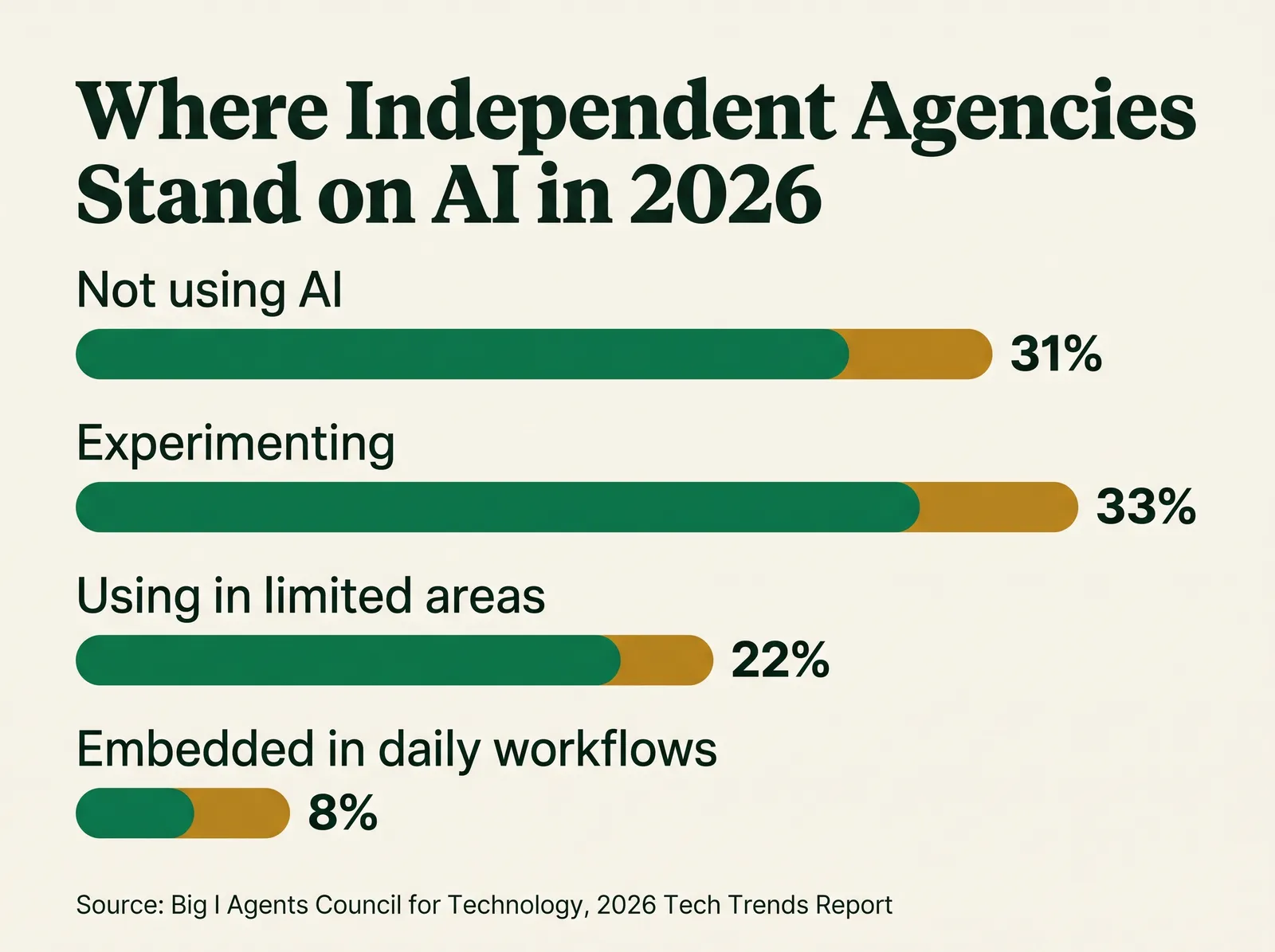
Most independent insurance agencies say they’re about to use a lot more AI. Far fewer can say they’ve actually built it into how they work. The Big “I” Agents Council for Technology’s 2026 Tech Trends Report puts the intent-to-use number at 68% over the next twelve months, and the currently-embedded-in-daily-workflow number at roughly 8%. That sixty-point gap is the real story of AI in insurance agencies this year, more than any single tool or model. Most of what counts as “using AI” right now is one person pasting a client email into a public chatbot, not a system doing a job on its own.
This article works through what the best available survey data actually shows about AI adoption among independent agents, why so much of that adoption is a general chatbot rather than anything built for insurance, what sitting on the sidelines costs in plain labor-hour terms, the method for picking a bottleneck worth fixing with AI instead of buying a tool because a competitor has one, and where a narrow, purpose-built AI voice caller fits into that picture, honestly, including where it doesn’t.
The short version
- 68% of independent agencies plan to increase AI use in the next 12 months, but only about 8% currently have it embedded in daily workflows, per the Big "I" Agents Council for Technology's 2026 Tech Trends Report.
- Where AI is already in use, 45% of agencies point to ChatGPT or another public large language model as the primary tool, more than any purpose-built option, the same survey found.
- 55% of agencies have no written AI use policy at all, a governance gap that sits on top of, not instead of, existing calling and marketing compliance rules.
- An insurance sales agent's median wage was $29.02 an hour as of May 2024, per the Bureau of Labor Statistics, a real number worth running against the actual cost of the hours AI would replace before buying anything.
- The agencies the ACT survey describes as seeing a return start with one measurable bottleneck, most often slow lead response, not a blanket AI rollout.
Where Independent Agencies Actually Stand on AI in 2026
The honest answer, straight from the only national survey we found asking this question with a published breakdown, is that most agencies are still experimenting or not using AI at all, even as a majority plan to expand. The Big “I” Agents Council for Technology released its 2026 Tech Trends Report in February, built on a national survey of independent agency members. It found 38% of agencies “very likely” and 30% “somewhat likely” to increase AI use in the next 12 months, a combined 68%, against 19% calling it “not likely.”
Set against that intent, current practice looks thin. The same survey breaks current AI usage into four tiers: 33% of agencies describe themselves as experimenting, 22% use AI in limited areas, and just 8% have it embedded in daily workflows. Meanwhile 31%, close to a third, report no AI use of any kind. Read those two data points side by side and the pattern is plain: intent to adopt AI is nearly universal, but the agencies that have actually operationalized it, built it into a daily workflow rather than trying it once, are still a small minority.
| Category | Share of agencies | What it means |
|---|---|---|
| Not currently using AI | 31% | No AI tool in use anywhere in the agency |
| Experimenting | 33% | Trying tools informally, without a defined workflow |
| Using in limited areas | 22% | AI applied to one or two tasks, not a running process |
| Embedded in daily workflows | 8% | AI is a standing part of how a specific job gets done |
| Plan to increase AI use in next 12 months | 68% | Combined "very likely" (38%) and "somewhat likely" (30%) |
Source: Big "I" Agents Council for Technology, 2026 Tech Trends Report, published February 2026. This is the only national survey with a published breakdown we found asking this specific question; treat the exact figures as directional, not triangulated across multiple independent studies.
Define the terms before the numbers matter
General AI: a broad-purpose model, like a public chatbot, that answers questions across any topic with no specific configuration for your agency. Vertical AI: a system built and configured around one specific job, such as answering every inbound call or qualifying a new lead, using the same model technology under the hood but wired into your calendar, CRM, and phone lines. Agentic AI: AI that takes an action on its own, dialing a number, booking a slot, updating a record, rather than only producing text for a person to act on. Most current agency AI use, per the survey below, is general AI used for text, not agentic AI doing a job.
If you want the honest first-source read: see the full ACT 2026 Tech Trends Report rather than a secondhand summary of it, including ours.
Why So Much “Using AI” Right Now Is Just ChatGPT
Ask what tool agencies actually reach for and the answer narrows fast. Per the ACT 2026 survey, among agencies using AI in any form, 45% name ChatGPT or another public large language model as their primary tool, well ahead of the next options: policy comparison tools (20%), AI-enabled marketing tools (18%), AI chatbots or virtual assistants (13%), and document or data extraction tools (13%). Respondents could pick more than one, so these don’t sum to 100%, but the ranking is the point. A general chatbot is, by a wide margin, the most common thing agencies mean when they say they “use AI.”
What agencies use AI for, when they use it at all
Share of AI-using independent agencies naming each tool category as a use case. Multi-select; totals exceed 100%.
Source: Big "I" Agents Council for Technology, 2026 Tech Trends Report.
There’s nothing wrong with using a chatbot to draft a client email or summarize a coverage document faster. It’s genuinely useful, and it’s why 60% of agencies in the same survey cite operational efficiency and 52% cite staff productivity as their top reasons for adopting AI at all. But a general chatbot has a structural limit: a person still has to open it, type the prompt, read the output, and act on it, one task at a time. It doesn’t answer a phone at 9 p.m. on a Sunday. It doesn’t notice a new lead landed and dial it. It doesn’t check a calendar and book a slot. Those are jobs a system has to do on its own, continuously, without someone remembering to open a tab, and that’s a different category of tool than the one 45% of agencies are actually using.
This is also where the “AI replaces producers” fear and the “AI is just a chatbot” dismissal both miss the actual shape of what’s happening. Neither is quite right. What the data shows is narrower: agencies are using general AI for general tasks, and the specific, repetitive, time-sensitive jobs, the ones a licensed producer shouldn’t be spending hours on anyway, mostly still aren’t automated at all.
There’s a reason industry analysts keep describing the next phase of insurance AI as “agentic” rather than “generative.” Deloitte’s insurance outlook work frames the shift as moving past AI that only produces text toward AI that takes an action end to end, inside a specific workflow, with a human still owning the outcome. That’s a useful way to read the 45% ChatGPT figure: it’s the generative phase, a person still in the loop for every single use, and it’s where most agencies currently sit. The 8% embedded-in-daily-workflows figure is closer to the agentic phase: AI doing a defined job continuously, checked and governed, but not re-prompted by hand every time. The gap between those two isn’t a technology gap. The model behind a chatbot and the model behind a calling agent aren’t fundamentally different. The gap is configuration: wiring the AI into a phone line, a calendar, and a CRM once, instead of asking a person to open a tab every time.
The governance gap sitting underneath all of this
55% of independent agencies report having no written AI use policy, per the same 2026 ACT survey; another 23% have one in development and only 13% have a formal policy adopted. That matters beyond the abstract: a producer pasting a prospect's health information or policy details into a public chatbot with no data policy in place is a real, current exposure, separate from and in addition to the consent, disclosure, and CMS marketing rules that already apply to any automated calling or texting an agency runs.
What Sitting on the Sidelines Actually Costs
68%
Of independent agencies plan to increase AI use in the next 12 months
Source: Big "I" ACT, 2026 Tech Trends Report
8%
Currently have AI embedded in a daily workflow, not just tried once
Source: Big "I" ACT, 2026 Tech Trends Report
$29.02
Median hourly wage for an insurance sales agent, May 2024
Source: U.S. Bureau of Labor Statistics
$0.20
Per-minute cost of a managed AI caller, Single Account plan
Source: TheAffordableAI pricing, fetched 2026-08-25
Put real numbers next to each other and the argument for aiming AI at a narrow, repetitive job gets concrete fast. The Bureau of Labor Statistics puts the median wage for an insurance sales agent at $29.02 an hour as of May 2024, with 568,800 people holding the job nationally and about 47,000 average annual openings projected as the occupation grows 4% from 2024 to 2034, roughly in line with the average for all occupations. That’s not a hiring crisis by itself, but it does mean a producer’s hour has a real, measurable cost, and every hour that producer spends re-dialing a lead that didn’t pick up, or manually working a list of a hundred aged contacts one at a time, is an hour billed at that rate or higher toward a task that doesn’t require a license to perform.
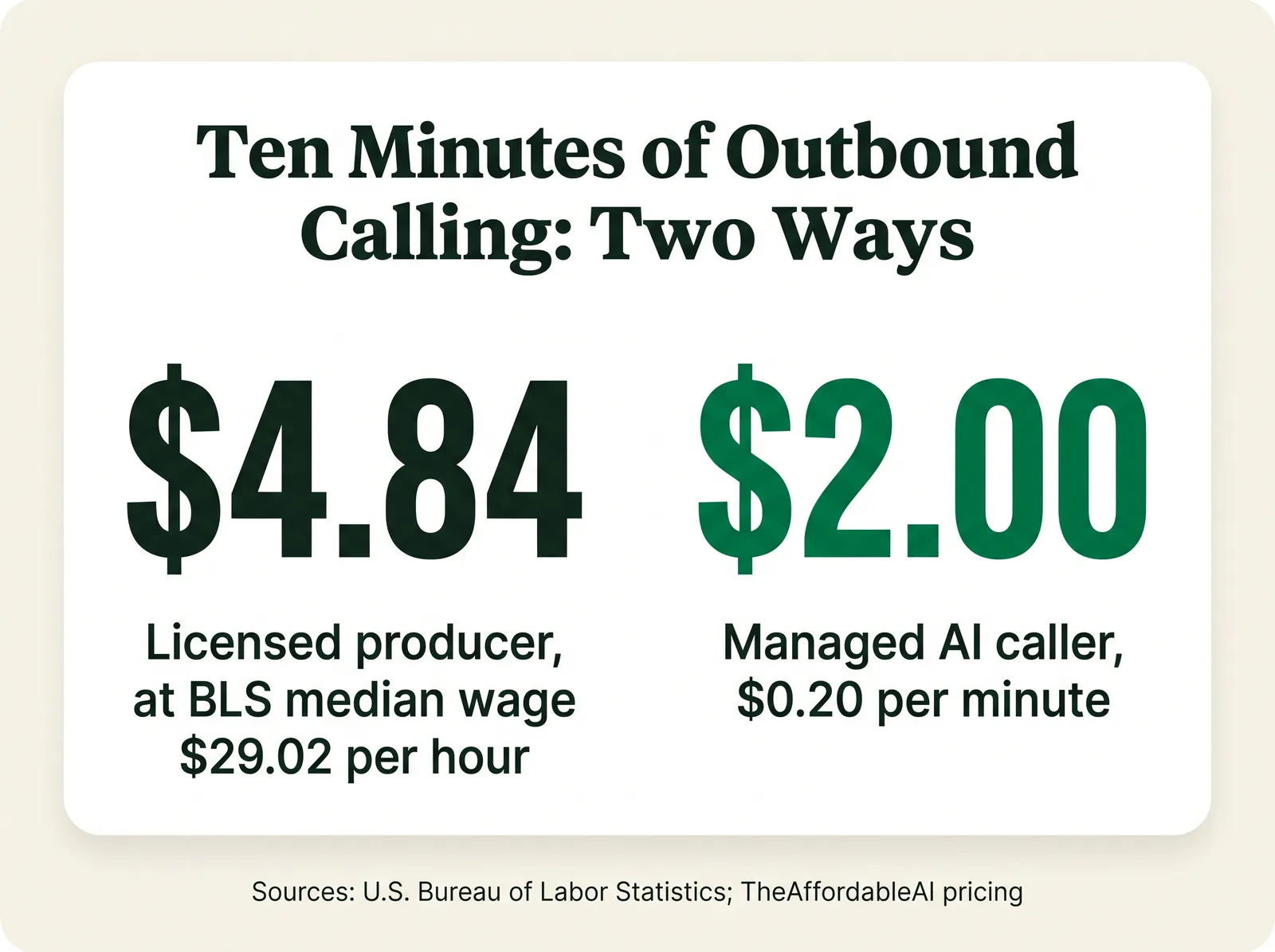
Compare that to what a managed AI caller costs to do the same mechanical work: $0.20 a minute on a Single Account plan, dropping to $0.15 a minute at bulk volume, with a $200 monthly base and a $500 one-time setup, no contract, cancel anytime. A ten-minute outbound call costs $2.00 at the standard rate. The same ten minutes of a producer’s time, at the BLS median wage, costs roughly $4.84, and that’s before accounting for the fact that a producer’s time is worth more spent advising and closing than dialing a number that goes to voicemail. This isn’t an argument that AI is free or that it replaces judgment; it’s an argument that the mechanical part of outbound and inbound calling, the dial, the wait, the redial, is priced very differently depending on who or what is doing it, and that gap is exactly the kind of measurable bottleneck the survey data above suggests most agencies haven’t touched yet.
| Who's dialing | Rate | Cost for 10 minutes |
|---|---|---|
| Licensed producer (BLS median wage) | $29.02/hour | ≈ $4.84 |
| Managed AI caller, Single Account | $0.20/minute | $2.00 |
| Managed AI caller, Agency plan | $0.18/minute | $1.80 |
Sources: U.S. Bureau of Labor Statistics, Occupational Outlook Handbook (median wage, May 2024); TheAffordableAI pricing, fetched 2026-08-25. Producer wage figure is a national median, not a per-call cost estimate; it's shown to illustrate the price of an hour of licensed time, not a claim about how agencies actually staff dialing.
None of this is an argument to stop hiring or to remove producers from calls that need judgment. It’s an argument for being deliberate about which calls need a license and which just need someone, or something, to dial the number the moment a lead comes in.
A Worked Example: 40 New Leads a Week, Two Ways
Numbers move faster than arguments, so here’s one worked all the way through, using only the sourced rates above. Say an agency gets 40 new leads a week and wants every one of them called within minutes of coming in, seven days a week, including nights and weekends. Assume an average call, connected or not, runs 4 minutes, a reasonable placeholder for a dial, a few rings, and either a short qualifying conversation or a voicemail.
Producer-staffed, spread across the week: 40 leads at 4 minutes each is about 2.7 hours of raw call time. But “within minutes, nights and weekends included” isn’t a straight 2.7-hour task; it’s a standing-by task, since a lead can arrive at any hour and someone has to be reachable to take it immediately rather than batching calls once a day. Staffing genuine always-on coverage, even loosely, costs far more producer-hours than the call time itself, and every one of those hours is billed, in opportunity-cost terms, at something close to the $29.02 median hourly wage cited above, whether the calls happen or not.
Managed AI caller, Single Account: 40 leads at 4 minutes each is 160 minutes of call time, at $0.20 a minute, for $32 a week in usage on top of the $200 monthly base. The AI doesn’t need to be “on shift” to be available at 11 p.m. on a Saturday; it already is. The producer’s time is spent entirely on the calls the AI transfers, the ones where a real, interested prospect is already live on the line, not on the 90% of dials that hit voicemail or go nowhere.
| Approach | Raw call time | What it actually requires |
|---|---|---|
| Producer dials every lead directly | ≈ 2.7 hrs/week | Someone reachable and available at the moment each lead lands, any hour, any day |
| Managed AI caller, Single Account | 160 min/week | $200/mo base + ≈$32/week usage at $0.20/min; producer time reserved for live, transferred calls only |
Sources: BLS Occupational Outlook Handbook (median wage); TheAffordableAI pricing, fetched 2026-08-25. The 4-minute average call length and 40-lead weekly volume in this example are illustrative assumptions for the arithmetic, not sourced statistics; substitute your own lead volume and average call length before drawing a conclusion for your agency.
Run your own volume through the same math before deciding anything. An agency getting five leads a week has a very different equation than one getting two hundred, and the $200 monthly base on a Single Account plan matters a lot more at low volume than it does once usage climbs. That’s exactly why step one of the method below is pulling your own numbers before picking a fix.
How to Pick the One Bottleneck Worth Fixing With AI
Give this away completely, because the method doesn’t require buying anything: an agency that wants AI to actually show up in its numbers, not just its intentions, should pick one measurable bottleneck, fix that one thing, and prove it out before touching anything else. That’s also what the survey data implies about the gap between the 68% planning to expand AI and the 8% with it embedded daily: the agencies in that 8% almost certainly didn’t get there by rolling out AI everywhere at once.
- Pull your own numbers first. For every lead in the last 90 days, log two timestamps: when it came in, and when someone first called it. Get the median and the 90th percentile, not just the average, because the average hides the nights and weekends where the real damage happens.
- Find the single biggest gap, not the most interesting one. For most agencies that gap is speed to lead: how long a new inquiry sits before anyone calls it. For others it’s coverage: nobody answers the phone after 6 p.m. or on Saturdays. Pick the one costing you the most conversations, not the one that sounds the most like “AI.”
- Write down what “fixed” looks like in a number you can check in 30 days. “Every new lead gets a first call attempt within five minutes, 24/7” is checkable. “We use more AI” is not.
- Decide whether the fix needs a license or not. Dialing, qualifying, checking a calendar, and handing off a live, interested caller doesn’t require a producer’s license. Giving coverage advice does. Draw that line before you automate anything, and keep the human step exactly where the license requirement sits.
- Try it on one channel before every channel. New inbound leads, or one lead source, not your entire book, so a bad result is cheap to reverse and a good one is easy to measure.
- Re-pull the same 90-day report after 30 days of the fix running. Compare median time-to-first-call, not vibes. If it didn’t move, the bottleneck wasn’t what you thought it was, or the fix wasn’t built correctly, and either way you’ve learned something for $0, not a wasted year.
- Only then decide whether to expand. A second workflow, a second channel, a written AI use policy for the data-handling side of things. Expansion earned by a measured result is a different decision than expansion driven by not wanting to be behind.
What 92% of agencies are doing
- A general chatbot used inconsistently for emails and summaries
- No written policy on what client data goes into it
- The actual bottleneck, slow or missed calls, still handled manually or not at all
- "We should use more AI" as the whole plan
What the ACT survey's own advice points toward
- One specific bottleneck identified from the agency's own numbers
- A defined, checkable target: response time, coverage hours, contact rate
- The license line drawn clearly before anything is automated
- Expansion decided by a 30-day result, not by not wanting to fall behind
You can build the lead-response version of this yourself with a dialer, a shared inbox, and a rotating on-call schedule. Plenty of agencies do exactly that, and it’s worth pricing against buying something before you decide either way.
Closing the Governance Gap: What Belongs in a One-Page AI Use Policy
The 55% of agencies without a written AI policy, cited above, aren’t necessarily doing anything wrong today. But “we haven’t written it down” and “we haven’t thought about it” tend to become the same thing under any real scrutiny, whether that’s an E&O claim, a carrier audit, or a client asking where their information went. A policy doesn’t need to be long to close most of the gap. It needs to answer five questions, in writing, that every agency using any AI tool, general or vertical, should already be able to answer out loud:
- What client or prospect data is allowed into a general AI tool, and what isn’t. Health details, policy numbers, and Social Security numbers typically shouldn’t go into a public chatbot at all; drafting a generic email template usually can.
- Which AI tools are approved for use, by name. Not “AI” as a category. A specific, short list, so a new hire knows what’s sanctioned without guessing.
- Who’s responsible for what an AI system does or says. For a calling system, this is the licensed agent and agency, full stop, regardless of vendor. Write that down so it isn’t ambiguous later.
- How consent, disclosure, and CMS marketing rules apply to any AI-assisted calling or texting. These obligations exist independent of AI and don’t change because a system is automated; the policy should say so explicitly rather than leaving it implied.
- How often the policy gets reviewed. State and federal rules on AI are moving fast enough that a policy written today and never revisited will be stale within a year.
None of this requires a law firm to draft on day one, though it’s worth having counsel review before you rely on it. It requires someone sitting down for an hour and writing the five answers above, which puts most agencies ahead of the 55% that currently have nothing in writing at all.
Where a Managed AI Voice Caller Fits
If the bottleneck you find is speed to lead or after-hours coverage, which the ACT survey’s own reasoning, and most agencies’ actual numbers, point to more often than not, this is the specific, narrow job TheAffordableAI is built to do. Not a general assistant. One workflow: answer, qualify, and hand off a live call.
Outbound on lead creation
The AI dials a new lead the moment it lands, not whenever someone gets to the list.
Every inbound call answered
Nights, weekends, and the gap between calls, covered without a seasonal hire.
Warm transfers to a licensed agent
The AI handles the mechanical part; a qualified, live prospect gets handed to a person while still on the phone.
Number warmup and spam defense
Standing routine, not a one-time fix, so outbound caller ID keeps landing.
Native HighLevel CRM sync
Dispositions and transcripts land on the same contact record your compliance documentation already lives on.
No contracts either way
Single Account runs $200/mo plus a $500 one-time setup at $0.20/min, down to $0.15 at bulk. Agency runs $500/mo plus a $1,000 setup at $0.18/min, down to $0.16 at bulk. Cancel anytime.
There’s a live demo call on the homepage if you want to hear what an actual answered call sounds like before deciding anything, and the full feature list is on the features page.
What You Actually Get
Concretely, not as a promise of results: a lead gets a first call attempt in seconds instead of hours. An inbound call at 9 p.m. gets answered instead of going to voicemail. A qualified, interested caller gets warm-transferred to a licensed agent while they’re still on the line, rather than booked into a calendar slot a producer discovers three days later. Every call’s transcript and disposition lands on the contact record automatically, so there’s a record of what was actually said, not just what a script intended.
What you don’t get, and shouldn’t expect from any AI calling product: a guaranteed close rate, a promised conversion lift, or a transfer of legal responsibility. Consent, disclosure, and CMS marketing rules for Medicare still belong to the licensed agent, the same as before AI was involved. Using AI to dial and qualify changes who’s doing the mechanical work. It doesn’t change who’s responsible for getting the call right.
68% of agencies plan to use more AI this year. 8% have it embedded in a daily workflow. The gap between those two numbers is where most of the industry's AI hype and most of its actual opportunity both live.
Mike MooreWhere This Is the Wrong Fix
Be straight about the limits. If your bottleneck isn’t speed or coverage, if leads get called within minutes already and the problem is closing rate, offer fit, or lead quality upstream, a faster dialer doesn’t fix any of that, AI-powered or not. If your volume is genuinely low, a handful of new leads a week, the math on a managed calling platform may not beat a human doing it directly; run the numbers from the table above with your own volume before assuming otherwise. And no calling tool, AI or human, fixes a consent problem: if a number was never validly opted in to be called, the fix is upstream in how the lead was sourced, not in what dials it once it’s already in the system.
The same honesty applies to the general chatbot 45% of agencies are already using. It’s a legitimate, useful tool for drafting and summarizing, and nothing here argues against it. It’s just not the same category of tool as a system that answers a phone on its own, and treating “we use ChatGPT” as having solved the follow-up problem is the specific confusion this article is trying to clear up.
Compliance disclaimer
Prior express consent is required for automated or artificial-voice calls and texts to a cell phone under the TCPA, and that obligation belongs to the licensed agent, not to any vendor or platform. Any AI caller must disclose it's AI where required by applicable law and honor opt-outs immediately. Medicare marketing carries CMS's separate rules, including the TPMO disclaimer and call recording retention requirements. Using AI for calling does not transfer compliance liability away from the licensed agent or agency. This article reflects a review of the cited survey and government sources as of the date published and is general information, not legal or business advice for your specific setup.
The industry conversation about AI in insurance right now is mostly about the 68% who plan to do more of it. The more useful question for a working agency is what the 8% who already have it embedded in a daily workflow actually did differently: they picked one measurable job, most often the one where a lead sits too long before anyone calls it, and they fixed that job specifically instead of buying a general tool and hoping it would show up in the numbers on its own.
Hear the one workflow that actually moves the follow-up numbers
There's a live demo call on the homepage. Put your number in and listen to how it answers, qualifies, and hands off.
Frequently asked
Are insurance agents actually using AI in 2026, or is this mostly hype?
Both things are true at once. The Big "I" Agents Council for Technology's 2026 Tech Trends Report found that 68% of independent agencies plan to increase their AI use in the next 12 months, but only about 8% currently have AI embedded in daily workflows. A third describe themselves as still experimenting, and 31% report no current AI use at all. So the intent is real and widespread, but for most agencies the actual practice is still early and shallow, not the wall-to-wall transformation vendor marketing implies.
What percentage of independent insurance agencies use AI in their daily workflow?
About 8% of independent agencies report AI embedded in daily workflows, per the Big "I" Agents Council for Technology's 2026 Tech Trends Report. Another 22% use it in limited areas and 33% are experimenting. That leaves roughly a third of agencies, 31%, not using AI in any form as of the survey. This is one national survey with a published methodology; we did not find a second independent study asking the identical question, so treat the exact percentages as directional rather than triangulated.
What AI tools do insurance agents actually use most right now?
General-purpose tools dominate. Per the same 2026 ACT survey, 45% of agencies using AI point to ChatGPT or another public large language model as their primary tool, well ahead of policy comparison tools (20%), AI-enabled marketing tools (18%), AI chatbots or virtual assistants (13%), and document or data extraction tools (13%). Respondents could select more than one category. The pattern is that most current AI use is a general writing or research assistant, not a system built to fix a specific operational bottleneck like slow lead response.
What's the difference between general AI and AI built specifically for insurance?
General AI, meaning a tool like a public chatbot, knows a broad range of topics but nothing about your book of business, your carriers, your compliance obligations, or your calendar. It's useful for drafting an email or summarizing a document, one interaction at a time, with a human doing the work of applying it. Vertical or purpose-built AI is trained and configured around one job end to end, such as calling every new lead the moment it's created, checking real availability, and handing a qualified prospect to a licensed agent. The tradeoff is breadth versus depth: general AI does a little of everything adequately; a narrow system does one workflow completely, without a human re-entering data or repeating the setup for every use.
Is AI worth it for a small insurance agency?
It depends entirely on what job it's doing, not on whether the agency "has AI." Buying a general AI subscription because a competitor mentioned one rarely shows up in the numbers. Aiming AI at a specific, measurable bottleneck, most commonly missed calls or slow follow-up on a new lead, is where agencies of any size tend to see a return, because the before-and-after is countable: how many leads got a live conversation within minutes instead of hours. Start with one workflow, measure it for a real stretch of time, and expand only once it's actually paying for itself.
Does using AI replace insurance producers?
Not in any legal or practical sense that matters here. An AI voice agent can dial a new lead in seconds, ask qualifying questions, check a calendar, and warm-transfer a live, interested caller to a person, but the advice, the recommendation, and the sale still belong to a licensed producer. Nothing about using AI to handle the mechanical, repetitive part of outreach changes who is licensed, who is liable for what gets said, or who has to be the one giving insurance advice.
What's the biggest AI adoption risk for insurance agencies right now?
Governance, not the technology itself. In the 2026 ACT survey, 55% of independent agencies report they have no written AI use policy, and only 13% have a formal one in place. Agents are already using consumer AI tools like ChatGPT with client and prospect information running through them, often without a documented policy on what data can go where. That gap sits alongside the more familiar compliance obligations that already apply to any automated calling or texting, consent, disclosure, and CMS marketing rules for Medicare, none of which change because a vendor calls its product AI.
Where does AI voice calling fit into an agency's overall AI strategy?
As the one workflow with the clearest, most countable return: answering and following up on leads fast enough that the agency is the first conversation a shopper has, not the fourth. It's a narrower claim than "AI for your agency" in general, and that's the point. A managed AI caller that dials on lead creation, answers every inbound call, and warm-transfers a qualified prospect to a licensed agent is a specific fix for a specific, measurable problem, the kind the ACT survey's own respondents say is where the return actually shows up, rather than a general-purpose tool layered on top of everything an agency does.
Sources
- Big "I" Agents Council for Technology (ACT) — 2026 Tech Trends Report
- IndependentAgent.com — Two-Thirds of Independent Agents Plan to Increase AI Use This Year (ACT 2026 Tech Trends Report coverage, published February 2026)
- U.S. Bureau of Labor Statistics — Occupational Outlook Handbook: Insurance Sales Agents (median wage, employment, and projections, May 2024 / 2024-34 data)
- TheAffordableAI — Pricing
- Deloitte Insights — 2026 Global Insurance Outlook
Put this on your own phone line
See the AI dial, qualify, and warm-transfer a live call in under a minute. No contract, no dev work.
Keep reading

AI Calling Mistakes Insurance Agencies Make in 2026
Two-thirds of independent agencies plan to expand AI use in 2026, but 55% have no written policy. Seven setup mistakes that turn a caller into a liability.

Build vs Buy: What an AI Voice Agent Costs in 2026
Should your agency build its own AI voice caller or buy one? Real 2026 rates from GoHighLevel, Twilio, Vapi, Bland AI, and Retell, compared line by line.
Speed to Lead in 2026: Why the First 60 Seconds Decides Who Writes the Policy
The lead you paid for is not lost to a better agent. It is lost to a faster one. Here is what response time actually does to contact and conversion rates, and how to get to sixty seconds without hiring a dialer team.