Local Presence Dialing for Insurance Agents (2026)
Does matching a lead's area code get more calls answered? What local presence dialing is, where it turns into illegal spoofing, and how to do it right.
You dial forty leads on a Tuesday afternoon and four people pick up. Not because the leads are bad, and not because your list is stale. It’s because your outbound caller ID shows an 800 number, or an area code from three states away, and most people have already decided, before the second ring, that an unfamiliar number is not worth answering. Local presence dialing is the practice of calling from a number that matches the lead’s own area code instead. It can help. It can also, done wrong, turn into illegal caller ID spoofing with a federal fine attached. This article covers what the practice actually is, why unfamiliar numbers get ignored in the first place, exactly where the legal line sits, and how to set it up the way that doesn’t put your agency at risk.
The short version
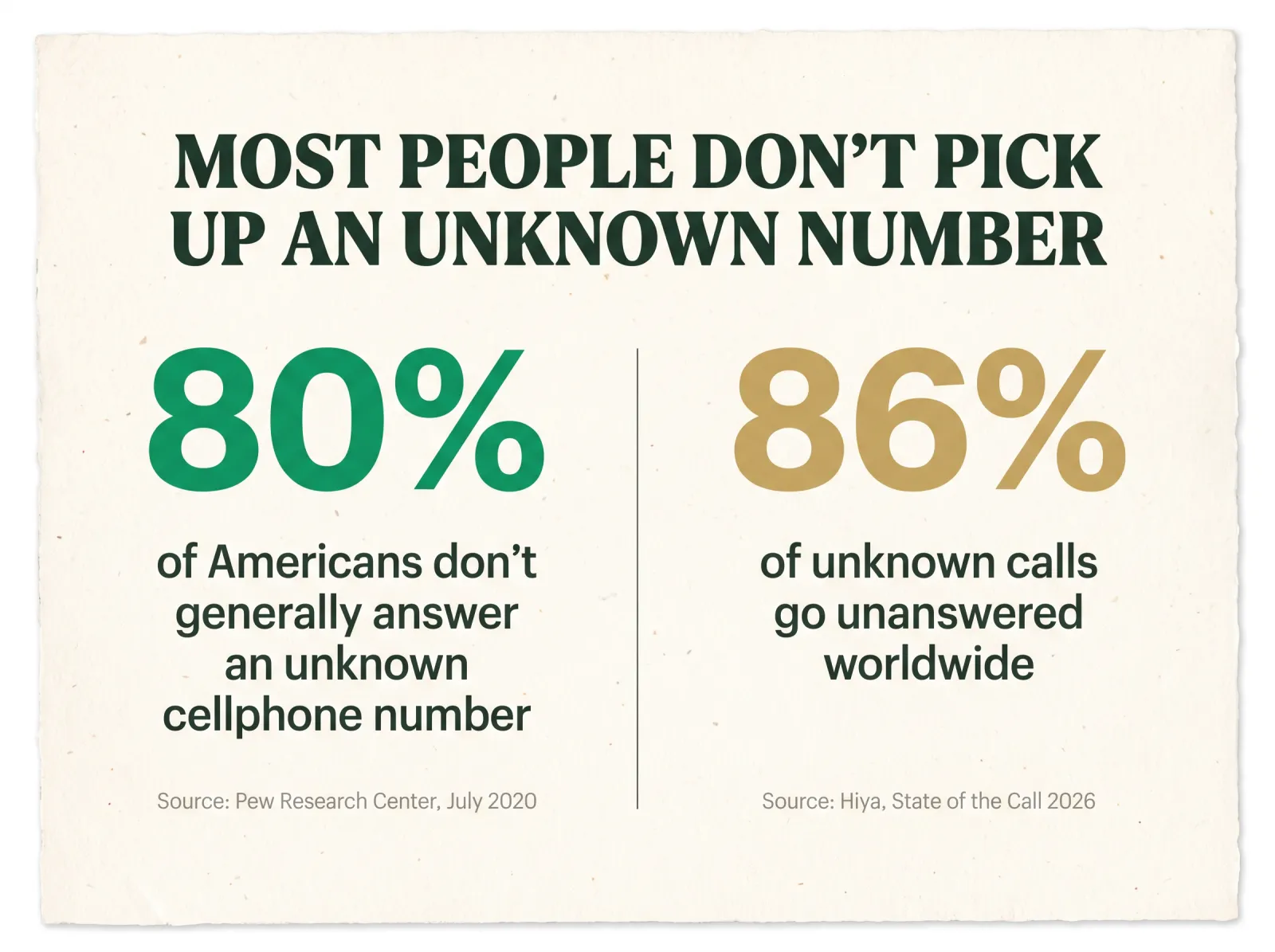
- 80% of Americans say they don't generally answer a cellphone call from an unknown number, per Pew Research Center's 2020 survey; Hiya's 2026 State of the Call report puts unanswered unknown calls at 86% worldwide.
- Local presence dialing displays a number you own, matched to the lead's area code. Caller ID spoofing displays a number you don't own, with intent to deceive. Only one is legal under 47 U.S.C. Section 227(e).
- Illegal spoofing carries a civil forfeiture of up to $10,000 per violation, or three times that per day, capped at $1,000,000 for a single act, plus a separate criminal fine of up to $10,000 per violation.
- STIR/SHAKEN attestation matters as much as area code: per Twilio's own documentation, a verified number reaches "A" attestation and is less likely to be answered as spam; an unverified number, even one you own, can land at "B" or "C" and get flagged anyway.
- Local presence changes whether a compliant call gets picked up. It does nothing to create the TCPA consent that has to exist before you dial in the first place.
Why Most of Your Dials Never Get Picked Up
The honest starting point is that this isn’t really about insurance leads specifically. It’s about how people treat phones in general in 2026. Pew Research Center’s national survey, fielded July 13 through 19, 2020, across 10,211 U.S. adults, found that eight in ten Americans, 80%, say they don’t generally answer their cellphone when an unknown number calls. Two-thirds said they’d let it go to voicemail and check later rather than pick up live. That survey is a few years old now, but the direction hasn’t reversed; if anything the newer data point is worse. Hiya’s State of the Call 2026 report, based on a survey of more than 12,000 consumers across six countries, found that 86% of calls from numbers people don’t recognize go unanswered. Those are two independent organizations, five years and a different methodology apart, landing on the same basic fact: an unrecognized number is now the default reason not to pick up, not the exception.
Run that against your own dial list and the math is unforgiving. If somewhere between 80% and 86% of people ignore an unfamiliar number on principle, before they’ve heard a single word about your offer, then a huge share of your connect-rate problem isn’t your script, your timing, or your lead source. It’s that the screen showing “Unknown Caller” or a random out-of-state area code has already lost the call before it started ringing.
Define the terms before the tactic matters
Local presence dialing: displaying an outbound caller ID that matches the area code of the person being called, using a number the caller actually owns or has licensed. Caller ID spoofing: transmitting caller ID information that's inaccurate or misleading, for a number the caller doesn't control, with intent to defraud, cause harm, or wrongfully obtain something of value. STIR/SHAKEN: the industry framework carriers use to cryptographically verify that a call's caller ID is legitimate, producing an attestation level of A, B, or C per call. Attestation: the specific confidence rating, A through C, a carrier assigns to a given outbound call based on how well the originator's identity and right to use that number can be verified.
Neighbor spoofing, the practice of showing a number with the same area code and first three digits as the person being called, works on the same psychology as local presence but crosses into the illegal category almost by definition, since it typically uses numbers the caller has no relationship to at all and is deployed specifically to trick someone into thinking a stranger is a known contact. That’s the tactic giving the whole category a bad name, and it’s exactly what separates it from the legitimate version this article is about: legitimate local presence dialing never borrows a specific person’s number, only a shared area code on lines the business itself owns.
What Ignoring the Problem Actually Costs
80%
Of Americans don't generally answer an unknown cellphone number
Source: Pew Research Center, 2020
86%
Of unknown calls go unanswered worldwide
Source: Hiya, State of the Call 2026
$10,000
Maximum civil forfeiture per illegal caller ID spoofing violation
Source: 47 U.S.C. Section 227(e)
$0.20
Per-minute cost of a managed AI caller, Single Account plan
Source: TheAffordableAI pricing, fetched 2026-08-26
Put a real number on what a low answer rate costs before deciding whether to fix it. Say your agency buys 40 leads a week at a typical shared-lead price and every unanswered dial is a lead you already paid for that never got a real conversation. If an 800 number or out-of-state caller ID means 80% of those calls get ignored on the first attempt, roughly 32 of your 40 leads need a second, third, or fourth dial just to get a live human on the line once, each additional attempt costing call time and, if you’re using a managed AI caller, $0.20 a minute on a Single Account plan. A local-looking, properly verified number doesn’t make that 80% disappear. It removes one specific, well-documented reason people ignore a call, which is often enough to meaningfully cut the number of redials it takes to reach someone, without inventing a lift percentage nobody can source.
The other side of the ledger is legal exposure, and it’s asymmetric in a way worth sitting with. Getting local presence right costs the price of a phone number, typically $1 to $2 a month through a provider like Twilio, per TheAffordableAI’s own pricing page, plus the time to set up verification. Getting it wrong, by displaying numbers you don’t control, exposes the agency to a federal civil forfeiture of up to $10,000 per violation under 47 U.S.C. Section 227(e), or three times that per day for a continuing violation, capped at $1,000,000 for a single act, on top of a separate criminal fine of up to $10,000 per violation. At any real dial volume, that’s not a rounding error next to the monthly cost of doing it correctly.
The $0.20-a-minute figure above is the current Single Account rate; check it against the live pricing page and run it with your own weekly lead volume and average call length before deciding anything, since the base fee matters a lot more at low volume than it does once usage climbs.
Local Presence Dialing vs. Caller ID Spoofing: Where the Line Actually Sits
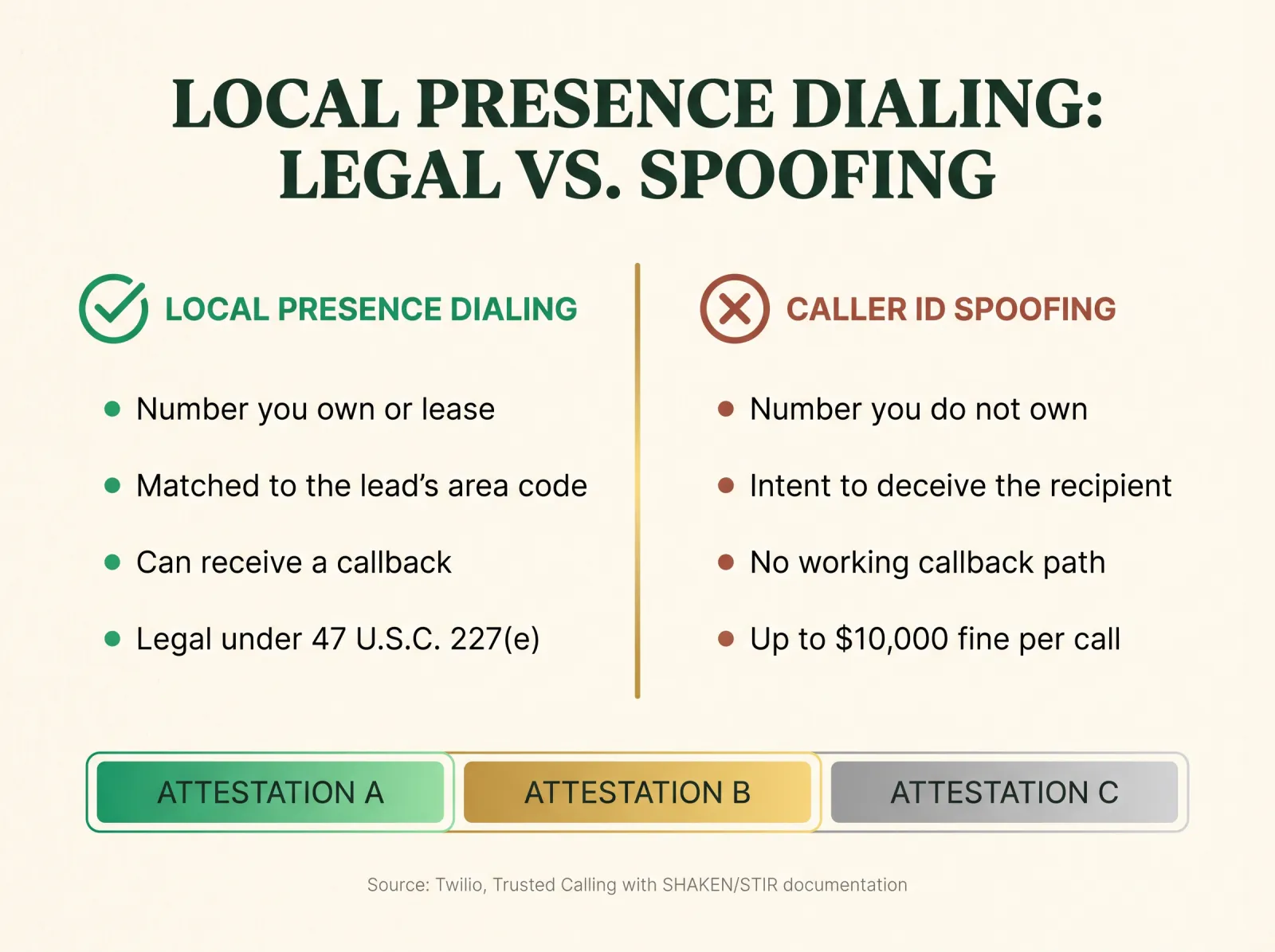
The two practices look identical from the recipient’s phone: a number on the screen that isn’t the caller’s main published business line. The difference is entirely in ownership and intent, and federal law is specific about both.
47 CFR Section 64.1601(e) sets the baseline for any telemarketing call: caller identification information transmitted must include the calling party’s number, and when available through the telemarketer’s carrier, the telemarketer’s name, or alternatively the seller’s name and a working customer service number. Critically, “the telephone number so provided must permit any individual to make a do-not-call request during regular business hours,” and the same rule flatly prohibits blocking caller ID transmission outright. A number that goes nowhere, or that nobody at your agency actually monitors, doesn’t satisfy this even if you technically hold the account.
47 U.S.C. Section 227(e), the Truth in Caller ID Act, is where the penalty exposure lives. It prohibits knowingly causing a caller ID service to transmit misleading or inaccurate caller identification “with the intent to defraud, cause harm, or wrongfully obtain anything of value.” That intent standard is the whole ballgame. Displaying a number you own, that rings back to your business, matched to a lead’s area code purely to increase the odds they’ll answer, doesn’t carry intent to defraud anyone about who’s calling once they pick up and you identify your business, which federal telemarketing rules already require you to do at the start of the call. Displaying a number you have no relationship to, particularly one belonging to an actual third party who now gets angry callbacks meant for you, is a different situation entirely.
| Element | Local presence dialing | Caller ID spoofing |
|---|---|---|
| Who owns the number | The caller, provisioned through a carrier | A third party, or no one |
| Can it receive a callback | Yes, routes back to the business | Usually not, or rings an uninvolved party |
| Intent standard | To be seen as a familiar, reachable local caller | To defraud, harm, or wrongfully obtain something |
| Legal status | Legal, per 47 U.S.C. Sec. 227(e) and 47 CFR Sec. 64.1601(e) | Federal civil and criminal penalties apply |
| Maximum penalty | None, if implemented as described | $10,000 per violation, up to $1,000,000 continuing |
Sources: 47 U.S.C. Section 227(e); 47 CFR Section 64.1601(e), both via Cornell Law School Legal Information Institute.
The two narrow federal exceptions
47 CFR Section 64.1604 carves out exactly two situations where caller ID manipulation isn't a violation: lawfully authorized law enforcement or intelligence activity, and action taken pursuant to a specific court order authorizing it. Neither applies to insurance sales calling. There's also no exception in the statute for "the recipient probably wouldn't have answered otherwise." Good intentions about answer rates don't change the ownership requirement.
STIR/SHAKEN: Why an Owned Number Can Still Get Labeled Spam
Owning the number is necessary but not sufficient. This is the part local presence setups most often get wrong, and it’s specific to how carriers actually decide what shows up on the recipient’s screen: a name, a “Spam Likely” warning, or nothing at all.
STIR/SHAKEN, an acronym combining two related standards, is the framework carriers use to cryptographically sign and verify caller ID on every call as it moves across the network. Each call gets an attestation level. Per Twilio’s own documentation on trusted calling, the levels work like this: “A” or full attestation means the originating carrier confirms the caller is a known customer with the verified right to use that specific number as caller ID. “B” or partial attestation means the customer is known but the carrier can’t verify their right to that particular caller ID. “C” or gateway attestation means the call can only be traced to a known gateway, with no verification of the customer or the number at all.
The consequence, straight from Twilio’s guidance: full “A” level attestation calls “are much more likely to be answered than unidentified numbers, directly impacting sales productivity,” and verified numbers with the highest attestation level are less likely to be marked “Spam” or “Scam Likely” by carriers in the first place. A number you own but never registered through a verified Business Profile with your carrier can still land at B or C attestation on outbound calls, which means it can pick up a spam label despite being a real, legitimate, owned number. Buying local numbers and stopping there gets you halfway. Registering them properly is the part that actually protects the answer rate you’re trying to build.
Full attestation
Carrier confirms you're the verified customer with the right to use this exact number as caller ID. Best answer odds, lowest spam-label risk.
Partial attestation
You're a known customer, but the carrier can't confirm your right to this specific caller ID. Not automatically blocked, but weighed against you.
Gateway attestation
Only the originating gateway is verified. Unregistered numbers and most international-routed calls land here. Highest spam-label risk.
How to Set Up Local Presence Dialing the Right Way
Give this away completely, because doing it correctly doesn’t require buying anything from anyone: it requires paperwork and a few configuration steps most carriers and CRMs already support.
- Map your actual lead geography first. Pull the last 90 days of leads and count them by area code, not by state. Most agencies find their volume concentrates in a handful of metro area codes, not evenly across every possibility. This tells you exactly which numbers to buy, not a nationwide list you’ll never fully use.
- Provision real numbers for those area codes through your carrier. Twilio, and most CRMs built on top of it, let you search and purchase numbers by area code directly. At roughly $1 to $2 a number per month, a pool covering your top 15 to 20 area codes is a modest, predictable cost next to what a single unresolved spoofing complaint could expose you to.
- Register every number through a verified Business Profile, not just a purchase. This is the step that earns “A” attestation instead of leaving you at B or C. Skipping it is the single most common reason a legitimately owned local number still gets flagged as spam.
- Confirm each number can actually receive a callback and reaches a real line. 47 CFR Section 64.1601(e) requires this for any telemarketing call; it’s also just good practice, since a lead who calls back to a dead line will assume the worst about your business regardless of what the law technically requires.
- Configure area-code matching in your dialer or CRM. GoHighLevel’s own local presence documentation describes a three-tier fallback: an exact area code match first, a same-region alternative second, your default number third. Most modern dialers and CRMs, including systems built on Twilio, support the same pattern; you’re configuring logic, not building it from scratch.
- Rotate and monitor, don’t set and forget. Even a properly owned, verified number can accumulate a spam reputation over time from complaint reports or high call volume, the same underlying mechanism covered in our guide to number warmup and spam recovery. Local presence and number warmup aren’t the same practice, but they share the same underlying carrier reputation system, and a local-presence pool needs the same ongoing monitoring a single main line does. If managing a number pool and attestation registration yourself sounds like more infrastructure than your agency wants to own, there’s a demo call on the homepage that shows how a managed setup handles it without any of this becoming your problem.
- Keep the do-not-call and consent process entirely separate from this. Local presence changes whether a compliant call gets answered. It changes nothing about whether you had the right to make the call in the first place.
Numbers you don't own or verify
- Caller ID pulled from a random pool with no ownership record
- No verified Business Profile, so calls land at "B" or "C" attestation anyway
- The number rings nowhere, or rings an uninvolved third party, if called back
- No monitoring once it's set up
An owned, verified local number pool
- Numbers purchased and held by your business through your carrier
- Registered through a verified Business Profile for "A" attestation
- Every number routes back to your agency when called
- Reputation monitored and rotated the same as a main line
Where Local Presence Dialing Is the Wrong Fix
Be straight about the limits, because this isn’t a fix for every connect-rate problem. If your leads already answer reliably and the actual bottleneck is what happens after they pick up, a mismatched offer, a slow qualifying script, or a calendar with no real availability, local presence numbers won’t move the number that matters. If your real problem is speed to lead, meaning the call happens hours after the lead came in rather than minutes, a better caller ID on a late call still arrives late. And if your agency isn’t set up to provision, verify, and monitor real owned numbers, don’t attempt a version of this using a shared or unverified pool; that version is the one carrying the $10,000-per-violation exposure, not the modest monthly cost of doing it correctly.
The same honesty applies to what this tactic can’t do for consent. No caller ID strategy, local presence or otherwise, substitutes for prior express consent under the TCPA. A familiar-looking number might get a call answered that a valid database entry didn’t earn the right to make in the first place, and that’s a worse outcome than the unanswered call would have been.
How TheAffordableAI Handles This
Owned, verified numbers
Twilio-provisioned numbers on every plan, registered for proper STIR/SHAKEN attestation, not a shared or anonymous pool.
Number warmup and spam defense
A standing routine that monitors reputation across the whole number pool, not a one-time setup step.
Volume the AI can carry
More dials from the same list, so a lower per-attempt answer rate still means more live conversations overall.
Warm transfers to a licensed agent
When someone does answer, a qualified, live prospect gets handed to a person while still on the line.
HighLevel CRM sync
Dispositions and call outcomes land on the contact record automatically, so you can see which numbers and area codes are actually converting.
No contracts either way
Single Account runs $200/mo plus a $500 one-time setup at $0.20/min, down to $0.15 at bulk. Agency runs $500/mo plus a $1,000 setup at $0.18/min, down to $0.16 at bulk. Cancel anytime.
There’s a live demo call on the homepage if you want to hear an actual answered call before deciding anything, and the full setup is on the features page. You can also build a version of this yourself with a dialer platform and a set of properly provisioned numbers; plenty of agencies do exactly that, and it’s worth pricing against buying something managed before you decide either way.
What You Actually Get
Concretely: outbound calls that display a number matching the lead’s own area code, owned and verified so it earns full carrier attestation instead of getting flagged despite being real. More of your paid leads get a live conversation on the first or second attempt instead of the fourth or fifth. Number reputation gets monitored on an ongoing basis instead of discovered broken after it’s already cost you a week of dead calls.
What you don’t get, and shouldn’t expect from any dialing setup: a guaranteed answer rate, a promised percentage lift, or a bypass around consent requirements that have to be satisfied before the call is placed. Local presence dialing changes one variable, whether a compliant call gets picked up. It doesn’t change who’s responsible for making sure the call was allowed in the first place, and using AI or any other technology to place the call doesn’t transfer that responsibility away from the licensed agent or agency.
80% of Americans don't answer an unknown number. The fix isn't a number you don't own. It's one you do, registered correctly, so it stops looking unknown.
Mike MooreCompliance disclaimer
Prior express consent is required for automated or artificial-voice calls and texts to a cell phone under the TCPA, and that obligation belongs to the licensed agent, not to any vendor or platform, regardless of what caller ID is used. Any AI caller must disclose it's AI where required by applicable law and honor opt-outs immediately. Medicare marketing carries CMS's separate rules, including the TPMO disclaimer and call recording retention requirements. Using AI, or a local presence dialing setup, for calling does not transfer compliance liability away from the licensed agent or agency. This article reflects a review of the cited federal statutes, regulations, and platform documentation as of the date published and is general information, not legal advice for your specific setup.
Your dial list isn’t the problem. The screen your leads look at before they decide whether to answer it is. Fix that one variable correctly, with numbers you actually own and register, and the same list you’re calling today starts converting a meaningfully larger share of its own dials into real conversations, without touching your script, your offer, or your consent process at all.
Hear a call come in on a properly warmed, verified number
There's a live demo call on the homepage. Put your number in and listen to how it answers, qualifies, and hands off.
Frequently asked
Does matching a lead's area code actually get more people to answer?
It can, directionally, though there is no single sourced percentage worth repeating. What's well documented is the underlying problem it responds to: Pew Research Center found 80% of Americans say they don't generally answer their cellphone when an unknown number calls, and Hiya's 2026 State of the Call report puts the share of unknown calls that go unanswered at 86% worldwide. A caller ID that looks local and familiar removes one specific reason to ignore a call; it doesn't remove all of them, and vendor claims of a precise 20 to 60 percent lift don't trace back to a published methodology we could verify, so this article doesn't repeat one.
What's the actual difference between local presence dialing and caller ID spoofing?
Ownership and intent. Local presence dialing displays a phone number you own or lease, provisioned through your carrier, matched to the area code of the person you're calling; someone can call that number back and reach your business. Caller ID spoofing displays a number you have no right to use, transmitted with intent to defraud, cause harm, or wrongfully obtain something of value, per 47 U.S.C. Section 227(e), the Truth in Caller ID Act. Both practices put a number on the screen that isn't your main business line. Only one of them is legal.
Is local presence dialing legal for insurance agents?
Yes, when the number displayed is one you actually own or have licensed, is capable of receiving a return call, and isn't transmitted to deceive the recipient about who's calling. The relevant federal telemarketing rule, 47 CFR Section 64.1601(e), requires that a telemarketer's transmitted caller ID permit an individual to make a do-not-call request during regular business hours, and separately prohibits blocking caller ID transmission outright. Owning a pool of real, working local numbers and displaying the one that matches the lead's area code satisfies that. Displaying a number you don't control, or that goes nowhere when called back, doesn't.
What happens if I use a caller ID I don't actually own?
You're exposed to the Truth in Caller ID Act's penalty structure if intent to defraud, cause harm, or wrongfully obtain something of value can be shown: a civil forfeiture of up to $10,000 per violation, or three times that per day for a continuing violation, capped at $1,000,000 for a single act, per 47 U.S.C. Section 227(e). There's also a separate criminal fine of up to $10,000 per violation. That's before any state telemarketing statute or a private TCPA claim layers on top. The legal use case, local presence with numbers you own, doesn't carry this exposure; the illegal one does.
Does STIR/SHAKEN affect whether my local presence numbers get flagged as spam?
Yes, and this is where a lot of local presence setups quietly undermine themselves. STIR/SHAKEN is the industry call-authentication framework carriers use to assign an attestation level to every outbound call: A (full), B (partial), or C (gateway), per Twilio's own documentation on trusted calling. A number registered to your business through a verified Business Profile earns A-level attestation. A number used as caller ID without that verification, even one you technically own, can land at B or C. Twilio's guidance states plainly that full A-level attestation is more likely to be answered than an unidentified number, and that verified numbers with the highest attestation are less likely to be marked spam or scam likely by carriers. A local area code with weak attestation can still get labeled, which defeats the point.
Do I have to buy a separate phone number for every area code I call into?
In practice, a pool covering the region you actually work, not every area code nationwide. If your leads come from three states and a handful of metro areas, provisioning numbers for those specific area codes and letting your dialer or CRM match automatically covers the overwhelming majority of calls. GoHighLevel's own local presence documentation describes exactly this pattern: exact area code match first, a same-region alternative second, and a default number as the fallback. You don't need a number for every possible area code, only for where your actual lead volume is.
Does local presence dialing change my TCPA consent obligations?
No. Prior express consent for automated or artificial-voice calls and texts to a cell phone, and the obligation to honor opt-outs, exist independently of what caller ID is displayed. Local presence dialing is about getting a compliant call picked up; it does nothing to establish or substitute for the consent that has to already exist before the call is placed. Treat it as a completion-rate tool layered on top of a consent process that's already correct, never as a way around one that isn't.
Should every insurance agency use local presence dialing?
Only if the agency is set up to do it correctly, meaning real, owned, verified numbers with proper STIR/SHAKEN attestation, and only if unanswered outbound calls are actually the bottleneck. If your leads already answer reliably, or if the real problem is speed to lead or what happens after someone picks up, local presence numbers won't move the number that matters. And if an agency isn't willing to provision and verify real numbers, it shouldn't attempt a version of this that relies on numbers it doesn't control, because that version is the illegal one.
Sources
- 47 U.S. Code Section 227(e), Truth in Caller ID Act — prohibition and penalties for caller ID spoofing (via Cornell Law School Legal Information Institute)
- 47 CFR Section 64.1601(e), Delivery requirements and privacy restrictions — telemarketing caller ID transmission rule (via Cornell Law School Legal Information Institute)
- 47 CFR Section 64.1604, Truth in Caller ID Regulation — intent-to-defraud standard and exceptions (via Cornell Law School Legal Information Institute, current through 84 FR 45669, Aug. 30, 2019)
- Pew Research Center — Most Americans don't answer cellphone calls from unknown numbers (survey conducted July 13-19, 2020; n=10,211 U.S. adults)
- Hiya — State of the Call 2026 (survey of 12,000+ consumers across six countries)
- Twilio — Trusted calling with SHAKEN/STIR (attestation levels A, B, C and their effect on call answer and spam-labeling)
- GoHighLevel Help Center — How to use Local Presence Dialing with the HighLevel phone system
- TheAffordableAI — Pricing
Put this on your own phone line
See the AI dial, qualify, and warm-transfer a live call in under a minute. No contract, no dev work.
Keep reading
Why Your Outbound Number Says 'Spam Likely' — and How to Get It Clean Again
A flagged number quietly destroys a calling operation. Nobody tells you it happened; the pickups just stop. Here is what causes the label, how carriers decide, and the warmup routine that keeps a number healthy.
Speed to Lead in 2026: Why the First 60 Seconds Decides Who Writes the Policy
The lead you paid for is not lost to a better agent. It is lost to a faster one. Here is what response time actually does to contact and conversion rates, and how to get to sixty seconds without hiring a dialer team.
AI Voice Disclosure Laws for Insurance Agents (2026)
Do you have to tell an insurance lead they're talking to AI? What the FCC, Utah, California, and CMS actually require, state by state, verified in 2026.