New York Telemarketing Law: What It Costs Insurance Agents
New York fined insurance sellers up to $257,400 under GBL Section 399-z. Here's what the do-not-call law actually requires before you dial.

Is cold-calling an insurance lead legal in New York? Mostly, if the number isn’t on the National Do Not Call Registry, or if you have a documented basis that exempts it, and if your opening disclosure covers who you are and who you’re calling for within the first 30 seconds. New York General Business Law §399-z doesn’t ban telemarketing to insurance shoppers. It regulates how that call has to happen, and the New York Department of State has shown it will enforce §399-z directly against insurance sellers by name: Choice Health Insurance LLC, a subsidiary of Alight Solutions LLC, settled for $257,400 in 2024; SelectQuote Insurance Services settled for $132,000 in March 2025; and Odyssey Insurance Agency LLC settled for $44,000 in a 2025 consent order. All three cases cite the identical underlying conduct, calling numbers that had been sitting on the National Do Not Call Registry for more than 31 days, with no documented exemption on file. This article works through exactly what GBL §399-z and its companion statute, §399-p, require, how New York’s one-party consent rule for call recording differs from states most agencies already know about, how the state law stacks with the federal TCPA, and what the real enforcement record shows it costs to get this wrong, all verified against New York’s and the federal government’s own text and filings this session, on October 24, 2026.
The short version
- GBL §399-z bars unsolicited telemarketing calls to any number on the National Do Not Call Registry for 31+ days, with no insurance-specific exemption, and the New York Department of State has fined three insurance sellers under it: $257,400, $132,000, and $44,000.
- The statutory ceiling is $20,000 per violation under §399-z, and up to $2,000 per call, capped at $20,000 per 72-hour period, under the related autodialer statute, §399-p. The FTC's federal Telemarketing Sales Rule carries a separate, higher $53,088-per-violation maximum.
- New York is a one-party consent state for call recording under Penal Law §250.00 and §250.05, unlike the two-party states (California, Florida, Illinois) many agencies already script around. Recording without any consent is a class E felony.
- Clearing New York's state law doesn't clear the TCPA. A private TCPA suit can recover $500 per violation, or up to $1,500 if willful, under 47 U.S.C. §227(b)(3), and an AI or autodialed call to a wireless number separately needs prior express written consent under 47 CFR 64.1200(a)(2).
- Using an AI voice agent to place the call doesn't change any of these tests or move the liability off the licensed agent and agency whose name is on the resulting business.
What New York’s Telemarketing Law Actually Regulates
What does GBL §399-z actually cover, in terms an agent dialing a Tuesday afternoon list would recognize? The statute, administered by the New York Department of State, defines “telemarketing” as more than one call or text in a single campaign made to induce a payment for goods or services. That’s broad enough to cover an insurance agent’s outbound campaign without any special insurance carve-out, and broad enough that a single call to a single lead generally isn’t itself “telemarketing” under this definition, though it can still trigger other provisions, including the recording-disclosure and caller-ID rules discussed below.
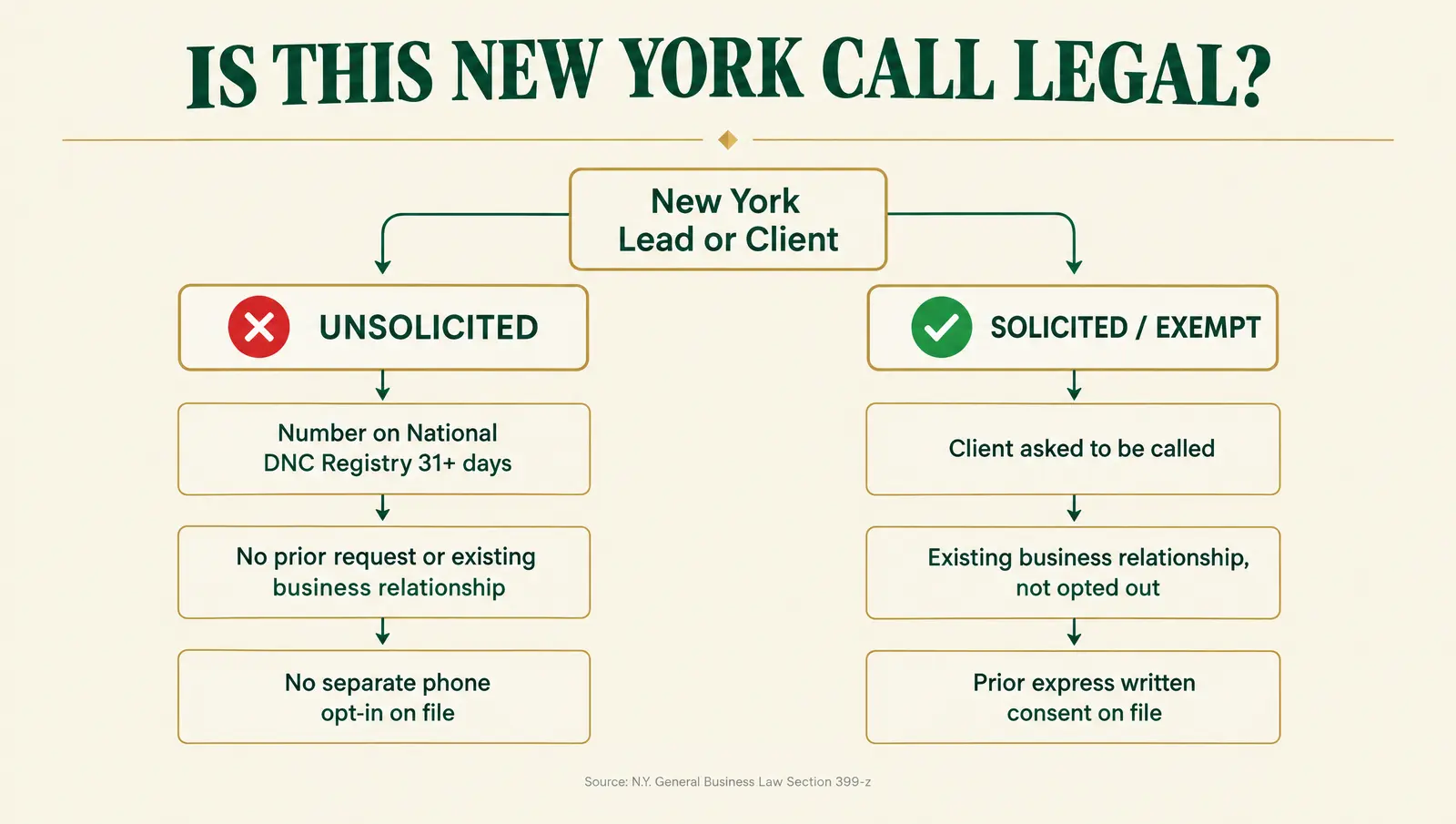
The statute excludes two categories from its restricted “unsolicited telemarketing sales call” definition, and both matter to an agency’s day-to-day list management. First, a call made in response to the customer’s own express request isn’t unsolicited; a lead who filled out a quote-request form asking to be called falls here. Second, a call made within an established business relationship that the customer hasn’t terminated isn’t unsolicited either; a current client calling in, or one you’re calling about their own existing policy, generally falls here, up until the point they tell you to stop. Neither exclusion covers a name someone else gave you. A client who hands you their neighbor’s number hasn’t created an established business relationship between you and the neighbor, and the neighbor hasn’t requested anything from you directly.
This is separate from, and in addition to, federal law
GBL §399-z is New York's own statute, enforced by the Department of State under 19 NYCRR Part 220. It sits alongside the federal Telephone Consumer Protection Act and the FTC's Telemarketing Sales Rule, not in place of them. A call that clears New York's rule can still violate the TCPA, and vice versa. Both have to clear before the call goes out to a New York number.
Three operational requirements fall directly out of the statute’s text, and each one is a place agencies actually get caught. Calling hours are limited to 8:00 a.m. to 9:00 p.m. at the customer’s location, not the caller’s, which matters for an agency calling a New York list from a different time zone. The opening disclosure has to happen within 30 seconds of the call starting: the caller’s name, the name of any seller on whose behalf the call is placed, and the customer’s option to be added to that seller’s own entity-specific do-not-call list, all up front, followed by disclosure of whether the call is recorded and the purpose of the call before any sales pitch proceeds. Caller ID cannot be knowingly manipulated to show false or misleading information, though displaying the seller’s own accurate name or number is fine. None of these three requirements has anything to do with whether the lead is on the national registry; they apply to every covered call, registry status aside.
The Three New York Consent Orders Against Insurance Sellers
Here’s what actually happens when an insurance seller gets this wrong in New York, drawn from three real, signed Department of State consent orders, not a hypothetical.
Choice Health Insurance, LLC, a subsidiary of Alight Solutions LLC, settled an enforcement action, case 2024-C-032100, for a civil penalty of $257,400. The order states the Department’s allegation plainly: Choice Health Insurance “utilizes telemarketing and ha[s] made or caused to be made unsolicited telemarketing sales calls to customers when said customer’s telephone numbers were on the national do-not-call registry,” for a documented 31-day-plus period before the calls. The company didn’t contest the violations and agreed to the penalty within ten business days of the order’s execution. The order also notes Choice Health Insurance had already stopped telemarketing in New York State by the time the matter settled.
SelectQuote Insurance Services settled a separate matter in March 2025 for a civil penalty of $132,000, again under GBL §399-z, again for unsolicited telemarketing sales calls to registered numbers. The order required payment by April 7, 2025, and closed the Department’s investigation into any violations predating the order, with prejudice, contingent on SelectQuote’s compliance going forward.
Odyssey Insurance Agency LLC settled case 2024-C-093001 for $44,000, structured as five monthly installments of $7,333.33 running from July through November 2025, rather than a lump sum. The underlying allegation is the same pattern again: unsolicited telemarketing sales calls to customers whose numbers were on the national registry. The order adds a condition the other two don’t spell out as explicitly: Odyssey has to register as a telemarketer in New York under GBL §399-p before conducting any future telemarketing activity, and can’t be found in violation of §399-z again for three years without the settlement’s protections lapsing.
| Respondent | Civil penalty | Year signed | Alleged conduct |
|---|---|---|---|
| Choice Health Insurance, LLC (subsidiary of Alight Solutions LLC) | $257,400 | 2024 | Unsolicited telemarketing calls to registered numbers, Case 2024-C-032100 |
| SelectQuote Insurance Services | $132,000 | 2025 | Unsolicited telemarketing calls to registered numbers |
| Odyssey Insurance Agency LLC | $44,000 | 2025 | Unsolicited telemarketing calls to registered numbers, Case 2024-C-093001 |
Source: New York Department of State consent orders, cited individually above.
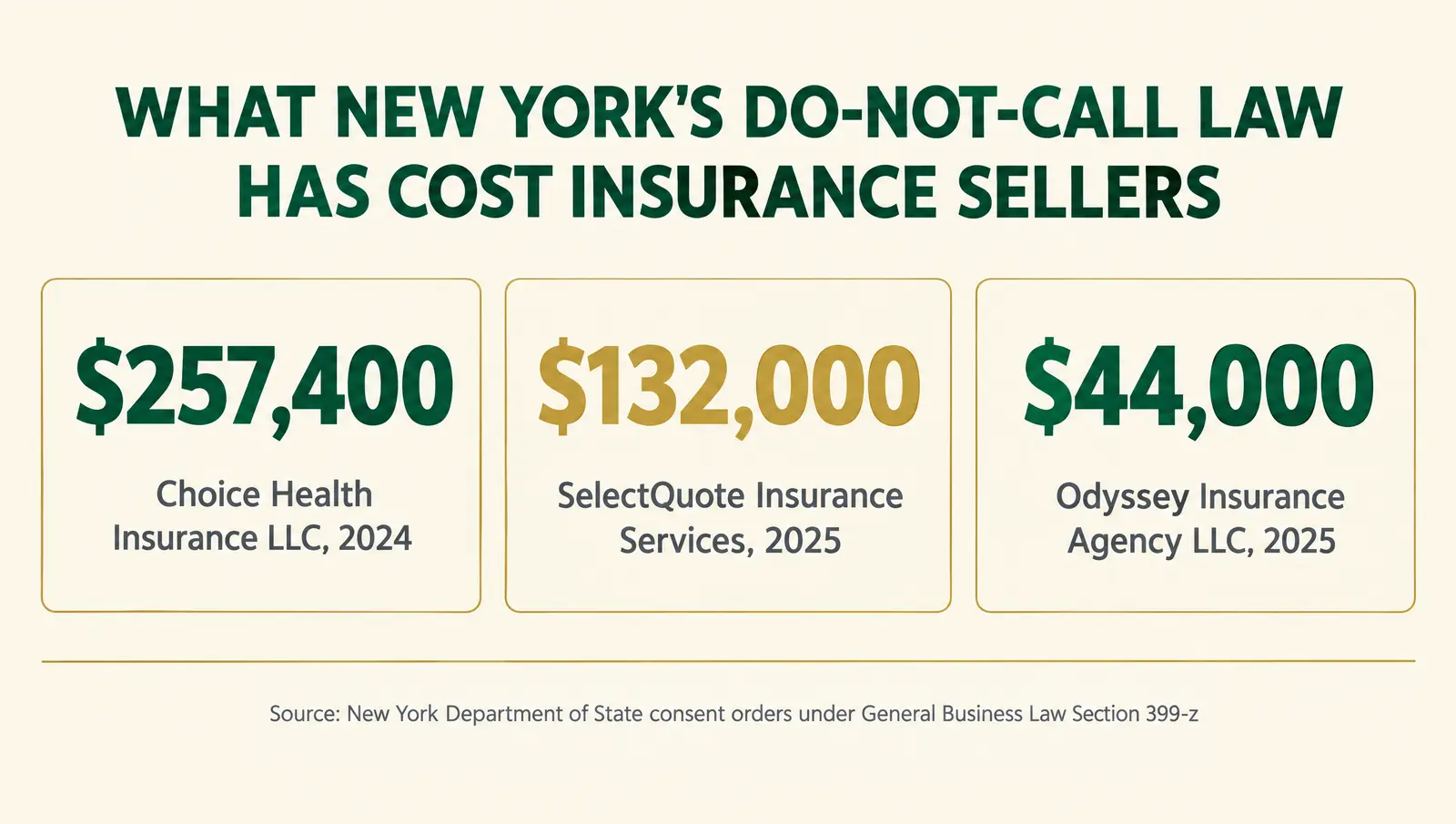
Read those three cases side by side and a pattern emerges that has nothing to do with lead quality or sales technique. Every one of them traces back to the same mechanical failure: a number stayed on a call list past the point where the National Do Not Call Registry made it off-limits, and nothing in the company’s process caught it before the call went out. None of the orders allege a defective product, a misleading quote, or a bad-faith sales tactic. They allege a list hygiene failure, repeated at volume, across a customer base large enough to generate a six-figure settlement in two of the three cases.
These are settlements, not the statutory ceiling
GBL §399-z caps the Secretary of State's civil penalty at $20,000 per violation after a hearing. A consent order is a negotiated settlement, typically covering many individual calls bundled into one resolved amount, which is why Choice Health Insurance's $257,400 and SelectQuote's $132,000 both exceed the per-violation statutory cap without contradicting it. The settlement number reflects volume and negotiation, not a single call's maximum exposure.
How New York’s Penalty Compares to the Federal Floor
New York’s $20,000-per-violation ceiling under §399-z, and the related $2,000-per-call cap under §399-p (itself capped at $20,000 within any 72-hour period), sit below the federal maximum for the same underlying conduct. The FTC’s Telemarketing Sales Rule, 16 CFR Part 310, carries a civil penalty of up to $53,088 per violation under the FTC’s current inflation-adjusted penalty schedule, with each individual call potentially counted as a separate violation. On top of the regulatory penalty, a consumer who receives a call in violation of the TCPA can bring a private lawsuit and recover $500 in statutory damages per violation, or up to $1,500 per violation if a court finds the violation was willful or knowing, under 47 U.S.C. §227(b)(3). That last number is deceptively small-sounding until it’s multiplied by a call list; a 2,000-number list dialed once without a valid exemption is $1,000,000 in potential exposure at the willful rate, before a regulator even opens a file.
Maximum penalty per violation, by legal framework
State and federal maximums for an unlawful telemarketing call to a New York number
Source: N.Y. General Business Law §399-z and §399-p; Federal Trade Commission, Complying with the Telemarketing Sales Rule; 47 U.S.C. §227(b)(3). The TCPA figure is per-call statutory damages in a private suit, not a regulatory penalty, and is shown on the same per-violation basis for comparison.
The practical read isn’t “New York is lenient.” It’s that New York is simply one of several agencies and private plaintiffs with independent authority to act on the same call, each applying a different test and a different penalty structure. A call can clear GBL §399-z’s documented-exemption standard and still trigger TCPA exposure if it was autodialed to a wireless number without the TCPA’s own written consent. The three consent orders above are New York’s enforcement record specifically; none of them says anything about whether the same conduct also drew FTC or private TCPA action, which is a separate question an agency in this position would still need to answer.
| Requirement | New York (GBL §399-z / §399-p) | Federal (TCPA / FTC TSR) |
|---|---|---|
| Registry scrub frequency | Every 31 days | Every 31 days |
| Opening disclosure window | Within 30 seconds | No fixed seconds-based deadline in the TSR text itself |
| Consent standard for autodialed/AI calls to cell numbers | Written agreement under §399-z for prerecorded calls | Prior express written consent, signed, under 47 CFR 64.1200(a)(2) and (f)(9) |
| Max regulatory civil penalty, per violation | $20,000 (§399-z); $2,000/call, $20,000/72 hrs (§399-p) | $53,088 (FTC TSR) |
| Private right of action | Injunction; actual damages or $50, up to 3x for willful (§399-p(9)) | $500 per violation, up to $1,500 if willful (47 U.S.C. §227(b)(3)) |
| Record retention | 24 months | Varies by requirement; TSR requires its own retention schedule |
Source: N.Y. General Business Law §399-z and §399-p; Federal Trade Commission TSR guidance; 47 U.S.C. §227; 47 CFR 64.1200.
If you want to hear what a compliant, fast first call actually sounds like before deciding anything about your own process, there’s a demo call on the homepage: theaffordableai.com.
New York’s One-Party Consent Rule for Recording Calls
Agencies that already script around California, Florida, or Illinois, all two-party consent states, sometimes assume New York works the same way. It doesn’t. New York Penal Law §250.00 defines wiretapping as the unlawful overhearing or recording of a telephonic communication “without the consent of either the sender or receiver,” meaning the conduct is only covered when neither party consents, which makes one party’s consent sufficient as a matter of statutory text. The companion provision, covering “mechanical overhearing of a conversation,” states its own consent threshold directly: it applies “without the consent of at least one party thereto.” Either way the statute is read, an agent who is a participant on the call can lawfully record it under New York law without separately notifying or obtaining the other party’s consent. Recording a call you aren’t a party to, without any party’s consent, is eavesdropping under Penal Law §250.05, a class E felony.
One-party consent is a floor, not a blanket answer
New York's own rule doesn't require disclosing that a call is recorded to lawfully record it. But GBL §399-z's own disclosure requirement, discussed above, separately requires telling the customer the call is being recorded as part of the opening 30-second script, which is a state telemarketing-law obligation layered on top of, not derived from, the wiretapping statute. And if the person on the other end of the call is physically in a two-party-consent state, that state's stricter law can still govern the same conversation. Script every call as if the stricter rule applies, since you often can't verify where a cell number's holder is physically sitting when they answer.
Building the Consent-Basis Check Into Your Own Process
None of the compliance work here requires buying a platform. It requires tagging every lead with a documented basis for the call, before volume makes manual judgment unreliable, and routing the channel off that tag rather than off list source or lead cost.
- Timestamp a National DNC Registry check against every number before the first call, and re-check every 31 days for any number still in an active campaign. A check from 40 days ago doesn’t satisfy either New York’s or the FTC’s safe harbor, regardless of how recently you dialed the number before that.
- Log the specific exemption basis for any registered number you still call: an established business relationship not yet terminated by the customer, or the customer’s own documented request for contact. “I think this is an existing client” is not a logged basis; a CRM field with a date and a source is.
- Build the 30-second opening disclosure into your script itself, not into agent training alone: your name, the entity you’re calling for, the entity-specific opt-out offer, whether the call is recorded, and the call’s purpose, in that order, before any sales content.
- Exclude referral names from any automated or bulk-dialed campaign. A referral doesn’t create an established business relationship with the person referred, and it isn’t that person’s own request for contact, so it doesn’t clear the unsolicited-call exemption on its own.
- Separate your GBL §399-z documentation from your TCPA consent documentation. They’re different legal tests answering different questions; a lead cleared under one framework can still be unresolved under the other, especially for any autodialed or AI-placed call to a wireless number.
- Keep telemarketing records for the full 24 months GBL §399-z requires, not just whatever your CRM retains by default, since that’s the specific retention window New York’s own statute sets.
- Register as a telemarketer under GBL §399-p before conducting covered telemarketing activity in New York, a requirement the Odyssey consent order calls out explicitly as a forward-looking condition, and one worth confirming your agency already satisfies rather than assuming.
A list ages quietly until an investigation starts
- DNC scrubs happen "periodically," with no logged date on any individual number
- Referral names get dialed the same week a client mentions them
- The opening script varies by agent, with no required disclosure sequence
- Nobody can produce, after the fact, which numbers had a documented exemption
Every call traces back to a logged, dated reason it was allowed
- Every active number carries a DNC-check date, refreshed on a fixed 31-day cycle
- Referral names route to mail or a manual, non-autodialed call only
- The disclosure sequence is scripted into the first 30 seconds, every call
- Records are retained on a schedule that matches the statute, not the CRM default
You can build this yourself with a CRM custom field, a recurring calendar reminder to re-pull the registry, and a disciplined intake habit. Plenty of agencies do exactly that, and it costs nothing but staff time disciplined enough to do it every 31 days without fail, which is the part that tends to slip once volume climbs.
A Worked Example: One List, Two Outcomes
An agency buys a shared list of 1,200 New York prospects in January and checks it against the National Do Not Call Registry once, at purchase. By March, roughly nine weeks later, the agency is still dialing the same list without a second scrub. Some unknown share of those 1,200 numbers has since joined the registry, or had been on it longer than 31 days at the original check and gotten missed. Every one of those calls, made without a current scrub or a documented exemption, is a separate potential violation under GBL §399-z, a separate potential violation under the FTC’s TSR, and, if any of the calls were autodialed or AI-placed to a wireless number without TCPA consent, separate exposure to a $500-to-$1,500 private claim per call on top of the regulatory penalties. The three consent orders cited earlier didn’t arise from one bad call each; they arose from exactly this pattern, repeated across a large enough customer base to draw a formal investigation.
Run the same list with a 31-day re-scrub built into the calendar, and the math changes completely. Say 80 of the original 1,200 numbers have joined the registry by March. A re-scrub removes those 80 before the next calling cycle, or routes them to a documented-exemption check if the agency believes an established business relationship still applies. The agency loses access to 80 numbers it was never safely entitled to call in the first place, not 80 numbers it’s “giving up.” Everything else proceeds exactly as before, at the cost of one recurring calendar task, not a six-figure settlement five states don’t want to find out about the hard way.
How We Solve It
TheAffordableAI is a managed AI caller, not a compliance platform, and it doesn’t replace the work of scrubbing a list against the National Do Not Call Registry or logging a lead’s documented exemption basis. What it does, per TheAffordableAI’s own Features page: it fires outbound within seconds of a lead landing in your CRM, so a fresh, freshly-scrubbed New York lead who just requested a quote, the cleanest kind of GBL §399-z-exempt contact, gets reached while that request is still current rather than two days later. It syncs two-way with HighLevel, which is exactly where a DNC-check date, an exemption basis, and a TCPA consent flag all belong if you’re building the tagging system described above into a single system of record instead of a spreadsheet nobody checks. And every call’s recording and transcript write back automatically, supporting the 24-month record-retention requirement GBL §399-z sets, without a separate manual export step.
Hear a compliant first call before you decide anything
There's a live demo call on the homepage if you want to hear an AI caller reach a fresh, exempt New York lead and hand off a warm transfer.
Outbound within seconds of a documented request
A lead who just submitted a request-a-quote form is the cleanest kind of GBL §399-z exemption, and also the one most worth reaching before it goes cold.
HighLevel sync for the compliance record
Every call's disposition, transcript, and recording write back automatically, feeding the same CRM record a DNC-check date and a consent basis both belong in.
Number warmup and spam defense
A caller ID that gets flagged "Spam Likely" stops reaching anyone, compliant lead or not. Warmup and spam defense keep the line itself usable.
None of New York's three insurance-sector consent orders allege a bad sales pitch. They allege a number that should have come off the list weeks earlier and never did. That's a process failure, and it's the specific failure a 31-day recheck habit fixes before it becomes a six-figure settlement.
Pricing, since the comparisons above lean on it: Single Account runs $200 a month plus a $500 one-time setup fee, at $0.20 a minute, dropping toward $0.15 at bulk volume. Agency runs $500 a month plus a $1,000 one-time setup fee, at $0.18 a minute, dropping toward $0.16 at bulk volume, and adds routing across 20-plus agents, useful if your New York book is large enough that one person checking exemption tags by hand has become the bottleneck. Both run month to month with no long-term contract, per TheAffordableAI’s pricing page, fetched for this article on October 24, 2026. The math above uses $0.20 a minute because that’s what a Single Account costs; run it against your own New York call volume at theaffordableai.com/pricing before deciding anything, since the live page is the source of truth, not this article.
Where This Doesn’t Fix Anything
Say it plainly: no calling platform, AI or human, turns an unsolicited call into a solicited one, and no amount of speed helps a number that was never safely callable in the first place. If your list hasn’t been scrubbed against the registry in the last 31 days, the fix is scrubbing it, not calling it faster or with better software. A speed advantage only matters once a lead has already cleared the exemption bar; it does nothing for the ones that haven’t, and routing an unscrubbed list through an automated AI caller multiplies the exposure described above rather than reducing it, since every one of those calls becomes an AI-placed call to a number that may also trigger separate TCPA consent requirements. And if your New York volume is small enough that one person can run a monthly DNC recheck and log exemptions by hand in under an hour, the economics in this article may not move the needle for your agency specifically. Run your own list size and calling volume against the numbers above before assuming otherwise.
What You Get When the List Hygiene Is Right
A documented DNC check date and a logged exemption basis decide what you’re allowed to do with a New York number before lead cost, lead source, or calling speed enters the picture at all. Get that backwards, and an agency can run a fast, well-funded, technically impressive calling operation that’s still generating unsolicited contacts by the hundreds every quarter, invisible until a complaint or an investigation surfaces the pattern, the way it apparently did for three different insurance sellers in New York over the past two years. Get it right, and speed stops competing with compliance: a lead with a current scrub and a logged exemption is exactly the lead worth calling fastest, and it’s also the one New York’s statute never restricted in the first place. The three consent orders above didn’t cost those companies speed. They cost them a combined $433,400, over a failure that a recurring 31-day calendar reminder would have caught before a single dollar of it came due.
No contracts either way, so the risk of testing any of this against one month of New York volume is one month’s subscription, not a multi-year commitment.
Frequently asked
Does New York's telemarketing law apply to insurance agents?
Yes. New York General Business Law §399-z defines telemarketing broadly as more than one call or text in a campaign made to induce a payment, with no carve-out for insurance producers. The New York Department of State has enforced it directly against insurance sellers: Choice Health Insurance LLC, a subsidiary of Alight Solutions LLC, paid a $257,400 civil penalty in 2024 (case 2024-C-032100); SelectQuote Insurance Services paid $132,000 in March 2025; and Odyssey Insurance Agency LLC paid $44,000 in a consent order case 2024-C-093001 signed in 2025. All three settlements cite the same statute, over the same underlying conduct: unsolicited telemarketing sales calls to numbers on the National Do Not Call Registry.
What is the maximum penalty for violating New York's do-not-call law?
Under GBL §399-z, after a hearing conducted under the State Administrative Procedure Act, the Secretary of State can fine a violator up to $20,000 per violation. A related provision, §399-p, which governs autodialed prerecorded-message calls specifically, caps Attorney General civil penalties at $2,000 per call up to $20,000 within any continuous 72-hour period. Those are the state-law maximums. They sit alongside, not instead of, federal exposure: the FTC's Telemarketing Sales Rule carries a civil penalty of up to $53,088 per violation as of the FTC's current inflation-adjusted schedule, and a consumer's private TCPA lawsuit can recover $500 per violation, or up to $1,500 if the violation was willful or knowing, under 47 U.S.C. §227(b)(3). The three insurance-sector consent orders above settled well under the state statutory ceiling, which is typical of a negotiated order, not a litigated maximum.
How often do I need to scrub my call list against the Do Not Call Registry to call New York numbers?
At least every 31 days, under both state and federal rules. New York's GBL §399-z prohibits calls to any number that has been on the National Do Not Call Registry for 31 days or more before the call, and its safe harbor requires obtaining an updated registry version no more than 31 days old. The FTC's Telemarketing Sales Rule sets the identical 31-day synchronization requirement at the federal level. A list that's 32 or 45 days old doesn't just risk a technical violation; it falls outside both safe harbors entirely, which is the detail that turns an honest mistake into a documented, indefensible one in a Department of State investigation.
Can I record a sales call with a New York client without telling them?
Legally, often yes, which surprises agents used to working two-party-consent states. New York Penal Law §250.00 defines wiretapping and mechanical overhearing, and both provisions require only one party's consent, meaning the agent, as a participant on the call, can lawfully record it without the other party's knowledge under this specific statute. Recording without any party's consent is a class E felony under §250.05. That one-party rule is New York's floor, not the end of the analysis: if the other party is calling in from a two-party-consent state like California, Florida, or Illinois, that state's stricter law can still apply to the same call, and your own call-recording disclosure practice should be built around your highest-risk caller, not your home state's minimum.
Does an existing client relationship let me call them freely under New York's telemarketing law?
Within limits. GBL §399-z excludes from 'unsolicited telemarketing sales call' any call made within an established business relationship that the customer hasn't terminated, and any call made in response to the customer's own express request. A current policyholder calling you with a question, or a client who's told you to call them about renewal, falls outside the restricted category. That exclusion ends the moment the customer says they don't want further calls, and it doesn't cover a name a client referred to you who's never spoken to you directly. The referral is a new, unsolicited contact to that third person, regardless of how warm the introduction felt.
Does calling with an AI voice agent instead of a human change what New York's telemarketing law requires?
No. GBL §399-z and §399-p regulate the call and the message, not the technology placing it, and an automated or AI-generated voice call is exactly the kind of conduct §399-p's prerecorded-message provisions were written to cover. Separately, the TCPA's heightened prior-express-written-consent standard under 47 CFR 64.1200(a)(2) is triggered specifically by an autodialer or an artificial or prerecorded voice calling a wireless number, which an AI voice agent is. Using AI to place the call doesn't transfer the consent, disclosure, or recordkeeping obligations away from the licensed agent or agency whose name is on the resulting business. The three consent orders cited in this article were negotiated against the companies responsible for the calls, not against whatever dialing technology made them.
What does New York's law require me to say in the first 30 seconds of a call?
GBL §399-z requires a telemarketer to disclose, within 30 seconds of the start of the call, the caller's name and the name of any seller on whose behalf the call is made, plus the customer's option to be added to that seller's entity-specific do-not-call list. The statute also requires disclosure of whether the call is being recorded, the purpose of the call, and the nature of any goods or services that carry a cost, before the customer agrees to anything. Skipping the identification in the opening seconds is itself a separate violation from the do-not-call issue, which is why a compliant opening script matters as much as list hygiene.
What should I actually do before dialing a New York lead?
Confirm four things, in order: the number has been checked against a National Do Not Call Registry version no older than 31 days; the lead has a documented basis that exempts it, such as an existing business relationship or the customer's own request, if it's on that registry; your opening disclosure covers your name, the seller's name, and the entity-specific opt-out option within the first 30 seconds; and if the call uses an autodialer, prerecorded message, or AI voice, you hold prior express written consent under the TCPA in addition to whatever New York basis you're relying on. A lead that fails any one of those four checks should route to a different channel, mail or a live manually dialed call with a thin consent record, rather than an automated campaign, until the gap is closed.
Sources
- New York State Senate — General Business Law §399-z, Telemarketing
- New York State Senate — General Business Law §399-p, Restrictions on use of automatic dialing-announcing devices
- New York State Senate — Penal Law §250.00, Eavesdropping; definitions of terms
- New York State Senate — Penal Law §250.05, Eavesdropping
- New York Department of State — Consent Order, Choice Health Insurance, LLC (subsidiary of Alight Solutions LLC), Case 2024-C-032100
- New York Department of State — Consent Order, SelectQuote Insurance Services (signed March 27, 2025)
- New York Department of State — Consent Order, Odyssey Insurance Agency LLC, Case 2024-C-093001
- Federal Trade Commission — Complying with the Telemarketing Sales Rule
- Cornell Law School Legal Information Institute — 47 U.S. Code §227, Telephone Consumer Protection Act
- Cornell Law School Legal Information Institute — 47 CFR §64.1200, Delivery restrictions and consent requirements
- TheAffordableAI — Pricing
- TheAffordableAI — Features
Put this on your own phone line
See the AI dial, qualify, and warm-transfer a live call in under a minute. No contract, no dev work.
Keep reading

Insurance Leads and the Do Not Call Registry in 2026
The Do Not Call Registry topped 258.5 million numbers in FY2025. What the EBR exemption covers, a violation's real cost, and how to call insurance leads fast.
Illinois Call Recording Law for Insurance Agents (2026)
Illinois requires all-party consent to record a call, with no insurance exemption. What the eavesdropping test actually checks, and what a felony costs.

TCPA Revoke-All Rule 2026: What the FCC Just Adopted
The FCC adopted a new TCPA revocation order on September 30, 2026, months ahead of the 2027 deadline. Here is what changed for insurance agents.