Is Ringless Voicemail Legal for Insurance Leads in 2026?
The FCC ruled ringless voicemail is a call under the TCPA. What that means for insurance agents, what a violation costs, and how to send one safely.

Yes, it’s legal, but only under the same consent rules that already govern an automated or prerecorded call, and a lot of the agencies using it don’t realize that. Ringless voicemail drops a prerecorded message straight into someone’s voicemail box without the phone ever ringing, and for years vendors sold it as a way around the Telephone Consumer Protection Act on exactly that basis: no ring, no call, no consent required. The FCC closed that argument in November 2022. A Wisconsin insurance agent has already sued another insurance marketing firm over it. This article covers what the FCC actually decided, what a violation costs an agency that gets it wrong, and how to use ringless voicemail, if you use it at all, without turning a cheap outreach tactic into a five-figure demand letter.
The short version
- The FCC's Declaratory Ruling and Order, FCC 22-85, adopted November 14 and released November 21, 2022, found that ringless voicemail to wireless phones is a "call" under the TCPA and requires prior express consent, the same as an autodialed or prerecorded call.
- An unconsented ringless voicemail carries $500 in statutory damages per message under 47 U.S.C. Section 227(b)(3), or up to $1,500 if a court finds the violation willful or knowing.
- In Van Elzen v. Advisors Ignite USA LLC (No. 1:22-cv-00859, E.D. Wis.), a Wisconsin insurance agent alleged another insurance marketing firm sent over 15,000 ringless voicemails to agents without consent; class certification was denied in January 2024, but the underlying statutory exposure on an individual claim doesn't need a certified class.
- Marketing messages sent by ringless voicemail to a wireless number need prior express written consent under 47 CFR Section 64.1200(a)(2), the same signed, specific standard required for any other automated or prerecorded marketing call.
- Ringless voicemail is roughly a tenth the per-touch cost of a live managed call, but it's a one-way broadcast with no disclosure and no live conversation, which is exactly the profile the FCC's ruling targets when consent is missing.
What Ringless Voicemail Actually Is, and Why It Feels Like a Loophole
Ringless voicemail, often shortened to RVM, is a prerecorded audio message deposited directly into a recipient’s cell phone voicemail box using a technical process that bypasses the normal ringing step. The recipient’s phone never rings and shows no missed call; they simply see a voicemail notification and, when they check it, hear a message that was never actually “called in.” The vendor that fought the FCC over this technology described its own process, in its 2017 petition, as creating what it called “a landline to landline session directly to the telephone company’s voicemail server,” specifically arguing that because no call is placed to the recipient’s actual phone number in the traditional sense, the TCPA’s call restrictions shouldn’t apply.
That argument is the entire reason ringless voicemail got marketed to insurance agents, real estate agents, and debt collectors as a compliance workaround for years. If it’s not a “call,” the thinking went, then none of the consent rules built around calls, cell phones, and autodialers apply to it. Agencies could blast a list at scale, at a fraction of what a live dial costs, without triggering the same exposure a robocall or an autodialed campaign would.
Define the terms before the ruling matters
Ringless voicemail (RVM): a prerecorded audio message delivered directly into a recipient's voicemail box without the phone ringing. Prior express consent: permission the FCC's rules require before most automated or artificial-voice calls to a wireless number. Prior express written consent: a stricter, signed version of that permission, required specifically for a call that advertises or markets something to a wireless number. Artificial or prerecorded voice: the TCPA's own term for a non-live, recorded message, the same category ringless voicemail falls into once the FCC classified it as a call. Declaratory ruling: a formal FCC decision that resolves how an existing rule applies to a specific practice, binding going forward the same as if the rule had said so from the start.
The problem with the “not a call” argument was that it asked regulators to focus on the delivery mechanism, ringing versus not ringing, instead of on what actually lands on the recipient’s phone: an artificial or prerecorded voice message, delivered to a wireless number, that the recipient didn’t ask for. That’s precisely the category of contact Congress wrote Section 227(b)(1)(A)(iii) of the TCPA to require consent for in 1991, years before ringless voicemail existed as a technology. The FCC had to decide whether a new delivery method could sidestep an old consent requirement just because it was engineered around the letter of “the phone rings.”
The FCC Already Answered This: Ringless Voicemail Is a “Call”
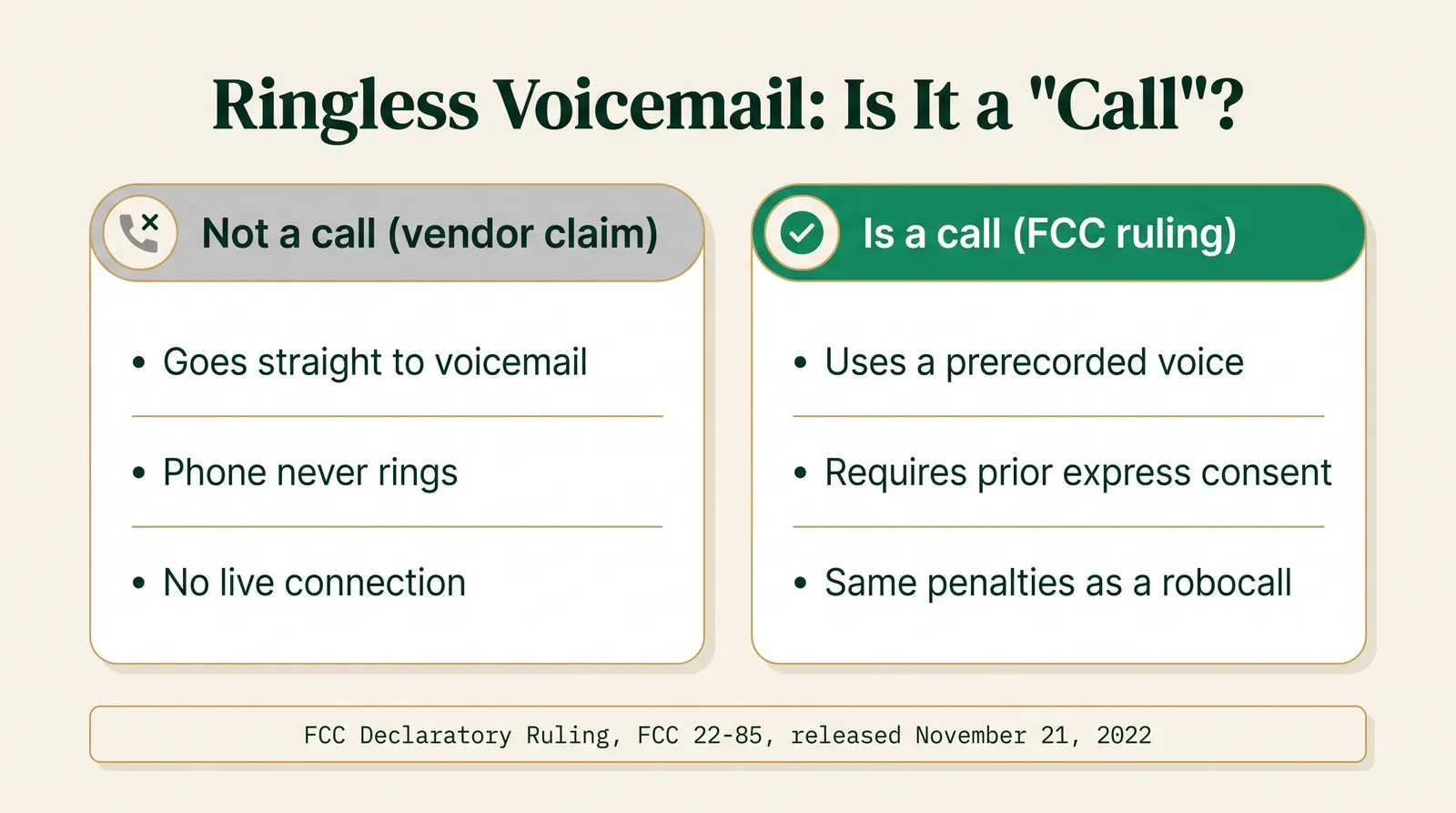
The petition that forced the FCC’s hand came from All About the Message, LLC (AATM), a ringless voicemail provider, filed March 31, 2017. AATM asked the Commission to declare that its service falls outside the TCPA entirely and, failing that, to grant a retroactive waiver of the rules for any past use of the technology. The Consumer and Governmental Affairs Bureau opened the petition for public comment and received more than 8,000 responses, almost all opposed. AATM tried to withdraw the petition in June 2017, but because it had already drawn attention from commenters and members of Congress, the Commission kept the docket open and eventually ruled on the merits anyway.
The ruling came down as FCC 22-85, a Declaratory Ruling and Order in CG Docket No. 02-278, adopted by the Commission on November 14, 2022 and released November 21, 2022. The holding is stated in the ruling’s own opening paragraph: “we find that ‘ringless voicemail’ to wireless phones requires consumer consent because it is a ‘call’ made using an artificial or prerecorded voice and thus is covered by section 227(b)(1)(A)(iii) of the 1991 Telephone Consumer Protection Act.” The Commission denied AATM’s petition to declare ringless voicemail exempt, and separately denied its request for a retroactive waiver.
Two things about that ruling matter for how it applies to your agency specifically. First, it isn’t limited to AATM or to the particular technology AATM used. The ruling applies to any entity that delivers a ringless voicemail to a wireless number, regardless of which vendor’s software does the delivery. Second, it didn’t invent a new rule; it clarified that an existing one, the consent requirement in Section 227(b)(1)(A)(iii), already covered this delivery method. That distinction matters because it means the ruling isn’t a novel restriction agencies can plausibly claim they didn’t know about going forward. As of late 2022, “ringless voicemail isn’t really a call” stopped being a good-faith legal position for anyone paying attention to FCC guidance.
What the ruling didn't change
FCC 22-85 didn't create a special, harsher rule for ringless voicemail. It applied the same consent standard that already governed autodialed and prerecorded calls to wireless numbers. A ringless voicemail sent with valid prior express consent, or prior express written consent for a marketing message, is treated the same as a compliant automated call. The ruling only closed the argument that the delivery mechanism itself put RVM outside the TCPA's reach.
What a Violation Actually Costs
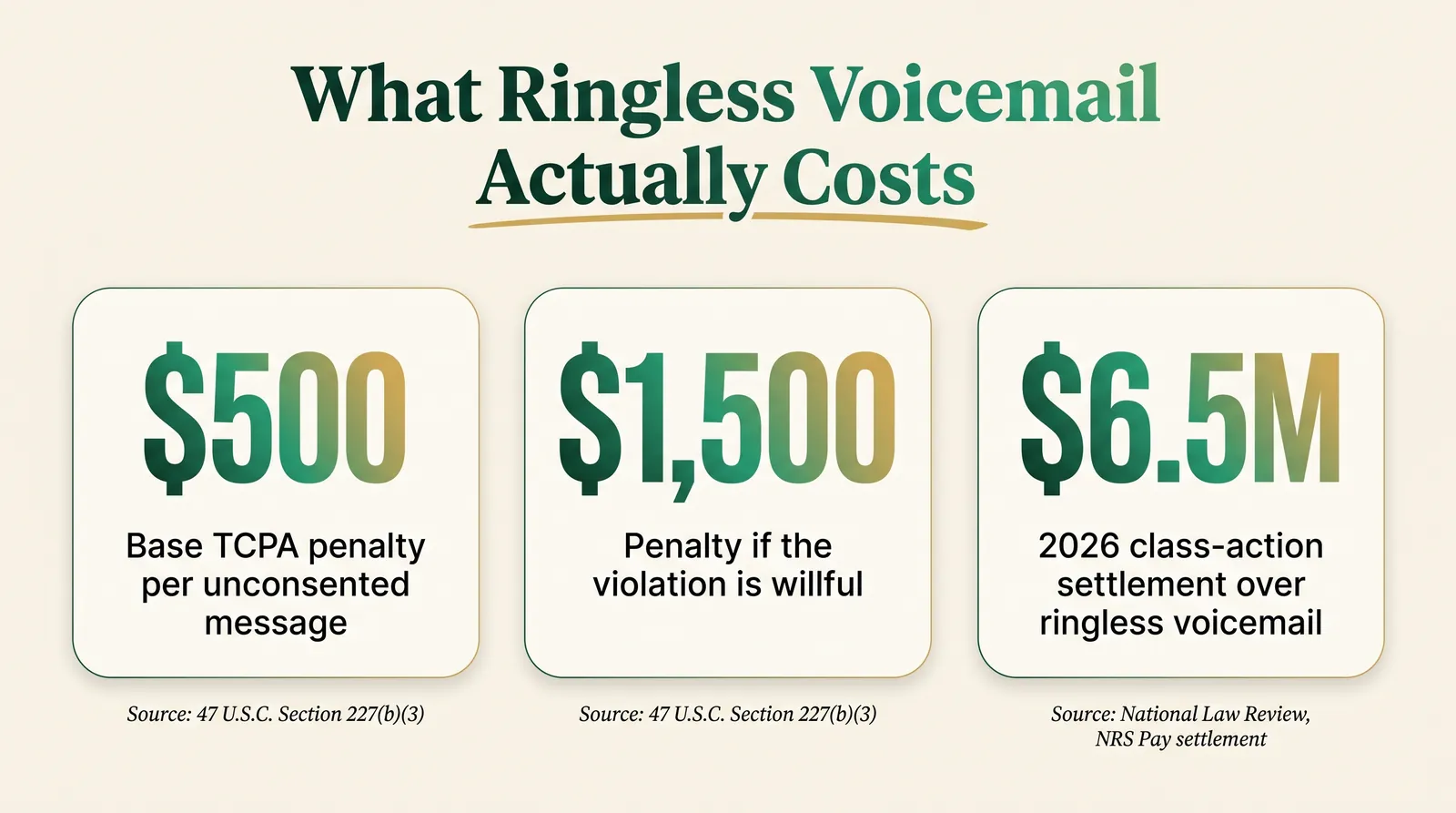
Run the actual statute. Section 227(b)(3) of the TCPA gives a person receiving a non-compliant automated or prerecorded call, which now includes an unconsented ringless voicemail per FCC 22-85, a private right of action to recover actual monetary loss or $500 in damages for each violation, whichever is greater. A court can increase that award to as much as three times the base amount, up to $1,500 per violation, if it finds the defendant willfully or knowingly violated the rule. Because a ringless voicemail campaign typically sends the same message to thousands of numbers at once, and because the statute counts each message as its own violation, the exposure scales directly with list size, not with how many people actually complain.
$500
Statutory damages per unconsented message, base rate
Source: 47 U.S.C. Section 227(b)(3)
$1,500
Statutory damages if the violation is willful or knowing
Source: 47 U.S.C. Section 227(b)(3)
15,000+
Ringless voicemails a marketing firm allegedly sent to insurance agents in one campaign
Source: Van Elzen v. Advisors Ignite USA LLC, per National Law Review
$0.20
Per-minute cost of a managed AI caller, Single Account plan
Source: TheAffordableAI pricing, fetched 2026-08-28
Put those figures against a realistic list size instead of a worst case. An agency that sends 5,000 ringless voicemails to a purchased or scraped list, one it never separately confirmed had valid consent for automated or prerecorded messages, is looking at a theoretical exposure of $2,500,000 at the base $500 figure, or $7,500,000 if the conduct is found willful. Most cases never settle anywhere near the statutory ceiling. But that ceiling is what a plaintiff’s attorney negotiates against from the opening position, and settlements built off multi-thousand-message campaigns still land in real money: National Law Review’s coverage of a 2026 TCPA class action against National Retail Solutions (NRS Pay), resolved over ringless voicemails sent using VoiceLogic’s service, reports a $6.5 million settlement covering a class period from January 8, 2020 through final approval, with more than 50,000 class members each receiving over $100.
| Messages sent without documented consent | Base rate ($500/violation) | Willful rate ($1,500/violation) |
|---|---|---|
| 500 | $250,000 | $750,000 |
| 1,000 | $500,000 | $1,500,000 |
| 5,000 | $2,500,000 | $7,500,000 |
| 15,000 | $7,500,000 | $22,500,000 |
Figures are simple multiplication of the per-violation statutory maximums under 47 U.S.C. Section 227(b)(3); they illustrate statutory ceilings, not typical settlement values. Actual settlements, including the NRS Pay example below, have historically resolved well below these ceilings.
Statutory ceiling vs. a real settlement payout, side by side
Per-violation statutory maximum compared against what an actual 2026 class member received
Sources: 47 U.S.C. Section 227(b)(3) via Cornell Law School Legal Information Institute; National Law Review's coverage of the 2026 NRS Pay ringless voicemail settlement (class period January 8, 2020 through final approval, 50,000+ class members). Figures shown are per-violation statutory maximums and one reported real-world payout, not a prediction of any specific case's outcome.
None of this means every agency that has ever used ringless voicemail is sitting on a multimillion-dollar liability. It means the statute counts by the message, the FCC has already foreclosed the “it’s not a call” defense, and the gap between what a compliant campaign costs and what a non-compliant one can cost is not a rounding error at any real list size.
A Real Case: What Happened When an Insurance Marketing Firm Used Ringless Voicemail on Agents
The clearest illustration of this exposure applied to the insurance industry specifically is Van Elzen v. Advisors Ignite USA LLC, No. 1:22-cv-00859, filed in the U.S. District Court for the Eastern District of Wisconsin. According to National Law Review’s and TCPAWorld’s coverage of the case, the plaintiff, an insurance agent named Van Elzen, alleged that Advisors Ignite USA used SlyBroadcast’s ringless voicemail technology to send more than 15,000 prerecorded messages to insurance agents, advertising marketing events the defendant said could help recipients “substantially increase” their income. The recipients were, notably, not consumers being sold insurance; they were other insurance agents being marketed a business opportunity, sourced from what the coverage describes as an industry data provider list.
Van Elzen sought to represent a class of everyone who received similar messages. On January 18, 2024, Judge William C. Griesbach denied class certification. The court’s reasoning wasn’t that ringless voicemail is exempt from the TCPA, or that the underlying allegations lacked merit; it turned on Rule 23’s class-action mechanics specifically. Per the coverage, the court found that whether class members suffered a real injury from receiving the messages was too individualized a question to resolve on a class-wide basis, since some recipients may have found the marketing message unwelcome while others may have viewed it as a beneficial business tip, undermining predominance, typicality, and superiority.
Denied class certification isn't the same as no liability
Van Elzen's case shows how hard it is to certify a nationwide class over a communication where recipients might react differently to the message. It says nothing about whether an individual plaintiff, suing on their own behalf rather than as a class representative, could still recover the $500-to-$1,500 per-message statutory damages the TCPA provides. A ringless voicemail campaign that would survive a class-certification fight can still generate a stack of individual claims, each one carrying its own statutory exposure and its own legal fees to defend.
The detail worth sitting with is who the recipients were: insurance agents, marketed by another firm in the same industry, off a purchased data list. It’s the exact pattern a lot of agencies run in reverse, marketing to consumers instead of to other agents, using the same technology and the same “we bought a list, we didn’t call them, we just dropped a voicemail” logic. The case doesn’t need a favorable outcome for the plaintiff to make the point: this fact pattern, purchased list plus mass ringless voicemail plus no documented consent, is the one that ends up in federal court.
How to Use Ringless Voicemail Without Getting Sued, or Decide Not To
Give this away completely, because none of it requires buying a different product; it requires building a consent record before the message goes out, which is the same discipline any compliant automated or prerecorded outreach needs.
- Confirm what kind of consent standard applies to your message. If the ringless voicemail advertises anything, a quote, a policy, an event, a callback offer, it’s advertising or telemarketing under 47 CFR Section 64.1200(a)(2), which means it needs prior express written consent, not the lower prior-express-consent standard that covers some non-marketing calls. Assume the stricter standard applies to anything your agency would actually send.
- Never send ringless voicemail to a purchased or scraped list without separately verifying consent for that specific channel. A list vendor’s assurance that leads “opted in” to being contacted isn’t the same as a signed, specific authorization to receive automated or prerecorded messages at that number. Ask the vendor directly what the consent language said, when it was captured, and whether it named your agency or was a blanket authorization to unnamed third parties; a blanket authorization to “partners” generally doesn’t satisfy the specific-seller requirement in 47 CFR Section 64.1200(f)(9).
- Capture and store the consent record itself, not just a checkbox result. A timestamped certificate showing exactly what language the consumer agreed to, and when, is the difference between a defensible record and a guess if a complaint arrives years later. The TCPA’s lookback period for a private claim runs years, not weeks, so a consent record that only lives in a vendor’s dashboard you no longer have access to isn’t a record you can actually produce.
- Identify your business and provide a real opt-out mechanism in every message. Every ringless voicemail should say who’s calling and give a clear, working way to stop future messages, whether that’s a callback number, a reply-STOP text option, or both. An opt-out that goes nowhere is close to the same problem as no opt-out at all.
- Honor every opt-out immediately, and apply it across channels. A consumer who opts out of ringless voicemail messages has revoked consent for that contact method going forward; treat a revocation as covering related automated contact from the same campaign, not just future ringless voicemail specifically, and stop promptly rather than on the next scheduled list pull.
- Reserve ringless voicemail for numbers where consent already exists for another reason. The lowest-risk use case is a warm list: existing clients or leads who already gave prior express written consent for automated contact as part of an application, quote request, or account relationship. That’s a narrower and smaller list than a purchased one, but it’s the one the statute was written to allow.
- If your agency can’t answer exactly what consent record exists for a given list, don’t send to it. That’s not overly cautious; it’s the standard the statute already sets. “We assumed the list was clean” is not a defense once FCC 22-85 has told every business in the country that ringless voicemail needs the same consent a live automated call needs.
The purchased-list broadcast
- List bought or scraped with no specific consent record for automated messages
- No documentation of what, if anything, the numbers agreed to
- Message identifies the offer but not always the business clearly
- Opt-out requests handled manually, if at all
The consented warm-list drop
- Sent only to numbers with a stored, timestamped written consent record
- Consent language names the sender and the specific contact method
- Message identifies the business and a working opt-out immediately
- Opt-outs applied automatically and instantly across the campaign
Ringless Voicemail vs. a Live Call: The Real Trade-off
Price is the reason ringless voicemail is attractive in the first place, so put the actual numbers side by side instead of an abstract comparison. Drop Cowboy, a named ringless voicemail vendor, publishes its own pricing: the Prime plan runs $125 a month for 62,762 messages a year, with overage priced at 2.1 cents per message and a separate $0.0031 per-message compliance fee, landing around two to three cents per drop at that tier. TheAffordableAI’s Single Account plan, a managed AI caller that places live, disclosed calls, runs $200 a month plus a $500 one-time setup at $0.20 a minute. On a strict per-touch basis, ringless voicemail is roughly ten times cheaper.
| Element | Ringless voicemail | Live managed AI call |
|---|---|---|
| Typical cost per touch | ~2.1¢ to 3¢ per message, Drop Cowboy Prime tier | $0.20/min, TheAffordableAI Single Account |
| Consent standard if it markets anything | Prior express written consent, 47 CFR 64.1200(a)(2) | Prior express consent, disclosed at call start |
| Live conversation possible | No, one-way prerecorded message only | Yes, qualifies and can warm-transfer live |
| AI disclosure required | Not applicable, message is prerecorded | Yes, discloses it's AI where required by law |
| Exposure if consent is missing | $500 to $1,500 per message, 47 U.S.C. 227(b)(3) | Same TCPA exposure applies to any unconsented automated call |
Sources: Drop Cowboy Pricing (fetched 2026-08-28); TheAffordableAI Pricing (fetched 2026-08-28); 47 CFR Section 64.1200; 47 U.S.C. Section 227(b)(3), both via Cornell Law School Legal Information Institute.
The trade-off isn’t really price versus safety, because both channels carry the same underlying consent obligation once a message markets something. The real difference is what happens when consent does exist. A ringless voicemail, even a fully compliant one, is a one-way broadcast: the recipient hears a recording and has to call back to reach anyone, which is exactly the mechanism our comparison of warm transfers against voicemail drops covers from the effectiveness side rather than the legal one. A live call from a managed AI caller can qualify the lead and warm-transfer them to a licensed agent in the same conversation, with no callback step and no second chance for the moment to go cold. Ringless voicemail is cheaper per touch. It’s also structurally worse at the one thing that actually closes a policy, getting a real person on the phone with your agent while they’re still interested.
Where Ringless Voicemail Is the Wrong Fix
Be straight about the limits here, because “just switch to live calling” isn’t automatically the right answer for every agency either. If your real problem is that you don’t have enough dial capacity to reach a large list at all, ringless voicemail on a properly consented warm list is a legitimate, inexpensive way to remind existing leads or clients you exist, and it’s a lot cheaper than trying to live-dial the same volume. If your real problem is that leads bought from a vendor never had documented consent for anything, the fix isn’t a different delivery channel; it’s fixing what you buy, and no amount of careful ringless voicemail practice solves a lead source that was never compliant in the first place.
And if your agency’s actual goal is reaching more prospects who haven’t already consented to anything, ringless voicemail isn’t a safer version of cold outreach. It’s the same TCPA exposure a cold robocall would carry, delivered through a channel that used to be marketed as exempt from that exposure and no longer is.
How TheAffordableAI Handles This
Live, disclosed calls, not one-way drops
Every call is a real conversation with disclosure built in, not a prerecorded broadcast the recipient has to call back to respond to.
Consent and dispositions logged automatically
Every dial, timestamp, and outcome lands on the contact record instead of a vendor dashboard nobody can produce months later.
Opt-outs honored immediately
A stop request ends future contact from that number without relying on someone remembering to update a static list by hand.
Warm transfers to a licensed agent
A qualified prospect gets handed to a real person while they're still on the phone, instead of being asked to call a number back.
HighLevel CRM sync
Call and consent history sync automatically, which is the audit trail a documented compliance process actually needs behind it.
No contracts either way
Single Account runs $200/mo plus a $500 one-time setup at $0.20/min. Agency runs $500/mo plus a $1,000 setup at $0.18/min. Cancel anytime.
None of this replaces the consent work described above. A managed AI caller still needs a properly consented list to call, the same as a compliant ringless voicemail campaign would. What it changes is the shape of the follow-up: instead of a recording that waits for a callback, a real conversation happens the first time, with the disclosure and the opt-out built into the call itself. There’s a live demo call on the homepage if you want to hear what that actually sounds like before deciding anything. You can also build a compliant ringless voicemail program yourself with a vendor like the one priced above and your own documented consent process; plenty of agencies do exactly that, and it’s worth pricing against a managed live-calling platform before choosing either path.
What You Actually Get
Concretely: clarity on where the legal line actually sits, instead of relying on a vendor’s marketing copy about what counts as a “call.” A documented consent process turns ringless voicemail, or any automated outreach, from an open-ended liability into a bounded, ordinary compliance cost. It means an opt-out gets honored the moment it’s requested instead of on the next list refresh. It means if a complaint or a demand letter does show up, there’s a timestamped record to produce instead of a shrug and a vendor contract that promised compliance without proving it.
What it doesn’t do is make ringless voicemail, or any calling channel, risk-free by default. The consent obligation exists before the message goes out, not after, and no platform, prerecorded or live, removes that requirement or the licensed agent’s responsibility for it.
The phone not ringing was never the legal question. Whether the recipient consented always was.
Mike MooreCompliance disclaimer
Prior express consent is required for automated or artificial-voice calls and texts to a cell phone under the TCPA, and prior express written consent is required specifically for a call, including a ringless voicemail, that advertises or markets something to a wireless number, per 47 CFR Section 64.1200(a)(2). That obligation belongs to the licensed agent or agency, not to any vendor or platform. Any AI caller must disclose it's AI where required by applicable law and honor opt-outs immediately. Medicare marketing carries CMS's additional rules, including the TPMO disclaimer and call recording retention requirements, on top of the TCPA. Using AI, ringless voicemail, or any calling platform does not transfer compliance liability away from the licensed agent or agency. This article reflects a review of the cited FCC ruling, statutes, regulations, and case coverage as of the publish date and is general information, not legal advice for your specific situation.
Ringless voicemail didn’t get more dangerous in 2026. It got clearly labeled in 2022, and a lot of agencies are still running campaigns as if the old “it’s not a call” pitch still holds up. It doesn’t. A documented consent record, a working opt-out, and an honest read of what you’re actually sending cost a fraction of what one demand letter over a purchased list would, and that’s true whether the message reaches a lead through a prerecorded drop or a live disclosed call.
Hear a live, disclosed call instead of a recording
There's a live demo call on the homepage. Listen to the disclosure, the qualifying questions, and the warm transfer end to end.
Frequently asked
Is ringless voicemail legal for insurance agents to use on leads?
It's legal, but it isn't a loophole around the TCPA the way a lot of vendors market it. The FCC's Declaratory Ruling and Order in CG Docket No. 02-278 (FCC 22-85), adopted November 14, 2022 and released November 21, 2022, found that ringless voicemail to wireless phones requires consumer consent because it's a 'call' made using an artificial or prerecorded voice under section 227(b)(1)(A)(iii) of the TCPA. That means sending one to a cell number without prior express consent, or prior express written consent for a marketing message, carries the same statutory exposure as an illegal robocall. With consent documented, it's a legal channel. Without it, it isn't, regardless of what a ringless-voicemail vendor's sales page implies.
What did the FCC actually rule about ringless voicemail?
In FCC 22-85, the Commission denied a petition from All About the Message, LLC, a ringless voicemail provider, that asked the FCC to declare its technology exempt from the TCPA because the message is deposited directly into a voicemail box without the phone ever ringing. The FCC rejected that argument and held plainly: 'we find that "ringless voicemail" to wireless phones requires consumer consent because it is a "call" made using an artificial or prerecorded voice and thus is covered by section 227(b)(1)(A)(iii) of the 1991 Telephone Consumer Protection Act.' The Commission also denied the vendor's alternative request for a retroactive waiver. The ruling applies to any ringless voicemail provider or user, not just the one that petitioned.
Has an insurance agent actually been sued over ringless voicemail?
Yes. In Van Elzen v. Advisors Ignite USA LLC, No. 1:22-cv-00859 (E.D. Wis.), a Wisconsin insurance agent alleged that Advisors Ignite used SlyBroadcast's ringless voicemail technology to send more than 15,000 prerecorded messages to insurance agents advertising marketing events, without the required consent, according to National Law Review's and TCPAWorld's coverage of the case. On January 18, 2024, Judge William C. Griesbach denied class certification on predominance, typicality, and superiority grounds, because the court found individual agents may have reacted differently to the messages. The case shows the exposure is real even though this particular plaintiff didn't get a certified class; a different fact pattern, or an individual claim instead of a class claim, doesn't need class certification to result in statutory damages.
What happens if I send ringless voicemail to a purchased list without consent?
Each unconsented message is a separate violation under 47 U.S.C. Section 227(b)(3), carrying $500 in statutory damages, or up to $1,500 if a court finds the violation willful or knowing. At real volume that adds up fast: 5,000 messages to a list that was never actually screened for consent is a theoretical exposure of $2,500,000 at the base figure, or $7,500,000 if a court calls it willful, before any settlement discount or before a state's own mini-TCPA statute adds its own separate exposure on top. Most cases settle well below the statutory ceiling, but the ceiling is what a plaintiff's attorney is negotiating against, and it's the number that should drive how much consent documentation exists before the first message goes out, not after a demand letter arrives.
Does 'prior express consent' for ringless voicemail have to be in writing?
It depends on the message. Per 47 CFR Section 64.1200(a)(2), prior express written consent is required specifically for a call, including a ringless voicemail, that includes or introduces an advertisement or constitutes telemarketing to a wireless number. Section 64.1200(f)(9) defines that as a signed agreement that clearly authorizes the seller to deliver automated or prerecorded messages to a specific number, discloses that the signature isn't required as a condition of purchase, and states the number the consent applies to. A ringless voicemail that isn't advertising or telemarketing, like a purely informational service message to an existing customer, can rely on a lower prior-express-consent standard, but insurance marketing to a prospect almost always falls on the advertising side of that line.
Is ringless voicemail cheaper than calling, and does that matter if it's risky?
On price alone, yes. Drop Cowboy's own published pricing, fetched this session, shows its Prime plan at $125 a month for 62,762 messages a year, with overage priced at 2.1 cents per message, plus a $0.0031 compliance fee per message. That's roughly two to three cents landed per drop. A managed AI caller runs $0.20 a minute on TheAffordableAI's Single Account plan, so the per-touch cost is genuinely higher. The comparison that matters isn't the per-unit price, though; it's that a ringless voicemail to an unconsented number carries the same $500-to-$1,500 statutory exposure per message as an illegal robocall, and a live disclosed call to a properly consented lead doesn't carry that exposure at all. Cheap and risky isn't automatically a worse deal than expensive and safe, but it's a different bet, and it should be made on purpose.
Can I use ringless voicemail safely at all?
Yes, on a list where consent already exists and is documented, the same way you'd need consent before an automated or prerecorded call to the same numbers. The safe use case is narrow: existing leads or customers who gave prior express written consent to be contacted with automated or prerecorded messages at that specific number, with the consent timestamped and storable, and with every message honoring an opt-out immediately. The unsafe use case, which is also the common one in the marketing pitches for this technology, is buying a list and mass-dropping voicemails to numbers nobody separately consented, on the theory that because the phone never rings, the TCPA doesn't apply. FCC 22-85 closed that theory in 2022.
Does using an AI calling platform instead of ringless voicemail remove my compliance risk?
No, and treat any claim otherwise as false. Consent has to exist before contact is made, whether that contact is a ringless voicemail, an autodialed call, or an AI-placed call, and that obligation belongs to the licensed agent or agency, not to the technology or the vendor. What switching to a managed, disclosed, live-call platform changes is the shape of the risk: a live call, answered and disclosed, isn't the kind of one-way prerecorded broadcast that FCC 22-85 and Section 227(b) were written to police, and every dial, consent timestamp, and opt-out can be logged automatically instead of reconstructed after a complaint. That's a real reduction in operational risk. It is not a transfer of legal responsibility away from the agent.
Sources
- FCC 22-85, Declaratory Ruling and Order, CG Docket No. 02-278, In the Matter of Rules and Regulations Implementing the TCPA (Petition of All About the Message, LLC) — adopted Nov. 14, 2022, released Nov. 21, 2022
- 47 U.S. Code Section 227(b), Telephone Consumer Protection Act — restrictions on automated/prerecorded calls and private right of action, subsection (b)(3) (via Cornell Law School Legal Information Institute)
- 47 CFR Section 64.1200, Delivery restrictions — prior express written consent requirement and definition, subsections (a)(2) and (f)(9) (via Cornell Law School Legal Information Institute)
- National Law Review — Big Win for Wisconsin: Court Denies Class Certification in TCPA Case on Predominance, Typicality, and Superiority Grounds (Van Elzen v. Advisors Ignite USA LLC, No. 1:22-cv-00859, E.D. Wis.)
- TCPAWorld — Big Win for Wisconsin: Court Denies Class Certification in TCPA Case (Van Elzen v. Advisors Ignite USA LLC)
- National Law Review — RVM Resolution: POS Solutions Provider National Retail Solutions (NRS) to Pay $6.5MM to Resolve TCPA Class Action Over Ringless Voicemails
- Drop Cowboy — Pricing (ringless voicemail per-message and plan pricing)
- TheAffordableAI — Pricing
Put this on your own phone line
See the AI dial, qualify, and warm-transfer a live call in under a minute. No contract, no dev work.
Keep reading
Warm Transfers vs Voicemail Drops: What Actually Gets an Insurance Prospect on the Phone
Voicemail drops feel productive and cost almost nothing. Warm transfers feel expensive and interrupt your day. Only one of them reliably puts a licensed agent in front of a prospect who is ready to talk.

TCPA Revoke-All Rule: What Insurance Agents Do Now
The FCC delayed its TCPA revoke-all consent rule to January 31, 2027. Here is what already applies today, what changes then, and how agencies should prepare.

FCC One-to-One Consent Rule Is Dead: Insurance Leads Now
The FCC's one-to-one consent rule is vacated and repealed. Here is what changed, what didn't, and how to vet an insurance lead vendor's consent in 2026.