Spanish-Speaking Insurance Leads: Why They Go Cold Faster
Spanish-speaking insurance leads go cold faster than English ones at most agencies. Here is why, what it costs, and how to fix it without a new hire.

A lead comes in at 7:40pm on a Tuesday. The form field for preferred language says “Español.” Your agency has one bilingual producer, and she left at 5. The lead sits in the queue until tomorrow, by which point she’s already got three other leads ahead of it, and the caller who filled out that form an hour after dinner has probably already talked to someone else. That’s the whole problem in one sentence: Spanish-preferring leads don’t go cold because nobody wants to help them. They go cold because the one person who can help them isn’t always the one who’s free.
This piece walks through why that gap exists, what it’s actually costing you in a market that’s grown to 70.1 million people, the full method for closing it without a new hire, and where an AI voice agent helps and where it plainly doesn’t.
The short version
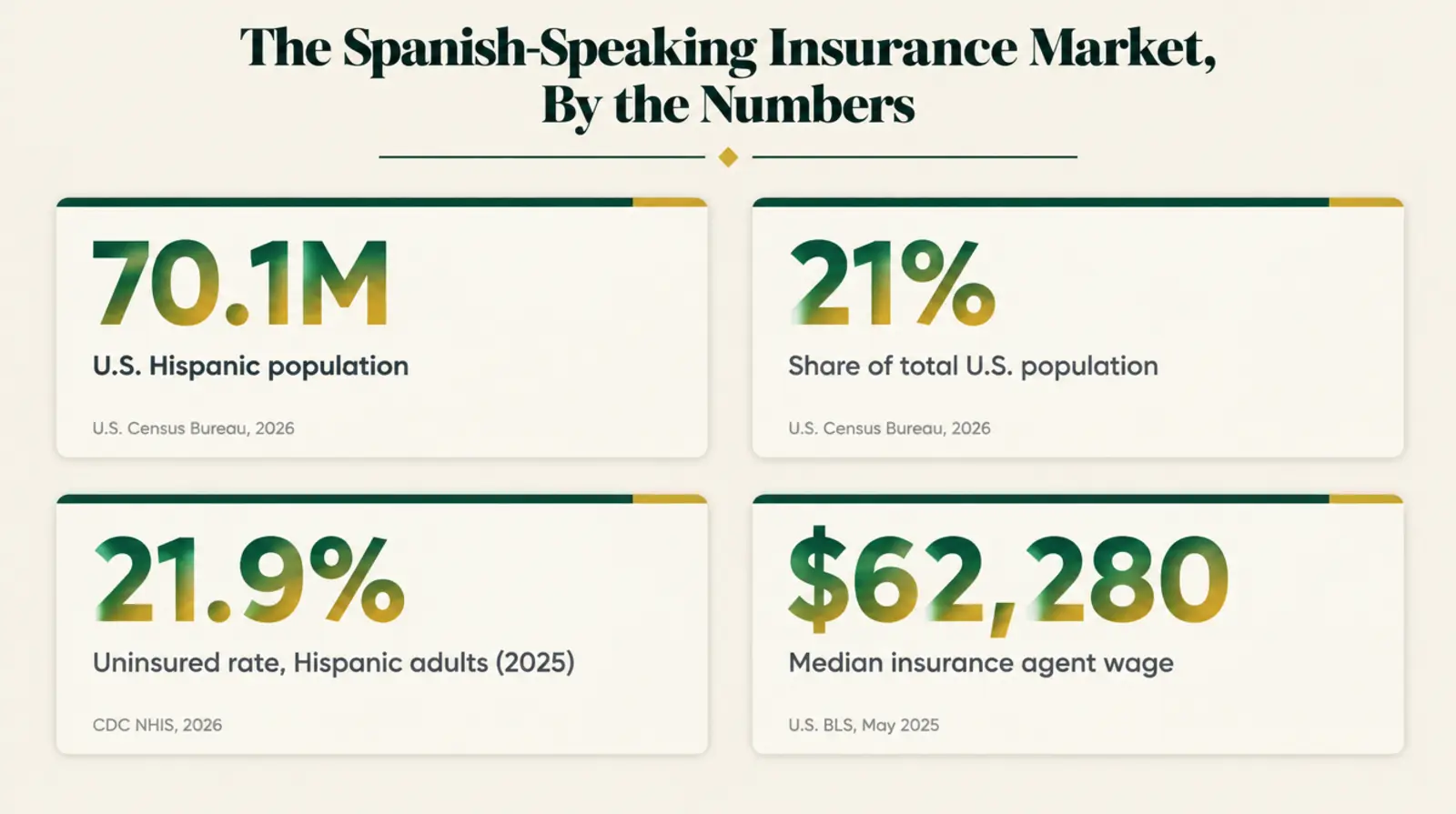
- The U.S. Hispanic population reached 70.1 million as of July 1, 2025, 21% of the country, per the Census Bureau's 2026 Facts for Features release.
- Spanish is the language spoken at home by 61.1% of U.S. residents age 5+ who speak a non-English language, and 61.0% of Spanish speakers ages 18-64 say they speak English "very well," per the Census Bureau's 2018-2022 American Community Survey, meaning roughly 39% of that group do not.
- Hispanic adults remain the demographic group most likely to lack health insurance: 21.9% were uninsured in 2025 per the CDC's National Health Interview Survey, and separately, KFF puts the 2024 uninsured rate for Hispanic people ages 0-64 at 18.4% against 6.8% for White people, about 2.7 times as high.
- The fix most agencies need isn't a bilingual hire, it's a language-preference field that's actually acted on, a fast acknowledgment in Spanish, and a routing rule that gets the lead to whoever on your team can actually have the conversation, before they call someone else.
- Be honest about the limits: an AI voice agent's confirmed Spanish fluency is not something to assume. What it reliably does is answer fast and route correctly, in any language, which still matters even when a human has to finish the call.
Why Spanish-Preferring Leads Go Cold Faster
Every lead your agency buys or generates competes on the same clock: whoever reaches the prospect first, while they’re still thinking about the quote they just requested, usually wins the conversation. For an English-speaking lead, “whoever’s free” is most of your staff. For a lead who checked “Spanish” on the intake form, or who answers your call in Spanish when your rep answers in English, the pool of people who can actually run that conversation shrinks to whoever on your team happens to be bilingual and happens to be available right now.
That’s a narrower window stacked on top of the same general speed problem every agency already fights. If a bilingual-capable lead lands at a moment your one Spanish-speaking producer is on another call, in a meeting, or off shift, the lead doesn’t wait politely. It goes to voicemail, sits in a queue, or gets picked up by whoever answers next, English-only, who does their best with a few shared words and a translation app and loses the thread on anything that actually matters, like a deductible or an enrollment deadline.
None of this is a willingness problem. Agents want these leads; Hispanic-owned small businesses and Hispanic households represent a growing share of the insurance-buying public, and most producers would happily write the policy. The problem is structural: your coverage for this specific kind of lead is only as good as your busiest bilingual staffer’s calendar, and nobody built a backup plan for the hours that person isn’t on.
Define the terms before you build anything
Language preference: a field in a lead form, CRM contact record, or IVR response that records which language a prospect wants to be served in. LEP (limited English proficiency): the term used in federal civil-rights and healthcare guidance for someone who doesn't speak English as their primary language and has a limited ability to read, write, speak, or understand English. Skill-based routing: sending an inbound call or lead to a specific person or group based on an attribute, like language, rather than whoever's simply next in a round-robin. Warm transfer: connecting a live caller directly to an available agent while they're still on the call, rather than taking a message for someone to act on later.
Why It Happens: The Mechanism, Not Just the Symptom
Three separate things usually have to go wrong at once for a Spanish-preferring lead to go cold, and understanding each one tells you exactly what to fix.
The language-preference field exists but nobody routes on it. Most modern lead forms and CRMs, including HighLevel, let you capture a language field. The data gets collected. It just sits there as a tag nobody built a workflow around, so a Spanish-preferring lead enters the same generic follow-up sequence as everyone else, assigned by whatever round-robin or first-available rule governs the rest of your pipeline, language be damned.
Bilingual staffing is a smaller, harder-to-fill pool inside an already hard-to-fill role. The Bureau of Labor Statistics puts the median annual wage for an insurance sales agent at $62,280 as of May 2025, with about 572,600 people working the role nationally and 3% projected growth from 2025 to 2035, roughly in line with the average occupation. That’s the baseline hiring market. Add “and fluent in Spanish” as a requirement and you’re drawing from a narrower slice of that same pool, while competing against every other industry that also wants bilingual talent, something employers have been chasing for a while: Combined Insurance announced back in 2017 that it planned to hire 500 Spanish-speaking sales agents across Florida, Texas, Illinois, and Arizona by the end of that year, a sign this isn’t a new scramble, it’s a long-running one.
Informal interpretation breaks down exactly where it matters most. When an agency has no bilingual staff on hand, the fallback is often whoever the prospect brought to the phone, a son, a daughter, a neighbor. That works fine for “what’s your address.” It works much worse for “what’s your deductible, what’s excluded, and what happens if you miss a payment,” because insurance language is precise and an untrained interpreter, however fluent conversationally, usually hasn’t learned the vocabulary. The agent doesn’t know what got lost in translation, and the client doesn’t know what they agreed to.
Put those three together and you get a lead that looked exactly like any other lead in your dashboard, source, timestamp, intent, except the one field that would have told you to route it differently got ignored, the person who could have handled it wasn’t free, and the stopgap that filled in instead wasn’t built for the job.
What This Gap Is Actually Costing You
Start with how big the addressable group actually is. The Census Bureau’s National Hispanic Heritage Month 2026 release, published August 11, 2026 using population estimates as of July 1, 2025, puts the U.S. Hispanic population at 70.1 million people, 21% of the country. Separately, in the Census Bureau’s 2018-2022 American Community Survey 5-year estimates, released December 7, 2023, Spanish was the language spoken at home by 61.1% of the roughly one in four U.S. residents age 5 and older who speak a language other than English at home, more than the next several languages combined. That’s not a niche segment of your total addressable market; depending on where you sell, it may already be a meaningful share of the leads landing in your pipeline whether or not your routing acknowledges it.
Within that same Census release, 61.0% of Spanish speakers ages 18 to 64 reported speaking English “very well.” Read the other direction: roughly 39% of that age group does not, which is the share where a rushed, English-only call is most likely to leave real gaps in understanding, not because the prospect isn’t paying attention, but because the call simply isn’t happening in the language they’re most confident in.
| Figure | Value | Source & period |
|---|---|---|
| U.S. Hispanic population | 70.1 million | U.S. Census Bureau, as of July 1, 2025 (released Aug. 11, 2026) |
| Share of total U.S. population | 21% | U.S. Census Bureau, as of July 1, 2025 |
| Share of non-English home speakers who speak Spanish | 61.1% | U.S. Census Bureau, 2018-2022 ACS 5-year estimates |
| Spanish speakers (18-64) who speak English "very well" | 61.0% | U.S. Census Bureau, 2018-2022 ACS 5-year estimates |
| Annual Hispanic/Latino population growth | 1.8% | U.S. Census Bureau, Vintage 2023 (July 2022-July 2023) |
Now the insurance side specifically. The CDC’s National Health Interview Survey early release for 2025, published May 2026, found Hispanic adults ages 18-64 remained the demographic group most likely to lack health insurance coverage: 21.9% were uninsured in 2025, down from 30.1% in 2021 and 24.6% in 2024, each year’s drop statistically significant. The same report found exchange-based (ACA Marketplace) coverage higher among Hispanic people, 7.4% in 2025, than among White non-Hispanic people at 5.8% or Black non-Hispanic people at 6.9%, meaning Hispanic consumers are both more likely to still need coverage and more likely to be the ones actually shopping the individual marketplace where a licensed agent gets paid to help them enroll.
A second, independent source backs the coverage-gap direction even though it measures a slightly different population: KFF’s analysis of race and ethnicity in health coverage put the 2024 uninsured rate for Hispanic people of all ages under 65 at 18.4%, against 6.8% for White people in the same age range, roughly 2.7 times as high. CDC measures adults 18-64 only; KFF measures ages 0-64. The exact percentages differ because the populations differ, but both independently sourced datasets point the same direction: a real, persistent coverage gap that insurance agents are positioned to help close, if the lead actually gets reached.
Uninsured rate, Hispanic vs. White adults (2024-2025, two independent sources)
CDC/NHIS measures adults 18-64, 2025 preliminary data. KFF measures ages 0-64, 2024 data. Different populations, same direction.
Sources: CDC/NCHS, Early Release of Estimates From the NHIS, 2025 (released May 2026); KFF, Health Coverage by Race and Ethnicity (2024 data).
Put the pieces together and the cost of the gap isn’t abstract. It’s every Spanish-preferring lead that calls back a competitor who answered faster, every policy that doesn’t get written because the explanation happened in broken half-Spanish over a bad phone connection, and every hour your one bilingual producer spends triaging leads that a routing rule could have sorted automatically.
How to Fix It: The Full Method, No New Hire Required
Here’s everything, in order. None of it requires buying software, though some of it gets easier with the right platform underneath it.
- Capture language preference at the point of intake, every time. Add a language question to your lead forms and landing pages if it isn’t there. If you buy leads, check whether your vendor already passes a language or locale field, most do, and confirm it’s mapped into your CRM rather than discarded.
- Build an IVR or voicemail option that acknowledges Spanish immediately. This doesn’t require a bilingual system, just a short recorded line: “Hemos recibido su llamada. Un representante que habla español se comunicará con usted pronto.” That single sentence tells a caller they were heard, which matters more than most agencies assume.
- Tag every contact with a language field in your CRM, and build a routing rule off it. In HighLevel or any comparable platform, a workflow condition on a language tag can route a contact to a specific pipeline, assign it to a specific user, or trigger a specific notification, the same mechanism you’d use for any other lead-qualification branch.
- Identify your actual bilingual capacity, including people who aren’t full-time producers. A licensed assistant, a part-time contractor, or a bilingual team member in an adjacent role may be able to take the first qualifying call even if a different licensed agent closes it later. Map out who that is before you need them at 7pm on a Tuesday.
- Keep a qualified interpreter line as a real stopgap, not a last resort. For the hours nobody bilingual is reachable, a telephone interpreter service lets a licensed agent run the substantive part of the call correctly instead of guessing. It costs money per use; compare that cost to the value of the lead before deciding it’s not worth having on file.
- Never let a family member interpret the parts that matter. Basic scheduling, fine. Deductibles, exclusions, enrollment deadlines, and what happens on a missed payment, not fine without a qualified interpreter or a bilingual licensed agent directly on the line. Document who interpreted and what was covered either way.
- Measure time-to-first-contact separately for your Spanish-tagged leads. If that number is meaningfully worse than your English-tagged leads, your routing rule isn’t actually working yet, whatever you built in step 3.
- Review the gap monthly, not once. Staff turn over, forms get edited, and workflows drift. A rule that worked in January can quietly stop firing by June if nobody checks it.
You can do all of this yourself
Everything above is buildable with a CRM you probably already have and a willingness to set up one more workflow condition. If you want to price a managed alternative instead of building it yourself, that's a real option too, not a sales trick, just one more input to weigh against the hours it takes to set up and maintain the manual version.
Where TheAffordableAI Fits
Be clear about what this is and isn’t. TheAffordableAI is a managed AI caller: it answers inbound calls and dials outbound the moment a lead is created, qualifies by voice, checks real calendar availability, and warm-transfers to an available person on your team, or auto-books if nobody’s free, with everything synced natively to HighLevel. It does that on the Single Account plan ($200/mo plus a $500 one-time setup, $0.20 a minute, from $0.15 at bulk) or the Agency plan ($500/mo plus a $1,000 one-time setup, $0.18 a minute, from $0.16 at bulk, routing to 20+ agents with round-robin across numbers and team availability toggles), both with no long-term contract. Re-check current numbers on the pricing page before budgeting.
Speed doesn't depend on language
The AI answers or dials on the same timeline for every lead, so a Spanish-tagged contact doesn't wait any longer for a first response than an English-tagged one.
Warm transfer to whoever's actually right
The Agency plan rings 20+ agents at once; first to answer takes the call live. Build a campaign or calendar for your bilingual producers and route accordingly.
Multiple campaigns and calendars
Run a separate campaign for a language-tagged segment so it isn't competing in the same generic queue as every other lead source.
Native HighLevel sync
Language tag, transcript, and disposition land on the contact record automatically, so the handoff to a bilingual producer comes with full context, not a cold start.
24/7 coverage, including the hours nobody's on shift
A Spanish-preferring lead at 9pm on a Sunday still gets answered or dialed, same as any other hour.
No contract, cancel anytime
Test it against your actual language-tagged lead volume before deciding it's the right fix for this specific gap.
What You Actually Get
A Spanish-preferring lead comes in. Instead of entering the same queue as everyone else and waiting for whoever’s next, the call is answered or placed immediately, qualified, and either routed straight to an available bilingual producer through a warm transfer or booked onto that producer’s calendar for the next slot they have open, transcript and language tag already attached in HighLevel. Nobody has to remember to check for the language field manually. Nobody’s bilingual producer has to triage a backlog on top of their own calls. The lead gets a fast response either way, and the substantive conversation, the part that actually requires fluent Spanish and a license, still happens with a human who can do it right.
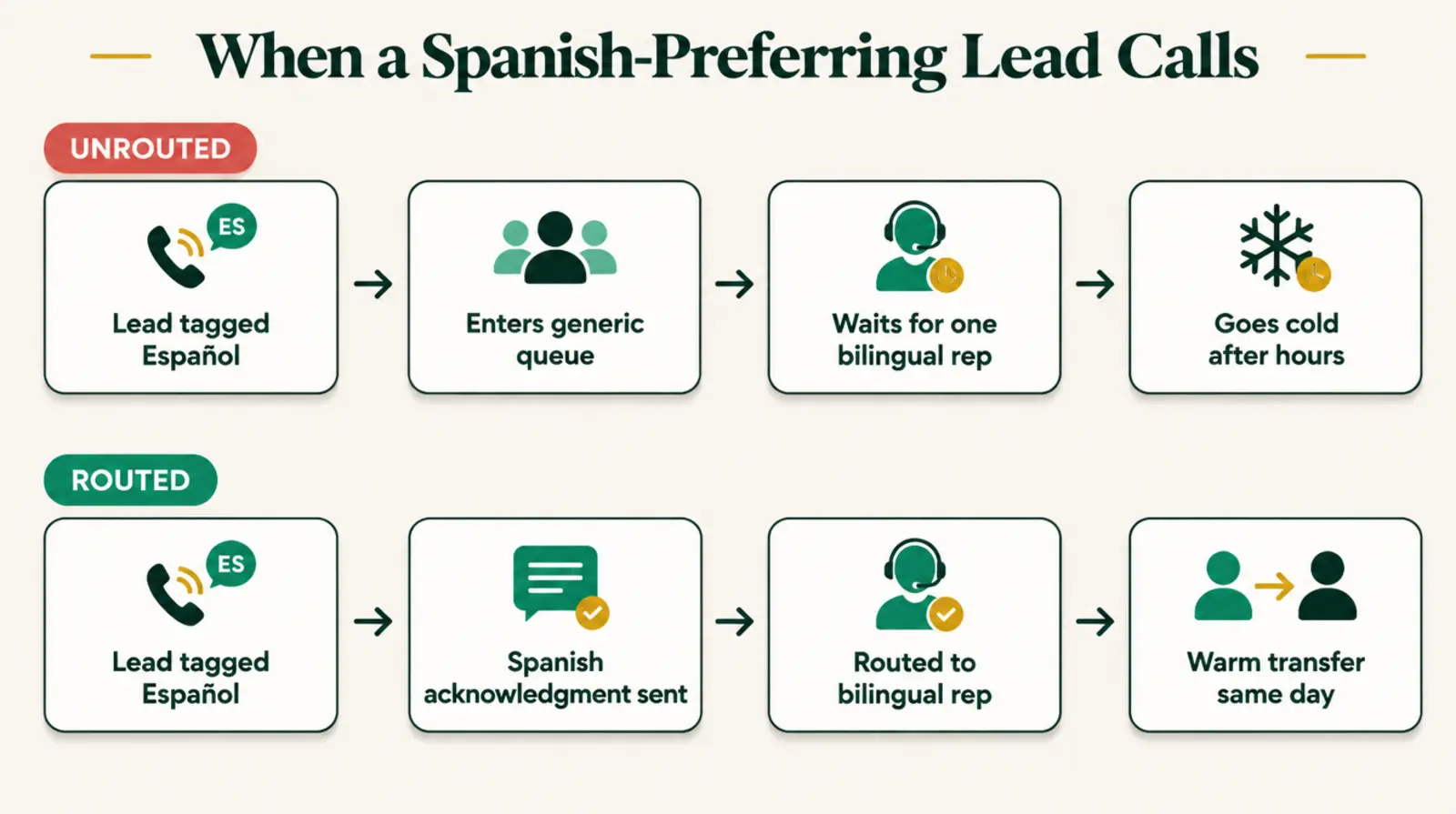
Spanish-Tagged Leads: Unrouted vs. Routed
Language field collected, never acted on
- Spanish-tagged lead enters the same generic follow-up sequence as every other lead
- First contact depends entirely on whether the one bilingual producer happens to be free
- After-hours calls sit until someone checks the queue the next business day
- No acknowledgment in the lead's preferred language while they wait
- A rushed English-only call sometimes substitutes, with real gaps in understanding
Language field drives a real workflow
- Language tag captured at intake and mapped into the CRM automatically
- Immediate Spanish acknowledgment, even if the full call follows later
- Fast routing or warm transfer to an available bilingual team member
- Coverage doesn't depend on which hour the lead happens to call
- A qualified interpreter line fills the gap when nobody bilingual is reachable
A Worked Example: Two Versions of Rosa’s Call
Picture a prospect named Rosa, calling an agency’s published number at 7pm on a Wednesday about an ACA plan for her and her husband, a plan deadline a few weeks out.
On the unrouted path, Rosa reaches a recorded greeting in English, leaves a message mentioning she’d prefer Spanish, and hangs up uncertain anyone understood. The message sits in a shared voicemail box overnight. The next morning, whoever checks voicemail first assigns it to the one bilingual producer on staff, who’s already got four calls ahead of it. By the time Rosa gets a callback, two days have passed, and she’s already spoken with an agent who called her back the same evening.
On the routed path, Rosa’s call is answered immediately. A short Spanish greeting acknowledges the call and gathers the basics: her name, her situation, and the deadline she’s working against. The system checks the calendar, confirms the bilingual producer has an opening the next afternoon, and either books it directly or warm-transfers Rosa live if that producer happens to be free right now. Either way, the producer sees the full context, including the language tag and the deadline note, before the appointment even starts.
Nothing about Rosa changed between the two versions. The only variable was whether the system handling her call actually acted on the one piece of information she’d already given it.
Where This Is the Wrong Tool
Say this plainly: if a lead needs their entire conversation conducted in Spanish from the first word, and you haven’t confirmed your AI voice agent actually speaks Spanish, buying a voice AI platform doesn’t solve that by itself. Don’t assume a vendor’s “premium voices” language includes Spanish fluency; ask, get it confirmed in writing, and test it on a real call before you build a workflow around it. If it isn’t there yet, what you’re actually buying is speed and routing, which matters, but it’s not the same as buying bilingual capacity. If your agency’s real problem is that you have zero bilingual staff anywhere in the business, no software fixes that; that’s a hiring or partnership decision, and it’s worth solving directly rather than hoping technology quietly papers over it.
A fast answer in the wrong language still isn't an answer. Speed buys you time to get the right person on the phone, it doesn't replace them.
Mike MooreCompliance applies the same way, in any language
Prior express written consent for automated calls and texts, clear disclosure, and a working opt-out are required regardless of what language the call happens in, and consent is the agent's obligation, not a vendor's. For Medicare business, CMS marketing rules including the TPMO disclaimer, call-recording retention, and restrictions on unsolicited contact still apply. Using AI, or a bilingual interpreter, or any other tool in the chain does not transfer liability away from the licensed agent. This is general information, not legal advice; confirm your specific obligations with counsel.
Hear how fast it answers, in your own test
There's a live demo call on the homepage. Put your number in and hear an AI voice agent answer, qualify, and offer a transfer, in real time, on your own phone.
The math on this one doesn’t need a spreadsheet to land. A lead that checks “Spanish” on your intake form is exactly as real as any other lead you paid for, and the only reason it goes cold faster is that your busiest bilingual producer can’t be everywhere at once. Fix the routing, not the roster, and most of the gap closes without a single new hire. If you still need actual bilingual capacity on your team, that’s a separate, worthwhile project, just don’t let a vague hope that “the AI probably handles that” stand in for solving it.
Frequently asked
What percentage of insurance leads prefer to speak Spanish?
No insurance-specific national figure is published, so be wary of anyone who quotes one. What is published: the U.S. Census Bureau's Vintage 2025 population estimate puts the Hispanic population at 70.1 million people, 21% of the country, as of July 1, 2025. Separately, in the Census Bureau's 2018-2022 American Community Survey 5-year estimates, Spanish was the language spoken at home by 61.1% of people age 5 and older who speak a language other than English. Neither number tells you your own lead mix. Pull the language-preference field from your own CRM or lead vendor before assuming a share.
Do insurance agents have to serve clients in Spanish by law?
There's no general federal mandate that a licensed agent personally speak Spanish. What does apply: Title VI of the Civil Rights Act requires language access for programs receiving federal funds, which has shaped how CMS and state Medicaid/Marketplace programs handle interpreter services, and some states and carriers layer on their own requirements for materials and disclosures. None of that requires an agency to hire bilingual staff; it mainly affects what the carrier or exchange itself must provide. Confirm your specific obligations with your carrier contracts and your state insurance department rather than treating this paragraph as legal advice.
Does TheAffordableAI's AI voice agent speak Spanish?
Be straight with yourself here: TheAffordableAI's public features and how-it-works pages describe premium, human-like voices but don't publish a confirmed Spanish-language voice option as of this writing. Don't assume it and don't take our word for it either; ask directly before you build a plan around it. What the platform verifiably does, regardless of language, is answer or dial fast, qualify by voice, check a calendar, and warm-transfer to an available person on your team, which is useful even when that last person has to be a bilingual human, not the AI itself.
Is it legal to have a family member interpret insurance coverage details over the phone?
It's common, and it's risky for anything beyond a basic hello. A family member, often a bilingual adult child, can usually relay simple facts, but insurance coverage language, exclusions, premiums, and plan rules use precise terms that an untrained interpreter can easily get wrong, and the licensed agent is the one who stays on the hook for what the client understood. If a lead's chosen interpreter isn't confident with insurance terminology, treat that as a flag to slow down, use a qualified interpreter service for the substantive part of the call, and document what was explained and how.
How do I find out if my leads have a language preference without asking every one of them directly?
Most lead vendors and CRMs already have a language field; the problem is usually that it's not set up or not acted on, not that it's missing. Check your lead form or landing page for a language question, check your lead vendor's data fields for anything like preferred_language or locale, and check whether your IVR or missed-call flow offers a language option at all. If none of that exists, add a single language-preference field to your intake and start tagging contacts from today forward. You won't get historical data, but you'll stop losing new leads to the same gap.
Is it cheaper to hire a bilingual agent or outsource bilingual calls?
It depends on your volume, and the honest answer requires your own numbers, not an industry average. The U.S. Bureau of Labor Statistics puts the median annual wage for an insurance sales agent at $62,280 as of May 2025; a bilingual, licensed hire typically narrows an already competitive labor pool further, though BLS doesn't break out a bilingual-specific wage. Outsourcing or routing through an existing bilingual team member avoids a new salary but caps your capacity to whoever's available. Price both against your actual Spanish-preferring lead volume before deciding either way; a fast but English-only answer followed by a same-day bilingual callback may beat both options at low volume.
What's the fastest fix if I have zero bilingual staff right now?
Two things you can do this week without hiring anyone: add a short Spanish greeting to your voicemail and IVR that tells the caller you received their call and someone will follow up ('Hemos recibido su llamada, un representante se comunicará pronto'), and identify one person, even a part-time contractor or a qualified telephone interpreter line, you can route a Spanish-preferring lead to same-day. Neither solves everything, but both stop the lead from sitting in silence while you figure out the rest.
Does using AI to answer or route a Spanish-speaking lead change who's liable for compliance?
No. Whether a call is answered by a human, an AI voice agent, or routed by an automated workflow, the licensed agent and agency stay responsible for TCPA consent, required disclosures, honoring opt-outs, and for Medicare business, CMS marketing rules including the TPMO disclaimer and call-recording retention. None of that liability transfers to a vendor or a piece of software, in English or Spanish.
Sources
- U.S. Census Bureau — National Hispanic Heritage Month: 2026 (Facts for Features, released August 11, 2026; data as of July 1, 2025)
- U.S. Census Bureau — Language Use in the United States: 2018-2022 American Community Survey 5-Year Estimates (press release, December 7, 2023)
- U.S. Census Bureau — Percent Change in the Hispanic or Latino Population by County: July 1, 2022 to July 1, 2023 (Vintage 2023 Population Estimates)
- National Center for Health Statistics (CDC) — Health Insurance Coverage: Early Release of Estimates From the National Health Interview Survey, 2025 (released May 2026)
- KFF — Health Coverage by Race and Ethnicity (2024 data)
- U.S. Bureau of Labor Statistics — Occupational Outlook Handbook: Insurance Sales Agents (data as of May 2025, 2025-35 projections)
- Chubb Newsroom — Combined Insurance Aims to Hire 500 Spanish-Speaking Sales Agents by End of 2017 (press release, June 22, 2017)
- TheAffordableAI — Pricing
- TheAffordableAI — Features
Put this on your own phone line
See the AI dial, qualify, and warm-transfer a live call in under a minute. No contract, no dev work.
Keep reading

Insurance Agency Staffing Shortage 2026: The Real Numbers
Insurance agencies can't hire fast enough in 2026. Real BLS, SHRM, and NFIB data on hiring delays, and how to cover lead follow-up while a seat sits open.

Speed to Lead in 2026: Why the First 60 Seconds Decides Who Writes the Policy
The lead you paid for is not lost to a better agent. It is lost to a faster one. Here is what response time actually does to contact and conversion rates, and how to get to sixty seconds without hiring a dialer team.

Warm Transfers vs Voicemail Drops: What Actually Gets an Insurance Prospect on the Phone
Voicemail drops feel productive and cost almost nothing. Warm transfers feel expensive and interrupt your day. Only one of them reliably puts a licensed agent in front of a prospect who is ready to talk.