Virtual Assistants for Insurance Leads: Cost and Risk
A calling VA for insurance leads runs $1,360 to $2,320 a month, and the NAIC producer licensing model act raises a question worth asking before you hire one.

Yes, but only for the parts of the call that don’t require a license, and that line is easier to cross than most agencies think. A virtual assistant can dial your list, confirm basic eligibility, and book a callback window without touching insurance licensing law at all. The moment that same VA starts describing what a plan covers, comparing one carrier to another, or asking someone to apply for a specific policy, they’re doing something the NAIC’s own model act calls “soliciting,” and that requires a producer license in the state the lead lives in, regardless of what country the VA is calling from.
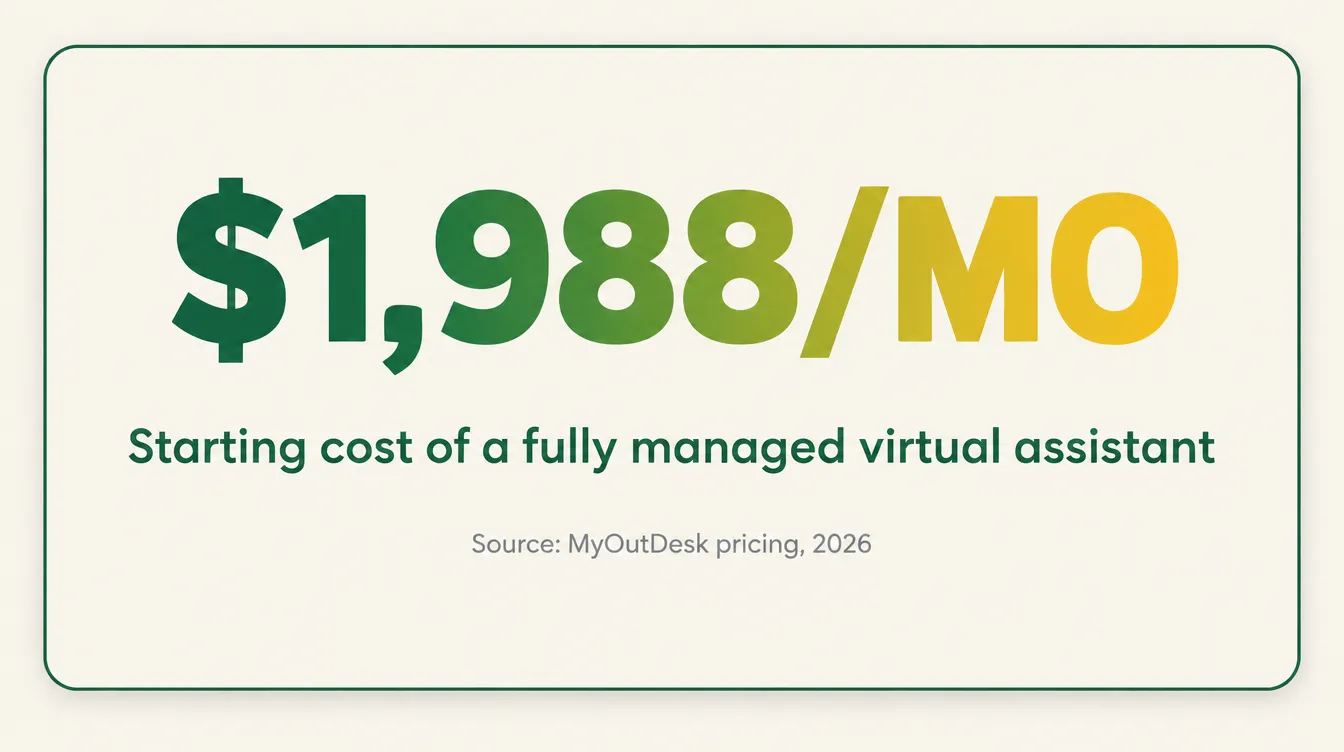
That distinction rarely comes up in the online conversation about hiring a VA to call insurance leads, which agencies usually start looking into for the same reason a local hire is hard to find in the first place. That conversation mostly focuses on cost: a Filipino telemarketing VA runs $8.50 to $14.50 an hour according to VA MASTERS’ own published rates, a fully managed VA through MyOutDesk starts at $1,988 a month, and either one is dramatically cheaper than a $44,770-a-year US-based hire, per the Bureau of Labor Statistics’ median wage data for customer service representatives. All of that is true and worth knowing. None of it answers the question that actually determines whether the arrangement is safe to run: what is the VA allowed to say once someone picks up the phone.
The short version
- A dedicated offshore telemarketing VA runs $1,360 to $2,320 a month full-time; a managed VA agency like MyOutDesk starts at $1,988 a month; both are billed flat, whether or not a single call connects.
- The NAIC Producer Licensing Model Act defines "solicit" as attempting to sell insurance or asking a person to apply for a particular kind of insurance from a particular company, and most states track that definition closely in their own producer licensing statutes.
- A VA confirming eligibility and booking a callback is doing administrative work. A VA describing plan benefits or urging someone toward a specific carrier is soliciting, licensed or not.
- Section 13 of the model act bars paying commission, a service fee, or "other valuable consideration" to an unlicensed person for selling, soliciting, or negotiating insurance, which rules out per-sale bonuses for VA calling work.
- A managed AI caller faces the identical rule. What changes is that the disclosure, qualification script, and warm-transfer handoff to a licensed agent can be built once and run the same way on every call, instead of depending on one hired person's judgment in the moment.
What “Hiring a Virtual Assistant” Actually Means
“VA” covers three different arrangements that get lumped together in agent Facebook groups, and they carry different cost structures and different amounts of oversight you have to build yourself.
The first is a freelance marketplace hire: you post a job on Upwork, OnlineJobs.ph, or a similar platform, interview candidates directly, and manage payroll, training, and performance yourself. This is the cheapest option on an hourly basis and the one with the least built-in structure. You are the HR department.
The second is a specialized VA staffing service, like VA MASTERS, which recruits and places a dedicated telemarketing VA with you for an hourly or monthly rate, handling sourcing and often offering a replacement if the placement doesn’t work out. You still manage the VA’s day-to-day work and script, but someone else handled the hiring funnel.
The third is a fully managed VA agency, like MyOutDesk, which bundles recruiting, vetting, payroll, benefits, HR administration, onboarding, and a dedicated account manager into one flat monthly rate. You get less choice over exactly who you’re assigned and pay more for it, but you’re not running a mini HR operation for a single remote hire.
None of these three is the same thing as outsourcing to a BPO or call center, where you’re leasing a team’s capacity rather than hiring a specific individual, and the vicarious liability questions that come with a third-party vendor apply differently than they do to a person working under your direct supervision. A VA, in any of the three forms above, is functioning much closer to an employee or a direct contractor of your agency, which is exactly why the licensing question below lands on you more squarely than it would with an arm’s-length vendor.
What a Calling VA Actually Costs in 2026
The rate you’ll see quoted depends heavily on which of the three arrangements above you’re looking at, and the spread is wide enough that “a VA costs $10 an hour” and “a VA costs $2,000 a month” can both be true statements about the same job.
| Arrangement | Typical cost | Billed when idle? | Producer license required? |
|---|---|---|---|
| Offshore telemarketing VA (VA MASTERS rate) |
$8.50–$14.50/hr; $1,360–$2,320/mo full-time | Yes, flat rate regardless of connects | No, unless the VA solicits |
| Fully managed VA agency (MyOutDesk rate) |
Starting at $1,988/mo, month-to-month | Yes, flat monthly rate | No, unless the VA solicits |
| Local US/UK/Australia telemarketer (VA MASTERS' own comparison figure) |
$3,200–$5,000/mo plus benefits | Yes, salaried | No, unless soliciting |
| Shared telemarketing agency seat (VA MASTERS' own comparison figure) |
$1,500–$5,000/mo | Usually, per-seat or retainer | No, unless soliciting |
| Managed AI caller, Single Account (TheAffordableAI) |
$200/mo + $500 one-time setup, $0.20/min talk time (from $0.15 at bulk) | No, billed only for connected talk time | No, when scoped to qualification and scheduling |
Sources: VA MASTERS, Telemarketing Virtual Assistant pricing page, fetched September 26, 2026. MyOutDesk, Pricing page, fetched September 26, 2026. TheAffordableAI, Pricing page, fetched September 26, 2026.
$1,988
Starting monthly rate for a full-time managed VA, MyOutDesk, month-to-month
$21.53
Median hourly wage, US Customer Service Representatives, BLS, May 2025
1.8%
Monthly quits rate, professional and business services, BLS JOLTS, July 2026
$0.15
Per-minute talk-time rate at bulk, TheAffordableAI Single Account
Notice the pattern across every hired-human arrangement in that table: you pay for the hours or the seat, not for the outcome. A VA who dials for eight hours and connects with six people gets paid the same as one who connects with sixty. That’s not a criticism of the workers; it’s just how hourly and flat-rate staffing is structured, and it’s the single biggest mechanical difference from a per-minute-of-talk-time billing model.
The Math Nobody Runs: Cost Per Connected Minute
Here’s a worked example using only the vendor-published numbers above, not a performance benchmark, to show why “cost per hour” and “cost per outcome” tell you different things. The same per-minute logic drives the live-agent-versus-AI cost comparison elsewhere on this site; the math below applies it specifically to a hired VA instead of a live in-house agent.
Say your agency needs roughly 500 minutes of actual qualifying conversation with leads in a given month, a reasonable number for a few hundred calls that connect and run a few minutes each. A full-time VA through MyOutDesk costs $1,988 that month whether those 500 minutes happen or not, because you’re paying for the seat, not the connected time. VA MASTERS’ offshore telemarketing VA runs $1,360 to $2,320 a month full-time under the same logic.
A managed AI caller on TheAffordableAI’s Single Account bills only for connected talk time: 500 minutes at $0.20 a minute is $100, plus the $200 monthly platform fee, for $300 that month, or $275 at the $0.15 bulk rate. No charge accrues for voicemail connections or failed dial attempts, according to the plan’s own published billing terms.
Illustrative monthly cost at 500 minutes of connected talk time
Built from each vendor's own published rate card, not a reported performance benchmark. Your actual connected-minute volume will differ.
Sources: VA MASTERS and MyOutDesk pricing pages, fetched September 26, 2026; TheAffordableAI Pricing, fetched September 26, 2026. Local telemarketer figure is VA MASTERS' own $3,200–$5,000 comparison range, midpoint plotted.
The gap widens further at higher volume, because the VA’s flat rate doesn’t move whether you need 200 connected minutes or 2,000 in a given month, while the AI’s cost scales with actual usage in both directions. That also means the AI option can look worse than a VA in a genuinely slow month with very little call volume, since the VA at least represents fixed, predictable capacity. Neither of these facts, by itself, answers the licensing question, which is the part that actually determines whether either arrangement is safe to scale.
The crossover point is worth working out for your own agency rather than taking the 500-minute example on faith. At the $0.20-a-minute Single Account rate, connected talk time would have to reach roughly 9,940 minutes in a month, about 166 hours of pure connected conversation, before the AI’s usage-based cost caught up to MyOutDesk’s flat $1,988. That’s an enormous volume for qualification calls that typically run two to four minutes each; most agencies running a few hundred leads a month land nowhere near it. The comparison flips even further in the AI’s favor at the $0.15 bulk rate, which pushes the crossover past 13,000 minutes. This is simple algebra on published rate cards, not a claim about how much volume your agency actually generates, so run it with your own numbers before deciding anything.
| Connected minutes/month | AI, Single Account ($0.20/min + $200/mo) | Offshore telemarketing VA, full-time | Managed VA agency (MyOutDesk) |
|---|---|---|---|
| 150 minutes | $230 | $1,360–$2,320 (flat) | $1,988 (flat) |
| 500 minutes | $300 | $1,360–$2,320 (flat) | $1,988 (flat) |
| 1,500 minutes | $500 | $1,360–$2,320 (flat) | $1,988 (flat) |
AI figures calculated from TheAffordableAI's published $200/mo plus $0.20/min Single Account rate; VA figures are the flat vendor rates from the earlier table and do not change with volume. Sources: TheAffordableAI Pricing, VA MASTERS and MyOutDesk pricing pages, all fetched September 26, 2026.
You can build a version of this yourself with a dialer and a VA. Plenty of agencies do, and for some volumes it’s the right call. It’s worth pricing both against your own numbers rather than either one on faith.
The VA’s cost line stays flat across all three rows because that’s the nature of a seat-based rate. The AI’s line only overtakes a flat-rate VA at a volume most single-agent operations won’t hit; the calculation looks very different for an Agency-plan operation running thousands of connected minutes across 20+ agents, where the flat-rate comparison would need to be against several VA seats, not one.
Edge Cases Worth Planning For
A few situations complicate the clean comparison above, and it’s worth thinking through them before you commit to either arrangement.
A VA calling leads in multiple states. The NAIC model act’s definitions apply to insurance solicited in “this state,” meaning the licensing question tracks where the lead lives, not where the VA sits. A VA working a Texas list and a Georgia list in the same shift needs the same qualification-only discipline for both, since both states’ producer licensing statutes are built from close variations of the same model language, even though Georgia’s own telemarketing statute adds separate consent requirements on top of the licensing question.
Medicare leads specifically. CMS’s TPMO disclaimer requirement and current Scope of Appointment rules apply regardless of whether a VA, an AI caller, or a licensed agent makes the call, and a VA who starts walking a Medicare lead through plan differences is both soliciting without a license and skipping a required federal marketing disclosure in the same breath. Route Medicare qualification calls to a strictly eligibility-and-scheduling script, full stop.
Part-time VA arrangements. A VA working 20 hours a week instead of 40 cuts the monthly cost roughly in half using the same hourly rate, which narrows the gap with a per-minute AI caller at lower volumes but doesn’t touch the licensing question at all. A part-time VA who solicits is exactly as exposed as a full-time one.
Mixing a VA with an AI caller. Some agencies run both: an AI caller for the first-touch qualification wave and a VA for warm relationship management with an existing book of clients. That split can work well precisely because it keeps the highest-volume, most repetitive, most license-sensitive work on the system built to run the same script every time, and reserves the VA’s time for work that genuinely benefits from a person who knows the client.
The Licensing Problem Nobody Mentions
Every blog post ranking for “insurance agency virtual assistant” talks about cost, English proficiency, and time zones. Almost none of them mention that the content of the call itself can trigger a state producer licensing requirement, independent of who’s paying whom or what country the call originates from.
The NAIC’s Producer Licensing Model Act, the template most state insurance codes are built from, defines the relevant terms plainly. Section 3 states: “A person shall not sell, solicit or negotiate insurance in this state for any class or classes of insurance unless the person is licensed for that line of authority in accordance with this Act.” The definitions in Section 2 do the real work:
| Term | Model act definition | Section |
|---|---|---|
| Sell | To exchange a contract of insurance, by any means, for money or its equivalent, on behalf of an insurance company | § 2(M) |
| Solicit | Attempting to sell insurance, or asking or urging a person to apply for a particular kind of insurance from a particular company | § 2(N) |
| Negotiate | Conferring directly with, or offering advice directly to, a purchaser about the substantive benefits, terms, or conditions of a particular contract | § 2(K) |
| Commissions to unlicensed persons | An insurer or producer may not pay, and a person may not accept, a commission or other valuable consideration for selling, soliciting, or negotiating insurance if that person is required to be licensed and isn't | § 13(A)–(B) |
Source: NAIC, Producer Licensing Model Act, MO-218, fetched September 26, 2026. Most states' producer licensing statutes track this model closely, though exact wording and adopted definitions vary by state; confirm the current text of your own state's insurance code.
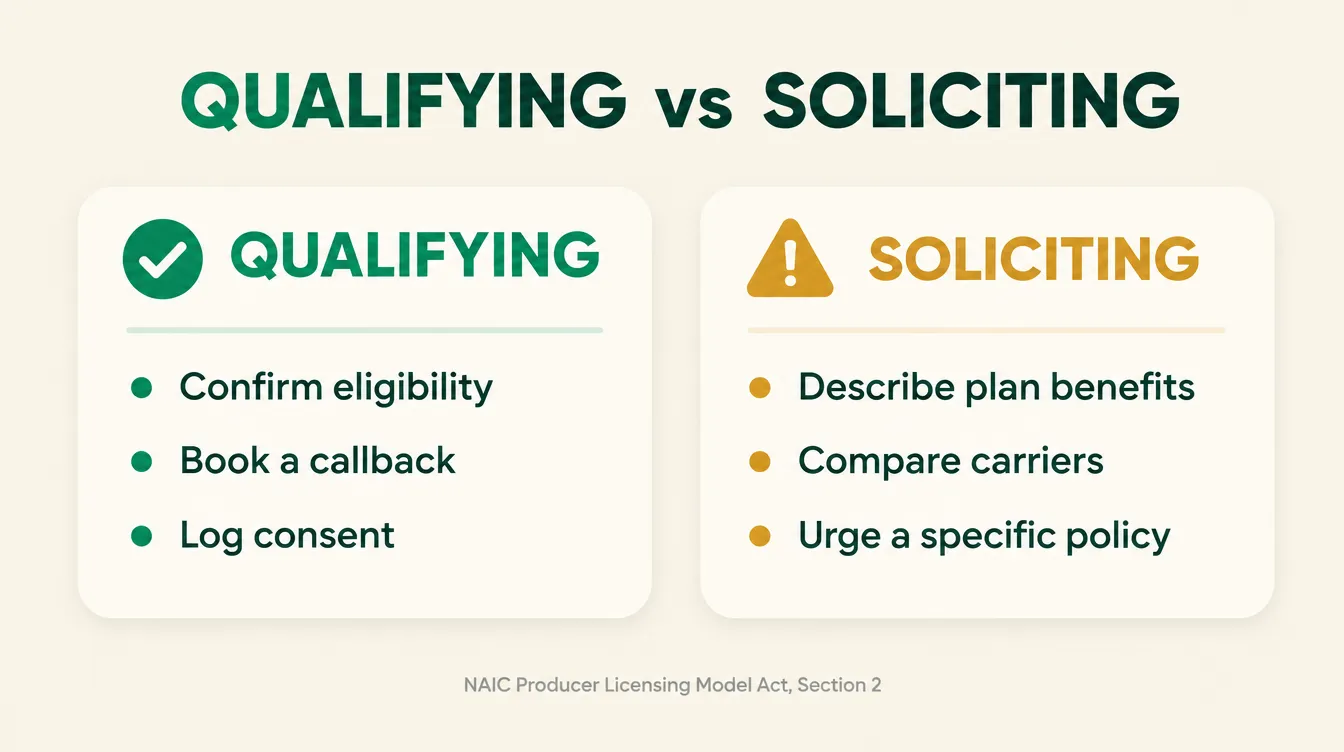
Read that “solicit” definition again: attempting to sell, or asking or urging a person to apply for a particular kind of insurance from a particular company. That’s a lower bar than most agencies assume. A script that has a VA say “based on what you told me, a lot of people your age go with a Medicare Advantage plan instead of Supplement, want me to walk you through why” is urging a person toward a particular kind of insurance. It doesn’t matter that the VA never quotes a premium or names a carrier by name if the pitch itself is doing the urging. A script that instead says “I just need to confirm you’re on Medicare Part A and B and find a 15-minute window for one of our licensed agents to call you back” is neither selling, soliciting, nor negotiating under any of the three definitions above.
The commission rule in Section 13 catches a second, quieter problem. Agencies commonly pay a VA a small bonus per booked appointment that converts to a sale, on top of the hourly rate, to keep the VA motivated. If that VA isn’t a licensed producer, that bonus is compensation “for selling, soliciting, or negotiating insurance” the moment it’s tied to whether the lead actually bought something, and Section 13 bars both sides of that transaction, the agency paying it and the VA accepting it. A flat hourly rate, or a bonus tied to a non-sale metric like calls completed or appointments booked regardless of outcome, sits outside that rule.
Before you write a VA's calling script
- Keep the VA's role to confirming basic eligibility facts and booking a callback, never describing plan benefits or comparing carriers.
- Never pay a bonus tied to whether a lead converts to a sale unless the VA holds a producer license for that line of authority in the lead's state.
- Every automated or scripted call to a wireless number still needs prior express consent under the TCPA, and Medicare-related calls carry CMS's TPMO disclaimer requirement on top of that, regardless of who or what is dialing.
- Using a VA, a BPO, or an AI caller does not transfer liability for how the call is conducted. The licensed agent and agency stay responsible for consent, disclosure, and the line between qualifying and soliciting.
This is general information, not legal advice. Confirm the current producer licensing statute in every state you call into, and have counsel review your actual VA or AI call scripts before scaling volume.
The mistakes that actually show up in practice
A handful of patterns account for most of the real exposure agencies walk into with a calling VA, and none of them require bad intent.
- Writing a script that sounds like qualification but functions like a pitch. “A lot of people in your situation end up going with X, want me to explain why” is urging, not qualifying, even if it never mentions a specific premium.
- Letting a motivated VA improvise past the script. A VA who genuinely wants to help a confused caller will sometimes explain a benefit unprompted. That instinct is the exact behavior the script has to train against, not reward.
- Structuring pay around outcomes without checking Section 13. A per-sale bonus feels like normal sales-team incentive design and is exactly what the commission rule was written to catch when the person earning it isn’t a licensed producer.
- Assuming a staffing agency’s compliance language covers this. A VA staffing company’s marketing page focuses on recruiting, payroll, and replacement guarantees, not on your state’s producer licensing statute. That’s your review to do, not theirs.
- Treating “the VA never quoted a price” as the whole test. Solicitation under the model act’s definition doesn’t require a price quote. Urging someone toward a particular kind of insurance from a particular company is enough on its own.
Turnover, Ramp Time, and the Quality You Actually Get
Cost per hour and licensing exposure aren’t the only variables. A VA also has to be trained, has to be managed, and can leave. The commonly cited “40 to 45 percent annual call center turnover” figures that circulate in marketing blog posts rarely name a source or a methodology, so this guide won’t repeat them. What’s actually measurable from a primary source: the Bureau of Labor Statistics’ JOLTS report put the quits rate for professional and business services, the broad government category VA staffing sits inside, at 1.8 percent for July 2026, a level of 401,000 quits that month. That’s one month’s rate across a sector far wider than phone-based lead qualification alone, so treat it as a general signal about labor market churn in adjacent job categories, not a VA-specific attrition statistic.
What that number doesn’t capture, and what agencies actually feel, is ramp time. A new VA needs to learn your product, your CRM, your disqualification criteria, and the exact line between “confirming eligibility” and “urging someone to apply,” and that training investment resets every time a placement doesn’t work out. A managed agency like MyOutDesk builds a replacement guarantee into its flat rate specifically because this is a known cost of the model; a freelance marketplace hire usually doesn’t come with that cushion built in.
If you want to hear what the qualification-only version of this actually sounds like before you decide anything, there’s a demo call on the homepage; putting your own number in takes less time than reading the next section.
None of this means a VA does worse work than a person on your own payroll would. It means the labor-market and management overhead that comes with any human calling role, sourcing, training, script drift, and eventual replacement, applies here the same as it would to an in-house hire, just distributed across a vendor relationship instead of your own HR function.
Virtual Assistant vs Managed AI Caller, Side by Side
Hired, trained, and managed by you
- Flat hourly or monthly rate, billed whether or not calls connect
- Ramp time and script training reset with every new hire
- Coverage limited to that person's working hours and time zone
- Solicitation risk depends on the individual sticking to the script every time
- Turnover means re-training, and re-explaining the licensing line, from scratch
Configured once, runs the same way every time
- Billed only for connected talk time on TheAffordableAI's Single Account and Agency plans
- 24/7 coverage for outbound and inbound, per TheAffordableAI's published features
- The qualification-only script runs identically on call one and call ten thousand
- Warm transfer hands the conversation to a licensed agent the instant it needs advice
- Consent, disposition, and transcript sync to the CRM automatically
The core difference isn’t intelligence or even cost, it’s consistency of scope. A well-trained VA can absolutely stay inside the qualification-only lane every single call. The risk is that “well-trained” has to be re-earned after every hire, every script update, and every long shift, and a single call where a VA drifts into describing plan benefits is the call that creates exposure. A managed AI caller’s script doesn’t have good days and bad days; it runs the version you configured, which makes the qualification-versus-solicitation line something you set once at the platform level instead of re-enforcing with every new person who picks up a headset.
The question isn't whether a VA can do this job well. It's whether "well" survives the fortieth call of a long Tuesday, on every hire, forever.
Mike MooreWhen a Virtual Assistant Is Still the Right Call
None of this makes a virtual assistant the wrong tool everywhere. A VA makes sense when the work benefits from an ongoing human relationship at a volume that doesn’t justify full automation: a bilingual VA who knows a specific book of Spanish-speaking clients personally and can handle nuanced questions a script can’t anticipate, someone managing your calendar, inbox, and light client communication alongside occasional calls, or a VA doing entirely non-phone work like carrier paperwork, data entry, or CRM cleanup where the licensing question never arises because no solicitation is happening at all.
Where it gets risky is routing high-volume, first-touch, script-driven lead calling, exactly the job most agencies hire a calling VA to do, to a role that’s billed by the hour regardless of outcome and has no structural guardrail against a well-meaning VA trying to be more helpful on a call than the license allows. If you already have a VA doing this work today, the fix usually isn’t firing them. It’s auditing the actual script against the definitions above and moving anything that sounds like urging someone toward a specific plan to a licensed agent’s side of the handoff.
Where TheAffordableAI Fits
I want to be direct about what changes and what doesn’t when you swap a VA for a managed AI caller: the licensing rule is identical either way. What a well-built AI calling setup does is make the qualification-only scope the default, instead of something you have to keep re-training into a rotating cast of hires. The full feature list covers how each piece works together; the six that matter most for this comparison are below.
Qualification, not solicitation, by design
The AI completes qualification in the opening seconds, per TheAffordableAI's published features, listening for eligibility signals and disqualifiers, not pitching plan benefits.
Warm transfer to a licensed agent
Rings up to 20+ agents at once; the first to answer gets the call the moment it needs a license to continue.
Billed for talk time, not seat time
No charge for voicemail connections or failed dial attempts, unlike a flat hourly or monthly VA rate.
24/7, no time zone gap
One system runs cold calling, renewals, reminders, win-backs, and inbound support around the clock.
HighLevel CRM sync
Transcript, disposition, and consent notes land on the contact record automatically, not in a VA's personal notes.
No contracts
Single Account runs $200/mo plus a $500 one-time setup, $0.20/min. Agency runs $500/mo plus $1,000 setup, $0.18/min. Cancel anytime.
Hear the qualification script before you hire anyone
Put your own number in on the homepage and the AI will call you in seconds. It's the fastest way to hear exactly where the qualification stops and the handoff to a licensed agent begins.
Where to Start This Week
You don’t need to fire anyone or rip out a working process to close the gap here. Start with these three things.
- Pull the actual script your VA is using, not the one you think they’re using, and check every line against the model act’s definitions above. Anything that describes benefits, compares carriers, or urges a specific application gets moved to a licensed agent.
- Check how any performance bonus is structured. If it’s tied to whether a lead converts to a sale and the VA isn’t a licensed producer, that arrangement runs directly into Section 13’s commission rule.
- Run the cost-per-connected-minute math for your own volume, using your actual monthly minutes rather than the illustrative 500 used here, before deciding whether a flat-rate VA or a per-minute AI caller fits your call volume better.
This isn't unique to VAs
The same qualifying-versus-soliciting line applies to a BPO seat, an in-house employee, or an AI caller. A VA just happens to be the arrangement where agencies are least likely to have written the script down and reviewed it against their own state's producer licensing statute.
A virtual assistant can be the right, affordable answer to “I can’t hire fast enough.” What it can’t do is turn a licensing requirement into an optional one just because the person on the call is a contractor instead of an employee, or because the call originates outside the state, or the country, the lead lives in. Write the script first. Decide who’s allowed to say what. Then decide whether a VA, an AI caller, or both is the right way to run it.
Frequently asked
What does hiring a virtual assistant to call insurance leads actually cost in 2026?
It depends on how you hire one. A dedicated Filipino telemarketing VA through a staffing service like VA MASTERS runs $8.50 to $14.50 an hour, or $1,360 to $2,320 a month full-time at 160 hours, based on that company's own published rates. A fully managed VA through MyOutDesk starts at $1,988 a month on a month-to-month basis, which includes recruiting, payroll, HR, and a dedicated success manager. For comparison, VA MASTERS' own page cites $3,200 to $5,000 a month plus benefits for a local US, UK, or Australian telemarketer, and $1,500 to $5,000 a month for a shared-resource telemarketing agency.
Can an unlicensed virtual assistant legally talk to insurance leads on the phone?
It depends entirely on what the VA says. The NAIC's Producer Licensing Model Act, Section 3, states that a person shall not sell, solicit, or negotiate insurance unless licensed for that line of authority, and most states' producer licensing statutes track this model closely. A VA who confirms an appointment time or gathers contact information is doing administrative work. A VA who describes plan benefits, compares carriers, or asks a lead to apply for a particular kind of insurance from a particular company is soliciting under the model act's own definition, licensed or not.
What is the difference between qualifying a lead and soliciting insurance under state law?
The NAIC Producer Licensing Model Act, Section 2(N), defines 'solicit' as attempting to sell insurance or asking or urging a person to apply for a particular kind of insurance from a particular company. Section 2(K) defines 'negotiate' as conferring directly with or offering advice about the substantive benefits, terms, or conditions of a specific contract. Confirming that someone is over 65 and has Medicare Part A and B, or asking what time works for a callback, does neither of those things. Walking through what a plan covers, or telling someone why one carrier beats another, does.
Can I pay a virtual assistant a commission or bonus tied to leads that convert to a sale?
Not if the VA isn't a licensed producer in the relevant state. Section 13 of the NAIC Producer Licensing Model Act says an insurance producer or insurer shall not pay a commission, service fee, brokerage, or other valuable consideration to a person for selling, soliciting, or negotiating insurance if that person is required to be licensed and isn't, and the person receiving it shall not accept it either. A flat hourly or monthly rate for administrative call work sits outside that rule. A per-sale bonus for the same work does not, unless the VA holds a license for that line of authority.
How much turnover should I expect from an offshore calling VA?
There's no single sourced figure for VA-specific attrition, and widely circulated 'call center turnover' percentages online rarely name a methodology, so treat them skeptically. What's actually measurable: the Bureau of Labor Statistics' JOLTS report put the quits rate for professional and business services, the broad sector VA staffing sits inside, at 1.8 percent for July 2026, on a level of 401,000 quits that month. That's a monthly figure, not an annual one, and it covers a much wider set of jobs than phone-based lead qualification specifically, so use it as a general labor-market signal, not a VA-specific benchmark.
Is a managed VA agency like MyOutDesk different from hiring a freelance VA directly?
Yes, mainly in who handles the parts you'd otherwise do yourself. A managed agency's flat monthly rate, $1,988 at MyOutDesk as of this writing, bundles recruiting, vetting, payroll, HR administration, and a replacement if the VA leaves. A freelance VA hired directly through a marketplace is usually cheaper per hour but puts sourcing, training, script quality control, and replacement entirely on you. Neither arrangement changes whether the calls that VA makes count as soliciting insurance under your state's producer licensing law.
Does using an AI voice caller instead of a VA solve the licensing question?
The mechanics can be built to keep the AI's role limited to qualification, disclosure, and scheduling, the same administrative lane that doesn't require a producer license, with a warm transfer to a licensed agent the moment a conversation needs advice or a plan comparison. That design choice matters more than which technology makes the call. An AI caller scripted to compare plan benefits would raise the same solicitation question a VA does. Using AI does not transfer liability for how the call is actually conducted away from the licensed agent and agency.
When does a virtual assistant still make more sense than a managed AI caller?
When the work genuinely benefits from a person building an ongoing relationship at a volume that doesn't justify full automation: a bilingual VA handling a specific book of Spanish-speaking clients with complex questions, someone managing your calendar and inbox alongside occasional calls, or a VA doing non-phone administrative work like carrier paperwork and data entry. The problem isn't virtual assistants. It's routing high-volume, first-touch, script-driven lead calling to a role that's billed by the hour regardless of how many connect, and that has no built-in guardrail against drifting from qualifying into soliciting.
Sources
- NAIC — Producer Licensing Model Act, MO-218 (Sections 2, 3, and 13)
- U.S. Bureau of Labor Statistics — Occupational Outlook Handbook: Customer Service Representatives (data as of May 2025)
- U.S. Bureau of Labor Statistics — Job Openings and Labor Turnover Survey, Table 4, Quits Levels and Rates by Industry (July 2026)
- MyOutDesk — Pricing (fetched September 26, 2026)
- VA MASTERS — Telemarketing Virtual Assistant Pricing (fetched September 26, 2026)
- TheAffordableAI — Pricing
- TheAffordableAI — Features
Put this on your own phone line
See the AI dial, qualify, and warm-transfer a live call in under a minute. No contract, no dev work.
Keep reading

Outsourcing Insurance Follow-Up Calls: What Doesn't Transfer
Outsourcing your calls can cost $8 to $11.50 each and still leave your agency holding TCPA liability. The FCC rule, real cost math, and a vendor checklist.

Insurance Agency Staffing Shortage 2026: The Real Numbers
Insurance agencies can't hire fast enough in 2026. Real BLS, SHRM, and NFIB data on hiring delays, and how to cover lead follow-up while a seat sits open.

Cost Per Call: Live Agent vs AI Voice Agent in 2026
AI voice agents run about $0.07 to $0.50 a minute in 2026, versus $0.75 to $1.40 for a US live agent. Here is the real cost-per-call math, by volume.