Auto Insurance Leads: Why Nobody Answers the Phone
Auto insurance leads run $0.50 to $90 each and often reach several agents at once. Here's the real 2026 pricing, market data, and how to fix low answer rates.

An auto insurance lead is cheap compared to life or annuity leads, which is exactly the problem. At $0.50 to $90 depending on exclusivity, most agencies buy them in bulk, and bulk buying runs into a wall that has nothing to do with price: the same lead is frequently sold to more than one agent at once, so the phone gets dialed by several offices within minutes of each other, and only the first one to actually connect gets a conversation. The result is a familiar afternoon for anyone who has run an auto book: a full dial sheet, four or five live answers, and a stack of voicemails and no-answers that cost real money and produced nothing. This article breaks down what auto insurance leads actually cost right now, what the 2026 market data says about the size of the pool you’re calling into, why so many dials go unanswered, and where a managed AI caller does and doesn’t change that math.
The short version
- Auto insurance leads range from $0.50 for an aged record up to $90 for an interest-verified live transfer, per two lead vendors' own published pricing, fetched for this article.
- Most of that range sits in shared-lead territory ($1.50 to $35), where the same consumer inquiry is sold to more than one agent at close to the same time.
- The top 10 U.S. auto insurers wrote roughly 72% of direct premium in 2023, led by State Farm at $57.97 billion, per NAIC data compiled by S&P Global and published by Triple-I; 80% of insured drivers carry comprehensive coverage and 76% carry collision on top of liability, a large, constantly-renewing base of policies to work.
- Do Not Call and illegal-robocall violations can draw fines up to $50,120 per call, and telemarketers have paid the FTC more than $290 million in judgments, regardless of how cheap the lead that triggered the call was.
- An AI caller can dial a bigger stack of shared leads than a team can work manually and warm-transfer the ones that answer. It cannot rate a vehicle, compare carriers, or bind a policy, and no legitimate vendor should tell you otherwise.
What an Auto Insurance Lead Actually Costs You
Start with the price range, because it’s wider and, on the low end, far cheaper than most other insurance lines. Per InsureLeads’ own published rates, an aged auto insurance lead starts around $2, a real-time exclusive lead runs $35 delivered within roughly 30 seconds of the consumer submitting a form, and an interest-verified live transfer, where the vendor’s own call center has already confirmed the person is real and wants a quote before connecting the call, runs $90. A second vendor, The Leads Warehouse, prices its own inventory even lower on the aged end: from $0.50 a lead, with real-time leads running $1.50 to $30 depending on exclusivity and freshness, and inbound calls priced at $45, per its own pricing guide published July 28, 2026.
| Lead type | InsureLeads | The Leads Warehouse | Exclusivity |
|---|---|---|---|
| Aged lead | from $2 | from $0.50 | Shared, resold |
| Real-time / shared lead | $10-$25 (typical) | $1.50-$30 | Sold to multiple agents |
| Exclusive web lead | $35 | not published | One agent, never resold |
| Live transfer / inbound call | $90 | $45 | One agent, per connected call |
Source: InsureLeads (GetInsureLeads.com), auto insurance leads pricing page, and The Leads Warehouse, its own pricing guide published July 28, 2026. Both fetched September 2026. Prices are set by the vendors, vary by state and filters, and are subject to change; re-check before budgeting. "Real-time / shared lead" range for InsureLeads is a typical band inferred from its published aged and exclusive anchors, not a single quoted figure; treat it as directional.
That’s a lower floor than life insurance, annuity, or final expense leads carry, and the reason is simple: an auto policy is a smaller, shorter commitment than a life policy, so the vendor can sell the same inquiry to more buyers and still find a market for it at a low price. The tradeoff you’re buying into at the cheap end isn’t lead quality in the sense of a fake or disinterested consumer. It’s competition. A $2 aged lead or an $8 shared real-time lead is inexpensive specifically because you are one of several agents who will dial that number, not because the person on the other end doesn’t want a quote.
Run this math with your own numbers
Take your monthly auto lead spend and split it by type: aged, shared real-time, exclusive, live transfer. Then look at your actual answer rate on each bucket, not your close rate. If your shared real-time leads connect at a fraction of the rate your exclusive leads do, that gap is competition, not a bad list. The fix is more dial capacity on the cheap bucket, not more money on the expensive one.
Why Nobody Answers the Phone
Here’s the mechanism, and it’s mostly not about your team’s dialing habits. A shared lead is a single consumer inquiry sold by the vendor to more than one agent at close to the same moment, which both InsureLeads and The Leads Warehouse describe plainly on their own pricing pages as the defining feature of their lower-priced tiers. An exclusive lead is sold to exactly one agent, and a live transfer is a call the vendor’s own team has already screened and connected in real time, so there’s no dialing involved on your end at all. Those three terms describe the entire spectrum of what you can buy, and the price difference between them is, almost entirely, a price on how many other agents are also calling the same number.
For a shared lead specifically, the reason nobody answers isn’t that the number is bad. It’s that the consumer already picked up for someone else, is mid-conversation, or has started screening calls from a burst of unfamiliar numbers that all showed up within the same hour. Every agency working that shared inquiry is running the identical play: dial, dial again, leave a voicemail, move to the next lead. The consumer’s phone rings four or five times from four or five different agencies, and by the time your team’s third attempt lands, the person has either already bought or has learned to ignore the number.
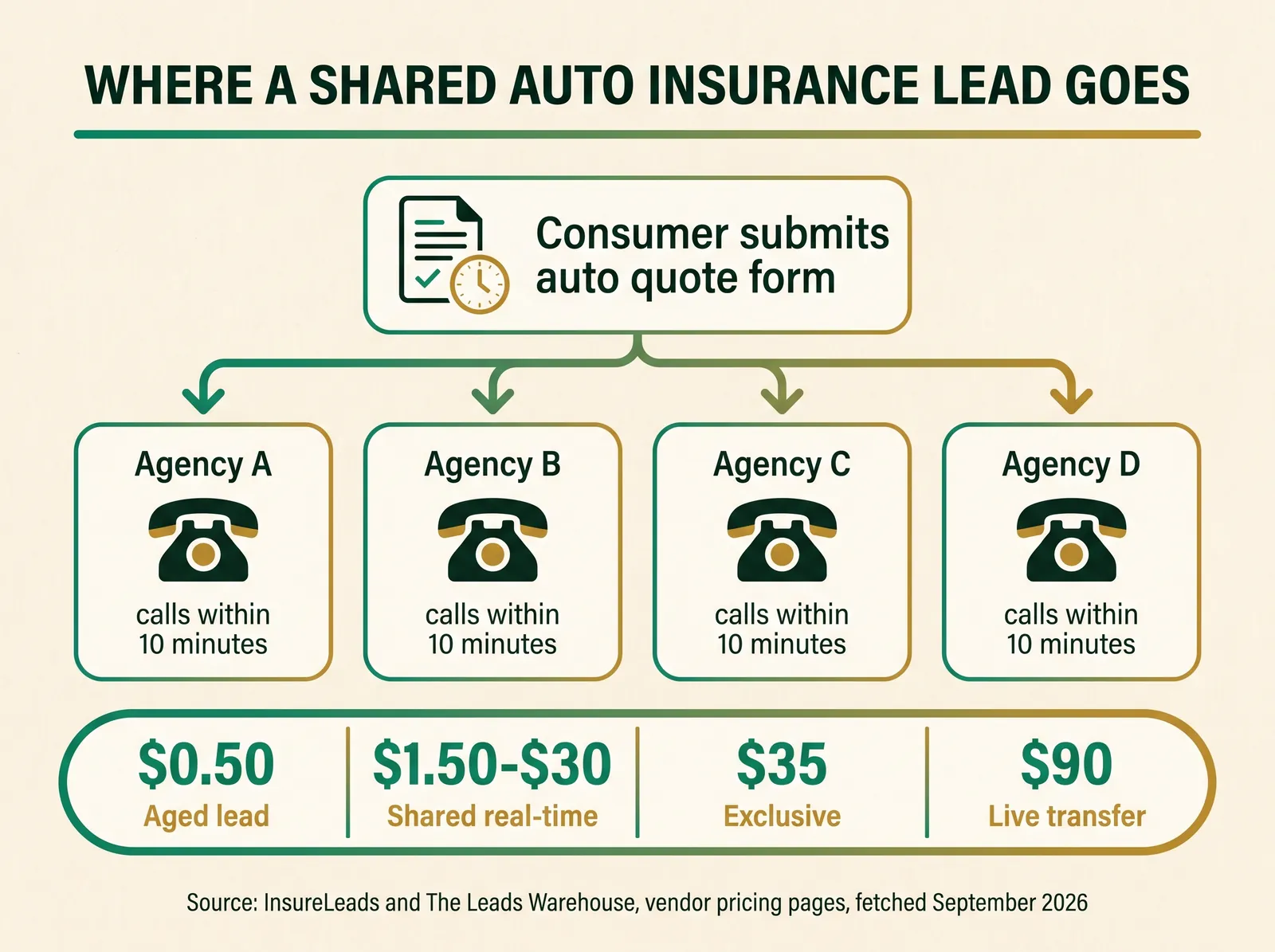
This is a volume problem before it’s a speed problem, and that distinction matters for how you fix it. A life insurance agent chasing a single $65 exclusive lead needs to win a footrace against one or two other calls. An auto insurance team working a stack of $5 to $15 shared leads needs enough dial capacity to place a real attempt on every lead in the stack, fast enough that at least some of those attempts land before the consumer stops answering unfamiliar numbers altogether. A team of three people making 40 calls a day each can place about 120 dials. A stack of 300 shared auto leads a day needs roughly two and a half times that capacity just to touch every lead once, before anyone accounts for voicemail, callbacks, or a second attempt.
Volume outpaces dial capacity
- Team dials as many leads as the day allows, working the newest first when there's time
- Shared and exclusive leads mixed in one queue with no priority
- Leads that don't answer on the first try often don't get a second one
- New outbound numbers dial at full volume from day one
Every lead gets a real attempt, not just the fast ones
- Every new lead triggers a call attempt on arrival, at whatever scale the stack requires
- Exclusive and live-transfer leads called ahead of the shared queue
- Every attempt logged, with automatic retries on no-answer
- New numbers ramp up gradually to protect caller ID reputation
The caller ID side of this compounds the volume problem, and it’s worth naming without repeating the full explanation, since we’ve covered it in depth elsewhere. When an outbound number places a high volume of short calls in a short window, the pattern can look like a robocaller to carrier spam filters, and once a number picks up a “Spam Likely” label, live answer rates drop regardless of how good the list is. Number warmup, ramping a new number’s daily call volume gradually rather than dialing hundreds of calls from day one, is the standing defense against that. If you want the full mechanism behind why insurance calls specifically get flagged and what STIR/SHAKEN attestation has to do with it, we wrote a dedicated piece on that; it’s linked at the end of this one.
What the Auto Insurance Market Actually Looks Like Right Now
The reason volume-based lead buying makes sense for auto insurance at all is the size and turnover of the market underneath it. The top 10 U.S. auto insurers wrote roughly 72% of direct premium between them in 2023, led by State Farm at $57.97 billion, according to NAIC data compiled by S&P Global and published by the Insurance Information Institute (Triple-I). That concentration doesn’t mean the market is closed to smaller agencies; it means the volume moving through the channel every year, as policies renew, lapse, and get re-shopped at each renewal, is large enough to support a lead-generation industry built almost entirely around price competition rather than scarcity.
Coverage habits reinforce the size of the pool. Per Triple-I’s own analysis of NAIC data, 80% of insured drivers carry comprehensive coverage and 76% carry collision coverage in addition to the liability coverage nearly every state requires, which means most policies in force involve more than a single line item to quote and bind. The average countrywide expenditure per insured vehicle was $1,062 in 2021, up 1.4% from $1,046 in 2020, per the same NAIC-sourced Triple-I data; a separate AAA study cited on the same Triple-I page put the average full-coverage cost for a medium sedan at $1,694 and a medium SUV at $1,529 in 2022. None of those figures are current-year, and Triple-I’s own page doesn’t refresh them annually, so treat them as the most recent published benchmark rather than a live 2026 number; the direction, a market with real, rising premium dollars attached to nearly every household, hasn’t reversed since.
| Metric | Figure | Period |
|---|---|---|
| Top 10 insurer share of direct premium | ~72% | 2023 |
| State Farm direct premium written | $57.97B | 2023 |
| Drivers carrying comprehensive coverage | 80% | 2021 |
| Drivers carrying collision coverage | 76% | 2021 |
| Average expenditure per insured vehicle | $1,062 | 2021 |
| Average full-coverage cost, medium sedan | $1,694 | 2022 |
Source: Insurance Information Institute (Triple-I), Facts + Statistics: Auto insurance, citing NAIC, S&P Global, and AAA. Fetched September 2026. Triple-I's published page does not refresh every metric annually; each figure is labeled with its own most recent covered period.
Where a $100 auto lead budget goes, by lead type
Approximate leads purchased per $100, using the lower end of each vendor's published range
Source: InsureLeads and The Leads Warehouse published pricing, lower end of each range ($0.50 aged, $1.50 shared, $35 exclusive, $45 live transfer). Illustrative arithmetic, not a vendor-published conversion table; actual lead counts depend on state, filters, and vendor minimums.
That chart is arithmetic, not a promise: at the cheap end of the range, $100 buys roughly 200 aged leads or 67 shared real-time leads, against about one live transfer. The decision isn’t which number looks bigger. It’s whether your team, or a caller working on your behalf, can turn that pile of cheap leads into real conversations faster than the other agencies also holding copies of the same list.
What a Low Answer Rate Actually Costs
Put the lead price and the call cost side by side and the arithmetic gets specific fast. At TheAffordableAI’s published Single Account rate of $0.20 a minute (from $0.15 at bulk volume), a two-minute qualifying call costs about 40 cents. Against a $2 aged lead, that’s a fifth of the lead’s own cost to attempt it. Against a $35 exclusive lead or a $90 live transfer, the same call costs a rounding error, well under 2% of what the lead cost to acquire. The economics don’t change because the lead is cheap; if anything, a cheap lead that never gets a real attempt is a worse outcome in percentage terms than an expensive one that does, because you spent the same acquisition dollar and got fewer total attempts placed against it.
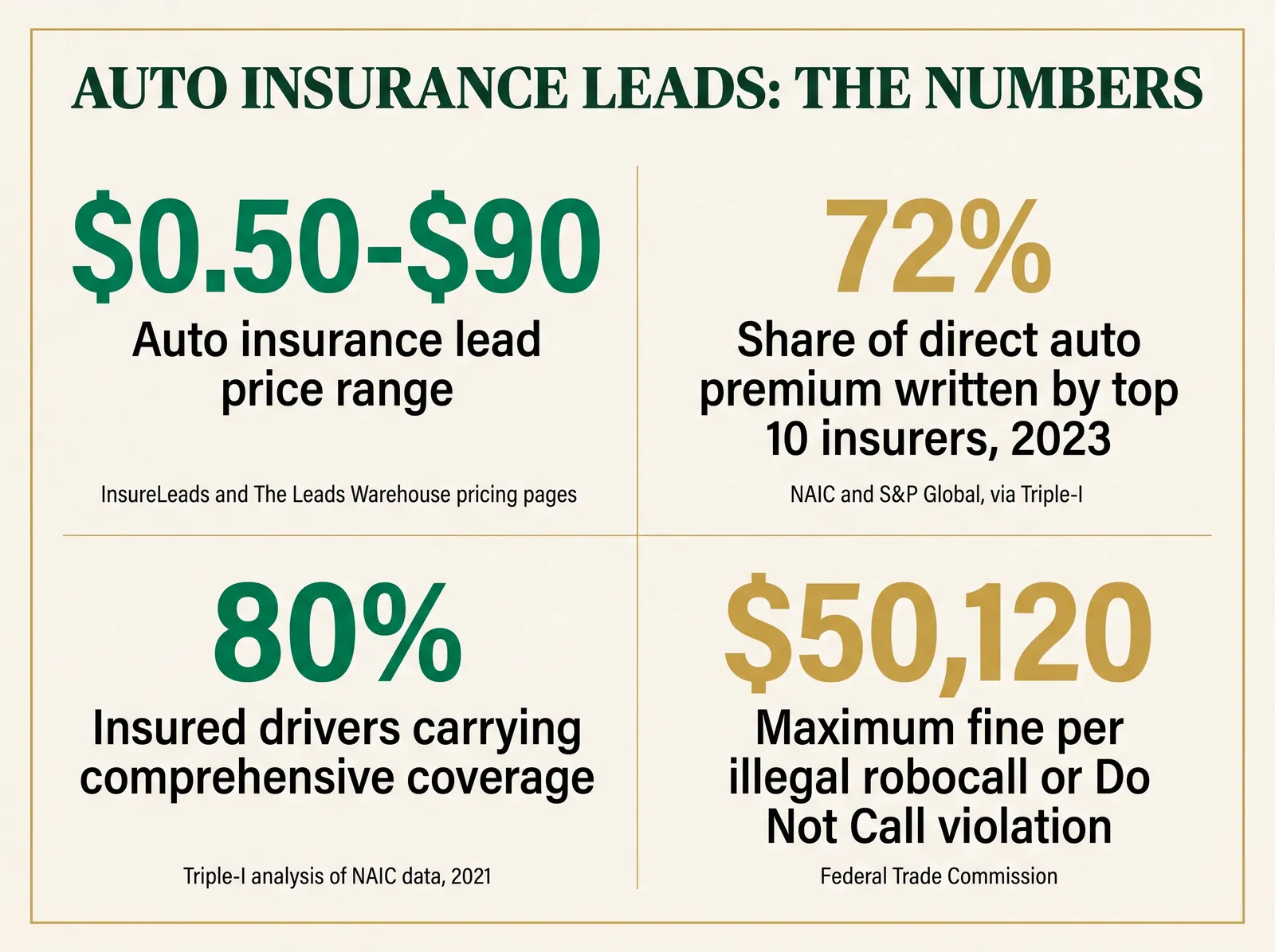
There’s a compliance-side cost that sits alongside the sales-side one, and volume buying makes it more important to name, not less. Automated or prerecorded calls to a cell number without prior express consent are restricted under 47 U.S.C. § 227(b)(1)(A)(iii), the section of the U.S. Code the TCPA’s core consent requirement is codified in, per Cornell Law School’s Legal Information Institute. Separately, companies that call numbers on the National Do Not Call Registry or place illegal robocalls can currently be fined up to $50,120 per call, according to the FTC’s own consumer guidance, which also states that telemarketers who made illegal calls have paid the agency more than $290 million in judgments. A high-volume auto lead strategy means more numbers dialed per day, which means more chances to call a number that shouldn’t be called if your list scrubbing isn’t keeping pace with your dial volume. Speed and scale are never a reason to skip consent verification; they’re an argument for building the scrubbing step into the same system that’s doing the dialing.
This is not legal advice
Consent requirements vary by call type (live agent, prerecorded, autodialed, text) and by state, and several states layer their own telemarketing statutes on top of the federal TCPA. Confirm your specific obligations with your compliance department or counsel before building a high-volume calling program around anything in this article.
How to Fix This Yourself, No Vendor Required
You can run a version of this without buying anything. Here’s the actual method.
- Size your dial capacity to your lead volume, not the other way around. If you’re buying 300 shared leads a day and can place 120 dials, you’re not running a follow-up problem, you’re running a math problem. Either cut lead volume to what your team can actually call, or add capacity.
- Call new leads the moment they arrive, every time, not on a batch schedule. If your lead vendor or CRM can fire a webhook or push notification on delivery, wire it to trigger an immediate call attempt. Checking a lead queue once an hour concedes the fastest-answering competitor the entire window.
- Split exclusive and live-transfer leads from the shared queue and call them first. A $35 exclusive lead sitting behind a hundred $2 aged leads in an undifferentiated queue is a decision you’re making by accident.
- Build in automatic retries on no-answer, spaced across the day rather than dialed back-to-back. A single unanswered attempt tells you almost nothing about whether the lead is real; three attempts spread across a few hours tells you a lot more, and shared leads that go quiet on the first ring sometimes answer on the third.
- Keep a real-time disposition log: answered, voicemail, callback requested, not interested, do-not-call. This is also your compliance record for who was called, when, and what happened, which matters more as your dial volume rises.
- Scrub every list against the National Do Not Call Registry and your own internal do-not-call list before every dial session, not once when you bought the list. Non-negotiable regardless of how cheap or expensive the lead was.
- If you’re staffing this manually, ramp new outbound lines gradually rather than dialing hundreds of numbers on a brand-new line in week one. That’s the number warmup practice described above, and it protects your caller ID reputation whether you build it yourself or buy it as a feature.
An agent who reads this and thinks “I can hire two more dialers and hit this volume myself” is right, and for some agencies that’s the correct call. The tradeoff is the same one it always is: consistent volume dialing, retried on schedule, with proper number rotation and disposition tracking, is a staffing commitment measured in headcount, not a task squeezed between other work.
Hear how the first answer actually sounds
There's a live demo call on the homepage if you want to hear an AI caller dial, qualify, and hand off a warm transfer before you decide anything.
Where a Managed AI Caller Fits, and Where It Doesn’t
This is the one section making a product claim, and it’s kept to what’s actually documented. TheAffordableAI is a managed AI caller: it dials outbound the moment a lead is created, answers every inbound call in under a second, and hands qualified, interested prospects to a licensed agent on a warm transfer, ringing 20-plus agents at once so the first one available takes the call, per TheAffordableAI’s own published Features page, fetched for this article. If nobody’s available inside a few rings, it resumes the conversation itself and books a meeting against real-time calendar availability. It runs a staged number warmup, ramping a new number’s daily call volume from roughly 10 to 40 calls a day over four weeks rather than starting at full volume, and it tags calls as spam or voicemail and hangs up fast rather than leaving a monologue. It syncs natively with HighLevel, two-way, so tags, custom fields, pipeline stages, call recordings, and transcripts land in the CRM you’re probably already running the moment the call ends.
Volume the AI can carry
Outbound calling starts the moment a new lead lands and scales to the size of the stack, not the size of the staff.
Warm transfer to a licensed agent
A qualified, interested driver gets handed to a human live, while they're still on the line, not queued for a callback.
Number warmup and spam defense
New outbound numbers ramp up gradually instead of starting at full volume, so calls keep landing at higher dial counts.
What it does not do, and should never claim to: rate a vehicle, compare carrier options, or bind a policy. Those require a licensed producer working from real underwriting and rating data, and they are not a decision tree a voice AI can responsibly run. TheAffordableAI’s role stops well short of it: it dials at scale, confirms real interest, and gets a licensed human on the line fast. If a vendor tells you their AI can quote and close an auto policy on its own, that’s a claim worth being skeptical of regardless of who’s making it.
The pricing is worth restating plainly, since the volume math above depends on it: Single Account runs $200 a month plus a $500 one-time setup fee, at $0.20 a minute (from $0.15 at bulk volume). Agency runs $500 a month plus a $1,000 one-time setup fee, at $0.18 a minute (from $0.16 at bulk volume), and adds routing to 20-plus agents, round robin across numbers, and team availability toggles, useful specifically when the lead volume you’re buying outpaces what any single line can dial. Both plans are month to month with no long-term commitment, per TheAffordableAI’s own pricing page, fetched for this article. You can build a version of the volume piece yourself with a multi-line dialer, a disposition sheet, and staffed hours. Plenty of agencies do exactly that, and it’s worth pricing both approaches against your own lead cost before deciding which one fits.
A $2 lead and a $90 lead both go unanswered the same way: by ringing into a phone the consumer has already stopped picking up for strangers.
Shared vs. Exclusive Auto Leads: Does the Volume Math Change?
Not fundamentally, but the auto-specific numbers push the decision in a particular direction. We’ve covered the mechanics of shared versus exclusive leads in general elsewhere on this site, including how ping-post auctions decide who gets a lead and what a documented real-world study found about how fast contact odds fall off; that piece is linked at the end of this one for the full breakdown. What’s specific to auto insurance is the price gap: at $0.50 to $30 for shared leads against $35 to $90 for exclusive and live-transfer leads, per the vendor pricing above, the same budget buys somewhere between five and sixty times more shared leads than exclusive ones, depending on where in each range you’re buying.
That gap argues for a volume-first strategy more strongly in auto insurance than in a line like life or final expense, where the exclusive lead’s premium is smaller relative to the shared lead’s price and the sales cycle is long enough that a slower callback still has a real shot. An auto quote is usually a same-day or same-week decision for the consumer; if you’re not competitive on speed and volume, the cheap shared leads you bought stop being cheap in any meaningful sense, because you paid for access to a pool of people you never actually reached.
What You Get When Volume and Warm Transfer Work Together
Handled well, dial volume and a clean warm transfer reinforce each other instead of trading off. A system that can place a real attempt on every lead in a large shared-lead stack, retried a few times across the day, means more of those attempts land while the consumer is still shopping rather than after they’ve already bound a policy with a competitor. A warm transfer that hands a live, interested driver straight to a licensed agent means the volume isn’t wasted on connections that then sit in a callback queue of their own. Neither half fixes the other’s failure on its own: a huge dial volume that dumps qualified callers into an unanswered transfer queue just moves the bottleneck downstream, and a perfect warm-transfer process attached to a small dial volume still only touches a fraction of the leads you paid for.
Your Aged Auto Insurance Database Is a Lead Source Too
Everything above assumes freshly purchased leads, but the same volume logic applies to a book you already own: policies approaching renewal, past quotes that never bound, and multi-line households where you only wrote one policy. That list doesn’t carry the same multi-agent competition a purchased shared lead does, since nobody else has a copy of your own book, but it still decays if it just sits there. A database reactivation campaign, meaning a structured, scheduled effort to work back through an aged list rather than leaving it untouched, runs on the same volume-and-documentation logic as a fresh lead stack: enough dial capacity to actually work the list, every attempt logged, and current consent confirmed before you resume outreach. We’ve written a full guide to running that process, also linked at the end.
How This Plays Out on a Real Day
Picture a Tuesday where an agency buys 150 shared auto leads and 10 exclusive leads, arriving steadily between 8 a.m. and 6 p.m. as consumers fill out quote forms across the day. In the manual-queue version, a three-person team places roughly 120 total dials that day, prioritizing whatever’s newest when someone has a free minute; call it 100 first-attempts on the shared pile and the rest split across exclusives and callbacks, leaving 50 shared leads that never get dialed at all and several more that only get one attempt with no retry. In the structured version, every lead triggers an attempt on arrival and every no-answer gets automatically retried later in the day, so all 160 leads get a first touch and a meaningful share get a second one before close of business. The total lead spend for the day is identical in both scenarios. What changes is how many of those dollars actually bought a conversation instead of a ring that nobody picked up.
Compliance Notes That Apply Regardless of How You Call
A few standing rules apply to every outbound and inbound call your agency places for auto insurance, or any other line, and they belong here explicitly rather than assumed. Automated or prerecorded calls and texts to a cell phone for marketing purposes are restricted under the TCPA’s consent requirement, codified at 47 U.S.C. § 227(b)(1)(A)(iii); obtaining and documenting valid consent is the agent’s obligation, and it does not transfer to any vendor or platform. Any call using an AI voice should disclose that fact where required, and honor opt-out requests immediately. Internal do-not-call lists and the National Do Not Call Registry both apply regardless of lead source or volume, and violations can draw fines up to $50,120 per call, with the FTC reporting more than $290 million collected in judgments from telemarketers over illegal calls. Using AI to place or answer a call does not transfer liability for TCPA consent, Do Not Call compliance, or any state insurance disclosure or suitability requirement away from the licensed producer whose name is on the sale. None of this article promises a close rate, a conversion lift, or an income outcome, because no legitimate source can promise you one, and any vendor who does is worth treating with real skepticism.
Frequently asked
What does an auto insurance lead actually cost in 2026?
It depends on exclusivity and delivery speed. Per InsureLeads' own published pricing, aged auto insurance leads start around $2, a real-time exclusive lead runs $35, and an interest-verified live transfer runs $90 per call. A second vendor, The Leads Warehouse, prices its own aged leads from $0.50, real-time leads from $1.50 to $30, and inbound calls at $45, per its own published pricing guide dated July 28, 2026.
Why does an auto insurance lead get answered by so few calls?
Because most auto insurance leads are shared, meaning the same consumer inquiry is sold to more than one agent close to the same time, per InsureLeads' and The Leads Warehouse's own descriptions of their shared-lead products. Every agent who bought that lead is dialing the same number, and once the consumer picks up and starts a conversation with whoever reached them first, the remaining calls in that queue are far less likely to connect at all.
Is the auto insurance market big enough to justify buying leads at volume?
Yes. The industry's top 10 insurers alone wrote roughly 72% of direct auto premium in 2023, led by State Farm at $57.97 billion, according to NAIC data compiled by S&P Global and published by the Insurance Information Institute (Triple-I). Eighty percent of insured drivers carry comprehensive coverage and 76% carry collision coverage on top of required liability coverage, per Triple-I's analysis of NAIC data, which is a wide base of policies that renew, lapse, and get re-shopped every year.
Does calling an auto insurance lead faster actually change whether it turns into a policy?
We can't hand you an invented conversion number specific to auto insurance leads, because we couldn't verify one that met our sourcing bar this session. What we can say, sourced: shared auto insurance leads are, by the vendors' own descriptions, sold to more than one buyer at once, and a consumer who is already on the phone with a competing agent is not a consumer you are going to reach, regardless of how good your pitch would have been.
Can an AI caller actually sell someone an auto insurance policy?
No, and it shouldn't try. Rating a vehicle, comparing carriers, and binding coverage require a licensed producer working from real underwriting data. What a managed AI caller can do is dial the moment a lead lands, work a larger volume of calls than a team can dial manually, and warm-transfer a qualified, interested driver to a licensed agent while they're still on the line. The quote and the sale stay entirely human.
Does using an AI caller transfer any compliance liability away from the licensed agent?
No. Using AI to place or answer a call does not transfer liability for TCPA consent, Do Not Call compliance, or any state insurance disclosure requirement away from the licensed producer. The agent whose license is on the sale stays responsible for consent, disclosure, and suitability, regardless of what software placed or answered the call.
What's the real financial risk of calling an auto insurance lead without proper consent?
Companies that call numbers on the National Do Not Call Registry or place illegal robocalls can currently be fined up to $50,120 per call, according to the FTC's own consumer guidance, and the FTC states that telemarketers who made illegal calls have paid more than $290 million in judgments. Automated or prerecorded calls to a cell number without prior express consent are separately restricted under 47 U.S.C. § 227(b)(1)(A)(iii), the federal statute the TCPA is codified in, per Cornell Law School's Legal Information Institute.
Should I buy shared auto insurance leads at all, or only exclusive ones?
That's a budget and staffing decision only you can make, but the volume math is worth running with real numbers. A shared lead at roughly $1.50 to $30 costs a fraction of a $35 to $90 exclusive or live-transfer lead, per the two vendor pricing sources in this article, which means the same monthly budget buys a much larger stack of shared leads. Whether that trade is worth it depends entirely on whether your team, or an AI caller, can actually dial that stack fast enough to matter.
Sources
- InsureLeads (GetInsureLeads.com) — Auto Insurance Leads pricing page
- The Leads Warehouse — Auto Insurance Lead Prices In 2026: What Agents Should Expect To Pay (published July 28, 2026)
- Insurance Information Institute (Triple-I) — Facts + Statistics: Auto insurance
- Federal Trade Commission — National Do Not Call Registry FAQs (Consumer Advice)
- Cornell Law School Legal Information Institute — 47 U.S. Code § 227, Telephone Consumer Protection Act
- TheAffordableAI — Pricing
- TheAffordableAI — Features
Put this on your own phone line
See the AI dial, qualify, and warm-transfer a live call in under a minute. No contract, no dev work.
Keep reading

Shared vs Exclusive Insurance Leads: What Wins in 2026
A shared insurance lead can ring at five other agents at once. How the ping-post auction works, what it costs, and how to win the call anyway.
Speed to Lead in 2026: Why the First 60 Seconds Decides Who Writes the Policy
The lead you paid for is not lost to a better agent. It is lost to a faster one. Here is what response time actually does to contact and conversion rates, and how to get to sixty seconds without hiring a dialer team.

Insurance Lead Database Reactivation Guide 2026
Your CRM has leads you already paid for and never worked. Here's how to legally reactivate an insurance lead database in 2026, and what it's actually worth.