Insurance Appointment No-Shows: Why Booked Calls Fail
You booked the call, they agreed to the time, then nobody answered. Why insurance appointments no-show, and the re-contact method that recovers them.

The call was booked. The prospect said yes to the time, out loud or by tapping a confirm button. The agent cleared the slot, pulled the file, and dialed at the agreed minute, and nobody answered. That’s an insurance appointment no-show, and it happens for a reason that has nothing to do with lead quality: the plan to talk is fragile, and most agencies do almost nothing between booking it and showing up for it. The fix isn’t a better script. It’s closing the gap between “they agreed to this” and “they’re still planning on it” with one more touch, and having a real plan for the exact minute the first call doesn’t connect.
This piece covers why booked insurance appointments fall through, what’s actually known about how often it happens (and what isn’t), the one body of real research on fixing it, a method you can run today with no new hires, and where a managed AI caller fits into closing the gap, and where it doesn’t.
The short version
- No published, sourced study measures an insurance-specific appointment no-show rate. Agents on public forums self-report no-show rates in the 30 to 50+ percent range for phone-booked appointments, which is consistent anecdote, not a verified industry number.
- The one large, peer-reviewed body of research on the actual mechanism, reminder contact versus none, is a 2016 BMJ Open meta-analysis of 21 studies and over 16,000 patients: notified patients were 25% less likely to no-show (15% versus 21%) and 23% more likely to attend. It's a healthcare clinic finding, not an insurance one, and the mechanism still transfers.
- At the U.S. Bureau of Labor Statistics' May 2025 median hourly wage for insurance sales agents, $29.94, an agent who clears 15 minutes of calendar for a no-show appointment loses roughly $7.49 in pure time cost before counting the lost chance to write business, and that's before the lead itself is priced in.
- The fix is a confirmation touch between booking and the appointment, plus an immediate re-dial inside the same window the prospect already agreed to be reachable in, the moment the first call doesn't connect. Treating a no-show as the end of the attempt instead of the start of a second one is the single most common and most fixable mistake.
- Medicare personal marketing appointments carry their own Scope of Appointment documentation, which CMS's CY2027 final rule changed by dropping the 48-hour wait requirement, separate from the general no-show problem covered here.
The Pain: “They Said Yes, Then Nobody Picked Up”
Every agent who has ever booked a phone appointment has a version of this story. A lead comes in, the agent or an assistant calls, the prospect sounds genuinely interested, and a time gets set: Thursday at 2pm, or “call me back tomorrow morning.” The agent writes it down, blocks the time, and shows up. The phone rings. Nobody answers. Ten minutes later, still nothing. The slot that was supposed to be a conversation is now just fifteen cleared minutes with no outcome, and the agent is left guessing whether the prospect forgot, got busy, got cold feet, or found another agent in between.
Search any long-running insurance agent forum and this isn’t a rare complaint, it’s a recurring one. On Insurance-Forums.com, a discussion thread titled “What am I doing wrong to be constantly no-showed?” runs for pages, with one agent writing that their own no-show rate is “more than 50% whether I set the appointment by phone or at the door.” That’s one agent’s own number, not a measured study, and it shouldn’t be read as an industry rate. But the thread’s existence, and the pages of other agents agreeing it happens to them too, says something real: this isn’t a problem confined to bad leads or sloppy agents. It’s a structural gap in how appointments get held between the booking and the call.
Here’s the part that should bother you more than the no-show itself: that prospect was, at the moment they agreed to the time, more qualified than almost any cold lead you’ll touch today. They picked up the phone once already. They gave you a specific window. And then the only thing connecting that moment of agreement to the actual appointment was a note on your calendar, nothing on theirs beyond memory, and silence in between.
Why It Happens: The Mechanism Behind the Empty Slot
Three things are usually happening at once, and each is separately fixable.
The commitment decays with nothing reinforcing it. A prospect who agrees to “Thursday at 2” is making a plan under conditions that change by the time Thursday at 2 actually arrives: a shift got extended, a kid got sick, a different bill showed up first and ate their attention, or they simply forgot. None of that reflects on how real their interest was Tuesday when they booked it. Plans made days in advance and left unattended decay by default; that’s not specific to insurance, it’s how memory and competing priorities work for everyone, and it’s exactly why clinics, dentists, and salons all run reminder systems. An agency with no touch between booking and the call is relying entirely on the prospect’s own memory and motivation to survive several unattended days.
One generic confirmation isn’t the same as a live reconfirmation. A calendar invite or an automated “see you Thursday” text acknowledges the appointment exists. It doesn’t ask the person to actively reaffirm they’re still planning on it, and it gives them no chance to reschedule in advance instead of silently no-showing. There’s a real difference between a notification that sits in an inbox and a touch, a call or a text that expects some kind of response, that re-establishes the appointment as a live thing two people are both still planning to do.
A missed appointment usually gets treated as closed, not as a second attempt. This is the part most agencies get backward. When the scheduled call doesn’t connect, the slot just empties and the agent moves to the next task. But the prospect told you, specifically, what time works for them. That’s more information than a cold dial ever gives you. A callback placed 10 to 15 minutes after the no-show, still inside the window the prospect chose, is working with real information about their availability. A callback scheduled for “whenever I get to it” three days later has thrown that information away.
Define the terms before you build anything
No-show: a scheduled call or meeting where the other party doesn't answer or doesn't appear at the agreed time, as distinct from a cancellation, where they proactively said they can't make it. Confirmation or reminder touch: any contact, call, text, or email, sent between booking and the appointment that re-establishes it's still happening. Re-dial window: the period immediately after a missed appointment during which the prospect's stated availability is still the most current information you have about when they can be reached. Warm transfer: connecting a qualified, reachable prospect directly to a live licensed agent in real time, rather than booking yet another future appointment. Scope of Appointment (SOA): the CMS-required written or electronic documentation that must be completed before a Medicare personal marketing appointment, covering which products will be discussed.
What This Actually Costs: The Honest Version
Be skeptical of any number you see attached to “insurance appointment no-show rate.” It’s one of those figures, like the widely circulated per-call cost claims this blog has flagged before, that gets repeated across vendor pages without a traceable study behind it. We looked. There is no LIMRA report, no published academic study, no government data series that measures how often a booked insurance sales appointment, by phone or in person, fails to happen. What exists is agent self-report on forums, consistent in direction (it happens a lot, and often) but not something you can cite as a verified rate.
What can be stated with a real source is the cost of the time itself, and the shape of the fix.
| Slot cleared for the appointment | Cost at $29.94/hour median wage | Cost at $62,280/year median annual wage, amortized |
|---|---|---|
| 15 minutes | $7.49 | $7.49 |
| 30 minutes | $14.97 | $14.97 |
| One no-show a day, 5 days a week, 48 weeks | $7.49 x 240 = $1,798 | ≈ 2.9% of annual wage |
Source: U.S. Bureau of Labor Statistics, Occupational Outlook Handbook, Insurance Sales Agents, median hourly wage $29.94 and median annual wage $62,280, data as of May 2025. Figures are the agent's own time cost only and exclude the price of the lead itself, any commission that call could have produced, and any opportunity cost of calls not made during that slot.
That table is deliberately conservative. It only prices the agent’s own cleared time, at a government-sourced median wage, against nothing else. It doesn’t add the cost of the lead that produced the appointment, doesn’t add a commission estimate, and doesn’t add the cost of whatever else that producer could have been doing with those 15 or 30 minutes. Even restricted to just the time itself, one no-show a day adds up to roughly 3% of a median agent’s annual wage in pure dead time across a year, before a single dollar of lost business gets counted. Run the same math against your own agency’s actual hourly cost, your real lead price, and your real average commission, and the number only grows from there.
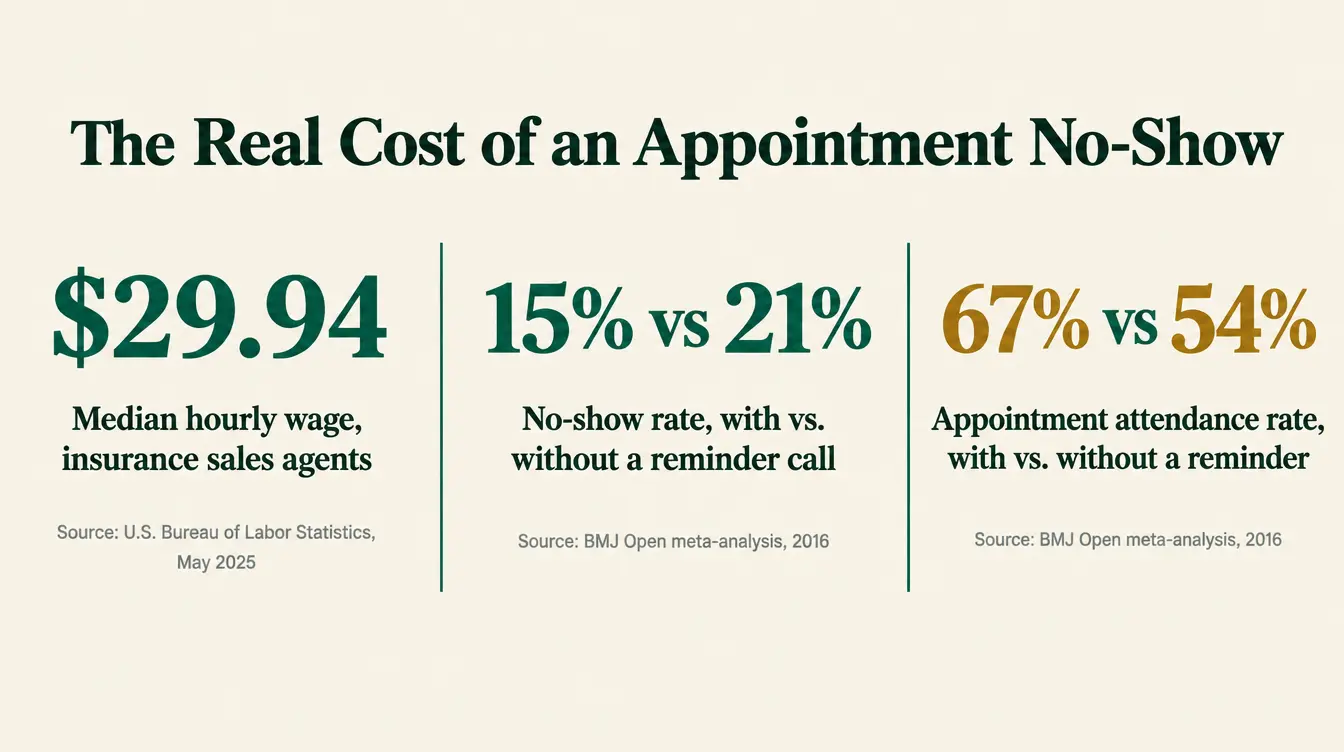
Now look at the one rigorous body of research that does exist on the actual mechanism, even though it comes from a different industry. A 2016 systematic review and meta-analysis published in BMJ Open pooled 21 randomized studies with a no-reminder control group, covering 8,345 patients who received electronic text notifications against 7,731 who received none. The notified group was 23% more likely to attend their appointment, 67% attendance versus 54%, and 25% less likely to no-show, a 15% no-show rate versus 21%. That’s a healthcare clinic setting, and the exact percentages won’t map one-to-one onto an insurance sales appointment. The mechanism they isolated, that a touchpoint between booking and the appointment measurably changes whether people show up, is the part worth taking seriously regardless of which industry measured it, because there’s no competing study that found the opposite.
Attendance and no-show rate, with vs. without a reminder notification
Healthcare clinic setting; 21 pooled randomized studies, 16,076 total patients. Not an insurance-specific study, cited for the mechanism, not the exact rate.
Source: Robotham D, Satkunanathan S, Reynolds J, Stahl D, Wykes T. "Using digital notifications to improve attendance in clinic: systematic review and meta-analysis." BMJ Open. 2016;6(10):e012116.
How to Fix It: The Full Method, No New Hire Required
None of this requires software you don’t already have access to in some form. It requires someone running the reminder and the re-dial every single time, not when they remember to.
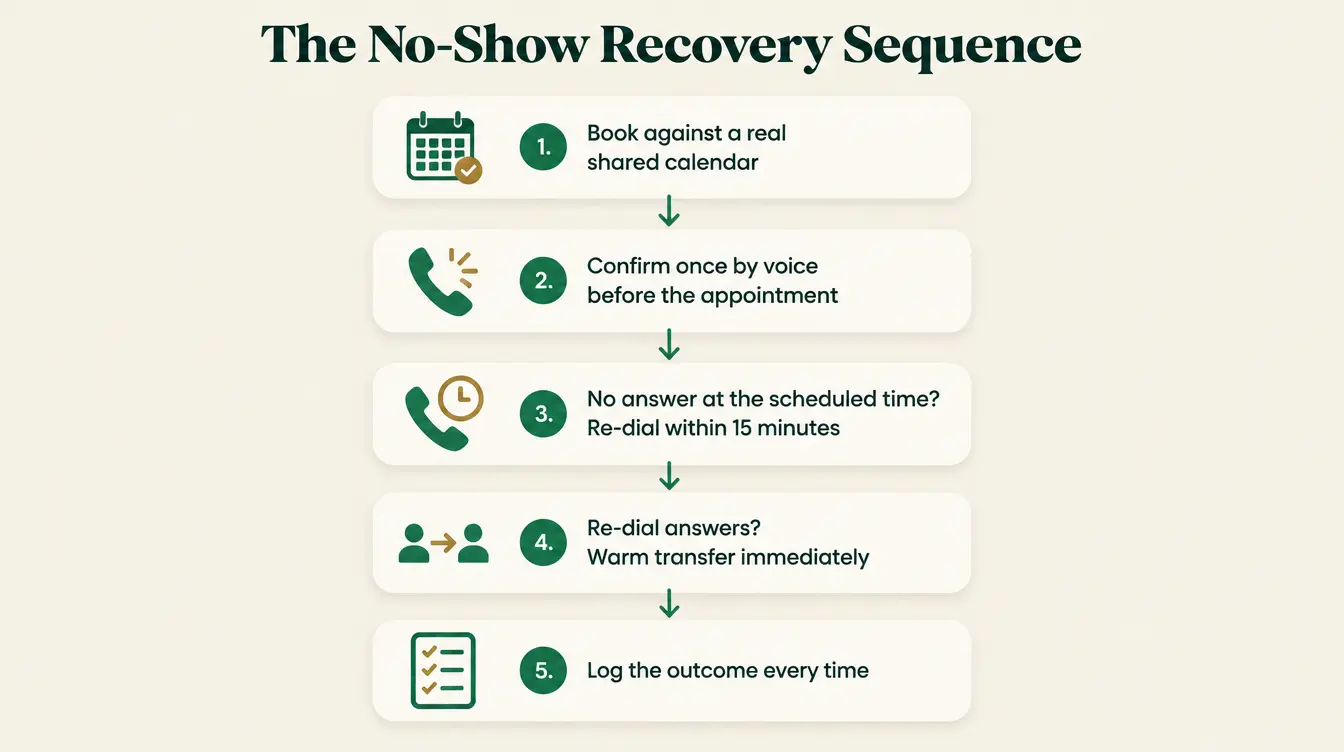
- Book against a calendar you actually check, not a notebook. If two people can book the same slot because nobody’s looking at one source of truth, you’ll generate no-shows that have nothing to do with the prospect; they’re double-booked. A shared, real-time calendar is step zero.
- Confirm once, by voice, between booking and the appointment. A calendar invite is not a confirmation. A short call or a conversational text that asks the person to reaffirm, not just notifies them, is what the research above measured. If the appointment is more than a day or two out, a touch partway there catches the person who’s already forgotten.
- If the appointment is Medicare-related, make sure your SOA is actually on file before the call starts. Under CMS’s CY2027 final rule, finalized April 6, 2026, the Scope of Appointment must still be completed before a personal marketing appointment begins, though the prior 48-hour waiting period between completing the SOA and holding the appointment was eliminated. A no-show on a Medicare appointment where the SOA wasn’t yet on file isn’t just a missed call, it’s a compliance gap waiting to surface later.
- The moment the scheduled call doesn’t connect, re-dial immediately, inside the same window. Not an hour later, not tomorrow. The prospect told you this window works; use that information while it’s still fresh instead of parking the lead back at the end of a queue.
- If the re-dial connects, route it straight to a warm transfer or a fresh booking on the spot, not another round of “I’ll call you back.” You already spent the hard part, getting them on the phone twice. Don’t lose the conversion by making them wait a third time.
- Log every outcome, every time: confirmed, no-show, re-dialed, connected, rescheduled. Without a record, you can’t tell whether your reminder touch is actually reducing no-shows or whether you’re just guessing. A spreadsheet with four columns gets you most of the way there.
- Review the no-show rate by lead source and by time of day, not just in aggregate. Appointments booked for early mornings or immediately after a workday often behave differently than midday slots. If one source or one time block is consistently emptier, that’s a scheduling fix, not a calling-harder fix.
- Don’t confirm so aggressively that you give people an easy out. One rheumatology clinic study found that live phone reminders cut no-shows but increased last-minute cancellations instead, trading one empty slot for another. A reasonable confirmation asks “are we still on for Thursday at 2,” not “let me know if you want to cancel.”
You can run this exact method without buying anything
A shared calendar, a reminder call or text the day before, and a personal rule to re-dial within 15 minutes of any no-show will get a solo agent most of the benefit described here. The limiting factor isn't the method, it's whether a human has the bandwidth to execute it on every single booked slot, every day, without ever skipping the step when things get busy, which is exactly when no-shows tend to spike.
Where TheAffordableAI Fits, and Where It Doesn’t
Be precise about this. TheAffordableAI doesn’t have a published, named “no-show reduction” feature, and claiming otherwise would be exactly the kind of overstated number this piece is arguing against. What it does have, per its own features page, is the set of pieces the method above actually needs run consistently: real-time calendar checking so a booking is never made against a slot that’s already gone, outbound calling that explicitly covers “renewals, reminders, win-backs” as a stated use case, and a warm-transfer and booking fallback that kicks in the moment a call doesn’t connect to an available agent, rather than just dropping it.
Real-time calendar checks before booking
Google and Outlook calendars are checked live before a slot is offered, so the appointment that gets booked is one that's actually open, not a guess.
Outbound reminder and re-dial calling
The same outbound calling engine that handles new-lead outreach runs reminder and re-contact calls, at $0.20/min on Single Account or $0.18/min on Agency, without pulling an agent off a live conversation to make them.
Warm transfer the moment someone answers
A prospect who picks up on a re-dial gets routed to an available licensed agent live, or onto a real calendar slot, instead of landing back in a queue for someone to notice later.
Every call and outcome synced to HighLevel
Confirmed, no-show, reconnected, rescheduled, each outcome lands on the contact record with a transcript, so the review step in the method above has real data behind it instead of memory.
No contract, cancel anytime
Single Account runs $200/mo plus a $500 one-time setup; Agency runs $500/mo plus a $1,000 one-time setup. Price a month of reminder and re-dial calling against what a single recovered appointment is worth to your book.
If you want to hear what an actual reminder or re-dial call sounds like before deciding anything, there’s a live demo on the homepage. https://theaffordableai.com/
What You Actually Get
A booked appointment stops being a coin flip between “they remembered” and “they didn’t.” One system checks the calendar before it ever offers a slot, confirms the appointment with a real voice touch beforehand, and the instant a scheduled call goes unanswered, tries again inside the same window the prospect already told you works, instead of waiting for a human to notice an empty fifteen minutes on the schedule. When someone does pick up, they go straight to a transfer or a fresh booking, not back into a pile. None of that manufactures interest that wasn’t there. It just stops losing the interest that already existed between the moment someone said yes and the moment the call was supposed to happen.
Booked-and-Forgotten vs. Booked-and-Held
One note, no reinforcement
- Appointment goes on a calendar or notebook with no confirmation before the day arrives
- If nobody answers at the scheduled time, the slot is marked dead and the agent moves on
- The next attempt, if there is one, happens whenever someone has time, often days later
- No record of why a given slot didn't convert, so the pattern repeats unnoticed
Confirmed once, re-dialed immediately
- A voice touch between booking and the appointment re-confirms it's still happening
- A missed call triggers an immediate re-dial inside the same agreed window
- Anyone who answers the re-dial goes straight to a transfer or a new booking
- Every outcome is logged, so the agency can see which sources or times actually no-show more
A Worked Example: Two Versions of the Same Appointment Block
Picture an agency with twelve phone appointments booked for Wednesday afternoon, spread across ACA, Medicare, and final expense leads. On the booked-and-forgotten path, the agent works straight down the list, calling each prospect once at the scheduled time. Five of the twelve don’t answer. Those five slots just end; the agent notes “no show” and moves to the next task, planning to circle back to that list “sometime.” Two days later, when someone finally gets around to re-calling, two of the five have already booked with a different agent, one says they’re no longer interested, and the other two don’t answer again, this time at a worse hour that was never actually confirmed as good for them.
On the booked-and-held path, the same twelve prospects each got one voice confirmation the day before, catching two who had genuinely forgotten and would otherwise have been silent no-shows. Of the remaining ten who still get called at the scheduled time, four don’t answer. Each of those four gets re-dialed within 15 minutes, still inside the window they originally agreed to. Two pick up on the second attempt and go straight to a warm transfer. The other two genuinely aren’t reachable that day, and that’s logged as a real outcome, not a guess, so the next attempt is scheduled deliberately instead of whenever someone remembers.
Nothing about lead quality changed between the two versions. The only difference was whether the appointment got one reinforcing touch beforehand and one immediate second attempt when the first call didn’t land. Run that same twelve-slot block every working day for a month, and the gap compounds: five extra no-shows a day, recovered or not, is the difference between a book that grows on schedule and one that’s permanently a few appointments behind where the pipeline says it should be.
Multi-Line Agencies Have a Second Version of This Problem
Agencies that write ACA, Medicare, and final expense out of the same call center often don’t notice that no-show behavior isn’t uniform across lines. A Medicare prospect booked during AEP, when call volume on both sides of the phone is elevated, behaves differently than an ACA prospect booked in the first week of open enrollment, who in turn behaves differently than a final expense prospect, who is often older, more likely to be home at a fixed time, and less likely to be juggling a second or third competing call that same week. Treating all three as one undifferentiated “appointments booked” number hides which line is actually driving your no-show rate.
This is where the calendar-routing side of the fix matters as much as the reminder-call side. If ACA, Medicare, and final expense appointments all land in one shared calendar with no distinction, a reminder cadence tuned for one line gets applied uniformly to all three, and it will underperform on whichever line actually needed a different cadence. Separating appointment types by calendar, even if the same agent works all three, makes it possible to measure no-show rate by line and adjust the confirmation and re-dial timing where it’s actually failing, instead of applying one blanket fix and hoping it averages out.
Where This Is the Wrong Tool
Be honest about the limits here too. No calling system, AI or otherwise, fixes a no-show caused by a prospect who was never seriously interested, who was humoring a pushy appointment-setter, or who genuinely can’t afford what you’re selling. If your agency’s real problem is that appointments get set with people who were never going to buy, a better reminder and re-dial cadence will just get you a faster, more efficient “no.” And if your no-show rate is concentrated on a specific lead source rather than spread evenly across your book, the fix is replacing that source, not calling it more persistently.
The prospect already told you the one piece of information a cold lead never gives you: the exact time they'd be reachable. Throwing that away the moment the first call doesn't connect is the whole problem.
Mike MooreCompliance doesn't change because the call is "just a reminder"
If a reminder, reconfirmation, or re-dial call touches Medicare Advantage or Part D marketing content, or is placed with an autodialer or an artificial or prerecorded voice to a wireless number, it carries the same prior express written consent, disclosure, and recording requirements as any other marketing call under 47 CFR 64.1200 and, for Medicare business, CMS's marketing rules. Using AI to place the call does not transfer that obligation away from the licensed agent or agency responsible for it. This is general information, not legal advice; confirm your specific obligations with your own compliance counsel.
Stop losing the appointments you already won
See what a managed reminder-and-re-dial setup costs against your own no-show rate, no contract either way, so trying it one month is the entire risk.
The prospect already did the hard part: they picked up once and told you a time that works. An empty calendar slot isn’t proof they changed their mind. Most of the time, it’s proof nobody reminded them, and nobody called back the second the first attempt failed. Fix that gap before you fix anything else about your follow-up.
Frequently asked
Why do so many insurance appointments no-show?
Three mechanisms usually combine. First, a lot of the time between booking and the appointment carries zero contact, so the plan is the only thing holding the prospect to it, and plans erode. Second, most agencies send one confirmation at most, often a generic calendar invite rather than a call that re-establishes the appointment as a live commitment. Third, when nobody answers at the scheduled time, most agencies treat the slot as dead rather than re-dialing within the same window the prospect already agreed to be reachable in. None of these require a bad lead; they happen to real, interested prospects who simply get busy, forget, or get cold feet alone with no reinforcement in between.
Is there a verified industry-wide no-show rate for insurance appointments?
No, and it would be dishonest to hand you one. There's no published, methodologically sourced study of insurance-specific appointment no-show rates the way there is for medical clinics. What exists is agent self-report on public forums like Insurance-Forums.com, where producers routinely describe no-show rates in the 30 to 50+ percent range for appointments booked by phone, which is directional and consistent but not a measured statistic. The closest rigorous research measuring the actual mechanism, reminder contact versus no contact, comes from healthcare scheduling, covered in this piece and clearly labeled as a healthcare-setting study, not an insurance one.
Do reminder calls or texts actually reduce no-shows?
In the one large, peer-reviewed body of evidence that exists on this exact mechanism, yes, substantially. A 2016 systematic review and meta-analysis in BMJ Open pooled 21 randomized studies covering 8,345 patients who received electronic text notifications against 7,731 who received none, and found notified patients were 23% more likely to attend (67% versus 54%) and 25% less likely to no-show (15% versus 21%). That's a healthcare clinic setting, not an insurance sales appointment, so the exact percentages won't transfer directly. The mechanism, a touchpoint between booking and the appointment that re-confirms it's still happening, is the part worth borrowing regardless of industry.
What should I do the moment a booked appointment no-shows?
Call again, immediately, inside the same window the prospect already agreed they'd be reachable. The single biggest mistake agencies make is treating a no-show as the end of the attempt rather than the start of a second one. The prospect told you, in writing or in words, that this specific time worked for them; that's more signal than a cold lead ever gives you. A call placed 10 to 15 minutes after a missed appointment, during a window the person chose, converts at a meaningfully different rate than a callback scheduled for whenever someone gets to it.
Does a Medicare appointment have special no-show rules?
A Medicare personal marketing appointment has its own documentation requirement, the Scope of Appointment (SOA), which under CMS's CY2027 final rule must still be completed before the appointment starts, carries a 12-month validity period, and, as of the rule CMS finalized April 6, 2026, no longer requires a 48-hour wait between the SOA and the appointment itself. CMS's rule doesn't specifically address what happens procedurally when the appointment is missed; as a practical matter, agents report that the same SOA covers a rescheduled appointment for the same product and plan year, but a new product or a new plan year needs a new one. Confirm your own carrier's and compliance team's position before assuming that applies to your situation.
Is it better to confirm an appointment the day before, or not confirm at all?
This is a genuinely contested question, and the honest answer is that it depends on your mechanism, not a universal rule. A UT Arlington release on an outpatient clinic reported that calling three or more days ahead reduced no-shows more than a single call placed the day before. Separately, one rheumatology clinic abstract found that live phone reminders cut no-shows but increased last-minute cancellations, trading one failure mode for another, emptier slot either way. The practical takeaway for an agency: a single touchpoint beats none, multiple touchpoints beat one, and whichever you choose, pair it with an immediate re-dial plan for when it still doesn't work, because some rate of no-show survives even a good reminder system.
Does using an AI caller to handle reminder calls change any compliance obligations?
No. A reminder or reconfirmation call about an existing appointment is a different legal category than a marketing or sales call, but if the call touches Medicare Advantage or Part D marketing content, or if it's being placed with an autodialer or prerecorded/synthetic voice to a wireless number, the same consent, disclosure, and recording-retention rules apply regardless of whether a human or an AI places it. Prior express written consent under 47 CFR 64.1200(f)(9), clear disclosure, and a working opt-out are the agent's and agency's obligation either way. Using AI to run the reminder and re-dial cadence does not transfer that obligation to a vendor.
What's a reasonable method to actually fix this without hiring anyone?
Confirm the appointment at least once between booking and the scheduled time, ideally by a live or AI voice call rather than only a calendar invite or a single text. Log every booking against a real, checked calendar so you're not double-booking the same slot two leads think they own. The moment a scheduled call goes unanswered, re-dial inside the same window instead of waiting for a human to notice the slot is empty. Route anyone who does pick up on that re-dial straight to a warm transfer or a fresh booking, not back to the end of a queue. None of that requires new headcount; it requires the reminder and the re-dial to happen every time, not when someone remembers.
Sources
- U.S. Bureau of Labor Statistics — Occupational Outlook Handbook, Insurance Sales Agents (data as of May 2025)
- Robotham D, Satkunanathan S, Reynolds J, Stahl D, Wykes T. 'Using digital notifications to improve attendance in clinic: systematic review and meta-analysis.' BMJ Open. 2016;6(10):e012116, via PubMed
- 47 CFR § 64.1200 — Delivery Restrictions (autodialed/prerecorded consent rules, prior express written consent definition), via Cornell Law School Legal Information Institute
- Hall Render — CMS Revises Medicare Advantage Marketing Guidance for Scope of Appointment Forms (June 1, 2026), summarizing the CY2027 final rule finalized April 6, 2026
- TheAffordableAI — Pricing (verified October 30, 2026)
- TheAffordableAI — Features
- Insurance-Forums.com — 'What am I doing wrong to be constantly no-showed?' (agent discussion thread)
Put this on your own phone line
See the AI dial, qualify, and warm-transfer a live call in under a minute. No contract, no dev work.
Keep reading

The Insurance Lead Follow-Up Cadence That Works (2026)
Most agents quit after two calls. Here is the insurance lead follow-up cadence backed by real response-time data, and how to automate every attempt.
Multi-Calendar Intent Routing for Insurance Agents
Multi-calendar intent routing books ACA, Medicare, and dental leads onto separate calendars, keeping every Medicare appointment inside its CMS scope.

Warm Transfers vs Voicemail Drops: What Actually Gets an Insurance Prospect on the Phone
Voicemail drops feel productive and cost almost nothing. Warm transfers feel expensive and interrupt your day. Only one of them reliably puts a licensed agent in front of a prospect who is ready to talk.