Long-Term Care Insurance Leads: The Slow-Close Problem
Long-term care insurance leads take weeks to close. Here's why underwriting and price-shopping stall deals, and a cadence built for that timeline.

A long-term care insurance lead doesn’t die the way an auto or ACA lead dies. It doesn’t go cold because you called four hours late. It goes cold because you called once, sounded great, sent a quote, and then never called again — while the prospect spent the next three weeks talking to their spouse, comparing a second quote a different agent sent them, and quietly deciding whether a premium they’ll pay for the next twenty years is worth it. By the time they’re ready to say yes, you’ve moved on to this week’s fresher leads. The lead didn’t lose interest. You stopped showing up.
This article explains why long-term care insurance has a genuinely different sales cycle than almost anything else in your book, puts real numbers on what that cycle costs a prospect who waits too long and what it costs an agency that treats every lead like a same-day close, and lays out a follow-up cadence built for a multi-week decision instead of a same-day one. It also covers where a managed AI caller changes the economics of running that cadence at volume, and where a licensed human still has to be the one on the phone.
The short version
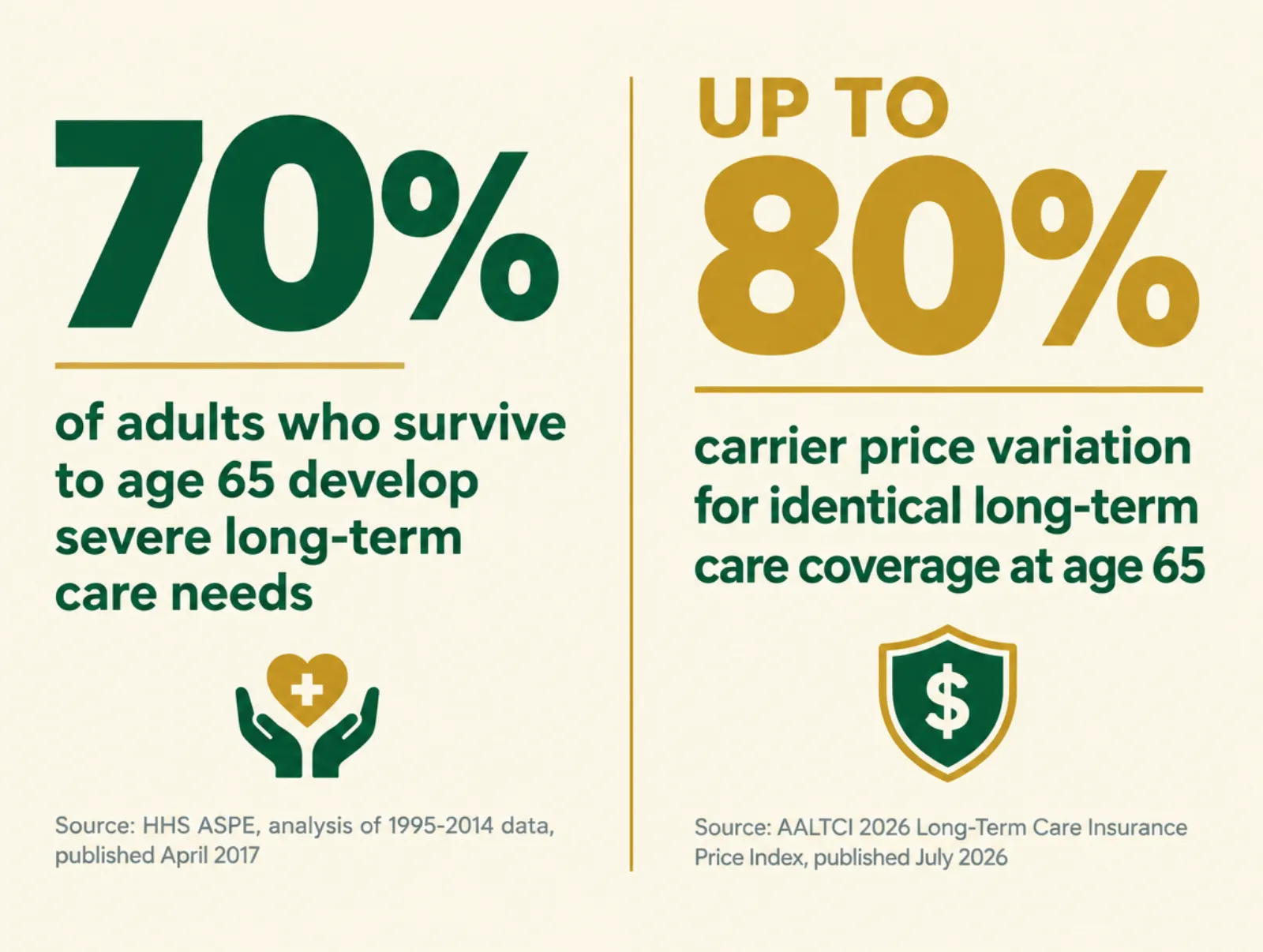
- Identical long-term care coverage can cost up to 80% more from one carrier than another at age 65, per the American Association for Long-Term Care Insurance's 2026 Price Index — which means real shoppers take real time to compare quotes before they buy.
- 70% of adults who survive to age 65 eventually develop severe long-term-care needs, and 48% receive some paid care in their lifetime, per an HHS analysis of Health and Retirement Study data. That's the number that makes the sale worth making, even on a slow timeline.
- Without coverage, the CareScout 2025 Cost of Care Survey puts the national median cost of a nursing home semi-private room at $114,975 a year, assisted living at $74,400 a year, and in-home care at $80,080 a year for 44 hours a week.
- Combination fixed universal life products, which pair life insurance with long-term care coverage, were the only growth area in fixed UL sales in Q2 2026, per LIMRA — hybrid products are quietly becoming the default way this coverage gets sold.
- CMS's Medicare marketing rules don't apply to long-term care insurance, but the TCPA's consent, disclosure, and opt-out rules apply in full, with statutory damages of $500 to $1,500 per violation under 47 U.S.C. § 227(b)(3).
What a Long-Term Care Insurance Lead Actually Is
A long-term care insurance lead is a consumer who’s inquired about coverage for the cost of extended personal care, help with daily activities like bathing, dressing, and eating, or supervision for a cognitive condition like dementia, delivered at home, in an assisted living community, or in a nursing home. It’s a different product from health insurance, which covers medical treatment, and different from Medicare, which covers only limited, short-term skilled nursing care after a hospital stay, not the extended custodial care this product is built for.
There are two structurally different ways this coverage gets sold today, and the difference matters enormously for how long a lead takes to close.
Traditional (standalone) long-term care insurance is a dedicated policy: the buyer pays a premium, and if a covered long-term care need arises, the policy pays a daily or monthly benefit up to a lifetime maximum. If the buyer never needs care, the premiums are gone, with nothing paid out and nothing passed to heirs. That “use it or lose it” design is the single biggest objection agents hear on this product, and it’s a legitimate one, not a stalling tactic.
Hybrid, or combination, long-term care insurance pairs a long-term care benefit with a life insurance policy or an annuity. If the buyer needs care, the policy pays for it. If they never need care, the death benefit still pays out to their beneficiaries, or the cash value is still there. Per LIMRA’s Q2 2026 individual life sales data, combination fixed universal life products, policies that pair life insurance with long-term care coverage, were the only area of growth within the fixed universal life category that quarter, while the broader fixed UL category posted $233 million in new premium, down 3% year over year, and just a 5% share of total new individual life premium. Put plainly: the traditional standalone category has been shrinking for years, and hybrid products are where the growth in this space is actually happening.
| Feature | Traditional (standalone) LTC | Hybrid / combination LTC |
|---|---|---|
| If care is never needed | Premiums are not returned | Death benefit or cash value still pays out |
| Underwriting | Full health underwriting, sometimes a paramedical exam | Varies; often simplified, but still medically underwritten |
| Premium structure | Ongoing annual premium, subject to rate increases | Often a single premium or fixed-period pay, generally not subject to LTC-style rate increases |
| 2026 product momentum | Category has been shrinking for years | Only growth area in fixed UL sales, Q2 2026 |
Source: LIMRA, "U.S. Individual Life Insurance Sales Continue Growth Trend in the Second Quarter, Led by Whole Life and VUL," Q2 2026 data.
Both structures require the buyer to answer a meaningful number of questions about their health, and both require them to understand riders, especially inflation protection, that materially change the premium. That combination of complexity and consequence is the first reason this category doesn’t close on the first call. It’s also, not coincidentally, why every soft-close-focused script built for a $30 auto insurance lead falls apart here.
Why the Sales Cycle Runs Long: The Actual Mechanism
Three separate mechanics stack on top of each other to stretch a long-term care sale from a same-day decision into a multi-week one. Understanding each one is what lets you build a cadence that survives the wait instead of giving up during it.
Mechanism one: carrier pricing varies enormously for identical coverage, so real shoppers compare. Per the American Association for Long-Term Care Insurance’s 2026 Price Index, published in July 2026, a single 55-year-old man buying $165,000 in initial benefits with no inflation protection can pay as little as $950 a year from one carrier, while a couple both age 55 buying the same $165,000 in benefits each will see a combined average premium around $5,010 a year with the same insurer selected. At age 65, AALTCI’s study found carrier pricing for identical benefit designs differed by as much as 80% between the least and most expensive insurer. An 80% spread on a premium the buyer will pay for decades is not a spread most people gloss over. It’s a spread that sends them looking for a second quote, and often a third, before they sign anything.
Mechanism two: inflation protection riders change the premium dramatically, and the buyer has to understand why before agreeing to pay for one. AALTCI’s 2026 data shows that same single 55-year-old man’s $950 level-benefit premium climbs to roughly $2,200 a year with a 3% compound inflation rider added, and to roughly $3,710 a year with a 5% compound rider. For a single 55-year-old woman, the jump is even steeper: from $1,500 a year with level benefits to $3,750 with 3% growth and $6,400 with 5% growth. That’s not a rounding difference. It’s the single decision inside this sale with the biggest dollar impact, and explaining why a benefit pool that doesn’t grow with future care costs can leave a buyer underinsured twenty years from now takes real conversation, not a single-call pitch.
Annual Premium by Inflation Protection, Single 55-Year-Old Buyers
$165,000 initial benefit pool, 2026 national averages
Source: American Association for Long-Term Care Insurance, 2026 Long-Term Care Insurance Price Index, published July 2026.
Mechanism three: the buyer usually isn’t the only decision-maker. A long-term care premium comes out of household income for years, and the benefit, if it’s ever used, affects a spouse’s finances and an adult child’s caregiving load directly. It’s routine for a prospect to tell you, honestly, “I need to talk to my husband about this,” and mean it. That’s not a brush-off. Treating it like one, by not calling back for two weeks because the lead “wasn’t ready,” is how a legitimately warm lead gets marked dead while it’s still very much alive.
None of this means the lead has gone cold. It means the clock on this specific product runs in weeks, not hours, and a follow-up system copied from a faster-moving line will read patience as disinterest every time.
How Underwriting Actually Works, and Why That Adds Weeks
Underwriting is the insurer’s process for deciding whether to offer coverage, and at what price, based on the applicant’s health. For long-term care insurance, that process is more involved than it is for most of the products insurance agents sell by phone, and every step in it adds calendar time between first contact and a signed policy.
A traditional long-term care application typically starts with a detailed health questionnaire covering current conditions, medications, and family history, particularly anything related to cognitive decline, since dementia and Alzheimer’s disease are among the most expensive long-term care triggers an insurer can underwrite against. Many carriers follow that questionnaire with a phone interview conducted by an underwriter or a contracted screening company, which asks additional questions and, for older applicants or higher benefit amounts, may include a short cognitive screening test done over the phone. Depending on age, health history, and the benefit amount requested, the insurer may also order an attending physician statement, records pulled directly from the applicant’s doctor, which alone can take two to four weeks to arrive once requested. Hybrid products underwritten on a life insurance chassis follow a similar path, since the life insurance component still requires medical underwriting even when the long-term care rider itself is simplified.
None of this is a reason to slow down your own outreach. It’s the opposite: it’s the reason your outreach needs to keep going while the insurer’s process runs in the background. A lead who submitted an application three weeks ago and hasn’t heard back isn’t disengaged, they’re often just waiting on the same attending physician statement you are. A check-in touch during that gap, even a short one confirming there’s nothing further needed from them right now, keeps you top of mind for the moment underwriting clears and a real decision point arrives.
This is also where the case for treating aged leads differently gets reinforced. An LTC lead that’s 30 or 45 days old isn’t automatically a dead one the way it might be read on a faster-moving product line; it may simply be a lead that’s still moving through underwriting, or still working through a household conversation, and the right move is a well-timed check-in, not a write-off.
What It Costs to Get This Wrong
There are two costs here, and they run in opposite directions: what it costs the prospect to go without coverage, and what it costs the agency to give up on a lead too early.
On the prospect’s side, per the CareScout 2025 Cost of Care Survey, based on more than 16,000 completed surveys of long-term care providers nationwide collected between July and November 2025, the national median annual cost is $114,975 for a semi-private nursing home room, $129,575 for a private room, $74,400 for an assisted living community, and $80,080 for 44 hours a week of non-medical home care. And per the HHS ASPE analysis referenced above, 70% of people who survive to age 65 eventually develop severe long-term care needs, with 48% receiving some paid care over their lifetime. That’s a single research analysis, not a stack of independent confirmations, so hold it as a strong estimate rather than a guarantee for any one person. But it’s the number that explains why this sale matters even when it’s slow: the underlying need is common, and the annual cost of going without coverage dwarfs the premium being quoted.
| Care setting | Median annual cost |
|---|---|
| Nursing home, semi-private room | $114,975 |
| Nursing home, private room | $129,575 |
| Assisted living community | $74,400 |
| In-home care (44 hrs/week, non-medical) | $80,080 |
Source: CareScout / Genworth, 2025 Cost of Care Survey, data collected July–November 2025.
On the agency’s side, the cost of giving up early is a math problem, not a feelings problem. If your CRM’s default cadence for a new lead is five touches over two weeks, then marks it dead, you’re closing the file on a long-term care prospect right around the point where they’ve had time to compare a second quote and are actually ready to talk seriously. You paid for that lead once. Letting it go stale because your cadence was built for a faster product means either buying a fresh lead to replace it, or worse, watching a competitor’s agent close the same household because they were still calling in week five.
How to Fix It: A Cadence Built for a Multi-Week Decision
Here’s the method, and every piece of it works whether you run it by hand or automate it.
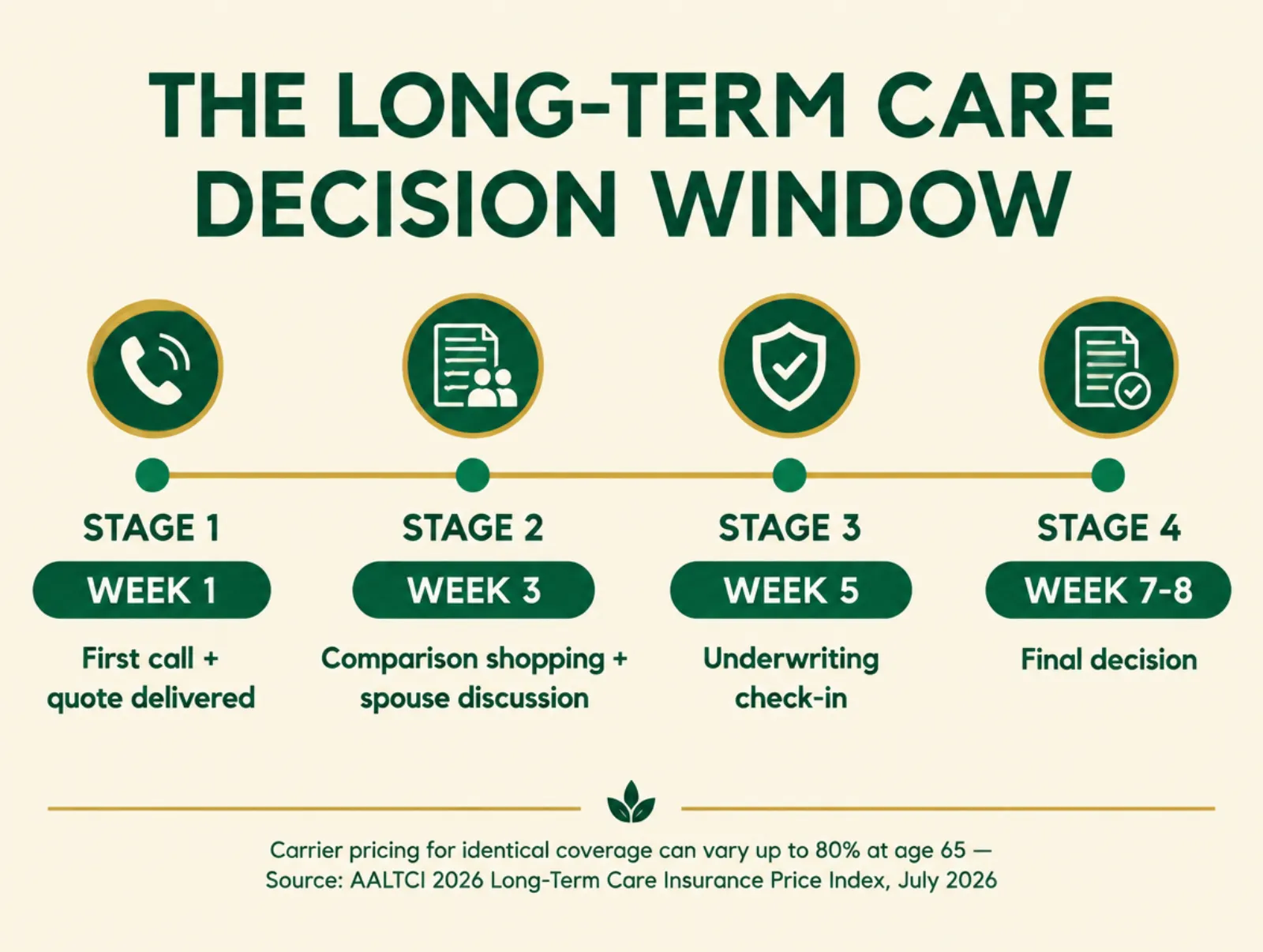
Step 1: Tag every LTC lead with an expected decision window at intake, separate from every other product line in your CRM. Don’t let it inherit a generic “5 touches, 14 days, then dead” sequence built for auto or ACA leads. Give it its own stage list: initial contact, quote delivered, comparison period, spouse/family discussion, decision.
Step 2: Make first contact fast, same as any other line, but set expectations on the call for what happens next. Speed to first contact still matters here exactly as it does everywhere else; a same-day callback beats a next-day one, full stop. The difference is what you say once you’ve connected: tell the prospect plainly that most people take a few weeks to decide on something this size, that you’ll check in periodically rather than pressure them, and that they should feel free to compare other quotes, because per AALTCI’s own data, prices for identical coverage really do vary enough to be worth comparing.
Step 3: Deliver a real quote fast, and be the one who explains the inflation-rider math, not the one who waits for them to ask. Given how much a 3% or 5% compound rider changes the premium, walking through that tradeoff proactively, in plain numbers, is more useful to the buyer than a generic brochure and builds the kind of trust that survives a multi-week decision period.
Step 4: Build a touch schedule that spans four to eight weeks, not two, mixing channels. A reasonable cadence: a call and a follow-up text in week one, a check-in call or text in week two, an email with a plain-language comparison of what they’re looking at (traditional vs. hybrid, level vs. growing benefit) in week three, a call in week five to see where the household conversation landed, and a final check-in call around week seven or eight before moving the lead to a slower, long-term nurture track rather than marking it dead.
Step 5: Ask directly whether a second household decision-maker needs to be included, and offer to get them on a call. If a spouse is part of the decision, and it usually is, offer a joint call instead of hoping the prospect relays your pitch accurately on their own. This single step resolves more stalled LTC deals than any amount of additional follow-up volume.
Step 6: Route every health question and every underwriting-adjacent detail to a licensed agent, every time. This is true whether a human or an AI made the outreach call. Health questions on a long-term care application carry real underwriting consequences, and a non-licensed process, human or automated, making judgment calls there is an E&O and compliance problem waiting to happen.
Step 7: Log consent and honor opt-outs immediately, on every single touch across the full multi-week cadence. A longer cadence means more calls and texts per lead over more weeks, which means more opportunities to violate the TCPA if consent isn’t documented and opt-outs aren’t respected the moment they’re requested.
An agent reading this and thinking “I could run an eight-week, multi-channel cadence by hand with a spreadsheet and some discipline” is right. Plenty of agencies do exactly that. The honest tradeoff is what it takes to actually hold that discipline: eight-plus weeks of consistent, correctly-timed touches across dozens or hundreds of leads simultaneously, without letting the newest, freshest leads crowd out the ones sitting in week five of their decision. That’s the part that tends to slip, not because anyone’s lazy, but because a human’s attention naturally goes to what’s loudest and newest.
What it looks like
- Five touches over two weeks, then marked dead
- Quote sent once, no proactive explanation of riders
- "Need to talk to my spouse" treated as a soft no
- Newest leads get all the attention; week-five leads go quiet
What it looks like
- Four-to-eight-week touch schedule, mixed channels
- Inflation-rider math explained proactively with the quote
- Spouse or co-decision-maker invited onto a call directly
- Health questions and application details route to a licensed agent every time
A Worked Example: The Math on 150 Leads
Say you’re running 150 long-term care leads a month through the seven-step cadence above: an eight-touch schedule per lead over roughly eight weeks, mixing short calls, voicemail drops, and text follow-ups. That’s 1,200 total touches across the batch. Working that by hand, at a realistic pace of maybe 15 to 18 dials an hour once notes, voicemail, and scheduling around business hours are factored in, this is a modeling assumption, not a sourced benchmark, runs somewhere around 65 to 80 hours of a producer’s time a month, every month, on outreach alone, separate from the actual sales conversations that outreach produces.
Run those same 1,200 touches through a managed AI caller at TheAffordableAI’s published Single Account rate of $0.20 a minute, assuming an average of two minutes per touch across a mix of short live calls and voicemail drops: that’s roughly $480 in usage on top of the $200 monthly fee and the one-time $500 setup fee. On the Agency plan’s bulk rate of $0.16 a minute, the same volume runs closer to $384 in usage. This number was pulled directly from TheAffordableAI’s pricing page the day this article published; verify the current rate before you budget against it, since published pricing can change.
That lines up with the broader per-call economics of AI versus human calling at volume. It’s not a promise about how many of those 150 leads convert. It’s the cost of making sure every lead gets its full eight-week runway instead of the five-touch, two-week sprint a busy producer defaults to when the pipeline is long and attention is finite. You can absolutely build a version of this yourself with a dialer, a CRM automation, and a virtual assistant handling the check-in texts. Plenty of agencies do, and for a smaller book, that’s a completely reasonable way to run it. The comparison worth making before committing either way is hours against dollars: what 65-plus hours a month of producer time costs you, against a usage bill in the low hundreds of dollars on a month-to-month plan with no early-termination penalty.
How We Solve It
TheAffordableAI is a managed AI caller built to run a cadence like this without someone manually re-checking a spreadsheet every week to see who’s due for a touch. It fires the first outbound call the moment a fresh long-term care lead lands, and because it syncs natively with HighLevel, it can run a genuinely different, longer cadence for LTC leads than it runs for a same-day-close product line, the same GoHighLevel workflow logic that routes a fast lead to an immediate call can route an LTC lead onto its own multi-week stage list, instead of forcing every lead through one generic sequence. Multi-calendar intent routing means a spouse or co-decision-maker can be scheduled onto a joint call without a human having to coordinate two calendars by hand. Warm transfers hand the call to a licensed agent live the moment anything touches health questions, riders, or pricing specifics that call for a licensed judgment call, not a script. And because a multi-week cadence means more total outbound touches per lead over more calendar time than a fast-close product needs, the built-in number warmup and spam defense matter more here, not less: a number that gets flagged “Spam Likely” in week three of an eight-week cadence doesn’t just lose that week’s calls, it can undermine every call still scheduled after it. Full feature details are on the features page.
None of that changes who’s responsible for TCPA consent, for confirming a lead’s number hasn’t been reassigned, or for the licensed judgment calls that long-term care underwriting requires. Using AI to keep a longer cadence running consistently doesn’t transfer that liability anywhere; the agent and agency carry it, same as always.
You can build a version of this yourself with a dialer, a CRM workflow, and a VA running the check-in texts. It’s worth pricing both before you decide. If you want to hear what a call like this actually sounds like first, there’s a demo call on the homepage: https://theaffordableai.com/
What You Get
Run this correctly, whether by hand or with help, and here’s what changes: a lead that says “I need to talk to my spouse” gets a joint call offered instead of a quiet drop-off. A quote gets followed by a plain explanation of why the inflation rider costs what it does, instead of leaving the buyer to guess. A lead sitting in week six of its decision window gets the same attention it got in week one, instead of losing out to whichever competing agent happened to still be calling. And every health question, every underwriting detail, lands with a licensed human who’s supposed to be handling it, not a script guessing at it.
The math above uses TheAffordableAI’s published Single Account rate; run it against your own lead volume and touch count before deciding what it’s worth to you. https://theaffordableai.com/pricing
Edge Cases the Basic Method Doesn’t Cover
A prospect who’s already been declined by another carrier. Long-term care underwriting can result in a decline for health reasons that wouldn’t affect other insurance lines, cognitive screening results or certain diagnoses, for instance. If a lead mentions a prior decline, that’s a signal to get them to a licensed agent quickly rather than continuing a generic nurture cadence, since the conversation they need next is about options, not more marketing touches.
Leads who are really shopping for a parent, not themselves. It’s common for an adult child to initiate the inquiry on behalf of an aging parent. The actual decision-maker, and sometimes the actual premium-payer, may be a different person entirely than whoever filled out the form, which changes who needs to be on the call and whose health questions actually matter for underwriting.
State Partnership Program eligibility. Most states run a Long-Term Care Partnership Program that offers Medicaid asset protection for buyers of qualifying tax-qualified policies, per the Deficit Reduction Act of 2005 framework described by state insurance departments including North Dakota’s. Specific rules and available policies vary by state, so confirm current details with your state’s program before presenting this as a selling point, and never guarantee a specific Medicaid outcome; that’s a compliance line no agent should cross.
Where This Doesn’t Apply
If your long-term care book is small and built entirely on warm referrals from an existing client base, people who already trust you and are coming to you specifically for this conversation, the multi-week comparison-shopping dynamic described here matters less, because they’re not out getting a second and third quote from strangers. This method earns its keep specifically when you’re buying leads at volume from people who don’t know you yet and genuinely are comparing options, which is exactly the situation where an inconsistent, fast-product-style cadence loses the most business. Know which one you’re running before you spend money on either a spreadsheet system or a platform to run it.
See an eight-week LTC cadence, start to finish
Watch how a fresh long-term care lead gets a same-day first call, a proactive rider explanation, and a warm transfer to a licensed agent the moment underwriting questions come up.
Frequently asked
Why do long-term care insurance leads take so long to close?
Because the decision isn't just about price, it's about underwriting and comparison shopping. A traditional long-term care policy usually requires health questions and sometimes a paramedical exam, and pricing for identical coverage can differ by as much as 80% between carriers at age 65, according to the American Association for Long-Term Care Insurance's 2026 Price Index. Most buyers also want to loop in a spouse or adult child before committing to a premium they'll pay for decades. That's weeks of legitimate deliberation, not lost interest.
What's the difference between traditional and hybrid long-term care insurance?
Traditional long-term care insurance is a standalone policy: you pay a premium, and if you never need care, that premium is gone (a 'use it or lose it' design that made the category unpopular for years). Hybrid, or combination, policies pair long-term care benefits with a life insurance or annuity chassis, so an unused long-term care benefit still pays a death benefit or cash value. LIMRA's Q2 2026 sales data shows combination fixed universal life products, which pair life insurance with long-term care coverage, were the only growth area within fixed universal life products in that quarter, while the broader fixed UL category was flat to declining.
How much does long-term care actually cost if you don't have coverage?
Per the CareScout 2025 Cost of Care Survey, based on data collected from long-term care providers nationwide between July and November 2025, the national median annual cost is $114,975 for a semi-private nursing home room, $129,575 for a private room, $74,400 for an assisted living community, and $80,080 for 44 hours a week of non-medical in-home caregiver services. These are national medians; costs vary significantly by state and metro area.
What percentage of people actually end up needing long-term care?
An HHS Office of the Assistant Secretary for Planning and Evaluation analysis of Health and Retirement Study data from 1995 to 2014, published in April 2017, found that 70% of adults who survive to age 65 develop severe long-term-services-and-supports needs before they die, and 48% receive some paid care over their lifetime. That's the most-cited figure in this category, and it comes from a single research analysis rather than multiple independent studies, so treat it as a strong estimate, not a certainty for any individual.
Does CMS regulate long-term care insurance marketing the way it regulates Medicare?
No. Long-term care insurance is not a Medicare product, so CMS's Third-Party Marketing Organization disclaimer, its mandatory call-recording and 10-year retention rule, and its restrictions on unsolicited Medicare contact don't apply. The Telephone Consumer Protection Act's consent, disclosure, and opt-out requirements still apply in full to any automated or prerecorded call, along with the National Do Not Call Registry and any applicable state telemarketing law.
What is a Long-Term Care Partnership policy?
It's a state-federal program, created under the Deficit Reduction Act of 2005, that lets someone who buys a qualifying tax-qualified long-term care policy protect an amount of personal assets equal to the benefits the policy actually pays out when they apply for Medicaid later in life. Most states run a Partnership Program; the specific asset-protection rules and available policies vary by state, so confirm current details with your state insurance department before presenting this as a selling point.
How many follow-up touches does a long-term care insurance lead need?
There's no single published industry benchmark for this specific product line, so this is operating guidance, not a sourced statistic: because the buying decision routinely spans weeks and often involves a second household decision-maker, a cadence built for a same-day close (three to five calls in 48 hours, then done) will mark a genuinely live lead as dead before the real decision-making has even started. A cadence that spreads touches across four to eight weeks, mixing calls, texts, and emails, matches how this specific sale actually happens.
What does it cost to run a multi-week LTC lead cadence with an AI caller instead of by hand?
At TheAffordableAI's published Single Account rate of $0.20 a minute, eight touches per lead averaging two minutes each (a mix of short calls and voicemail drops) runs about $3.20 in usage per lead on top of the $200 monthly fee and one-time $500 setup fee. Run 150 leads through that same eight-touch cadence and usage runs roughly $480, on a month-to-month plan with no long-term contract. Pricing was verified directly from TheAffordableAI's pricing page on the day this article was published; confirm current rates before budgeting.
Sources
- American Association for Long-Term Care Insurance — 2026 Long-Term Care Insurance Price Index (published July 2026)
- LIMRA — U.S. Individual Life Insurance Sales Continue Growth Trend in the Second Quarter, Led by Whole Life and VUL (Q2 2026)
- CareScout / Genworth — 2025 Cost of Care Survey Results (survey conducted July–November 2025)
- HHS Office of the Assistant Secretary for Planning and Evaluation — What Is the Lifetime Risk of Needing and Receiving Long-Term Services and Supports? (data 1995–2014, published April 2017)
- North Dakota Insurance Department — Long-Term Care Partnership Program
- Cornell Law School Legal Information Institute — 47 U.S.C. § 227, Telephone Consumer Protection Act (current text)
- TheAffordableAI — Pricing
Put this on your own phone line
See the AI dial, qualify, and warm-transfer a live call in under a minute. No contract, no dev work.
Keep reading

Final Expense Insurance Leads: A Different Playbook
Final expense insurance leads skew older, and FTC data shows elder scam-wariness is real and rising. Here's a follow-up cadence built for that, not for ACA.

Medicare Supplement Leads: Why They Don't Wait for AEP
Medigap has no annual enrollment period. 16 states run birthday-rule windows year-round, and leads don't wait for AEP. What they cost and how to follow up.

Aged Insurance Leads in 2026: What's Legal to Call
The FCC's one-to-one consent rule for insurance leads is dead. Here's what changed, what still applies, and how to reactivate an aged database correctly.