Call Routing by License: What Multi-State Agencies Miss
Round robin can hand a call to an agent not licensed in that state. What NIPR's numbers and a 2026 New York fine show, and how to route by license instead.

A round-robin pool doesn’t know what state a caller lives in, and neither does the agent it hands the call to until they’re already on the line. That’s the actual mechanism behind a question more multi-state agencies are starting to ask out loud: can a call-routing system accidentally route a lead to an agent who isn’t licensed to talk to them at all. The honest answer is yes, routinely, and it has nothing to do with the agent’s intentions.
Most agencies that sell across state lines built their call routing to solve a different, narrower problem: get the lead to somebody fast, and don’t let one producer hog every call. Round robin and availability toggles do that job well. Neither one was designed to ask “is this specific agent legally allowed to talk to this specific caller,” because that question depends on a fact the dialer never sees: which state the lead actually lives in, and whether the agent who just picked up holds a resident or nonresident license there.
The short version
- NAIC's own producer licensing page counts more than 2 million individually licensed people and over 236,000 licensed business entities nationwide, most of them working under a resident license plus one or more nonresident licenses in other states.
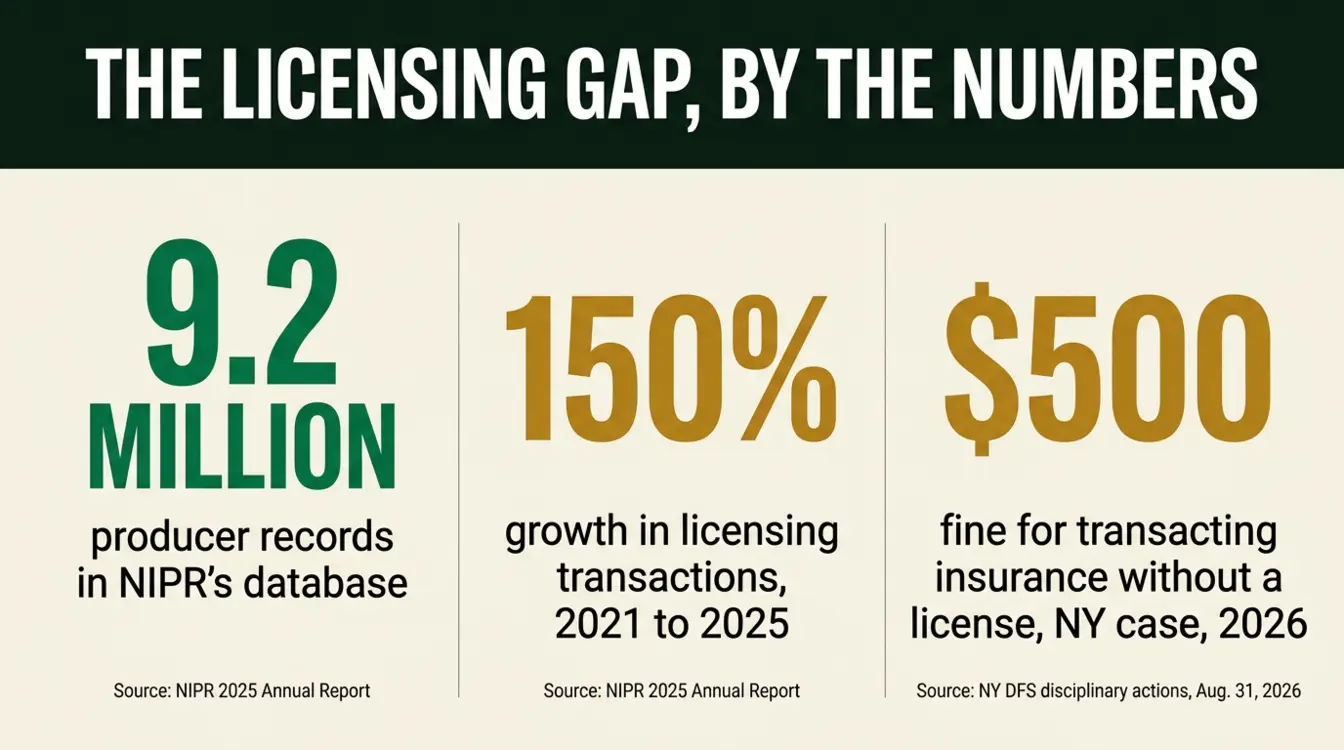
- NIPR's Producer Database, the shared national record of who is licensed where, held 9.2 million producer records in 2025, up 2.2 percent year over year, and processed 185.9 million licensing transactions that year, a 150 percent jump from the 74.4 million processed in 2021, per NIPR's own 2025 Annual Report.
- Texas Insurance Code § 101.102 bars doing insurance business in the state without statutory authorization, and a 2019 Texas Department of Insurance bulletin confirms an agent can be pursued "whether the agent or TPA knew the product was unauthorized or not."
- New York's Department of Financial Services fined one agent $500 in 2026 for transacting insurance without a license over roughly three weeks, and fined a second agent $1,500 the same month for failing to report a separate state's own disciplinary action within 30 days, exactly the kind of cross-state compliance gap a license matrix is built to catch.
- Round robin and skill-based routing both distribute calls across whichever agents are available; neither checks licensing by default. The fix is building the routing pool around license first, then letting round robin or availability toggles run inside that already-filtered group, which takes a spreadsheet and a standing review date, not new software.
The Pain: A Pool That Doesn’t Know Where the Caller Lives
Picture an agency with eight producers, three states of resident licenses between them, and a single inbound number for the whole book. A lead calls in from a state where exactly two of those eight hold a nonresident license. The routing pool, set up months ago to spread volume evenly and keep nobody idle, doesn’t know that. It just knows who’s available right now. Five times out of eight, on average, the call lands with someone who legally should not be quoting, binding, or in some states even discussing coverage with that caller.
Nobody built the pool that way on purpose. It happened the normal way these things happen: the agency started in one state, added producers as it grew, picked up nonresident licenses opportunistically as deals came in, and never went back to rebuild the routing logic around the licensing map that had quietly gotten more complicated. The spreadsheet, if one exists at all, usually lives in someone’s memory more than in the CRM. “Sarah’s licensed in Texas and Oklahoma, I think Marcus added Florida last spring” is not a control, it’s a guess dressed up as institutional knowledge.
This is a close cousin of the problem covered in round-robin versus skill-based routing, but it’s not the same problem. That piece compares two ways of distributing calls evenly or by specialty. This one is about a filter that has to run before either method gets applied at all: who’s even allowed to take this specific call, full stop, before you worry about who’s next in rotation or who’s best at closing that product line.
Why It Happens: Reciprocity, Resident vs. Nonresident, and the Database Nobody Routes Against
A resident license is issued by the state where an agent’s primary place of business is, earned through that state’s exams and prelicensing education. A nonresident license lets the same agent sell in a different state without repeating those steps there, built on reciprocity agreements between states under the NAIC’s Producer Licensing Model Act. The system exists specifically because agents sell across state lines constantly, and nobody wanted every producer retaking a full licensing exam in every new state. Per NAIC’s own producer licensing page, Gramm-Leach-Bliley pushed states toward this uniform approach starting in 1999, and a working group later recommended 40 jurisdictions for full reciprocity certification, though the same page notes several large states were never fully brought into that uniform standard. Reciprocity closed most of the friction. It didn’t close all of it, and it definitely didn’t make licensing automatic or permanent.
That’s the part that gets lost in a routing conversation: a nonresident license isn’t a permanent, one-time approval. It has its own renewal cycle, its own continuing-education requirements in the home state that can affect every license tied to it, and its own exposure if the agent’s home-state license ever gets disciplined. The National Insurance Producer Registry (NIPR), a not-for-profit affiliate of the NAIC, exists to be the shared source of truth for all of this. Its Producer Database (PDB) aggregates licensing and appointment data from all 50 states, DC, Puerto Rico, Guam, and the US Virgin Islands into one lookup, and its Gateway is the electronic system regulators and licensees actually use to file and track applications, renewals, and appointments. Per NIPR’s own 2025 Annual Report, the database held 9.2 million producer records in 2025, up 2.2 percent from 2024’s 8.9 million, and the registry processed 185.9 million licensing and credentialing transactions that year, a 29 percent jump over 2024 and a 150 percent increase over the 74.4 million transactions it processed just four years earlier, in 2021.
Define the terms before you build a routing pool around them
Resident license: issued by the state where the agent's primary business address is. Nonresident license: issued by a different state based on reciprocity with the agent's resident state, under the NAIC Producer Licensing Model Act. NIPR: the National Insurance Producer Registry, the shared database regulators and the industry both use to track who holds which license where. Appointment: a separate authorization from a specific carrier letting a licensed agent sell that carrier's products, tracked alongside the license itself in NIPR's Producer Database. A license without a current, carrier-specific appointment still isn't enough to write business for that carrier, even in a state the agent is fully licensed in.
That growth curve, 150 percent more transactions in five years, is not a sign the system is getting more complicated for its own sake. It’s a sign more agents are holding more licenses across more states than they were five years ago, which is exactly the trend that makes a single shared, license-blind routing pool riskier every year an agency keeps using it unchanged. The database that tracks all of this already exists, maintained by the states themselves through NIPR. Almost no agency’s call routing is actually built to respect it.
Reciprocity also isn’t uniform across every line of business, which is where a lot of agencies get tripped up after they’ve already built what they thought was a complete license matrix. A property and casualty line, a life line, and a health line can each carry separate license-type codes within the same state, and a producer holding a nonresident license for one line in a given state isn’t automatically licensed there for another. NAIC’s own producer licensing page notes that full uniformity across jurisdictions was never fully achieved even after the post-Gramm-Leach-Bliley reciprocity push, which means a matrix built around “is this person licensed in Ohio” without the follow-up question “licensed for which line, in Ohio” is still incomplete. The fix isn’t more complexity for its own sake; it’s one more column on the same spreadsheet: agent, state, line of business, license number, expiration.
For agencies writing Medicare or ACA business specifically, state producer licensing is only half of what has to line up before a call should route to a given agent. Selling Medicare Advantage or Part D plans also requires a current, carrier-specific annual certification, commonly built around AHIP’s standardized training module, on top of the state license itself and a current appointment with that carrier. A producer can hold a spotless nonresident license in a state and still not be authorized to discuss a specific Medicare Advantage plan there if that year’s carrier certification hasn’t been completed yet. If your routing pools serve Medicare or ACA callers, the matrix needs a column for carrier appointment status and certification-cycle date alongside the state license fields, not as a separate system nobody checks at the same time.
What This Actually Costs
Start with the base rule, because it’s shorter than most agencies assume. Texas Insurance Code § 101.102 states plainly that a person may not “directly or indirectly do an act that constitutes the business of insurance” in the state “except as authorized by statute.” There’s no minimum call count, no dollar threshold, no exception for a single unlicensed conversation that didn’t result in a sale. The statute is about the act, not the outcome.
| Consequence | What it means | Statute |
|---|---|---|
| Underlying prohibition | Doing the business of insurance in Texas without statutory authorization is barred outright, no intent requirement in the text | Tex. Ins. Code § 101.102 |
| Administrative penalty cap | Up to $25,000 per violation unless a different amount is specified elsewhere in the code, based on severity, harm, history, and intent | Tex. Ins. Code § 84.022 |
| Future licensing bar | A person found to have acted as an agent without a license may not obtain a Texas agent license for five years after that determination | Tex. Ins. Code § 4005.106 |
| No-knowledge-required standard | TDI can act against an agent who assisted an unauthorized placement "whether the agent...knew the product was unauthorized or not" | TDI Bulletin B-0007-19 |
Source: Texas Insurance Code §§ 101.102, 84.022, 4005.106, via Texas Public Law; Texas Department of Insurance Commissioner's Bulletin B-0007-19 (Aug. 12, 2019). Texas is used here as one illustrative state; penalty structures differ by jurisdiction and your own state's insurance code controls for your agency.
That last row is the one worth sitting with. It is not a defense that the agent didn’t realize the caller lived in a state they weren’t licensed in. The routing system that handed them the call doesn’t get named in the bulletin, but it’s the actual point of failure every time this happens.
Real enforcement backs this up, and it isn’t hypothetical. New York’s Department of Financial Services issued a disciplinary bulletin on August 31, 2026 covering licensees across the state. One entry: an agent in Saratoga Springs, New York, fined $500 after the department found he “transacted the business of insurance without a license” during a roughly three-week window between late November and mid-December 2025, in violation of New York Insurance Law § 2102(a)(1). A separate entry in the same bulletin fined a different agent, based in Indiana, $1,500 for failing to report, within the required 30 days, that the California Department of Insurance had already taken a disciplinary action against him and assessed a fine. A third entry fined an agent $7,500 for certifying on a license renewal that he’d completed 15 hours of required continuing education when he hadn’t. None of these are headline-sized dollar figures. All three are exactly the kind of licensing-integrity failures, an unlicensed act, an unreported cross-state action, a false CE claim, that a routing system built around a real, current license matrix is designed to prevent from ever reaching a caller in the first place.
NIPR licensing transaction volume, 2021 to 2025
Annual credentialing and reporting transactions processed on behalf of states and the industry.
Source: NIPR 2025 Annual Report. Bars scaled to 2025's 185.9 million transactions as 100%.
None of these dollar figures, on their own, will bankrupt an agency. That’s not really the point. The point is that every one of them traces back to the same root cause: a call reached an agent whose license status, in that specific state, nobody had actually checked recently against a system of record that already exists and is free to query.
How to Fix It: Build the Pool Around License First
None of this requires new software, a compliance vendor, or an expensive licensing-tracking platform, though those exist if your agency is large enough to want one. It requires a license matrix your agency actually maintains, and a routing setup that reads from it before anything else runs.
- Build one list: every agent, every state, every license number, every expiration date. A spreadsheet is fine. The columns that matter are agent name, state, license type (resident or nonresident), license number, expiration date, and date last verified. If this doesn’t exist anywhere right now in a form someone could pull up in thirty seconds, that’s the actual gap, not the routing software.
- Verify it against NIPR’s Producer Database or your state DOI’s own lookup, not against memory. NIPR’s PDB is the shared record every state regulator already uses. Most state insurance department websites also offer a free producer license lookup. Pick one as your standing source of truth and note the date you checked it.
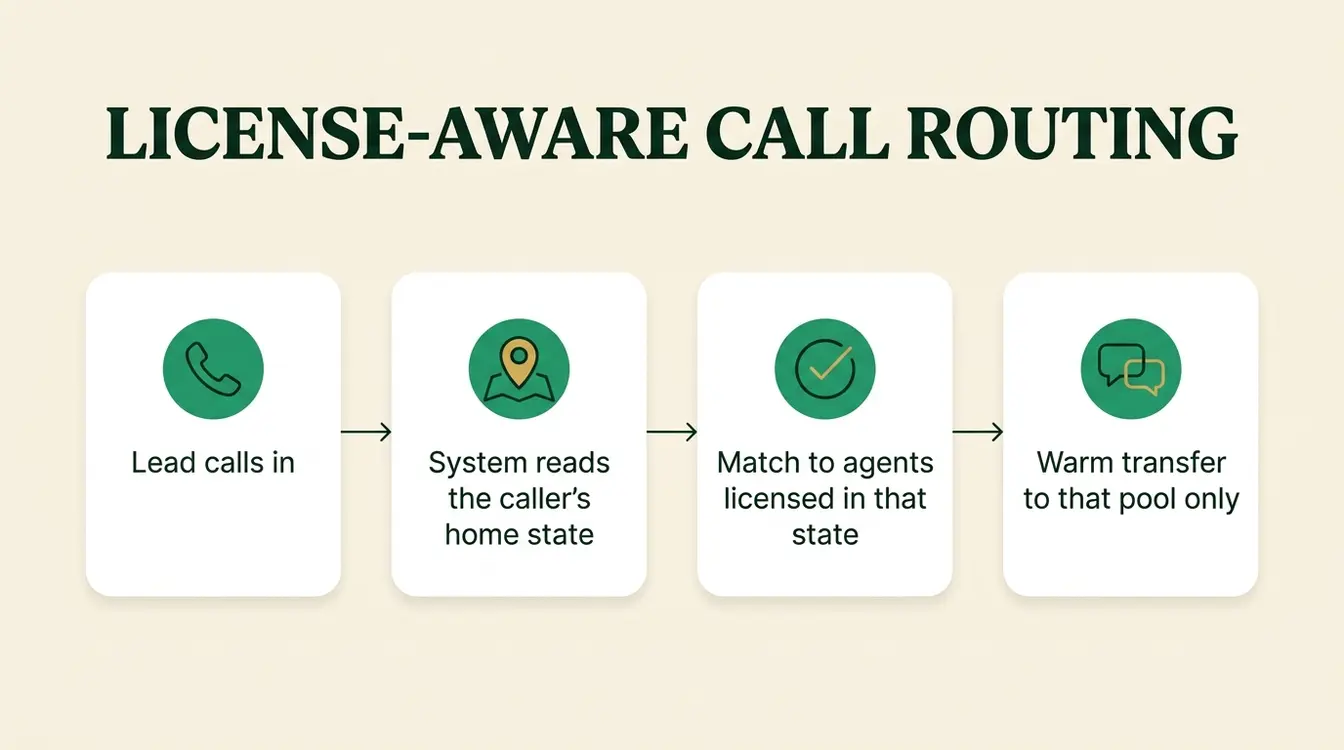
- Build routing pools by state, not one pool for the whole book. If your inbound number serves callers from twelve states, you need, functionally, twelve eligible-agent lists, even if many of them overlap heavily. An agent licensed in Texas, Oklahoma, and Florida belongs in three pools, not one undifferentiated pool that happens to include them.
- Let round robin or availability toggles run inside each state-specific pool, not across the whole roster. This is the step that actually uses the tools most agencies already have. Round robin solves “who’s next” well. It just needs to be running against the right, already-filtered list, not the entire team regardless of where any given caller lives.
- Set a standing review date, not a one-time setup. Licenses expire. CE requirements lapse. An agent who was licensed in a state in March might not be by the time a renewal deadline passes in September if nobody’s tracking it. Quarterly is a reasonable cadence for a growing multi-state book; monthly if your agency adds nonresident licenses frequently.
- Pull new agents off a state’s routing pool the moment a license lapses, not after someone notices in a call review. This should be a deliberate step in your onboarding and offboarding checklist, not something that happens because a producer mentions it in a team meeting.
- Keep a record of what the routing configuration actually did, not just what the license matrix says. If a complaint or an audit ever asks which agent took a specific call and whether that was within their license, you want two things that agree with each other: the matrix, and the actual routing log.
- Account for renewal cycles that don’t match each other. Most states run two-year producer license terms, but the actual renewal month depends on when the license was originally issued, not a single calendar date every agent shares. A matrix that only gets reviewed once a year, on a fixed date, will still miss licenses that renew on a different schedule. Tie the “last verified” column to each agent’s actual renewal month instead of one annual sweep.
- Separate state licensing from carrier appointments and, for Medicare and ACA business, annual certifications. A current state license doesn’t mean a producer is appointed with every carrier whose plans your agency sells, and for Medicare Advantage or Part D specifically, it doesn’t mean that year’s carrier certification is done. Routing pools for those lines need to check both, not just the state license field.
The agency that does all nine of these steps isn’t running a more complicated operation than the one that skips them. It’s running the same operation with one extra filter applied before round robin or availability toggles ever see the call, which is the actual gap most license-blind routing has.
You can run this whole fix with what you already pay for
None of the seven steps above require a new platform. A shared spreadsheet, a recurring calendar reminder to re-check NIPR or your state DOI's lookup tool, and routing pools built per state instead of one pool for everyone gets you most of the way there. The only thing that costs money is the time it takes to build the matrix the first time, and that's a few hours, not a project.
Where TheAffordableAI Fits, and Where It Doesn’t
Be precise about this, because overstating it would undercut the exact point this article is making. TheAffordableAI does not verify an agent’s license, check NIPR’s Producer Database, or determine who is legally allowed to take a given call. No calling platform should be trusted to make that legal judgment for an agency; that responsibility sits with the licensed agency itself, and using any calling system, AI-powered or otherwise, does not transfer it away.
What a managed calling setup can do is give an agency the infrastructure to act on its own license matrix once it’s built. On the Agency plan, calls route round-robin across more than 20 agents at once with team availability toggles and multiple campaigns and calendars, meaning an agency can configure separate routing groups per state rather than one undifferentiated pool for every inbound number. The system runs that configuration consistently, every call, without a dispatcher having to remember who’s licensed where in the middle of a busy afternoon. The full list is on the features page.
Multiple campaigns and routing pools
Configure separate call-routing groups, so a state-specific license pool is a setup choice your agency controls, not something the platform assumes for you.
Round-robin across 20+ agents
Once a pool is built correctly, round robin distributes calls evenly inside it, on the Agency plan, so no single licensed producer in that state carries the whole load.
Team availability toggles
Agents can mark themselves unavailable without manually editing a routing list, useful the moment a license lapses and someone needs pulled from a pool quickly.
Every call logged with a transcript
Transcript, timestamp, and disposition sync to HighLevel automatically, giving your agency the routing-log half of the two records a license question would actually require.
Warm transfers to a real licensed agent
A qualified call reaches a live person inside whichever pool you've configured, so the conversation that actually binds coverage happens with someone legally able to have it.
No contract, cancel anytime
Agency runs $500/mo plus a $1,000 one-time setup at $0.18/min, from $0.16 at bulk. Single Account runs $200/mo plus a $500 one-time setup at $0.20/min, from $0.15 at bulk. https://theaffordableai.com/pricing
If you want to hear what the routing and warm-transfer setup actually sounds like before you decide anything, there’s a live demo on the homepage. https://theaffordableai.com/
What You Actually Get
A call comes in, the system checks which pool it belongs in based on how you’ve configured routing for that state, and it reaches an agent who’s actually supposed to be on that list, distributed evenly so the same two or three people aren’t absorbing every call in your highest-volume states. That doesn’t replace the license matrix. It’s the execution layer that runs reliably against whatever matrix your agency keeps current, call after call, without a dispatcher’s memory being the only thing standing between a caller and the right producer.
The routing software never gets named in a disciplinary bulletin. The agent does. Build the pool around the license, not the other way around.
Mike MooreA License-Blind Pool vs. a License-Aware One
One group, whoever's free
- Single routing pool covers every inbound number regardless of caller state
- License matrix, if it exists, lives in someone's memory rather than a maintained document
- Nobody re-checks NIPR or the state DOI lookup on a schedule
- A lapsed license is caught only if someone happens to notice
- No record ties a specific call to proof the agent was licensed for it
Pools built per state, reviewed on a schedule
- Separate routing pools per state, agents appear only where currently licensed
- Written license matrix: agent, state, license number, expiration, last-verified date
- Quarterly (or more frequent) check against NIPR's Producer Database or state DOI
- Lapsed agents pulled from a pool as a deliberate offboarding step
- Routing log plus license matrix together document which agent handled which call, and why they were eligible to
Where This Is the Wrong Tool
Be honest about the limits here too. No calling platform, AI-powered or otherwise, can tell you whether a given agent is licensed in a given state right now. It can’t query NIPR for you, it can’t catch a continuing-education shortfall before a renewal application gets filed, and it can’t retroactively fix a call that already reached the wrong person before you read this. If your agency doesn’t have a current license matrix at all, the first move is building one, not reconfiguring call routing around a document that doesn’t exist yet. And if a specific past call has already turned into a complaint or an inquiry from a state regulator, that’s a conversation for an attorney who handles insurance licensing matters, not something a routing fix addresses after the fact.
Licensing compliance doesn't transfer, in any configuration
Maintaining accurate, current producer licensing across every state an agency does business in is the licensed agency's obligation, not a vendor's or a calling platform's. Using an AI calling platform, or any calling platform, does not transfer that responsibility away from the agency or its licensed producers. This article describes publicly available regulatory text, one state's statutes used as an illustrative example, and published enforcement bulletins; it is general information, not legal advice. Talk to your own counsel or your state insurance department about your agency's specific multi-state licensing obligations, which vary by state and by line of business.
Build the routing pool your license matrix actually supports
See what a managed calling setup with state-level routing pools and availability toggles looks like against what you're running now. No contract either way, so the only real risk of trying it is one month.
NIPR’s own numbers show the licensing system growing busier every year, 150 percent more transactions in five years, which means more agents holding more state licenses, not fewer. A call-routing pool that hasn’t been rebuilt to match that reality isn’t a minor oversight. It’s the one piece of infrastructure standing between a caller and an agent who may or may not be legally allowed to talk to them, and fixing it starts with a spreadsheet you probably already have the data for.
Frequently asked
What's the difference between a resident and a nonresident insurance license?
A resident license is issued by the state where you live and have your primary place of business. A nonresident license lets you sell in a different state without retaking that state's exams or prelicensing education, built on reciprocity between states under the NAIC's Producer Licensing Model Act. Per NAIC's own producer licensing page, more than 2 million individuals and more than 236,000 business entities hold licenses nationwide, and most producers who write business across state lines are working under a resident license at home plus one or more nonresident licenses elsewhere, applied for and renewed through NIPR's Gateway.
Can an agent get in trouble for taking a call from a state they're not licensed in?
Yes, and it does not require intent. Texas Insurance Code Section 101.102 bars doing an act that constitutes the business of insurance in that state except as authorized by statute, with no carve-out for a single phone call. Texas Department of Insurance Bulletin B-0007-19 states plainly that the department can act against an agent whether the agent knew the product or placement was unauthorized or not. New York's Department of Financial Services fined an agent $500 in 2026 for transacting business without a license over roughly a three-week window, a small case by dollar amount but a real one, built entirely on the unlicensed act itself.
What is NIPR, and why does it matter for call routing?
NIPR, the National Insurance Producer Registry, is the not-for-profit registry that holds the Producer Database, the central record of who is licensed where, used by all 50 states, DC, and US territories. Per NIPR's own 2025 Annual Report, the database held 9.2 million producer records in 2025, up 2.2 percent from 2024, and processed 185.9 million licensing and credentialing transactions that year, a 150 percent increase over the 74.4 million transactions processed in 2021. It matters for routing because it's the same underlying fact, who is licensed where, that a call-routing pool has to respect; the database doesn't route your calls for you, but it's the system of record your own license matrix should match.
Does round-robin call routing automatically account for licensing?
No. Round robin and skill-based routing, the two methods most agencies compare, both distribute calls across whichever agents are in the pool and available; neither one checks licensing by default. If an agency builds one shared pool for every inbound number regardless of the caller's state, an unlicensed agent can end up fielding, and potentially binding, a call they have no legal authority to handle. The fix isn't a different routing method, it's building the pool itself around license, then letting round robin or availability toggles run inside that already-filtered group.
Does a managed AI calling platform verify an agent's license before routing a call?
Not on its own, and no AI platform should be trusted to make that legal determination for you. A calling system can route calls to whichever group of agents or numbers you configure it to use, in round robin or by availability, but the accuracy of a state-licensed routing pool depends entirely on your agency keeping that list current against your own NIPR and state DOI records. Using an AI calling platform does not transfer that compliance obligation away from the licensed agency; it still has to maintain the license matrix the routing logic reads from.
What should a multi-state agency keep on file to prove a call went to a properly licensed agent?
A dated license matrix naming every agent, every state they hold a resident or nonresident license in, each license's expiration date, and the date it was last checked against NIPR's Producer Database or the state's own lookup tool, reviewed on a fixed schedule rather than only at onboarding. Pair that with a routing configuration, whatever system you use, that can show which pool a given call was eligible to reach and which agent actually took it. Neither document stops a complaint by itself, but together they're what turns Section 101.102 or its equivalent in your own state from an open question into a closed one.
How often do agent licenses actually lapse without the agency noticing?
There's no national figure for this specific failure mode, so don't expect a precise percentage; what exists instead is the enforcement record showing it does happen. New York's own August 31, 2026 disciplinary bulletin fined one agent $7,500 for falsely certifying completed continuing education on a renewal application, and fined a second agent for failing to report a separate state's administrative action within the required thirty days. Both are license-integrity failures the agency, not just the individual, ultimately bears consequences for if that agent kept taking calls on the strength of a license that had quietly gone stale.
Sources
- NAIC — Producer Licensing (overview, reciprocity history, licensed-producer count)
- NIPR — 2025 Annual Report: Blueprint for Success
- New York State Department of Financial Services — Disciplinary Actions, issued August 31, 2026
- Texas Insurance Code § 101.102 — Unauthorized Insurance Prohibited
- Texas Insurance Code § 4005.106 — Application for License After Certain Determinations
- Texas Insurance Code § 84.022 — Penalty Amount
- Texas Department of Insurance — Commissioner's Bulletin B-0007-19 (Aug. 12, 2019)
- TheAffordableAI — Pricing
- TheAffordableAI — Features
Put this on your own phone line
See the AI dial, qualify, and warm-transfer a live call in under a minute. No contract, no dev work.
Keep reading

Insurance Lead Routing: Round-Robin vs Skill-Based
Round-robin, skill-based, and first-to-answer routing compared for insurance agencies: how each works, what breaks, and how to build a fair one in 2026.
Multi-Calendar Intent Routing for Insurance Agents
Multi-calendar intent routing books ACA, Medicare, and dental leads onto separate calendars, keeping every Medicare appointment inside its CMS scope.

Insurance Agent TCPA Settlements Top $4 Million in 2026
Two Farmers Insurance agents settled 2026 TCPA Do Not Call lawsuits for $2.875M and $1.25M. What the filings show, and what agencies should fix first.