New Jersey Telemarketing Law: The Cost to Insurance Agents
New Jersey fined one company $502,000 over unregistered telemarketing calls. Here's what the Do Not Call Law requires before you dial a New Jersey lead.

Yes, New Jersey’s Telemarketing Do Not Call Law applies to licensed insurance agents, with no profession-based exemption, and it stacks a separate state registration requirement, a 9 p.m. to 8 a.m. calling-hour ban, and state civil penalties of up to $10,000 for a first offense and $20,000 for each later one on top of whatever the federal TCPA already requires. New Jersey’s own Division of Consumer Affairs made that enforcement posture concrete in July 2023, when it settled with a national mortgage servicer for $502,000 over telemarketing calls the state alleged were made without registering as a telemarketer in the first place.
This piece covers what New Jersey’s Do Not Call Law actually requires, how it layers on top of the TCPA you’re probably already tracking, what the state has shown it will do when both get ignored, how to build a clean calling process for New Jersey leads with no new software, and where a managed AI caller closes the gap a busy agency reliably leaves open.
The short version
- New Jersey's Telemarketing Do Not Call Act, N.J.S.A. 56:8-119 to -129, requires telemarketers, insurance agencies included, to register annually with the Division of Consumer Affairs before placing unsolicited sales calls to New Jersey residents. There's no insurance-specific exemption in the statute.
- Calls can't go out between 9 p.m. and 8 a.m. at the lead's location, and the state's own in-house do-not-call obligations apply on top of the federal registry.
- Violations carry state civil penalties of up to $10,000 for a first offense and $20,000 for each subsequent offense, separate from and in addition to federal TCPA statutory damages of $500 to $1,500 per violation under 47 U.S.C. Section 227(b)(3).
- New Jersey's Division of Consumer Affairs settled with Freedom Mortgage Corporation for $502,000 in July 2023 over allegations that included making telemarketing calls without being registered as a telemarketer, and continuing to call people who'd asked to stop.
- A handful of narrow exceptions exist, existing customers, written permission, a genuinely isolated call, but none of them is a blanket pass, and an AI caller doesn't change who's responsible for any of it.
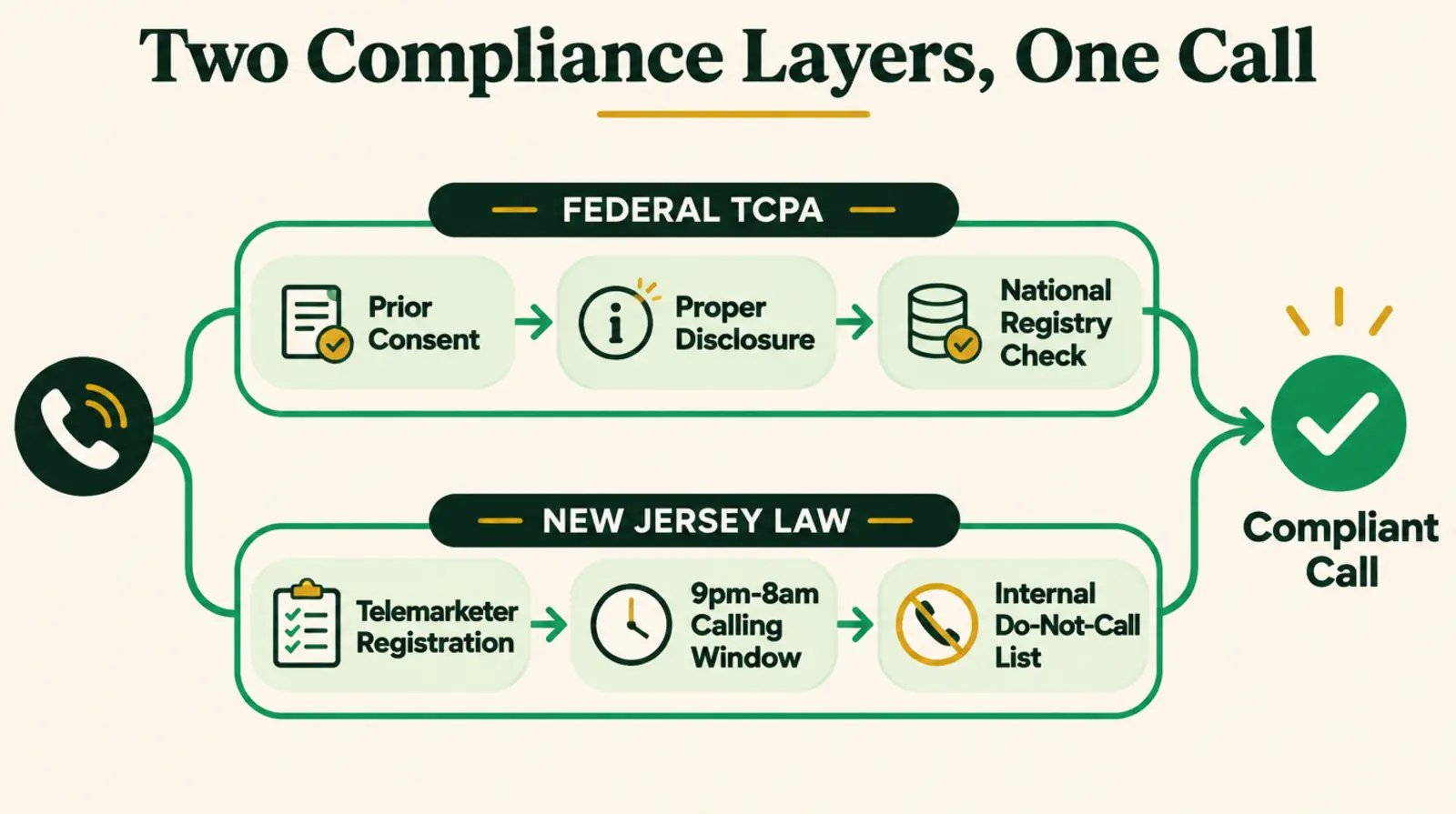
The Pain: Two Compliance Layers, One Call
Most agencies calling leads across state lines have built their process around the TCPA, because it’s the framework that shows up in every lead vendor’s consent language and every compliance webinar. That’s necessary, but in New Jersey it isn’t sufficient. New Jersey runs its own statute, the Telemarketing Do Not Call Act, enforced by a state agency with its own registration requirement, its own calling-hour rule, and its own civil penalty schedule, entirely apart from whatever the FCC does federally.
An agency can do everything right under the TCPA, hold valid prior express written consent, honor the federal registry, disclose the caller’s identity, and still be out of compliance in New Jersey for the simple reason that nobody registered with the Division of Consumer Affairs before the first call went out. That’s not a hypothetical gap. According to the State of New Jersey’s own consumer rights page on its Do Not Call law, telemarketers who are not registered with the Division of Consumer Affairs cannot call any New Jersey resident, full stop, independent of whether that resident is on any do-not-call list at all. An unregistered caller is out of bounds in New Jersey even when calling someone who never asked to be left alone.
This is a different question from the general federal Do Not Call Registry obligations covered in this piece on the national registry, which apply everywhere regardless of state. New Jersey layers its own registration and calling-hour rule on top of that baseline, so clearing the federal registry check is necessary in New Jersey but not sufficient.
The cost of missing this isn’t theoretical either. In July 2023, New Jersey’s Attorney General and Division of Consumer Affairs filed a consent order against Freedom Mortgage Corporation, a national mortgage servicer, alleging violations of the state Consumer Fraud Act, the Advertising Regulations, and the Telemarketing Do Not Call Law and its regulations. Among the specific practices the Division cited: making unsolicited telemarketing sales calls to consumers without being registered as a telemarketer, and continuing to call consumers who had already asked to be removed from the call list. The company settled for $502,000, denying the allegations as part of the deal, but paying the number regardless.
Why It Happens: Two Statutes, Different Agencies, Different Triggers
The confusion has a specific shape, and it’s worth naming precisely before fixing anything.
The federal TCPA governs consent for the call itself: whether you had prior express consent, written consent if it’s an automated or prerecorded call for marketing, and whether the call discloses what it needs to disclose. It’s enforced through the FCC and through private lawsuits, and its statutory damages, $500 per violation or up to $1,500 if a court finds the violation willful or knowing under 47 U.S.C. Section 227(b)(3), attach to the call regardless of which state it lands in.
New Jersey’s Telemarketing Do Not Call Act is a different animal. It doesn’t ask whether you had consent for this specific call the way the TCPA does; it asks whether you, as a telemarketer, are registered with the state at all, whether this particular call falls inside the permitted calling hours, and whether the person you’re calling is on the federal registry or the company’s own internal do-not-call list. P.L. 2003, c.76, the law’s original enacting text, defines a telemarketer broadly, as any individual proprietor, corporation, partnership, or other business entity, whether acting for itself or on behalf of others, with no built-in exception for a licensed insurance producer.
Define the terms before you build anything
Telemarketer (New Jersey): any individual or business entity, including one based outside New Jersey, that makes unsolicited telemarketing sales calls to a New Jersey consumer, as defined by P.L. 2003, c.76. Telemarketer registration: the annual filing a telemarketer must make with the Division of Consumer Affairs, including a fee set by the Director and a disclosure statement, before placing those calls. Existing customer exception: a carve-out from the definition of an unsolicited call for calls to a current customer who hasn't separately asked to stop receiving them. Isolated call exception: a narrow safe harbor for a single call made no more than one time in a 12-month period, subject to other conditions in the Act. TCPA: the federal Telephone Consumer Protection Act, governing consent, disclosure, and statutory damages for autodialed, prerecorded, or artificial-voice calls and texts nationwide, separate from and in addition to New Jersey's own statute.
Three specific failure patterns show up once an agency looks closely at a New Jersey list:
Nobody checked whether the agency is registered as a telemarketer with the Division of Consumer Affairs. Most insurance compliance checklists are built around TCPA consent language and CMS marketing rules. A New Jersey-specific registration requirement, enforced by a state consumer affairs division rather than the FCC, often isn’t on that checklist at all, because it doesn’t come up unless someone is calling New Jersey leads specifically.
The 9 p.m. to 8 a.m. calling-hour rule gets conflated with the federal guidance an agency already tracks. They’re close, both roughly cover the same overnight hours, but they’re enforced by different bodies under different statutes, and New Jersey’s own rule is measured at the customer’s location specifically, per the original Act text.
The existing-customer and isolated-call exceptions get treated as broader than they are. An agency assumes a past policyholder is permanently exempt from the Do Not Call framework, when the exception depends on that person not having separately opted out, or assumes “we only called once” covers any single call to any single person, when the isolated-call exception in the statute is narrower and fact-specific.
A mixed Medicare and ACA list gets treated as one compliance problem instead of two. New Jersey carries a meaningful Medicare Advantage and Medicare Supplement population, and a New Jersey lead who’s also a Medicare prospect sits under the Telemarketing Do Not Call Act and CMS’s own marketing rules at the same time, including the TPMO disclaimer and the Medicare-specific call recording and retention requirements. Neither framework satisfies the other, and a campaign built to clear only one of them is still exposed on the side nobody checked.
How New Jersey Compares to States You May Already Be Calling
New Jersey’s posture isn’t the same as every state’s, and that matters if your agency runs multi-state campaigns off one shared compliance checklist. Texas, for example, carries a specific statutory exemption for licensed insurance agents from its state no-call list, covered in the Texas no-call list piece, which changes the calculus meaningfully for a Texas-heavy book. Washington runs the opposite way: no insurance exemption and a flat per-call penalty, a pattern closer to what New Jersey does, detailed in the Washington telemarketing law piece. New Jersey sits with Washington here, not Texas. There’s no carve-out in the statute for a licensed producer, and the state’s own enforcement record, the Freedom Mortgage order among it, shows the Division of Consumer Affairs treating registration and opt-out failures as core violations rather than technicalities.
The practical takeaway for an agency calling leads across several states: a single national compliance checklist built around whichever state has the most lenient rule will leave gaps in every state that runs stricter than that baseline. New Jersey, Washington, and a handful of others belong in a stricter tier that assumes no insurance-specific exemption exists unless you’ve confirmed one in that state’s actual statute text.
| Requirement | Federal TCPA | New Jersey Do Not Call Act |
|---|---|---|
| Enforcing body | FCC and private lawsuits | Division of Consumer Affairs |
| Core trigger | Lack of prior express (written) consent for the call | Caller not registered as a telemarketer, or calling a listed/opted-out number |
| Calling hours | Guidance tracks 8 a.m. to 9 p.m. local time generally | 9 p.m. to 8 a.m. ban at the customer's location, per P.L. 2003, c.76 |
| Per-violation exposure | $500, up to $1,500 if willful/knowing | Up to $10,000 first offense, $20,000 each subsequent offense |
| Insurance-specific exemption | None in the statute itself | None in P.L. 2003, c.76 |
Sources: 47 U.S.C. Section 227(b)(3) via Cornell Law School's Legal Information Institute; State of New Jersey, NJ PowerSwitch Do Not Call page; New Jersey Legislature, P.L. 2003, c.76. Federal calling-hour guidance is summarized generally and callers should confirm current FCC guidance directly rather than relying on this table alone.
What It Costs: State Penalties, Federal Damages, and a Real Number
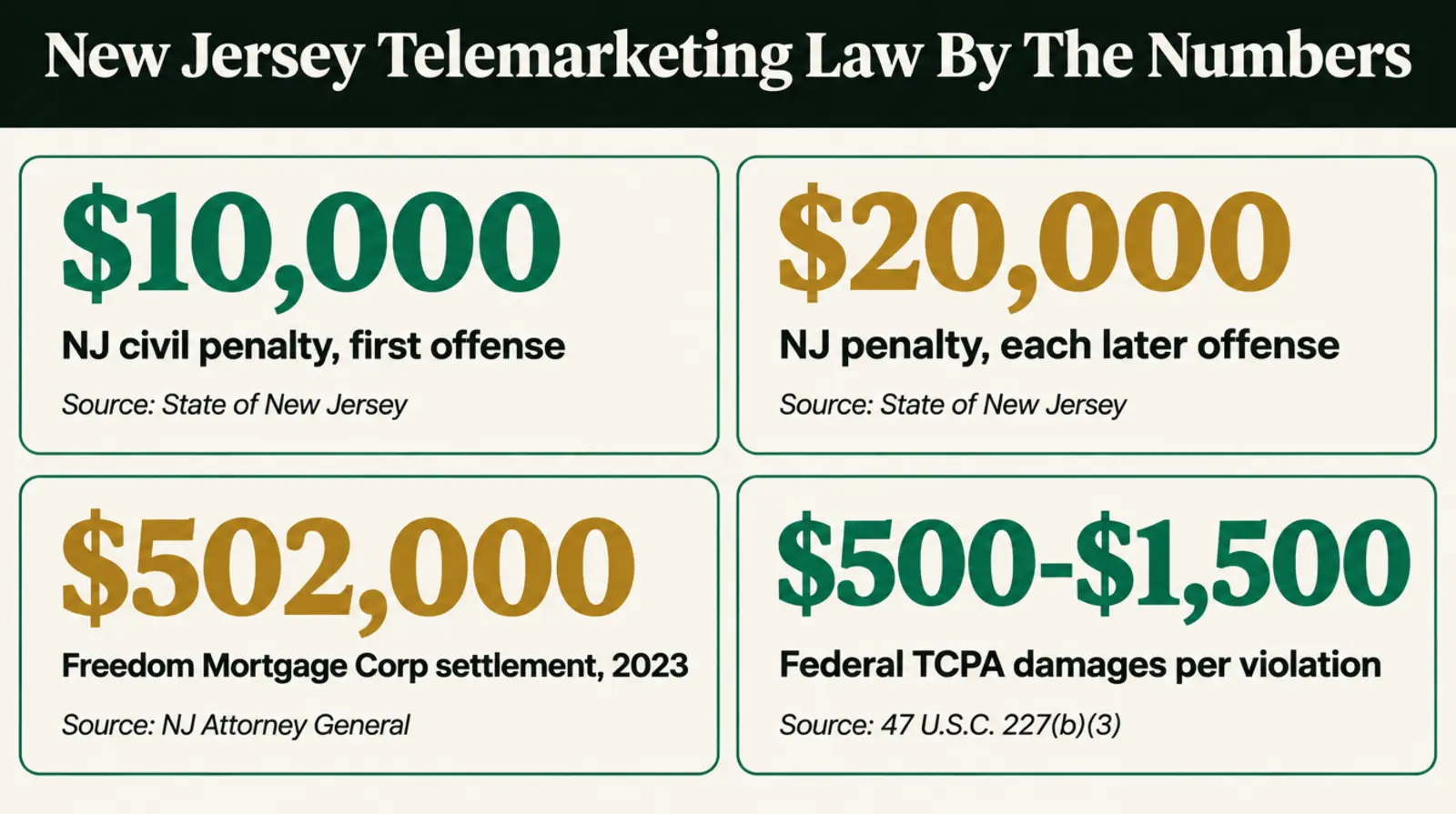
New Jersey’s own consumer-facing Do Not Call page states the civil penalty structure plainly: up to $10,000 for a first offense, and up to $20,000 for each subsequent offense. That’s a state civil penalty, assessed under the New Jersey Consumer Fraud Act provisions the Telemarketing Do Not Call Act cross-references, and it runs entirely separate from the federal TCPA’s own private right of action.
$10,000
NJ civil penalty, first offense
Source: State of New Jersey, NJ PowerSwitch Do Not Call page
$20,000
NJ civil penalty, each subsequent offense
Source: State of New Jersey, NJ PowerSwitch Do Not Call page
$502,000
Freedom Mortgage Corp. consent order, July 2023
Source: NJ Office of the Attorney General, Consent Order
$500 to $1,500
Federal TCPA statutory damages, per violation
Source: 47 U.S.C. Section 227(b)(3), via Cornell Law School
The Freedom Mortgage order is worth sitting with because it shows how those pieces combine in practice rather than in the abstract. The Division alleged, among other things, that the company made telemarketing sales calls without being registered as a telemarketer, and that it kept calling people who had asked to stop. The $502,000 settlement broke down into three components, all drawn directly from the consent order itself.
| Component | Amount | Statutory basis |
|---|---|---|
| Civil penalties | $365,200 | N.J.S.A. 56:8-13 |
| Attorneys' fee reimbursement | $45,000 | N.J.S.A. 56:8-19 |
| Investigative cost reimbursement | $91,800 | N.J.S.A. 56:8-11 |
| Total settlement | $502,000 | — |
Source: New Jersey Office of the Attorney General, Consent Order, In the Matter of Freedom Mortgage Corporation, filed July 11, 2023. Respondent denied the Division's underlying allegations as part of the settlement; the figures above are the agreed settlement terms, not an adjudicated finding of liability.
Layer the federal picture on top and the exposure compounds rather than replaces itself. If any of the calls behind a state violation were also placed without valid TCPA consent, each one separately carries its own $500 to $1,500 statutory exposure under 47 U.S.C. Section 227(b)(3), and that’s assessed call by call, not campaign by campaign. A state civil penalty and a federal statutory damages claim aren’t mutually exclusive; they’re two different plaintiffs, a state regulator and a private consumer, with two different theories, running on the same underlying call.
Run the arithmetic on a mid-size campaign and the stacking becomes concrete rather than abstract. An agency that dials 500 unregistered New Jersey numbers, and is later found to have made those calls without the required telemarketer registration, is exposed to a single state civil penalty as a first offense, up to $10,000 under the Division’s own stated cap, for the registration failure itself. That’s separate from whatever a private TCPA claim could recover if consent was also missing on some portion of those 500 calls: at $500 per call on just 50 of them, that’s another $25,000 in statutory exposure before a court even considers whether to treble it for a willful violation. None of this requires a company the size of a national mortgage servicer to add up fast. It requires an unregistered number and a list.
How to Fix It: A New Jersey Calling Checklist You Can Build Today
None of this requires new software. It requires treating New Jersey as its own compliance lane rather than folding it into a general TCPA checklist.
- Confirm whether you’re a “telemarketer” under New Jersey’s definition. If your agency or any vendor placing calls on your behalf makes unsolicited sales calls to New Jersey consumers, you’re covered by P.L. 2003, c.76’s broad definition. There’s no size threshold and no insurance-specific carve-out in the statute.
- Register with the Division of Consumer Affairs before the first call, not after. The registration is annual, requires a disclosure statement, and carries a fee the Director sets. Freedom Mortgage’s consent order shows exactly what the state treats as a foundational violation when this step gets skipped.
- Scrub every New Jersey number against the federal Do Not Call Registry. New Jersey residents registered on the federal list are automatically covered under the state framework; there’s no separate state registry to check in addition.
- Build and actually use an internal do-not-call list. Every New Jersey telemarketer has to maintain its own list of customers who’ve asked to stop, and honor it going forward, independent of the federal registry.
- Enforce the 9 p.m. to 8 a.m. calling window at the lead’s location, not your own. If your dialing platform’s quiet-hours setting is keyed to your office time zone rather than the lead’s, that’s a gap worth closing before the next New Jersey campaign runs.
- Treat the existing-customer and isolated-call exceptions as narrow, documented exceptions, not defaults. Keep a record of why a specific call qualified; don’t assume an entire segment of your list is covered by one of these carve-outs without checking each record.
- Disclose caller identity at the start of every call. New Jersey’s framework, like the federal one, expects the telemarketer, the company, and the purpose of the call to be identified up front.
- Keep a record that shows registration status, consent, and suppression together, not in three separate places. If a complaint ever comes in, the question won’t just be “did we have consent.” It’ll be “were we registered, did we honor the opt-out, and can we show both.” A clean disposition system, like the one covered in this piece on recent insurance agent TCPA settlements, is what makes that record producible on short notice instead of reconstructed after the fact.
- Re-check this annually, not once. Telemarketer registration with New Jersey is an annual filing, not a one-time setup step, and the underlying rules themselves are subject to periodic readoption, most recently effective October 27, 2023, through October 27, 2030, per the New Jersey Register. Put a calendar reminder on the registration renewal date specifically; a lapsed registration creates the exact same exposure as never having registered at all.
You can build this checklist without buying anything
Registration is a form and a fee. Scrubbing against the federal registry and maintaining an internal do-not-call list are processes any CRM can support with a filtered field. Setting calling hours by the lead's time zone rather than your own is a dialer configuration change. An agency with a few hours to spend on the registration filing and a dialing-hours audit can close most of the gap described in this piece before its next New Jersey campaign goes out.
Where TheAffordableAI Fits, and Where It Doesn’t
Be precise here. Telemarketer registration with New Jersey’s Division of Consumer Affairs is the agency’s own legal obligation; no vendor can file that on an agency’s behalf or make it unnecessary. What a managed AI caller changes is whether the operational pieces, the calling-hour cutoff, the do-not-call suppression, the disposition logging, actually hold up on every single call, at whatever volume a New Jersey campaign runs at, rather than depending on a human remembering to check the clock before the last dial of the evening. The full rundown of what’s included on a managed calling plan is on the features page if you want more than the summary below.
Calling-hour rules enforced automatically
Quiet hours are set against the lead's own time zone, not a default, so a New Jersey list stays inside the 9 p.m. to 8 a.m. window without a human tracking it call by call.
Opt-out and do-not-call suppression, logged immediately
A request to stop calling gets tagged the moment it's heard and suppresses that contact across the account, rather than riding on an agent's memory to flag it afterward.
Native HighLevel sync for disposition and consent records
Call outcomes, transcripts, and consent details write to the contact record when the call ends, giving an agency a real audit trail rather than a notes field nobody reviews.
Warm transfers to a licensed agent
The AI caller qualifies and hands off; the licensed agent still closes, consistent with the fact that using AI doesn't transfer regulatory responsibility away from the agency.
No contract, cancel anytime
Single Account runs $200/mo plus a $500 one-time setup at $0.20/min; Agency runs $500/mo plus a $1,000 one-time setup at $0.18/min, dropping to $0.16 at bulk. Price a month of consistent compliance against what one unregistered calling campaign has already cost one company.
If you want to hear what an actual call sounds like before deciding anything, there’s a live demo on the homepage. https://theaffordableai.com/
What You Actually Get
A New Jersey calling program that doesn’t depend on one person remembering a second statute on top of the TCPA checklist everyone already knows. Registration status that’s actually current rather than assumed. A calling-hour cutoff that holds at the lead’s location regardless of what time it is in your office. An opt-out that suppresses a contact the moment it’s requested, not whenever someone gets around to updating the CRM. None of that guarantees a sale. It closes the exact two gaps, unregistered calling and ignored opt-outs, that New Jersey’s own most recent public enforcement action was built around.
Untracked vs. New Jersey-Ready
One checklist, built for the TCPA alone
- No one has confirmed whether the agency is registered as a telemarketer with New Jersey's Division of Consumer Affairs
- Calling hours are set by the office's time zone, not the lead's
- Opt-outs land in a notes field that no suppression workflow reads
- The existing-customer and isolated-call exceptions get applied to whole segments instead of individual records
Two checklists, tracked separately
- Telemarketer registration confirmed current with the Division before any New Jersey campaign launches
- Calling-hour cutoff enforced at 9 p.m. to 8 a.m. in the lead's own time zone
- Every opt-out suppresses the contact account-wide the moment it's heard
- Exceptions documented record by record, not assumed across a list
A Worked Example: Two Versions of the Same New Jersey Campaign
Picture an agency buying a list of 3,000 New Jersey ACA and Medicare Supplement leads for a fall campaign. On the untracked path, nobody checks whether the agency’s telemarketer registration with the Division of Consumer Affairs is current, because the agency has never called New Jersey leads before and the question never came up. Calls go out on the office’s own working hours, which run until 8 p.m. office time, 9 p.m. New Jersey time during part of the year depending on daylight saving, close enough to the cutoff that a handful of late calls land just past it. Three leads ask to stop being called over the course of the campaign; one tells a human agent directly, one replies to a text, one calls the office number back. Only the text opt-out gets logged anywhere a workflow reads. The other two stay in the active dial list.
On the New Jersey-ready path, registration status gets confirmed before the list is uploaded, as a standing step in the campaign launch checklist, not a one-time afterthought. The calling window is set against each lead’s own New Jersey time zone, so there’s no edge case around office hours drifting past the cutoff. All three opt-out requests, however they arrive, phone, text, or a callback, suppress the contact immediately and account-wide. Same list, same 3,000 leads. One version carries real exposure on three separate fronts: an unregistered-telemarketer gap, two un-suppressed opt-outs, and whatever calling-hour edge cases slipped through. The other doesn’t.
Where This Is the Wrong Tool
None of this fixes a list that was never any good, and registering with New Jersey doesn’t make a cold lead warm. If your New Jersey calls are strictly business-to-business, the Do Not Call Act’s residential consumer framework may not reach them the same way; confirm that distinction with counsel rather than assuming it based on this piece. And if an agency places only a handful of calls into New Jersey a year, genuinely isolated under the statute’s own narrow exception, the overhead of a full annual telemarketer registration may be worth a direct conversation with the Division of Consumer Affairs about whether it’s required at your specific volume, rather than defaulting to either extreme.
New Jersey didn't fine a national mortgage servicer half a million dollars for bad consent language. It fined them for not registering as a telemarketer and for ignoring the opt-outs. Those are the two things any agency can fix this week.
Mike MooreUsing AI does not transfer this responsibility away from you
Telemarketer registration, consent, disclosure, honoring opt-outs, and National Do Not Call Registry obligations stay the responsibility of the licensed agent and agency, whether a human or an AI caller places the call. If any part of your New Jersey book touches Medicare Advantage or Part D marketing, CMS's own marketing rules, including the TPMO disclaimer and call recording retention requirements, apply on top of everything in this piece. This is general information, not legal advice; confirm your specific obligations, including current registration fees and any recent amendments to N.J.S.A. 56:8-119 et seq., with your own compliance counsel before launching a New Jersey campaign.
Get New Jersey calling hours and opt-outs right, automatically
See what a managed caller that enforces quiet hours by the lead's time zone and suppresses opt-outs the moment they happen costs against what one unregistered campaign has already run a company. No contract either way, so trying it one month is the entire risk.
New Jersey’s Do Not Call Law isn’t an obscure add-on to the TCPA checklist most agencies already run. It’s a separate statute, with its own registration requirement and its own enforcement record, and the state has already shown, in a $502,000 settlement, exactly what it does when both get ignored. Confirm the registration before the next New Jersey list goes out, not after.
Frequently asked
Does New Jersey's Do Not Call Law apply to licensed insurance agents?
Yes. New Jersey's Telemarketing Do Not Call Act, N.J.S.A. 56:8-119 to -129, does not carve out an exemption for insurance producers or licensed agents. The original enacting law, P.L. 2003, c.76, defines a telemarketer broadly as any individual or business entity making unsolicited telemarketing sales calls to a New Jersey customer, with no profession-based exception. That's a different posture from some other states, where an insurance license alone narrows what the state telemarketing law reaches. In New Jersey, an agency calling a New Jersey consumer to sell a policy is doing exactly what the Act was written to cover.
What's the difference between the federal TCPA and New Jersey's state Do Not Call Law?
They're separate obligations that both apply to the same call. The federal Telephone Consumer Protection Act, enforced through the FCC and private lawsuits, governs consent for autodialed, prerecorded, and artificial-voice calls and texts nationwide, with statutory damages of $500 to $1,500 per violation under 47 U.S.C. Section 227(b)(3). New Jersey's Do Not Call Law is a separate state statute, enforced by the Division of Consumer Affairs, that layers on its own requirements: a telemarketer registration before placing sales calls to New Jersey residents at all, a 9 p.m. to 8 a.m. calling-hour ban, and state civil penalties of up to $10,000 for a first offense and $20,000 for each later one. A call can clear federal TCPA consent requirements and still violate the New Jersey Do Not Call Law if the caller never registered with the Division, or vice versa. Both have to be satisfied independently.
Do I actually have to register with New Jersey before calling New Jersey leads?
If the calls are unsolicited telemarketing sales calls to New Jersey consumers, yes. P.L. 2003, c.76 requires every telemarketer, including those based outside New Jersey, to register annually with the Division of Consumer Affairs, pay the registration fee the Director sets, and file a disclosure statement. The state's own consent order against Freedom Mortgage Corporation, filed July 11, 2023, shows exactly what happens when that step gets skipped: one of the Division's core allegations was that the company made telemarketing sales calls to consumers without being registered as a telemarketer, and it became part of a $502,000 settlement. Registration isn't a formality anyone can safely skip because enforcement seems unlikely; it's the specific gap the state's most recent public telemarketing enforcement action was built around.
What actually happened in the Freedom Mortgage case, and why does it matter for insurance agencies?
New Jersey's Division of Consumer Affairs alleged that Freedom Mortgage Corporation violated the state Consumer Fraud Act, the Advertising Regulations, and the Telemarketing Do Not Call Law and its regulations, among other things by making unsolicited telemarketing sales calls to consumers without being registered as a telemarketer, and by continuing to call consumers after they'd asked to be removed from the call list. The July 11, 2023 consent order settled those allegations for $502,000 total: $365,200 in civil penalties under N.J.S.A. 56:8-13, $45,000 in attorneys' fee reimbursement under 56:8-19, and $91,800 in investigative cost reimbursement under 56:8-11, with Freedom Mortgage denying the underlying allegations as part of the settlement. It's not an insurance case, but the two allegations at its center, unregistered telemarketing and ignoring opt-out requests, are the exact two failure points that apply just as directly to an insurance agency dialing New Jersey leads. The size of the number is the point: this wasn't a small operator, and the state didn't treat the violations as minor.
Can I ever legally call a New Jersey lead who's on the Do Not Call Registry?
Sometimes, under narrow exceptions that both the federal and state frameworks share in spirit: an existing customer who hasn't asked to stop being called, a lead who gave express written permission to be contacted, or a genuinely isolated call made no more than one time in a 12-month period, per the New Jersey Telemarketing Do Not Call Act. None of those exceptions are a blanket pass to keep dialing; they're narrow, fact-specific carve-outs, and the existing-customer exception in particular depends on that person not having separately asked you to stop. Treat every one of these exceptions as something you'd need to defend with a specific record, not a general policy you apply to a whole list.
What are New Jersey's permitted calling hours for telemarketing?
Telemarketers may not make unsolicited calls between 9 p.m. and 8 a.m., local time, at the customer's location, under the original Telemarketing Do Not Call Act, P.L. 2003, c.76. That's measured at the lead's location, not the caller's, which matters for any agency dialing across time zones or running calls into the evening for a working list. It's also a narrower window than some agencies assume if they're only tracking the federal TCPA's own calling-hour guidance, since the two rules are enforced by different agencies and a call that's fine under one framework's hours can still fall outside the other's.
Does using an AI caller change any of this?
No. New Jersey's Telemarketing Do Not Call Act defines a telemarketer by the call being made, not by who or what places it, and the registration, calling-hour, and opt-out requirements attach to the entity doing the telemarketing regardless of whether a human or an AI voice agent is on the line. The same is true federally: the FCC's February 2024 declaratory ruling, FCC 24-17, confirmed that AI-generated voices count as an 'artificial voice' under the TCPA, so the same consent and disclosure rules apply. An AI caller can make it easier to enforce a calling-hour cutoff consistently and log every opt-out the moment it happens, which is a real operational advantage, but it doesn't change who's responsible for registering with New Jersey or for the underlying consent. That responsibility stays with the licensed agent and the agency, exactly as it would with a human dialer.
Sources
- State of New Jersey, NJ PowerSwitch — Do Not Call (official state consumer rights page: scope, registration requirement, calling hours, penalties)
- New Jersey Legislature — P.L. 2003, c.76 (original Telemarketing Do Not Call Act: definitions, registration, exceptions, calling hours)
- New Jersey Office of the Attorney General — Consent Order, In the Matter of Freedom Mortgage Corporation (filed July 11, 2023; $502,000 settlement)
- New Jersey Register, 55 N.J.R. 2416(a) — Notice of Readoption, N.J.A.C. 13:45D, Telemarketing: Do Not Call (effective October 27, 2023, through October 27, 2030)
- Cornell Law School Legal Information Institute — 47 U.S.C. Section 227, Telephone Consumer Protection Act (statutory damages, Section 227(b)(3))
- TheAffordableAI — Pricing (verified November 5, 2026)
Put this on your own phone line
See the AI dial, qualify, and warm-transfer a live call in under a minute. No contract, no dev work.
Keep reading

Virginia Telemarketing Law 2026: Insurance Agent Guide
Virginia's telemarketing law changed January 1, 2026: new opt-out rules, caller ID standards, and joint liability. Here's what insurance agents must do.

Washington Telemarketing Law for Insurance Agents (2026)
Washington's telemarketing law does not exempt insurance agents, and one bad call can carry a flat $1,000 penalty. Here is what actually applies to you.

Insurance Leads and the Do Not Call Registry in 2026
The Do Not Call Registry topped 258.5 million numbers in FY2025. What the EBR exemption covers, a violation's real cost, and how to call insurance leads fast.